Introduction
Disasters have and will continue to occur throughout all areas of the world. Governments, individuals, and communities must adequately prepare for potential disasters.Reference Newport and Jawahar 1 The goal of disaster preparedness is to effectively respond to the inevitable consequences of disasters and mitigate adverse effects on vulnerable populations. 2 High-income countries have recognized the need to improve disaster preparedness, allocating significant human and monetary resources to assess and improve disaster preparedness.Reference Al Khalaileh, Bond, Beckstrand and Al-Talafha 3 , Reference Lillibridge, Noji and Burkle 4 Due to limited resources and inadequate risk perception, low-and-middle-income countries (LMICs) are especially vulnerable to adverse consequences following natural and man-made disasters.Reference Goldfrank 5
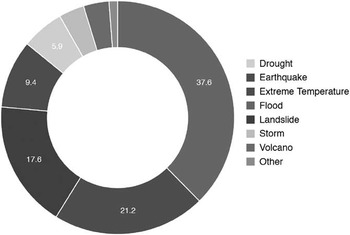
Peru has a current population of over 30 million people and is the third largest country in South America. Despite its growing population, Peru has allocated limited resources towards disaster preparedness. Trujillo, a coastal city, is home to approximately one million people and is the second largest city in Peru. Both the inner city and surrounding communities of Trujillo have limited infrastructure and preparation to manage disasters. According to the United Nations Office for Disaster Risk Reduction (UNISDR; Geneva, Switzerland), the most common disasters in Peru from 1990-2014 were floods, earthquakes, landslides, and extreme temperatures (Figure 1 shows the frequency of Peruvian disasters during this time period). 6 The National Institute of Civil Defense, also known as El Instituto Nacional de Defensa Civil (INDECI; Lima, Peru), is responsible for all disaster management in Peru; INDECI is a combination of national and regional defense systems in Peru that not only coordinate disaster response, but also prepare citizens for disasters. Peru has also worked with various international nongovernmental organizations to decrease communities’ vulnerability in the event of a disaster.
Frequency of Disasters in Peru from 1990-2014. The most common disasters in Peru are flood, earthquake, landslide, and extreme temperatures.

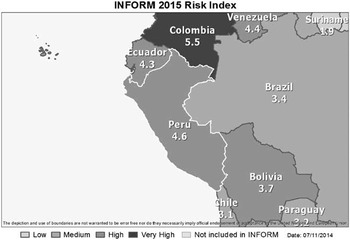
INFORM is a risk assessment tool utilized for disasters that can assist with preparedness and improve response. The INFORM Risk Index utilizes three components to determine a countries’ risk to potential disasters: (1) Hazard and Exposure; (2) Vulnerability; and (3) Coping Capacity. According to the INFORM 2015 Risk Index, Peru was classified as a high-risk country for disasters and was higher than many surrounding countries in South America (Figure 2). 7 As disasters are common in Peru and the country is at high-risk for disaster impact, it is essential that the government, health care workers, and community members are prepared for potential disasters.
INFORM Risk Index Identifies Peru as a High-Risk Nation for Disasters. The INFORM Model incorporates the following three aspects when determining a countries’ vulnerability: (1) Hazard and Exposure; (2) Vulnerability, and (3) Coping Capacity.

The purpose of this study was to assess disaster preparedness and risk perception in communities surrounding Trujillo, Peru. The investigators hypothesize that while communities near Trujillo may perceive a high impact from future disasters, they are not adequately prepared for potential disasters. By understanding disaster preparedness and risk perception in LMIC communities, targeted public health interventions can be implemented to improve community preparedness and awareness to avoid unnecessary mortality and morbidity following a natural or man-made disaster.
Methods
Study Design and Setting
Investigators performed a cross-sectional study of communities surrounding Trujillo, Peru, focusing on rural impoverished neighborhoods. The neighborhoods were selected by consulting with local counterparts at the medical school of the Universidad de César Vallejo (Trujillo, Peru) to ensure an adequate representation of communities surrounding the city of Trujillo. The primary investigator obtained approval from the Institutional Review Board at the University of Utah (Salt Lake City, Utah USA) for the research project.
Selection of Participants
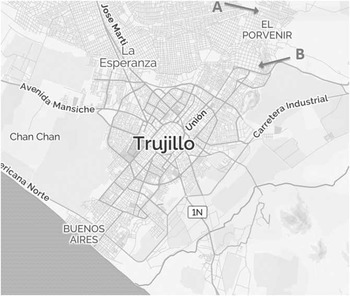
Investigators selected participants within the community by convenience sampling during the study period. After consulting with local community members at the University of César Vallejo School of Medicine, two primary locations were chosen due to their proximity to the city center. Figure 3 represents the two survey sites (labeled as “A” and “B”) utilized in this investigation. Global Positioning System/GPS coordinates were used to confirm desired community site location.
Community Geographical Locations where Surveys were Performed. A: El Porvenir - approximately 9 km from the city center. B: Near Hospital Santa Isabel - approximately 6 km from the city center.

Investigators and local counterparts surveyed household members located in the communities by convenience sampling. All surveys were performed in the native language and language comprehension was ensured prior to beginning each survey. Study participants provided verbal consent and were informed of potential risks associated with the investigation. Exclusion criteria included <18 years of age and inability to provide verbal consent.
Methods and Measurements
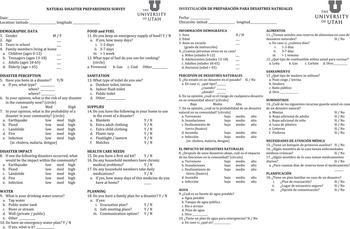
A novel survey tool was designed to assess perception of disaster occurrence, disaster impact, and disaster preparedness. Using disaster preparedness training guidelines published by the American College of Emergency Physicians (ACEP; Irving, Texas USA) and the International Federation of the Red Cross and Red Crescent Societies (IFRC; Geneva, Switzerland), investigators developed the survey tool in conjunction with local counterparts that can be seen in Figure 4. 8 , 9 Medical students at the Universidad de César Vallejo in Trujillo, Peru evaluated the final translated survey to ensure language accuracy and appropriate cultural relativity. The medical students complete rural medicine rotations with clinics providing care for the surveyed communities and understand the communities’ level of written and verbal comprehension necessary to complete the survey.
Novel Survey Instrument in English (left) and Spanish (right).

Investigators and local counterparts collected surveys on paper forms and then entered the data into the Research Electronic Data Capture (REDCap; Harvard Catalyst; Boston, Massachusetts USA) database. Data were imported into a Microsoft Excel (Microsoft Corporation; Redmond, Washington USA) database for further analysis. To ensure data reliability, multiple investigators reviewed both data entry and the results generated by REDCap.
Outcomes
Primary study outcomes include disaster occurrence perception and disaster impact perception. Disaster occurrence was defined as the probability of a disaster occurring in the selected communities. Survey participants rated the occurrence of each individual disaster as low, medium, or high. Disaster impact was defined as the perceived impact on community infrastructure and ability to function. Disaster impact perception was identified as low, medium, or high. Additional data for disaster preparedness items were collected for the following: water, food, sanitation, supplies, medical needs, and disaster planning. These items were selected based on IFRC recommendations and their importance for disaster preparedness. Figure 4 shows the full survey used for the study.
Analysis
The investigators analyzed the data utilizing descriptive statistics, with data presented using percentages for categorical variables and means for continuous variables. Sub-group analysis was performed to detect differences in disaster preparedness within the communities. The sub-groups chosen for analysis included gender, education level, and prior disaster exposure. These sub-groups were chosen due to their possible effect on perception of disaster occurrence and disaster impact.
Results
A total of 230 surveys were performed during the study period, with 37% completed by males and 63% by females. The average age of participants was 33 years old, with ages ranging from 18 to 85 years old. The average household size was approximately four people, with a distribution ranging from one to 15 people living in a single home. Of the households surveyed, 65% had children aged 0-12 years old, with an average of two children per household. Elderly people, defined as over 65 years old, were living in 17% of the households surveyed. Of the participants, four percent had no schooling, 40% had entered primary school, 50% had entered secondary school, and six percent had entered either university education or technical school.
Of the participants, 41% (n=95) had previously experienced a natural disaster, the most common of which were earthquakes (n=50), hurricanes (n=22), floods (n=14), and landslides (n=7). The most common previously experienced disaster was during the Great Peruvian Earthquake in 1970 with an epicenter located 35km from the Peruvian coast and south of Trujillo, Peru.
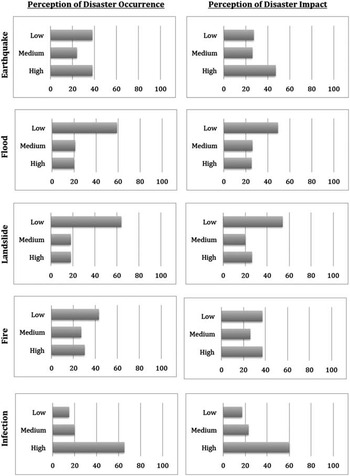
Compiled results for disaster occurrence perception and disaster impact perception can be found in Figure 5. While only 38% of study participants perceived the risk of an earthquake occurring was high, 47% perceived that the impact of an earthquake in the community was high. Of interest, males had both a higher perception of earthquake occurrence and earthquake impact when compared to females. Additionally, study participants with higher levels of education perceived a higher potential earthquake impact. Finally, individuals who had experienced a prior disaster had both a higher perception of earthquake occurrence and impact when compared to individuals who had not experienced a disaster.
Perception of Disaster Occurrence and Impact Stratified by Disaster Type. All charts represent percentage of total survey participants.

The majority of study participants perceived that both the risk and impact of flood and landslides in the community was low. Overall, study participants perceived the risk and impact of infections (such as malaria, cholera, or dengue) was high.
Of the participants, 53% used tap water and 46% used a public water tank as their primary source of water supply. Only 24% of study participants had an emergency plan for water, the majority stating they had an emergency water supply in either tanks or bottles filled from their primary water source. The majority of participants purchased food daily and only 26% reported to have an emergency supply of food. Of those with an emergency food supply, 84% had at least three to seven days of food in the household. Ninety percent of study participants used gas for food preparation. Regarding sanitation practices, 60% had an indoor flush toilet, while 38% used an outdoor latrine with no running water.
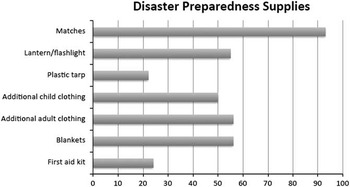
Figure 6 represents common disaster preparedness resources found in the households of study participants. Of note, only 22% of individuals had a plastic tarp to be used for temporary shelter and only 55% had a flashlight or lantern in the house. Nearly all individuals had matches in the house that were intended for use with cooking stoves. First aid kits were located in only 24% of the households; however, a much greater proportion of individuals with higher-level education possessed a first aid kit.
Percentage of Study Participants with Necessary Disaster Preparedness Supplies.

Twenty-four percent of the households had at least one member with a chronic medical illness and a supply of medicines ranging from one week to one month. While 80% of the study participants did not have an established evacuation plan or safe meeting spot for their family, 84% of study participants stated they would use their cell phone for communication following a disaster.
Discussion
Approximately 85% of disasters and 95% of disaster-related deaths occur in developing countries, yet less than one percent of current disaster-related literature are focused on LMICs.Reference Nohojit, Thakkar and Shah 10 Additionally, the economic impact of natural disasters is disproportionally high for LMICs, accounting for approximately one percent of the gross domestic product (GDP) for middle-income countries versus 0.1% of the GDP for high-income countries. It has been proposed that the cause of these disparities is largely due to the lack of preparation among vulnerable populations in LMICs.Reference Michel-Kerjan, Hochrainer-Stigler and Kunreuther 11
The rural communities of Trujillo have frequently experienced disasters. The most notable of these disasters is the 1970 Great Peruvian Earthquake, the 1997-1998 El Niño heavy rains and floods, and the most recent outbreaks of infectious diseases such as dengue.Reference Lomnitz 12 In the current study, the majority of participants with previous disaster experience had experienced one of these three events. Despite living in an area marked by frequent disasters, the communities were found to be largely unprepared for future disasters. Of those surveyed, 26% had an emergency food supply, 24% had an emergency water supply, 24% had a first aid kit, and only 20% had a family evacuation plan.
Disasters that occur at a low frequency but have a high negative community impact have the greatest potential for causing economic- and health-related problems. Communities that fail to prepare for disasters are more likely to suffer negative impacts when they occur. Failure to prepare for disasters is not only common in LMICs, but also is common in the high-income countries. A recent study in the Midwestern USA found that 57% of individuals had little to no preparedness for potential disasters.Reference Shannon 13 Similar to this prior study, the current study found that the majority of study participants did not have common disaster preparedness supplies, clearly seen in Figure 6. If households and community members take simple measures to prepare themselves, they are more likely to survive the initial 72 hours following a disaster until governmental support and relief agencies can arrive to provide additional support.Reference Kapucu 14 , Reference Mahdaviazad and Abdolahifar 15 For these reasons, it is essential that communities are aware of potential disasters in their geographical region and are prepared for their occurrence.
This study identified the community’s disaster occurrence perception, disaster impact perception, and individual household preparedness. These characteristics can be used to develop targeted public health interventions to alleviate future disease burden following a natural disaster in Peru and potentially other LMICs. In order to prepare for a disaster, the Centers for Disease Control and Prevention (CDC; Atlanta, Georgia USA) recommends having an emergency supply kit, making a family plan, and becoming aware of potential disaster scenarios. 16 To improve disaster response in Peru, community education focusing on the potential impact and preparation for natural disasters is essential. Public health education would include information on preparing an emergency supply kit. The CDC recommends that this kit include a supply of food and water, flashlight, batteries, a first aid kit, blankets, and medical supplies. 17 Additionally, the communities should be encouraged to develop a family evacuation plan in the event of a natural disaster. Finally, the local government and health care services play an important role by increasing community awareness of natural disasters, improving coordinated disaster relief efforts, and decreasing potential negative impact when a disaster occurs.
Limitations
The investigators acknowledge potential limitations within the study. The study was performed in two communities outside of Trujillo, and is thus limited to the demographic characteristics, disaster preparedness, and perceptions of disaster specific to these communities. While the study population near Trujillo is not identical to communities in other LMICs, the study findings provide an initial understanding of disaster perception and preparedness patterns in a limited-resource setting that can be used to guide future improvements. Additionally, the research survey can be used as a tool to assess communities in other LMICs.
The process of convenience sampling within the communities could also lead to multiple types of bias, including selection bias, recall bias, and self-reporting bias. While investigators randomly selected individuals within the community, the time of day affected the demographics of which household members were available to take the survey. For example, it is speculated that the majority of survey participants were women because the study was performed during the day when male household members were at work. According to recent census data, Peru is comprised of approximately 50.1% males and 49.9% females, while the current study included 63% females.
Other limitations related to data collection arise from language comprehension by investigators and study participants. Attempts to avoid this included using a simple survey with minimal open-ended questions and utilizing local counterparts to evaluate the survey to ensure appropriate grammar and cultural relativity. Finally, this study occurred in June of 2015 and may not capture potential disaster perception present during other seasons of the year.
Conclusions
Disasters will remain a constant threat to the safety and security of communities in all parts of the world; however, potential impacts following a disaster are greater within vulnerable communities of LMICs. Little research has been done to identify disaster perception, vulnerability, and preparedness in LMIC communities. The current study established that community members in Trujillo, Peru believe that the probability of disaster occurrence is low for floods and landslides, medium for earthquakes and fires, and high for infection. For each specific disaster, the perceived impact of the disaster was much higher than the perceived rate of disaster occurrence. While the community members perceived a higher impact from potential disasters, the majority of families did not have a disaster plan and did not possess basic disaster preparedness supplies, creating vulnerable communities if a disaster occurs. In order to reduce overall adverse health impacts from future disasters, public health efforts are needed to educate and prepare vulnerable communities in the following areas: emergency water supplies, emergency food supplies, medical supplies at home, and establishing evacuation plans.