INTRODUCTION
The Argentinean prawn Artemesia longinaris (Bate, 1888) is an endemic species from the south-western Atlantic, occurring from Rio de Janeiro (Brazil—21°37′S) to Puerto Rawson (Argentina—43°00′S). This species belongs to the penaeid family, which includes other commercially important species, such as Farfantepenaeus paulensis (Pérez-Farfante, 1967); F. brasiliensis (Latreille, 1817); Litopenaeus schimitti (Burkenroad, 1936) and Xiphopenaeus kroyeri Heller, 1862 (D'Incao, Reference D'Incao, Buckup and Bond-Buckup1999; D'Incao et al., Reference D'Incao, Valentini and Rodrigues2002). Artemesia longinaris has a preference for muddy and sandy soft bottoms (Boschi, Reference Boschi1969; Costa et al., Reference Costa, Fransozo, Castilho and Freire2005). The species has a bathymetric distribution restricted to shallow marine waters, with higher densities recorded between 11 and 20 m (Boschi, Reference Boschi1969; Nascimento, Reference Nascimento1981; D'Incao, Reference D'Incao, Buckup and Bond-Buckup1999). Unlike most penaeid prawns, A. longinaris has a strictly marine life cycle, not demanding an estuarine nursery phase (D'Incao, Reference D'Incao, Buckup and Bond-Buckup1999).
Due to its high abundance in shallow coastal waters, A. longinaris is an important link in the food-web of this ecosystem in the south-western Atlantic. Analysis of feeding habits and trophic interactions showed that this species accounts for 30% in diet of coastal fish (Capitoli et al., Reference Capitoli, Bager and Ruffino1994). Since the Argentinean prawn is a valuable species for artisanal and commercial fleets, there is a growing interest in this resource, especially after the decreasing yields observed for most traditional prawn species exploited in Brazilian waters (D'Incao et al., Reference D'Incao, Valentini and Rodrigues2002).
Morphometric and meristic characters provide an important tool for delineating stocks either of fish (Swain et al., Reference Swain, Frank and Maillet2001; Pinheiro et al., Reference Pinheiro, Teixeira, Rego, Marques and Cabral2005) or crustaceans (Tzeng & Yeh, Reference Tzeng and Yeh2002), since very often different morphological traits may reflect reproduction isolation or environment influence (Gulland, Reference Gulland1971; Begg & Waldman, Reference Begg and Waldman1999; Begg et al., Reference Begg, Hare and Sheehan1999). In fact, stock identification is of primary interest in fisheries management, since population replenishing and reducing effects of recruitment and mortality operate independently on the individual stock units (Waldman, Reference Waldman1999).
The biometry of A. longinaris was previously investigated on the Argentinean (Boschi, Reference Boschi1969) and the southern Brazilian coasts (Nascimento, Reference Nascimento1983). However, inclusion of individuals from the northern limit of distribution and analysis of seasonal and interannual trends in length relationships have never been developed. The aim of this study is, therefore, to use morphometric and meristic traits to elucidate the population structure of A. longinaris along its entire distribution area to provide practical and biological information about this species in the south-western Atlantic.
MATERIALS AND METHODS
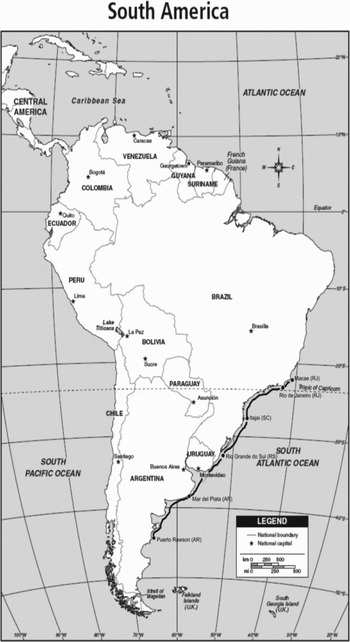
Sampling took place in shallow marine waters, adjacent to the Patos Lagoon estuarine mouth (Figure 1). This area is located in southern Brazil, under the influence of the Subtropical Convergence (STC) and the Coastal Water (CW), which is highly influenced by freshwater discharge from La Plata river (can reach up to 60,000 m3s−1 during El Niño) and Patos Lagoon estuary (can reach up to 30,000 m3s−1 during El Niño). This water mass stretches northwards from La Plata for about 1300 km, but during specific years it may reach the São Paulo coast. The CW presents seasonal and annual variations in strength and shape, highly dependent on a combination of rainfall and wind stress (Piola et al., Reference Piola, Möller and Palma2004, Reference Piola, Matano, Palma, Möller and Campos2005). The samples obtained in southern Brazil, more precisely off the coast of Rio Grande do Sul State, will be treated as STC, in a reference to its latitudinal position. However it is important to stress that the convergence itself takes place in greater depths. The Patos Lagoon estuary is located at the costal plain of Rio Grande do Sul State, Brazil (32°S 49°W) and it is the largest choked lagoon in the world, covering an area of 10,360 km2. The drainage basin covers 201,626 km2 (Asmus, Reference Asmus, Seeliger, Odebrecht and Castello1996) and pluvial intensity as well as wind direction regulate the water movements in the study area (Piola et al., Reference Piola, Matano, Palma, Möller and Campos2005).
Distribution of Artemesia longinaris in the south-western Atlantic Ocean (black line). Samples were seasonally obtained in Rio Grande do Sul and compared to a single sampling in Mar del Plata and Rio de Janeiro.

The samples were monthly collected from the surrounding area of Patos Lagoon estuary, in two different years (2002 and 2004) using a short-range artisanal trawler operating in depths that varied from 2 to 15 m (Figure 1). To establish possible morphometric and meristic differences between A. longinaris populations along the distribution area, samples from Argentina (Mar del Plata, 37°56′S) and south-eastern Brazil (Macaé, 21°37′S, Brazil) were also obtained from fishery catches during the spring and compared to individuals from Rio Grande do Sul. Fifty individuals from each site were randomly chosen to be used in this analysis. Measurable variables (e.g. total length) were considered as morphometric, while countable structures (e.g. number of rostral teeth) were considered as meristic traits.
Carapace length (CL, mm) was measured as the distance from the postorbital margin to the mid-dorsal posterior edge of carapace. Total length (TL, mm) was considered as the distance from the tip of the rostrum to the end of the telson. Rostrum length (RL, mm) was measured from the tip of rostrum to postorbital margin of carapace. Telson length (TsL) was taken from the base to the tip of this structure. The number of rostral teeth (RT) was also counted and used as a meristic trait to identify possible population structure.
Assumptions of normality and homogeneity of variances were tested by Lilliefor's and Levene's (Zar, Reference T.H.1984) routines, respectively. Raw length and weight data showed normal distribution (Lilliefor's P < 0.2) but did not show homogeneity of variances (Levene's P > 0.05). However, log transformation and Loess smoothing procedure were applied to reduce noise without arbitrarily determining which points should be excluded from analysis due to measuring errors. The pattern observed using the smoothing procedure was compared to log transformed data, attempting to check whether slopes would keep the same pattern when noise was removed.
Length–length relationships were seasonally estimated by using the log transformed data through simple linear regression, considering TL as dependent variable. The equation of linear regression is given by TL = a+bCL, where TL is total length, a is the intercept with dependent variable axis, b is the slope and CL is the carapace length. Points outside the 95% confidence intervals were automatically excluded since they were considered as undetected, broken or regenerating rostrum as well as the result of a deformed carapace. Data were also log transformed and smoothed a posteriori according to a Loess algorithm (Cleveland, Reference Cleveland1979). This procedure was adopted to remove noise from analysis with minimum intervention, providing a way of comparison with original data to confirm that differences in slopes were not associated to excessive noise, but with a biological process, such as migration or allometric growth (Cleveland, Reference Cleveland1979). Since linear regression may be influenced by different adjustment qualities, a correction procedure was applied by using coefficients of correlation values. Differences in slopes were pairwise tested based on confidence intervals, in such a way that non-overlapping intervals were considered as statistically different.
To elucidate population structuring, 50 males were randomly selected from each population to test significant (P < 0.05) differences in relationships between variables (TL/CL, CL/RL, CL/TsL and RT) by one-way ANOVA and post-hoc Tukey's test. Since samples obtained from fishery may not represent the entire size composition of a population, the influence of size composition on relationships previously mentioned (TL/CL, CL/RL, CL/TsL and RT) was tested by using a linear model. Only the variable CL/TsL showed significant relationship with CL (P = 0.000, r = 0.95), therefore results obtained must be carefully analysed due to the effect of different CL composition of samples. The other variables did not show significant correlation with size (CL/RL—P = 0.58, r = 0.07; TL/CL—P = 0.15, r = 0.03; RT—P = 0.46, r = 0.1). Euclidean distances were estimated and cluster analysis was performed to elucidate population structure based on morphometric variables previously selected. All data were fitted to linear models by an automated least square procedure.
RESULTS
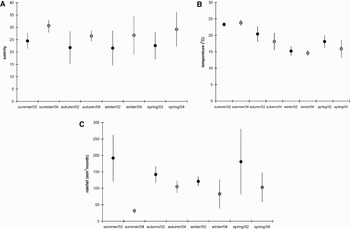
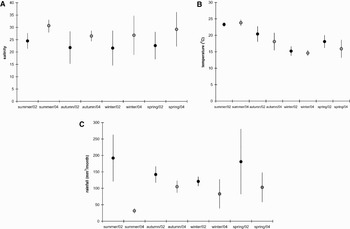
Abiotic parameters showed seasonal and interannual variations and during 2002 lower values of salinity and higher values of temperature and rainfall were recorded (Figure 2). Rainfall statistics allowed concluding that exceptionally high precipitation was recorded in 2002, surpassing values observed for intense El Niño Southern Oscillation (ENSO) events, such as 1997–1998. Total volume of rainfall registered in 2002 for the city of Rio Grande was 1915 mm3 while the volume observed in 2004 (969 mm3) was considerably below mean values for the region (1215 mm3) (Figure 2).
(A) Trends in mean salinity in surrounding area of Patos Lagoon estuarine mouth; (B) trends of water temperature (°C) in marine waters surrounding Patos Lagoon estuarine mouth; (C) trends in mean rainfall (mm3/month) registered for the city of Rio Grande during 2002 and 2004. Circles represent mean values and bars the standard deviation of means. Black dots represent the estimates obtained during 2002, while 2004 is represented by the grey dots.
A total of 5368 individuals was used in regression analysis (Tables 1 & 2), being 2971 males and 2116 females. Moreover, 139 individuals from Argentina and 142 individuals from Rio de Janeiro were analysed. Deviation from 1:1 sex-ratio (Ruffino & Castello, Reference Ruffino and Castello1992) resulted from a higher number of females discarded due to broken or regenerating rostrums.
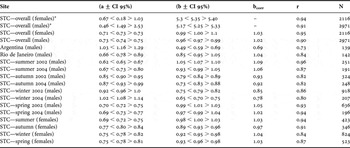
Linear regression summary obtained from Artemesia longinaris total (TL) and carapace length (CL) data for different sexes, sites and seasons, containing estimates of intercept (a±confidence interval (CI) at 95%), slope (b±CI at 95%), coefficient of correlation (r) and number of individuals used (N). STC, Subtropical Convergence. All linear regressions presented significance level of fit (P < 0.05). Due to different R values, slopes were corrected based on different coefficient of correlation values (bcorr). *indicates predictive regression parameters obtained from raw data.

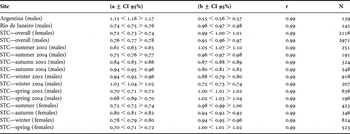
The males inhabiting southern Brazil had a slightly lower TL slope (b = 5.25) than females (b = 5.35) (Table 1). The smoothed and log transformed data showed the same pattern of higher relative growth in TL for females, resulting in estimates close to isometry in length relationships (b = 1) (Table 2). Linear regression coefficient estimated for males inhabiting Rio de Janeiro was 0.95 for log transformed and 0.97 for smoothed data. Slopes estimated for males sampled in Argentina were consistently lower (0.59 and 0.56 for log transformed and smoothed data, respectively) than the overall pattern observed for the other two populations sampled (Tables 1 & 2). Seasonal analysis of slopes presented different patterns for both sexes. Slopes estimated for females inhabiting southern Brazil, ranged from 0.92 (autumn 2002) to 1.01 (spring 2002) without a clear pattern of seasonal variation (Tables 1 & 2).
Linear regression summary obtained from log transformed and smoothed (Loess) data of Artemesia longinaris total (TL) and carapace length (CL) for different sexes, sites and seasons, containing estimates of intercept (a±confidence interval (CI) at 95%), slope (b±CI at 95%), coefficient of correlation (r) and number of individuals used (N). STC, Subtropical Convergence. All linear regressions presented significant level of fit (P < 0.05).

A wider range of slopes was observed in the linear regression estimated for males, ranging from 0.73 (winter 2004) to 1.07 (summer 2002). Unlike females, slopes of males showed marked seasonal trends, with lower values observed from autumn to winter, suggesting that increment of carapace (CL) is higher than total length (TL), or that contribution of cephalothorax to total length is relatively more important. The same pattern of negative isometry during autumn and winter was observed in both years analysed. Nevertheless, 2004 showed a sharp reduction in slopes during autumn and winter (Table 2). For this reason, only data from males were analysed, since this was more informative.
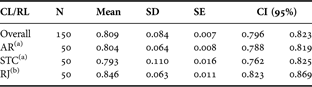
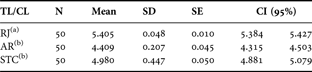
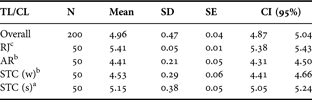
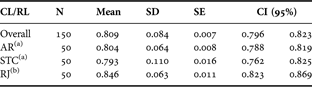
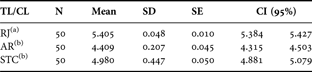
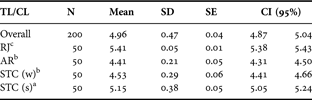
The mean CL/RL was significantly different between populations inhabiting southern areas (Argentina and STC) and RJ (Table 3). The variable TL/CL also grouped the southern stocks (Argentina and STC) and separated the population inhabiting RJ (Table 4). Since seasonal trends in TL/CL regression were observed, summer and winter individuals sampled in the STC area were compared by one-way ANOVA to males from the extremes of distribution (Rio de Janeiro and Argentina). The ANOVA results suggested that individuals from Argentina and those inhabiting STC during winter have similar values for this variable. The other groups were statistically different (Table 5).
Descriptive statistics of carapace (CL) and rostrum length (RL) ratio, obtained from Artemesia longinaris males in different sampling sites, containing number of individuals sampled (N), mean CL/RL values, standard deviation (SD), standard error (SE) and confidence intervals (CI95%). RJ, Rio de Janeiro; AR, Argentina; and STC, Subtropical Convergence. Superscript letters indicate groups separated by one-way ANOVA (P < 0.05).
Descriptive statistics obtained from total (TL) and carapace length (CL) ratio of Artemesia longinaris males in different sampling sites, containing number of individuals sampled (N), mean TL/CL values, standard deviation (SD), standard error (SE) and confidence intervals (CI 95%). RJ, Rio de Janeiro; AR, Argentina; and STC, Subtropical Convergence. Superscript letters indicate groups separated by one-way ANOVA (P < 0.05).
Descriptive statistics from total and carapace length ratio (TL/CL) obtained from Artemesia longinaris males in different sampling sites, containing number of individuals sampled (N), mean number of rostral teeth (RT), standard deviation (SD), standard error (SE) and confidence intervals (CI95%). RJ, Rio de Janeiro; AR, Argentina; STC (w), Subtropical Convergence in winter; and STC (s), Subtropical Convergence in summer. Superscript letters indicate groups separated by one-way ANOVA (P < 0.05).
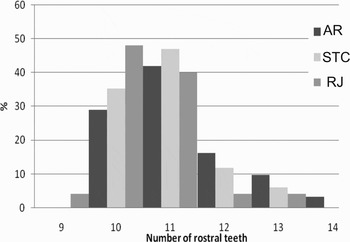
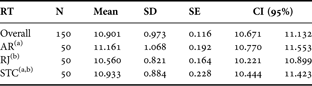
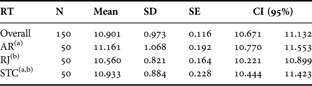
The analysis of number of rostral teeth (RT) indicated significant differences between groups located at extremes of the distribution area. The pattern observed, was that mean number of RT decreases with latitude, varying from 11.16 in Argentina to 10.56 in Rio de Janeiro (Table 6). In the populations inhabiting Argentina and STC, frequency of RT was concentrated between 10 (29% and 33.3%, respectively) and 11 (42% and 46.66%) (Figure 3). However, a different pattern was observed for the males from the Rio de Janeiro population, with 48% presenting 10 teeth and 40% 11 teeth.
Relative frequency of number of rostral teeth (RT) in males of Artemesia longinaris inhabiting Argentina (AR), Subtropical Convergence (STC) and Rio de Janeiro (RJ).

Descriptive statistics from number of rostral teeth (RT) of Artemesia longinaris males in different sampling sites, containing number of individuals sampled (N), mean number of rostral teeth (RT), standard deviation (SD), standard error (SE) and confidence intervals (CI95%). RJ, Rio de Janeiro; AR, Argentina; and STC, Subtropical Convergence. Superscript letters indicate groups separated by one-way ANOVA and Tukey's test.
The same pattern was observed for both variables analysed (TL/CL and CL/RL), grouping southern stocks (AR and STC) in the same cluster. Lower distances were recorded between Argentina (AR) and Subtropical Convergence in winter (STC(w)). The males inhabiting STC in summer (STC(s)) also clustered together with southern populations, but showing slightly higher distance from winter and Argentina (Figure 4).
Cluster analysis estimated for males of Artemesia longinaris from CL/RL and TL/CL variables. AR, Argentina; RJ, Rio de Janeiro; STC (w) = Subtropical Convergence in winter; and STC (s) = Subtropical Convergence zone in summer.

DISCUSSION
The overall pattern of relative growth in size was similar for both sexes, with values close to expected isometry for the size relationships. However, a slightly higher TL growth was observed for females. A similar pattern was observed for other penaeid prawns such as Penaeus aztecus (Parrack, Reference Parrack1979), Penaeus indicus (Devi, Reference Devi1986), Penaeus longystilus (Dredge, Reference Dredge1990), Litopenaeus vannamei (Chow & Sandifer, Reference Chow and Sandifer1991), Metapenaeus endeavouri (Buckworth, Reference Buckworth1992) and Penaeus monodon (Primavera et al., Reference Primavera, Parado-Estepa and Lebata1998). Previous investigation on length–length relationships for A. longinaris described a slightly higher relative growth of TL in males (Boschi, Reference Boschi1969; Nascimento, Reference Nascimento1983), which may be explained by higher frequency of regenerating and broken rostrum of females, directly influencing TL measurements.
In the present study, percentage of excluded females surpassed the amount of males (5.21% of females and 3.0% of males were located outside the CI 95%), which is likely related to larger rostrum of females and consequently higher probability of breakdown. We hypothesize that slightly higher relative growth observed in previous investigations (Boschi, Reference Boschi1969; Nascimento, Reference Nascimento1983) was due to inclusion in the linear regression of individuals, of both sexes, with undetected broken or regenerating rostrum.
Nascimento (Reference Nascimento1983) analysed changes in size relationships for A. longinaris along the STC suggesting that these different trends might be attributed to environment-induced growth patterns, allometry caused by interactions between different populations or the presence of a puberty moult. Another cause of trends in linear slopes in penaeids could be the presence of old, slow growing individuals forcing the slope down (Primavera et al., Reference Primavera, Parado-Estepa and Lebata1998). However, the analysis of size composition does not support this hypothesis since small recruits can also be observed during autumn and winter and larger males were mainly captured in spring. In fact, reproductive interaction has been previously reported for this species by using allozymes (Weber et al., Reference Weber, Conceição, Ruffino and Levy1993) and mtDNA sequencing (Dumont et al., unpublished data), which confirmed the similarity between STC and AR populations as well as the isolation of the group inhabiting the RJ coast.
Mean water temperature registered for Macaé (RJ) is 24°C, except in summer when temperature decreases due to a coastal upwelling process (20–22°C) (Beisl et al., Reference Beisl, Miranda and Silva Junior2001). Conversely, water temperatures in Mar del Plata (AR) are consistently lower, ranging from 10°C–20.5°C (Ciemchomski & Vigo, Reference Ciemchomski and Vigo1971). Hence, lower temperatures recorded in the southern area, where AR and STC populations are located, may explain the significant differences observed in relative growth. Cluster analysis, including summer and winter individuals, showed reduced distances between individuals from AR and STC(w), which may also suggest that the temperature is an important factor influencing the morphometric traits of A. longinaris. Additionally, the lower slopes observed during 2004 may also indicate the influence of temperature on relative growth for this species.
However, oceanographic features of the studied region may also imply genetic interchange between AR and STC populations as well as isolation of the RJ population. Changes in morphometric traits (TL/CL ratio and slope of TL/CL regression estimated for males), observed during colder periods of autumn and winter may be linked to the presence of morphotypes from AR, carried to southern Brazil by the Coastal Water (CW). The CW is a colder water mass that is mainly influenced by the La Plata river freshwater outflow and it is displaced northwards when south-westerly winds are frequent and intense. This water mass stretches northwards reaching the coast of Rio Grande do Sul (32°00′) all year round but its presence is especially noticeable in autumn and winter (Piola et al., Reference Piola, Möller and Palma2004, Reference Piola, Matano, Palma, Möller and Campos2005). This ‘diluted’ water is therefore, the dispersion vector by which prawns and/or larvae from southern stocks, with relative larger carapace and rostrum lengths, can be transported to the Rio Grande do Sul coast, especially during winter. Assuming that individuals from AR are carried by CW in autumn and winter and that the main reproductive event takes place in spring (Ruffino & Castello, Reference Ruffino and Castello1992; Calazans, Reference Calazans2002; Dumont & D'Incao, unpublished data), it is likely that genetic interchange occurs between these two stocks.
It is also important to highlight that sampling was performed during two contrasting years in terms of amount of rainfall, salinity and water temperature. During 2002, the total volume of rain recorded was the highest in the last thirty years, overcoming elevated values observed in intense El Niño events (ENSO), such as 1997–1998 (NOAA, 2007). On the other hand, 2004 was considered as a dry year, presenting lower rainfall values, higher salinity and lower temperature. It is important to point out that the changes in salinity do not have a direct influence on relative growth but denote the presence of a particular water mass capable of transporting either larvae or adults. Therefore, reduction of slopes during 2004 may be linked to larger amount of CW on the coast of Rio Grande do Sul (CZ). This water mass is quite variable in terms of salinity and temperature, showing latitudinal displacements regulated by rainfall and wind stress along the coast (Piola et al., Reference Piola, Möller and Palma2004, Reference Piola, Matano, Palma, Möller and Campos2005).
The meridional penetration of the river plume is largely controlled by the magnitude and direction of south-westerly winds predominant in winter (Kourafalou et al., Reference Kourafalou, Oey, Wang and Lee1996). During ENSO events, south-westerly winds are weakened and north-easterly wind predominates in the south-western Atlantic, reducing northwards penetration of CW (Piola et al., Reference Piola, Matano, Palma, Möller and Campos2005). Thus, this may explain the lower abundances of morphotypes from Argentina in the STC during 2002. Conversely, during years of intense south-westerly winds and moderate rainfall, the influence of CW on south and south-eastern Brazil is more intense, reaching the latitude 23°32′S (São Paulo) (Piola et al., Reference Piola, Möller and Palma2004) (e.g. 2003, when maximum landings of A. longinaris were recorded in southern Brazil). The isolation of the RJ population is therefore also explained by the maximum expansion of CW that does not reach this region even during exceptionally favourable combinations of wind and rainfall (Piola et al., Reference Piola, Matano, Palma, Möller and Campos2005).
Relative growth of rostrum also allowed the identification of significant similarities between males from Argentina and Rio Grande do Sul. Populations inhabiting southern areas (STC and AR) tend to have a relatively longer rostrum, which does not occur in the northern range of distribution (Rio de Janeiro). Previous investigation of relative growth of A. longinaris (Nascimento, Reference Nascimento1981) also suggested that individuals inhabiting latitudes higher than 32°05′ presented relatively larger rostrums. However, that investigation was restricted to STC and did not analyse the extremes of A. longinaris distribution.
Additionally to molecular (Weber et al., Reference Weber, Conceição, Ruffino and Levy1993; Dumont et al., unpublished data) and morphometric analysis, meristic counts of number of rostral teeth (RT) also showed a certain level of population structuring for A. longinaris in the south-western Atlantic. According to D'Incao (Reference D'Incao, Buckup and Bond-Buckup1999) A. longinaris presents great variability in number of RT, showing values that range from 7–14. In the present investigation, the number of rostral teeth varied from 9–14, which may have been caused by exclusion of females from analysis or due to reduced sampling numbers.
A latitudinal pattern in mean number of RT was observed, in such a way that reductions in mean values were recorded as latitude decreases. Mean comparison tests indicated that only populations inhabiting distribution extremes (AR and RJ) showed significant differences in mean number of RT. However, the modal value of population inhabiting RJ was located at intervals of 10, while the most frequent number of rostral teeth in the other two populations (AR and CZ) was 11.
Therefore, the analysis of this variable reinforces similarity between stocks located at southern regions and the isolation of the northern population (RJ), caused either by environmentally-induced or migration phenomena. Even though meristic differences may be environmentally-induced rather than genetically-based, consistent morphological differences among areas may indicate the existence of ‘phenotypic stocks’ with sufficient distinctness to warrant separate management (Shepherd, Reference Shepherd1991). However, the exact causes of variation in morphological analysis are not easily distinguishable, since these characters are phenotypically expressed and may represent both genetic and environment information, but lack from the information on their respective contributions (Waldman, Reference Waldman1999).
The phenotypic (Nascimento, Reference Nascimento1981, Reference Nascimento1983) and genetic (Weber et al., Reference Weber, Conceição, Ruffino and Levy1993; Dumont et al., unpublished data) traits analysed allowed concluding that stocks of A. longinaris inhabiting southern regions (STC and AR) show higher level of similarity when compared to the northernmost stock. These evidences are supported by geographical distance, differences of water temperature and oceanographic systems observed in species’ distribution in the area, which requires an international effort to properly manage this valuable resource.
ACKNOWLEDGEMENTS
The authors acknowledge Secretaria de Ciência e Tecnologia do Estado do Rio Grande do Sul for providing financial support to project Camarões Oceânicos and to CAPES for the fellowship provided. We would also like to thank Dr Ernesto Boschi (INIDEP), Dr Marcelo Vianna and Dr Karina Keunecke (UFRJ) for helping in collections of individuals from distribution limits (Argentina and Rio de Janeiro).