Significant outcomes
∙ With transcranial direct current stimulation (tDCS), schizophrenia patients with catechol-o-methyl transferase (COMT) Val/Val genotype patient reported significantly greater reduction in auditory hallucination sub-scale (AHS) score than Met/Met or Val/Met carriers.
∙ NRG1 genotypes alone did not have any influence on the tDCS outcome but, when present with COMT-GG genotype had an additive effect on COMT × tDCS outcome interaction.
∙ Overall women patients had a better treatment response to tDCS as compared with males.
Limitations
∙ The study sample size is small.
∙ Further research using a randomized controlled trial design may avoid potential confounding factors.
∙ Concurrent assessment of brain measure would have enhanced objectivity.
Introduction
Abnormal synaptic plasticity in schizophrenia has been reported to involve both glutamatergic and dopaminergic pathways; these abnormalities are implicated in the pathogenesis of auditory verbal hallucinations (AVH) (Reference Lewis and Moghaddam1–Reference Voineskos, Rogasch, Rajji, Fitzgerald and Daskalakis4). Recent studies have reported significant improvement in persistent AVH in schizophrenia with an add-on treatment with tDCS – a non-invasive brain stimulation method (Reference Bose, Shivakumar, Narayanaswamy, Nawani, Subramaniam, Agarwal, Chhabra, Kalmady and Venkatasubramanian5–Reference Brunelin, Mondino, Gassab, Haesebaert, Gaha, Suaud-Chagny, Saoud, Mechri and Poulet7). Although the mechanistic basis of tDCS effects on AVH is yet to be elucidated definitively, emergent findings suggest neuroplasticity modulation as one of the likely mediating factor.
In animal model-based tDCS studies, application of anodal current has been shown to result in N-methyl d-aspartate (NMDA) receptor mediated long-term potentiation (LTP) of motor cortex (Reference Fritsch, Reis, Martinowich, Schambra, Ji, Cohen and Lu8,Reference Bikson, Inoue, Akiyama, Deans, Fox, Miyakawa and Jefferys9). Later studies have documented this tDCS-induce LTP changes in human subjects as well (Reference Hasan, Nitsche, Rein, Schneider-Axmann, Guse, Gruber, Falkai and Wobrock10–Reference Nitsche and Paulus12) through modulation of transmembrane potential through altered intracellular ions concentration across synapse (Reference Krause, Marquez-Ruiz and Kadosh13). These tDCS induced changes in neuroplasticity have been shown in both healthy subjects as well as schizophrenia patients (Reference Antal, Paulus and Nitsche14–Reference Nawani, Bose, Agarwal, Shivakumar, Chhabra, Subramaniam, Kalmady, Narayanaswamy and Venkatasubramanian16).
Studies have also reported that tDCS significantly decreased the motor evoked potential and increased the early somatosensory evoked potential components (N20 and P25) (Reference Kirimoto, Ogata, Onishi, Oyama, Goto and Tobimatsu17). In addition, tDCS has been shown to cause changes in the regional cerebral blood flow (rCBF). Studies have stated that anodal tDCS increases rCBF as compared with cathodal tDCS (Reference Lang, Siebner, Ward, Lee, Nitsche, Paulus, Rothwell, Lemon and Frackowiak18) and these changes persist for up to 50 min following a single session of tDCS(Reference Venkatakrishnan and Sandrini19).
Given the compelling evidence for neuroplasticity modulation by tDCS as per the studies summarised above, one would expect that genes that influence neuroplasticity to demonstrate a significant impact on tDCS-induced neuroplastic effects as well. Atleast with respect to neuroplasticity aberrations in schizophrenia, studies have supported a significant role for some important genetic variations involving Neuregulin-1 (NRG1) [rs35753505] (Reference Mei and Xiong20) and COMT [rs4680] (Reference Ho, Wassink, O’Leary, Sheffield and Andreasen21).
COMT gene plays an important role in dopaminergic neurotransmission. The Met allele of the COMT gene polymorphism (rs4680) is associated with lower expression of COMT mRNA with resultant hyperdopaminergic system (Reference Bray, Buckland, Williams, Williams, Norton, Owen and O'Donovan22); this effect is tune with the COMT haplotype showing a significant association with schizophrenia symptoms in a large sample case-control study (Reference Shifman, Bronstein, Sternfeld, Pisante-Shalom, Lev-Lehman, Weizman, Reznik, Spivak, Grisaru, Karp, Schiffer, Kotler, Strous, Swartz-Vanetik, Knobler, Shinar, Beckmann, Yakir, Risch, Zak and Darvasi23). COMT gene polymorphism has been linked with increased mRNA expression of tyrosine hydroxylase in mesencephalic dopamine neurons which, in turn, increases susceptibility to psychosis (Reference Akil, Kolachana, Rothmond, Hyde, Weinberger and Kleinman24). Moreover, Met allele of this COMT gene polymorphism [rs4680] was found be associated with executive dysfunction (Reference Opgen-Rhein, Neuhaus, Urbanek, Hahn, Sander and Dettling25), elevated pre-pulse inhibition (Reference Quednow, Wagner, Mossner, Maier and Kuhn26) and poor performance in antisaccade task (Reference Haraldsson, Ettinger, Magnusdottir, Sigmundsson, Sigurdsson, Ingason and Petursson27).
As COMT gene variations plays a significant role in schizophrenia pathogenesis as well as in aberrant neuroplasticity, and tDCS is emerging out to be an effective form of treatment possibly through adaptive modulation of neuroplasticity, determining effect of this gene polymorphism on tDCS effects has been of interest in recent studies. COMT gene polymorphism and transcranial magnetic stimulation [using protocol for an excitatory paired-associative stimulation (PAS25)] interaction study has reported Met homozygotes to have a significantly higher change in plasticity as compared with the other genotypic groups (Reference Witte, Kurten, Jansen, Schirmacher, Brand, Sommer and Floel28). Studies which investigated the interaction of tDCS and COMT polymorphism reported that cathodal tDCS on dorsolateral prefrontal cortex (DLPFC) had an impairing effect on response inhibition in COMT homozygous Val genotype carriers (Reference Nieratschker, Kiefer, Giel, Kruger and Plewnia29) and those with COMT Met homozygous genotype had a deteriorating effect during of set-shifting ability task following anodal tDCS (Reference Plewnia, Zwissler, Langst, Maurer, Giel and Kruger30). In addition, our previous preliminary results demonstrated that tDCS mediated reduction in auditory hallucinations in patients with schizophrenia were also affected by COMT gene polymorphism. Met allele carriers had a significantly lower percentage reduction in auditory hallucinations in comparison with Val allele carriers (Reference Shivakumar, Chhabra, Subbanna, Agarwal, Bose, Kalmady, Narayanaswamy, Debnath and Venkatasubramanian31).
The area of NRG1 gene polymorphism and brain stimulation interaction is relatively new considering the evidences on NRG1 polymorphism’s [rs35753505] involvement with schizophrenia (Reference Yang, Si, Ruan, Ling, Han, Wang, Zhou, Zhang, Kong, Liu, Zhang, Yu, Liu, Ju, Shu, Ma and Zhang32). This polymorphic form of NRG1 has been strongly linked with emotion processing (Reference Kukshal, Bhatia, Bhagwat, Gur, Gur, Deshpande, Nimgaonkar and Thelma33,Reference Kurnianingsih, Kuswanto, McIntyre, Qiu, Ho and Sim34), Brodmann area 10 (BA 10) activation (Reference Krug, Markov, Eggermann, Krach, Zerres, Stocker, Shah, Schneider, Nothen, Treutlein, Rietschel and Kircher35) and changes in other morphological and functional properties in schizophrenia (Reference Thirunavukkarasu, Vijayakumari, John, Halahalli, Paul, Sen, Purushottam and Jain36–Reference Kircher, Thienel, Wagner, Reske, Habel, Kellermann, Frommann, Schwab, Wolwer, von Wilmsdorf, Braus, Schmitt, Rapp, Stocker, Shah, Henn, Sauer, Gaebel, Maier and Schneider38). While, one study (Reference Thirunavukkarasu, Vijayakumari, John, Halahalli, Paul, Sen, Purushottam and Jain36) reported volumetric differences between homozygotes of the risk allele (AA) and heterozygotes (AG) of NRG1, with increased grey matter volume in bilateral cingulate gyri, right precentral gyrus and left cuneus and reduced grey matter volume in tuber of left cerebellar vermis in AA homozygotes, similar allelic association with overrepresented A allele was reported by other schizophrenia studies (Reference Prata, Breen, Osborne, Munro, Clair and Collier39–Reference Georgieva, Dimitrova, Ivanov, Nikolov, Williams, Grozeva, Zaharieva, Toncheva, Owen, Kirov and O'Donovan41). Results from diffusion tensor imaging study suggest NRG1 rs35753505 homozygous risk allele carriers to have an elevated fractional anisotropy in right medial temporal lobe which highlights the role of NRG1 polymorphism on synaptic connectivity in schizophrenia (Reference Nickl-Jockschat, Stocker, Krug, Markov, Huang, Schneider, Habel, Eickhoff, Zerres, Nothen, Treutlein, Rietschel, Shah and Kircher42). NRG1 gene polymorphism has been reported to weaken the synaptic integration by causing NMDA receptor to hypo function, which, in turn, causes glutamatergic dysfunction (Reference Yeganeh-Doost, Gruber, Falkai and Schmitt43).
Considering the evidences supporting the role of NRG1 gene polymorphism (rs35753505) in schizophrenia aetiology and the significance of COMT gene polymorphism and brain stimulation interaction, in the current study, we examined the potential effects of COMT and NRG1 gene interactions with tDCS mediated changes on persistent auditory verbal hallucinations in schizophrenia patients.
Material and methods
Subjects
Schizophrenia patients who attended the clinical services of the National Institute of Mental Health & Neurosciences (India) and qualifying DSM-IV criteria (n=32; Age=35.81±12.29 years; M : F=16 : 16), presented with persistent auditory hallucinations (Psychotic Symptom Rating Scales AHS (Reference Haddock, McCarron, Tarrier and Faragher44)) despite adequate antipsychotic medication treatment were administered with an add-on tDCS (Reference Brunelin, Mondino, Gassab, Haesebaert, Gaha, Suaud-Chagny, Saoud, Mechri and Poulet7). AHS measured auditory hallucinations characteristics like frequency, duration, location, loudness, belief of voice origin, negative content in voice, distress caused by them and patient’s control over the voice. Each characteristic was rated from zero to four, with a maximum attainable score of 44 and a minimum of zero on the scale. A minimum score of more than or equal to two on measures of frequency, duration and intensity of distress on the scale was kept as the inclusion criteria. The patients were right hand dominant as per Edinburgh inventory (Reference Oldfield45) and atleast one psychiatrist confirmed the clinical diagnosis as per as established by the MINI International Neuropsychiatric Interview Plus (Reference Sheehan, Lecrubier, Sheehan, Amorim, Janavs, Weiller, Hergueta, Baker and Dunbar46). Patients were on stable dose of antipsychotics during tDCS with a mean chlorpromazine equivalent of 755.19±522.26 mg/day. Mean age at onset (AAO), age at treatment (AAT) and duration of untreated illness (DUI) was 23.32±7.68 years, 24.15±7.77 years and 12.35±9.71 months, respectively. Of the 32 patients, 14 were also on additional medications other than antipsychotics [Fluoxetine (n=3), Valproate (n=3), Sertraline (n=2), Escitalopram (n=2), Clonazepam (n=6), Lorazepam (n=2), Thyroxine (n=2), oxcarbazepine (n=1) and Baclofen (n=1)] and 16 were on trihexyphenidyl. One patient was on anti-hypertensives (amlodipine and atorvastatin), three patients were on B-vitamin supplements and two were on folate supplements.
The patients were also examined for potential side-effects due to antipsychotics; on clinical examination, none of them had severe extrapyramidal symptoms or tardive dyskinesia. It is to be noted that a subset of patients (n=16) received concomitant anticholinergic medication (trihexyphenidyl); it is possible that these patients might have developed extrapyramidal symptoms earlier for which they were co-prescribed with trihexyphenidyl and this would have confounded our assessment of extrapyramidal symptoms. We did not collect information on metabolic side-effects due to antipsychotics in these patients. The patients were not recruited for the study if there was any indication of neurological co-morbidity, any form of drug dependence, nicotine dependence, developmental delay, history of stroke or epilepsy or any head metal implants. All the patients provided a written consent. The research assessments were carried out as per Helsinki guidelines as approved by the institute ethics committee.
Administration of tDCS
tDCS was administered with adequate safety measures using Neuroconn (Neuroconn DC Stimulator Plus, http://www.neuroconn.de/dc-stimulator_plus_en/) as described previously (Reference Brunelin, Mondino, Gassab, Haesebaert, Gaha, Suaud-Chagny, Saoud, Mechri and Poulet7,Reference Brunoni, Amadera, Berbel, Volz, Rizzerio and Fregni47). Stimulation was delivered with 35 cm2 conductive silicon rubber electrodes. Cathode was placed at left temporo-parietal junction and anode at left DLPFC; 2 mA of current for 20 min was administered per tDCS session. Current ramp up and ramp down time was set at 20 s each. The sessions were administered twice daily (separated by atleast 3 h) for 5 consecutive days. A well-structured tDCS adverse effects questionnaire was administered to assess for any potential intolerance after every tDCS session (Reference Brunoni, Amadera, Berbel, Volz, Rizzerio and Fregni47). The adverse effects reported were limited to mild to moderate tingling, itching or burning sensation with a few instances of skin redness. There were no drop outs in the study because of tDCS intolerability.
Genotyping
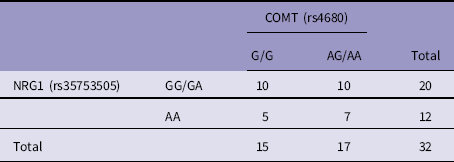
Peripheral blood of 5 ml was collected in K2 EDTA vacutainers (Becton & Dickinson, NJ, USA) and was used for genomic DNA extraction. COMT (rs4680) and NRG1 (rs35753505) genotyping was done using the Taqman 5' nuclease allelic discrimination assay. The procedure used for blood collection and genotyping were similar to those published earlier (Reference Shivakumar, Chhabra, Subbanna, Agarwal, Bose, Kalmady, Narayanaswamy, Debnath and Venkatasubramanian31). Commercial spin column method was used for DNA extraction (Qiagen, Inc, Limburg, the Netherlands). The extracted DNA was then subjected to UV spectrophotometry for quality check (Thermo Scientific, Waltham, MA, USA) and was stored at −80°C. Taqman-based 5' nuclease allelic discrimination assay was used for genotyping with predesigned primers and allele-specific MGB probes (FAM and VIC) purchased commercially (Applied Biosystems, Foster City, CA, USA). Genotyping assay was performed in a 96-well plate-based Real-Time polymerase chain reaction (PCR) (StepOne PlusTM Real-Time PCR Systems, Applied Biosystems). Genotyping was performed with samples were loaded in duplicates along with both positive and negative controls. Reaction volume per sample per well used was 10 µl (10 ng genomic sample DNA, assay mix and PCR Universal Master Mix with AmpErase® Uracil-DNA Glycosylase). PCR protocol steps followed were −60°C for 30 s, then 95°C for 10 min and then followed by 92°C for 15 s and 60°C for 90 sec for 50 cycles. Based on the available literature, the genotypes were grouped as per allele dominance. COMT genotypes were grouped into Val group (GG; n=15) and Met group (GG/AG; n=17) and NRG1 genotypes were grouped into AA group (n=12) and AG/GG group (n=20) (Table 1).
COMT and NGR1 allelic frequency distribution in 32 schizophrenia patients

Statistical analyses
Baseline differences in clinical score within genotype groups were analysed using independent samples t-test. Repeated measure analysis of variance (RM-ANOVA) was used to analyse the gene–gene interaction effects and repeated measure analysis of co-variance (RM-ANCOVA) was used to study the effects of duration of illness, age and effect of medication on the tDCS medicated outcome.
Results
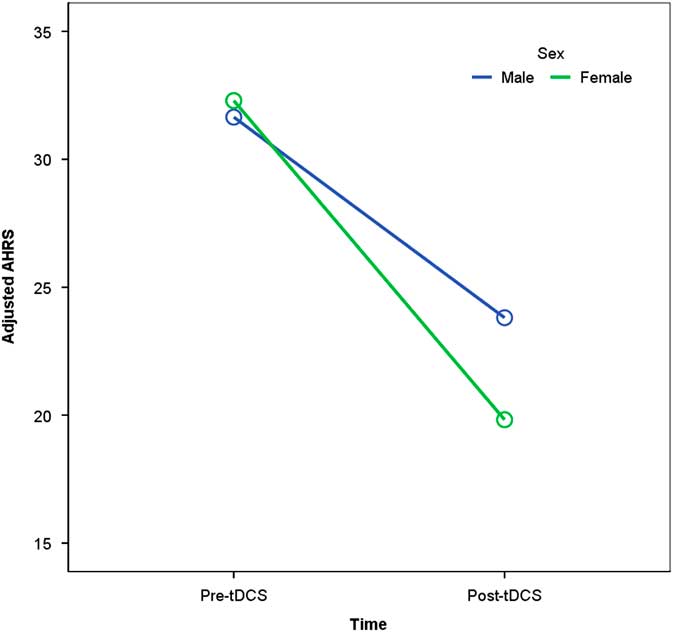
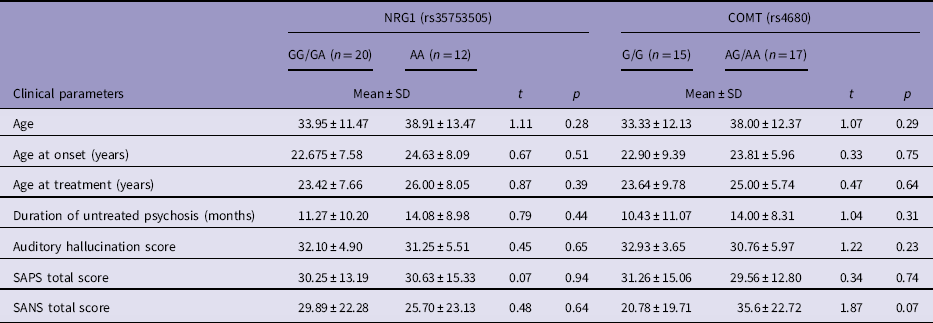
Baseline clinical scores did not differ significantly among the genotype groups (Table 2; Fig. 1). Genotype groups were also found to have a comparative treatment profile with regards to non-anti-psychotics (non-AP) and trihexyphenidyl [NRG1 (non-anti-psychotics χ2=0.31, p=0.58; THP χ2=0.53, p=0.46) COMT (non-THP χ2=0.10, p=0.75; THP χ2=0.12, p=0.72)]. RM-ANOVA for tDCS mediated effect on AHS scores, with COMT and NRG1 genotypes as between subjects factors, revealed a statistically significant reduction in AHS scores irrespective of the genotype [F(1,28)=85.11, p<0.001, ɳ2=0.75]. When tDCS and COMT interaction was studied with respect to the magnitude of reduction in AHS, it was observed that GG genotype was associated with better tDCS outcome [Time×COMT interaction: F(1,28)=10.55, p=0.003, ɳ2=0.27] (Fig. 2). On the other hand, NRG1 genotypes did not have any significant effect on AHS scores reduction [Time×NRG1 interaction: F(1,28)=3.42, p=0.075, ɳ2=0.12]. However, upon examining the gene–gene interaction effects, the impact of COMT was found to be modulated by NRG1-AA genotype. That is, the positive effects of COMT-GG genotype on tDCS induced AHS was significantly improved by the co-occurrence of NRG1-AA genotype [Time×COMT×NRG1 interaction: F(1,28)=8.09, p=0.008, ɳ2=0.22] (Fig. 3). RM-ANOVA with modelling trihexyphenidyl and Non-AP medication as an additional between subject factor, revealed a significant effect of these medications on tDCS outcome and gene–gene interaction [F(1,16)=8.59, p=0.01, ɳ2=0.3]. Carrying forward the interaction analysis, significant tDCS mediated AHS change and gene–gene interaction persisted even after co-varying for effects of duration of illness, age and CPZ equivalents and modelling sex as additional factor (without considering trihexyphenidyl and non-AP as between subject factors) [RM_ANCOVA: F(1,21)=6.06, p=0.02, ɳ2=0.22]. The sex-based analysis was attempted as an exploratory analysis as the sample size was small. The results showed that irrespective of genotype tDCS response was better for females as compared with males [Time×sex interaction: F(1,21)=4.67, p=0.04, ɳ2=0.18] (Fig. 4).
Graph shows the mean baseline AHS scores plotted against both COMT (rs4680) (GG=15; AG/AA=17) and NRG1 (rs35753505) (GG/GA =20; AA=12) gene genotypes depicting not significant difference between the hallucination scores pre tDCS.

Graph shows the effect of COMT Genotype on AHS score. GG genotype (Val homozygous) (n=15) was associated with better tDCS outcome as compared to Met carriers (n=17).

Graph shows the interaction effect of NRG-1 and COMT gene polymorphisms and its effect on change in AHS scores post tDCS. tDCS outcome was co-varied for the effects of duration of illness, age and CPZ equivalents. NRG-1 AA geneotype has a synergistic effect with COMT Val homozygous genotype (NRG-1 AA and COMT Val homozygous no. of patients = 5) but not with Met carriers (NRG-1 AA and COMT Met carriers no. of patients = 7). No interaction effect of NRG-1 G allele carrier (GG/GA=20) and COMT genotypes (GG=15; AG/AA=17) was found.

Graph shows that females had better tDCS outcome as compare to males (M:F=16:16). tDCS outcome was covaried for the effects of duration of illness, age and CPZ equivalents.

Comparative profile of socio-demographic and clinical parameters between patients grouped according to the allelic distribution for both COMT and NRG1 genotypes (pre-tDCS)

SAPS, Scale for the Assessment of Positive Symptoms; SANS, Scale for the Assessment of Negative Symptoms.
Discussion
Our study findings suggest that the effect of tDCS on AVH in schizophrenia is potential influenced by COMT gene polymorphism (rs4680) as well as interaction between COMT-GG (Val homozygous) and NRG1-AA genotypes.
These findings support and extend the observations reported in earlier studies. In a group of 23 patients who received tDCS, add-on tDCS was reported to result in significantly greater reduction of AVH in patients with COMT Val homozygous genotype in comparison with Met allele carriers (Reference Shivakumar, Chhabra, Subbanna, Agarwal, Bose, Kalmady, Narayanaswamy, Debnath and Venkatasubramanian31). Studies on healthy subjects have also reported the effect of COMT genotype on tDCS effects. For instance, anodal current was found to impair set-shifting abilities indicating a deterioration of cognitive flexibility in healthy subjects that had Met homozygous COMT genotype (Reference Plewnia, Zwissler, Langst, Maurer, Giel and Kruger30). However, impairing effect of cathodal tDCS on response inhibition was observed only in Val allele carriers and Met allele carriers were not affected by the cathodal stimulation (Reference Nieratschker, Kiefer, Giel, Kruger and Plewnia29). The differential effect of COMT genotype are in line with the hypothesis of inverted U relationship between the dopaminergic signalling and the executive performance (Reference Cools and D’Esposito48). This hypothesis states that if the dopamine levels are below or above the optimum then there is a decline in cognitive performance. Met allele carriers of COMT genotype have higher level of dopamine, so anodal tDCS can be expected to cause the dopaminergic signalling to surge beyond the optimal level leading to cognitive impairment. Similarly, Val allele carriers have lower dopaminergic signalling which is further lowered by cathodal tDCS, this resultant sub-threshold signalling again results in cognitive impairment. Building on empirical evidences and hypothesis discussed above, it can be surmised that COMT gene polymorphism indeed plays an important role in tDCS medicated specific outcomes. In a transcranial magnetic stimulation (TMS) study that examined the effect of COMT and BDNF genotypes on cortical plasticity using paired-associative stimulation using PAS25 protocol (90 pairs of electrical stimulation of the ulnar nerve at the wrist combined with suprathreshold TMS impulse over the hot spot of the abductor digiti minimi over the contralateral hemisphere at a rate of 0.05 Hz), BDNF carrier status alone did not significantly influence PAS-induced cortical plasticity, but a significant BDNF×COMT interaction was found to be associated with a greater plasticity induction (Reference Witte, Kurten, Jansen, Schirmacher, Brand, Sommer and Floel28).
COMT polymorphism alters tyrosine hydroxylase mRNA expression in mesencephalic dopamine neurons, which causes hyper-production of dopamine and in turn increases susceptibility to psychosis (Reference Akil, Kolachana, Rothmond, Hyde, Weinberger and Kleinman24). COMT Met allele is stated to suppress the COMT mRNA expression leading to hyperactive dopaminergic system (Reference Bray, Buckland, Williams, Williams, Norton, Owen and O'Donovan22), this causes slower degradation of dopamine and increases the receptor-binding period. The significance of COMT-aided modulation in schizophrenia is ascertained by a large case-control study in which COMT haplotype was significantly associated with schizophrenia symptoms (Reference Shifman, Bronstein, Sternfeld, Pisante-Shalom, Lev-Lehman, Weizman, Reznik, Spivak, Grisaru, Karp, Schiffer, Kotler, Strous, Swartz-Vanetik, Knobler, Shinar, Beckmann, Yakir, Risch, Zak and Darvasi23). A few studies on cognition have reported significant effect of COMT polymorphism in schizophrenia population and its association with deficits in executive attention efficiency (Reference Opgen-Rhein, Neuhaus, Urbanek, Hahn, Sander and Dettling25), elevation of pre-pulse inhibition (Reference Quednow, Wagner, Mossner, Maier and Kuhn26) and inadequate performance in visually guided antisaccade task (Reference Haraldsson, Ettinger, Magnusdottir, Sigmundsson, Sigurdsson, Ingason and Petursson27).
NRG1 gene has been associated with risk for schizophrenia. NRG1-based haplotype studies implicate haplotype marker SNP8NRG221533 and two other microsatellite polymorphisms as the principal risk factors for schizophrenia (Reference Munafo, Attwood and Flint49,Reference Gong, Wu, Xing, Zhao, Zhu and He50). NRG1 gene’s role in schizophrenia pathogenesis has been explained by ‘gain of function’ hypothesis which states that increased expression of NRG1 stimulates gamma amino butyric acid transmission in the prefrontal cortex, this in turn, antagonistically causes reduction in glutamatergic transmission (Reference Mei and Xiong20). Other evidences that link NRG1 to schizophrenia are from examination of its role in dopaminergic regulation through ErbB receptor (Reference Ledonne, Nobili, Latagliata, Cavallucci, Guatteo, Puglisi-Allegra, D'Amelio and Mercuri51–Reference Roy, Murtie, El-Khodor, Edgar, Sardi, Hooks, Benoit-Marand, Chen, Moore, O'Donnell, Brunner and Corfas53). Such dopaminergic dysregulation of neuronal transmission causes disruption in synaptic plasticity.
Our study findings suggest that NRG1 gene polymorphism in conjunction with COMT polymorphism to affect tDCS induced changes in AVH. NRG1-AA genotype was found to result in greater AVH improvement only in COMT Val homozygous patients. Thus, the findings from our study suggest that NRG1 has a synergistic effect on dopaminergic pathway along with COMT with regards to its influence on tDCS effects.
Furthermore, interest in the role of COMT gene polymorphism on tDCS mediated outcome is relatively recent. Majority of the studies have till date focused their attention on tDCS BDNF gene polymorphism interaction alone (Reference Teo, Bentley, Lawrence, Soltesz, Miller, Wille, McHugh, Dodds, Lu, Croft, Bullmore and Nathan54,Reference Brunoni, Kemp, Shiozawa, Cordeiro, Valiengo, Goulart, Coprerski, Lotufo, Brunoni, Perez, Fregni and Bensenor55). tDCS itself is a re-emergent neuromodulation technique that is administered as an add-on treatment for persistent psychiatric symptoms, particularly for severe disorders like schizophrenia. The mechanistic basis of tDCS action has been hypothesised to be alteration to the neuronal excitability and consequently affecting the LTP like changes for sustained effects (Reference Rroji, van Kuyck, Nuttin and Wenderoth56). Such change in plasticity is caused by the sub-threshold level modifications in the resting membrane potential, but the persisting after effects may be NMDA-receptor dependent (Reference Monte-Silva, Kuo, Hessenthaler, Fresnoza, Liebetanz, Paulus and Nitsche15,Reference Nitsche, Fricke, Henschke, Schlitterlau, Liebetanz, Lang, Henning, Tergau and Paulus57). This proposition can be supported by the rCBF studies that have demonstrated increase or decrease in rCBF with anodal and cathodal tDCS, respectively (Reference Lang, Siebner, Ward, Lee, Nitsche, Paulus, Rothwell, Lemon and Frackowiak18,Reference Venkatakrishnan and Sandrini19). In addition, the impact of tDCS on plasticity can be examined by functional connectivity changes in active state or in resting state networks (Reference Polania, Paulus, Antal and Nitsche58–Reference Kunze, Hunold, Haueisen, Jirsa and Spiegler61). Increasing evidence in support of tDCS-induced neuroplasticity modulation and with potential mediating effect of gene polymorphisms underscores the need for further studies in this area.
Though suggestively novel, our study findings need to be interpreted in the context of following limitations. The major limiting factor is that of a small sample size. Our preliminary observations require replication with larger sample size and further systematic research towards understanding these neuroplastic gene determinants that modulate the effect of tDCS. Another important limitation is the evaluation of peripheral blood sample instead of brain tissue or cerebrospinal fluid-based analyses. In this context, we also acknowledge a related limitation that epigenetic factors like methylation might influence the gene expression; lack of analysis to characterise these epigenetic factors is yet another limitation. However, we have ensured that certain clinical characteristics like duration of untreated psychosis that might potentially influence neuroplasticity factors (e.g. brain-derived neurotrophic factor (Reference Rizos, Michalopoulou, Siafakas, Stefanis, Douzenis, Rontos, Laskos, Kastania, Zoumpourlis and Lykouras62)) were matched between sub-groups; this avoided potential confounding effects. While the reliability and validity of diagnosis is ensured in this study, the representativeness of the sample to the general population may not be ascertained given the small sample size. Therefore, further research studies in larger community-based sample selection are recommended.
In conclusion, our study findings offer preliminary support that the effect of tDCS on AVH in schizophrenia is influenced by COMT gene polymorphism (rs4680) as well as interaction between COMT-GG (Val homozygous) and NRG1-AA genotypes. This needs to be replicated in larger, representative sample for definitive inference with regards to the interaction between tDCS effects and neuroplasticity genes. Further research in this area might facilitate implementation of personalised neuromodulatory treatment approaches for administering tDCS in schizophrenia.
Financial Support
This study is partly supported by the Department of Science and Technology (Government of India) Research Grant [DST/SJF/LSA-02/2014-15] to GV. HC is supported by the Department of Biotechnology, Government of India (DBT/2015/NIMHANS/345). V.S. is supported by Department of Health Research, Young Scientist in Newer Research Areas (DHR/HRD/Young Scientist/Type-VI(2)/2015). AB is supported by Department of Science and Technology [DST/SJF/LSA-02/2014-15]. SVK & SMA are supported by the Department of Biotechnology, Government of India CEIB Programme Support Grant to GV (BT/PR5322/COE/34/8/2012).
Conflicts of Interest
There are no potential conflicts of interest to report for any of the authors.
Acknowledgements
None.