Significant outcomes
-
Hallucinations are one of the main psychiatric characteristics of Alzheimer’s disease.
-
Little is known however about olfactory hallucinations in the disease.
-
While olfactory hallucinations are scarce, they experienced unpleasant for patients with Alzheimer’s disease.
Limitations
-
One limitation of the present study is the lack of an evaluation of characteristics of olfactory hallucinations, such as vividness and insight of patients into these hallucinations.
At the cognitive level, Alzheimer’s disease (AD) has been mainly associated with memory compromise (McKhann et al., Reference Mckhann, Knopman, Chertkow, Hyman, JackKawas, JrKawas, Klunk, Koroshetz, Manly, Mayeux, Mohs, Morris, Rossor, Scheltens, Carrillo, Thies, Weintraub and Phelps2011; El Haj et al., Reference El Haj, Antoine, Nandrino and Kapogiannis2015a, Reference El Haj, Antoine, Amouyel, Lambert, Pasquier and Kapogiannis2016a). At the psychiatric level, one hallmark of AD is depression (Speck et al., Reference Speck, Kukull, Brenner, Bowen, Mccormick, Ten, Pfanschmidt, Thompson and Larson1995; Jost and Grossberg, Reference Jost and Grossberg1996; Diniz et al., Reference Diniz, Butters, Albert, Dew and Reynolds2013). Another psychiatric hallmark of AD is hallucinations (El Haj et al., Reference El Haj, Roche, Jardri, Kapogiannis, Gallouj and Antoine2017), with a prevalence ranging from 4% to 76% (median 23%) (Bassiony and Lyketsos, Reference Bassiony and Lyketsos2003). Research in AD has been mainly concerned with visual and auditory hallucinations (Tariot et al., Reference Tariot, Mack, Patterson, Edland, Weiner, Fillenbaum, Blazina, Teri, Rubin, Mortimer and Stern1995; Rubin et al., Reference Rubin, Drevets and Burke1988; Jeste and Finkel, Reference Jeste and Finkel2000; Tsuang et al., Reference Tsuang, Larson, Bolen, Thompson, Peskind, Bowen, Mccormick, Teri, Kukull, Vavrek, Montine and Leverenz2009), and thus little is known about hallucinations in other modalities, such as olfactory hallucinations. Although it is generally known that olfactory hallucinations are typically unpleasant as they can evocate smoky, decay, body, and animal-like odours (Kopala et al., Reference Kopala, Good and Honer1994), very few studies have examined this issue and never in AD.
As mentioned above, research has been mainly concerned with visual and auditory hallucinations in AD. For instance, Wilson et al. (Reference Wilson, Gilley, Bennett, Beckett and Evans2000) assessed the occurrence of hallucinations in a cohort of 410 AD patients. The authors found that hallucinations were exclusively visual in 15.2% of the cohort, exclusively auditory in 7.9% of the cohort, and both visual and auditory in 17.9% of the cohort. However, the study did not assess olfactory hallucinations. The same can be said concerning a study by Wilson et al. (Reference Wilson, Krueger, Kamenetsky, Tang, Gilley, Bennett and Evans2005) who assessed hallucinations in a cohort of 407 AD patients. The authors found that hallucinations were exclusively visual in 36.9% of the cohort, exclusively auditory in 16.7% of the cohort, and both visual and auditory in 46.4% of the cohort. In a similar vein, hallucinations were assessed in studies by Ballard et al. (Reference Ballard, Holmes, Mckeith, Neill, O’Brien, Cairns, Lantos, Perry, Ince and Perry1999) and El Haj et al. (2019) albeit only in regard to hallucinations in the visual and auditory modalities. Further, research has frequently assessed hallucinations in AD without taking into account sensory modalities (e.g. whether hallucinations were visual or auditory) (Lyketsos et al., Reference Lyketsos, Sheppard, Steinberg, Tschanz, Norton, Steffens and Breitner2001; Mega et al., Reference Mega, Lee, Dinov, Mishkin, Toga and Cummings2000; Steinberg et al., Reference Steinberg, Sheppard, Tschanz, Norton, Steffens, Breitner and Lyketsos2003; El Haj et al., Reference El Haj, Laroi, Gely-Nargeot and Raffard2015b, Reference El Haj, Jardri, Laroi and Antoine2016b).
Although research has evaluated visual and auditory hallucinations in AD, 1 longitudinal study assessed olfactory hallucinations in a cohort of 456 AD patients who were followed up semi-annually for up to 14 years (Scarmeas et al., Reference Scarmeas, Brandt, Albert, Hadjigeorgiou, Papadimitriou, Dubois, Sarazin, Devanand, Honig, Marder, Bell, Wegesin, Blacker and Stern2005). At the baseline evaluation, the study found hallucinations in 32 patients: 12 patients had auditory hallucinations, 11 had visual hallucinations, 9 had olfactory hallucinations, 2 had tactile hallucinations, and 3 had other modalities of hallucinations (e.g. gustatory). Among the 130 patients who had hallucinations at any time during the follow-up, 85 had auditory hallucinations, 108 had visual hallucinations, 20 had olfactory hallucinations, 15 had tactile hallucinations, and 12 had hallucinations in other modalities. The study by Scarmeas et al. (Reference Scarmeas, Brandt, Albert, Hadjigeorgiou, Papadimitriou, Dubois, Sarazin, Devanand, Honig, Marder, Bell, Wegesin, Blacker and Stern2005) is unique in the literature in that it highlighted olfactory hallucinations in AD, however, the study both did not investigate the characteristics of olfactory hallucinations, nor were relations between olfactory hallucinations and cognitive function examined. Considering these issues, the aim of the present study was to evaluate characteristics (i.e. frequency, duration, and unpleasantness) of olfactory hallucinations in AD, as well as correlations between these hallucinations and cognitive function (i.e. general cognitive decline and memory compromise) and psychiatric characteristics of AD (i.e. depression).
Olfactory hallucinations can be assessed based on a comprehensive study by Stevenson et al. (Reference Stevenson, Langdon and Mcguire2011) who assessed characteristics of these hallucinations in 37 participants diagnosed with schizophrenia or schizoaffective disorder. The authors found that olfactory hallucinations were mainly described as intense, vivid, and lasting for a few seconds or a minute. These hallucinations were mainly associated with unpleasant smells such as burning or decomposing flesh/death, smoke, or faeces. The procedures used in Stevenson et al. (Reference Stevenson, Langdon and Mcguire2011) were replicated in our study as the first aim of our study was to assess the frequency, duration, and unpleasantness of olfactory hallucinations.
Our second aim was to assess correlations between olfactory hallucinations and cognitive characteristics (i.e. general cognitive decline and memory compromise) and psychiatric characteristics (i.e. depression) of AD. These correlations were assessed because AD is mainly characterised by general cognitive compromise, and more specifically, by memory compromise (McKhann et al., Reference Mckhann, Knopman, Chertkow, Hyman, JackKawas, JrKawas, Klunk, Koroshetz, Manly, Mayeux, Mohs, Morris, Rossor, Scheltens, Carrillo, Thies, Weintraub and Phelps2011). Memory compromise can be related to hallucinations. A relationship has been found between hallucinations and the ability to suppress mental representations from memory in schizophrenia (Waters et al., Reference Waters, Badcock, Maybery and Michie2003; Hemsley, Reference Hemsley2005; Badcock et al., Reference Badcock, Waters and Maybery2007; Soriano et al., Reference Soriano, Jimenez, Roman and Bajo2009) and AD (El Haj et al., Reference El Haj, Laroi, Gely-Nargeot and Raffard2015b). According to this research, dysfunction of memory suppression leads to the emergence of redundant or irrelevant information from memory into awareness, generating hallucinations (for a review, see, El Haj, Reference El Haj2016). Because previous studies on memory suppression have not investigated olfactory hallucinations in AD, we investigated correlations between memory performance and olfactory hallucinations in our AD participants. Regarding depression, we assessed its relationship with olfactory hallucinations due to the fact that depression is considered to be a major psychiatric risk factor for AD (Speck et al., Reference Speck, Kukull, Brenner, Bowen, Mccormick, Ten, Pfanschmidt, Thompson and Larson1995; Jost and Grossberg, Reference Jost and Grossberg1996; Diniz et al., Reference Diniz, Butters, Albert, Dew and Reynolds2013). Also, depressive disorders can be observed in individuals suffering from auditory hallucinations (Birchwood and Chadwick, Reference Birchwood and Chadwick1997; Chaudhury, Reference Chaudhury2010). In severe depression, patients tend to hear single words or short phrases communicating thoughts that are congruent with their depressed mood (Birchwood and Chadwick, Reference Birchwood and Chadwick1997; Chaudhury, Reference Chaudhury2010). As for AD, a study found significant correlations between hallucinations and depression (El Haj et al., Reference El Haj, Jardri, Laroi and Antoine2016b). Because the latter study did not consider the sensory modality of hallucinations, we investigated correlations between depression and olfactory hallucinations in AD.
To summarise, although olfactory hallucinations are typically unpleasant, no published study has assessed their characteristics in AD. Our study assessed this issue by evaluating the frequency, duration, and unpleasantness of olfactory hallucinations. Another aim was to examine the relationship between olfactory hallucinations and cognitive characteristics (i.e. general cognitive compromise and memory compromise) and psychiatric characteristics (i.e. depression) in AD.
Method
Participants
The present study included 31 participants with a clinical diagnosis of probable AD (22 women and 9 men; mean age = 71.42 years, SD = 4.53; mean years of formal education = 8.61, SD = 2.15). The participants were recruited from local retirement homes and were diagnosed with probable AD of the amnestic form by an experienced neurologist or geriatrician following criteria of the National Institute on Aging–Alzheimer’s Association (McKhann et al., Reference Mckhann, Knopman, Chertkow, Hyman, JackKawas, JrKawas, Klunk, Koroshetz, Manly, Mayeux, Mohs, Morris, Rossor, Scheltens, Carrillo, Thies, Weintraub and Phelps2011). Participants were exempt from any major visual or auditory acuity difficulties that would have prevented the completion of the tasks. They freely consented to participate and could withdraw from the study whenever they wished. The study did not include healthy older adults as they tend to demonstrate little, if any, hallucinations.
Materials and procedure
Cognitive and psychiatric assessment
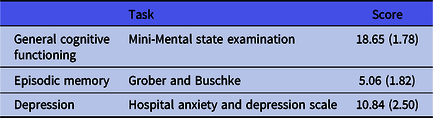
Participants were administered tests of general cognitive functioning, episodic memory, and a scale assessing depression (scores are summarised in Table 1). General cognitive functioning was evaluated with the Mini-Mental State Exam (MMSE) and the maximum score was 30 points (Folstein et al., Reference Folstein, Folstein and Mchugh1975). Episodic memory was evaluated with the French version of the task of Grober and Buschke (Reference Grober and Buschke1987). Participants had to retain 16 words, and after an immediate cued recall, they proceeded to a 20-second distraction phase during which they had to count numbers aloud. This phase was followed by 2 min of free recall; the score from this phase (out of a maximum of 16) was retained as the episodic score. Depression was assessed with the Hospital Anxiety and Depression Scale (Zigmond and Snaith, Reference Zigmond and Snaith1983). This self-report scale consists of seven items with a four-point scale from 0 (not present) to 3 (considerable).
Cognitive and psychiatric characteristics of Alzheimer’s disease participants

Note. Standard deviations are given between brackets; the maximum score on the Mini-Mental State Examination is 30 points; performance on the Grober and Buschkle task refers to correct responses/16; performances on the forward and backward spans refer to the number of correctly repeated digits; the maximum score on the Hospital Anxiety and Depression Scale is 21 points.
Hallucinations assessment
We solicited informants (e.g. caregivers, spouses, children, …) to evaluate hallucinations. We solicited informants to avoid any potential effect of anosognosia, limiting awareness of AD participants towards their own hallucinations. Informants answered the following three items: ‘Had the patient ever experienced a smell that others don’t notice?’, ‘Had the patient ever seen something that wasn’t there that other people could not see?’, ‘Had the patient ever heard any voices that other people said did not exist?’. Informants replied using a four-point response scale (1 = never, 2 = sometimes, 3 = often, 4 = always). If a hallucinatory experience was reported, the informants rated the duration (1 = few seconds, 2 = from few seconds to 1 min, 3 = from 1 to 5 min, 4 = more than 5 min). Degree of pleasantness was also evaluated (1 = very unpleasant, 2 = unpleasant, 3 = pleasant, four = very pleasant). The items and responses were provided in written format.
Results
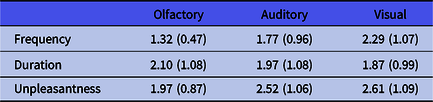
First, we assessed frequency, duration, and pleasantness of olfactory, auditory, and visual hallucinations (means are depicted in Table 2). Because our variables were scalar, we did not use any parametric comparisons. When comparisons were significant, we provided effect sizes using Cohen’s d criterion (Cohen, Reference Cohen1992) (0.20 = small, 0.50 = medium, 0.80 = large). Note that effect size was calculated for non-parametric tests following recommendations by Rosenthal and DiMatteo (Reference Rosenthal and Dimatteo2001), and Ellis (Reference Ellis2010). Second, we carried out Spearman’s correlations between the frequency of hallucinations and performances on evaluations of episodic memory and scores on a depression scale. For all tests, the level of significance was set at p ≤ 0.05, and p values between 0.051 and 0.10 were considered as trends.
Frequency, duration, and pleasantness of olfactory, auditory, and visual hallucinations

Note. Frequency was rated from 1 (never) to 4 (always). Duration was rated from 1 (few seconds) to 4 (more than 5 min). Pleasantness was rated from 1 (very unpleasant) to 4 (very pleasant).
Occurrence of olfactory hallucinations
Friedman’s repeated measures analysis of variance showed significant differences between the frequency of olfactory, auditory, and visual hallucinations, χ2 (2, N = 31) = 17.51, p < 0.001, Cohen’s d = 2.20. Post hoc analysis with Wilcoxon signed-rank tests showed less frequency of olfactory than of auditory hallucinations (Z = −2.28, p < 0.05, Cohen’s d = 0.90), less frequency of olfactory than of visual hallucinations (Z = −3.65, p < 0.001, Cohen’s d = 1.64), and less frequency of auditory than of visual hallucinations (Z = −2.16, p < 0.05, Cohen’s d = 0.84). The mean rating of the frequency of olfactory hallucinations was significantly higher than the value ‘never’ (the one-point value, as proposed by the four-point frequency scale) (Z = −3.16, p < 0.01, Cohen’s d = 1.38), but significantly lower than the value ‘sometimes’ (the two-point value, as proposed by the four-point frequency scale) (Z = −4.78, p < 0.001, Cohen’s d = 3.34). No significant differences were observed between the mean rating of the frequency of auditory hallucinations and the value ‘sometimes’ (Z = −1.12, p > 0.1). The same can be said for the mean frequency of visual hallucinations (Z = −1.63, p > 0.1). Taken together, analyses demonstrated a significantly low level of occurrence of olfactory hallucinations compared with the other two sensory modalities, more specifically, the occurrence of olfactory hallucinations that was rated between ‘never’ and ‘sometimes’.
Duration of olfactory hallucinations
Friedman’s repeated measures analysis of variance showed no significant differences between the duration of olfactory, auditory, and visual hallucinations, χ2 (2, N = 31) = 2.09, p > 0.1. No significant differences were observed between the mean rating of the duration of olfactory hallucinations and the value ‘from a few seconds to 1 min’ (the two-point value, as proposed by the four-point duration scale) (Z = −0.67, p > 0.1). The same can be said concerning the duration of auditory hallucinations (Z = −0.06, p > 0.1) and visual hallucinations (Z = −0.66, p > 0.1). Taken together, analyses demonstrated a relatively short duration of olfactory hallucinations, a duration that was similar to that of auditory and visual hallucinations.
Degree of pleasantness of olfactory hallucinations
Friedman’s repeated measures analysis of variance showed significant differences between pleasantness of olfactory, auditory, and visual hallucinations, χ2 (2, N = 31) = 8.75, p < 0.05, Cohen’s d = 1.25. Post hoc analysis with Wilcoxon signed-rank tests showed significantly less pleasantness of olfactory than of auditory hallucinations (Z = −2.09, p < 0.05, Cohen’s d = 0.81), less pleasantness of olfactory than of visual hallucinations (Z = −2.57, p < 0.05, Cohen’s d = 1.04), and similar (non-significant) degrees of pleasantness of auditory and visual hallucinations (Z = −0.41, p > 0.1). No significant differences were observed between the mean rating of pleasantness of olfactory hallucinations and the value ‘unpleasant’ (the two-point value, as proposed by the four-point pleasantness scale) (Z = −0.18, p > 0.1). The mean rating of pleasantness of auditory hallucinations was significantly higher than the value ‘unpleasant’ (Z = −2.60, p < 0.01, Cohen’s d = 1.05) but lower than the value ‘pleasant’ (the three-point value, as proposed by the four-point pleasantness scale) (Z = −2.38, p < 0.05, Cohen’s d = 0.94). The mean rating of pleasantness of visual hallucinations was also significantly higher than the value ‘unpleasant’ (Z = −2.89, p < 0.01, Cohen’s d = 0.77) but lower than the value ‘pleasant’ (Z = −1.95, p = 0.051, Cohen’s d = 0.74). Taken together, analyses demonstrated a significantly lower degree of pleasantness of olfactory hallucinations compared with the other two sensory modalities.
Correlations between olfactory hallucinations and depression
As depicted in Table 3, olfactory hallucinations were significantly correlated with depression but not with general cognitive functioning nor with episodic memory decline.
Correlations between hallucinations, general cognitive functioning, episodic memory, and depression

Discussion
This paper investigated the characteristics of olfactory hallucinations in AD. The results demonstrated that olfactory hallucinations are relatively rare in AD patients, compared with auditory or visual hallucinations. The results also showed that olfactory hallucinations last from a few seconds to 1 min, a duration that was similar to that of auditory and visual hallucinations. Also, a significantly lower level of pleasantness of olfactory hallucinations compared with auditory or visual hallucinations was observed.
Concerning the occurrence of olfactory hallucinations, our results demonstrated a low occurrence of these hallucinations relative to auditory hallucinations, and low occurrence of auditory hallucinations relative to visual hallucinations. These findings provide empirical support to the notion that hallucinations in AD are mainly visual (Wilson et al., Reference Wilson, Gilley, Bennett, Beckett and Evans2000; Bassiony and Lyketsos, Reference Bassiony and Lyketsos2003; Wilson et al., Reference Wilson, Krueger, Kamenetsky, Tang, Gilley, Bennett and Evans2005; El Haj et al., Reference El Haj, Roche, Jardri, Kapogiannis, Gallouj and Antoine2017). These findings also mirror the study by Scarmeas et al. (Reference Scarmeas, Brandt, Albert, Hadjigeorgiou, Papadimitriou, Dubois, Sarazin, Devanand, Honig, Marder, Bell, Wegesin, Blacker and Stern2005), which found less olfactory hallucinations than auditory or visual hallucinations. However, even though olfactory hallucinations occur less frequently than auditory or visual hallucinations in AD, the three categories of hallucinations seem to share a similar duration, that is, from a few seconds to 1 min. These findings are of interest as they suggest that the experience of hallucinations spans a relatively short time interval. Finally, the findings from the present study also demonstrated that olfactory hallucinations in AD are typically unpleasant.
Another main finding of our study was the significant correlations between the three modalities of hallucinations and depression. However, and unlike auditory or visual hallucinations, olfactory hallucinations were not significantly correlated with general cognitive functioning or episodic memory. These findings are of interest as they suggest that, unlike auditory or visual hallucinations, olfactory hallucinations in AD are more typically associated with psychiatric symptoms (depression) than with cognitive functioning. Individuals suffering severe depression can experience hallucinations (Birchwood and Chadwick, Reference Birchwood and Chadwick1997; Chaudhury, Reference Chaudhury2010). Also, numerous studies suggest a relationship between olfaction and depression (Marine and Boriana, Reference Marine and Boriana2014). For instance, depression is more prevalent among individuals with olfactory loss than in those with no olfactory compromise (Deems et al., Reference Deems, Doty, Settle, Moore-Gillon, Shaman, Mester, Kimmelman, Brightman and Snow1991; Seo et al., Reference Seo, Jeon, Hummel and Min2009). A study reported depressive symptoms in 60% of individuals with olfactory loss in the months after the beginning of olfactory decline (Faulcon et al., Reference Faulcon, Portier, Biacabe and Bonfils1999). As for AD, olfactory compromise has been observed in patients who were genotyped for the presence of the ApoE allele, a major genetic risk of the disease (Handley et al., Reference Handley, Morrison, Miles and Bayer2006). Another study found that among patients who have a genetic risk of developing AD, the risk was five times higher for those who are anosmic (i.e. those with no sense of smell) (Graves et al., Reference Graves, Bowen, Rajaram, Mccormick, Mccurry, Schellenberg and Larson1999). Interestingly, brain areas including the olfactory bulb, amygdala, and hippocampus, which are involved in olfaction processing, are altered in depression and AD (Marine and Boriana, Reference Marine and Boriana2014). For instance, the olfactory bulb volume has been found to decrease in depression (Negoias et al., Reference Negoias, Croy, Gerber, Puschmann, Petrowski, Joraschky and Hummel2010) and AD (Thomann et al., Reference Thomann, Dos Santos, Toro, Schonknecht, Essig and Schroder2009). Also, the volume of amygdala, a brain area that is involved in odour intensity perception, and odour identification and memorisation (Pouliot and Jones-Gotman, Reference Pouliot and Jones-Gotman2008) have found to decrease in depression (Hamilton et al., Reference Hamilton, Siemer and Gotlib2008;, Rubinow et al., Reference Rubinow, Mahajan, May, Overholser, Jurjus, Dieter, Herbst, Steffens, Miguel-Hidalgo, Rajkowska and Stockmeier2016) and AD (Basso et al., Reference Basso, Yang, Warren, Macavoy, Varma, Bronen and Van Dyck2006; Poulin et al., Reference Poulin, Dautoff, Morris, Barrett and Dickerson2011). The same can be said for the hippocampus, a brain area activated during odour memorisation tasks (Kesner et al., Reference Kesner, Gilbert and Barua2002) that is compromised in both depression (Campbell et al., Reference Campbell, Marriott, Nahmias and Macqueen2004) and AD (McKhann et al., Reference Mckhann, Knopman, Chertkow, Hyman, JackKawas, JrKawas, Klunk, Koroshetz, Manly, Mayeux, Mohs, Morris, Rossor, Scheltens, Carrillo, Thies, Weintraub and Phelps2011). Therefore, the relationship between olfactory hallucinations and depression, as observed in our study, can be supported by common brain regions. Another explanation may be that depression, as characterised by the general loss of joy and pleasure, may result in the unpleasant experience of imagined odours. The reverse may also be true, that is, the negative experience as associated with olfactory hallucinations may result in a state of helplessness and depression.
Our findings contribute to the understanding of the characteristics of hallucinations in AD. These characteristics can be summarised with the ALZheimer’s and Hallucinations (ALZHA) model (El Haj et al., Reference El Haj, Roche, Jardri, Kapogiannis, Gallouj and Antoine2017), according to which hallucinations can be attributed to neurological, genetic, iatrogenic, and cognitive factors. More specifically, the ALZHA model proposes that hallucinations in AD mainly occur in patients with trait markers (e.g. neurological, genetic, or cognitive deficits), who experience, at a given moment, one or more state markers (e.g. psychological distress and/or iatrogenic factors) that will trigger hallucinations. While this model proposes a comprehensive view of hallucinations, it offers few insights into the role of specific sensory (e.g. olfactory or visual) modalities of hallucinations. The present paper contributes to the ALZHA model by demonstrating that hallucinations may not be solely investigated regarding their neurological/genetic/cognitive characteristics but also regarding their sensory modalities. In our view, these sensory modalities should be considered by clinicians and researchers when assessing hallucinations. This issue is important because, to the best of our knowledge, there is a lack of a validated assessment tool for hallucinations in AD yet there is an urgent need for such a tool. Clinicians and researchers will need to develop this tool taking into account the characteristics of hallucinations in AD as highlighted by the available research (e.g. the sensory modalities of hallucinations as investigated by our paper).
Because AD is characterised by olfactory compromise (Marine and Boriana, Reference Marine and Boriana2014), it would be of interest to examine a potential relationship between olfactory hallucinations and many olfactory factors, such as compromise of odour threshold, odour identification, or odour recognition. It would also be of interest to evaluate the potential implication of a history of nasal pathology or smoking history on the occurrence of olfactory hallucinations in AD.
Unlike olfactory hallucinations, auditory and visual hallucinations were rated between the values of ‘pleasant’ and ‘unpleasant’. To the best of our knowledge, no published study has investigated the pleasantness of auditory and visual hallucinations in AD. These findings are of clinical relevance as they suggest that some auditory and visual hallucinations may be associated with a positive subjective experience in AD patients (e.g. hearing the pleasant voice of/seeing a deceased beloved one).
One limitation of the present study is that each sensory modality of hallucination was evaluated with only one item. Another limitation is the relatively small sample size.
Regardless of this limitation, this study has the merit of highlighting, for the first time in the literature, a number of aspects including the relatively short duration but unpleasantness of olfactory hallucinations in AD, and the relationship between olfactory hallucinations and depression. The evaluation of hallucinations in AD is important because these experiences may reduce patients’ well-being, increase the burden of caregivers, and contribute to early institutionalisation.
Acknowledgements
The authors would like to thank the patients and their informants for their participation in the study.
Author contributions
MEH designed the study and supervised the data collection. MEH and FL analysed and interpreted data and wrote the article.
Financial support
Dr. El Haj was supported by the LABEX (excellence laboratory, programme investment for the future) Development of Innovative Strategies for a Transdisciplinary Approach to Alzheimer’s Disease (DISTALZ) and the EU Interreg CASCADE 2 Seas Programme 2014–2020 (co-funded by the European Regional Development Fund).
Conflicts of interest
None.
Ethical standards
This study complied with the ethical standards of the relevant national and institutional committees on human experimentation and with the Helsinki Declaration of 1975, as revised in 2008.