INTRODUCTION
Reduced cognitive function has been reported in candidates for coronary artery bypass graft surgery (CABGS) in previous studies (Ernest, Murphy et al., 2006; Millar et al., 2001; K.P. Rankin et al., 2003; Rosengart et al., 2005; Vingerhoets et al., 1997). Because patients with cognitive impairment pre-bypass seem to be at a higher risk for developing post-operative cognitive impairment (Ho et al., 2004; Millar et al., 2001), it is important to identify factors that contribute to this reduced cognitive function. However, only a few studies have examined predictors of pre-bypass cognitive function (Tsushima et al., 2005; Vingerhoets et al., 1997). Vingerhoets and colleagues (1997) explored medical and sociodemographic factors in valve and CABGS patients, whereas Tsushima and colleagues (2005) examined sociodemographic and emotional characteristics in CABGS patients. To our knowledge, no study has investigated all three categories of potential predictors of reduced cognitive function in CABGS candidates, particularly the relative strengths of significant predictors.
The cardiovascular disease process itself has been implicated as a causative factor in bypass candidates' reduced cognitive performances (Selnes et al., 2003; Vingerhoets et al., 1997). In recent reviews, reduced cognitive function has been found to be associated with chronic hypertension, reduced ejection fraction, impaired left ventricular function, atherosclerosis, cardiac arrhythmia, acute myocardial infarction and cardiac arrest (Byrne, 1994; Elias et al., 2001; Moser et al., 1999; Waldstein & Katzel, 2001; Waldstein et al., 2001; Zuccala et al., 1997). Nevertheless, only one study has examined medical predictors of cognitive function in patients listed for cardiac surgery, albeit with the study sample containing both candidates for CABGS and for valve surgery (Vingerhoets et al., 1997).
Additionally, it is well established that performances on cognitive tests are influenced by sociodemographic characteristics, with published test norms being adjusted for age, education, and in some cases gender (Lezak et al., 2004; Mitrushina et al., 1999; Spreen & Strauss, 1998). Studies by Vingerhoets et al. (1997) and Tsushima et al. (2005) implicate age and education as significant predictors of cognitive function in candidates for cardiac surgery. Moreover, language and cultural background have been shown to influence cognitive test scores (Carstairs et al., 2006; Ferraro, 2002; Guenole et al., 2003), as has socioeconomic status defined by education and occupation (Kaplan et al., 2001; Turrell et al., 2002). It is particularly important to understand the sociodemographic factors that are associated with pre-bypass cognitive function, so that patients at risk of post-bypass cognitive compromise can be identified.
Finally, it has been suggested that cognitive impairment prior to bypass might be explained in terms of patients' emotional distress (Keith et al., 2002). Higher levels of depression have been associated with reduced cognitive function in a sample of elderly participants drawn from the general population (Biringer et al., 2005). In comparison with healthy controls, a higher incidence of anxiety and depression has been observed in patients before cardiac surgery (Andrew et al., 2000). Yet, to our knowledge, only one study that investigated predictors of cognitive function in bypass candidates included indices of anxiety and depression (Tsushima et al., 2005). Furthermore, associations between bypass candidates' cognitive function and emotional factors such as anger, fatigue, or confusion has not been examined, despite their prevalence in this group of patients (Fitzsimons et al., 2000; Jonsdottir & Baldursdottir, 1998; Screeche-Powell & Owen, 2003).
The two previous investigations of predictors of pre-surgical cognitive function have important methodological limitations. Both used regression analyses to predict variance in individual cognitive test performances (Tsushima et al., 2005; Vingerhoets et al., 1997). Because these tests are not independent of each other, overlap in variance was not accounted for, making findings difficult to interpret. The study by Vingerhoets et al. (1997) is somewhat compromised by the lack of corrections for the multiple relationships tested and a low participant to predictor ratio (approximately 6:1) compared with that recommended for stepwise regression analyses (at least 50:1) (Hair et al., 2006). Finally, neither of the studies examined all three categories of potential predictors (i.e., medical; sociodemographic; and emotional) either separately or in combination.
This study was designed to overcome some of the limitations of previous studies by using statistical methods that allowed for the analysis of cognitive function as a single construct, with adequate screening processes for selecting potential predictors. Thus, Type I error caused by multiple comparisons and overlapping variances was minimized. In addition, a larger sample consisting exclusively of candidates for CABGS was used, thereby increasing the participant to predictor ratio. Furthermore, three sets of potential predictor variables (pre-operative medical, sociodemographic, and emotional) were examined in separate models and in one combined analysis. The aim of this study was to examine a wide range of potential predictors of pre-bypass cognitive function using structural equation modeling.
METHOD
Participants
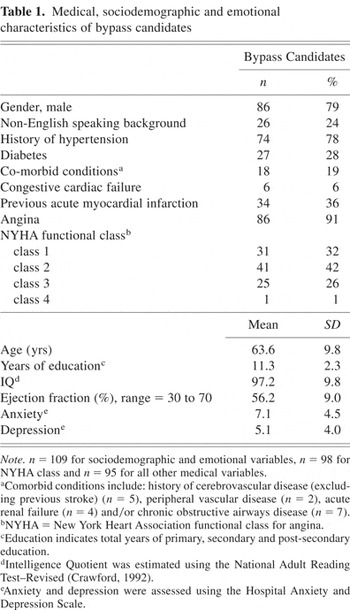
Participants were candidates for bypass surgery admitted to The Royal Melbourne Hospital, Australia, between July 2001 and April 2004, and who were recruited for a randomized trial comparing off-pump and on-pump bypass surgery, described elsewhere (Ernest, Worcester et al., 2006). Patient characteristics are shown in Table 1. Patients eligible for the randomized trial were those who were listed to undergo first-time elective CABGS by participating surgeons, without concurrent valve or other cardiac surgical procedures, had no prior history of stroke or carotid artery stenosis greater than 95%, and were considered suitable for off-pump or on-pump techniques. Only patients whose English competency was considered adequate to complete the neuropsychological test battery were included. During the recruitment period, a total of 445 patients were listed for CABGS by all surgeons at the designated hospital. Of these, 117 patients of participating surgeons were identified and recruited using the inclusion criteria defined earlier. A further eight were excluded for the cognitive component of the trial (n = 109) because of the presence of a neurological or psychiatric condition with cognitive impairment or patient refusal to undertake cognitive testing. Patients recruited for the study (N = 117) did not differ from non-recruited patients (N = 336) in any of the sociodemographic, medical or emotional characteristics listed in Table 1, with the exception of age. The mean age of study participants was slightly lower than non-recruited patients (mean age = 66.5, SD = 9.36, p < .01). Institutional ethics committee approval was obtained for this study and written consent was obtained from all participants. This research was completed in accordance with the guidelines of the Helsinki Declaration.
Medical, sociodemographic and emotional characteristics of bypass candidates

Measures
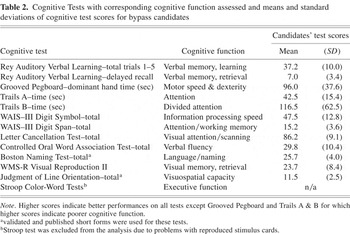
Medical, sociodemographic, and emotional information was collected for all bypass candidates. Cognitive function was assessed using 11 standardized cognitive tests covering a variety of domains. Table 2 shows the cognitive tests used, the corresponding cognitive domains that the tests were designed to measure, and the candidates' mean test scores.
Cognitive Tests with corresponding cognitive function assessed and means and standard deviations of cognitive test scores for bypass candidates

Test selection was based on use in previous cardiac studies, availability of published norms, adequacy of psychometric properties (i.e., reliability and validity), brevity and ease of administration (Blumenthal et al., 1995; Murkin et al., 1995). Psychometrically comparable short forms were used for the Boston Naming Test and the Judgment of Line Orientation Test. Standard recommendations were followed for test administration and scoring (Lezak et al., 2004; Spreen & Strauss, 1998).
Tests took approximately 60 minutes to administer. To minimize fatigue effects on cognitive performances, two predetermined orders of test administration were followed for alternate participants. Assessments were conducted by doctoral level neuropsychology interns supervised by a qualified neuropsychologist. The cognitive testing of patients was undertaken at a mean of 23.3 (SD = 28.6, median = 13) days prior to bypass surgery. As indicated by the standard deviation, this time interval varied widely from 1 to 140 days before surgery, mainly because of unexpected delays or postponement of surgery. Testing was not performed on the day of surgery.
Pre-operative medical history was obtained from patient records. Sociodemographic characteristics including age, education, occupation (manual vs. non-manual), gender, and non-English speaking background (defined as non-English speaking country of birth) were also recorded. Pre-surgical anxiety and depression were measured using the 14-item Hospital Anxiety and Depression Scale (HADS) (Zigmond & Snaith, 1983), which has been widely used and validated in studies of cardiac patients (Bambauer et al., 2005; Strik et al., 2001). Emotional variables, such as anger, fatigue, and confusion, were measured using the Profile of Mood States (POMS) (McNair et al., 1992), which consists of 65 adjectives rated on a five-point intensity scale. Six independent mood states have been identified and defined, measuring tension/anxiety, depression/dejection, anger/hostility, vigor/activity, fatigue/inertia, and confusion/bewilderment. The POMS has been used in previous studies of cardiac patients (Doering et al., 2004; S. H. Rankin, 2002; Yu et al., 2001) and has adequate psychometric properties (Lezak et al., 2004; Spreen & Strauss, 1998). The HADS and POMS were administered by mail and were completed at a mean of 25.7 (SD = 27.3, median = 16) days prior to surgery. As such the emotional assessment was undertaken approximately two to three days before the cognitive assessment.
Data Analysis
The Stroop test was excluded from the analyses because of problems in the spectral resolution of the reproduced stimulus cards, leaving 10 cognitive tests. Because the tests generated a large number of variables, 12 key measures were selected for analysis. Selection criteria were (a) relative loadings of test variables on a principal components analysis; (b) use of test summary scores when they were found to correlate highly with subtest scores; (c) use in previous studies; and (d) expert opinion based on theoretical grounds. The 12 variables selected from each of the 10 remaining tests are listed in Table 2.
A global measure of cognitive functioning was derived from the 12 cognitive test variables selected using a confirmatory factor analysis (CFA) to ensure that all of the tests were tapping into the same underlying construct. For nine of the tests, higher scores indicated better cognitive performance whereas higher scores on three tests (Trails A and B and Grooved Pegboard) indicated reduced cognitive performance. Hence, prior to the CFA, the three latter measures were reverse scored to maintain consistency of interpretation. The total (standardized) cognitive ability score is the sum of the weighted contributions of each of the 12 cognitive test scores. The weights are determined by the loadings of the test scores on the overall composite measure.
Three sets of predictors were included in the analyses: medical, sociodemographic, and emotional characteristics. Hence, three sets of analyses were initially carried out; one for each set of potential predictors. Each of these analyses contained two steps, an initial screening process followed by structural equation modeling. The screening process aimed to optimize the number of potential predictors to be included in the modeling process in order to reach a satisfactory compromise between making Type I and Type II errors. Two screening strategies were adopted. First, dichotomous variables were excluded from further consideration if there were fewer than 10 cases endorsed in any of the (two) response categories. Second, continuous and dichotomous variables were excluded if they had no correlation coefficients (with any of the 12 cognitive variables) that produced p-values of less than .100. (Subjecting dichotomous variables to correlational analyses in this context is equivalent to subjecting them to a t-test.) These strategies were designed to remove variables that could produce unreliable results or would be unlikely to be significant predictors of overall cognitive functioning (thereby reducing Type I errors). The adoption of a p-value of .100 (rather than .050) was designed to allow for the possibility that some variables might have a significant (p < .050) relationship with the overall cognitive measure, despite having a non-significant (.100 > p > .050) correlation with any of the 12 tests.
Finally, a combined analysis was undertaken, which included variables from the three sets that significantly predicted cognitive function in the individual modeling analyses to determine the relative contributions of various predictors across sets.
Confirmatory factor analysis and structural equation modeling were carried out using the AMOS (Arbuckle, 2003) statistical package. The Statistical Package for the Social Sciences (SPSS for Windows, Rel. 13.0, 2004) was utilized for the screening analyses.
RESULTS
Construction of a Composite Measure of Cognitive Ability
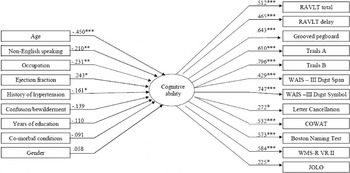
Cognitive test scores from the 12 selected cognitive test variables for bypass candidates are shown in Table 2. Standardized factor loading for the 12 cognitive variables on the underlying cognitive ability construct are presented in Figure 1. All of the loadings for the measured tests were significant. This result confirms that all 12 cognitive tests tap into the same underlying cognitive construct.

Structural equation model showing β values for predictors of cognitive ability in candidates for bypass surgery (n = 109).
Note. Non-English speaking = patients from a non-English speaking country of birth; Occupation = manual versus non-manual. Confusion/bewilderment measured using the Profile of Mood States; Comorbid condition indicates the presence of one of the following conditions: history of cerebrovascular disease (excluding previous stroke), peripheral vascular disease, acute renal failure, chronic obstructive airways disease or carotid stenosis. RAVLT = Rey Auditory Verbal Learning Test; WAIS–III–Wechsler Adult Intelligence Scale–III; COWAT–Controlled Oral Word Association Test; WMS–R VR II–Wechsler Memory Scale–Revised–Visual Reproduction delayed recall; JOLO–Judgment of Line Orientation Test.
Medical variables
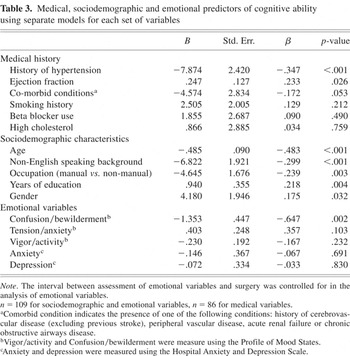
There were 10 medical variables under consideration: history of cerebrovascular disease (including previous transient ischemic attacks and carotid artery stenosis between 75% and 95%), peripheral vascular disease, history of hypertension, smoking, high cholesterol, diabetes, acute renal failure, chronic obstructive airways disease, as well as pre-operative ejection fraction and beta blocker use. All variables were dichotomous except for ejection fraction, which was measured as a continuous variable. Of the dichotomous variables, the initial screening process determined that five variables had fewer than 10 cases in at least one response category (history of cerebrovascular disease, peripheral vascular disease, acute renal failure, and chronic obstructive airways disease). Because all these variables were reporting a co-morbid condition, a new dichotomous variable termed “co-morbid conditions” was created. Patients who had a history of any of these conditions were classified as having a co-morbid condition. This screening strategy reduced the number of potential medical predictors to seven. Furthermore, history of diabetes was eliminated from further analyses because it was not sufficiently correlated with any of the 12 cognitive tests. The lowest p value for a relationship between diabetes and any one of the cognitive tests was .328, substantially greater than the minimum (.10) adopted for screening. Table 3 shows the results of regressing the overall cognitive function measure on the remaining six medical variables.
Medical, sociodemographic and emotional predictors of cognitive ability using separate models for each set of variables

Two of the six medical variables significantly predicted overall pre-bypass cognitive function. Reduced cognitive function was associated with the presence of a history of hypertension and low ejection fraction. In addition, a trend was observed on the combined comorbid conditions variable, with the presence of any one of the five comorbid conditions being associated with reduced cognitive function.
Sociodemographic variables
The sociodemographic set contained five variables: age, years of education, non-English speaking background, occupation, and gender. All five variables passed the initial screening. The dichotomous variables all had more than 10 cases in each response category and all five variables correlated significantly with at least one of the cognitive tests. The results of the subsequent structural equation modeling are presented in Table 3.
All five socio-demographic variables significantly predicted overall pre-bypass cognitive function. Reduced cognitive function was associated with older age, fewer years of education, non-English speaking background, manual occupation, and male gender.
Emotional variables
Eight emotional variables were included in the study as potential predictors of cognitive function: anxiety and depression scales from the HADS, and the tension/anxiety, depression/dejection, anger/hostility, vigor/activity, fatigue/inertia, and confusion/bewilderment scales from the POMS. Because all of these measures were continuous in nature, none was removed as a result of having too few cases in a response category. However, three measures (depression/dejection, anger/hostility, and fatigue/inertia) were removed because they failed to correlate sufficiently with any of the cognitive tests. Hence, the remaining five measures were included in subsequent structural equation modeling as potential predictors of cognitive function (Table 3). Because of the variability in the interval between assessment of emotional factors and surgery, this variable was controlled for in this analysis. There was no correlation between testing interval (in days) and anxiety (p > .10) or depression (p > .10).
Only one emotional variable significantly predicted overall pre-bypass cognitive function, with higher levels of confusion/bewilderment on the POMS being associated with reduced cognitive function.
Combined Analysis
Variables from the three sets that significantly predicted cognitive function (including close trends defined as p = .05) were selected as potential predictors for the combined analysis. These variables consisted of three medical factors (history of hypertension, pre-operative ejection fraction, and comorbid condition), all five sociodemographic characteristics (age, years of education, non-English speaking background, occupation, and gender) and one emotional variable (confusion/bewilderment). Figure 1 shows the results of regressing the overall cognitive function measure on the nine significant variables selected from the three sets of potential predictors.
Sociodemographic characteristics were the strongest predictors of pre-bypass cognitive function, with older age, non-English speaking background and manual occupations significantly predicting reduced cognitive test performance. These were closely followed by medical factors, namely history of hypertension and low ejection fraction, which were also significant predictors. Confusion/bewilderment, the only emotional variable included in the combined analysis, did not significantly predict cognitive function when included with the other predictors.
DISCUSSION
As expected, sociodemographic characteristics, particularly older age, non-English speaking background, and manual occupation were the strongest predictors of pre-bypass cognition. However, of note, this study also found that the reduced cognitive function in bypass candidates reported previously (Ernest, Murphy et al., 2006) is associated with pre-operative medical variables, namely a history of hypertension and low ejection fraction. Emotional variables, including anxiety and depression, were not associated with cognitive function prior to bypass surgery.
Similar to our findings, hypertension and reduced ejection fraction were associated with cognitive impairment in a sample of cardiac rehabilitation patients (Moser et al., 1999). Recent reviews have also reported an association between reduced cognitive function in cardiac patients and chronic hypertension (Elias et al., 2001; Waldstein & Katzel, 2001; Waldstein et al., 2001), as well as low ejection fraction or reduced cardiac output (Zuccala et al., 1997). Disruptions to the functioning of the heart, such as long-term changes in blood pressure or reduced cardiac output, can result in compromised cerebral blood supply, and consequently, compromised cerebrovascular function (Byrne, 1994; Waldstein et al., 2001). However, the pre-operative ejection fraction or cardiac output of patients in this study (ranged from 30% to 70%) was not extremely low, although it is possible that these patients may have experienced episodes of extremely low cardiac output in the past. Therefore, reduced cognitive function in patients with low ejection fraction could be because of indirect causes, such as risk of stroke from embolization of ventricular mural thrombus or associated atrial fibrillation, which were not examined in this study. Additionally, although fatigue was controlled for by alternation of order of test administration, fatigue could have been a mediating factor in the association between ejection fraction and cognitive function. Finally, Vingerhoets and colleagues (1997) have also highlighted other medical predictors of reduced cognitive performances in candidates for cardiac surgery. Associations between pre-operative medical factors and cognitive performances are not entirely surprising, as cerebrovascular complications have been shown to accompany cardiovascular disease, with both showing similar pathophysiological disease processes (Byrne, 1994; Moser et al., 1999; Waldstein et al., 2001).
In this study, a history of diabetes, smoking status, beta blocker use, and high cholesterol were not associated with pre-bypass cognition. This lack of association between cognition and smoking history, beta blocker use, and high cholesterol is consistent with previous studies that have reported somewhat contradictory findings (Elias et al., 2001; Jonas et al., 2001; Muldoon et al., 2001; Waldstein et al., 2001). In terms of the history of diabetes, cognitive dysfunction is common in certain subgroups of diabetes, namely Type I or juvenile onset diabetes, but is less often observed in patients with Type II diabetes (Ryan, 2001), which is more common among older adults with cardiovascular disease. Further, there is little evidence of a relationship between diabetes and cognitive dysfunction in candidates for bypass. Specifically, Vingerhoets and colleagues (1997), whose sample most closely resembles ours, did not find an association between pre-bypass cognition and diabetes.
Reduced cognitive function was associated with older age, less education, non-English speaking background, manual occupation and male gender. Associations between cognitive function and age, education and gender have been evident in previous studies (Tsushima et al., 2005; Vingerhoets et al., 1997) and are consistent with cognitive test manuals (Lezak et al., 2004; Mitrushina et al., 1999; Spreen & Strauss, 1998). It is not surprising that age was one of the strongest predictors in the combined model, because most cognitive tests provide age-adjusted normative data or age-scaled scores (Lezak et al., 2004; Mitrushina et al., 1999; Spreen & Strauss, 1998). The association of reduced cognitive function in those working in manual occupations is probably a reflection of educational and socioeconomic factors (Kaplan et al., 2001; Turrell et al., 2002). It is of note that normative data for most cognitive tests are derived from English-speaking populations, which limits their use in non-English speaking populations, resulting in difficulties in interpreting test scores in cross-cultural applications (Carstairs et al., 2006; Ferraro, 2002; Guenole et al., 2003). Although patients were included in our study only if they had adequate competency in English to be able to complete the neuropsychological test battery, it seems that those of non-English speaking background showed poorer cognitive test scores. The current findings underscore the need to design culturally-relevant and demographic-specific cognitive tests or to re-standardize test norms for existing tests to allow for cross-demographic comparisons. Additionally, cognitive findings in cardiac studies that do not use a demographically matched control group or appropriate test norms may lead to misinterpretation of the causative factors of reduced cognitive performances in cardiac patients. Control participants should be matched not only by age, gender and education but also by occupation, language and cultural backgrounds.
With regard to emotional predictors, our finding that anxiety and depression were not associated with pre-bypass cognitive test scores is consistent with that of the only other study which focused on emotional factors associated with cognitive function in bypass candidates (Tsushima et al., 2005). It is of note that even when controlling for the variations in testing interval in this study, these emotional variables were not significant predictors. Although emotional factors, such as anxiety and depression, have been associated with poorer cognitive function in the general population (Biringer et al., 2005), this association has not been found with regard to pre-surgical cognitive function in cardiac surgery (Andrew et al., 2000; Rosengart et al., 2005; Tsushima et al., 2005; Vingerhoets et al., 1995). Andrew and colleagues (2000) reported that, although pre-operative mood predicted post-cardiac surgery mood and cognition in cardiac surgical patients (N = 147), this relationship was not observed between pre-operative depression and anxiety, and pre-operative cognitive test scores. Similarly, Vingerhoets and colleagues (1995) reported no associations between pre-operative depression and anxiety with pre-operative cognitive test scores in a sample of cardiac surgery patients (N = 130). Another recent study examining candidates for cardiac surgery has similarly concluded that anxiety and depression have almost no effect on cognitive performances before cardiac surgery (Rosengart et al., 2005). Although Vingerhoets and colleagues (1997) did not examine emotional factors as potential predictors, bypass candidates showed reduced cognitive function when compared with healthy controls, even after controlling for anxiety and depression. Finally, that cardiac patients not awaiting surgery exhibit cognitive impairment similar to bypass candidates (Selnes et al., 2003) also suggests that cognitive difficulties observed prior to cardiac surgery cannot be attributed to pre-surgical emotional distress. Our findings add to the growing body of evidence suggesting that reduced cognitive performances in bypass candidates cannot be explained by pre-surgical emotional factors. Therefore, pre-bypass cognitive dysfunction should not be dismissed as being merely an artifact of pre-surgical emotional distress (Tsushima et al., 2005).
One of the strengths of this study was the inclusion of a wide range of emotional factors, in addition to anxiety and depression. Of these variables, the confusion/bewilderment scale of the POMS was a significant predictor of cognitive function in the individual analysis. The POMS test manual states that this scale might be indicative of cognitive efficiency instead of, or in conjunction with, a mood state (McNair et al., 1992). Therefore, this scale would be expected to have some association with the underlying construct of cognitive function that is measured by standardized cognitive tests. Nonetheless, this variable was eliminated as a possible contributor to pre-bypass cognitive function in relation to other sociodemographic and medical predictors. Therefore, our findings, along with those of previous studies, indicate that pre-surgical emotional status in candidates for cardiac surgical procedures, including coronary bypass surgery, may be less important than sociodemographic and medical predictors in determining cognitive function in this population.
The main strength of this study is the use of structural equation modeling, which allows for predictors to be identified for overall cognitive function, a measure derived from the wide range of cognitive tests used in this study. Additionally, the combined analysis that examined the relative strengths of significant predictors from the different sets allowed for comparison across the various sets. Furthermore, the present study had a relatively large sample compared with previous studies of predictors of pre-bypass cognition (Tsushima et al., 2005; Vingerhoets et al., 1997).
Nevertheless, there were some limitations that should be acknowledged. The need to combine comorbid conditions into a single medical variable makes it difficult to differentiate the relative contributions of these comorbid conditions to cognitive function. The fact that measures of pre-surgical anxiety and depression were undertaken on average about two to three days before the cognitive assessment could partly explain the lack of association between cognitive test scores and anxiety and depression. Another explanation for this lack of association could be the lack of sensitivity of the instruments used, because neither the POMS nor the HADS is designed specifically for use with cardiac patients, although the latter has been used extensively in this population. That patients completed the questionnaires at home could have compromised the reliability of patients' responses: it is impossible to determine whether patients were assisted in completing these inventories. Although both the emotional and cognitive assessments were undertaken approximately two to three weeks prior to surgery, anxiety and depression were found not to be associated with cognitive function even when this interval was controlled for in the analysis of the emotional variable set. However, it would have been preferable if the emotional assessment were completed closer to the day of surgery.
In conclusion, the findings of this study highlight the importance of certain medical factors, which influence cognitive function prior to bypass, along with the usual sociodemographic characteristics. Of note, our study adds to a growing body of research suggesting that the reduced cognitive function found in bypass candidates might not be explained by pre-surgical emotional distress, such as anxiety or depression. Because pre-bypass cognition has been linked to post-bypass cognitive outcomes, the findings of this study could assist clinicians to identify patients at higher risk of adverse cognitive outcomes. Furthermore, future bypass outcome studies should include a detailed baseline investigation and a well-matched control group, taking into account all relevant demographic factors that influence cognitive function, including those commonly overlooked factors such as occupation, language, and cultural backgrounds. This study also underscores the need to control for pre-surgical medical factors in the analysis of post-bypass cognitive outcomes.
ACKNOWLEDGMENTS
Funding for this study was provided by the Percy Baxter Charitable Trust, the Eirene Lucas Foundation, and the Marian and E.H. Flack Trust. There are no financial relationships or conflicts of interest affecting this manuscript between any of the authors and the manufacturers of any commercial product and/or providers of commercial services. Nor is there any commercial support of the research reported in the manuscript submitted for publication that could be interpreted as a conflict of interest. The authors wish to acknowledge the expertise of clinical neuropsychologist Assoc. Prof. David Andrewes of The University of Melbourne. Thanks are also due to Sue Rice and Penelope Davis from The Cardiothoracic Surgical Unit of The Royal Melbourne Hospital for their assistance in collecting pre-operative medical data for this study. The information in this manuscript and the manuscript itself is new and original and is not currently under review by any other publication. It has never been published either electronically or in print.