

Introduction
The Editor's request for papers on interdisciplinary work coincided with the ongoing work of the author on the role of institutional economics in social policy, especially as compared with behavioral economics. The connection is that institutional economics, in its essence, is an interdisciplinary enterprise. The successful applications but also the suboptimal use of institutional economics in social policy analysis provides insights about interdisciplinarity. In particular, it suggests a kind of Gresham's Law of social scientific inquiry: the disciplinary orientation tends not only to obstruct the interdisciplinary, but also to cause the latter to sag back into a disciplinary posture. This tension is perhaps unavoidable, and maybe even healthy, but, following one of the dictums of institutional economics, it is worthwhile to be self-conscious (Williamson, Reference Williamson1975) about this tug of war, and where one is with respect to it at any point of social research and analysis.
These themes will be fleshed out in this essay in the following manner. First, some background on institutional economics, in particular the work of Oliver Williamson, who emphasizes the interdisciplinary nature of his work on transactions cost economics, will be provided. This will be followed by a discussion of the ‘collapse’ of interdisciplinary work back into disciplinary paradigms and the reasons for this. Next, institutional economics will be compared with other purportedly interdisciplinary approaches to health policy analysis: first, interdisciplinary studies of the politics of health regarding macro health policy and also rationing of health careFootnote 1; and second, behavioral economics. There follows a discussion of the benefits of strengthening the use of institutional economics in health policy analysis, especially in terms of retaining interdisciplinarity, with special reference to the notion of trust. The conclusion suggests ways forward.
Background on institutional economics
Oliver Williamson, Nobel Laureate in Economics in 2009, is widely considered the father of transaction cost economics. However, in discussing the latter, he not only emphasized its grounding in a previous tradition of institutional economics, but also recited the ‘Carnegie Triple’, which turns out to be very relevant to the concern with interdiscplinarity. The Carnegie Triple, in Williamson's words, exhorts the following: ‘be disciplined, be interdisciplinary, have an active mind’ (Williamson, Reference Williamson2007). Following this dictum, Williamson explored the deficiencies of neoclassical economics in seeking to explain economic behavior, especially of organizations. Williamson found the stance of neoclassical economics that viewed the ‘firm as a production function’ unsatisfying in the face of organizational complexity. He realized that an interdisciplinary approach is needed to uncover the ‘inter-temporal realities of complex organizations’ (Williamson, Reference Williamson2007).
Drawing on the tradition of the Carnegie School, and scholars such as Herbert Simon, Franco Modigliani, Merton Miller, Richard Cyert, James March, John Muth, Allan Meltzer and William Cooper, Williamson sought to meld economics with organizational theory. The issue was explaining how the need for economic actors to interact, in particular to contract with each other, calls into being different organizational forms. This focus on contracting, among others, led to the development of the concept of transactions costs as the determinant of organizational form. In his Markets and Hierarchies (Williamson, Reference Williamson1975), Williamson developed an ‘organizational failures framework’, on the basis of the insight that all organizations seek to minimize transactions costs. He then proceeded to illustrate how employment relations and internal organization supplant market interactions, when the latter are subject to unduly high transactions costs, followed by the development of even more complex hierarchies and networks.
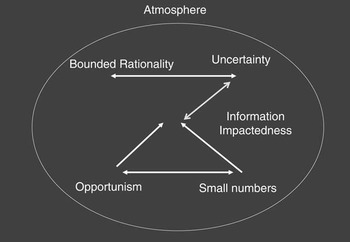
It is instructive to present the organizational failures framework in the context of a discussion of interdisciplinarity. The framework is laid out in Figure 1.
Organizations failures framework, Williamson (Reference Williamson1975).

The diagram suggests that contracting is made difficult by the combination of human characteristics and environmental conditions. Therefore, for example, the well-known concept of bounded rationality, previously enunciated by Herbert Simon (Simon, Reference Simon1951), and usually not accounted for in neoclassical optimizing models, is brought to bear when there are conditions of significant uncertainty. When bounded rationality and uncertainty are combined, contracting, especially of a long-term nature, becomes difficult. Another couple is small numbers and opportunism. Small numbers relates to situations of existing long-term commitments between parties, such as when one party relies on the other for access to specialized, specific assets. If the owner of the specific asset tends to behave opportunistically, for instance, by seeking to raise the price of access, obvious transactional difficulties are posed. In the middle of the diagram, we see the ‘derived’ condition of information blockages, particularly important in the data-driven economy and social policy today, which arises when actors with specialized information can exploit information asymmetries.
The micro-analytic inside of the framework provides the tool for analyzing the ability of different organizational forms to minimize transaction costs. Numerous analysts, including those in health policy, have sought to apply this transaction cost economics approach to explain the structure and regulation of insurance arrangements, franchise bidding for natural monopolies, and whether horizontal and vertical integration flow only from considerations of market power, or also from economizing on transaction costs.
Interdisciplinarity is clearly implicated in the transaction cost approach. Psychology is brought to bear through recognition of bounded rationality. This has implications for articulation of goals, interpersonal communication, performance assessment and more. The tendency to opportunistic behavior is influenced by culture, requiring input from sociology and anthropology. One social phenomenon, about which Williamson is skeptical (Williamson, Reference Williamson1993) but which seems to make its way into any discussion of health policy and management, is trust. There is a huge literature on trust that has almost become a discipline in its own right (Hardin, Reference Hardin2006). Elinor Ostrom, who shared the Nobel Prize with Williamson, paid much attention to trust (Ostrom and Walker, Reference Ostrom and Walker2005).
Williamson, following the interdisciplinary imperative, leaves room for such approaches, both within micro-analysis of transactions and in the concept of atmosphere, seen in the diagram as surrounding the internal micro-analytic model. By atmosphere Williamson refers to cultural tendencies, social tensions and values that are not inherent in the technical mechanisms of transactions but can certainly interact with them. Atmosphere can influence and constrain organizational forms that arise to solve transactional difficulties, and can also be influenced by organizational shifts based on transaction cost minimization. It seems fair to say that most applications of Williamson's work have dealt less with atmosphere than with transaction cost economics in the spirit of the internal micro-analytic part of the framework (Pessali, Reference Pessali2006). This is a manifestation of the tendency to focus on the more quantifiable, or clearly strategic, assessment of organizational performance, and on the adversarial nature of contracting, as opposed to the cooperative tendencies that some institutional arrangements might encourage through atmosphere.
However, and in a way following Simon, Williamson leaves the broadest possible interdisciplinary approach open by encouraging use of the organizational failures framework to perform ‘comparative institutional analysis’ (Williamson, Reference Williamson1980), according to which organizational design and policy analysis are less about sequentially setting goals and then determining he means to achieve them and more about choosing from discrete institutional alternatives that combine ends and means (Wildavsky, Reference Wildavsky1979; Bardach, Reference Bardach2011). The criteria for evaluating institutional alternatives can be wide ranging. While a transaction cost analysis might lead to the conclusion that hierarchy is called for in some cases, if cultural conditions are unfriendly to hierarchy, a different organizational form, such as one that involves less intrusive monitoring and supervision, may be called for (Simon, Reference Simon1978; Chinitz et al., Reference Chinitz, Meislin and Grau2009). Following Simon, comparative institutional analysis is particularly potent in public policy where goals are difficult to enunciate and often emerge with more clarity from the act of comparing institutional alternatives (Simon, Reference Simon1978).
To sum up, institutional economics, as developed by Williamson, was born of dissatisfaction with the disciplinary approach of neoclassical economics that could not account for psychological, social and other variables that have an impact on economic interactions between human beings. Transaction cost economics takes account of the social interactions in economic activity, thus requiring an interdisciplinary approach. Practitioners of transaction cost economics, however, tend to focus on the relatively quantifiable and strategic aspects of transaction costs, and less on ‘atmospheric’ aspects, thus sagging back toward a disciplinary posture. Comparative institutional analysis continues to allow for a structured integration of less quantifiable aspects such as culture and trust (to be discussed further below) in the assessment of organizational alternatives.
The disciplinary tendency
Rich eclecticism vs technical fixes
As already hinted, it is difficult to stay interdisciplinary. There is something unsatisfying about ‘being all over the place’. There is the fear that ‘if you try to explain everything, you explain nothing’. And so, interdisciplinary movements reduce back to disciplines.
Examples abound. We have discussed the tendency to narrow institutional economics to analysis of quantifiable transactions costs. Two other examples will be explored now, political institutional analysis and behavioral economics, which will be discussed in regard to health policy analysis.
Ever since Charles Lindblom's seminal article on incrementalism (Lindblom, Reference Lindblom1959), policy analysts have been active in explaining how existing institutional structures hamper significant change (Baumgartner and Jones, Reference Baumgartner and Jones1993; Wilsford, Reference Wilsford1994; Brown, Reference Brown2010; Kingdon, Reference Kingdon2010). In a recent volume summarizing decades of health policy analysis, Marmor and Klein plead for an eclectic approach, focusing on interests, ideas and institutions (Marmor and Klein, Reference Marmor and Klein2012). History is important, they argue, for without understanding the development of systems it is impossible to understand why actors hold certain beliefs and are given to identify with certain ideas. This wide-ranging interdisciplinary approach is applied to everything from the ‘high politics of system change’, to rationing of health care. Throughout, one central theme is that it is essential to draw on multiple disciplines to explain health policy outcomes. Take as an example rationing.
A group of essays (Blustein and Marmor, Reference Blustein and Marmor1994; Klein and Day, Reference Klein and Day1998; Oberlander et al., Reference Oberlander, Jacobs and Marmor2001) exposes the futility of attempts to base policy on technical decision tools such as cost-effectiveness analysis and evidence-based medicine. The latter, seeking to neutralize politics, and taking heat off of decision makers trying to limit health expenditure, will always become embroiled in politics. Experts disagree; science leaves us with uncertainty and attitudes toward risk and the value of life vary among stakeholders. The sought after disciplinary hegemony of health economists trying to base resource allocation on the results of economic evaluation is unrealized. Moreover, the desire of analysts and decision makers to rely on technical tools and rules leads to unrealistic expectations, regarding the ease with which costs can be contained. Williamson notes, regarding similar decisions about risks in food regulation, that technical tools can be a decision aid, but not a decision made (Williamson, Reference Williamson1981). Without the necessary institutional underpinnings that, for example, frame the opportunity for stakeholders to be heard, govern the availability of information and the like; no technical tools alone will serve as the basis for rationing decisions.
Despite the fact that the Marmor and Klein volume is largely a collection of essays published over decades, it is of note that disciplinary, technical approaches to allocating health care resources continue unabated. Attempts are made repeatedly to define value in health care, with the implicit assumption that technical tools of measurement can soften the political weight of rationing decisions (Porter, 2010; Porter et al., Reference Porter, Larson and Ingvar2012). This must be, in part, why Marmor and Klein saw fit to collect the essays in a volume and why they are still relevant. However, this also provides an example of the disciplinary tendency. First of all, the ‘value’ movement succeeds in ignoring the need for rich interdisciplinary analysis by providing a purportedly unequivocal tool for managing health systems. As Marmor and Klein admit, it is hard for a policy analyst to use all the tools of the trade all the time, even as they insist on the necessity of this very thing. But it is simply difficult for interdisciplinary approaches to compete, especially when the goal is not only the explanation but also the prescription.
And it is here that, in a sense, even rich interdisciplinary approaches become disciplinary themselves. Explaining outcomes using multi-perspective political analysis becomes a sort of school of its own. There is a sub-culture of interdisciplinary policy analysts. They develop their language and style, and begin to take on the trappings of a discipline. A related symptom is that the political institutional approach holds back from prescriptive policy analysis. Prescription, if done well, begs consideration of more factors than have entered into the preceding analysis, no matter how interdisciplinary it has been. This stopping short perhaps contributes to ‘regress’ to a disciplinary posture. And perhaps the reticence to prescribe comes out of a valid sense of humility that comes from the effort to capture more than a single, ostensibly more quantifiable and manageable dimension of social policy.
How does institutional economics help? The answer is by insisting on comparative institutional analysis. The basic notion of choosing from among alternative institutional arrangements that bundle, without necessarily seeking to aggregate, various aspects such as values, costs, motivations, history, culture and more, provides a framework for policy analysis that keeps the richness while also focusing the mind on decisions. It helps to clarify the competing, non-commensurate goals of stakeholders for decision makers. Instead, for example, of a one best way notion of defining and implementing measures of ‘value in health care’, it allows for comparison of different arrangements that combine values, political considerations, economic evaluations and culture. This takes the best from both comprehensive, but sometimes unmanageable interdisciplinariness, and the sharpness of technical, disciplinary tools.
Nudging and fudging
Thaler and Sunstein, in their book Nudge (Thaler and Sunstein, Reference Thaler and Sunstein2010), provide an interdisciplinary approach, combining economics and psychology. They label their approach ‘libertarian paternalism’, which basically means getting people to do the right thing without coercion. If we can frame choice situations, we can ‘tip’ people to choose healthier food, as well as make better choices in selecting health insurance policies and pension plans.
The interdisciplinary nature of this school of thought is reflected in the fact that Kahneman, a pioneer in behavioral economics who influenced the nudge approach, was awarded the Nobel Prize in Economics, despite never having taken a course in economics and being mainly a psychologist. Closely related, though strikingly not often associated with Simon's notion of bounded rationality, Kahneman and other behavioral economists reveal the nonrational behavior of people. We do not make decisions consistently or always in our own self-interest. Assuming the contrary can lead to very bad predictions about human behavior.
Although clearly a breath of interdisciplinary fresh air relative to traditional economics, behavioral economics itself, or at least some of its applications, risk becoming a fad. Policy becomes a matter of anticipating non-‘rational’ behavior outcomes, Kahneman himself expresses some malaise when casting about for coping with what he has discovered about human behavior. Toward the end of his 2011 intellectual autobiography, Thinking, Fast and Slow (actually on page 417 of 418), he raises the matter of organizations.
Organizations are better than individuals when it comes to avoiding errors, because they naturally think more slowly and have the power to impose orderly procedures. Organizations can institute and enforce the application of useful checklists, as well as more elaborate exercises, such as reference-class forecasting and the premortem. At least in part by providing a distinctive vocabulary, organizations can also encourage a culture in which people watch out for one another as they approach minefields. Whatever else it produces, an organization is a factory that manufactures judgments and decisions.… An organization that seeks to improve its decision product should routinely look for efficiency improvements at each of these stages. The operative concept is routine (Kahneman, Reference Kahneman2011).
Of course, institutional economics has been on to this for decades (Schwartz, Reference Schwartz2002). Routine efficiency improvements at every stage of decision making, and efficient conduct of meetings, are all issues dealt with in the organizational literature. One can hypothesize that appearance of this summary of organization theory appearing at the end of Thinking Fast and Slow, as well as the rush to popularize behavioral economics relative to institutional economics, is related to the relative ease with which the former reduces to a discipline. It is very focused in the way it uses laboratory experimentation to reveal surprising human behavior. But the need for a broader approach is immediately felt. In the rush to uncover irrational, or as Kahneman says, human behavior, less attention is paid to explaining the ‘positive deviants’ who, in experiments, actually perform as predicted by the rational model. In this connection, Ariely (Reference Ariely2010) reminds us of the notion of ‘social norms’ as opposed to market norms, also hearkening back to writers with a more institutional approach, such as Richard Titmuss (Titmuss et al., Reference Titmuss, Oakley and Ashton1997) when he wrote about blood donations. But this is the exception that proves the rule that behavioral economics has disciplinary tendencies that need to be corrected for.
Institutional economics would propose considering the organizational framework within which nudging, that is seeking to modify individual choice, takes place. Who sets the rules? Who determines desired behavior? How should we account for feedback loops in which individuals begin to figure out that they are being nudged? Again, this speaks for comparative institutional analysis, within which behavioral economics would provide one part of the picture for evaluating alternative organizational arrangements. We might call this positive fudging, not in the sense of obfuscating what disciplinary efforts have refined, but, rather, in the sense of providing a systematic framework for simultaneous self-conscious consideration of multiple, nonaggregative but nonetheless subject to trade-offs, dimensions important in making decisions about organizational form and social policy. Positive fudging implies realism in understanding that fine-tuned interventions must be placed rigorously in the institutional contexts in which they will need to function. The interdisciplinary imperative of institutional economics is characterized by realism both in analysis and prescription.
Supplementing transaction cost economics with trust: a challenge to the interdisciplinary dictum?
Until now, we have explored how institutional economics, relative to other approaches, encapsulates interdisciplinariness and seems to provide a manageable way of retaining a multi-faceted approach to social policy and decision making. In this last section, we review how the ‘elusive’ notion of trust fits in with institutional economics (Williamson, Reference Williamson1993). Another way of putting it is to see where the rubber of transaction cost economics meets the road of ‘atmosphere’. This is important, because, although transaction cost economics has been widely applied in the field of industrial organizations, this seems usually to avoid issues of atmosphere. It seems that in areas such as health policy the application of institutional economics encounters the need to confront outcomes in which softer issues such as trust are unavoidably implicated.
Williamson himself is very reticent about notions of trust that are devoid of what he calls ‘calculativeness’.Footnote 2 He argues that the emergence of social networks that manage to complete transactions without explicit, observable safeguards can be explained by the fact that such networks are themselves the safeguards. It is in the interests of the parties to a transaction to reduce the costs of monitoring. Thus, it would be inefficient to introduce monitoring into situations of consummate cooperation. If physicians are likely to follow clinical guidelines without monitoring, it would be a folly to introduce obtrusive measures that might elicit a backlash. Indeed, it might be that simple awareness of inefficiencies due to divergence from guidelines might induce physician cooperation (Kahan et al., Reference Kahan, Kahan, Kitai and Chinitz2009). In Williamson's view, the calculation of whether to rely on perceived cultural norms, or move to reliance on explicit monitoring or pecuniary incentives, ought to take into account social contingencies, in particular ‘atmosphere’. The health economics literature, including transaction cost economics, should take atmosphere, including tendencies to behave opportunistically, into account more than they do. This clearly requires an interdisciplinary posture in which the assessment of the role of competition, regulation, health education, health promotion and other tools of health policy considers the degree to which atmosphere encourages trust based on social norms as opposed to confidence in transactions based on legal and economic safeguards.
Conclusion
This essay has presented institutional economics as an interdisciplinary enterprise and compared it with other interdisciplinary approaches that have been brought to bear in health policy. It has been argued that institutional economics has advantages relative to other approaches in that it provides a stronger frame for interdisciplinary analysis and prescription regarding complex policy choices. We have also suggested why institutional economics has within it the capacity to resist regression to a disciplinary posture, and how it can admit controversial and elusive notions such as trust into systematic health policy analysis. Although it would appear that, at least in health policy, more disciplinary approaches have prevailed, it is hoped that this essay will strengthen the contribution of institutional economics to interdisciplinarity in health policy analysis.