Introduction
The US military services have become increasingly aware of the clinical problem of controlling hemorrhage from inguinal wounds since the event commonly referred to as Black Hawk Down in Mogadishu, Somalia in 1993 where Corporal James “Jaimie” Smith died on the battlefield from potentially preventable exsanguination from a groin gunshot wound.Reference Kragh, Lunati, Kharod, Cunningham, Bailey, Stockinger, Cap, Chen, Aden and Cancio 1 - Reference Kragh, Dubick and Aden 6 In recent and current wars, despite countermeasures (such as hemostatic dressings), hemorrhage occurring at the junction of the trunk and its appendages (junctional hemorrhage) accounts for 19%-21% of potentially preventable battlefield deaths.Reference Bowden 2 - Reference Kragh, Dubick and Aden 6
The development of junctional tourniquets since 2009 led to the US Food and Drug Administration (FDA; Silver Spring, Maryland USA) clearing models for hemorrhage control of inguinal wounds.Reference Eastridge, Mabry and Seguin 7 - Reference Kragh, Murphy and Steinbaugh 12 Junctional tourniquets recommended by the Committee on Tactical Combat Casualty Care (US Department of Defense; Washington, DC USA) currently include three models: Combat Ready Clamp (CRoC; Combat Medical Systems; Harrisburg, North Carolina USA), Junctional Emergency Treatment Tool (JETT; North American Rescue Products; Greer, South Carolina USA), and SAM Junctional Tourniquet (SJT; SAM Medical Products; Wilsonville, Oregon USA).Reference Kragh, Mann-Salinas and Kotwal 13 - 15 In order to prepare for possibly fielding a junctional tourniquet to US military services, trainers asked about ease of use since they may have to create lesson plans for new blocks of instruction. Given an absence of such knowledge, the investigators created a dataset from US medical personnel using all models of junctional tourniquets. To aid in preparation for a possible new curriculum, the investigators studied the time to control hemorrhage and blood volume lost in order to provide evidence for ease of use.
Methods
Study Design and Ethical Oversight
A US Army Institute of Surgical Research (USAISR; Fort Sam Houston, Texas USA) laboratory protocol was approved by the USAISR Regulatory Office (Practical Biomedical Engineering Research of Tourniquet Application and Use, L-12-009). The study was conducted in accordance with the approved protocol which did not involve human subjects in research. As an experimental design in a laboratory, on manikins, the hypothesis was that models of junctional tourniquet could perform differentially by blood loss, time to hemostasis, and user preference.
Population and Setting
Military medical personnel who wanted to be trained were referred to the investigator, and each was trained one-on-one. The USAISR includes the Joint Trauma System’s headquarters, is co-located with San Antonio Military Medical Center (a large hospital), and is near to the Medical Education Training Campus (Fort Sam Houston, Texas USA; medical training center for military enlisted personnel), thereby facilitating accrual of individuals interested in out-of-hospital hemorrhage control. Each volunteer was trained to proficiency by the investigator with use of online videos, hardcopy instructions, device handling, and three sequential and successful uses of each model on a manikin. The number of subjects trained was 30 (26 males, four females), including 13 physicians or surgeons, 10 medics, three physician assistants, one nurse, one physiologist, one medical student, and one biomedical engineer. Users included 29 Americans and one Israeli medical officer.
Experimental Protocol
There were three tourniquet models on which to train: CRoC, JETT, and SJT. No other junctional tourniquet on the market at the time of the study was to be applied to the groin; a tourniquet (Abdominal Aortic Tourniquet) was excluded because its instructions for use did not permit groin application at the time of the study.
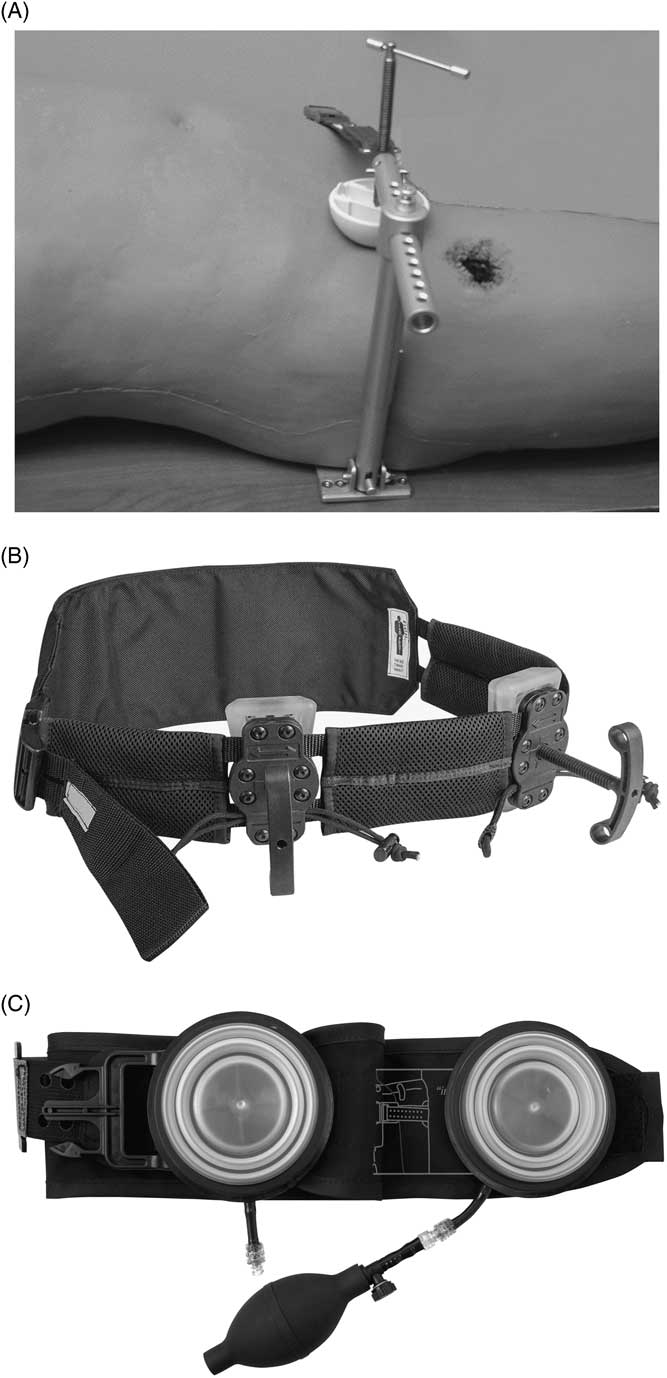
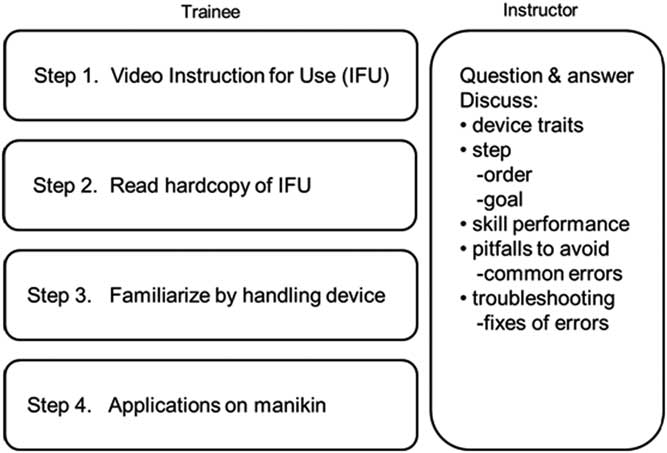
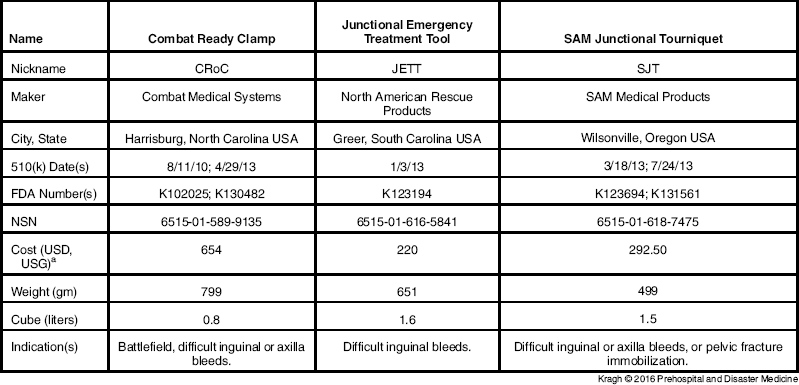
The order of training was the chronologic order of FDA-clearance for the indication of control of difficult inguinal bleeding by application to the groin (Table 1; Figure 1). There were 270 replicates (30 persons, three devices, three uses per device). Each model of junctional tourniquet was represented by one device, and that one device was used in 90 tests. The training location was a laboratory in the USAISR (Figure 2).
Photographs of Junctional Tourniquet Models: A) Combat Ready Clamp (CRoC); B) Junctional Emergency Treatment Tool (JETT); C) SAM Junctional Tourniquet (SJT).

Training Flow Diagram. Training was in four steps for each trainee. The omnipresent instructor emphasized key points and immediate feedback. Steps 1 to 3 were completed sequentially by model, and Step 4 was completed for all models of junctional tourniquets. Abbreviation: IFU, instructions for use.

Junctional Tourniquet Models Studied

Abbreviations: FDA, US Food and Drug Administration; USD, United States dollars; USG, United States Government.
a Estimated cost, in US dollars, for purchase by the US Government.
The manikin (CRoC Trainer Manikin, Operative Experience, Inc.; North East, Maryland USA) allowed users to evidence the differential performance of junctional tourniquets should it occur. The manikin allowed for assessment of hemorrhage control (yes/no) in stopping the flow of blood simulant from the right thigh gunshot wound, which was observed directly by the investigator while training the users.Reference Kragh, Murphy and Steinbaugh 12 The criterion to define effectiveness (efficacy) was the absence of outflow seen by the investigator who looked into the wound’s arterial lumen. Additionally, the time of application in seconds, and the blood volume lost from hemorrhage, were measured. The manikin had a right inguinal gunshot wound that included the common femoral artery transection. Such a wound was similar to that of a case from Black Hawk Down.Reference Kragh, Lunati, Kharod, Cunningham, Bailey, Stockinger, Cap, Chen, Aden and Cancio 1 The investigator filled the blood reservoir with 5.0 liters of water and refilled the reservoir after every 1.5 liters of lost fluid. Tourniquet models were placed to apply pressure upon the skin of the inguinal fold, a place where the femoral pulse is most easily palpated in clinical care. There was a 3-cm distance between the pressure point where compression was applied and the proximal extent of the wound which was distal to the pressure point. The manikin bleeds much at first and tapers off over time as in trauma care, and the manikin model has a research track record with face validity.Reference Kragh, Murphy and Steinbaugh 12 When interventions such as junctional tourniquets are applied, they may affect the rate of hemorrhage even before they become fully effective; for example, partial hemorrhage control is affected by snug fits of a junctional tourniquet. The evaluation of junctional tourniquet performance was made during the user’s training, so there is no evaluation-training differentiation in the present study. The manikin has blood loss that is able to demonstrate changes of complete and partial hemorrhage control with interventions, just as clinicians see in trauma care. Despite longer times to stop bleeding by slower application of certain models, partial hemorrhage control during such use may lead to lower losses than other models, which are all-or-nothing in their capacity to stop bleeding despite being faster; in reality, as in the manikin, losses may be incremental in step-wise application, non-linear, or complex since they may have periods of no hemorrhage control, periods of partial control, and periods of full control.
The investigator-trainer gave feedback to the user in real-time on technique throughout instruction and tourniquet uses in order to train users well. Emphases in feedback included subtle features of videos, instructions for use, and device design. For example, the SJT video showed the inventor pulling slack out of the strap four times before inflation; this number indicated the mechanical importance of maximal slack removal for optimal use—a principle of all circumferential tourniquets that may not be picked up by a casual viewer of the videos.Reference Kotwal, Butler and Gross 16 Emphases also included countermeasures to common pitfalls. For example, the JETT video showed the user’s non-dominant hand holding the belt to the subject’s torso in order to provide counter-tension against the applied tension of the dominant hand’s pull on the running end of the strap; without counter-tension, the dominant pull would slide the belt and twist the device around the torso, thereby sliding the bladder off the previously targeted point of application and off the underlying artery.
After training and assessment, users ranked tourniquet performance subjectively.Reference Klotz, Leo and Anderson 17 The user’s rank, R, was a whole number ascribed by the user to a given model (Rank=1 “Best;” Rank=3 “Worst”). The rank was converted into a score (Score=4 - Rank). The users’ scores by model were summed. For 30 subjects, the best possible overall score was a sum of 90, and the worst possible score was 30.
Analytical Methods
Box and whisker plots were used to show the distribution of all continuous variables across the difference tourniquet models. Time to hemostasis and total blood loss were log-transformed and analyzed using a mixed model analysis of variance (ANOVA) with the users represented as random effects and the tourniquet model used as the treatment effect. Preference scores were analyzed with ANOVA and Tukey’s honest significant difference test was used for all post-hoc pairwise comparisons. Testing was made using SAS (SAS Institute; Cary, North Carolina USA) and MS Excel 2003 (Microsoft Corporation; Redmond, Washington USA).
Results
All devices were 100% effective. There were significant user-to-user variations, which lead to the decision to adjust for the user effect as a random component of the statistical model.
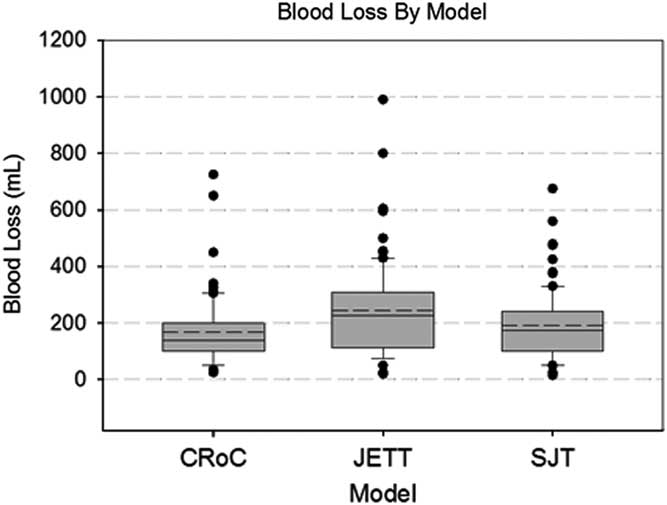
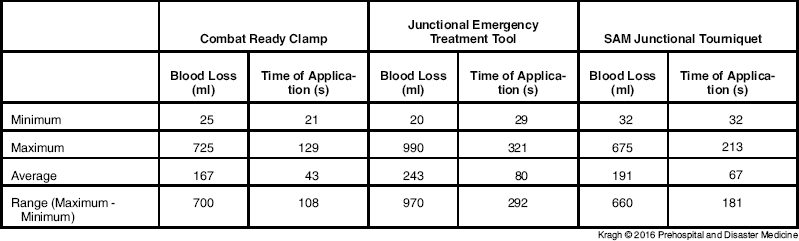
For blood loss, the user effect contributed to 30% of the total variability in the statistical model. After this adjustment, it was observed that blood loss was significantly associated with the model of junctional tourniquet (P < .0001; Figure 3). Results were in two tiers. The first tier had two models, CRoC and SJT, which performed best with least blood loss and significantly better than JETT. In pairwise comparison, CRoC-JETT (P < .0001) and SJT-JETT (P = .0085) were statistically significant in their mean difference while CRoC-SJT (P = .35) was not. The variation in results by model of junctional tourniquet was measured (Table 2).
Blood Loss Results by Junctional Tourniquet Model. The solid line across the box is the median; the mean is dashed. Differences in mean blood loss volume by model were not statistically significant (all three, P > .05). Abbreviations: CRoC, Combat Ready Clamp; JETT, Junctional Emergency Treatment Tool; SJT, SAM Junctional Tourniquet.

Blood Loss Results and Time of Application Results by Model

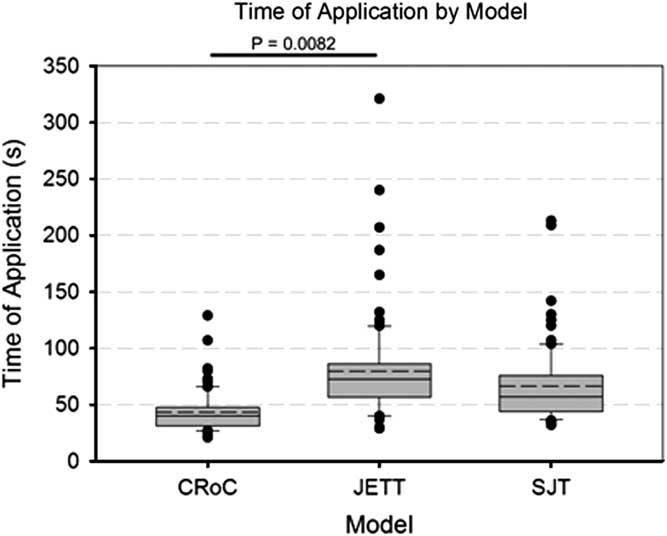
Time to hemostasis also varied by user, which contributed 25% of the total variability in the statistical model. After adjusting for the user effect, the time to hemostasis was also significantly associated with the model of junctional tourniquet (P < .0001; Figure 4). In the pairwise comparisons, the CRoC had a significantly shorter time compared to JETT and SJT (P < .0001, both comparisons). The pairwise comparison of SJT vs JETT was also significant (P = .0087).
Results of Time of Application by Junctional Tourniquet Model. Differences in mean time of application by model were not statistically significant between CRoC and SJT and between SJT and JETT, but were significant between CRoC and JETT (P = .0082). Abbreviations: CRoC, Combat Ready Clamp; JETT, Junctional Emergency Treatment Tool; SJT, SAM Junctional Tourniquet.

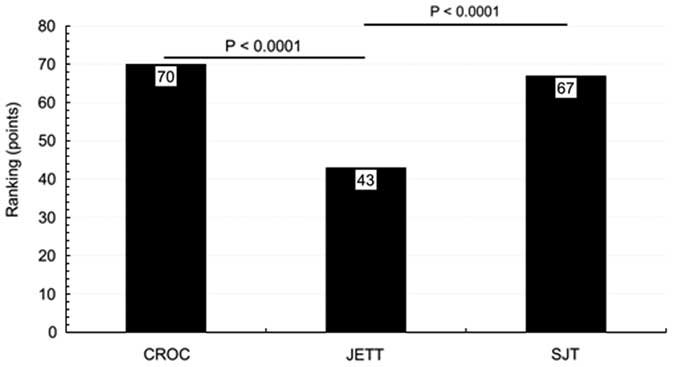
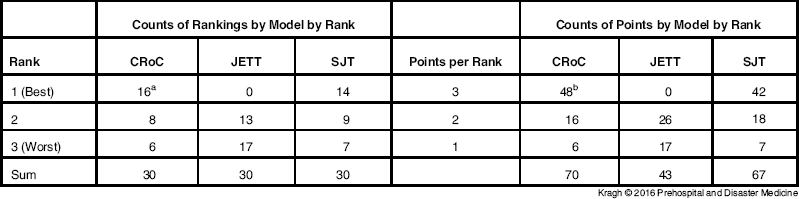
In responding to the directive, “Rank the performance of the models from best to worst,” users preferred junctional tourniquet models differently (P > .5, all models; Figure 5; Table 3).
Subjective Rankings by Users of Junctional Tourniquets. The CRoC and SJT were ranked better in subjective performance by users. The JETT was ranked last. Abbreviations: CRoC, Combat Ready Clamp; JETT, Junctional Emergency Treatment Tool; SJT, SAM Junctional Tourniquet.

Subjective Ranking of Performance Results

Abbreviations: CRoC, Combat Ready Clamp; JETT, Junctional Emergency Treatment Tool; SJT, SAM Junctional Tourniquet.
a Number of users who gave this model a rank of 1 (best).
b Score for each model (number of users x score).
Although the devices were intended as single-use for one patient, each model had only one device used in 90 tests.
Discussion
The main finding of the present study was that with the methods used, the CRoC and the SJT performed well in each assessment category (Table 4). Through the use of a manikin and 30 tourniquet users, the investigators were able to show that the CRoC and SJT consistently remained in the best statistical group for blood loss, time of application, and user preference. Models of junctional tourniquet performed differentially by blood loss and time to hemostasis.
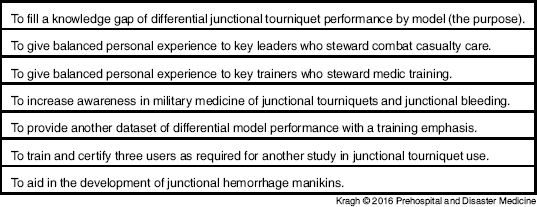
Intended Uses of the Present Study

The first minor finding of the present study was that the order of performance results among the models was similar in measures of central tendency (average, median). Blood loss, time of application, and the subjective ranking were all similar in best-to-worst order. This similar ordering of results across the measures indicates that within the methods used, the findings are coherent and consistent.
The last minor finding of the present study was unexpected in that one user of junctional tourniquets took a different strategy of hemorrhage control than the other users. All users except one used both hands to apply the tourniquets in order to move swiftly, but one user, in effect, applied the tourniquet with one hand as the other hand controlled hemorrhage temporarily while the tourniquet was readied. This one user put a finger in the wound to cover the vessel lumen with his index finger tip and stopped hemorrhage early. Then the user applied the tourniquet and withdrew the finger at the last moment before finishing tourniquet application. This strategy prioritized blood loss as more important than time. This one user had low blood losses but long times of application; the strategy difference increased the data variability a bit but not the study findings. This user’s technique was permitted; no prohibition existed. These aspects of the minor finding indicate that training is important from a blood loss perspective. User performance makes up to almost a liter in difference (eg, 970mL for one model), which, in a patient who has already lost perhaps that much or more, may be a life-death difference. This importance to training of users also has implications for maintenance of skills.
Although the SJT mean time was 1.6 times greater than that of the CRoC, the mean blood loss was similar (only 1.1 times greater), likely because of partial hemorrhage control as the SJT strap was tightened before full hemorrhage control was later attained by subsequent inflation of the SJT compression devices.
The strength of the present study is in its coherence as all the evidence showed similarities in effectiveness for the CRoC and the SJT. In the methods used, both tourniquets showed similar results in efficiently stopping blood loss. The SJT is nearly US $361 less expensive and weighs 300 g less than the CRoC (Table 1). If distributed to users like the military services, the SJT may save money, and if carried by users, it may save weight. If the carrier already had a SAM Pelvic Sling, a pelvic binder that is the basis of the SJT, exchanging the binder for the SJT would make the change even less expensive and lighter according to military doctrinaires.
Limitations
The limitations of the present report are numerous. Using a manikin as a surrogate of health care delivery is inherently limited. With more than 30 users, a larger study than the present study may be able to differentiate more among results. Ease of use, as in a Likert scale, may be a more direct measure for trainers than the metrics selected. The manikin was placed on a table above waist height in a temperature controlled room, and this laboratory environment differs from the battlefield which is complex and chaotic. Other interventions were not studied, such as those with periumbilical compression, as the manikin did not permit it.
Conclusion/Future Directions of Study
There are many directions for further study. On the battlefield, the placement of a tourniquet typically occurs while the casualty is on the ground where users may wear gloves. Such differences in application may affect performance, which may vary by model. Additionally, a casualty may not be on a flat surface, so placing the manikin on uneven ground may affect results. As manikins and simulators become more developed and available, studies can be done in different ways to assess models or users. A healthy human volunteer study with Doppler ultrasound assessment or a porcine model might help assess model or user performance.
In summary, new laboratory evidence of junctional tourniquet use by medical personnel to control difficult inguinal bleeding in simulated care indicates that the CRoC and SJT performed well in each assessment made.