


Why are some individuals and communities less tolerant of out-groups, more xenophobic, and more supportive of radical right-wing parties? Prior work has considered contemporaneous factors when looking for answers to these questions: exclusionary attitudes have been linked to deteriorating economic conditions (Funke, Schularick, and Trebesch Reference Funke, Schularick and Trebesch2016), globalization (Kriesi et al. Reference Kriesi, Grande, Lachat, Dolezal, Bornschier and Frey2006), cultural and identity-based fears (McLaren Reference McLaren2003; Norris and Inglehart Reference Norris and Inglehart2018; Sniderman et al. Reference Sniderman, Hagendoorn and Prior2004), security threats (Hetherington and Suhay Reference Hetherington and Suhay2011; Sullivan et al. Reference Sullivan, Marcus, Feldman and Piereson1981), and personal characteristics and attributes (Harteveld and Ivarsflaten Reference Harteveld and Ivarsflaten2018).
We argue that exclusionary attitudes toward out-groups may have much deeper historical roots. Our argument is motivated by a growing line of research showing that long-deceased coercive institutions often continue to influence contemporary political attitudes and behavior (e.g., Acharya, Blackwell, and Sen Reference Acharya, Blackwell and Sen2016a; Charnysh and Finkel Reference Charnysh and Finkel2017; Lupu and Peisakhin Reference Lupu and Peisakhin2017; Mazumder Reference Mazumder2018; Nunn and Wantchekon Reference Nunn and Wantchekon2011; Voigtländer and Voth Reference Voigtländer and Voth2012; see also Simpser, Slater, and Wittenberg Reference Simpser, Slater and Wittenberg2018 for a review). Some of the most coercive institutions in recent European history were the Nazi concentration camps implemented during the Third Reich. Although the long-term effects of these camps have received little scholarly attention, recent work has uncovered the persistence of antisemitism promoted by the regime (see Charnysh Reference Charnysh2015; Voigtländer and Voth Reference Voigtländer and Voth2015). Building on this and other literature on historical legacies, we argue that current-day differences in out-group intolerance and xenophobia among Germans partially trace back to the Nazi-era concentration camps.
The role of the camps after 1934 was to hold the so-called racially undesirable elements, which referred to Jews and other racial and ethnic out-groups (Evans Reference Evans2006). As such, the camps epitomized the racist philosophy of the regime and took racial hatred to its extreme. In these camps, prisoners were subjected to deliberate mistreatment, starvation, disease, harsh labor, and other atrocities. Many died of inhumane treatment or were executed. Concentration camps represented not just ideas about out-group inferiority and hatred, but extreme, state-sanctioned, and institutionalized behavior driven by these values.
Because the concentration camps in Nazi Germany were progressively integrated into the local economy (Kaienburg Reference Kaienburg1996; Sofsky Reference Sofsky1997), they promoted indoctrination into the belief system of the Third Reich. We argue that this belief system—with its focus on out-group hatred—spilled over from the concentration camps to the surrounding communities, incentivizing civilians to reconcile their attitudes with the new reality surrounding them. Closeness to concentration camps, in other words, triggered cognitive dissonance (Festinger Reference Festinger1957), i.e., a mental discomfort that individuals experience when exposed to new information that is in conflict with their preexisting beliefs, and that can lead to attitude change to reduce the discomfort (Acharya, Blackwell, and Sen Reference Acharya, Blackwell and Sen2018). This implies that individuals living close to concentration camps were likely to adopt negative attitudes toward out-groups to conform with the new social environment. These newly acquired values and beliefs were then transmitted across generations through parental and peer influence—a prominent mechanism for long-term persistence of attitudes identified in the literature on historical legacies (e.g., Acharya, Blackwell, and Sen Reference Acharya, Blackwell and Sen2016a; Lupu and Peisakhin Reference Lupu and Peisakhin2017; Voigtländer and Voth Reference Voigtländer and Voth2012).
To test our argument, we focus on Germany and combine (a) census data and election results from the Weimar Republic with (b) information on the geographic location of concentration camps in the Third Reich, (c) survey responses from the European Values Survey (EVS) and the German General Social Survey (ALLBUS), and (d) contemporary election results. We selected the case of Germany because historical records indicate that the site selection for concentration camps in this country was exogenous to the preexisting sociodemographic characteristics of communities. This was less likely to be the case in the rest of Europe, where the Third Reich often established concentration camps in areas with large Jewish or Romani populations (Megargee Reference Megargee2009).
Consistent with the expectations, we find that current-day Germans who live closer to Nazi-era concentration camps are more xenophobic, less tolerant of out-groups—including Jews, Muslims, and immigrants—and more likely to support extreme right-wing parties. The results are robust to a variety of data sources, different measures of out-group intolerance—both attitudinal and behavioral—and alternative specifications.
Furthermore, we show that the uncovered patterns cannot be explained by either preexisting levels of intolerance or antisemitism, or traditional contemporaneous predictors of out-group intolerance such as economic insecurity, political ideology, or education. We also find tentative support for our proposed mechanism that camp-era cognitive dissonance and intergenerational transmission of beliefs link Nazi camps to contemporary attitudes, and rule out potential alternative mechanisms related to geographic sorting, economic conditions, and modern-day use of the camps. Taken together, the analyses provide sustained support for the argument that present-day differences in out-group intolerance partially trace back to the spillover effects produced by Nazi camps. Finally, we provide preliminary evidence that contemporary efforts reminding people about the atrocities conducted in these camps might offer a way to break their detrimental long-term effects on out-group intolerance.
Our findings expand the literature on exclusionary attitudes toward out-groups by introducing a historical explanation for present-day prejudice. We also advance the literature on the legacies of coercive institutions in at least three crucial ways. First, in contrast to the institutions explored in prior work, Nazi-era camps were relatively short-lived and followed by reeducation efforts that were explicitly designed to wipe out the legacy effect outlined here. Yet, the effects of camps on attitudes are still observed, attesting to the strength and generalizability of this line of argument. Second, we provide preliminary support for the causal mechanism that links institutions to attitude change via cognitive dissonance and intergenerational transmission—something that the existing literature has struggled to demonstrate. Third, although prior work has gone to great length to show that long-term legacies indeed exist, we take a step further and provide preliminary evidence on how to break detrimental legacy effects. We elaborate on these and other contributions in the conclusion.
EXPLAINING OUT-GROUP INTOLERANCE
The racial policy of Nazi Germany was based on a specific doctrine asserting the superiority of the Aryan race. This doctrine justified the segregation, incarceration, sterilization, and extermination of other racial groups, including Jews, Roma, Slavs, and persons of color, who were seen as “sub-human” and “race defilers” (Burleigh and Wippermann Reference Burleigh and Wippermann1991). Although this policy of racism was put into practice throughout Germany, concentration camps became the most tangible institutional manifestations of racism and out-group hatred. It is important to note that the Nazi state defined out-groups more broadly by clearly codifying into the Nuremberg Laws of 1935 who was considered non-German. Only those of German blood were eligible to be Reich citizens. Stripping others of citizenship made them outsiders and thereby acceptable to be persecuted. The people who would become imprisoned in concentration camps were not only viewed as Jews, Roma, or foreign prisoners of war but also more generally as non-Germans and therefore racially inferior out-groups. The camps served to isolate, incarcerate, and dehumanize those out-groups (Megargee Reference Megargee2009), with their status justifying the brutal treatment, enslavement, mutilation through medical experiments, and execution. As such, concentration camps became the ultimate state-sponsored institutional expression of out-group hatred, racial hierarchy, and racist superiority.
We argue that proximity to a concentration camp played a major role in shaping individuals’ intolerance of out-groups. Yet, camps can affect individuals only if they are aware of this institution. This was most likely the case because the concentration camps and their purpose were not hidden from the local population; rather, they were prominently and proudly publicized (Gellately Reference Gellately2001). This was particularly true in Germany, where the concentration camps were mostly labor camps rather than extermination or transit camps.Footnote 1 The selection of sites for concentration camps in Germany was mostly driven by economic reasons, such as proximity to a quarry, a mine, or some industry (Megargee Reference Megargee2009). Most prisoners worked outside the camps in factories, construction projects, farms, or coal mines, and often had to walk to their workplace or use public transport to get there.Footnote 2 This progressive interconnectedness made the camps and their conditions visible to locals. For example, Wladimir Ostapenko, a survivor of the Neuengamme concentration camp, explained that a local farmer would regularly pick up the ashes from the crematorium to use as fertilizer. There are also photos that show locals going on family walks near the camp grounds.Footnote 3 Sofsky (Reference Sofsky1997) refers to the fact that locals were often involved in helping capture escaped prisoners, which further suggests both knowledge and contact. Furthermore, local papers were used to spread Nazi propaganda about the camps (Ast Reference Ast2013), displaying pictures of “typical” subhumans of other races with deformities, and calling for more camps for “those with hydrocephalus, cross-eyed, deformed half-Jews, and a whole series of racially inferior types” (Gellately Reference Gellately2001, 65).Footnote 4
In sum, concentration camps in Nazi Germany served as visible reminders of state-sponsored racism and extreme out-group hatred. Information about the camps and their purpose was accessible to locals, with those living closer to the camps most likely having more exposure or at least awareness. Furthermore, because camps were real, tangible, and physical manifestations of racism, their presence was even more likely to force locals to confront the new reality of the race-based state than a state-wide propaganda about an abstract doctrine alone.
Camps and Cognitive Dissonance
The prominence of these camps as symbols of out-group hatred helped legitimize such hatred and make it socially acceptable. We argue that, at the individual level, this occurred through the process of cognitive dissonance. Festinger (Reference Festinger1957) defines cognitive dissonance as the process by which an individual rationalizes new information that is inconsistent with his or her prior beliefs to reduce psychological discomfort stemming from the inconsistency.
The effects of cognitive dissonance on attitude change have been well documented in the literature on social psychology. Engaging in or witnessing violence against an individual or a group can breed negativity toward that individual or group (e.g., Davis and Jones Reference Davis and Jones1960). Similarly, acknowledging that one’s in-group has victimized an out-group can increase prejudice against that out-group (Imhoff and Banse Reference Imhoff and Banse2009). Cognitive dissonance, thus, serves as a likely mechanism for why ethnic or racial divisions and prejudice can be socially constructed from exposure to violence (Acharya, Blackwell, and Sen Reference Acharya, Blackwell and Sen2018; Fearon and Laitin Reference Fearon and Laitin2000; Hadzic, Carlson, and Tavits Reference Hadzic, Carlson and Tavits2017).
Applying cognitive dissonance theory to exposure to concentration camps suggests that individuals with relatively tolerant views of out-groups are likely to be confronted with psychological discomfort when living close to a camp. This occurs because the camp provides new information, discordant with the individuals’ prior beliefs, that out-group members are subhumans and can be mistreated. Although eliminating the camp is not an option for the individuals, one way in which they can reduce the unpleasant feeling of dissonance in this situation is to change their beliefs about out-groups. Local Germans had to rationalize the discrimination, enslavement, violence, and other inhumane treatment of people held in these camps, even if some of them had previously been their neighbors. A way to do so was to change individuals’ beliefs about the prisoners in these camps, to accept their status as out-groups, subhumans, and not worthy of the same rights. Some of this rationalization was necessary no matter where in the Third Reich an individual lived (Voigtländer and Voth Reference Voigtländer and Voth2015). However, as we argued above, the key difference that we capture in our study is that Germans who resided near concentration camps had to rationalize a more extreme example of intolerance than other Germans.Footnote 5 This enhanced rationalization effort led those living near the camps to maintain higher levels of out-group intolerance.Footnote 6
The Persistence of Political Attitudes
Various studies have demonstrated that attitudes can persist historically through an institutional channel, continued communal interaction with out-groups, or cultural transmission (see, for example, Acharya, Blackwell, and Sen Reference Acharya, Blackwell and Sen2016a; Mazumder Reference Mazumder2018; Nunn and Wantchekon Reference Nunn and Wantchekon2011; Voigtländer and Voth Reference Voigtländer and Voth2012). Studies of legacies of American slavery, for example, show that Southern institutions such as Jim Crow helped sustain racism even after slavery was abolished (Acharya, Blackwell, and Sen Reference Acharya, Blackwell and Sen2016a). In our case, the institution (i.e., concentration camp) was removed together with the Nazi regime and was not replaced with any alternative institution reinforcing out-group subjugation. This rules out the institutional channel. Other studies show that continued (economic) competition between locals and out-groups (e.g., Jews and racial minorities) generates a communal bond against out-groups and helps sustain attitudes over time (e.g., Acharya, Blackwell, and Sen Reference Acharya, Blackwell and Sen2016a; Charnysh Reference Charnysh2015; Grosfeld, Rodnyansky, and Zhuravskaya Reference Grosfeld, Rodnyansky and Zhuravskaya2013). This presumes that after the removal of the institution out-groups remain in the community. In our case, the prison population was removed from the local area when the institution was erased, and there was no competition between residents who lived closer to camps and the prisoners of these camps. This makes transmission due to continued interaction and competition also an unlikely mechanism.
Rather, we argue that individuals transmitted their attitudes via family ties and social interactions, which led to the differences in out-group intolerance measurable even today. A meta-analysis of 60 years of research confirms that children’s and parents’ out-group attitudes overlap to a significant degree (Degner and Dalege Reference Degner and Dalege2013), and at least some scholars attribute these similarities to intergenerational transmission of ideology rather than to other shared characteristics among family members (e.g., Duriez and Soenens Reference Duriez and Soenens2009).Footnote 7
Children acquire preferences from parents (and local peers) through altered social memory and by adaptation and imitation (Bisin and Verdier Reference Bisin and Verdier2000). Not necessarily aware that they are doing so, individuals pass on their belief systems to others in various contexts but especially through emotional and practical ties and relationships among generations. Furthermore, individuals tend to rely largely on the messages passed intergenerationally instead of history’s footprint (Anderlini, Gerardi, and Lagunoff Reference Anderlini, Gerardi and Lagunoff2010). This explains why anti–out-group sentiments can persist despite the fact that the truth about the atrocities committed at concentration camps was made public. Observers of post-war Germany often point out that for most people “education about the war begins at home” (Cowell Reference Cowell1995) because almost every German family has its own “complicated personal war history,” which is transmitted to subsequent generations (Sontheimer Reference Sontheimer2005). Parents’ views and expressed opinions about out-groups become part of that education. As a German educator put it, when children use the word “Jew” to give someone a bad name (despite having learned about the Holocaust at school), it often reflects the insensitivities they have obtained from their parents.Footnote 8
In sum, we argue that through cognitive dissonance individuals rationalized the imprisonment and inhumane treatment of non-ethnic Germans. This process inflated out-group hatred closer to the camps. The out-group animosity was later transmitted through family and communal ties from one generation to the next, leading to the persistence of out-group prejudice long after the racist institution was erased. The observable implication of this argument is that the closer an individual lives to the site of a Nazi-era concentration camp today, the higher his or her expressed level of out-group intolerance. We test this hypothesis in the following sections.
CASE SELECTION
The Nazi concentration camp system started in 1933. The initial aim of the camps was the imprisonment of political enemies. The camp system evolved into a European wide network with camps built for the purposes of labor, transport, detention, and murder. The intended purpose of the different concentration camps affected their location. For example, most camps in Poland were purposed for the extermination of the local Jewish population, and placed near Jewish communities (Charnysh and Finkel Reference Charnysh and Finkel2017). An extermination, or death camp, differed from other camps because there was a relatively low prison population and a high number of deaths. The purpose of these camps was not to hold prisoners, but to kill and cremate as quickly and efficiently as possible.Footnote 9 Similarly, transit camps were also placed in cities with comparatively large Jewish populations and with access to rail lines. These camps did not maintain a large footprint and served the purpose of holding people temporarily before they were sent off via train to other camps or extermination centers. In contrast to both the transit and extermination camps, the locations of labor camps were picked for reasons other than proximity to Jewish population centers (Megargee Reference Megargee2009).
In this study, we focus on Germany, where Megargee (Reference Megargee2009) identified 10 Nazi-era concentration camps located in present-day German territory: Arbeitsdorf, Bergen-Belsen, Buchenwald, Dachau, Flossenbürg, Hinzert, Mittelbau-Dora, Neuengamme, Ravensbrück, and Sachsenhausen.Footnote 10 We picked Germany because the camps here were predominantly labor camps and had two important features. First, the site selection for camps in Germany was not driven by proximity to Jewish population, but access to resources, such as a quarry, or a preexisting structure. Dachau, for example, was located in a former munitions factory (Megargee Reference Megargee2009).Footnote 11 Figure 1 displays the geographic dispersion of these 10 camps included in our study as well as the share of the Jewish population in 1925 and support for the Nazi party (NSDAP) in the 1933 election, with darker shades referring to higher proportions of Jews and more Nazi party support. As the figure suggests, the placement of these camps was exogenous to the Jewish population and to Nazi party support at the time.Footnote 12 The fact that (a) the site selection was mostly driven by economic rather than sociodemographic or attitudinal reasons, and (b) the camp location was exogenous to the Jewish population and Nazi party support, makes Germany an attractive case for identifying the effect of camps on contemporary attitudes.
Geographical Distribution of Concentration Camps within Current-Day Germany, Along with the Distribution of the Jewish Community (Panel a) and Support for the Nazi Party (Panel b)

Second, because the German camps mostly operated as labor camps, they were also more likely to be interwoven with the nearby communities via an extensive system of subcamps. These subcamps were subordinate to the leadership of the main camp and were predominantly located in geographic proximity. They were created to allow for additional forced labor and placed close to production sites, such as factories and mines, which made contacts with locals likely. Furthermore, subcamps in Buchenwald, Sachsenhausen, and Mittelbau-Dora explicitly allowed prisoners to work in the nearby communities. In contrast, camps established in other countries were often hidden from the local population.Footnote 13 As we argued in the theory section, the fact that these camps were interwoven with local communities increases the likelihood of exposure to and knowledge of the camps among locals, which is necessary for camps to be able to affect attitudes. This exposure was higher in Germany than in other locations, because of the nature of the camps and their extensive subcamp system.
EMPIRICAL STRATEGY
Assessing the consequences of an event that took place over 70 years ago is inherently complex. In a nutshell, our expectation is that concentration camps disproportionately shaped the attitudes of those living in the surrounding areas during the Nazi period. Intergenerational transmission of attitudes then led to the persistence of these attitudes. To incorporate the various aspects of this argument, our empirical strategy is divided into four steps. First, we show that early support for the Nazi party and the distribution of Jewish communities in Germany did not explain the location of Nazi camps built after 1933. Next, we investigate the relationship between proximity to the camps and current-day political attitudes. We then describe three empirical tests that provide evidence in line with the mechanism proposed. Finally, we report a series of sensitivity analyses that test the plausibility of alternative mechanisms and the robustness of the findings.
Preexisting Attitudes and the Location of Camps in Germany
Our theoretical argument and empirical approach rely on the assumption that the decisions regarding the location of concentration camps in Germany were unrelated to pre-existing mass political attitudes. The historiography of Nazi Germany reviewed above is in line with this argument. In this section, we complement the historical accounts with systematic empirical tests of whether preexisting political attitudes explain camp locations using the pre-war Census and electoral data.
We measure preexisting political attitudes for each of the 946 German electoral districts in 1933 in two ways. First, we use early support for the Nazi party to capture anti-Jewish sentiment and political intolerance more broadly. Second, and in line with the literature on group conflict, we use data on the relative size of Jewish communities at the time to measure geographic variation in the levels of out-group threat. Electoral and Census data come from Falter, Lindenberger, and Schumann (Reference Falter, Lindenberger and Schumann2009) and Hänisch (Reference Hänisch1989); both variables are measured in proportions and range from 0 to 1.
Our outcome of interest here is the location of the concentration camps. Since the unit of analysis is the electoral district, we operationalize camp location in two different ways: (1) as the Euclidean distance between the centroid of a given electoral district and the closest Nazi camp, and (2) as a binary measure that takes the value of 1 if a camp was established in the district, and 0 otherwise.Footnote 14
Based on these measures, Table 1 presents the results of four models that assess whether preexisting political attitudes explain concentration camp location (see Table SI2.1 for the full models). Columns 1 and 2 report estimates of OLS models with the distance to the closest camp (in 10 km) as the outcome variable, whereas Columns 3 and 4 present the results of logistic regressions with the binary measure of camp presence as the outcome variable.Footnote 15 Moreover, Models 2 and 4 extend the baseline specification by including additional socioeconomic covariates. Based on recent scholarship on the counter-extremist efforts of the Catholic Church during the rise of the Nazi party (Spenkuch and Tillmann Reference Spenkuch and Tillmann2018), we account for the religious composition of the districts. In addition, unemployment rates and district size capture the regional economic environment.
Interwar Political Attitudes and Camp Location in Germany
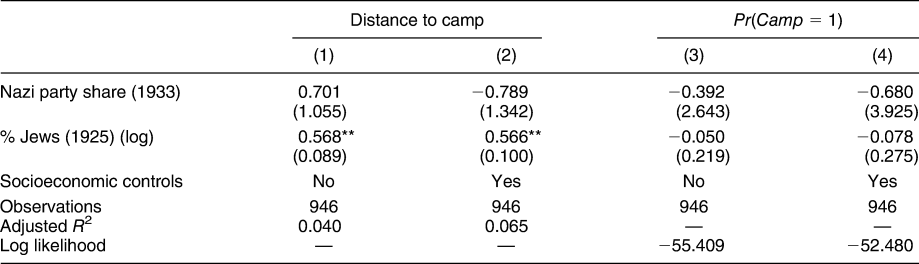
Note: Entries are coefficient estimates for the regression of Distance to Closest Camp (Columns 1 and 2), and Pr(Camp = 1) (Columns 3 and 4) on support for the Nazi party, Jewish presence in the district, and additional controls (standard errors in parentheses). Full models in Table SI2.1. * p < 0.05; ** p < 0.01.
Overall, the models show that district-level anti-Jewish sentiment is not a meaningful predictor of camp location. As an example, the coefficient for Nazi party support in Model 2 is indistinguishable from zero (−0.79; p-value = 0.56) and the point estimate suggests that a hypothetical increase from the lowest to the highest vote share obtained by the Nazi party in 1933 (from 13.3 to 83.0%) is associated with a decrease of Distance to Camp by only 5.5 km (≈3.4 miles).Footnote 16 In Model 1, which excludes the socioeconomic control variables, the coefficient flips sign (while remaining indistinguishable from zero at conventional levels). For the models predicting whether a given district has a camp, the coefficients for Nazi party support are also not statistically significant. Finally, the size of the Jewish community in a given district does not seem to predict the existence of a camp in any given district, but is positively associated with distance to the closest concentration camp. This result is in the opposite direction of what we would expect if the camps had been strategically placed close to Jewish communities.
We performed two further robustness tests. First, we used a dataset compiled by Voigtländer and Voth (Reference Voigtländer and Voth2012) with city-level information on the number of pogroms during the 1920s and in 1349, along with letters to the editor of the Nazi newspaper Der Stürmer. Previous research used these data to capture manifestations of antisemitism (e.g., Spenkuch and Tillmann Reference Spenkuch and Tillmann2018). Table SI2.3 replicates the models just described with this new set of covariates. Again, we find no systematic patterns that would explain proximity to the camps. Second, we looked at covariate balance between (a) electoral districts with and without a camp, and (b) between districts with camps and their neighboring districts. As the results in SI 2 show, the covariates are balanced across districts with and without camps in both types of comparisons.
Each of these results alone does not provide definitive proof that the location of concentration camps in Germany is completely unrelated to pre-existing beliefs. However, the consistency across the different empirical analyses and the fact that they line up with the historical accounts of the process through which German camps evolved gives us confidence that before the development of the Nazi camps, communities in the surrounding areas were no more prone to political intolerance, and xenophobia than those farther away.
The Consequences of Exposure to Camps
To test our expectations about the long-term consequences of exposure to Nazi camps in Germany, we rely on two nationally representative surveys of German adults: the German segment of the 2008 European Values Survey (EVS 2016), and the 2016 wave of the German General Social Survey (ALLBUS; GESIS 2017, 2018). These surveys were selected based on two criteria: (1) the inclusion of items on political tolerance and voting behavior, and (2) the provision of fine-grained regional identifiers.Footnote 17 To generate our quantities of interest, the surveys were combined with Census data from the interwar period, election results from the Weimar Republic, and the geolocation of the camps. Since we are ultimately interested in explaining current-day political attitudes, the unit of analysis is the individual survey respondent.
The key variable of interest in these analyses is Distance to Camp: the Euclidean distance between the location of a survey respondent and the closest Nazi camp.Footnote 18 This proxy for exposure to Nazi camps has two limitations that are worth noting. First, it does not account for historical roads and natural obstacles, since historical maps do not include a comprehensive description of the road system in place at the time. However, we have no reasons to believe that the measurement error generated by this decision is systematically related with current day political attitudes (see also Charnysh and Finkel Reference Charnysh and Finkel2017). Second, we identify the geolocation of respondents based on the centroid of the smallest regional identifier available in each survey: Kreis (N = 429) in the case of EVS, and Gemeinde (N = 11,084) in the case of ALLBUS.Footnote 19 Substantively, this means that all subjects within a given regional unit are assigned the same distance. This simplification may bias the results if subjects who live closer to the geographical center of an administrative unit are systematically different from those who live farther away, and if these differences are in turn systematically correlated with our outcome of interest. We do not have reasons to believe that this is the case. However, to assuage this possible concern we relied on different regional identifiers across our different survey and electoral analyses. The results produced across the different regional identifiers were substantively similar.Footnote 20
We analyze three outcome variables in each survey, capturing different facets of political tolerance, xenophobia, and political behavior. To facilitate the interpretation of the different variables in each survey, we describe these variables in the respective subsections below. For each outcome of interest, we estimated two sets of models: a linear regression with interwar covariates (before the establishment of the camps), and a two-stage regression estimator—the sequential g-estimator (Acharya, Blackwell, and Sen Reference Acharya, Blackwell and Sen2016b; Vansteelandt Reference Vansteelandt2009)—that considers different contemporary mediators. This approach allows us to account for contemporary variables that may explain people’s attitudes without inducing posttreatment bias in our model estimates (Montgomery, Nyhan, and Torres Reference Montgomery, Nyhan and Torres2018). The method starts by estimating a model with both pretreatment and posttreatment covariates (first stage). Next, it recalculates the outcome variable by removing from it the effects of the mediating variables of interest. Finally, it estimates the effect of the treatment on this “demediated” outcome (second stage). The sets of pretreatment covariates and posttreatment mediators included in the models are as follows.
Interwar (i.e., Pretreatment) Covariates
All the pretreatment covariates included in the analyses are based on the Census data and election results aggregated at the lowest administrative unit of the period. Because the administrative boundaries have shifted since the early 1930s, we rely on an area-weighting method to map data from the interwar period onto the lowest regional boundaries available in each survey.Footnote 21 This method allows us to create interpolated measures of interwar covariates within modern-day districts. We include two sets of interwar covariates. First, we measure preexisting political attitudes toward out-groups using the district level support for the Nazi party in 1933 and the share of the Jewish population in 1925. Although we showed that these variables do not explain camp location directly (cf. Table 1), an indirect causal pathway may still exist, which justifies including them as controls. Second, we measure local economic conditions by district-level unemployment rates in 1933. This allows us to account for the possibility that camps were located in more economically depressed areas (given their proximity to industries, quarries, and mines), which in turn could have driven political intolerance.Footnote 22 Figure SI4.2 illustrates the geographical distributions of these quantities at the Kreis level.
Contemporary (i.e., Posttreatment) Mediators
Differences in political tolerance and attitudes toward out-group members are often explained by contemporary forces. Building on the seminal work on political tolerance by Sullivan et al. (Reference Sullivan, Marcus, Feldman and Piereson1981), we therefore account for individual-level political ideology (ten-point scale), employment status, education level,Footnote 23 and district-level unemployment rate as well as level of urbanity.Footnote 24 We paid special attention to economic variables because the economic base of the areas surrounding the camps might have relied more heavily on manufacturing jobs than other parts of the country. This could have made these areas more vulnerable to economic depression in recent decades, which in turn might have led to perceptions of out-group threat (Funke, Schularick, and Trebesch Reference Funke, Schularick and Trebesch2016). By accounting for the economic variables with the sequential g-estimator, we can recover the controlled direct effect of proximity to the camps net of current economic dynamics.
Additionally, to account for perceived threat (Homola and Tavits Reference Homola and Tavits2018; McLaren Reference McLaren2003), we also control for the share of immigrants in the respondent’s district. The models with posttreatment mediators also account for respondent’s gender and age, and include a dummy for East vs. West Germany. We do not include these variables in the sequential g-estimator since it is unlikely that camp proximity explains these variables.Footnote 25
EVS Results
With data from the 2008 EVS, we generated three outcome variables measured as follows (the full question wording for all items is presented in SI 3.1).Footnote 26
Out-Group Intolerance
The measure of intolerance toward out-groups is based on six survey items that ask respondents about their openness to having different groups as neighbors: “people of a different race,” “Muslims,” “Jews,” “immigrants,” “homosexuals,” and “gypsies.”Footnote 27 When the six items are factor analyzed, only one factor has an Eigenvalue above 1.00 (2.54), suggesting that the different items represent a single dimension (Cronbach’s α = 0.90). The response options are binary: 1 if the respondent prefers not to have members of a given group as neighbors, and 0 otherwise. Hence, we estimated an Item Response Theory (IRT) model and extracted the factor scores for each respondent to create a continuous latent measure of intolerance toward out-groups.Footnote 28
Immigrant Resentment
Immigrants represent the most salient out-group in current-day Germany (e.g., Jäckle and König Reference Jäckle and König2017). Although the Nazi regime did not target immigrants per se, our theoretical argument predicts that the effects of camp exposure spill over to any community identified as out-group. We should therefore observe effects on resentment of immigrants. The measure is based on six survey items fully detailed in SI 3.1. A principal components analysis reveals a one-dimensional structure (Cronbach’s α = 0.82), and the individual factor scores of this first dimension were extracted to produce a latent measure of immigrant resentment.
Support for Far-Right Parties
The EVS includes two items on party support: (1) “Which political party would you vote for,” and (2) for those answering ‘Don’t know,’ “If you don’t know, which party appeals to you the most?” Based on these two variables, we created a binary measure that takes the value of 1 if respondents mentioned an extreme right-wing party (National Democratic Party, NPD; German People’s Union, DVU; or the The Republicans, REP), and 0 otherwise.
Table 2 reports the estimates of the effect of camp distance on the three outcomes. For each outcome variable, a first specification includes only interwar covariates,Footnote 29 while the second model employs the sequential g-estimator to also account for contemporary mediators (Table SI4.3 reports the full set of coefficients and the first stage results). Overall, the different analyses provide support for our main prediction: exposure to concentration camps during the Nazi period is associated with significant differences in attitudes toward out-groups and support for far-right parties in present-day Germany.
Effects of Camp Proximity on Out-group Intolerance, Immigrant Resentment, and Support for Far-Right Parties (EVS)
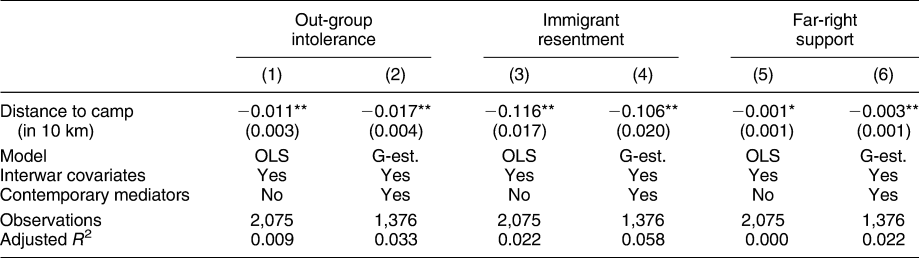
Note: Entries are estimates of the effect of distance to closest camp on the different outcomes, described in column headers. Models 1, 3, and 5 account exclusively for interwar covariates (standard errors in parentheses). Models 2, 4, and 6 are the second stage of the sequential g-estimator to also account for contemporary predictors (bootstrapped standard errors in parentheses). Full model results in Table SI4.3. *p < 0.05; ** p < 0.01.
For example, Model 2 provides the controlled direct effect of camp distance on out-group intolerance using the sequential g-estimator. The coefficient of −0.02 is reliable and substantively meaningful. According to the model, a 50 km increase in distance to the closest camp is associated with a decrease of 0.10 points in out-group intolerance, representing 11.2% of the variable’s interquartile range (IQR).Footnote 30 To put this result into an appropriate context, we can compare it with the coefficient for conservatism, a common predictor of out-group intolerance. According to the model, a one unit increase in the 10-point scale of conservatism is associated with a 0.05 increase in out-group intolerance, equivalent to 6.0% of the outcome’s IQR. In other words, a 50 km increase in distance is estimated to have an effect similar to a two point shift on the 10-point conservatism scale.
Similarly, the estimated direct effect of camp distance in the model predicting immigrant resentment is −0.11 (Model 4). With the remaining predictors held constant, the model estimates that the difference in immigrant resentment between someone living next to a camp and someone living 50 km from a camp is equivalent to 10.0% of the outcome variable’s IQR. Finally, we also find that proximity to a former camp is associated with voting behavior.Footnote 31 According to Model 6, a 50 km increase in camp distance is associated with a two percentage point decrease in the probability of supporting an extreme right-wing party.Footnote 32 Considering that less than 3% of the 2008 EVS respondents reported supporting one of the far-right parties active at the time, this effect is meaningful. Relative to the mean value of the outcome variable, it represents a 66.7% change in the probability of supporting a far-right party.Footnote 33
ALLBUS Results
We supplement the main analysis with an entirely new sample for several reasons. First, survey items in ALLBUS allow for a more detailed examination of the effects of camp proximity on attitudes toward different out-groups, including Jews and Muslims. Second, this survey includes lower level geographical identifiers than EVS [Gemeinde (N = 11,084) vs. Kreis (N = 429)] allowing for a more precise estimation of the respondents’ location. Third, it allows us to test the robustness of the EVS findings with a different sample from a different time period (2016 for ALLBUS vs. 2008 for EVS). If we find support for our theory in both datasets, the specific sampling pool adopted and the timing or political context of each survey is less likely to be driving our results.
Three outcome variables capture different facets of out-group intolerance. The full question wording and scaling for all questions is presented in SI 3.2.Footnote 34
Intolerance Toward Foreigners
Our first measure of intolerance is based on 10 items that capture attitudes toward foreigners in general. Examples include “foreigners in Germany should adjust their lifestyle to the German one,” “foreigners should have the same rights to social welfare transfers,” and “is the presence of foreigners an overall advantage or disadvantage for Germany.” A principal component analysis finds the first dimension to explain around 45% of the variation in all 10 items (Cronbach’s α = 0.84). We therefore extract this first dimension to produce the outcome measure.
Intolerance Toward Jews
To test our theory more explicitly in terms of potential effects on attitudes toward Jews, the second ALLBUS outcome variable is based on five items that capture these attitudes. Examples include “Jews have too much influence in the world,” “the Jews are not fully innocent for their persecution,” and “how comfortable would you be with a Jewish neighbor.” A principal component analysis finds the first dimension to explain around 48% of the variation in all five items (Cronbach’s α = 0.68), and we again extract this first dimension to produce our second outcome measure.
Intolerance Toward Muslims
Finally, given that Muslims have become an especially salient out-group in Germany (e.g., Jäckle and König Reference Jäckle and König2017), we would also expect to find our theorized effects when analyzing present-day attitudes toward Muslims. The ALLBUS data allows us to use another battery of six questions to capture these attitudes. Examples of these questions include “Islam fits into German society,” “Islamic associations/groups should be under state surveillance,” and “practicing the Islamic faith in Germany should be limited.” We again conducted a principal component analysis to find that the first dimension explains around 58% of the variation across the six items (Cronbach’s α = 0.84). This first dimension is extracted to produce our third outcome measure.
Table 3 presents the results of six models estimating the effect of camp proximity on present-day out-group intolerance. As before, we run two models for each outcome variable. The control variables are the same as in the EVS analysis (cf. Table 2, above). The full model and first-stage results are presented in Table SI4.4.
Effects of Camp Proximity on Intolerance Toward Foreigners, Jews, and Muslims (ALLBUS)
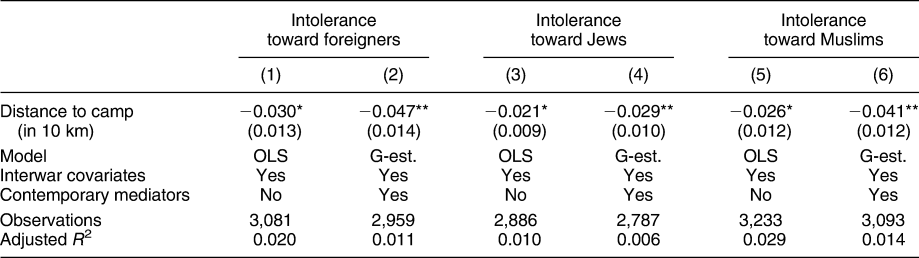
Note: Entries are estimates of the effect of distance to closest camp on the different outcomes, listed in column headings. Models 1, 3, and 5 account exclusively for interwar covariates (standard errors in parentheses). Models 2, 4, and 6 are the second stage of the sequential g-estimator to also account for contemporary predictors (bootstrapped standard errors in parentheses). Full-model results in Table SI4.4. * p < 0.05; ** p < 0.01.
The analyses provide further support for our theoretical argument: as a respondent’s distance to a former concentration camp increases, intolerance toward foreigners, Jews, and Muslims decreases. We find the largest effect sizes for Intolerance Toward Foreigners and Intolerance Toward Muslims. However, it is important to keep in mind that all three outcome variables are factor scores with a slightly different scaling. For example, the IQR of Intolerance Toward Foreigners is 6: 50% of all observations lie within −3 and +3. With that in mind, we can say that a distance increase of 50 km for an otherwise unchanged respondent should on average lead to a 0.24 point decrease in our measure of intolerance toward foreigners, representing 4% of its IQR. For Intolerance Toward Jews, the IQR is 4.4, so if a respondent’s distance to the closest camp increases by 50 km, their predicted factor score would decrease by 0.15 points, around 4% of the IQR. Finally, Model 6 estimates that a 50 km increase in distance is associated with a decrease of Muslim intolerance by 0.21 points, which would reflect a change of 4% of the outcome’s IQR.Footnote 35
To summarize, we find consistent support for our expectations in both surveys. Evidence from EVS and ALLBUS shows that respondents who live closer to former Nazi concentration camps today are more likely to hold negative views of different types of out-groups in present-day Germany. They are also more likely to indicate support for right-wing parties. These patterns are in line with our argument that concentration camps have long lasting effects that still play a role in explaining political attitudes today.
Mechanisms: Cognitive Dissonance and Belief Transmission
We argued that the patterns observed above likely result from processes of cognitive dissonance triggered by proximity to the camps during the Third Reich. This argument implies that the pre-existing attitudes among individuals living close to the camps were not systematically different from those living elsewhere, and that it was the mental discomfort produced by this new social environment that led them to update their beliefs. While plausible, this mechanism is hard to demonstrate because a direct test of it would require a careful micro-level analysis of individuals who witnessed this period. Such data are not available, which is why prior work on historical legacies has generally not tested the mechanism at all. We aspire to do more, and offer an alternative strategy to assess the plausibility of this segment of our argument.
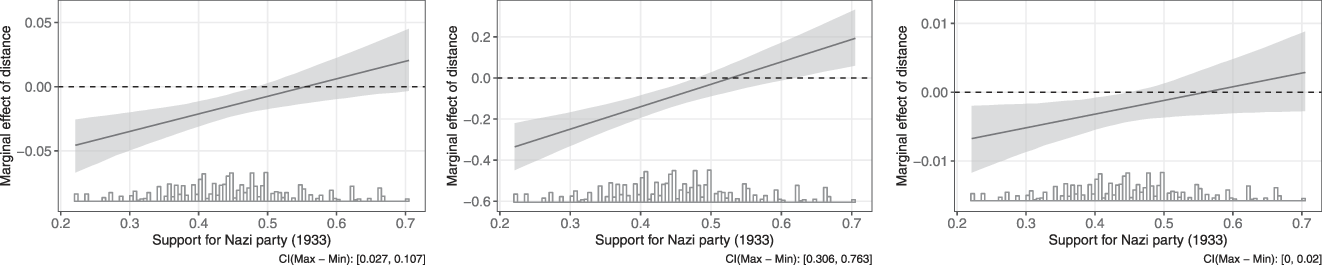
If cognitive dissonance is responsible for the relationship uncovered, individuals living in areas that were more supportive of the Nazi party before the creation of the camps should experience less cognitive dissonance. For these individuals, there should be less of a need to reconcile their pre-existing beliefs with the new social environment. Consequently, the effects of proximity to camps should be smaller. We test this implication by interacting our key predictor in the main analysis (distance to camp) with support for the Nazi party in 1933. The plots in Figure 2 present the marginal effects of distance to camp on out-group intolerance (left panel), immigrant resentment (central panel), and support for far-right parties (right panel), conditional on the vote share obtained by the Nazi party in the last contested election of the Weimar Republic.Footnote 36 In line with our expectations, the camp proximity effects are large and statistically significant in regions that previously had low levels of Nazi support. However, for all three outcome variables this effect decreases as Nazi support increases, and is no longer distinguishable from zero in districts with 50% or more support for the Nazi party. These results are consistent with the argument that cognitive dissonance links Nazi camps to contemporary intolerance, although they do not represent direct evidence for the mechanism proposed. Therefore, the findings should be interpreted as suggestive.Footnote 37
Marginal Effects of Camp Proximity on Contemporary Attitudes, Conditional on Support for the Nazi Party in 1933 (EVS)
Note: Plots depict the marginal effects of distance to camps on out-group intolerance (left panel), immigrant resentment (middle panel), and support for far-right parties (right panel), conditional on support for the Nazi party in 1933. Shaded regions represent 99% confidence intervals. The histograms at the base of each figure describe the distribution of support for the Nazi party. The full model results are reported in Table SI6.1.
We can also provide evidence consistent with the second part of our theoretical mechanism: the intergenerational transmission of beliefs. We argued that out-group intolerance was transmitted across generations through parental and social influence. This mechanism has been explored in Germany (Voigtländer and Voth Reference Voigtländer and Voth2012) and elsewhere (e.g., Lupu and Peisakhin Reference Lupu and Peisakhin2017; Nunn and Wantchekon Reference Nunn and Wantchekon2011). Still, to provide more direct evidence for this mechanism in the context of our study, we rely on two items from EVS.
First, respondents were asked in which Kreis they lived at the age of 14. Although communal transmission does not require that a given respondent, or their parents, were born in a specific district, we should expect clearer effects of camp proximity among respondents who lived in the same district all their lives, both due to longer cultural exposure and family ties in the area. Figure 3 provides evidence in line with this expectation. The marginal effects of camp proximity on out-group intolerance (left panel), immigrant resentment (middle panel), and support for far-right parties (right panel) are only distinguishable from zero for respondents who are still living in the Kreis of their childhood.Footnote 38 Second, EVS respondents were asked whether they discussed politics with their parents when they were young (“around 14 years old”). The argument about intergenerational transmission suggests that camp proximity should be a stronger predictor of contemporary attitudes among respondents who regularly discussed politics with their parents. Figure SI6.5 provides evidence in line with this expectation. The effects of camp proximity on out-group intolerance and immigrant resentment are only reliable among respondents who experienced this type of political socialization.Footnote 39
Marginal Effects of Camp Proximity on Contemporary Attitudes, Conditional on Place of Residence at Age 14 (EVS)
Note: Points are marginal effects of distance for EVS respondents who lived in the same Kreis at the age of 14 years and respondents who lived elsewhere. Outcome variables described at the top of each panel. At the time of the survey, 56.9% of respondents lived in the same Kreis they lived at the age of 14 years. Full model results in Table SI6.3.

Alternative Mechanisms
In this section, we explore three potential alternative explanations for our findings: economic conditions, geographic sorting, and contemporary cognitive dissonance. Recall that we also accounted for a potential economic explanation as part of our main analysis. Unless noted otherwise, detailed results of these additional tests are presented in SI 7.
Economic Conditions
To remind the reader, the sites for concentration camps in Germany were often selected based on economic conditions, such as proximity to industries, quarries, or mines. It is therefore possible that camps were located in areas that were more economically depressed at the time, which could have driven political intolerance. We accounted for this by including pre-war district-level unemployment rates in our main analysis. In addition, we reestimated the main EVS models with a broader set of economic controls that captured the economic base of the different districts in the interwar period (see Table SI5.1). The same key findings are obtained after accounting for the prevalence of blue-collar workers, white-collar workers, and farmers in the district. However, even controlling for these contemporaneous dynamics, it is still possible that manufacturing-intensive regions have become economically depressed in recent decades, which could have generated perceptions of out-group threat today (Funke, Schularick, and Trebesch Reference Funke, Schularick and Trebesch2016). We ruled out this alternative mechanism by accounting for current economic indicators (employment status and district-level employment rate) with the sequential g-estimator (see Tables 2, 3, SI4.3, and SI4.4 for these results).
Alternatively, it is possible that camps generated an economic boost during the war and in the following decades (cf. Charnysh and Finkel Reference Charnysh and Finkel2017), producing the patterns that we observe in our study. To address this, we collected Census information on property taxes (indicating the value of the housing stock), business taxes (indicating general economic prosperity), and total taxes at the Kreis level in 1950 and 1961, the first two censuses in West Germany after the war. We then regressed taxes at the Kreis level on our distance measure while controlling for population size (Table SI7.1). We find that distance does not affect any of these outcomes, suggesting that areas closer to the camps did not benefit economically (see SI 7 for details).
Geographic Sorting
The patterns uncovered above could also result from spatial sorting in the post-war period. Between 1944 and 1950, nearly 8 million ethnic Germans left the former eastern territories of the Third Reich and settled in West Germany (Braun and Kvasnicka Reference Braun and Kvasnicka2014; Douglas Reference Douglas2012). If geographic sorting explains the relationship between camp location and contemporary political attitudes, the patterns of mobility in areas close to the camps should differ from those observed elsewhere in a way that is related with the attitudes of migrants. It is unlikely that the migration patterns were driven by political beliefs, because in three of the four West German occupation zones the allocation of expellees relied on a common formula based on the availability of nutrition and housing space (e.g., Falck, Heblich, and Link Reference Falck, Heblich and Link2012).Footnote 40 Still, large variations in the degree to which communities changed in areas far from or close to the camps could explain the differences we observe today.
To assuage this concern, we investigate whether camp proximity explains population changes during the period of forced migrations from 1944 to 1950 (Braun and Kvasnicka Reference Braun and Kvasnicka2014; Braun and Mahmoud Reference Braun and Mahmoud2014). The analysis is based on Census data from May 1939 and September 1950. Table SI7.2 reports the results of a series of models where the proportional change in population between 1939 and 1950 is regressed on different measures of camp proximity (see SI 7 for details about the models). Together, the results suggest that the patterns of mobility observed in the aftermath of World War II are not explained by distance to the camps. The point estimates for the different measures of camp proximity are unreliable and fairly close to zero. Although this result does not inform us directly about the political beliefs of those moving in and out of a given region, it suggests that the location of the camps was not an important factor in the massive migration flows that characterized the post-war period.
Contemporary Cognitive Dissonance
Another alternative explanation for the relationship we uncovered is that the camps keep producing cognitive dissonance today. To varying degrees, the sites of most German camps are currently used as a memorial, documentation center, or museum. Hence, it is conceivable that these symbols of the Nazi era are still generating cognitive dissonance among those living in the surrounding areas. Research in psychology suggests that reminders of ingroup wrongdoing may prompt defensive reactions (Imhoff and Banse Reference Imhoff and Banse2009; Rotella and Richeson Reference Rotella and Richeson2013; but see Rees, Allpress, and Brown Reference Rees, Allpress and Brown2013). This mechanism would generate the same patterns uncovered here without requiring the transmission of attitudes across generations.
To assess the plausibility of this mechanism, we leverage the variation in current-day use of the German camps. For example, by the end of the 1940s, hardly anything remained to be seen of the former camp at Mittelbau-Dora. The grounds had rapidly been reclaimed by nature. A permanent exhibition on the camp history opened in a newly erected building only in 2006.Footnote 41 This stands in stark contrast to other former camps such as Dachau, where many of the original structures (e.g., the Jourhaus, the shunt room, prisoner baths, the bunker, the barracks, and the crematorium) have been preserved and their original utilizations displayed.Footnote 42 The memorial site gives visitors a very graphic and vivid experience about life in the camp, so realistic that an article described the experience as “A Day in Hell.”Footnote 43 If contemporary cognitive dissonance explains the patterns we observe, the effects should be most visible around camps that currently have a more noticeable presence.
We documented the current use of all camp locations and identified the existence of original physical structures as the most meaningful distinction between camps.Footnote 44 Finally, we reestimated the main models from EVS and ALLBUS interacting distance with a binary variable that identifies the current use of the camp.Footnote 45
Figure 4 presents the main findings from both surveys, and reveals significant differences between camps with and without physical structures. However, the results are the opposite of what the contemporary cognitive dissonance argument would predict. The overall effects of proximity are mostly driven by respondents living near camps with a less noticeable presence. On the other hand, in the surroundings of those camps where original structures have been preserved as a museum, the effects of distance are either significantly smaller or indistinguishable from zero across all six model specifications.Footnote 46
Marginal Effects of Camp Proximity on Contemporary Attitudes, Conditional on Current-Day Use of the Camp (EVS and ALLBUS)
Note: Plots depict point estimates and 95% confidence intervals for the standardized effects of distance to camps on contemporary attitudes (described on the y-axis), conditional on current-day use of the camp. Gray (black) points/bars correspond to respondents whose closest camp does (not) include physical structures. The full model results are presented in Tables SI7.3 and SI7.4.
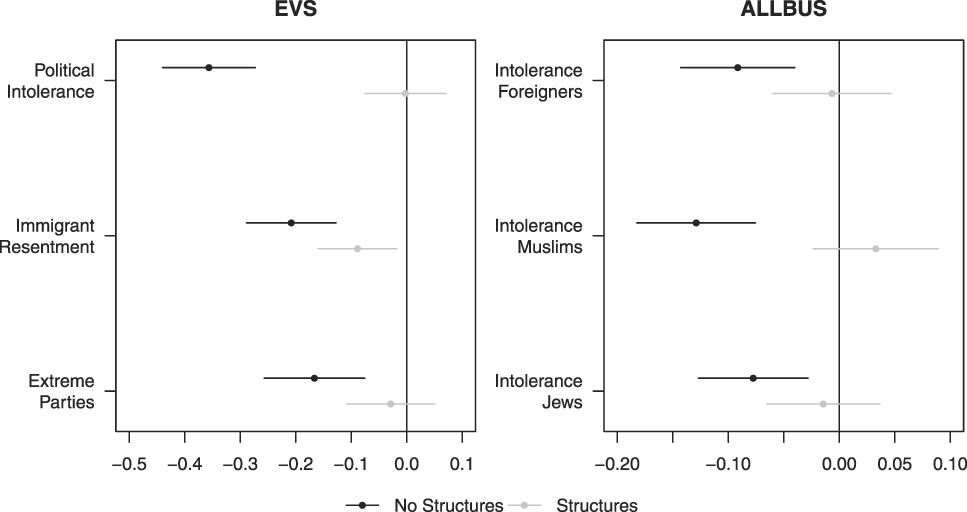
One possible interpretation of this pattern is that an educational effect of museums housed in the preserved physical structures of former camps is counteracting the legacy effects. Being able to see the actual structures of the institutions where atrocities were committed is likely to leave a strong impression on individuals visiting the camp locations. It is therefore possible that the Holocaust-related education promoted by these camps may offer a path to mitigate the effects of cognitive dissonance produced during the Nazi era. This interpretation is in line with recent policy debates in Germany: in spring of 2018, public discussion erupted in response to an anti-Semitic attack about whether school visits to concentration camps should be made compulsory because they can be transformative in promoting tolerance (Pastor Reference Pastor2018). In line with this, a museum director cited an example of how a camp visit eliminated a group of students’ prior fascination with neo-Nazi graffiti (Bennhold Reference Bennhold2018). As a further test of potential educational effects, we collected information on the number of years since a permanent exhibition about the Holocaust opened in the site of a former camp. Beyond the presence of original structures, any educational effect should be more prominent the longer an exhibit has been in place. This is exactly what we find as the results in Table SI7.7 show.Footnote 47
Admittedly, our test here is imperfect, and we interpret it with caution. However, the potential implications of this mitigating effect can be far-reaching. So far, the literature on historical legacies has focused primarily on firmly establishing the legacy effects. The determinism of historical legacies, however, makes chances of progress appear rather bleak. That is why the finding here is important: it takes us a step closer to identifying ways to break the seemingly deterministic persistence of the effect of past institutions and affirms that efforts to re-educate the population may not be in vain.
Sensitivity Analyses
We also performed various robustness tests of our main analysis. These include (1) an analysis of far-right voting using recent electoral data from Germany, (2) an analysis of additional outcome variables in the ALLBUS survey, (3) a series of placebo tests, (4) a cross-national analysis with data from other Nazi camps in Europe, and (5) an analysis of closeness to the Treblinka concentration camp in Poland. We discuss each of these tests in turn (for details, see SI 8).
To analyze whether our results hold outside of survey data, we compiled a dataset of recent election results from the 2017 Bundestag election at the Wahlbezirk level (electoral district, N = 88,511), which we then combine with geographic and socio-demographic information at the Gemeinde level. Whereas the survey data we use above gives us a rich set of outcome variables, the electoral data provides behavioral measures. Additionally, it allows us to focus on specific geographic units. By restricting the analysis to small radii around each camp, these restricted samples are better matched in terms of potential confounders while still providing variation in closeness to a camp (see Charnysh and Finkel (Reference Charnysh and Finkel2017) for a similar approach). We use vote share for the radical right-wing parties—Alternative for Germany (AfD) and National Democratic Party (NPD)—as the outcome variable. Table 4 provides the key findings, which suggest stronger support for AfD and NPD in areas closer to former camps. The results hold both nationally and within 70 km of each camp. A variety of alternative modeling strategies reported in SI 8 render similar conclusions.
The Controlled Direct Effect of Camp Proximity on Support for Radical Right Parties in 2017
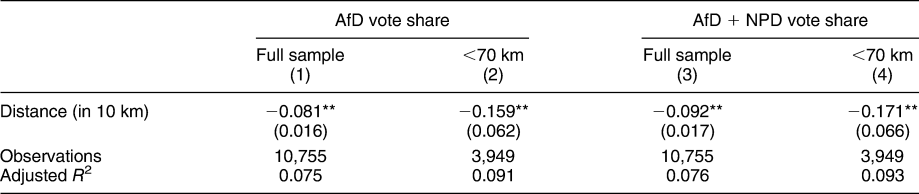
Note: Entries are estimates of the controlled direct effect of distance to closest camp on support for the AfD (Columns 1, 2) and AfD + NPD (Column 2, 3) in 2017. Full-model results and additional specifications are presented in Tables SI8.3–SI8.7; ** p < 0.01.
Given the comprehensive set of attitudinal questions asked in the ALLBUS survey, we tested the robustness of our findings on a complementary set of out-group intolerance measures. More specifically, we created factor scores for Perception of foreigners, Discrimination of foreigners, and a variable for respondents that indicated support of a far-right party. The perceptions items asked mostly about potential advantages and disadvantages of having foreigners in Germany, whereas the discrimination items asked about potential discrimination against or in favor of foreigners in different stages of life (education, job market, etc.). The Support for extreme parties variable takes the value of 1 if respondents indicated that they would vote for the NPD or AFD if there was an election next Sunday. The full question wording for these variables can be found in SI 3.2. We ran the exact same model specifications as in the main ALLBUS analysis above. The results are reported in Table SI8.8 and provide further support for our argument. Respondents living closer to concentration camps perceive foreigners more negatively, are less inclined to think that foreigners are discriminated against, and are more likely to support far-right parties.
Tables SI8.9 and SI8.10, in turn, report results from a series of placebo tests where we replaced the outcome variables with different contemporary attitudes that should not be meaningfully associated with either camp proximity or out-group intolerance. As expected, beliefs such as willingness to turn out, job and life satisfaction, or importance of leisure time are not explained by camp proximity. These results, although inevitably suggestive, indicate that the long-term effects of living close to Nazi camps are targeted and relate to attitudes toward out-groups.
Whereas our main analysis focuses exclusively on German survey respondents, the EVS includes respondents from other countries in Europe where the Nazi regime had also set up concentration camps. We use these data to test the generalizability of our findings. More specifically, we ran a cross-national analysis that includes EVS respondents from Austria, Belgium, Croatia, the Czech Republic, Estonia, France, Germany, Latvia, Lithuania, the Netherlands, and Poland (EVS 2016). For each respondent, we coded their distance to the closest former concentration camp. We used the same outcome variables as in Table 2: out-group intolerance, immigrant resentment, and support for far-right parties. The results of these model specifications can be found in Tables SI8.11 and SI8.12 and closely mirror our main results above. Across all model specifications, we find that respondents who live closer to concentration camps today are less tolerant of out-groups, exhibit stronger immigrant resentment, and are more likely to support far-right parties. The effect sizes tend to be smaller than in our main analysis, but are otherwise in line with our main findings and are equally statistically reliable.
Finally, we follow Charnysh and Finkel (Reference Charnysh and Finkel2017) for another empirical test of the implications of our theory with data from the area surrounding the Treblinka concentration camp in Poland. These authors argue that the location of this camp was “exogenous to the behavior and the views of the local population” (p. 802). We use their data and modeling strategy to analyze support for the PiS party in the 2015 national elections. We focus on PiS, because the party ran on a clearly anti-immigrant and anti-refugee platform. Our theory predicts that the party should have performed particularly strongly in communities that are closer to Treblinka. The results in Table SI8.13 confirm this expectation: across all different model specifications we find that the closer a community is to Treblinka, the higher its vote share for PiS.
CONCLUSION
In this article, we have shown that Nazi-era concentration camps cast a long shadow on people’s level of tolerance and prejudice, and continue to affect political attitudes today. Germans who live closer to a Nazi-era concentration camp are more xenophobic, less tolerant of various out-groups (Jews, Muslims, and immigrants), and more likely to support far-right parties. Although not always large in magnitude, these effects are robust across different datasets, different model specifications, and different outcome variables, and they hold cross-nationally. We also showed that these effects cannot be explained by preexisting levels of tolerance, or by contemporary factors such as economic insecurity, political ideology, or education. Furthermore, we provide tentative support for our two-part causal mechanism that (a) camp-era cognitive dissonance drives attitude change, and (b) intergenerational transmission of beliefs helps sustain these attitudes over time. We also rule out alternative mechanisms such as geographic sorting, economic conditions, and contemporary cognitive dissonance. Taken together, our results provide consistent support for the argument that the differences in attitudes toward out-groups that we observe today, trace back (at least in part) to the racism bred by the Nazi camps. That said, preliminary evidence also suggests that intense efforts to remind people about the atrocities conducted in these camps might offer a way to break their detrimental long-term effects on out-group intolerance.
Our findings make several important contributions. First, prior work has primarily focused on contemporary factors to understand why some people adhere to exclusionary attitudes. Our study complements that line of work by introducing a historical explanation for present-day prejudice. As the political developments in the United States and Europe have brought intolerance toward marginalized groups back into the limelight, it is important to understand both contemporary factors and historical legacies that make exclusionary political appeals attractive.
Second, we contribute to the literature on the historical legacies of coercive institutions. Although the causes of the Holocaust have attracted ample scholarly attention, its long-term sociopolitical consequences are less understood. We show that, when it comes to political attitudes, these consequences are real and measurable even today. The prejudice that this racist and inhumane institution instilled in the local population is hard to erase even after the institution itself is long gone. We further extend the literature on legacies in three important ways. First, in contrast to long-term effects of institutions explored in prior work, Nazi concentration camps most likely offered a conservative test of the persistence of political beliefs for multiple reasons. These camps were relatively short-lived and not replaced by other institutions to promote racism once they were dismantled. Furthermore, there have been intense efforts in post-war Germany to eradicate the effects of the Nazi regime, instilling in the population a deep regret for the Holocaust committed in these camps. These efforts are explicitly designed to counteract the legacy effect outlined here. That we were still able to uncover the long-term effects of this institution attests to the strength and generalizability of the legacy effects. Second, we also add to the existing literature by providing tentative support for the causal mechanism that links institutions to attitude change and persistence via cognitive dissonance and intergenerational transmission of beliefs. Testing these mechanisms more directly remains a challenging task for future research. One strategy in this regard might involve identifying similar contemporary situations (e.g., establishment of migrant detention centers or refugee/concentration camps in war zones), and collecting the microdata necessary to test the cognitive dissonance mechanism. Finally, prior work on historical legacies has focused primarily on firmly establishing the legacy effects. We take a step further and provide preliminary evidence on how to break the detrimental legacy effects, which is the inevitable next question for the legacy literature, and our results offer a way forward in this regard.
Our findings also contribute to better understanding the process of indoctrination into the totalitarian regime ideology. They show that even in totalitarian regimes, such indoctrination does not necessarily occur homogeneously (cf. Voigtländer and Voth Reference Voigtländer and Voth2015). Rather, those exposed to a more intense behavioral manifestation of that ideology will become more strongly indoctrinated, possibly because of the escalated cognitive dissonance that they experience. This implication opens an interesting avenue for future research about the differential indoctrination potential of totalitarian institutions.
Finally, this study may also inform postwar reconciliation policies. In the aftermath of conflicts, nations and international organizations often undertake substantive efforts to strengthen civil society and promote social cohesion. However, if the values of an oppressive regime tend to disseminate more in areas close to its coercive institutions, as shown here, reconciliation policies can benefit from a geographically targeted approach.
SUPPLEMENTARY MATERIAL
To view supplementary material for this article, please visit https://doi.org/10.1017/S0003055419000832.
Replication materials can be found on Dataverse at: https://doi.org/10.7910/DVN/J0GBTX.




Comments
No Comments have been published for this article.