Introduction
In Afghanistan in January 2004, members of the Constitutional Loya Jurga approved a new constitution. As late as September 2003 the draft constitution had included provision for a semi-presidential system with both a directly elected president and a prime minister responsible to the Wolesi Jirga, the lower house of the Afghan National Assembly (Rubin Reference Rubin2004: 12). In the end, a pure presidential system was recommended. There were political interests at stake in the choice of the system (ibid.). However, there were concerns about problems supposedly inherent in semi-presidentialism. One of the participants in the drafting procedure summed up the reasons why presidentialism was chosen ahead of semi-presidentialism: ‘There would be no uncertainty about who held executive power in Kabul, and Washington would retain the benefit of having a clearly identifiable Afghan partner . . .’ (ibid.).
The decision to reject semi-presidentialism in Afghanistan is symptomatic of the standard academic wisdom about the impact of this form of government on the process of democratization: semi-presidentialism should be avoided at all costs. The direct election of the president can lead to a dangerous personalization of the political process; the problem of dual legitimacy can be problematic when there is a divided executive, especially if the president and prime minister are from opposing forces; the absence of a majority in parliament can lead either the president or prime minister to ignore the rule of law in order to assert ‘effective’ decision making. In the context of these criticisms, Timothy Colton and Cindy Skach have recently summed up the academic consensus about semi-presidentialism. They write that it is time for ‘fragile democracies that suffer from the semi-presidential predicament to rethink [their] constitutional framework’ (Skach, Reference Skach2005: 124–5).
This article examines whether there is empirical evidence to support the arguments against semi-presidentialism. To date, there has been no rigorous test of these arguments. Instead, the evidence has remained largely qualitative. In this article, we examine whether semi-presidentialism has had a negative impact on democratic performance. We assume that semi-presidentialism is unlikely to have had such an effect in two situations – when a country is completely consolidated and when a country is autocratic. In these situations, we assume that other non-institutional factors cancel out any effects of semi-presidentialism on democratic performance. However, for countries that remain incompletely consolidated and yet not autocratic we might expect semi-presidential institutions to significantly affect democracy. Focusing only on countries with semi-presidential constitutions and using Polity's measures to identify the countries in this category that are incompletely consolidated and yet not autocratic, we identify the relationship between democratic performance and the three main arguments against semi-presidentialism – the strength of the presidency, cohabitation, and divided minority government. We find that there is a strong and negative association between presidential power and democratic performance, but that cohabitation and divided minority government do not have the negative consequences that the literature predicts.
The main finding of this article is important. It shows that some of the prevailing wisdom about semi-presidentialism is wrong. Specifically, there is no evidence to support two of the three main arguments against this form of government. By contrast, the findings do support one of the arguments against semi-presidentialism. Semi-presidential countries with strong presidents perform worse than those with weaker presidents. This finding is also significant. While this study does not allow us to draw any conclusions about the performance of semi-presidentialism relative to that of parliamentarism or presidentialism, it does suggest that if, for whatever reason, countries decide to adopt semi-presidentialism, they would be advised to adopt a form of semi-presidentialism where the president has very few powers. Thus, while Afghanistan may have been right to reject semi-presidentialism, in the context where countries wish to adopt this constitutional system or where they have no choice but to adopt it, then advice can still be given that can lessen the problems of semi-presidentialism.
The problems of semi-presidentialism
In semi-presidential systems, the president is directly elected and serves for a fixed term, while the prime minister and cabinet are collectively responsible solely to the legislature. The academic consensus against semi-presidentialism is profound. For example, Linz states that: ‘In view of some of the experiences with this type of system it seems dubious to argue that in and by itself [semi-presidentialism] can generate democratic stability’ (1994: 55). Valenzuela (Reference Valenzuela2004: 17) argues that semi-presidentialism ‘may not solve some of the inherent problems of presidentialism, and indeed could make them worse by reifying the conflict between two state powers and personalizing them in the figure of the president and the prime minister’. Stepan and Suleiman recommend against semi-presidentialism arguing that it ‘is a more risk-prone system than the modern parliamentarism that has evolved in Europe other than France after World War II’ (Stepan and Suleiman, Reference Stepan, Suleiman, Chehabi and Stepan1995: 412).
In this article, there is no attempt to compare the performance of countries with semi-presidential constitutions relative to those with parliamentary and/or presidential constitutions. Thus, we do not aim to contribute to the more general debate as to whether parliamentarism should be chosen ahead of both semi-presidentialism and presidentialism as the standard wisdom suggests. However, we seek to contribute to the literature by assessing the extent to which the problems of semi-presidentialism apply to different semi-presidential regimes. There are three main arguments against semi-presidentialism.
The problem of over-presidentialization in semi-presidential countries
The first argument against semi-presidentialism is similar to a criticism of presidentialism. The direct election of the president may encourage the personalization of the political process and it may encourage the president to disregard the rule of law because s/he feels above the normal political process. Presidents can claim to have a mandate from the people – no matter how close their winning margin may have been. This mandate, they might argue, gives them the authority to act in the best interests of the country, as they see it, and may encourage them to ignore any opposition. Linz expresses this concern when discussing semi-presidential systems in which the president has considerable powers. In this situation, he worries that semi-presidentialism can come to resemble ‘a constitutional dictatorship’ (Linz, Reference Linz, Linz and Valenzuela1994: 48). A further potential problem with direct election is that it may encourage political outsiders to seek election. If successful, such presidents tend to ignore political parties and personalize the presidential process. The survival of the regime becomes associated with the survival of the president in office. Opposition to the president becomes associated with opposition to the regime itself. Again, Linz worries about this problem of semi-presidentialism and states that ‘as much or more than a pure presidential system, a dual executive system depends on the personality and abilities of the president’ (ibid: 52). For his part, Lijphart has argued that semi-presidential systems ‘actually make it possible for the president to be even more powerful that in most pure presidential systems’ (2004: 102). The combination of a president with strong constitutional powers backed by a loyal parliamentary majority and a submissive prime minister can mean that there will be few if any checks and balances within and between the executive and legislative branches of government. In this event, the president may exercise untrammelled power and in the context of a nascent democracy such an extreme personalization of the political process has the potential to be destabilizing.
The problem of a divided executive in semi-presidential countries
The second argument against semi-presidentialism is also similar to a criticism of presidentialism, namely the problem of dual legitimacy, but it provides a distinct semi-presidential twist to this problem. In presidential systems, problems may arise when the majority in the assembly is opposed to the president. In this case, each institution is pitted against the other and deadlock ensues. When it does, the president may try to reassert decision-making authority by abusing the rule of law, or the military may take it upon themselves to intervene. In semi-presidential systems, problems may also arise when the majority in the assembly is opposed to the president. In this case, though, there is deadlock between the president and the prime minister rather than between the president and the legislature. In semi-presidential systems, this problem of a divided executive is known as cohabitation. Linz and Stepan (Reference Linz and Stepan1996: 286) identify the circumstances when the effects of cohabitation may be problematic:
When supporters of one or the other component of semi-presidentialism feel that the country would be better off if one branch of the democratically legitimated structure of rule would disappear or be closed, the democratic system is endangered and suffers an overall loss of legitimacy, since those questioning one or the other will tend to consider the political system undesirable as long as the side they favor does not prevail.
In these circumstances, they argue that ‘policy conflicts often express themselves as a conflict between two branches of democracy’ (ibid: 287). Each actor claims to be the legitimate authority and tries to assume power at the expense of the other. Naturally enough, democracy as a whole can suffer.
In fact, the problem of a divided executive under semi-presidentialism is compounded by the worry that intra-executive conflict may not be confined to periods of cohabitation. For Linz, semi-presidential systems are inherently problematic: ‘The result inevitably is a lot of politicking and intrigues that may delay decision making and lead to contradictory policies due to the struggle between the president and prime minister’ (Linz, Reference Linz, Linz and Valenzuela1994: 55). In this regard, Linz is particularly concerned about the relationship between the executive and the military. In semi-presidential systems, there may be three or even four major actors: the president, the prime minister, the minister for defence, and the joint chief of staff of the armed forces. In this situation, he states: ‘The hierarchical line that is so central to military thinking acquires a new complexity’ (ibid: 57). This complexity leaves room for ‘constitutional ambiguities regarding one of the central issues of many democracies: the subordination of the military to the democratically elected authorities and hopefully to civilian supremacy’ (ibid: 59). As we have seen, the absence of single point of contact is a reason why semi-presidentialism was rejected in Afghanistan.
The problem of divided minority government in semi-presidential countries
The third argument against semi-presidentialism is closer to a problem usually associated with parliamentarism. In her work, Cindy Skach identifies this problem as ‘divided minority government’. She defines this situation as the case where ‘neither the president nor the prime minister, nor any party or coalition, enjoys a substantive majority in the legislature’ (Skach, Reference Skach2005: 15). She says that this situation ‘can predictably lead to an unstable scenario, characterized by shifting legislative coalitions and government reshuffles, on the one hand, and continuous presidential intervention and use of reserved powers, on the other’ (ibid: 17–18). In turn, the situation can deteriorate: ‘The greater the legislative immobilism, governmental instability, and cabinet reshuffling resulting from the minority position of the government, the more justified or pressured the president may feel to use their powers beyond their constitutional limit, for a prolonged period of time’ (ibid: 18). In other words, while the scenario is different from cohabitation, the result is the same. When the executive is weakened, in this case because of the absence of either a stable presidential or prime ministerial parliamentary majority, directly elected presidents feel the need to assert their control over the system and the process of democratization suffers.
Seemingly, therefore, there are good theoretical reasons to suggest that semi-presidentialism is problematic. To date, though, the arguments against semi-presidentialism remain largely untested. In the one statistical study of the performance of semi-presidentialism relative to that of parliamentarism and presidentialism, Moestrup (Reference Moestrup, Elgie and Moestrup2007) has identified important regional differences. Specifically, she finds that while ‘semi-presidential regimes on average have performed worse than other regime types in the Americas and Asia, they appear to have performed . . . better than parliamentary systems in Eastern Europe’ (ibid.: 39). For the most part, though, evidence to support the arguments against semi-presidentialism is largely qualitative. For example, Linz and Stepan argue that divided government was particularly difficult for Poland in the years immediately following democratization. They state: ‘Because of party fragmentation and its dualistic deadlock, Poland's efforts to advance toward a balanced budget and a mixed economy stalled’ (Linz and Stepan, Reference Linz and Stepan1996: 282). In her work, Skach has suggested that divided minority government contributed to the collapse of democracy in Weimar Germany and that it is one of the causes of the problems of democracy in contemporary Russia: ‘It was during the intense crisis period of divided minority government in 1993 that Yeltsin took Russia largely out of the democratic box, and pushed through a constitution that boosted the power of the presidency’ (Colton and Skach, Reference Colton and Skach2005: 122). Finally, a study of Guinea-Bissau has suggested that semi-presidentialism may have been a better choice than pure presidentialism. However, the authors conclude that ‘it is the highly presidentialized nature of the system rather than the system itself that is problematic’ (Azevedo and Nijzink, Reference Azevedo, Nijzink, Elgie and Moestrup2007: 158). In the next section, we test whether there is robust empirical evidence to support the arguments against semi-presidentialism.
Sample, hypotheses, variables, model specification, and findings
In this article, semi-presidentialism is defined as the situation where there is a directly elected president and a prime minister and cabinet who are responsible to the legislature. This is now a common way of defining this type of system (see, for example, Elgie, Reference Elgie2005; Skach, Reference Skach2005; Shugart, Reference Shugart2005, Reference Shugart, Rhodes, Binder and Rockman2006). It should be noted that this definition makes no reference to the powers of the president. Therefore, a country like Ireland with a figurehead president, but nonetheless a directly elected president, should be classed as semi-presidential as well as a country like Russia with a very powerful directly elected president. In one sense, such a definition seems counterintuitive. However, there are at least two reasons for adopting this definition. Firstly, a definition that includes reference to the powers of the president leads to a problem of selection bias. If the list of semi-presidential countries includes only those countries with at least moderately powerful countries, then it is hardly surprising that semi-presidentialism is associated with the standard problems of presidentialization. By defining semi-presidentialism without reference to the powers of the president, we avoid any problem of selection bias. Certainly, it means that we should not operationalize semi-presidentialism as a discrete explanatory variable. However, it also means that we can explore the effects of variation within semi-presidentialism. To what extent does this variation matter? We hypothesize that it does matter and that semi-presidential countries with stronger presidents are likely to perform worse than those with weaker presidents. Secondly, it must be acknowledged that some countries choose to have directly elected presidents with very few powers. These countries choose to operate in a parliamentary-like manner, but, for whatever reason, they also choose to directly elect their president. This is a discrete constitutional choice and it is a choice that is different from a parliamentary system with an indirectly elected president or a monarch. Are there benefits to combining a directly elected and weak president and a strictly parliamentary system? We hypothesize that such countries may perform better than those that choose to combine a directly elected and powerful president with a government that is responsible to the legislature.
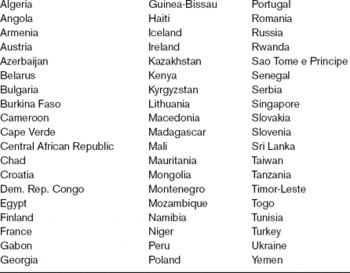
To identify a semi-presidential country on the basis of our definition, it is necessary simply to read the country's constitution. This means that there is very little room for the list of semi-presidential countries to vary from one writer to the next. There is no need to make a call as how powerful a country's president must be in order for it to be classed as semi-presidential. Instead, it is simply necessary to identify those countries that have both a directly elected president and a prime minister and cabinet that are responsible to the legislature. That said, there are still some judgment calls to be made. For example, we exclude countries such as South Korea, where the legislature has to consent to the individual appointment of the prime minister, rather like the case of cabinet nominations in the US, and where, once appointed, the legislature has no means to dismiss the government. All the same, we ensure that our findings are not sensitive to case selection on the basis of these and other definitional issues. Table 1 provides a list of countries with semi-presidential constitutions as of June 2008.
Countries with semi-presidential constitutions, 2008

Plainly, the list of semi-presidential countries in Table 1 is very diverse in terms of their democratic status. It includes some countries that are unequivocally autocratic, such as Chad, other countries that are unequivocally consolidated, such as Austria, and others that have started the process of democratization but are not yet fully consolidated, such as Madagascar. For the purposes of this article, it is assumed that the purportedly negative consequences of semi-presidential performance have the chance to ‘kick in’ only when a country has reached a certain point of democratization. In other words, in an autocracy the institutional effects of semi-presidentialism have no room to have a negative influence on democratic performance because the political system is so tightly controlled and democratic performance is already so poor. By the same token, it is also assumed that the negative consequences of semi-presidentialism have no impact on a country that is fully consolidated. In these countries, semi-presidentialism may have some or other effect on policy outcomes, but the quality of democracy cannot be impaired when democracy is ‘the only game in town’. Overall, it is assumed that the negative consequences of semi-presidentialism will be observable only in countries that remain incompletely consolidated and yet are not autocratic.
To identify this set of countries within the category of countries with semi-presidential constitutions, we use the measures of democracy provided by the Polity IV project.Footnote 1 The methodology adopted by Polity is widely used in comparative analysis. The Polity project scores countries on a scale from −10 (complete autocracy) to +10 (complete democracy). This scale cannot be used as a continuous measure of democracy.Footnote 2 However, there are various ways in which the scale can be adapted to the research project at hand. The authors of the Polity project make a distinction between three categories of countries. Those scoring from −10 to −6 inclusive are autocracies; those from −5 to +5 are anocracies; and those from +6 to +10 are democracies. Anocracies are transitional regimes that are ‘about three times more likely to experience major reversions to autocracy than democracies’ (Marshall and Gurr, Reference Marshall and Robert Gurr2003). Therefore, a key feature of anocracies is that they are relatively unstable and that instability is often associated with a shift to autocracy. Other writers have operationalized the Polity scores somewhat differently. For example, Przeworski et al. (Reference Przeworski, Alvarez, Cheibub and Limongi2000) adopted a dichotomous distinction between autocracies (−10 to 0 inclusive) and democracies (+1 to +10).
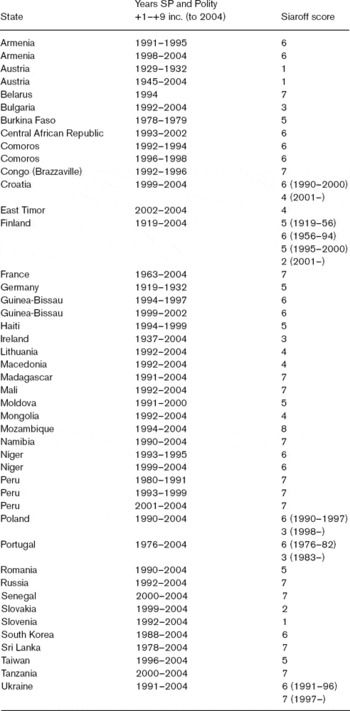
In this article, we assume that countries scoring 0 or below are insufficiently democratic for semi-presidentialism to have a negative effect on democratic performance. Equally, we assume that countries scoring +10 are fully consolidated and that again the institutional effects of semi-presidentialism will not affect democratic performance. However, within this range the supposed perils of semi-presidentialism may have an impact. Table 2 identifies all countries with semi-presidential constitutions that have been placed in the range +1 to +9 by Polity. We include countries, such as the Comoros, Congo-Brazzaville, Moldova, and Weimar Germany, which were semi-presidential for a period when they scored within that range, but have since abandoned semi-presidentialism. Each year that a country was semi-presidential and scored in the range +1 to +9 is one observation. There are 393 observations in total. This is a very unbalanced sample: 36 countries are observed across a period of 86 years. The number of years for which countries are observed ranges from one (Belarus) to 42 (France). The first country to be observed is Germany from 1919 to 1932, while Timor-Leste does not enter the dataset until 2002.
Semi-presidential case selection and power of the president

Given that we cannot use the Polity measures as a continuous variable, we dichotomize the dependent variable to measure the performance of democracy. Thus, we distinguish between two categories of countries – those that score in the range +1 to +5 inclusive (anocracies) and those that score in the range +6 to +9 (democracies). We assume that the three purported disadvantages of semi-presidentialism will be associated with poor democratic performance and, hence, with anocracies rather than democracies. In our sample, 32.7% of the observations are anocracies.
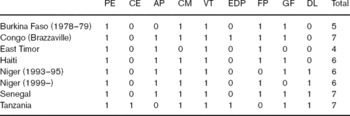
We have three explanatory variables. The first explanatory variable is the power of the president. We hypothesize that powerful presidents will be associated with anocracies rather than democracies. To measure the power of presidents, we use the scale proposed by Siaroff (Reference Siaroff2003). He identifies nine constitutional indicators of presidential power. He gives a value of 1 if the constitution includes the indicator and 0 otherwise. He then measures the powers of presidents cross-nationally within a range of 0 to 9.Footnote 3 The scores for the countries in our sample are given in Table 2. In a small number of cases, we had to measure the power of presidents ourselves because Siaroff did not code them. These scores are provided in Table 3. For our sample, the minimum score in Siaroff's schema is 1 because one of his indicators is the direct election of the president and all of the countries in our sample will score 1 for this indicator. Overall, our sample is skewed towards semi-presidential countries with strong presidents: the mean is 5.9 along a range of 1 to 9.
Presidential powers in semi-presidential countries not measured by Siaroff
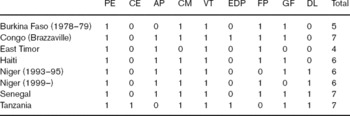
Notes: PE = popularly elected; CE = concurrent presidential and legislative elections; AP = discretionary appointments powers; CM = chairs cabinet meetings; VT = veto power; EDP = long-term emergency or decree powers; FP = central role in foreign policy; GF = central role in government formation; DL = ability to dissolve the legislature
Scores based on the indicators in Siaroff (Reference Siaroff2003).
The second explanatory variable is cohabitation. We hypothesize that cohabitation will be associated with anocracies rather than democracies. To identify periods of cohabitation, we began by consulting www.worldstatesmen.org. This is a very thorough and reliable data source. It provides the names and terms of office of all presidents and prime ministers. It also records their party affiliation. We identified all cases when the party affiliation of the two executive actors was specifically identified and when it was different. We excluded cases where either the president or the prime minister was classed as non-partisan. We then consulted secondary sources to confirm whether the cases where the party affiliation of the president and the prime minister were different were examples of coalition government – namely where the president and prime minister were from different parties but where the president's party was represented in government – or cohabitation – the situation where the president and prime minister were from opposing parties and where the president's party was not represented in government. Cohabitation is quite rare in our sample: it accounts for only 9.4% of 393 observations.
The third explanatory variable is divided minority government. We hypothesize that divided minority government will be associated with anocracies rather than democracies. We identified periods of divided minority government by consulting the World Bank's Database of Political Institutions (DPI).Footnote 4 This dataset has an entry called ‘Majority’. The DPI codebook states that this entry records ‘the fraction of seats held by the government’. It is calculated by dividing the number of government seats by the total number of seats in the main house of the legislature. When the score for ‘Majority’ was below 50% in a given year, we coded the case as a period of minority government. The DPI database only goes back to 1975. This range covers most of our examples. For pre-1975 cases, we use secondary sources to determine whether or not there was minority government. In our sample, minority government occurs in 21.1% of our observations.
There are six control variables: wealth, population, legislative fractionalization, and ethnic fractionalization, as well as dummies for Europe and the post-Cold War era. We follow the literature in taking the natural logarithm of GDP per capita and population as the first two control variables. More wealthy countries are expected to be associated with democracies as are those with smaller populations. We take data for GDP per capita in 1990 Geary-Khamis dollars and population from the Total Economy Database of the University of Gröningen Growth and Development Centre (http://www.ggdc.net/dseries/totecon.shtml). For missing values and pre-1950 figures, we use Angus Maddison's data set of Historical Statistics for the World Economy (http://www.ggdc.net/Maddison/). In effect, this data set is the precursor of the Total Economy Database and there is a very high correlation between the two. For Timor-Leste's population we used the World Bank's World Development Indicators. There is a wide variation on each of both the GDP and population measures. The third control variable is legislative fractionalization. The more fragmented the legislature, the more difficult it is to sustain democracy. Therefore, the greater the fractionalization, the more likely a country is to be an anocracy. For this measure, we use the effective number of political parties. We rely mainly on Michael Gallagher's data set (http://www.tcd.ie/Political_Science/staff/michael_gallagher/ElSystems/Docts/ElectionIndices.pdf). We also use Sarah Birch's (Reference Birch2003) calculations for early Central and East European elections. We calculated any missing values ourselves. The mean figure for ENPP is 3.6 across our 393 observations. Finally, we included Alesina et al.'s Reference Alesina, Devleeschauwer, Easterly, Kurlat and Wacziarg2002 figures for ethnic fractionalization, except for Timor-Leste where we used the figure for linguistic fractionalization. Semi-presidentialism has become much more widespread in the aftermath of the Cold War: only 28% of the observations predate 1990. Also, 56% of the observations are for European countries.
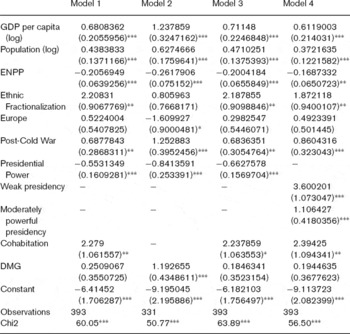
We did not opt for full fixed-effects estimation because of the radically imbalanced nature of our panel. However, we do test for country effects by dropping one by one all of the countries that appear for over ten years in the dataset. Our model is a pooled logit with NeweyWest standard errors to correct for heteroskedasticity and autocorrelation. We present four models in Table 4. The first is our basic model and the other three test its robustness to sampling and measurement issues. It is worth mentioning the performance of the controls included in all equations. As the literature would predict, the wealth variable is always a significant predictor of democracy. In contrast to previous studies, a larger population is associated with democracy. This effect may be due to the fact that micro-states are already excluded from the Polity data set. Unsurprisingly, the effective number of parties is associated with anocracy. However, ethnic fractionalization is associated with democracy, although its coefficient is not always significant. It seems likely that in our analyses much of the effect of ethnic fractionalization is channelled through the party system. The post-Cold War era is always positively and significantly associated with democracy. The results for the European dummy are inconsistent across the equations.
Logit analyses of semi-presidentialism and democratic performance

Notes: Cell entries are coefficients with Newey-West standard errors in parentheses set for a maximum lag of one. *Denotes p < 0.10. **Denotes p < 0.05. ***Denotes p < 0.01. In model 2, cohabitation perfectly predicts the dependent variable and has been dropped from the equation.
We will now discuss our semi-presidential variables equation by equation. As predicted, presidential power is bad for democracy. The presidential power coefficient is in the right direction and is highly significant. Logit coefficients are difficult to interpret directly. However, we can compare the probabilities for different values of the index of presidential power. Taking an average European post-Cold War observation in terms of GDP, population, party system, and ethnic fragmentation, without divided majority government or cohabitation and the maximum level of presidential power, then the probability of democracy is 0.51. Holding all else equal but reducing presidential power to the minimum the probability of democracy doubles to approach certainty −0.98. These figures are clearly substantively, as well as statistically, significant.
By contrast, the cohabitation variable is significantly in the wrong direction. The minority government hypothesis is insignificant and in the wrong direction.
We tested the robustness of these conclusions to the inclusion of countries in our sample by rerunning the model, while excluding one-by-one all 20 country cases that were observed for at least ten years. None of these exclusions made a substantive difference to the models, in terms of significance level and/or sign of coefficient, except for Sri Lanka. In model 2, we can see that the exclusion of Sri Lanka does not modify our conclusion regarding presidential power. Neither does the significantly positive result for divided minority government provide a basis for re-evaluating this variable. Nonetheless, model 2 is quite revealing in respect of cohabitation. Sri Lanka 2003 is the only observation of cohabitation in an anocracy. As we noted already, cohabitation is very rare in semi-presidential regimes. It is even rarer outside Europe: Niger, Sri Lanka, and Mongolia are the only non-European countries to have experienced cohabitation, for one, two, and three years respectively. In short, we suspect our striking finding on cohabitation is more likely a result of its rarity than it operating according to a logic, which is radically different to that outlined in the qualitative literature.
We also investigate the robustness of our models to two measurement issues. Sudden shifts in the Polity rating of countries may affect our conclusions. For example, according to our measure, described above, a democracy that underwent a sudden transition from democracy to autocracy, without going through even one year of anocracy would simply drop out of the dataset and no decline in democratic performance would be registered. Conversely, a country might move directly from anocracy to consolidated democracy without an increase being noted. There are seven cases of such sudden regime change in our sample (Belarus 1994, Austria 1932 and 1945, Peru 1991, Niger 1995, Germany 1932, and Finland 1943). We recoded each of these to record a shift to anocracy or democracy, as appropriate, before the country exits the dataset. As model 3 shows, this did not affect our conclusions.
Finally, we recode Siaroff's scale of presidential power. The literature tends to conceptualize presidential power under semi-presidentialism in terms of three ranked categories: strongly, moderately, and weakly presidential. We coded all countries with scores of over five as strongly presidential, those with scores of four or five as moderately presidential, and all those below four as weakly presidential. The vast majority of observations are strongly presidential, 22% are balanced, while only 10% are weakly presidential. The results in model 4 support our previous conclusions. Both moderately and weakly presidential systems outperform strongly presidential systems and have statistically significant coefficients. The dummy for weak presidents is much bigger than that for moderately powerful presidents. Taking the same values as in our illustration of the presidential power index, the probability of democracy in a weakly presidential system is 0.99. In a balanced system it is 0.86, and in strongly presidential systems it is 0.68.
Discussion
There are three major arguments against semi-presidentialism. The findings in the previous section showed that there was evidence to support one of those arguments but not the other two. In countries with a semi-presidential constitution, when the powers of the presidency are great, the performance of democracy is likely to be less good. However, when there is cohabitation and when there is a minority government, there is no statistical association with poor democratic performance, despite the prevailing academic wisdom. What might account for these findings?
In semi-presidential countries with strong presidents, there is the opportunity for the cumulation of powers in a way that resembles pure presidential systems. Under semi-presidentialism, a president who is supported by a parliamentary majority is able to appoint a loyal prime minister whose constitutional powers can also be called upon to implement the president's agenda. In this event, already enjoying considerable constitutional power in his/her own right, the president can exercise further powers indirectly because of the acquiescence of the prime minister. Given the supportive majority in the legislature, this situation means that there are very few constraints on the president's executive and legislative powers. In this scenario, there is little incentive for the president to share power and there is little opportunity for the opposition to have any influence over decision making. By contrast, there is plenty of opportunity for the president to pursue a self-interested agenda to the detriment of the quality of democracy. There is evidence to suggest that this situation is at least partly responsible for the problems of democratic consolidation in countries like Peru in the early 1900s, Mozambique, Namibia, and Tanzania.
That said, the association between strong presidents and poor democratic performance needs to be placed in context. While the association may be strong statistically, there is always the possibility that the problems experienced by countries with strong presidents may pre-date the adoption of semi-presidentialism. In other words, strong semi-presidential presidents may not be the cause of poor democratic performance. Instead, poor democratic performance may be endogenous to the selection of this form of semi-presidentialism. For example, Mozambique, Namibia, and Tanzania all began the process of democratization in the context of systems in which one party was dominant and where strong and/or historic leaders were already in power. In this context, while the maintenance of an anocracy with some democratic credentials may still be a remarkable achievement, the inability to establish a full democracy may be at least partly the result of the founding context rather than the exogenous impact of the particular form of president-dominant semi-presidentialism that can be found in these countries.
The absence of any statistically significant association between cohabitation and poor democratic performance runs counter to the standard academic consensus. In part, this may be because cohabitation is a relatively rare phenomenon. The association may become stronger as more countries experience semi-presidentialism and for longer periods of time. In addition, while cohabitation may not be associated with a poorer standard of democracy, there is anecdotal evidence to suggest that it does have an impact on the decision-making process more generally. For example, in France there have been three periods of cohabitation. Each time, it has raised issues in the area of foreign and defence policy making and in terms of France's policy towards the European Union. In the most recent period of cohabitation from 1997 to 2002, competition between right-wing President Chirac and left-wing Prime Minister Jospin caused particular problems. So, in the aftermath of the 9/11 attack on the US, President Chirac announced on television that France would take part in military operations in Afghanistan, whereas the next day the socialist Defence Minister, Alain Richard, stated that discussion with the Americans were still ongoing. This example indicates that cohabitation should not be ignored as a source of conflict. However, it does not provide evidence that it is democratically destabilizing.
The association between cohabitation and relatively good democratic performance may suggest that one of the main arguments in favour of semi-presidentialism has some basis. The main reason for supporting semi-presidentialism is because the dual nature of the executive can ensure that power is not a zero-sum game and that political actors from competing and/or opposing forces may have the opportunity to share power (Lijphart, Reference Lijphart2004: 102). This can give each of them a stake in the system and can help the consolidation of democracy. The research strategy in this article was not designed to provide evidence to either support or refute this hypothesis. However, the presence of cohabitation in the early years of democracy in semi-presidential countries such as Bulgaria, Mongolia, and Portugal may have helped the process of consolidation, even if it was a situation that neither the president nor the prime minister actively desired. Thus, while there is a clear association between cohabitation and the collapse of democracy in Niger in January 1996, overall there is at least some evidence to suggest that far from being problematic cohabitation may provide some power-sharing benefits for semi-presidential countries.
The absence of any significant relationship between minority government and poor democratic performance also runs counter to one of the more recent arguments against semi-presidentialism. There are individual cases that seem to support the problems associated with divided minority government. For example, there was minority government in Armenia some time prior to the complete collapse of democracy. However, at the time when it was experiencing minority government, Armenia was classed as a democracy by Polity, rather than as an anocracy. Thus, it may be the case that minority government contributed to a weakening in the foundations of democracy rather than an immediate decline in democratic performance per se. If correct, this point would be consistent with Skach's (Reference Skach2005) study of Weimar Germany. Here, minority government occurred a number of years prior to the final collapse of democracy. So, there is no direct association between the two. However, Skach argues that divided minority government was destabilizing and created a general situation that resulted in the decline of democracy a few years later.
There is also a sense in which the impact of divided government may be underestimated by the methodology used in this article. For example, in a couple of cases – notably Armenia and Belarus – the decline in the countries’ Polity scores was swift. Both of these countries went from the status of a democracy to an autocracy, and hence exited from the dataset, within the space of one or two years. These countries both experienced minority government but they did so when they occurred in our dataset as democracies. Thus, minority government may have had a negative effect on democratic performance, but it is not captured in our dataset because the country did not go through a long-term period of anocracy when there was divided minority government.
In addition, we have used the absence of a legislative majority as our proxy for divided minority government. While Skach (Reference Skach2005: 116) states that divided minority government is the case where ‘neither the president nor the prime minister has a legislative majority’, she adds that ‘the president is usually also divided against the prime minister’ (ibid.) and she calls this the ‘most difficult subtype of the semi-presidential model’ (ibid.). This suggests that, for Skatch, the most problematic cases are those where there is both cohabitation and minority government. Thus, our proxy may not have quite captured the most dangerous scenario that Skach identifies. That said, while 21% of our total number of observations were cases of minority government, only 11 observations combined cohabitation and minority government. They included short periods in France, Weimar Germany, and Poland. However, only in Sri Lanka 2003 was it also associated with an anocracy. Thus, while Skach may have identified a scenario that is potentially problematic, it is also particularly rare in terms of how we have defined democracy and anocracy. Altogether, we find no significant association between either minority government and poor democratic performance or the combination of both cohabitation and minority government and poor democratic performance.
Overall, the findings for minority government are not sensitive to the inclusion of particular countries. Indeed, the dataset provides no evidence at all for the negative effect of minority government. Certainly, more work needs to be conducted on the potentially negative effects of divided minority government, but no support is found for any such effects in this article.
Conclusion
This article has demonstrated that the conventional wisdom about semi-presidentialism needs to be reconsidered. We do not claim that semi-presidentialism should be adopted or that semi-presidentialism is a better constitutional choice than either presidentialism or parliamentarism. However, we have demonstrated that there is no evidence to support two of three main arguments against semi-presidentialism, namely those that emphasize the supposedly harmful effects of cohabitation and divided minority government. There are individual cases where these situations have led more or less directly to a decline in democratic performance or even a collapse of democracy. Overall, though, there is no significant relationship between either of these two situations and democratic performance.
By contrast, we have shown that there is strong evidence to support the conventional wisdom that semi-presidential countries with strong presidents are likely to be associated with poor democratic performance. The importance of this finding lies in more than just the statistical confirmation of a received wisdom that was previously based on anecdotal evidence. We have demonstrated that academics need to pay more attention to studying the effects of different types of semi-presidentialism. In this context, we have also demonstrated that constitution builders have a choice as to which type of semi-presidentialism to adopt. If constitution builders wish to adopt semi-presidentialism or if politically they have no option but to adopt semi-presidentialism, then the advice to them is clear. If you must choose semi-presidentialism, then choose a form of semi-presidentialism where the president has very few powers.
In October 2007, Turkish voters approved a constitutional amendment introducing a semi-presidential system. More than that, they approved the introduction of semi-presidentialism in a system where the president is a powerful figure. The findings of this article suggest that this form of semi-presidentialism is associated with poorer democratic performance than the situation where the semi-presidential president is more of a figurehead. Assuming the findings of this article are correct, then, all else equal, we predict a decline in the future performance of Turkish democracy.