Background
Loneliness has been described in the media as a major health and social issue confronting older people (Sample Reference Sample2014). The prevalence of loneliness among older Australians is similar to that found in other countries, including the United Kingdom (UK) and Finland, with about 7 per cent of those aged 65 and over experiencing severe loneliness (Steed et al. Reference Steed, Boldy, Grenade and Iredell2007). This is particularly marked for those considered ‘old old’ (80 and over) who experience a rate of loneliness second only to those aged 15–24 (Dykstra Reference Dykstra2009). Further, longitudinal research has demonstrated that older people tend to become lonelier over time, especially if they lose their partner (Dykstra, van Tilburg and de Jong Gierveld Reference Dykstra, van Tilburg and de Jong Gierveld2005). Thus far, the evidence that loneliness is more common among lower socio-economic groups is mixed (Honigh-de Vlaming et al. Reference Honigh-de Vlaming, Haveman-Nies, Bos-Oude Groeniger and van't Veer2014), although it has been associated with unemployment and lower education levels (Meltzer et al. Reference Meltzer, Begginton, Dennis, Jenkins, McManus and Brugha2013). Increasingly, researchers are turning their attention to the experience of loneliness in marginalised groups, with reports that loneliness is greater among non-Anglo migrant communities in Australia (Hawthorne Reference Hawthorne2008), as well as among African Caribbean, Chinese, African, Bangladeshi and Pakistani communities in Britain (Victor, Burholt and Martin Reference Victor, Burholt and Martin2012).
The question has also arisen about the experience of loneliness among lesbian, gay, bisexual, transgender and intersex (LGBTI) seniors (e.g. Heaphy Reference Heaphy2007). This has emerged in the context of a growing cultural, social and political awareness of the needs and rights of LGBTI older people, at least in some parts of the world, such as North America, Europe and Australia. Until recently, little attention has been given to the gender and sexually diverse nature of the older population resulting in LGBTI people being invisible in a wide range of settings and encounters, including in the delivery of social services in the home and in residential care (Bayliss Reference Bayliss2000). This invisibility has been reinforced by decades of discrimination involving the medicalisation and criminalisation of non-normative sex and gender characteristics and behaviours – an environment in which ‘institutional homophobia was sanctioned’ (Barrett et al. Reference Barrett, Whyte, Comfort, Lyons and Crameri2015: 138). For example, in the latest American Psychiatric Association Diagnostic and Statistical Manual of Mental Disorders (DSM-5), gender variance continues to be classified as a disorder (framed as gender dysphoria) (American Psychiatric Association 2013; Lev Reference Lev2013), and it was not until 1997 that the last Australian state (Tasmania) decriminalised homosexuality (when an 80-year-old gay man in 2015 was 62). Heteronormative (i.e. the presumption of heterosexuality) policies and practices have reinforced this invisibility and led to strategies for not only developing services targeted at LGBTI seniors, but also ensuring that mainstream services become LGBTI-friendly and accessible (Hughes Reference Hughes2007).
Initial studies of older LGBTI people have reported higher levels of loneliness among some of these populations than among the general population. For example, in Fokkema and Kuyper's (Reference Fokkema and Kuyper2009) study of people aged 55–89, the rate of loneliness among gay and bisexual men was about double that of heterosexual men, while the rate among lesbians and bisexual women was about 1.5 times that of heterosexual women. Similarly, the proportion of those identified as seriously lonely was much higher among gay and bisexual men (19%) than heterosexual men (2%), as it was among lesbians and bisexual women (14%) compared to heterosexual women (5%). Lesbian and gay people also commonly express concerns about becoming lonely or being left unsupported in later life. Hughes (Reference Hughes2010) reported that, in an Australian study, 10.5 per cent of 371 lesbian and gay adults believed that they would have no one to provide them with emotional support in later life. Notably, gay men were more likely than lesbians to believe this was the case. No studies have been identified that have specifically investigated the experience of loneliness among transgender and intersex older people. Although there are some indications it may be a key concern for transgender people given the challenges maintaining a support system if the person becomes estranged from family and friends when they transition (Persson Reference Persson2009).
Loneliness has been described as a perceived discrepancy between actual and desired social relationships (Shiovitz-Ezra and Leitsch Reference Shiovitz-Ezra and Leitsch2010). According to de Jong Gierveld et al. (2009: 497), it is a ‘subjective and negative experience, the outcome of cognitive evaluation of the match between the quantity and quality of existing relationships and relationship standards’. It is distinguished from social isolation in that loneliness is more about dissatisfaction with social connections rather than simply their lack or absence (de Jong Gierveld et al. Reference de Jong Gierveld, Broese van Groenou, Hoogendoorn and Smit2009). That is, loneliness is about perceived rather than objective social isolation (Hawkley and Cacioppo Reference Hawkley and Cacioppo2010). Indeed, there is some evidence that social isolation and loneliness are only weakly correlated (Cornwell and Waite Reference Cornwell and Waite2009; Coyle and Dugan Reference Coyle and Dugan2012).
The health consequences of loneliness have been given considerable attention in recent years with a wide range of morbidities – including hypertension, coronary heart disease, depression and cognitive impairment – associated with high levels of loneliness (Hawkley and Cacioppo Reference Hawkley and Cacioppo2010). A meta-analysis of social relationships and mortality risk (Holt-Lunstad, Smith and Layton Reference Holt-Lunstad, Smith and Layton2010) reported that those with adequate social relationships have a 50 per cent greater chance of survival compared to those with inadequate social relationships, which the authors argued is comparable to quitting smoking. However, conceptual confusion between social isolation and loneliness has complicated the analysis of their impacts on physical and mental health (Cornwell and Waite Reference Cornwell and Waite2009). When careful distinction between them is made, it appears that they are independently associated with lower physical health status, but that the relationship between social isolation and lower mental health is mediated by loneliness. That is, ‘socially disconnected older adults have worse mental health only to the extent that they feel isolated’ (Cornwell and Waite Reference Cornwell and Waite2009: 43). Despite this research on the general population, there is limited evidence of the relationship between loneliness and physical and mental wellbeing among older LGBTI populations. In one of the few studies, Grossman, D'Augelli and Hershberger (Reference Grossman, D'Augelli and Hershberger2000) reported in their sample of 416 LGB people aged 60 and over that those who lived with partners reported better physical and mental health than those who lived alone. In the same study, associations were identified between loneliness and mental health, as well as suicidal ideation (D'Augelli et al. Reference D'Augelli, Grossman, Hershberger and O'Connell2001).
In general population studies, reports of loneliness tend to be higher among those older people who live alone and who are not in a relationship (Koc Reference Koc2012; Shiovitz-Ezra and Leitsch Reference Shiovitz-Ezra and Leitsch2010). This has also proved to be the case in the initial studies of older LGB populations. Grossman, D'Augelli and Hershberger (Reference Grossman, D'Augelli and Hershberger2000) found that those LGB people who lived with their partners were significantly less lonely than those who lived alone. The higher rates of loneliness among LGB populations may, in part, be due to the fact that LGB people are more likely to live alone and are less likely to be in a long-term relationship than other people in the same age range (Adelman et al. Reference Adelman, Gurevitch, de Vries, Blando, Kimmel, Rose and David2006; Fokkema and Kuyper Reference Fokkema and Kuyper2009). These factors may be partly compensated for by the considerable meaningful contact LGB people have with their friends (Fokkema and Kuyper Reference Fokkema and Kuyper2009; Grossman, D'Augelli and Hershberger Reference Grossman, D'Augelli and Hershberger2000), commonly referred to as ‘chosen family’. However, again, there is limited evidence of the impact of these factors on loneliness among transgender and intersex older people.
Social support is another important factor that is associated with both loneliness (Schnittger et al. Reference Schnittger, Wherton, Prendergast and Lawlor2012) and wellbeing (de Jong Gierveld and Dykstra Reference de Jong Gierveld and Dykstra2008). Most older people expect to receive support from biological family members, including adult children (Lin and Wu Reference Lin and Wu2014). However, LGB people are less likely than the general population to have children and are sometimes estranged from biological family members (Cronin Reference Cronin, Daatland and Biggs2004). Many rely on friendship networks – their ‘chosen family’ – which may comprise same-sex partners, close friends and social acquaintances (Cronin Reference Cronin, Daatland and Biggs2004; Grossman, D'Augelli and Hershberger Reference Grossman, D'Augelli and Hershberger2000). In the Australian study noted earlier (Hughes Reference Hughes2010), it was reported that nearly 56 per cent of lesbian and gay respondents expected to receive emotional support from partners, 59 per cent from LGBT friends and 49 per cent from non-LGBT friends. Nearly 54 per cent expected to receive physical support from partners, 36 per cent from LGBT friends and 25 per cent from non-LGBT friends.
Interventions designed to reduce loneliness have typically focused on engaging people in social activities, with the aim of building social support (Routasalso et al. Reference Routasalo, Tilvis, Kautiainen and Pitkala2009; Savikko et al. Reference Savikko, Routasalo, Tilvis and Pitkälä2010; Stewart et al. Reference Stewart, Craig, MacPherson and Alexander2001). Group activities with educational input or targeted support have been identified in a systematic review as particularly effective (Cattan et al. Reference Cattan, White, Bond and Learmouth2005). Savikko et al. (Reference Savikko, Routasalo, Tilvis and Pitkälä2010) reported positive outcomes regarding loneliness and social support from psycho-social group interventions with older people living at home. Older people chose to participate in one of three groups that focused on art, exercise or writing. Health promotion activities have also been identified as important interventions for those at risk of loneliness or social isolation (Wilson et al. Reference Wilson, Harris, Hollis and Mohankumar2010). For example, a targeted health promotion programme involving 15 lessons on topics such as nutrition, personal safety and managing financial resources produced significant improvements in loneliness, sense of mastery and stress (Collins and Benedict Reference Collins and Benedict2006). Thus far, there is limited evidence of the engagement of LGBTI older people in these kinds of social and health-promoting activities, with little indication of what kinds of activities LGBTI seniors may be interested in.
The study reported on in this paper sought to investigate the health and wellbeing of LGBTI people aged 50 and over living in New South Wales, Australia. The focus of this paper is on their experience of loneliness and social support, as well as their preferences for participating in health and social activities with other people in the future. In line with the literature on loneliness, it was hypothesised that those who were living alone and who were not in a relationship would report higher levels of loneliness. It was also expected that those experiencing higher levels of loneliness would report higher levels of psychological distress, as well as lower health-related quality of life.
Method
The survey was delivered in online and paper-based form between March and December 2013. The sample was recruited through non-probability convenience methods due to the prohibitive cost of generating a probability sample from this population. The online survey was distributed by LGBTI community organisations, aged care providers and other community agencies through e-mail newsletters, advertisements on websites, and also through social media, such as Facebook and Twitter. The paper-based survey was made available in organisations’ reception areas, and was handed out during community meetings and seminars. While the initial response to the release of the survey was encouraging, it came almost exclusively from the Sydney metropolitan area. Two outreach trips to central and northern New South Wales subsequently helped boost regional participation. The study was approved by the Human Research Ethics Committee of Southern Cross University.
Survey respondents were required to identify as lesbian, gay, bisexual, transgender or intersex, be aged 50 or over, and be primarily resident in New South Wales. The decision to focus on LGBTI people reflected a trend in Australia to include intersex people in policies, programmes and research that examine discrimination based on gender and sexual diversity. This is reflected in recent changes to federal law, the Sex Discrimination Amendment (Sexual Orientation, Gender Identity and Intersex Status) Act 2013, and policy, such as the development of the National LGBTI Ageing and Aged Care Strategy (Department of Health and Ageing 2012). The decision to set the age criteria as 50 or above reflects a focus of this study on ageing and health promotion. While those aged 50–64 may not typically be consider ‘older’ or in ‘later life’, it was felt that these people were at a key point in the lifecourse to make changes to their life to improve healthy ageing. The focus on those living in New South Wales was based on the funding requirements of the project. The data of respondents who did not meet these criteria were removed from the study.
The survey comprised both forced-choice and open-ended questions generating quantitative and qualitative data, respectively. Demographic variables included: sex assigned at birth (female, male, intersex); current gender (female, male, trans female to male, trans male to female, gender queer, other); sexuality (asexual, bisexual, gay man, lesbian, heterosexual, queer, other); having a partner (yes, no); and co-habitation (no one, partner, children, parents, friends, others who are not friends, other). For the purposes of the analysis presented in this paper, this latter variable was recoded: lives alone, lives with others. Location was assessed by asking participants what area they live in, with the options: metropolitan Sydney, regional city, regional town, rural area. Respondents were also asked to provide a postcode, which was used to check the accuracy of the location selected.
The key dependent variables reported on in this paper are: loneliness, psychological distress and health-related quality of life. Loneliness was measured by the three-item Loneliness Scale, based on the R-UCLA Loneliness Scale, and designed specifically for large surveys (Hughes et al. Reference Hughes, Waite, Hawkley and Cacioppo2004). Scores can range between 3 and 9, with the higher score indicating the greater the degree of loneliness. Internal consistency between the items in the scale has been reported at Cronbach's α = 0.72 (Hughes et al. Reference Hughes, Waite, Hawkley and Cacioppo2004) and α = 0.82 (Coyle and Dugan Reference Coyle and Dugan2012). In this study α = 0.87 was achieved. A high degree of correlation with the longer R-UCLA scale has been established (r = 0.82, p < 0.001) (Hughes et al. Reference Hughes, Waite, Hawkley and Cacioppo2004). Further detail on discriminant and convergent validity of this scale can be found in Hughes et al. (Reference Hughes, Waite, Hawkley and Cacioppo2004).
Psychological distress was measured by the Kessler 10 instrument, which has strong psychometric properties (Kessler et al. Reference Kessler, Andrews, Colpe, Hiripi, Mroczek, Normand, Walters and Zaslavsky2002). In this study, the Cronbach's α for the Kessler 10 was 0.89. Scores can range from 10 to 50 with scores between 10 and 15 indicative of low distress, 16 and 21 moderate distress, 22 and 29 high distress, and 30 and above very high (Australian Bureau of Statistics 2011). The Kessler 10 is used widely in general population health studies, including the Australian Health Survey (Australian Bureau of Statistics 2011) and the 45 and Up study (Phongsavan et al. Reference Phongsavan, Grunseit, Bauman, Broom, Byles, Clarke, Redman and Nutbeam2013).
Health-related quality of life was assessed by the SF-12, a well-validated instrument based on the SF-36, and which is used to produce physical health and mental health summary scores (Ware, Kosinski and Keller Reference Ware, Kosinski and Keller1996). Scores range between 0 and 100 with scores between 40 and 49 representing mild disability, 30 and 39 moderate disability, and below 30 severe disability (Andrews Reference Andrews2002). The SF-12 has proven robust across diverse populations, including people with severe mental illness (Salyers et al. Reference Salyers, Bosworth, Swanson, Lamb-Pagone and Osher2000). It predicted at least 90 per cent of the variance in both the physical health and mental health scales of the SF-36 in the Australian National Health Survey (Sanderson and Andrews Reference Sanderson and Andrews2002).
Additional questions were asked regarding social support and social activities. They included an indicator of the availability of friends to provide support: respondents were asked if they had LGBTI and non-LGBTI friends that ‘would be there for you in a crisis’. They were also asked, using a three-point scale (agree, neither agree nor disagree, disagree), if they believed that friends were more important to them than their biological family. Open-ended questions on social support provided opportunities to respondents to elaborate on their answers in qualitative detail. With respect to participation in future social and health-promoting activities, respondents were asked about the kind of activities they would like to be involved in. They were given 13 options to select from (ranking them definitely not, maybe, definitely would, or not applicable) and were also able to record additional activities. Finally, respondents were asked who they would like to participate in these activities with: alone, with women only, with men only, with other LGBTI people, with other transgender people, with people aged 50 or over only, with anyone.
The online survey was delivered via Qualtrics survey software. Hard-copy surveys were entered into this online program, then all the data were exported into IBM SPSS Statistics version 19. Quantitative data were analysed by descriptive statistics, including chi-square, independent samples t-test, ANOVA and Pearson r. Given the relatively small number of people identifying as intersex and transgender, it was not possible to include these categories in the bivariate analysis. The alpha was set at 0.05. The limitations of using inferential statistics for a non-probability sample are acknowledged. The qualitative data reported on in this paper were analysed thematically and then treated as categorical data and reported as frequencies and percentages.
Results
Demographic characteristics
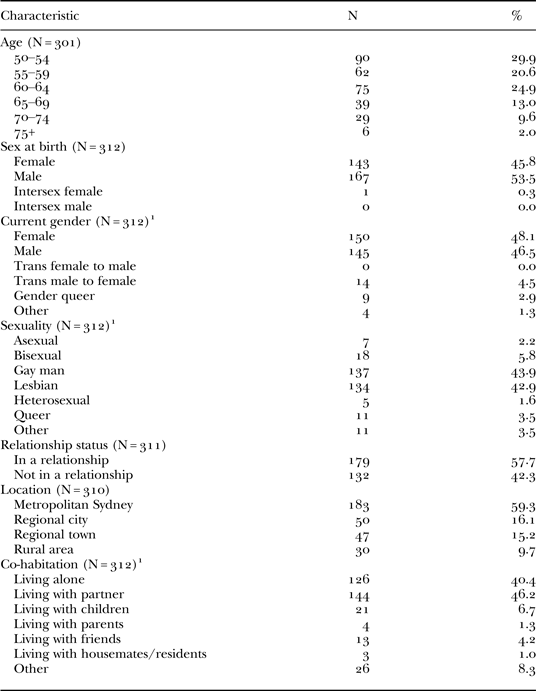
The demographic characteristics of the sample are presented in Table 1. The mean age of respondents was 59.87 (standard deviation (SD) = 7.186), with the oldest participant aged 84. Approximately 24.6 per cent of respondents were aged 65 or over. The majority of respondents (53.5%) identified that they were ascribed as male at birth, while only one person indicated that they were intersex. With respect to current gender, 48.1 per cent identified as female, and 4.5 per cent as trans male to female. The majority of respondents said that they are a gay man (43.9%) or a lesbian (42.9%). A small number of people (5.8%) identified as bisexual. A small proportion of people (1.6%), made up of those who are transgender, identified as heterosexual. The one intersex person who participated in the study said that there is ‘no current language to describe an Intersex sexual relationship’. The majority of respondents reported that they were in a relationship (57.7%) and that they were living with a partner (46.2%). Just over 40 per cent were living alone. While the majority of respondents were from metropolitan Sydney, 16.1 per cent were from a regional city, 15.2 per cent from a regional town and 9.7 per cent lived in a rural area.
Demographic characteristics

Note: 1. Respondents were able to select multiple options.
Loneliness
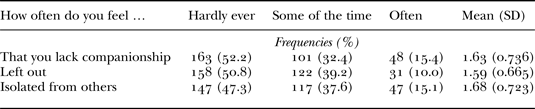
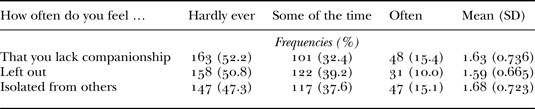
The mean score on the three-item Loneliness Scale was 4.877 (SD = 1.8609), while the median was 5.0. Table 2 presents the distribution of results across the three items. Using ANOVA, no significant associations were identified between loneliness and age, sex at birth, current gender, sexuality and location. With regard to the key LGBTI populations under study, the mean loneliness scores were 4.714 for lesbians (SD = 1.8377), 5.041 for gay men (SD = 1.9392), 4.438 for bisexual people (SD = 1.3647) and 4.846 for transgender people (SD = 1.8640). The one person who reported being intersex scored 5.0 on the loneliness scale.
Frequencies and mean scores on the 3-item Loneliness Scale
Note: SD: standard deviation.
As hypothesised, the experience of loneliness was significantly greater among those who lived alone (mean = 5.443, SD = 1.927) compared to those who lived with others (mean = 4.488, SD = 1.714) t(275) = 4.329, p < 0.001. It was also greater among those not in a relationship (mean = 5.815, SD = 1.436) compared to those who had a partner (mean = 4.166, SD = 1.953) t(274) = 8.087, p < 0.001. As expected, there were significant associations between greater loneliness and higher psychological distress r(260) = 0.630 p < 0.001, and lower mental health as reported on the SF-12 r(268) = −0.519, p < 0.05. Contrary to that hypothesised, loneliness was not associated with lower levels of physical health as measured by the SF-12.
Social support
The research was concerned with the degree to which respondents felt supported, particularly by biological family members. When asked about their friends and family, 31.0 per cent agreed with the statement ‘my friends are more important to me than my biological family’, while 17.6 per cent disagreed and 51.3 per cent neither agreed nor disagreed (N = 312). Those who agreed that friends are more important than family were significantly more likely to be lonely (mean = 5.363, SD = 1.817) than those who disagreed or who neither agreed nor disagreed (mean = 4.640, SD = 1.841) t(275) = 3.083, p < 0.01.
With regard to biological family members and whether or not they would support the respondent in a crisis, 57.8 per cent (of the 289 people who answered the question) reported positively. For example,
I have a son and a daughter from a previous marriage. Both children are supportive of my lifestyle and my partner. Their partners and family are also supportive and include my partner and I in family events. Other than my children I have no immediate relatives. My partner has siblings and they also are supportive of our relationship. I can't think of anyone in my family group who would not be there for us in a crisis. (Lesbian, aged 55)
I have an adult daughter, a son-in-law, two grandchildren, adopted cousins and an extended family of choice. Any of these people could be contacted in a crisis and all would respond. (Bisexual woman, aged 64)
Parents still alive and [I] have five siblings, three of whom know I am transgender. I have three children who know about me as well. In general terms my family would be supportive in a crisis. (Transgender woman, bisexual, aged 52)
I can count on my family. (Intersex woman, aged 60)
In contrast, 12.1 per cent indicated that they were estranged from biological family members and that they would not be able to rely on them for support:
My two living brothers are both homophobic and have excluded me from their lives and the lives of their families. I never see them. They would certainly not be there for me in a crisis. (Gay man, aged 63)
My wife is struggling with my desire to transition [as a transgender woman]. My adult children are more likely to support her than me. There is a big question as to whether any of them will come with me if I press on with my journey. (Transgender woman, heterosexual, aged 65) For 17.6 per cent, the distance between them and their biological family members was not due to estrangement, but rather to other issues, such as geographical distance and the impact of disability. For example,
I have one half-brother plus his family in South Australia, all other surviving relatives live in England and so being here in a crisis would be marginally practical only for the SA half-brother. (Gay man, aged 66)
Only child. Mother deceased. Father has advanced dementia. Unlikely to receive much support from cousins. (Gay man, aged 57)
All family overseas. (Bisexual man, aged 52)
For 12.5 per cent the degree of support received from biological family members was likely to be mixed:
I have a medium-size family. Most are fine about my sexuality and love my partner. I have two daughters 33 and 31 yrs. The younger one is homophobic and pretty cruel to me. She drains me of the support I receive. (Lesbian, aged 50)
Survey respondents were also asked specifically about their friends and who would be there for them in a crisis. With respect to LGBTI friends, 68.9 per cent said they had some in the same region as them to support them, while 70.8 per cent said they had some non-LGBTI friends in the same region who were able to provide support.
I have emotional/mental health support from friends, but not financial support. I have always rented a place near my friends and where I socialize. (Gay man, aged 55)
I am very fortunate to have a supportive family and partner, and good friends, particularly lesbians. (Lesbian, aged 56)
Some respondents commented that their reliance on LGBTI friends has shifted in later life, sometimes due to changes in health and other times due to a sense of exclusion from LGBTI communities. For example,
I ‘retired’ three years ago after a major stroke. Transition from ‘well’ to retired has meant the slow dilution of my gay friendship networks and their slow replacement by different sorts of networks based on common interests. (Gay man, aged 57)
I've always had some difficulty identifying with the gay community, despite having made many friends and having enjoyed many gay activities, but in recent years I have been finding it harder and harder to feel that I have anything in common with the ‘community’ as represented by the free gay press. (Gay man, aged 60)
Of the 312 respondents, 58 (18.6%) reported that they have no LGBTI friends who would be available to support them in a crisis. For one woman, this was a product of coming out as a lesbian later in life:
My best friends are straight and live a fair way from me. Because I was married and came out late in life I haven't had the support of a peer group … unlike women who come out early and lived in the gay community. (Lesbian, aged 64)
The rate of loneliness among those who had no LGBTI friends available to support them was significantly higher (mean = 5.667, SD = 1.818) than those who had at least one LGBTI friend (mean = 4.699, SD = 1.862) t(275) = 3.418, p < 0.001.
Fifty-six (17.9%) people had no non-LGBTI friends who would support them in a crisis. One person said:
I find I have not a lot in common with straight women and/or men. (Lesbian, aged 60)
In contrast with the reports regarding LGBTI friends, those who reported having no non-LGBTI friends were not more likely to experience a greater degree of loneliness than those who had at least one non-LGBTI friend who they could rely on in a crisis.
Of the 312 respondents, 31 (9.9%) reported having no friend at all who would support them in such a situation. For example,
I face the real prospect of facing old age lonely and isolated. My health has significantly deteriorated in the past year and I have experienced the frightful isolation and lack of support of living alone and without a support network. (Gay man, aged 60)
As might be expected, people who reported having no friends available to support them experienced a significantly greater degree of loneliness (mean = 5.552, SD = 1.806) than those who had at least one friend who was able to support them in a crisis (mean = 4.798, SD = 2.197) t(275) = 2.075, p < 0.05.
Interest in social and health-promoting activities
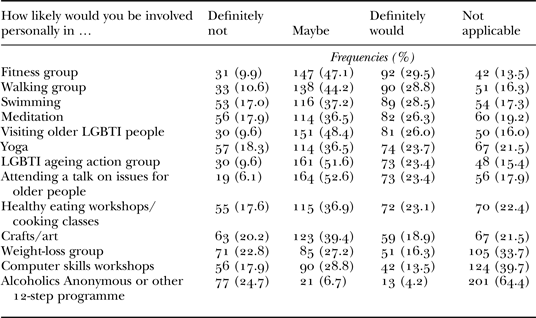
Respondents were asked about a series of social and health-promoting activities to gauge their interest in participating in them in the future. Table 3 presents these findings, rank ordered in terms of those activities with the largest proportion saying they would definitely want to be involved in them. The most popular activities were fitness group, walking group, swimming and meditation, while the least popular were attending Alcoholics Anonymous or similar 12-step programme, computer skills workshops, weight-loss group and craft/arts group. Interestingly, while a considerable proportion of people said they would definitely like to be involved in meditation, yoga and swimming, a good number said they definitely did not want to participate in those activities.
Social and health-promoting activities

Note: LGBTI: lesbian, gay, bisexual, transgender and intersex.
Some associations were identified between preferred activities and other variables. People who scored higher on the three-item Loneliness Scale were significantly more likely to definitely want to be involved in craft/arts groups than those who scored lower (31.6% versus 15.5%) χ2(2, 217) = 12.669, p < 0.01. Further, those who reported higher levels of loneliness were more likely to definitely want to be involved in an LGBTI ageing action group (33.9% versus 20.5%) χ2(2, 236) = 5.913, p < 0.05. Respondents’ age did not appear to be associated with their interest in participating in different activities, with the exception of a walking group. In this sample, more younger people reported being interested in this activity than the older people (41.7% of those aged 50–54 versus 22.2% for those aged 65+) χ2(6, 252) = 13.912, p < 0.05. With respect to gender, those identifying as female were significantly more likely than others to say they would definitely be involved with swimming (42.5% versus 25.8%) χ2(2, 258) = 10.897, p < 0.01, and walking groups (42.3% versus 26.7%) χ2(2, 261) = 7.053, p < 0.05.
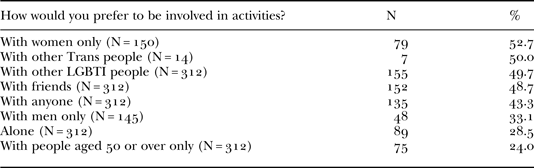
The research also sought to understand with whom respondents would like to be involved in these activities. Table 4 presents these results rank ordered in terms of percentage, noting that the items ‘with women only’, ‘with men only’ and ‘with other Trans people’ were calculated as a proportion of these respective sub-groups. More women (52.7%) wanted to participate in activities only with other women compared to men wanting to participate only with other men (33.1%). Half of the transgender people in the study (7/14) said that they wanted to be involved in activities with other trans people. Nearly half (49.7%) of the whole sample wanted to participate in activities with other LGBTI people, while 43.3 per cent did not mind who they participated with. Twenty-four per cent said that they only wanted to participate in activities with people who were aged 50 or over.
Preferred co-participants in social and health-promoting activities

Notes: Respondents were able to select multiple options. LGBTI: lesbian, gay, bisexual, transgender and intersex.
Some significant relationships were identified between preferred co-participants and other key variables. Wanting to participate in activities with other LGBTI people was more likely to be reported by those not in a relationship (57.6% versus 43.6% of people in a relationship) χ2(1, 311) = 5.957, p < 0.05; and by those experiencing greater loneliness (63.1% versus 38.2%) χ2(1, 277) = 17.154, p < 0.001. While wanting to participate in activities with people aged 50 and over was not associated with loneliness, it was associated with not being in a relationship relationship (31.1% versus 18.4%) χ2(2, 311) = 6.678, p < 0.05; and living alone (32.5% versus 18.3%) χ2(1, 312) = 8.365, p < 0.01.
Discussion
The experience of loneliness reported in this study of 312 LGBTI people aged 50 and over was greater than that reported in similar studies of the general population that also used the three-item Loneliness Scale. The mean score of 4.877 in this study compares unfavourably with 4.395 reported in a nationally representative study of 11,825 people aged 50 and over in the United States of America (USA) (Coyle and Dugan Reference Coyle and Dugan2012). In another US study of a nationally representative sample of 3,005 people aged 57–85, the mean loneliness score was 3.99. While gay men reported, on average, a higher level of loneliness than lesbians, bisexual people, transgender people and the one intersex person, this was not a statistically significant difference.
Other patterns in the data reflected previous findings on the general population, including the relationships between loneliness and living alone (Koc Reference Koc2012; Shiovitz-Ezra and Leitsch Reference Shiovitz-Ezra and Leitsch2010), not being in a relationship (Koc Reference Koc2012; Shiovitz-Ezra and Leitsch Reference Shiovitz-Ezra and Leitsch2010), and higher levels of psychological distress and lower mental health (Cornwell and Waite Reference Cornwell and Waite2009). With regard to the latter, in this study it was not possible to discern a causal or directional relationship between loneliness and mental health. In previous research it has been suggested that depression and loneliness impact on each other reciprocally, although loneliness predicts future depressive symptoms more consistently than the reverse (Hawkley and Cacioppo Reference Hawkley and Cacioppo2010).
When asked about who would be there to support them in a crisis, it appeared that most respondents had people who would be able to assist them in such a situation. Reflecting findings from previous research (Grossman, D'Augelli and Hershberger Reference Grossman, D'Augelli and Hershberger2000; Hughes Reference Hughes2010), the qualitative findings indicated that many LGBTI people in this study drew on a diversity of sources of support, including biological family members (such as children, parents and siblings), LGBTI friends and non-LGBTI friends. As Grossman, D'Augelli and Hershberger (2000: P176–7) concluded, ‘many older LGB people live complex and rich social lives and have social networks that provide them with considerable support’. Nonetheless, of the 312 respondents, about 10 per cent said that they had no friend who would be available to assist them in a crisis. Approximately 12 per cent said they were estranged from biological family, and an additional 17.6 per cent said that they would not receive support from biological family members because of other factors (e.g. distance and disability).
The potential for developing social and health-promoting activities that are of interest to LGBTI people was also highlighted in the findings. The most popular activities included fitness groups, walking groups, swimming and meditation. It was notable that women were more likely to be interested in walking groups and swimming than others in the sample. More women also wanted to participate in activities only with other women, than men were to participate only with other men. The scope for developing such social and health-promoting activities for LGBTI populations is considerable. The value of peer-run community groups in facilitating these kinds of initiatives has been acknowledged with regard to the general population (MacKean and Abbott-Chapman Reference MacKean and Abbott-Chapman2012). Such activities would be easily transferrable in work with LGBTI seniors.
The investigation of social support and participation in social and health-promoting activities also revealed the importance those who are experiencing loneliness place on friendship, and particularly the friendship of other LGBTI people. Those who believed that friends were more important than family were more likely to be lonely. Loneliness was also greater among those who said they had no friends to rely on in a crisis, and particularly for those who said they had no LGBTI friends to rely on. Loneliness was also associated with wanting to be involved in an LGBTI ageing action group, and to be involved in social and health-promoting activities with other LGBTI people. Given the association between loneliness and not having a partner, it is possible that for some people the wish to forge closer relationships with other LGBTI people may reflect a desire to form an intimate partnership. For others, it may reflect the significance of ‘chosen family’, especially when experiencing distance or alienation from biological family. The emphasis placed on engaging in activities with other LGBTI people suggests again the potential value of peer-facilitated LGBTI community activities.
There is a range of LGBTI seniors groups that have developed in countries like Australia, the UK and the USA, such as that described by Wilkens (Reference Wilkens2015). The degree to which these groups are formalised (e.g. with constitutions, formal memberships, etc.) varies, as does the extent to which they focus solely on social activities (as opposed to education, political action, etc.). According to Traies, however, such distinctions are not always easily made among lesbians’ social organisations:
Groups operate mainly at a local level, and still exercise a good deal of secrecy around their existence and the identities of their members, but are often highly organized through newsletters, e-mail groups, social media, and so on. Many women belong to more than one group, so that the lines of communication, both formal and informal, between individuals and groups make up a far-reaching web of connections. (Traies Reference Traies2015: 40)
A key concern must be those factors that impact on LGBTI people's capacity to participate in these kinds of activities. One of these may be the impact of caring for a person with dementia. Newman and Price (Reference Newman, Price, Ward, Rivers and Sutherland2012) examined the unique benefits that can be gained from an LGBT carers’ group, and from developing a telephone helpline to reach out to isolated LGBT carers.
Limitations and future research
This study, like others on LGBTI populations (e.g. Grossman, D'Augelli and Hershberger Reference Grossman, D'Augelli and Hershberger2000), was limited by its non-probability sample, which relied heavily on contacts made with LGBTI community organisations and media. Thus, caution is advised in generalising the results of this study to the wider population of LGBTI people aged 50 and over. The sample was limited because of the difficulty recruiting people with high-level care needs, including people living in residential care homes. It was also limited given the relatively small proportion of bisexual, transgender and intersex people who participated in the study. Difficulties were experienced in accessing large enough numbers of people in these groups to facilitate meaningful statistical analysis. Of key concern was the fact that no female to male transgender people participated, and only one intersex person participated in the study. Clearly there is a case for developing more targeted research on the experience of loneliness and social support among bisexual, transgender and intersex people. Or, at the very least, to set sampling quotas to ensure their adequate representation. The nature of the analysis conducted in this study, and the limitations noted above, thus mean that the diversity of experiences – their differences and similarities – between lesbian, gay, bisexual, transgender and intersex people has not been fully explored in this paper.
As in previous research (Shiovitz-Ezra and Leitsch Reference Shiovitz-Ezra and Leitsch2010), there were some limitations in using the three-item Loneliness Scale as it is not able to distinguish between social and emotional loneliness, nor between long-term loneliness and short-term or situational loneliness. The decision to use this instrument over the longer R-UCLA scale (Russell, Peplau and Cutrona Reference Russell, Peplau and Cutrona1980) or the de Jong Gierveld and Kamphuis (Reference de Jong Gierveld and Kamphuis1985) scale was based on the substantial length of the survey, which also included a considerable number of variables not reported on in this paper. Thus, there is potential for using one of these instruments and more contextual qualitative analysis to investigate further the experience of loneliness among LGBTI seniors. This would be assisted by more detailed analysis of the temporal experience of loneliness, such as how its experience varies across the lifespan, during the year and during the week. Further research is also needed to examine the relationship between mental health and loneliness among LGBTI seniors, particularly whether or not interventions targeting loneliness have a positive impact on mental health status.
Thus far, the literature on loneliness and social support among LGBTI seniors has tended to emerge from just a few developed countries. The experiences of the people reported on in this study have been informed, for the most part, by Western constructions of family, intimate relationships and sexuality. Further research is needed to explore whether loneliness is experienced to the same extent and in the same way in other countries. For example, in Hong Kong the experience of loneliness and social support may be mediated by an individual's identity status and access to stratified LGBTI (Tongzhi) spaces (Kong Reference Kong2012). In Latin American countries, such as Brazil, it may be impacted by a particularly hostile social context that makes people reluctant to disclose their identity to others (Ghorayeb and Dalgalarrondo Reference Ghorayeb and Dalgalarrondo2010). Further research is also needed to explore the experiences of LGBTI seniors from diverse cultural, language and migrant communities in countries such as Australia and the UK, as well as in Aboriginal and Torres Strait Islander communities in Australia. It was unfortunate that in this study there were not large enough groups of people from these backgrounds to facilitate statistical analysis.
Conclusion
This study provides confirmation that loneliness is an issue of concern for LGBTI people and is experienced at a higher rate than that found in the general population. It provides evidence that common patterns related to loneliness found in the general population are also found in the LGBTI population. Specifically the study found that loneliness among LGBTI seniors is associated with living alone, not having a partner, greater psychological distress and lower mental health. Despite these findings, the study also identified that the vast majority of LGBTI people aged 50 and over in this study had access to social support from biological relatives, LGBTI friends and non-LGBTI friends. The study highlights the diverse range of relationships LGBTI seniors draw on for support, while not discounting the continued relevance of support from biological family members.
The research also provided new findings on the social and health-promoting activities that LGBTI seniors want to participate in. It is notable that more than half of the women in this study wanted to participate in activities only with other women. Of particular importance was the emphasis placed on participating in activities with other LGBTI people by those who experienced the greatest degree of loneliness. These people also placed considerably more emphasis on the importance of friendship in their lives than those who were less lonely. These findings provide specific evidence that can inform the development of social and health-promoting activities.
Acknowledgements
The author wishes to thank all respondents and the contribution of colleagues from Evergreen Life Care, ACON NSW and other community organisations who assisted in the distribution of this survey. Particular thanks go to Sujay Kentlyn. This project was funded by Evergreen Life Care and Southern Cross University. The key research questions were negotiated with and agreed to by Evergreen Life Care. This project was approved by the Human Research Ethics Committee of Southern Cross University (approval number ECN-12-303). There is no conflict of interest in submitting this work for publication.