Introduction
How consistent and pertinacious is Russian policy! How vacillating and vague is our own!
Robert Bulwer-Lytton, 1885.Footnote 1
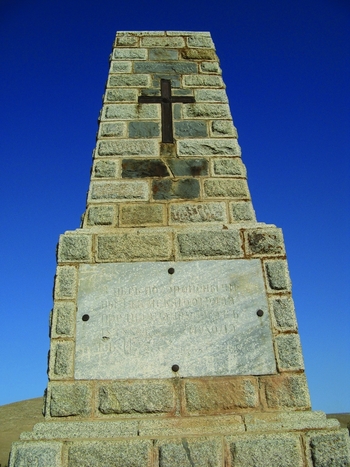
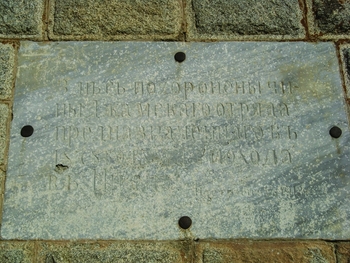
At the crossroads of Sary-Qul, near the village of Jam, at the southwestern edge of the Zarafshan valley in Uzbekistan, there is an obelisk built of roughly squared masonry, with a rusting cross embedded near the top. The worn inscription on a marble tablet at the base records that the monument was erected in 1913, probably as part of the 300th anniversary celebrations of the Romanov dynasty, over the burial place of the men of the ‘Jamskii otryad’ (Jam Force), ‘who were ordered on the expedition to India in 1878’ (see Figures 1 and 2).Footnote 2
The 1913 memorial to the Jam Force, Sary-Qul. Source: © Alexander Morrison.

The memorial inscription. Source: © Alexander Morrison.

The existence of this monument raises a number of interesting questions: first, how did it manage to survive into the twenty-first century, when almost every other Tsarist memorial in Central Asia was obliterated in the Soviet period? Second, what was this ‘expedition to India’? Is this some sort of proof that British paranoia regarding Russian intentions towards India was justified, as the dominant ‘Great Game’ narrative of Anglo–Russian relations in Central Asia would have us believe?
The answer to the first question remains unclear (possibly it was simply overlooked)—but this article will provide an answer to the second. The ‘Pokhod v Indiiu’ (‘Expedition to India’) commemorated on the 1913 monument at Sary-Qul was an often-overlooked aftershock of the wider ‘Eastern Crisis’ in European diplomacy which culminated in the Russo–Turkish war of 1877–8. It was conceived as a response to British manoeuvring that would rob Russia of the spoils of her victory in that conflict—the annexation of territory in Bessarabia and Transcaucasia, and the creation of a ‘Greater Bulgaria’ under Russian influence—which had been secured by the Treaty of San Stefano on 3 March 1878. This settlement would be revised to Russia's detriment at the Berlin Congress in July that year, with Bulgaria cut down to size, and much European territory returned to the Ottomans. While this averted a possible European war and preserved Russian territorial concessions in Bessarabia and Batumi (much to the disgust of British diplomats) it still prompted keen resentment among Russia's military and diplomatic elite.Footnote 3
There was never any fighting at Jam, but some soldiers died there of disease; in 1878 the Jam Force formed the largest of three columns ordered to march towards the Afghan frontier at Shirabad and Kerki in an operation designed to threaten and alarm the British by staging extensive troop movements in Russian Turkestan. The popular historian Peter Hopkirk melodramatically described this as a ‘30,000-strong force, the largest ever assembled in Central Asia’ aimed at invading India through Afghanistan.Footnote 4 Beryl Williams’ account of Central Asia during the ‘Eastern Crisis’ is more accurate and sober, but like almost everything published in English on this topic, suffered from a lack of direct access to Russian archives.Footnote 5 Russian historiography, beginning with the works of M. A. Terent'ev and A. E. Snesarev (both officers of the General Staff) has tended to stress British duplicity and the purity of Russian motives in seeking to protect Afghanistan's independence.Footnote 6 The standard Soviet accounts of this episode describe it as a case of ‘self-defence’, in conformity with their general argument that Britain was always the sole aggressor in Central Asia.Footnote 7 Post-Soviet scholarship from Central Asia turns this caricature on its head, attributing only the most dastardly and aggressive motives to the Russian conquest, and casting Central Asian resistance in anachronistically nationalist terms.Footnote 8 Unlike most of the other scholars who have written on this subject, Tatiana Zagorodnikova and Evgeny Sergeev have had access to both Russian and British archival sources. Sergeev concludes that ‘it appears absolutely incorrect to depict this project and all the steps taken by Kaufman and his subordinates as a mere nonaggressive stroll, or rattling the sabre on the Turkestan frontier in order to teach a lesson to the snobbish British’. Instead he argues that this episode was meticulously planned, and aimed at invading northern Afghanistan and, ultimately, destabilizing the British in India.Footnote 9 Zagorodnikova's collection of documents on the subject is more cautious—she writes that, from the outset, the Indian Expedition was intended as a demonstration, or as a diversionary manoeuvre, not a serious invasion force, and that it lost momentum after the signing of the Treaty of Berlin on 13 July 1878. Conceived in a fit of pique, St Petersburg quickly got cold feet over the operation, although Russia's ‘man on the spot’ in Central Asia—the governor-general of Turkestan, K. P. von Kaufman (1818–82)—urged a more aggressive line.Footnote 10
Alongside the troop movements of the Indian Expedition, the Russian war minister, D. A. Miliutin (1816–1912), also ordered Colonel N. G. Stoletov (1834–1912) to lead a Russian embassy to Amir Shir ‘Ali Khan in Kabul. The Stoletov mission has been seen as a masterstroke by the Russians, a cunning ploy to embroil the British disastrously in Afghan affairs; it led directly to the deposition of Shir ‘Ali and the forcible imposition of a British diplomatic mission at Kabul led by Captain Louis Napoleon Cavagnari; the envoy and his escort were massacred by a mob in September 1879, leading to further hostilities. This was followed by a shattering defeat of British forces at the battle of Maiwand, and the eventual installation on the Afghan throne of ‘Abd al-Rahman Khan (1844–1901), hosted for many years by the Russians in Samarkand and considered by some to have been a Russian client; he is remembered today as the ruthless creator of the modern Afghan state.Footnote 11
Scholars have tended to assume that the Russian authorities foresaw and intended these outcomes when despatching Stoletov to Kabul in the spring of 1878, part of a wider discourse that assumes a relentless and sinister logic of Russian expansion in the region.Footnote 12 M. Hassan Kakar claims that the ‘real purpose’ of the Stoletov mission ‘was for Russia to embroil the British in Afghanistan, so hoping that the latter would recall the Indian troops that they had sent to Malta in support of the Ottomans, with whom Russia was then at war’, while he describes ‘Abd al-Rahman's return as happening ‘with the connivance of the Russian authorities’.Footnote 13 J. A. Norris writes that the Russians ‘encouraged’ ‘Abd al-Rahman to return to Afghanistan after Ya'qub Khan's deposition and flight.Footnote 14 Gerald Morgan also refers to von Kaufman's ‘skilful finessing’ of his relations with Afghanistan in bringing about the second Anglo–Afghan war, though acknowledging that the Russians failed in their principal object, which was to influence the outcome of the Congress of Berlin.Footnote 15 Medlicott and Weeks suggest that skilful diplomacy by Count Petr Shuvalov brought the crisis to an end, and even Barbara Jelavich assumes that the outcome of the ‘Eastern Crisis’ strengthened the Russian position in Central Asia, although she does not refer to Afghanistan.Footnote 16 In earlier work I also attributed too much deliberate foresight to Russian policy towards Afghanistan in this period.Footnote 17
All these judgements are based on a retrospective reading of events—the second Anglo–Afghan War, while not quite as disastrous as the first, certainly did count as a debacle for the British, but the Russians would have needed mystical powers of divination to have foreseen this when they ordered their manoeuvres in Central Asia in April 1878. Terent'ev was scathing about the Stoletov mission, portraying Stoletov himself as timid and vacillating, and describing the treaty he signed with Shir ‘Ali as ‘still-born’—which was just as well since, in his judgement, it both exceeded his instructions and placed almost all the obligations on Russia.Footnote 18 Perhaps unsurprisingly, the most pertinent historical judgement comes from the doyen of Afghan historians, Fayz Muhammad, in his Siraj al-Tawarikh: ‘as the saying goes, “Fate laughs at the best laid plans,” the results were completely the opposite of what was intended’.Footnote 19 Examining documents from the Russian side, it becomes clear that the Russians did not anticipate that their embassy would provoke the British to invade Afghanistan, and were utterly dismayed when it happened. Their failure to provide any assistance to the beleaguered Shir ‘Ali revealed the weakness of their position in Central Asia and was seen as a severe blow to Russian prestige. Rather than being ‘installed’ in Kabul by his Russian patrons, ‘Abd al-Rahman seized his opportunity and secretly escaped from Russian territory without informing his erstwhile hosts, who may have passively accepted this, but certainly did not provide any active assistance.Footnote 20 His subsequent ascent to power owed nothing to Russian support; however, James Hevia's claim that the British deliberately and willingly ‘installed’ ‘Abd al-Rahman on the Afghan throne is equally wide of the mark.Footnote 21 Instead he owed his success partly to his own political ruthlessness and acumen, and partly to British desperation as they cast about for someone (anyone) to whom they could hand over power before retreating.
Drawing on published documents and research in Russian, British, Uzbek, and Indian archives, this article will explain how a hasty attempt by the Russians to put pressure on the British in India unintentionally triggered the second Anglo–Afghan War and provided the opportunity for ‘Abd al-Rahman Khan to seize power. Russian foreign policy is a neglected field, and this episode sheds significant light on the mentalities and decision-making processes that lay behind the diplomacy of the ‘Eastern Crisis’ and the Berlin Congress.Footnote 22 The British, while sometimes portrayed as on the defensive in their foreign relations in this period,Footnote 23 were in fact undone by the overly aggressive way in which they responded to Russian moves, just as they had been 40 years previously during the first Anglo–Afghan War.Footnote 24 Hugh Ragsdale long ago suggested that the myths surrounding the Russian threat to India should be discarded, Malcolm Yapp has played down the significance of the ‘Great Game’ even from the British perspective, and Benjamin Hopkins has provided an excellent general critique of the concept, highlighting the importance of local rulers in the formation of British policy.Footnote 25 However, there is still an assumption in the little scholarship that exists on British and Russian foreign policy in Central Asia in the later nineteenth century that, whether swayed by strategic, economic, or purely ideological motives, both powers could act more or less as they saw fit, treating the region as a giant ‘chessboard’ (to use G. N. Curzon's phrase)Footnote 26 in which local rulers and other actors were wholly deprived of agency, mere victims of the whims and manoeuvrings of the European great powers.Footnote 27 During 1878–9 there was an unusual crisis in Anglo–Russian relations, where the two powers came close to war over the ‘Eastern Question’; this article demonstrates that this crisis can neither be adequately understood within the framework of purely European diplomatic history which has dominated scholarship on the Berlin Congress, nor within the ‘Great Game’ paradigm that dominates the history of Central Asia in the nineteenth century.
The origins of the Indian Expedition
The possibility of striking at India through Afghanistan in order to put pressure on the British in the Balkans seems to have been suggested almost simultaneously by Russia's proconsuls in the two neighbouring regions of the empire, Turkestan and Transcaucasia. On 2 April 1878 the Turkestan governor-general, von Kaufman, sent a short telegram to the chief of the General Staff, Count F. L. Geiden (1821–1900), suggesting that England's interests in Asia could be threatened by a reinforcement of the Turkestan garrisons, and the advance of a force to the Amu-Darya at Shirabad, in concert with an advance from the Caucasus and Petro-Alexandrovsk towards Merv.Footnote 28 On 5 April the head of the Caucasian Mountain administration, Major-General V. A. Franchini (1820–92), despatched a memorandum ‘on war against England in Afghanistan’ to the deputy commander of the army of the Caucasus, Prince D. I. Svyatopolk-Mirsky (1825–99). He noted a number of obstacles, notably the lack of support that could be expected from Persia, and the difficulty of finding enough horses. Above all, they would have to be very cautious about the attitude of the Afghans themselves: ‘Muslim fanaticism cannot serve us as a weapon in the war against England, in the eyes of the people we ourselves are unbelievers; we have only just humiliated the caliphate, only just beaten off the outbursts of fanaticism in the Caucasus.’Footnote 29 Russia could, however, take on herself the role of protector of Amir Shir ‘Ali Khan's independence. It was important not to make the first aggressive move, but if the British were to invade first and the Russians then respond, they would appear as the liberators of Afghanistan.Footnote 30 The conviction among the Indian Army's general staff that they needed to hold advanced positions beyond the frontier passes to secure Afghanistan would thus work to the Russians’ advantage. Franchini's memorandum was forwarded to the viceroy of the Caucasus, Grand Duke Mikhail Nikolaevich (1832–1909) by Svyatopolk-Mirsky. In his covering letter he was still more bullish, writing that the importance of British possessions in India for her power and prestige far outweighed that of Russia's in Central Asia. He was even optimistic on the ‘Muslim fanaticism’ question, believing that this was more dangerous for Britain than for Russia, whose relations with the Muslim world he fondly believed would improve, now that her honour and interests among the Balkan Christians had been satisfied. He concluded that ‘we must appear in Asia in the quality of defenders of the native population from English dominion’.Footnote 31 It seems that many minds in Russia's military and foreign policy establishment were mulling over ways in which a land-based empire could strike at the interests of a maritime power; among the more fantastical was a suggestion from College Counsellor P. I. Pashino (1836–91) that the Russians send a secret agent to Bangkok to forge a hostile alliance against England between Siam and Burma.Footnote 32 Some of these schemes were leaked to the Russian press, whence they made their way into British intelligence reports.Footnote 33
On the 16 April 1878 Miliutin convened a special meeting on Asian affairs, attended by Grand Duke Mikhail Nikolaevich; Count N. P. Ignat'ev (1832–1908), formerly head of the Asiatic Department of the Ministry of Foreign Affairs, and lately ambassador in Constantinople; Nikolai Karlovich Giers (1820–95), standing in for A. M. Gorchakov (1798–1883), whom he would succeed as foreign minister in 1882, and N. A. Kryzhanovskii (1818–88), the governor of Orenburg. Its purpose was to consider yet another proposal, this time from Baron Nikolai Egorovich Tornau (1812–92),Footnote 34 for what Miliutin described in his diary as a ‘fantastical project for an expedition to Herat through Afghanistan’.Footnote 35 In the subsequent memorandum recording the committee's deliberations, which was circulated to the general staff, this was formulated in more moderate terms as ‘whether, in the event of a breach with England, we should take some sort of measures in Central Asia at the same time as military action in European Russia’.Footnote 36 Miliutin began by outlining Russia's strategic position in Central Asia, noting that while her territory there was not directly adjacent to British India, it might still be considered at threat from an English attack; on the other hand, Russia was also in a position to threaten East India from her Central Asian territories:
in view of the relative position of the two states, and in view of the current behaviour of England, remaining entirely passive on the Central Asian frontier would be decidedly inconvenient, and on the contrary, in order to forestall any thoughts the English government might have towards in Central Asia, and in order to threaten their interests in East India, we should now take suitable measures, both from the direction of Turkestan and that of the Caspian Sea.
Tornau's proposal was a forced alliance with Persia, occupying the country around Astrabad in the East, and pushing towards Najaf and Karbala in the West, before marching across Khurasan to Herat and India. Kryzhanovskii sounded a note of scepticism, remarking that an assault on India could not be contemplated with fewer than 150,000 troops, and that transporting the supplies for these would be impossible.Footnote 37 Giers added that Tornau's plan was completely impracticable, and Miliutin also poured cold water on the idea of any decisive attempt to drive the British out of India altogether at this juncture, partly because Russia had need of her troops elsewhere, and partly because, coming so soon after the war in the Balkans, the financial strain would be too great. Instead he suggested that there were cheaper measures, more suited to this particular conjuncture, which would simultaneously reinforce Russia's military position in Central Asia and make the British fear for the stability of their dominions in India. He endorsed von Kaufman's earlier proposal for a double-pronged assault with the Turkestan forces, reinforced from western Siberia, marching to Shirabad on the Amu-Darya, and those from the Caucasus to Merv. Von Kaufman was a professional officer in the mould preferred by Miliutin, and had been appointed to his post on the latter's recommendation; the two were close political allies. It was important, he added, not to upset the amir of Afghanistan, and for that purpose he suggested sending ‘a reliable person, or even an official embassy, which should explain that the advance of our forces is not intended to pose any kind of threat to Afghanistan, but on the contrary could be useful to them as a means of supporting their independence against the English’.Footnote 38 In his diary he noted with satisfaction the tsar's endorsement of these ‘more appropriate’ measures, though he did not mention the embassy.Footnote 39 Thus the decision to send a Russian embassy to Afghanistan—much the most fateful to take place at this conference—emerged almost as an afterthought beside the main question of military manoeuvres.
One week after the meeting in St Petersburg, the tsar approved the despatch of an embassy to Amir Shir ‘Ali under Major-General N. G. Stoletov, who in 1869 had founded the Russian fortress at Krasnovodsk on the Caspian and who had recently distinguished himself in the fighting in Bulgaria. Stoletov's main aim was to reinforce the amir's distrust of the British and stiffen his opposition to their meddling in Afghanistan. He was to inform the amir that the tsar had always viewed Afghanistan as a bulwark against British influence over the independent governments of Central Asia. In times of peace he could be assured of Russian support in pressing for his independence with the cabinet in London and in the event of a war between Britain and Russia, support could become more concrete. Thus the amir should not look on the appearance of Russian troops on his frontier as a threat, but as a friendly gesture which he could call upon in his negotiations with the British.Footnote 40 Stoletov's instructions added some suggestions as to how he could achieve this, pointing to British duplicity in the past in its relations with India, China, and Turkey, and the contrast with Russia's benevolent attitude to Central Asian rulers in Bukhara, Khiva, and Kashgar (the instructions pointedly did not mention Khoqand, whose khan had been deposed and territory annexed by Russia as recently as 1876). Stoletov could flatter Shir ‘Ali by pointing out that, while the Ottoman sultan was in the pocket of the English, ‘he had the prospect of being the head of the strongest and most powerful Muslim kingdom, and to become the successor to the Turkish Sultan’. Should they succeed in establishing an alliance, a hostile reaction could be anticipated from England, and it would be necessary for the amir to resist them.Footnote 41 However, Stoletov's orders unconsciously assumed that the amir would be able to defend himself with relative ease, and also that there would be no effective British reaction for some time unless news of a Russo–Afghan alliance became public. As Alfred Rieber has suggested, this was a period when the hawkish ‘national’ group of statesmen based in the War Ministry, the empire's Asian periphery, and the Asian department of the Foreign Ministry were in the ascendant in the formation of Russian foreign policy, partly because of the passions aroused by the recent conflict with Turkey, partly because of Foreign Minister Gorchakov's increasing senility. It is worth noting, however, that there seem to have been no dissenting opinions to this course of action from either the Finance or the Foreign ministries, who could usually be relied upon to advocate a more conciliatory policy.Footnote 42
Russian views of British India
Russian plans were based on the premise that British rule in India rested on fragile foundations—a weakness that, so they believed, had been fully revealed with the 1857 Rebellion. Russian knowledge of the system of governance in India was patchy, but generally characterized by excessive optimism regarding the sympathy the Indian population were supposed to feel for Russia and their readiness to revolt against British rule. In 1857, when he was the military attaché in London, Ignat'ev's despatches revealed a certain Schadenfreude at the outbreak of the Mutiny and scepticism at the ability of the British to suppress it, while General Staff publications on the subject underlined British foolishness in relying on ‘native’ troops.Footnote 43 The state of Russian thinking on India during the Eastern crisis is revealed in a memorandum by General A. K. Geins (1834–92), a former member of the Steppe Commission (in which capacity von Kaufman had relied heavily on his judgement)Footnote 44 and, at this date, governor of Turghai province. Miliutin's committee drew upon Geins's work in its deliberations and it also seems to have been circulated to von Kaufman in Tashkent. Geins began by noting that the British had no more than one soldier for every 1,000 inhabitants, but ‘the power of the British government in India is based not so much on the army, as on the moral superiority of a higher race, on the predominance of English strength, and on the conviction of the natives of the necessity of their conquerors’. Geins devoted considerable attention to the recruitment patterns of the Indian Army, noting the decision to shun caste Hindus after the 1857 Rebellion, and the disproportionate number of Muslims. He claimed that Sunnis and Shias in the army hated each other and that Indians of all faiths were resentful of a policy which did not allow them to become commissioned officers or rise above the rank of subadar. This, he claimed, meant that the Government of India did not trust its own forces.Footnote 45 The British themselves had investigated the consequences of a Russian attack on India hundreds of times and, despite their usual bombast, revealed unease on this subject, even in their newspapers. ‘Basing ourselves on the authority of the English themselves, we can without any mistake or exaggeration acknowledge as certain the following fact: the situation of the English in India is hopeless, and raises in them the apprehension that an external enemy could strike a heavy blow against the might of England from that quarter.’Footnote 46 There were only 120,000 English among a vast native population and the army was unreliable and might turn its guns on its masters. While he dismissed most of the Hindu population as passive, devoid of energy and initiative, and able to put up with any form of oppression, he considered that the Muslims had not lost their ‘robustness of body and spirit, energy and courage’ and might pose a significant threat. While the assumption that Muslims were dangerous was common to most Russian colonial officials, these last lines suggest that Geins had also imbibed a good deal of the British ‘martial race’ theory.Footnote 47 He went on to repeat many popular British conspiracy theories regarding the 1857 ‘Mutiny’, notably that it had begun as a pan-Islamic uprising orchestrated by the senile Mughal emperor, Bahadur Shah Zafar, in collusion with Persia and the Ottoman empire.Footnote 48
Geins concluded with some consideration of the Afghan situation. British relations with Kabul had deteriorated severely after a period of rapprochement, but Shir ‘Ali Khan also distrusted the Russians. Were the British to send tens of thousands of men to Kabul, even if they avoided the catastrophes of 1841, they would still only control the territory they were able to occupy directly with their forces. The situation of the British would then be very similar to that the Russians had encountered in the Caucasus before it was ‘cleansed’ and settled with Russians—constant guerrilla warfare. He believed the British would rather see the Russians invade and have to deal with Afghan resistance themselves, something the Russians must be careful not to do. Instead they could consider making use of their pensioner in Samarkand, ‘Abd al-Rahman Khan, of whom Geins had heard that he was ‘an able and energetic man and an outstanding soldier’. If Shir ‘Ali refused a Russian embassy, then a good tactic might be to give ‘Abd al-Rahman a large sum of money and despatch him to Balkh to make trouble. Von Kaufman had clearly read Geins's memorandum, and made a similar suggestion to Miliutin, saying that he would recommend Stoletov use the threat of Russian support for ‘Abd al-Rahman whose ‘name is very popular in Afghanistan, especially in the northern part’, to force Shir ‘Ali to negotiate.Footnote 49 Overall one thing emerges very clearly from Russian analyses of the British position on the Indian frontier—namely that they would be unlikely to risk an invasion of Afghanistan because it would prompt an uprising among their Indian Muslim subjects, and that, were they to do so, they would find themselves unable to control the country even in the short term.
Reading Russian accounts of the state of British rule in India, and comparing them with British correspondence regarding its Central Asian frontier in the same period, it is clear that the Russians spectacularly misjudged the mood within the Anglo-Indian and British metropolitan political leadership, whose attitude towards Russia had hardened significantly as the ‘Eastern Crisis’ progressed.Footnote 50 With hindsight, 1878 appears as a high-water mark of bumptious, self-confident British imperialism, embodied in Disraeli's aggressive manoeuvrings in Berlin (which secured Cyprus for the British empire), Sir Bartle Frere's triggering of the Zulu War in Natal, and, above all, the figure of Robert Bulwer Lytton (1831–91), viceroy of India from 1876–80. Lytton's fondness for pomp and circumstance is well known (the neo-medieval heraldry of the imperial durbar of 1877 where Victoria was proclaimed empress of India was very much his personal idea).Footnote 51 When it came to relations with Afghanistan, this translated into a powerful sense of the respect due to the British empire (and to himself as viceroy) from the amir, a respect that Lytton had felt was distinctly lacking well before the Stoletov mission arrived in Kabul.Footnote 52 He was also well primed to react to any suggestion of a threat from Russia. In a short note from 1876 Lytton dismissed the ‘waiting policy’ which successive viceroys had inherited from Sir John Lawrence (1811–79, viceroy 1859–64):
The neighbour we have now to fear is not Afghanistan, but Russia. And the danger with which we are most immediately menaced by Russia is not the loss of territory, but the loss of that political influence or prestige which is the most pacific safeguard of territory. Shere Ali may wish to remain stationary; we may wish to remain stationary; but the Russian power in Central Asia cannot remain stationary. Its position is too weak. Small bodies gravitate to great ones. If Afghanistan does not gravitate towards the British, it must gravitate towards the Russian Empire. And between bodies of equivalent gravity the attractive force of the one that is in movement will always exceed that of the one which is motionless.Footnote 53
Lytton's planetary analogy might have been worthy of Donald Rumsfeld at his most gnomic, but it indicated a serious intent, as he went on to insist that the aim of British policy must be to establish a permanent mission in Kabul. Later that year he was complaining of the over-friendly tone of von Kaufman's letters to Shir ‘Ali (which the British regularly intercepted)Footnote 54 and he continued to rail against what he called the ‘Lawrentian or inactivity policy’. Intercepted Russian correspondence regarding (quite genuine) plans for campaigns against the Akhal-Tekke Turkmen in Transcaspia added fuel to the fire and led Lytton to argue that an ‘active’ policy and the acquisition of a more defensible frontier were essential given ‘that it is impossible to retain an independent barbarous State between two great civilized powers, and that sooner or later Russia and England must touch in the East’. He noted ‘that a wild Russian invasion of India is not the danger we foresee and seek to guard against’, but instead that a Russian presence close to the Indian frontier would be likely to cause significant unrest and subversion within India itself.Footnote 55 This conformed to Geins's assessment of English fears (which was, after all, based on published works by Indian staff officers) with the crucial distinction that this was driving Lytton towards a more, rather than a less aggressive policy.
Both Lytton and his predecessor, Lord Northbrook, had made concerted efforts to draw up a new treaty with Shir ‘Ali that would involve a permanent British mission in Kabul, and in 1876–77 one of the amir's ministers came to Peshawar for talks, but these proved abortive; Sayyid Nur Muhammad Shah, the amir's envoy, claimed that he had no authority to negotiate a binding treaty, and settled the matter a few weeks later by dying (he had been in ill health for some time). The amir attempted to prolong negotiations by sending another envoy, but Lytton had already decided that he was only playing for time.Footnote 56 In short, well before the Russians began debating how they could use their position in Central Asia to put pressure on the British, Lytton was already looking for an excuse to despatch a British mission to Kabul, by force if necessary. In sending Stoletov there, the Russians were unwittingly about to give him a perfect pretext to abandon the policy of inactivity.
The Jamskii Otryad
Ten days after the meeting of the special committee on Asian affairs, Miliutin wrote to von Kaufman, ordering him to begin manoeuvres in Turkestan. He began by saying that a complete breach with England and a consequent European war looked more and more possible. The complement of active troops in Turkestan was to be raised to 12,000 men, with the addition of 8,000 reinforcements from Western Siberia, which should enable a force of 20 battalions to be despatched immediately to Shirabad on the Afghan frontier.Footnote 57 Having been reassured that the reinforcements would arrive fully equipped, and on the despatch of an additional force of Cossacks from Orenburg to serve as a reserve for Turkestan, von Kaufman issued orders for the formation of the Turkestan force on 26 May. The main body consisted of the 3rd, 5th, 6th, and 9th Turkestan Line battalions, together with two companies of the 17th and the 3rd Western Siberian line battalion. The cavalry was made up of the 4th Orenburg-Ural Cossack regiment, four sotnias (companies) each from the 2nd and 3rd Orenburg and 1st Siberian Cossacks, another two sotnias from the 5th Siberian Cossacks, two-and-a-half batteries from the Turkestan artillery brigade, the 1st and 5th Orenburg Cossack horse artillery, and a rocket battery. This force was to advance from Tashkent to Samarkand, and thence to Jam, where it would await further orders. The other two columns, advancing from Petro-Alexandrovsk in the Amu-Darya region to Charjui, and from Marghelan in Ferghana to Qizil-su, and thence through Qarategin to Shirabad, were smaller, each consisting of six companies of infantry and two sotnias of Cossacks, though the Ferghana column was to be further reinforced en route.Footnote 58 On 27 May von Kaufman wrote to Miliutin that military operations were now well under way, and that all the different columns would meet at Samarkand, and march on from there to ‘the border point [with Bukhara], the Jam depression (urochishche)’ where they would prepare for the onward march to the Afghan frontier.Footnote 59 On 24 June von Kaufman issued preliminary instructions giving the marching orders for the further advance to Shirabad, and on 26 June he announced his imminent departure from Tashkent to join them in anticipation of the final order from St Petersburg to move forward.Footnote 60 By 6 July the force consisted of 48 companies of infantry (most from the 5th Turkestan line battalion), 19 sotnias of Orenburg and Siberian Cossacks, 40 guns, and eight rocket batteries—of these 10 companies and 8 sotnias were at Jam and 13 companies at Sary-Qul, with the remainder divided between Andijan and Samarkand.Footnote 61 Von Kaufman inspected the troops at Sary-Qul in person on 12 July and pronounced himself fully satisfied with their morale and sanitary condition.Footnote 62 The troops were accompanied by a considerable supply train, largely carried on camels.Footnote 63
On 18 July von Kaufman reported that 12,356 men of the Turkestan force were now stationed at Jam, Anzherli, Sary-Qul, Samarkand, and Katta-Qurghan, awaiting further orders to move on to the Amu-Darya.Footnote 64 However, they were never destined to march any further. On 30 July, von Kaufman received what must have been a bitterly unwelcome telegram from Miliutin informing him that the tsar had decided that in view of the current state of affairs (by which he meant the outcome of the Berlin Congress), the military demonstrations in Turkestan and from Krasnovodsk should be cancelled and all troops return to barracks.Footnote 65 The Congress's conclusion had revealed Russia's European isolation, and initial annoyance was directed primarily against Berlin and Vienna rather than London, with whom Alexander II now desired a rapprochement.Footnote 66 Von Kaufman's orders dismissing the troops came two days later, though he wrote to Miliutin on 2 August that the men of the main force at Jam would have to remain in place a little longer while commissariat arrangements were made, and also that there had been some deterioration in the health of the force owing to the heat.Footnote 67 Von Kaufman's final report for 1878 on the state of the Turkestan forces did not mention any excess mortality as a result of the expedition and gave 116 as the total number of sick, without mentioning any deaths.Footnote 68 The only officer known for certain to have died was one Major Weinberg.Footnote 69 However, an anonymous correspondent for Sovremennoi Izvestii, who had accompanied the column, published a piece in October 1878 asserting that the conditions at Sary-Qul and Jam had been atrocious, owing to high temperatures and a constant hot wind. He alleged that they had buried at least two soldiers every day, which would mean an overall toll of at least 60–70 deaths from disease.Footnote 70 Fayz Muhammad, whose information on Russian movements at this time is often startlingly accurate, claims that 1,200 men came down with dysentery and had to be carried away from Jam on carts and that many died.Footnote 71 Zagorodnikova writes that the truth about the spread of disease and the high mortality rate was probably suppressed owing to the ‘secret’ nature of the expedition.Footnote 72
The British first learned of the stationing of the force at Jam via a report from the Paris correspondent of the Times, passing on a report from Le Temps of 16 July, just two days before Miliutin issued orders to recall and demobilize the troops (though the news of this did not become public until three months later).Footnote 73 This was probably a deliberate leak, given that the intimidatory purpose of these Russian manoeuvres would have been lost had the British not learned of them in time. They would be confirmed by later intelligence reports from Peshawar,Footnote 74 and eventually by a more detailed eyewitness account from an Afghan who had been at Samarkand in May 1878:
On the 26th Jamadi-ul-awal 1295 (21st May 1878) the troops at Samarkand and Kati Kurgan marched towards Jain [sic, Jam], where they halted fifteen days for want of adequate arrangements for supplies. I left Samarkand the following day for Bokhara, and entered that city on the 1st Jamadi-ul-sani, (3rd June 1878). A Russian merchant named ‘Ilian’ was purchasing grain in this city and sending supplies towards Urganj. On my enquiring from him the purpose for which these preparations were intended, he told me that the Czar had determined to send an army of 50,000 men via Merv to Herat. I asked him how the Russians could hope to gain over Sher Ali who was in receipt of an annual subsidy of one lakh of rupees, besides arms and ammunition, from the English, he replied that Russians would offer the Amir two lakhs, and promise him the Punjab should that province fall into their hands.Footnote 75
At no stage do such reports seem to have sparked particular British concern—Lytton would write in mid-August that, ‘They were probably devised, like the masks on the Chinese shields, for frightening, rather than for fighting, purposes.’Footnote 76 Rumours of a Russian advance, which Miliutin and von Kaufman imagined would stir the Indian population to rebellion and unrest, did not materialize. However, the presence of Stoletov at Kabul—which had originally been a mere incidental detail of the plan to march towards the Afghan frontier—would have an electrifying effect in Calcutta and London, provoking a diplomatic storm the Russians had entirely failed to foresee.
The reception of the Stoletov Mission
Stoletov's embassy included Colonel N. I. Razgonov (1831–96), Sub Lieutenant Nazirov (a Tatar, who would act as interpreter), Dr I. L. Yavorskii (who would later publish the standard Russian account of the embassy),Footnote 77 Titular Counsellor Malevinskii, a Turki-speaking judicial official called Zaman-Bek,Footnote 78 and a force of 23 Cossacks. Stoletov received his final set of orders from von Kaufman on 7 June, which largely repeated those from Giers, although the governor-general also gave him a lengthy briefing on the current international situation, and emphasized the need to sow distrust of English actions in Shir ‘Ali's mind and convince him to resist their efforts to entrench themselves in Afghanistan.Footnote 79 Travelling from Tashkent via Samarkand, and then through Bukharan territory to Shirabad, Stoletov and his embassy had reached Mazar-i Sharif by 5 July, after a delay while the Afghan governor of Char-Vilayat asked them to wait at Shirabad.Footnote 80 There is no trace of it in the Russian documents, but the arrival of Stoletov's mission on the Afghan frontier clearly presented Shir ‘Ali with a dilemma. Although both Lytton and the Russians were correct in seeing an estrangement between him and the Government of India over the previous two years, this did not mean (as both Lytton and von Kaufman assumed) that he was particularly enthusiastic about a Russian alliance either. The Government of India's Kabul akhbarnevis (newswriter) reported in early June that:
The Amir has again, after a full deliberation and a long counsel with his courtiers, written to the Russian Governor-General at Tashkand that owing to the ignorance and barbarism of his subjects he is not in a position to receive a Russian envoy into his country; [. . .] The Amir one day mentioned in private that if he should be blindly led (by the sense of revenge on the English for the injuries his people received at their hands in by-gone days) to form an alliance with Russia, who, in pursuance of the will (of Peter the Great)Footnote 81 aims at the universal monarchy, he might be deprived of his kingdom by the English if Russia should fail in her attempt to conquer India, which is quite possible considering the distance at which her base of operations would be situated. If, on the other hand, he should agree to the demands of the British Government and reject those of Russia, his fate would also be sealed. Therefore the Amir is now at a loss what to do.Footnote 82
These doubts are entirely invisible in Stoletov's account of the embassy, which dwelt instead on the sheer friendliness of the Afghan reception, the weight of Russian prestige, and the remoteness of the British threat. After travelling across the Hindu Kush via Gaibek and Bamiyan, the embassy arrived in Kabul on 10 August. Yavorskii (whose reminiscences are not always reliable) reports that the mission received a message from von Kaufman reporting the ‘sad’ outcome of the Berlin Congress on the eve of their entry into Kabul, which stiffened their resolve to rescue Russia's honour.Footnote 83 Stoletov certainly reported their reception in glowing terms:
Then came the ceremonial procession through the outskirts of Kabul. All the streets, bazaars, the rows of houses, hills, were covered with dense masses of people. Welcoming cries, similar to our ‘Ura’, rang out loudly on all sides. Further on the plain before the Bala Hissar . . . there were marshalled eight battalions of infantry, two regiments of cavalry and two batteries.Footnote 84
They were greeted by a cannonade saluting them, while ‘three choirs played military music very decently the whole time’. The amir himself, wearing a European uniform and a Hussar's white dolman, with trousers of the same colour, made a very favourable impression on Slotetov:
It seems to me that he is that type of Asiatic who has received neither a scientific education, nor upbringing, but who is by nature richly endowed with understanding of the significance and strength of European science and life. I have not seen Mehmet ‘Ali, the Pasha of Egypt, or Ranjit Singh, the ruler of the Sikhs, but think that Shir ‘Ali Khan has something in common with them.Footnote 85
The latter comparison is unlikely to have been very congenial to Shir ‘Ali, given the longstanding enmity which existed between the Afghans and the Sikhs, but Stoletov was in an expansive mood and saw in every remark the amir made evidence of a newly flowering relationship with Russia, which could offer support and understanding to this modernizing Asian monarch in a way the chauvinist British could never manage. Shir ‘Ali obliged by saying how highly he valued the opinions of the Russian tsar, and how the Afghan people hated the English, a hatred shared by the rajahs of Hindustan, who were only waiting for an opportunity to rise up against their oppressors. He showed a particular curiosity about the Cossacks, having heard that they were a different tribe (quite possible a garbled reference to Qazaq nomads), and Stoletov was able to show him his escort to demonstrate that this was not true. When it came to politics Shir ‘Ali showed an awareness of the damage the British had done to the Russians at the Berlin Congress, and talked at length of the dangers for any independent government of accepting the subsidies which the British had offered him.Footnote 86 According to Stoletov, at least, the amir never so much as hinted that the presence of the Russian mission might be in any way awkward, or call forth a hostile response from the British.
The British response
The first sign that the British were not reacting to the Russian initiative in quite the manner von Kaufman and Miliutin had anticipated came as early as the 2 July, well before Stoletov's arrival in Afghanistan, when Lord Augustus Loftus, the British ambassador in St Petersburg, asked Giers point blank whether or not the Russians had sent a mission to Kabul. In his report to London, Loftus claimed that Giers had denied this, something that would become a bone of contention in subsequent months.Footnote 87 The Foreign Office had been alerted to this possibility by Lytton, who sent a short telegram on 7 June reporting that a Russian ambassador was rumoured to be on his way to Kabul, and another on 1 July, passing on information from Cavagnari (which in turn came from a Peshawar merchant whose firm had interests in Bukhara) that a Russian agent was in Kabul, and had informed the amir that the Russians were about to construct a ‘cantonment’ at Shirabad.Footnote 88 What is striking about these exchanges is first the speed with which rumours of the mission's despatch reached London (Lytton's first telegram was sent before Stoletov's departure from Tashkent, and the second before he had reached Mazar-i Sharif), and also the bellicose attitude assumed by the British before they had any firm knowledge of the mission's presence. This is explained by the fact that the British had been monitoring von Kaufman's correspondence with Shir ‘Ali since at least 1870 and were paranoid regarding any suggestion of a Russian presence in Kabul. As recently as January 1877 Salisbury had sought and received assurances that von Kaufman had not despatched an agent to Kabul with the purpose of negotiating a treaty with the amir, and there was a steady flow of rumours regarding a possible Russian presence at the Afghan court; those Lytton first reacted to probably had nothing to do with Stoletov at all. The events of the summer of 1878 were the long-anticipated fulfilment of a repeated prediction.Footnote 89 London's information about the Stoletov mission would be confirmed only a month later by a pair of telegrams from Lytton dated 30 and 31 July, the first of which reported a rumour that a mission led by a European officer had crossed the Oxus; the second reported the arrival of messengers from Kabul who said that nine days previously ‘three Russians in European costume’, accompanied by ‘Cossacks and Uzbeg horsemen’ and led by a man whom Lytton identified as ‘General Abramoff, Governor of Samarkand’, had arrived in Kabul (in fact they would only reach the city ten days later).Footnote 90 Lytton's response to the arrival of ‘Abramoff’ at Kabul (it took several weeks before the British realized that the mission was led by Stoletov) was predictably furious and he began immediately to make plans for the despatch of a corresponding British mission. Three days later in a private letter to the secretary of state for India, Lord Cranbrook, he wrote that:
Now, the Russian officers and troops have been received with honour at Cabul, within 150 miles of our frontier, and of our largest military garrison. And this is a distance which, even on the large scale maps recommended to us by Lord Salisbury, looks very small indeed. [. . .] What am I to do, in the face of an alliance between the Ameer and the Russian Government? What am I to do, in the event of the death of the Ameer, and a bold bid for the throne of Afghanistan by Abdul Rahman, with the support of Russia?Footnote 91
Lytton considered that it might still be possible to come to an agreement with Shir ‘Ali, though he could not resist taking another swipe at his predecessors and their failure, as he saw it, to put sufficient pressure on the amir in the past. So far as he was concerned, the necessary course of action was clear:
It is now useless to recall the history of his long-growing hostility to us, nurtured under our ‘Masterly Inactivity’ system, and significantly revealed by the failure of the Peshawur negociations in 1876. The present most injudicious action of Russia fortunately affords us a convenient opportunity for making, without loss of dignity, and under somewhat more favourable conditions, another—and, as I conceive it must be, a last attempt to establish more satisfactory relations with the present Ameer. I propose, therefore, in accordance with your sanction, to send a British mission to Cabul as soon as it can be properly organised; and to precede it by a message, through a Native Agent, informing the Ameer that it is on its way to him, and that he is expected to receive it, (like the Russian one), with all becoming honours, &c.Footnote 92
The tone of triumph is unmistakable—and Lytton's reference to Russia's ‘injudicious action’ ‘fortunately’ providing a ‘most convenient opportunity’ to carry out the policy he had been maturing for some time makes it clear enough why this was so. Without the Russian presence, Lytton would have had great difficulty in convincing Whitehall of the necessity of action against Kabul. Now the decisive argument was that of prestige—since a Russian envoy had been received there, a British envoy would be also; anything less would compromise British honour and be taken as a sign of weakness. As we have seen, it was similar considerations which had prompted the Russians to send Stoletov to Kabul in the first place:
notwithstanding the immensely superior power represented, and wielded by the Viceroy of India, the Governor General of Russian Turkistan is, in the imagination of the Central Asian populations, a greater potentate, and one more to be feared and propitiated. Lord Salisbury rather took exception to this assertion. But could there be a stronger illustration of its truth than the fact that the Ameer, who was not in the least afraid to refuse (and even to refuse superciliously), to receive a mission from the Viceroy of India, has been afraid to refuse one from the Governor-General of Russian Turkistan? Indeed the Ameer himself, during the course of the Peshawar negociations, was at no pains to conceal the strength of his impressions and sentiments on this point, as you will find by reference to the record of them. And I am assured, by the translators, that his allusion to the firmness and fearlessness of the Russian, as compared with the timidity and vacillation of the British, was, in the original, much more insulting than it appears to be in the translation; where, however, it is sufficiently contemptuous.Footnote 93
As Lytton began energetic preparations to despatch the Kabul mission, he managed to bring a reluctant Foreign Office in London round to a similarly aggressive attitude.Footnote 94 On 10 August the Russian Foreign Ministry received a despatch from the Russian chargé d'affaires in London, Mikhail Fedorovich Bartolomei. He reported a conversation with the British foreign secretary, Lord Salisbury, who had told him that the explanations given to the British ambassador in St Petersburg by Giers regarding Russian troop movements in Turkestan were ‘altogether natural’, but ‘having admitted this, [Salisbury] believed he was within his rights to complain about the news which was coming from Kabul’. The British government had a right to be offended by the arrival of a Russian ambassador there, given that the amir did not accord to the British the right to maintain a representative in Kabul and London could not accept terms that were less favourable than those of another power. This question would arouse other weighty considerations, and would lead the Government of India to adopt ‘rigorous measures’ with regard to the amir. Bartolomei concluded:
Lord Salisbury spoke to me in a tone of menace with regard to this last, probably in order to impress me with the gravity of the dangers to which we are exposing ourselves. To my query as to whether all this was not based on mere rumour and Asiatic exaggerations, the Foreign Secretary replied that he was sure of his allegations and that he requested that I would bring this affair to the attention of the Imperial Government.Footnote 95
Bartolomei protested his ignorance, claiming that he too would have to approach St Petersburg to discover more. He expressed considerable embarrassment at the prospect of having to either deny or explain the presence of the Russian mission without any further information, suggesting that it might be better if the British government dealt directly with Giers, who appeared to have some idea of what was going on. In the same letter he reported the despatch of a force of 300 soldiers from the Guides and the Bengal Lancers under Sir Neville Chamberlain to Kabul.Footnote 96 On 26 August the British chargé d'affaires in St Petersburg, Francis Plunkett (1838–1907), sent an official letter to Giers stating that intelligence had reached the viceroy of India of both Russian troop movements (which they believed consisted of up to 15,000 men) towards the Oxus, and of the Kabul embassy, which he still believed was headed by ‘General Abramov, the Governor of Samarkand’.Footnote 97 Giers's reply made reference to Britain's attitude during the recent ‘crisis in the Orient’, but claimed that the mission, which, as he pointed out, was wrongly attributed to General Abramov, was ‘of a provisional character and one of pure courtesy’.Footnote 98
A few weeks later Foreign Minister Gorchakov wrote to Giers from Baden-Baden, enclosing the following private note from Disraeli:
The affair of Afganistan [sic] however has greatly embarrassed me and although I immediately put upon it a just interpretation and looked upon it as a quite legitimated [sic] act on your part. If war had occurred between our countries, I still feel that there will be much difficulty in restoring the identical state of affairs and feelings which some years ago your Highness had greatly assisted in establishing with your large and fine knowledge of mankind . . . This is not an official, or even a ministerial letter but one between two gentlemen in confidence.Footnote 99
However, Gorchakov did not rise to this bait—he both betrayed the confidence by sharing it with his subordinate and having the letter placed on file and sent a response that was entirely bland and non-committal. He was reassured a few days later by a telegram from Bartolomei passing on information from the German military agent in London that Britain had not mobilized and was not preparing for war with Russia in Europe.Footnote 100
Cold feet in Kabul
Meanwhile things were getting even more complicated in Afghanistan. Stoletov had set off from Kabul for Tashkent in late August after spending just 12 days in the city, leaving Colonel Razgonov in charge of the mission. Shir ‘Ali simultaneously despatched an envoy to von Kaufman in Tashkent, but his letter did not suggest any particular alarm at the threat from England, while in his reply von Kaufman assured him that Russia would protect Afghanistan's independence.Footnote 101 Razgonov's first report to Stoletov described a lengthy conversation with Shir ‘Ali's vazir (chief minister), who assured him of Afghan hatred for the British and their determination to resist them by force. However, he also emphasized that it was the presence of the Russian mission which had provoked British wrath, and that the Afghans expected concrete support; Razgonov added that he could not see the Afghan army being able to offer any effective opposition to the British in open battle. He urged that the mission be withdrawn as soon as possible, as they were up against a ‘strong and decisive enemy’ and for Russia war would clearly be premature.Footnote 102 On 17 September von Kaufman sent a coded telegram to Miliutin reporting Stoletov's return to Tashkent and claiming that the Afghan amir desired a Russian protectorate (a clear over-interpretation of Stoletov's report, which had only referred to the desire for military assistance).Footnote 103 Miliutin ordered Stoletov to leave Tashkent and report on the mission to him and the tsar at Livadia in the Crimea.Footnote 104 Von Kaufman repeated his call for an Afghan protectorate in greater detail in a report a few days later, in which he dwelt at length on the hatred of the Afghans for the English, the prospects of provoking a widespread rebellion in India through decisive action, and the supposed ease of communications between Samarkand and Kabul:
Such is the state of affairs. What can we conclude from it? It is clear that England cannot regard our influence in Afghanistan indifferently, and might declare war on the Amir, although to all the questions posed on this subject by General Stoletov the Amir always answered, that he is sure that the English will not declare war on him, even though he would not receive their embassy and declined to have any relations with them. The Amir explains this through the fear of the English that if they begin a war with him, it will arouse the native population of India. If the Amir's opinion is correct, then it is still more important for us to obtain a protectorate over Afghanistan.Footnote 105
In its assumption of British pusillanimity the amir's opinion was curiously close to that of the Russians themselves—and indeed we must consider the possibility that either Stoletov or von Kaufman was putting words in Shir ‘Ali's mouth. Von Kaufman went on to invoke a familiar argument, namely that a failure to act decisively now might lead to the total subjugation of Afghanistan to Britain, and a severe loss of prestige for Russia ‘in the East’: ‘All of this will demonstrate to the population of Afghanistan and India English strength and power, and our comparative weakness. We ourselves in this case will be closing the Central Asian theatre of action in the case of a breach with England.’ He appended to this a draft convention drawn up by Stoletov and Shir ‘Ali in Kabul which would have placed Afghanistan under Russian ‘protection’, including a commitment to provide troops to resist threats from a third power.Footnote 106 This reveals von Kaufman's confidence at this stage, together with his (wholly characteristic) tendency to overestimate the readiness of Indians to rebel, and the consequent fragility of British rule in India. He also harped on another constant theme—that of prestige in the eyes of ‘Asiatics’ and of other ‘Great Powers’—which is revealing of Russian imperial anxieties and which had played a crucial role in prior Russian advances in Central Asia. In this instance, however, von Kaufman's pleas fell on deaf ears and he soon became less sanguine about the weakness of the British and the ability of the Afghans to resist them. On 13 September Razgonov had written to von Kaufman from Kabul to say that Shir ‘Ali, emboldened by the Russian presence, was determined not to admit the British mission that was approaching Jalalabad and had instructed his border guards to resist it by force if necessary. Von Kaufman passed this message on to Miliutin with the following commentary:
The Afghans are clearly mistaken on the score of our rapid assistance. The explanations and advice of Razgonov to play for time have so far not prevailed. I am writing to Razgonov to tell him to talk round the Amir not to take the affair to extremes. It is unlikely that he will succeed in preventing a clash which will be risky for the Afghans and disadvantageous for us.Footnote 107
Miliutin replied two days later, stating that the tsar was of the opinion that, while friendly relations with Afghanistan should be preserved, nothing should be done to provoke the British.Footnote 108 Two weeks later Chamberlain's embassy received a definitive refusal from the amir's agent at Peshawar, Fayz Muhammad, while Cavagnari's attempt to advance past ‘Ali Masjid into the Khyber Pass was repulsed, revealing that the Russian counsel of caution had not prevailed.Footnote 109 Chamberlain began to prepare to enter Afghanistan by force. The Russian military agent in London, Major General A. P. Gorlov, reported to Miliutin that agitation in England over Afghan affairs was rising, and that there was no doubt that the British intended to push on energetically with their invasion of the country, and that they would be prepared to go to war with Russia over the matter.Footnote 110 Miliutin did not pass on this information to von Kaufman directly at first, simply telling him that the Foreign Ministry was opening direct negotiations with Britain to resolve the Afghan crisis, and to instruct Razgonov to remain in Kabul and act with caution.Footnote 111 Bartolomei reinforced Russian fears in a despatch a few days later, describing the latest intelligence on the scale of British preparations for war in Afghanistan, estimating the expeditionary force at 84 guns, 3,300 cavalry, and 11,000 infantry.Footnote 112 On 30 October Miliutin finally sent an urgent telegram to von Kaufman, saying that he had clear warning that the British were planning to push ahead with their mission despite the amir's refusal to admit it and telling von Kaufman to write to Shir ‘Ali himself and urge him to come to an accommodation with the British and avoid an inopportune war—‘It is essential,’ he wrote, ‘that your advice to the Amir reaches him before any British proposal.’ Von Kaufman was also to gather troops at points where they could easily advance into Afghanistan, though this last was to be kept an absolute secret.Footnote 113 On 4 November von Kaufman made a final attempt to convince Miliutin of the need to establish an Afghan protectorate with a permanent Russian garrison to threaten the British in India, repeating the plea of loss of prestige, but even he had to acknowledge that there was little the Russians could do now to counter the current British expedition; he had written directly to Shir ‘Ali to advise him to make peace.Footnote 114 Four days later Miliutin forwarded von Kaufman an official minute on Russia's position in Afghanistan, which decisively ruled out even covert military support to Shir ‘Ali; there was an uneasy acknowledgement that Russian intelligence on Afghanistan prior to the Stoletov Mission had been poor, but Shir ‘Ali's request for military assistance and his proposed alliance could not be contemplated. Instead the best Russia could do was work for a peaceful solution to the current conflict and to support Afghanistan's independence through diplomacy. Meanwhile, what was left of the embassy would remain in Kabul, as its withdrawal would be premature before negotiations with the British had begun (the idea was that this could later be presented as a concession).Footnote 115 On 2 November Chamberlain presented the British government's final ultimatum to the amir, and Lytton received confirmation that if it were refused he was authorized to open hostilities.Footnote 116
Second thoughts in St Petersburg and Tashkent
The Russian Foreign Ministry was even less inclined to support Shir ‘Ali than the War Ministry had been. On 28 November the Russian ambassador in London, Count P. A. Shuvalov (1827–89), wrote to Giers to say that he thought the time had come to withdraw the Russian mission in Kabul, as it was antagonizing the British––it would not be needed to relay reports of the advance of Lord Lytton's embassy because ‘military events are surrounded by so much publicity, that the daily telegrams absorb entire columns in the newspapers’.Footnote 117 Ten days later Giers added that while he was sure that the British ministers were sincere when they said they had no thought of permanently annexing Afghanistan, ‘the party of action’, led by Sir Henry Rawlinson, was arguing for a revision of the frontiers, while ‘the entire history of England in India and of Russia in Turkestan, proves that one does not stop when one wishes’—a reference to a well-known 1864 memorandum by Gorchakov in which the foreign minister had stated that for Russia in Central Asia ‘the greatest difficulty consists in knowing how to stop’.Footnote 118 Three days after this Shuvalov carefully noted Salisbury's surprise that the Russian embassy was still in Kabul; the British foreign minister made it clear that a return to the status quo ante bellum in Afghanistan was impossible and that there would now be a permanent British mission in Kabul.Footnote 119 By December the rhetoric had grown harsher: Shuvalov took strong exception to Salisbury's assertion in parliament that Gorchakov and Giers had lied about Russian relations with the amir—although his principal defence was that Giers had denied the despatch of a Russian mission before von Kaufman had received his instructions (but after the decision had been taken in St Petersburg)—while von Kaufman's earlier ‘negotiations’ with Shir ‘Ali were no more than the annual letter of courtesy which he sent to the amir (something that the Government of India in fact took strong exception to, though the Russians could be excused for not realizing this).Footnote 120
Razgonov's situation in Kabul became increasingly delicate. On 6 November he sent in a lengthy report, describing rumours of the extent of British preparations and predicting a speedy advance and victory before the end of the year:
The Afghan army is unarguably the best in Central Asia, but is of course not in a condition to sustain an open conflict with English forces of equivalent strength. The Vazir was very surprised when I said this to him openly. The Amir understands affairs better. He says ‘if military glory fails me, I will leave for the mountains, where I can support myself for a year, awaiting Russian assistance; at all events (if Russian assistance does not come in time), I will hand over the fragments of my rule to the Russians, rather than enter into any sort of relations with the English’, and it seems to me he says this entirely sincerely.Footnote 121
He went on to write of Shir ‘Ali's great admiration for Peter the Great, and the internal threat from his son, Ya'qub Khan, who favoured the British. However, when it came to passing on Miliutin and von Kaufman's urgent advice to the amir to admit the British mission and do everything possible to avoid war, Razgonov cavilled.Footnote 122 He wrote that nothing short of caving in to all their demands and an immediate expulsion of the Russian mission would satisfy the British, and that this would be tantamount to a complete surrender of Afghan sovereignty which, he claimed, the amir would refuse. Instead Razgonov had advised Shir ‘Ali through his vazir to play for time by negotiating with the British on the frontier. He added that he considered all promises made by the British to be perfectly worthless and that they only respected force. If open hostilities were to break out, which seemed increasingly likely, then the presence of the mission would no longer serve any useful purpose and might be actively damaging. As the passes in the north would soon be closed by snow and the mission was in what he described as ‘difficult sanitary conditions’ with at least one case of typhus, he implored an immediate evacuation.Footnote 123 Von Kaufman endorsed this when he passed on Razgonov's report to Miliutin, adding further lamentations about the ruin of Russia's policy in Afghanistan.Footnote 124 However, as we have seen, by this stage St Petersburg had determined to use the embassy's withdrawal as a bargaining chip in negotiations with the British.Footnote 125 In the same report von Kaufman also noted that, for the British, Shir ‘Ali's abrupt refusal of admittance to their mission was ‘not only foreseen in advance, but even desirable’, as it gave them an excuse to impose their authority on the Afghan regime.Footnote 126 This seems to have been the first inkling in Russian official circles that in sending their mission to Kabul they had provided Lytton with the perfect excuse to carry out an aggressive policy which had already been maturing for some time.
In ten years I have never before entered into such correspondence with the Afghan ruler. In all my relations, as with the Bukharan Amir, and with the late Yaqub Beg of Kashgar and the Khan of Khiva, also with their trusted agents, I avoided even pronouncing the words ‘England, Englishmen’, I deliberately ignored [‘ignoriroval’, a favourite term for von Kaufman] their existence, I never wrote to the Afghan Amir any letters apart from enquiries after his health, and assuring him that I wished to preserve friendly relations. In the understanding of neighbouring governments and in the understanding of the people this created a conviction that we had no dealings whatsoever with the English, that although we were at peace with them, their success or failure did not interest us. This year for the first time we took a step, which opened the eyes of the Asiatics; they divined that we and the English are antagonists for predominance in Asia; and at that our rival took, against our will, such a step forward, that in the understanding of all, illustrates England's strength, in other words, our weakness.Footnote 127
Von Kaufman added that he had little knowledge of the further complications that were arising in Europe, as his view was limited to the Asian frontier, but he repeated the logic that had led to the launching of the Indian Expedition and Stoletov's mission in the first place, namely that Russia, by achieving a position of sufficient strength in Central Asia, might enjoy a stronger hand in the Balkan Peninsula or Asia Minor. From supreme over-confidence in their ability to intimidate the British by playing on the supposed weakness of their position in India, by November 1878 the Russians had swung to the opposite pole, overestimating the strength of their opponents and assuming that the aggressive policy the British were now pursuing in Afghanistan would be crowned with success.
Russian retreat
On 18 December 1878 Miliutin wrote to von Kaufman reaffirming the tsar's absolute determination to avoid a European war and the consequent impossibility of using any active means to support Shir ‘Ali. He authorized the withdrawal of the mission from Kabul and also noted that if, as the newspapers were reporting, Shir ‘Ali had already fled, then the situation was already hopeless; Russia would have to give up on any future influence in Afghanistan, as his successor would almost certainly be his son, Ya'qub Khan, a ‘tool of the English’.Footnote 128 On the same day Razgonov wrote from Kabul to report that Shir ‘Ali had announced his intention to travel to St Petersburg to see the tsar. He interpreted this positively, writing that this trip would allow the amir and the Afghans (who had already seen the British in action in India) to appreciate the might of Russia.Footnote 129 Fayz Muhammad suggests that even at this late stage Shir ‘Ali still anticipated Russian support, as in December 1878 he sent a delegation of sardars (chiefs, officers) to Samarkand with orders to return with a Russian army.Footnote 130 In fact this seems to have been a face-saving way for the amir to retreat before the British advance, and the journey was not destined to end well. On 22 December Shir ‘Ali wrote to von Kaufman in Tashkent, saying that a gathering of the Afghan sardars had advised him that the English wanted him to break off all relations with Russia and to expel the embassy. They had reminded him that 40 years previously friendship with Russia had led to grave misfortune for Afghanistan (a reference to the Vitkevich Mission which preceded the first Anglo–Afghan War)Footnote 131 and unanimously advised him now to make his way to St Petersburg, ‘to the capital of the great Hazrat’, where some sort of negotiations with the British could be conducted.Footnote 132 Razgonov added a plea that the amir be allowed to proceed to Tashkent and from there to St Petersburg, ‘although I do not anticipate a negative reply from St Petersburg, such a reply would deal a decisive self-inflicted blow, and in such a case it would have been better not to begin the Afghan affair’.Footnote 133
In forwarding these letters to St Petersburg, von Kaufman urged Gorchakov to give an honourable welcome to Shir ‘Ali, writing that otherwise Russia would lose all standing in Afghanistan and adding that ‘everything that has been done to us in Europe, and in the last great and difficult epoch in the life of Russia, is the fruit of English intrigues’ (plod Angliiskikh proiskov—someone in the Foreign Ministry, possibly Giers, left a pencil annotation in the margin which read ‘this is entirely correct’)—‘it is impossible to doubt this. Everything that is unfortunate for us has happened under the influence of an extremely egotistical English policy, thanks to the cunning, shameless methods of the current Ministry of Great Britain.’ He concluded with a ringing (and familiar) invocation of the need to maintain Russia's imperial prestige: ‘In refusing to the Afghan government even the moral support which it expects from us, we finally risk demeaning ourselves in the eyes of all Asia.’Footnote 134 He was doomed to disappointment, as Gorchakov telegrammed in reply: ‘the visit of the Amir to St Petersburg would be useless’.Footnote 135 Gorchakov grudgingly wrote that the tsar had agreed that Shir ‘Ali could be allowed to stay temporarily in Tashkent, and Miliutin wrote a few days later to ask about the arrangements for a triumphal entry for the exiled amir when he arrived. Gorchakov's letter on the same subject was distinctly less enthusiastic and stressed instead the necessity of preventing Shir ‘Ali from travelling to St Petersburg, but he need not have worried, as the former amir was never destined even to reach the Russian border.Footnote 136 Two weeks later Kaufman reported that Shir ‘Ali Khan had fallen ill at Mazar-i Sharif and cancelled his visit to Russia (this was annotated ‘so much the better’—tem luchshe).Footnote 137 The last communication the Russians received from him was a report addressed to the governor of Herat, Muhammad ‘Umar Khan, reporting a victory over the British at ‘Ali Masjid (presumably the repulse of Cavagnari's reconnaissance mission on 22 September) and predicting their speedy retreat.Footnote 138 On 20 February 1879 von Kaufman forwarded a report from Yavorskii that Shir ‘Ali had gangrene in his right leg and that his condition was hopeless. On 4 March he reported the amir's death.Footnote 139
The British decision to invade and impose a mission in Kabul in response to Stoletov's mission was clearly unanticipated by the Russians, and the immediate aftermath of Shir ‘Ali's flight and their dismal failure to render him any assistance had them casting around for possible means of restoring their prestige in ‘Asiatic’ eyes which, as von Kaufman had warned, they would lose in consequence. Prince Sviatopolk-Mirsky and the chief of the Asiatic section of the general staff, A. N. Kuropatkin, both advocated an immediate advance into Transcaspia and the annexation of Merv.Footnote 140 A few days later an official memorandum from the general staff drew on these and the despatches received from Shuvalov in London to put forward a draft plan for an expedition from Krasnovodsk into the deserts of Transcaspia; within a few months it would be put into action.Footnote 141 The conquest of Transcaspia lies beyond the scope of this article, but it is worth noting that here, as was so often the case when the Russian leadership made crucial decisions to advance in Central Asia, the need to wipe out a perceived earlier humiliation and restore prestige in the eyes of ‘Asiatics’ was the decisive final argument. In a curious echo of their despairing and panicked response to the British invasion of Afghanistan 40 years earlier,Footnote 142 at no stage do the Russians appear to have anticipated that the British had once again over-reached themselves by invading the country and trying to establish a permanent presence in Kabul. By 1879 the Russians appear to have had a spy at Peterhof, the viceroy's residence at Simla, who forwarded them translations which he had made of two letters from von Kaufman to Ya'qub Khan and to Sardar Muhammad Musa Khan, the crown prince, expressing condolences on Shir ‘Ali's death and congratulations on the former's accession: ‘here I send on to you copies of two Russian letters in English translation, which I translated for the Viceroy of India. No doubt it will be not uninteresting to our friends on the Neva to know that the originals have reached Simla.’Footnote 143 Despite this the Russians had no involvement in or prior warning of the massacre of Cavagnari and the British mission in Kabul in September 1879, which clearly surprised them as much as it did the Government of India. St Petersburg first received the news via the Russian mission in London,Footnote 144 while von Kaufman was alerted by one Mirza Sayyid ‘Ali Khan in Herat, who in turn had received his information from a group of Afghan sarbaz (infantry) soldiers who had recently arrived there. Not long afterwards the amir of Bukhara informed the Turkestan governor general that Ya'qub Khan's attempt to negotiate with the British and prevent a punitive expedition had failed: ‘The Anglo-Indian government has received an order from London to punish the Afghan people, and to burn Kabul itself once and for all and raze it to the ground.’Footnote 145 Even before this, in some quarters at least, Russian thoughts had begun to turn once again towards their Afghan pensioner, ‘Abd al-Rahman Khan. In March 1879 Colonel Grodekov, recently returned from a famous ride through northern Afghanistan, suggested attempting to separate that region from the rest of the country and installing ‘Abd al-Rahman as its ruler.Footnote 146 Subsequent events would show that Grodekov had vastly over-estimated Russia's ability to control ‘Abd al-Rahman, whose ambitions extended far beyond acting as a Russian puppet in the northern portion of the country he considered to be rightfully his. His moment would come in late 1879 and early 1880, by which time Lytton's strategy in Afghanistan, which had left von Kaufman in despair a year previously, had unravelled disastrously with the massacre at Kabul. As Ya'qub Khan's position became untenable, the ‘Sardar’ scented opportunity from his exile in Samarkand.
Enter the ‘Sardar’
The first Russian contact with ‘Abd al-Rahman Khan had come in July 1868, when General Abramov, the governor of Samarkand, reported the arrival of ‘Abd al-Rahman's uncle bearing a letter from his nephew (whom Abramov referred to as the ‘Sardar’). The letter, as he described it, ‘does not say anything in particular, but informs us of the lack of success of the former Amir ‘Azim Khan in his struggle with Shir ‘Ali Khan’, and reported ‘Abd al-Rahman's own arrival via Kulab, Hissar, and Magian, with references to his earlier sojourn in Bukhara between the ages of 19 and 24.Footnote 147 After arriving in Bukhara in November 1869, in early 1870 ‘Abd al-Rahman moved to Russian territory in Samarkand, accompanied by a suite of over 200 followers, and after a debriefing with Abramov and von Kaufman in Tashkent, was granted a pension of 18,000 roubles a year.Footnote 148 In 1877 ‘Abd al-Rahman obtained permission to bring his son to Samarkand from Qandahar, although von Kaufman denied a request for an additional 2,000 roubles to cover the expenses of the journey.Footnote 149 His stay in Samarkand seems to have been largely uneventful, and so long as Shir ‘Ali remained in power and hostile to the British, the Russians had little interest in trying to make use of their Afghan asset—indeed, one later account suggests that they tried to prevent his interference in Afghan affairs.Footnote 150 Fayz Muhammad claims that von Kaufman tried to persuade ‘Abd al-Rahman to accompany the advance to Jam in the summer of 1878, but that the Sardar refused, on the grounds that if he were to return to Afghanistan no Russian troops would be needed.Footnote 151 This is not corroborated elsewhere, and it seems more probable that it was only as Shir ‘Ali's position became increasingly hopeless that Russian attitudes began to shift.
In December 1878 von Kaufman summoned ‘Abd al-Rahman to Tashkent, where he remained for a month.Footnote 152 He returned to Tashkent again in early March, but on neither occasion do their discussions seem to have encouraged von Kaufman to make use of the Sardar—instead he told him that henceforth he should reside permanently in Tashkent, to separate him still further from Afghan affairs and keep him under close supervision—one suggestion is that this was because there were rumours that the British wanted to invite him to Afghanistan.Footnote 153 A few days later, and one month after Shir ‘Ali's death, on 31 March 1879, Count Geiden sent a telegram to von Kaufman suggesting that perhaps the moment had come to end the pensions to ‘Abd al-Rahman and his brothers and instead send them into Afghanistan. Von Kaufman's reply was terse: ‘I cannot understand what circumstances in Afghanistan might have aroused the wish that ‘Abd al-Rahman be sent there with his brothers. For now I know that Ya'qub Khan wishes to continue the battle against the English, and that the people share this aim.’ Although the Russians had believed that Ya'qub Khan was a tool of the British, von Kaufman may have taken this attitude because (according to Fayz Muhammad) Ya'qub Khan had contacted him immediately after his accession promising to observe the terms of the treaty signed by his father and maintain friendship with the Russians and asking that ‘Abd al-Rahman be removed from Samarkand to Tashkent and kept under surveillance.Footnote 154 Von Kaufman certainly did suggest that ‘Abd al-Rahman be retained under supervision to avoid destabilizing the Afghan situation still further. A few days later another telegram suggested that this proposal had originated with a ‘friend of England’, namely Count Shuvalov, the now-recalled ambassador to London who had become the scapegoat for the outcome of the Berlin Congress.Footnote 155 Fayz Muhammad at this point notes that ‘Abd al-Rahman:
discovered that the governor-general, somewhat deceived by the expressions of friendship coming from the new Amir, had now adopted a certain coolness towards him. The Sardar wrote in his journal, ‘I could tell by his demeanour that the Russians no longer entertain cordial feelings towards me and are now behaving in a manner quite contrary to the way they acted before. But I pretended not to notice and did not inquire as to the convolutions in their attitude towards me. I went on living and behaving as if I had no idea that anything was going on and I kept busy with hunting and sports. But in secret I sent men to gather information about the envoys sent by the late Amir Shayr ʿAli Khan who were still in Tashkent and to bring it to me.’Footnote 156
The question of ‘Abd al-Rahman's future remained on hold, at least so far as the Russians were concerned. Meanwhile, however, he seems to have been kept well-informed of the situation in Afghanistan through his private agents, one of whom, ‘Abdullah Jan, was arrested by the Bukharan amir in April, alerting General Ivanov in Samarkand to the existence of this network.Footnote 157 By October 1879 von Kaufman's position seems to have changed—Fayz Muhammad writes that ‘Abd al-Rahman ‘also obtained secret information that the Russians would not be upset if he returned to Afghanistan but, in fact, were quite enthusiastic about it’.Footnote 158 Although von Kaufman did not actively assist ‘Abd al-Rahman with money or arms, he turned a blind eye to the very obvious preparations that he and his followers were making to leave Tashkent, which they did on the night of 12 December, before proceeding via Samarkand to Bukharan territory, finally crossing the Panj into Afghanistan at Burdalyk in early January 1880.Footnote 159 The argument that ‘Abd ur-Rahman arrived in Afghanistan with Russian connivance is only true to the extent that they did not actively attempt to prevent him from leaving. Otherwise the initiative, the resources, and the plans he made to seize power were all his own.
In the event ‘Abd al-Rahman's arrival turned out to be a godsend for the British, though they were slow to realize this. By early 1880 British policy in Afghanistan had descended into chaos; all thought of establishing a permanent mission or protectorate, or a puppet on the Afghan throne, had been abandoned. In the famous words of Lord Frederick Roberts: ‘We have nothing to fear from Afghanistan, and the best thing to do is to leave it as much as possible to itself. It may not be very flattering to our amour propre, but I feel sure I am right when I say that the less the Afghans see of us the less they will dislike us.’Footnote 160 The British found they were incapable of restoring order to Afghanistan, but at the same time considered that leaving it to the chaos they had created would also be potentially dangerous, creating a power vacuum into which the Russians, belatedly, might decide to step. They needed someone to take control, and ‘Abd al-Rahman's arrival seemed almost providential, even though they assumed he must have some sort of Russian backing (an impression ‘Abd al-Rahman himself did nothing to dispel, while simultaneously using his relations with the British to bolster his support and outmanoeuvre his Afghan rivals).Footnote 161 Lytton wrote in March that:
Abdul Rahman (barring his assumed Russian connections, of which more anon) fulfils all the conditions we require. His administrative capacity seems doubtful, but nobody else has shewn a grain of administrative capacity . . . Of his military capacity he has given signal proof, which is vividly remembered and appreciated throughout the country.Footnote 162
Lepel Griffin, the foreign secretary of the Punjab government, who had been tasked with finding a way out of the Afghan mess, was more sceptical, writing to Lytton that ‘There can be little doubt that he has left Samarkand with full Russian permission’, although he added:
that Abdur Rahman is, to a certain extent, under Russian influence, does not materially affect our negociations with him. Of course the risk that we might, in him, catch a Tartar, literally as well as metaphorically, was fully anticipated; but I have every hope that he may prove amenable, and understand that we can help him or hurt him more than Russia can, and no other argument has any effect with an Afghan.Footnote 163
However, the British were negotiating from a position of weakness, as ‘Abd al-Rahman himself knew very well. He refused to give any advance guarantees of friendship or favourable treatment to Britain and further rumours that he was, in fact, enjoying Russian military support drove Griffin to a state of despair that was uncannily reminiscent of von Kaufman's desperate correspondence with Miliutin a year and a half previously, in the dying days of Shir ‘Ali's reign:
It is further reported from the Sirdar's camp that he has received more assistance in money from Russia, and twelve mountain guns, which are reported, though probably incorrectly, to be manned by Russian Cossacks. But that he has been sent and assisted by Russia is perfectly clear; and in the face of this, it seems rather like putting our heads, ostrich-like, in the sand, to pretend to trust to Russian Treaties and engagements, which we know in our hearts are no better than waste-paper . . . . You throw away the results of years of labour and expenditure of millions; and in return you probably get a hostile Afghanistan directly under Russian influence, and one, too, which you cannot punish, as it is impossible for obvious reasons to undertake a third Afghan campaign.Footnote 164
However, even Griffin still thought that ‘Abd al-Rahman was the only option, and after an exchange of letters in which the Sardar certainly had the best of the argument, he received a final note which read: ‘Come to Kabul as quickly as you can and adorn the throne of authority.’Footnote 165 ‘Abd al-Rahman was duly proclaimed amir at a durbar in Kabul in July 1880, with a British withdrawal following swiftly afterwards. The news of the British offer to ‘Abd al-Rahman reached the Russians via London, and does not appear to have provoked any particular satisfaction, as by this stage they seem to have realized that he was nobody's puppet.Footnote 166 This would be confirmed a few years later in December 1883 when Sayyid Khan Karimkhanov, an Afghan in Russian service,Footnote 167 visited Kabul. He was received coldly by ‘Abd al-Rahman:
‘Abd ur-Rahman replied, that the enemies of the Afghan people were the Russians, through whom the Afghan people had experienced many hardships. That if five years earlier Shir ‘Ali Khan had not believed, in his foolishness, in General Stoletov who had arrived in Kabul, then there would not have been a war with the English, which brought so much unhappiness and ruin to the Afghan people. And thus the enemies of the Afghan people are the Russians.Footnote 168
The British had not secured a pliant ruler either: while they henceforth claimed Afghanistan as a protectorate, and were able to maintain a ‘Native Agent’ at Kabul, their real control over ‘Abd al-Rahman and his successor, Habibullah, was negligible, as the Russians discovered when they applied to Calcutta for redress in their disputes with Kabul in subsequent years. ‘Abd al-Rahman would use British subsidies and supplies of arms to build up the strength of his state and mount brutal campaigns of conquest north of the Hindu Kush and in Kafiristan, but he never did their bidding.Footnote 169
Conclusion
The story of the ‘Expedition to India’ and the Stoletov mission seems at first glance like a classic episode of the so-called ‘Great Game’ between the British and Russian empires, and indeed a point where this nineteenth-century Cold War very nearly turned hot. It has all the ingredients—great power competition in Central Asia, troop movements, embassies, derring-do in the passes, heavily moustachioed and bewhiskered protagonists—but on closer inspection it turns out to have been a tale of unmitigated blundering and unintended consequences on both the Russian and British sides. The Russians began by severely underestimating the strength of the British position in India, and seem to have been totally unaware of Lytton's bellicosity with regard to Afghanistan. The Stoletov embassy was not intended as a provocation, nor a deliberate attempt to embroil the British in Afghan affairs. It originated as an afterthought to the main Russian attempt to put pressure on the British in Central Asia, the despatch of troops to Jam and then, it was intended, the Afghan frontier. It was only after agreement was reached at the Berlin Congress and the troops were ordered to withdraw that the Russian embassy came to occupy centre-stage, triggering a sequence of events which provoked increasing horror in Tashkent and St Petersburg. As Otte has noted, one difficulty that Britain faced in her dealings with Russia was the divergence between the bland assurances the Foreign Office received from St Petersburg and the aggressive intentions of the War Ministry and the ‘men on the spot’ in Central Asia.Footnote 170 Certainly the original idea to send troops towards the Afghan frontier came from Russia's proconsuls in the Caucasus and Turkestan, but it would be wrong to exaggerate their independence. Their initiative would not have become a reality without the support of the War Ministry and the endorsement of the foreign minister and the tsar. There has been a certain amount of controversy over whether Stoletov offered Shir ‘Ali more than he was authorized to, but this is of minor importance. The instructions he received from Giers and von Kaufman already went beyond the mission of reassurance which had originally been mooted, and in any case the simple fact of a Russian presence in Kabul was more than enough to provoke Lytton. As Chamberlain's forces advanced towards Jalalabad, the emptiness of Russian promises to the Afghan amir became clear; St Petersburg was not prepared to risk a war with Britain over Afghanistan and, in the end, even von Kaufman never seriously advocated sending Russian troops to the rescue. The tsar and the Foreign Ministry did have the ability to rein in the actions of their men on the spot; what they could not do, of course, was control British reactions.
The miscalculations on the British side are much better known and as such have not been covered in detail in this article; the value of quoting British judgements lies in the comparisons that can be made with Russian ones, because they were so astonishingly similar. Each side at different times overestimated the other's cunning and determination and then when things went against them swung round to a thoroughly gloomy and paranoid view of their prospects in Central Asia; each side was obsessed with maintaining its ‘prestige’, often at the expense of more material considerations, and each side consistently underestimated the importance of the agency of Afghan rulers and population—whether this was Shir ‘Ali's stubbornness in refusing to admit the British mission, which horrified the Russians, or the actions of the Kabul mob in killing Cavagnari and the members of his mission, or the unexpected Afghan victory at Maiwand, or, most importantly, the wiliness, political instincts, and perfect timing of ‘Abd al-Rahman Khan. In the end it was not the representatives of the two Great Powers in Central Asia who controlled events; the only person who really knew what he was doing was the Central Asian ruler. While in terms of raw military power British and Russian agency dwarfed that of Central Asian actors, and Shir ‘Ali became a victim of this force majeure, ‘Abd al-Rahman's superior political acumen and knowledge of Afghan society and power structures allowed him to turn it to his advantage. This underlines the sheer inadequacy of the ‘Great Game’ narrative, premised as it is on the idea that Russia and Britain made their moves by playing according to a set of agreed rules and with defined goals in mind, and that local rulers were no more than onlookers, or picturesque background scenery. Even in the field of international relations, the history of nineteenth-century Central Asia is too rich and too complex to be conveyed by this tired metaphor.