INTRODUCTION
Several previous studies have documented the influence of continental margins in the burial process of organic matter in marine sediments and investigated the sources that control the content of organic matter (OM) in the deep sea (Hedges Reference Hedges1992; Burdige Reference Burdige2005). The characterization of these sources of OM in marine sediments can be used to infer the contribution of terrestrial organic matter in the total OM budget in marine sediments, and different geochemical proxies can be used to infer and interpret the origin of OM (Meyers Reference Meyers1997; Blair and Aller Reference Blair and Aller2012).
The most commonly used proxy is the total organic carbon/total nitrogen elemental ratio (TOC:TN), which distinguishes marine from terrestrial OM. However, the original ratios can be altered during transport or early diagenesis, and therefore the stable carbon isotope ratio (δ13C) of the OM must be used in order to better characterize its origin (Freire and Monteiro Reference Freire and Monteiro2013). Radiocarbon is an additional parameter and has been used along with 13C to better constrain the origin and nature of OM, providing some of the strongest evidence of the presence of fossil organic carbon in marine sediments (Dickens et al. Reference Dickens, Gélinas, Masiello, Wakeham and Hedges2004).
In this work, we use chemical proxies to determine the origin (marine vs. terrigenous) of OM in marine sediments of the Rio Grande Cone gas hydrate province in the South Atlantic Ocean, Brazil. With the purpose of searching for natural gas hydrate deposits in the Rio Grande Cone area, four oceanographic cruises for piston coring were carried out, leading to the discovery of gas hydrates in shallow sediments. Gas hydrates were recovered and described by Miller et al. (Reference Miller, Ketzer, Viana, Kowsmann, Freire, Oreiro and Augustin2015). This study, which resulted from a joint effort between Petrobras and the Pontifical Catholic University of Rio Grande do Sul, included the collection of geophysical, geological, geochemical, biological and oceanographic data between 2011 and 2013 (Miller et al. Reference Miller, Ketzer, Viana, Kowsmann, Freire, Oreiro and Augustin2015; Rodrigues et al. Reference Rodrigues, Ketzer, Lourega, Augustin, Sbrissa, Miller, Heemann, Viana, Freire and Morad2017).
The main goal of this work is to assess the sediment footprint of marine vs. terrigenous influence in complex natural gas hydrate deposits in the Rio Grande Cone area using a combination of physical and chemical proxies. For this purpose, two representative sediment cores collected in the Cone area were compared using TOC:TN, stable carbon isotopic composition and 14C content of bulk sediment OM. In addition, sub-bottom profile data was plotted with geochemical parameters to improve the interpretation of gas seepage on the seafloor.
It is important to mention that the sediment organic carbon composition and provenance have not yet been studied in the Rio Grande Cone. Therefore, the information reported in this paper is particularly important in understanding the sediment transport/deposition in this region and to support future studies concerning paleoenvironmental and paleoceanographic reconstructions.
METHODS
Geological Setting
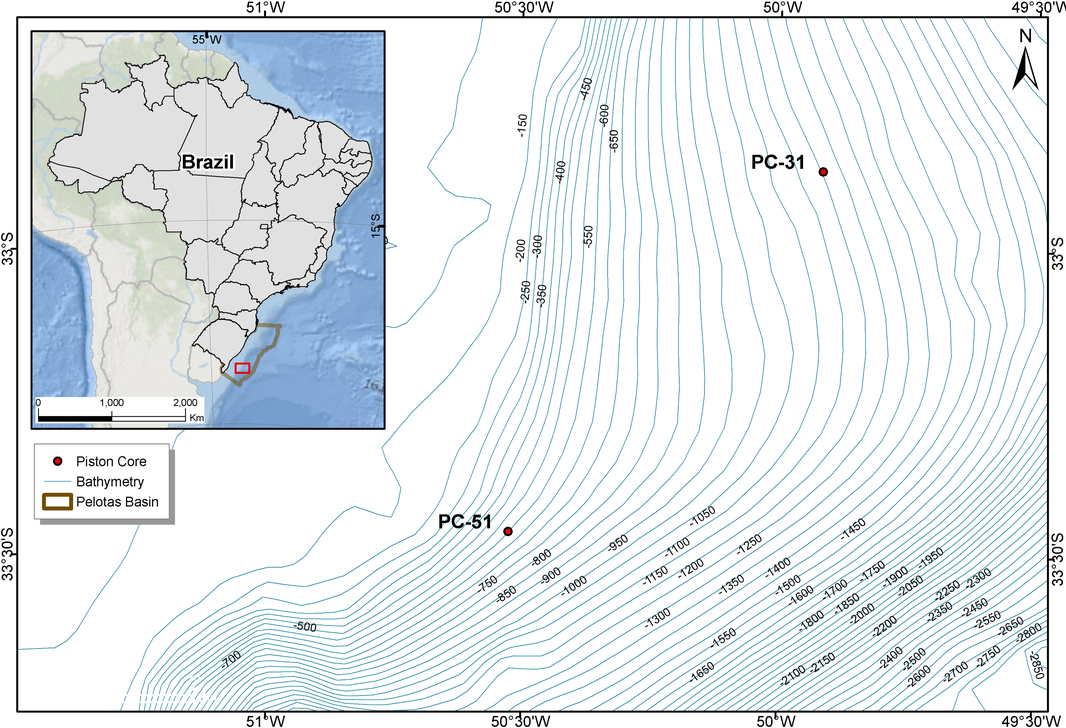
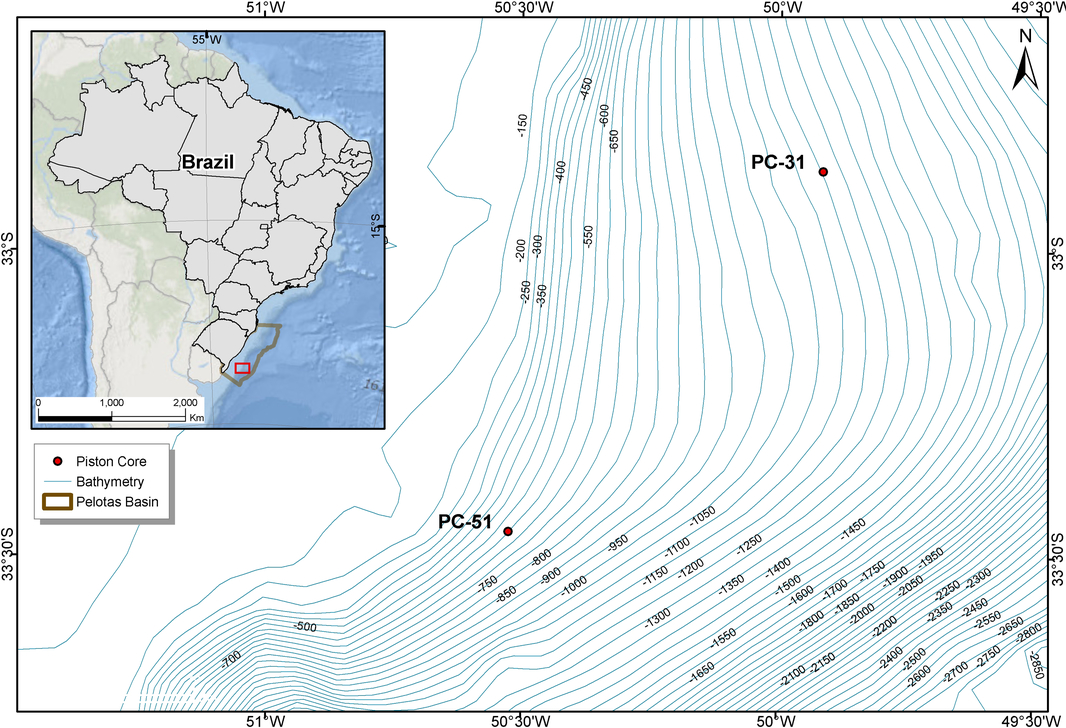
Our area study is positioned in the offshore portion of the Pelotas Basin, which originated from the breakup of the Gondwana supercontinent and the development of the South American Rift/Drift System during the Late Jurassic-Early Cretaceous (Milani et al. Reference Milani, Brandão, Zalán and Gamboa2000). This is the southernmost offshore basin of the Brazilian passive margin and extends onto the continental margin of Uruguay, covering an area of approximately 250,000 km2 (Silveira and Machado Reference Silveira and Machado2004) (Figure 1). In terms of stratigraphy, the Pelotas Basin contains volcanic and sedimentary sequences (mudstones, fine-grained sandstones and carbonates) deposited from the Lower Cretaceous to the Holocene. The Rio Grande Cone, our area of study, is a large-scale fanlike structure (40,000 km2 area) in the continental slope of the Pelotas Basin representing its main depocenter (Martins Reference Martins, Urien and Martins2005). The formation of this structure began in the Middle-Late Miocene during the drift phase of the basin, accumulating approximately 12 km of mudstones intercalated with sandy deposits.
Location map of the study area highlighting the bathymetry of the Rio Grande Cone in the Pelotas Basin and the location of the two piston cores sampled in this study. The red rectangle is the study area. (Please see electronic version for color figures.)
Biostratigraphic ages based on planktonic foraminifera assemblages in samples from both piston cores were analyzed by Petrobras (2011). The planktonic foraminifera identified were Globorotalia menardii, Pulleniatina ssp., Globorotalia inflata and Globorotalia truncatulinoides, indicating ages ranging from Pleistocene (Zone Y–Subzone Y1.B and Y1.A; 42–15 ka and 15–11 ka, respectively) to Holocene (Zone Z) (11 ka–0) (Ericson and Goesta Reference Ericson and Goesta1968; Petrobras 2011).
Sampling and Analysis
Two sediment cores, labeled PC31 and PC51, were obtained with a 6.0-m-long piston corer (PC) device during the MR11 oceanographic mission. Sub-bottom profiles (SBPs) were obtained during oceanographic mission NR12. The profiler used (EdgeTech DW106 SBP Chirp 1–6 kHz) was operated with a central frequency of 3.5 kHz.
Samples for total organic carbon (TOC) and total nitrogen (TN) were analyzed in a LECO elemental analyzer, model TRUSPEC (USA) while total sulfur (TS) was analyzed using a LECO elemental analyzer, model SC632. Sulfate concentrations in the interstitial waters were determined using a Dionex (model ICS 5000) ion chromatograph. A gas chromatograph (Shimadzu, model GC-14A) was used to determine C1–C5 hydrocarbon concentrations and stable isotope ratio measurements (13C/12C) was determined using a mass spectrometer (Thermo Scientific DELTAV Plus, Germany). For 14C, the OM of bulk sediment samples was analyzed by the accelerator mass spectrometry (AMS) technique at the Radiocarbon Laboratory of the Fluminense Federal University (LAC-UFF).
The procedures for sediment sampling to geochemical analysis, piston core description and the experimental conditions of the equipment are detailed in the supplementary material.
RESULTS
Chemical and Isotopic Results
In the sediment cores, the TOC contents ranged from 0.46 to 0.61% of the element in 100-g samples (m/m) for PC31 (Figure S2), and 0.31 to 0.62%m/m for PC51 (Figure S3). For TN contents, the ranges were 0.06 to 0.09%m/m in PC31(Figure S2) and 0.06 to 0.11%m/m in PC51 (Figure S3).
The total sulfur to total organic content ratio (TS:TOC) in PC31 was nearly zero for all depths (0.00 to 0.13), but in PC51 the value increased slowly and reached a maximum ratio value of 1.39 at 312 cmbsf (centimeters below sea floor) (Figures 2C and 2H, respectively). Sedimentary TOC δ13C values varied from –21.79 to –18.59‰ in PC31, while for PC51 the δ13C values varied from –25.31‰ to –22.63‰ (Figures 2D and 2I).
Concentrations of sulfate, TOC:TN, TS:TOC atomic ratios, δ13C-org and percentage of modern carbon (14C) in sediments in PC31 and PC51.
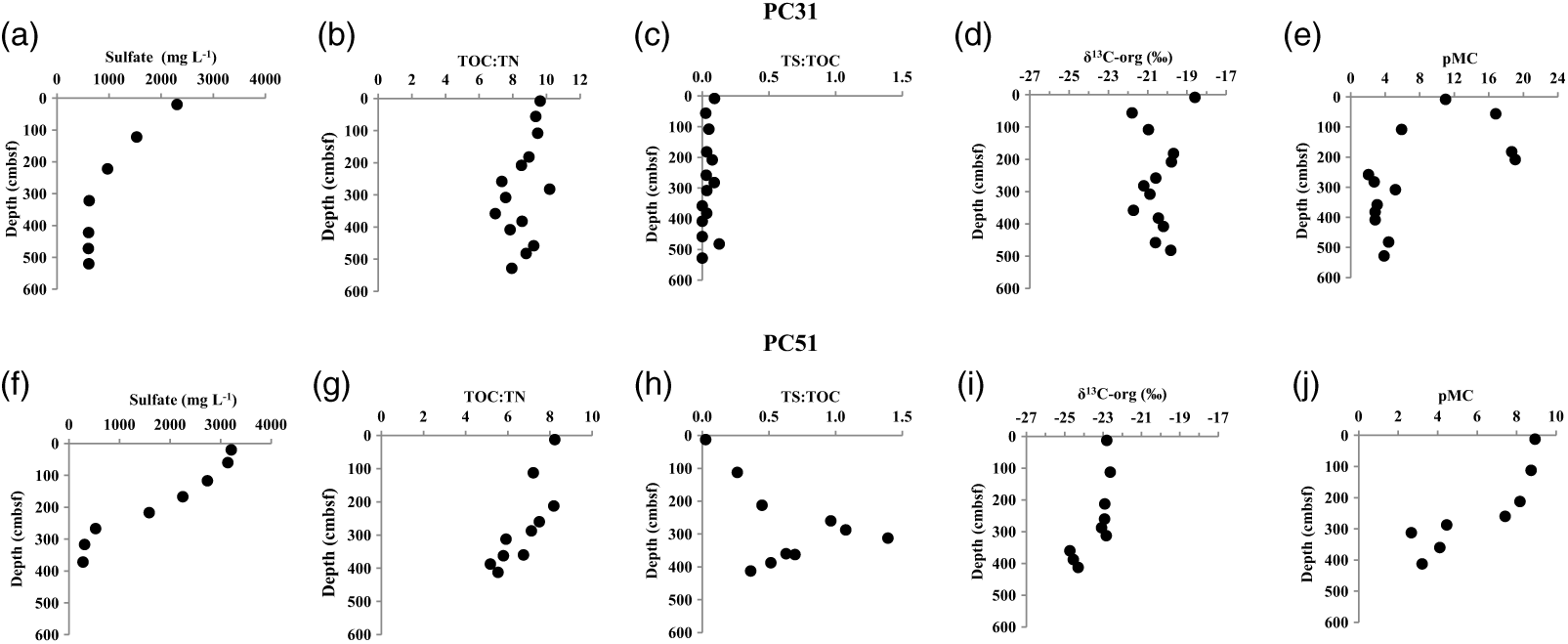
The 14C content displayed variable values between 8 to 210 cmbsf in PC31, with less variation below this depth (Figure 2E). For PC51, there was a slight decrease between 12.5 and 260 cmbsf from 8.93 to 7.42 pMC, but below this range there was an abrupt decrease between 260 and 312.5 cmbsf from 7.42 to 2.67 pMC (Figure 2J). Bulk organic carbon ages based on 14C AMS dating of all samples are listed in Table S1 (supplementary materials). The 14C ages for bulk organic carbon ranged from 29 to 19 ka BP for PC51, while for PC31 they ranged from 30.8 and 13.3 ka BP. We have summarized other graphical results in the supplementary material (Figures S2 and S3).
PC31 displayed low concentrations of methane (<10 ppmv/v) and sulfate concentrations reduced gradually between 20 and 520 cmbsf from 2300 to 610 mg L–1 (Figure S2). In PC51, methane concentrations increased sharply from 900 to 26,145 ppmv/v in the interval between 200 and 400 cmbsf, whereas sulfate concentrations decreased from a maximum of 3140 mg L–1 to nearly zero between 60 and 400 cmbsf (Figure S3).
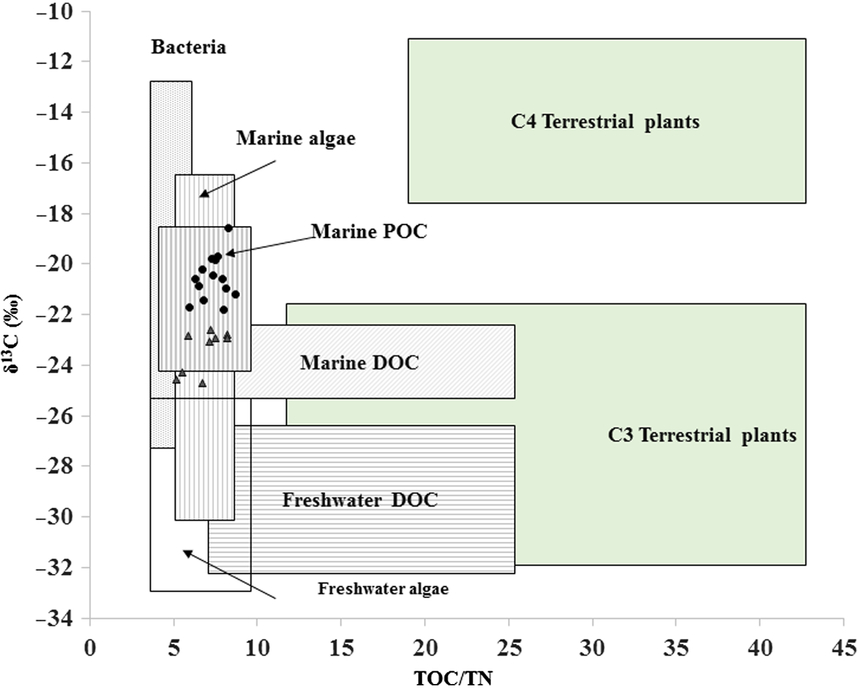
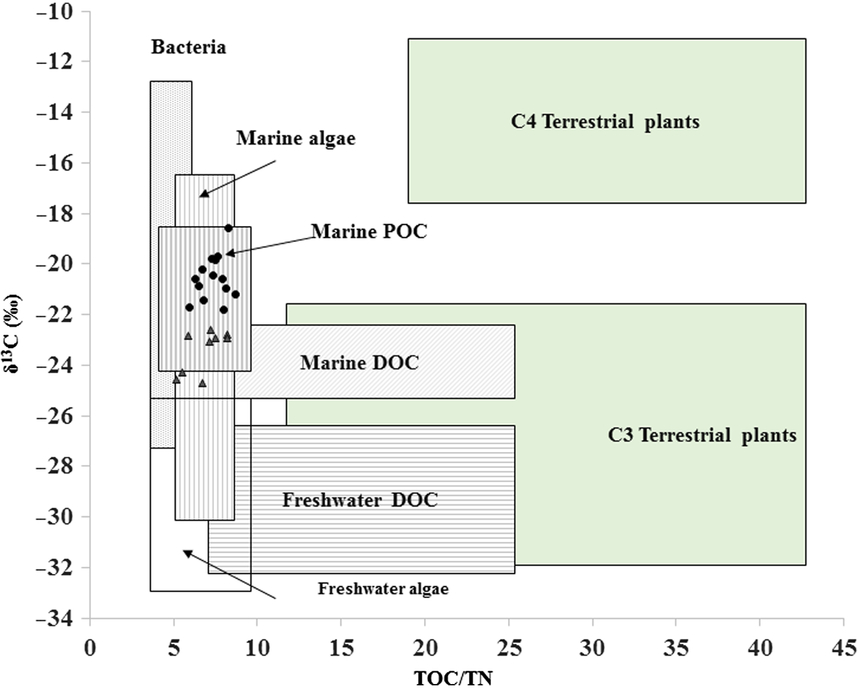
Figure 3 shows the classification of OM through the combination of isotopic and elemental ratios. The combination of δ13C values and TOC:TN ratios indicated that the main contribution of OM was of marine origin (Mayer Reference Mayer1994; Meyers Reference Meyers1997; Wilson et al. Reference Wilson, Lamb, Leng, Gonzalez and Huddart2005; Lamb et al. Reference Lamb, Wilson and Leng2006).
δ13C and C:N ratios of autochthonous (C3 vascular vegetation, marine algae and saltmarsh bacteria) and allochthonous (marine and freshwater POC and DOC) organic matter sources in sediments from the Rio Grande Cone. The circles represent the PC31 data while the triangles represent the PC51 data. Adapted from Wilson et al. (Reference Wilson, Lamb, Leng, Gonzalez and Huddart2005).
Seismic Results
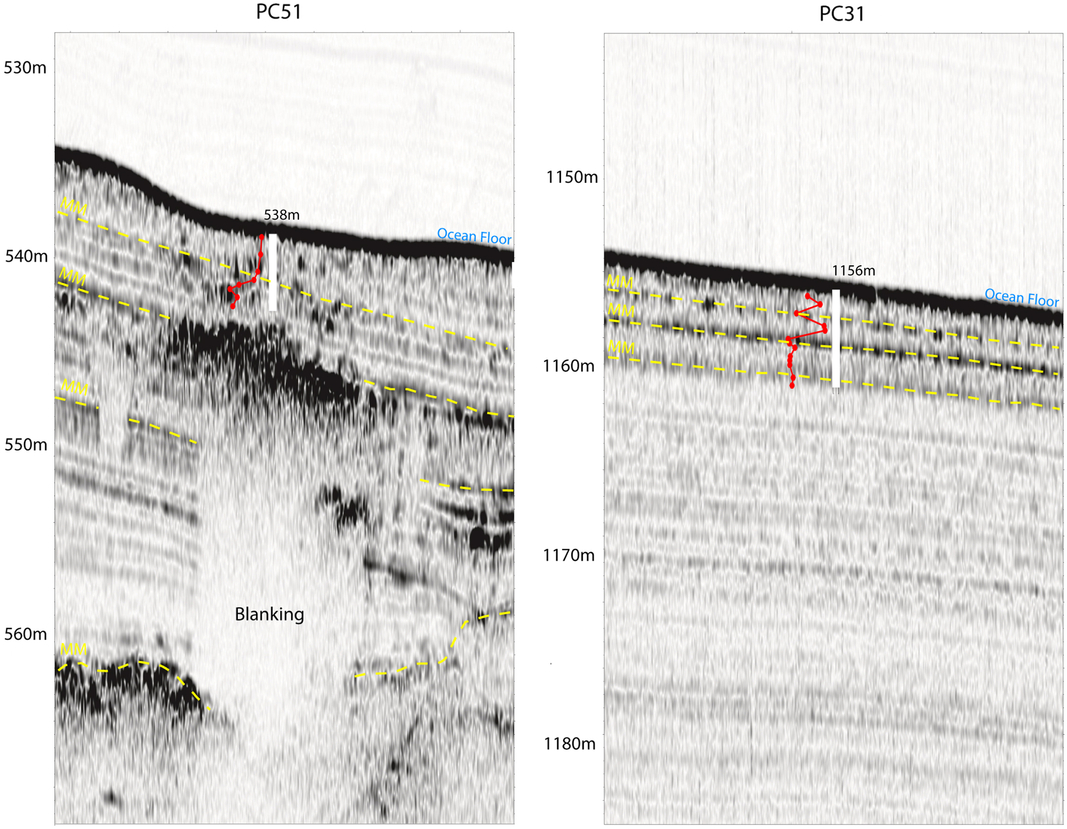
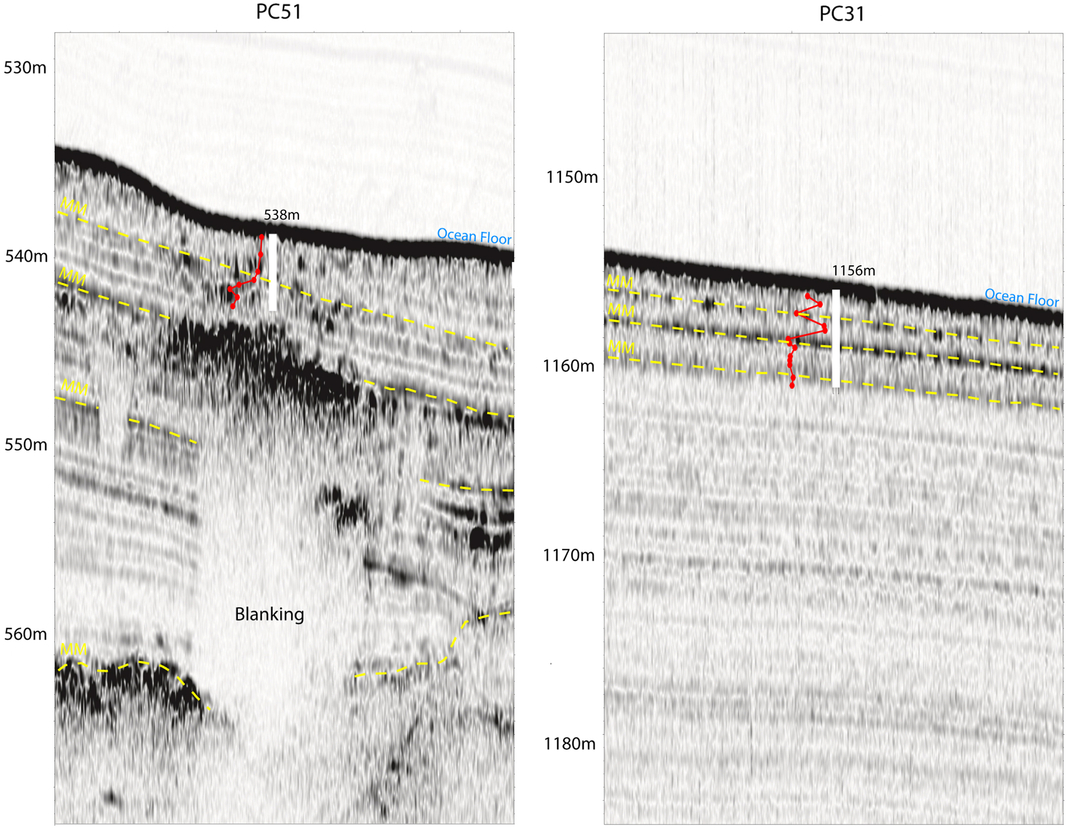
The seismic reflectors in PC31 (Figure 4) showed chaotic reflectors with high amplitude in the first 6 m, indicating the occurrence of gravitational mass movement deposits. Below this depth, the reflectors were parallel and horizontal with low amplitude, showing normal sedimentation. Regarding the deposits at the PC51 location, there were also chaotic reflections, which are evidence of mass movement deposits.
Dip-oriented seismic lines highlighting the gravitational mass flow of the offshore Pelotas Basin in the Rio Grande Cone. The yellow lines represent the mass movement and the red lines represent the percentage of modern carbon (14C) of each core piston. Extracted from Petrobras (2011).
DISCUSSION
OM Origin and Alteration of OM
Even after assuming a marine origin classification due to the δ13C values and TOC:TN ratios, three main factors could produce modifications in the original characteristic of OM sediments: (1) biological activities, (2) physical processes, and (3) deep sediment-sourced methane contribution.
Biological Activities
Oxidation of organic compounds by microorganisms can occur during sulfate reduction processes in the pore waters of marine sediments (Berner Reference Berner1981). The consumption of organic compounds from microbial activity may increase carbonate alkalinity and HS− concentration (Sassen et al. Reference Sassen, MacDonald, Guinasso, Joye, Requejo, Sweet, Alcalá-Herrera, DeFreitas and Schink1998; Matsumoto et al. Reference Matsumoto, Ryu, Lee, Lin, Wu, Sain, Pecher and Riedel2011).
In PC31 and PC51, these reactions took place at different rates, as shown by the behavior of the methane and sulfate profiles (Rodrigues et. al. Reference Rodrigues, Ketzer, Lourega, Augustin, Sbrissa, Miller, Heemann, Viana, Freire and Morad2017). Bacterial activity can be inferred from the sulfur content, since this originates from sulfate reduction. Inorganic carbon and TS content increased between 100 and 300 cmbsf in PC51, implying a consumption of OM and an increase in mineral matter production at the latter depth. In PC51, the microbial activity (sulfate reduction) was more pronounced than in PC31 due to the higher consumption of methane and OM, indicated by a higher TS:TOC ratio.
Previous studies show evidence that diagenetic processes can change the original composition of OM present in sediments. Microorganisms preferentially metabolizes 12C-enriched OM during diagenesis, potentially enriching the remaining organic compounds in 13C and possibly making the carbon isotopic composition of bulk terrestrial OM values more positive relative to their original values (Raymond and Bauer Reference Raymond and Bauer2001). As there was a carbon decrease due to microorganism consumption in PC51 (see the graphs of TOC and TOC:TN behaviors in supplementary material, Figure S3), there would also be a probable fractionation of OM, producing more positive δ13C-bulkorg values. The isotopic values were probably more depleted in the past but have been enriched values due to the high level of biological activity. This mechanism could cause positive isotope shifts in the isotopic fractionation of the marine sediments (Freudenthal et al. Reference Freudenthal, Wagner, Wenzhöfer, Zabel and Wefer2001).
In addition, the preferential utilization of young OM by microorganisms may significantly alter the original values of both 14C and δ13C, causing values of marine OM to appear older (Raymond and Bauer Reference Raymond and Bauer2001, Eglinton et al. Reference Eglinton, Aluwihare, Bauer, Druffel and McNichol1996). Another significant parameter that changed in PC51 was the TOC:TN ratio, which can have decreased due the higher carbon consumption by microbial activity
As mentioned before, the microbial activity was more pronounced in PC51 than in PC31 and probably, if there were trace amounts of terrestrial compounds in PC51, these compounds were consumed by microorganisms that modified the negative δ13C-bulk values to more positive values. Therefore, any contribution of terrestrial OM (especially in PC51) cannot be detected due to these effects.
Physical Processes
Physical processes (sediment erosion, resuspension and transport) are other important factor that also modify original OM composition (Dickens et al. Reference Dickens, Gélinas, Masiello, Wakeham and Hedges2004). In PC31, 14C (pMC) values showed random behavior in the interval between the seafloor and 200 cmbsf (Figure 2E) which is interpreted as a mass movement deposit. This type of deposit can intermix the OM contained in the original sediments. High-resolution seismic lines show the existence of gravitational mass flows, most likely resulting from detachment events originating at the shelf break and the upper slope of the Rio Grande Cone (Figure 4).
Although 14C ages found in some samples corroborate biostratigraphic ages based on planktonic foraminifera assemblages in samples from both piston cores (Vicalvi Reference Vicalvi1999), we have to take into account that the degree of mixing of carbon from different depths of marine sediments prevent us interpreting such ages as “true” ages. Therefore, chronological information must also rely on biostratigraphic age estimates. The Pleistocene ages measured based on biostratigraphy at the top of core PC31. Thus, we suggest that the absence of Holocene could be attributed to the strong contour currents from the South that have eroded and flattened recent deposits in the Rio Grande Cone. The Pelotas Basin is located on the western margin of the South Atlantic, where sediment deposition is influenced by deep contour currents in the Santos and Campos basins to the North (Viana Reference Viana2001) and in the Punta del Este basin to the South (Hernández-Molina et al. Reference Hernández-Molina, Soto, Piola, Tomasini, Preu, Thompson, Badalini, Creaser, Violante, Morales, Paterlini and Santa Ana2016).Further, we suggest that the gravitational mass flows are responsible for remobilization of the stratigraphy sequences of the Pelotas Basin in PC31, resulting in non-sequential chronostratigraphic ages (Figure 4).
In contrast to core PC31, biostratigraphic ages of the top 50 cm sediment of the core PC51 are Holocene (Vicalvi Reference Vicalvi1999). This core is located closer to the Rio de la Plata mouth (a potential sediment source for the Rio Grande Cone) as well as in shallower waters (549 m) than the PC31 (1162 m), and, therefore, higher sedimentation rates and a thicker Holocene interval is expected. Consequently, more sediments and OM may have been accumulated in PC51 and could explain the presence of Holocene ages on the top of core PC51.
In addition, 14C (pMC) values in PC51 showed a slight decrease between seafloor and 260 cmbsf (Figure 2J), which could indicate a normal sedimentation in the SBP profile. However, below 260 cmbsf there is an abrupt decease in the 14C value. This gap can be explained by the existence of older 14C-depleted mass movement deposits located at 260 cmbsf. These deposits cannot clearly be identified in the cores, but they are evident in high-resolution seismic profiles in the area (Figure 4). Therefore, we suggest that gravitational mass flows in PC51 are responsible for a hiatus originated by erosion of sediment by mass movements.
Deep Sediment-Sourced Methane Contribution
Natural sources of fossil carbon emanating from the seafloor may also be significant and can modify the bulk composition of OM (Pohlman et al. Reference Pohlman, Bauer, Canuel, Grabowski, Knies, Mitchell, Whiticar and Coffin2009). The 14C-free component will significantly affect 14C measurements of bulk organic carbon, making measured 14C ages for organic carbon appear substantially older than their “true” age (Dickens et al. Reference Dickens, Gélinas, Masiello, Wakeham and Hedges2004).
The 14C content decreased abruptly in PC51, which we assert is due to the presence of progressively “older” OM from relatively deeper sources, transported by fluids. The mixing with 14C-depleted (or -free) methane from below can also explain this gap, as the area has an active flow of methane at shallow depths below the seafloor (Rodrigues et al. Reference Rodrigues, Ketzer, Lourega, Augustin, Sbrissa, Miller, Heemann, Viana, Freire and Morad2017). According to Miller et al. (Reference Miller, Ketzer, Viana, Kowsmann, Freire, Oreiro and Augustin2015), deep-rooted faults that could transport fluids from deeper sources are present in this area and gas chimneys with upward migrating gas have been presented by Rodrigues et al. (Reference Rodrigues, Ketzer, Lourega, Augustin, Sbrissa, Miller, Heemann, Viana, Freire and Morad2017). Therefore, this input of “old” OM from pre-aged sources could make sediments appear to be substantially older than their “true” age (Hedges and Parker Reference Hedges and Parker1976).
These hydrocarbon seeps, including CH4 and a contribution from hydrate-sourced CH4, could also be an important source of “old” C contributing to sedimentary pools in the ocean, which can explain the very old 14C ages as measured in the deep (Coffin et al. Reference Coffin, Hamdan, Smith, Rose, Plummer, Yoza, Pecher and Montgomery2014). In a related study in the Northeastern Pacific Ocean, it has been estimated that sediment methane contributes about 28% of the carbon to the water-column-dissolved organic carbon pool (Pohlman et al. Reference Pohlman, Bauer, Waite, Osburn and Chapman2011; Coffin et al. Reference Coffin, Hamdan, Plummer, Smith, Gardner, Hagen and Wood2008). Thus, hydrocarbons produced within deep sediment can significantly contribute to the cycling of carbon.
In contrast, the occurrence of input of “old” OM from pre-aged sources is not apparent in the results for PC31, where the ages appear to be consistent. In these areas, we believe the concentration of methane is very low and there is no seismic evidence of acoustic blanking that represents gas chimneys.
CONCLUSIONS
In this work, we used chemical proxies (TOC:TN; δ13C-org) to study the origin of OM in marine sediments of the Rio Grande Cone, which are classified as of marine origin. Three main factors could produce modifications to the original characteristic of OM sediments:
1. Biological activities: the chemical composition results showed evidence of greater microbial activity in PC51 than in PC31.
2. Physical processes: according to the seismic data, the existence of gravitational mass flows was observed in both cores.
3. Deep-sediment-sourced methane contribution: the migration of natural sources of fossil carbon and a methane contribution from deeper sources were detected mainly in PC51.
The 14C AMS ages in PC31 are not in chronostratigraphic order, indicating sediment remobilization by mass movements. The 14C results in OM and seismic results showed the existence of younger sediments from mass wasting overlying older sediments. In addition, the Pleistocene biostratigraphic ages at the top of core PC31 probably indicates erosion of the Holocene sediments, which is possibly associated with the presence of strong contour currents from the South, which have eroded and flattened recent deposits in the Rio Grande Cone. Although 14C ages found in some samples corroborate biostratigraphic ages based on planktonic foraminifera assemblages in samples from both piston cores (Vicalvi Reference Vicalvi1999), the degree of mixing of carbon from different sources prevents us interpreting such ages as “true” ages.
Holocene ages were verified at the top of core PC51 by biostratigraphy, where the contour currents did not have a strong influence. Inconsistencies between 14C measurements and biostratigraphy can indicate a likely input of organic compounds depleted in 14C, causing measured organic carbon 14C ages to appear substantially older than their “true” age. The 14C content in OM decreased abruptly in PC51, where high gas concentrations were found. The input of “old” (>50 ka) organic compounds from pre-aged sources carried by upward by migrating fluids may cause measured organic 14C ages to appear substantially older than their “true” age. These age determinations may be subject to the presence of older carbon sources preventing their calibration and interpretation as true ages.
ACKNOWLEDGMENTS
The authors would like to thank the Brazilian funding agencies for their financial support: CNPq (Conselho Nacional de Desenvolvimento Científico e Tecnológico), FAPERJ (Fundação Carlos Chagas Filho de Amparo à Pesquisa do Estado do Rio de Janeiro) and CAPES (Coordenação de Aperfeiçoamento de Pessoal de Nível Superior). Luiz Frederico Rodrigues is indebted for the concession of grant (500422/2014-1 – CNPq) and to the support and analytical facilities of Universidade Federal Fluminense and Institute of Petroleum and Natural Resources/PUCRS. J. Marcelo Ketzer thanks the Brazilian Research Council (CNPq) for financial support (grant no. 309915/2015-5). We also thank Petrobras for releasing the data for this publication and to Kingdom software. Kita Macario thanks CNPq for grant 305079/2014-0 and INCT-FNA 464898/2014-5 and FAPERJ E-26/203.019/2016.
SUPPLEMENTARY MATERIAL
To view supplementary material for this article, please visit https://doi.org/10.1017/RDC.2019.109