


The goal of this article is to investigate palatal nasal decomposition from the perspective of three Slavic languages: Slovene, Upper Sorbian and Polish. An associated task is to see how the findings bear on Optimality Theory (OT, henceforth; Prince & Smolensky Reference Prince and Smolensky1993/Reference Prince and Smolensky2004, McCarthy & Prince Reference McCarthy, Prince, Beckman, Dickey and Suzanne1995), the framework in which the analysis is carried out.
Slovene, Upper Sorbian and Polish show three patterns in their realization and distribution of the three treatments of the palatal nasal:ɲ-retention, ɲ-decomposition and ɲ-depalatalization. The outcome of ɲ-decomposition is constant from language to language in the sense that ɲ always decomposes into a cluster of the glide [j] and a nasal consonant. However, the implementation of nasal decomposition is different in each of the three phonological systems considered. Slovene retains [ɲ] in the coda but decomposes it into [nj] in the onset. Upper Sorbian is the reverse of Slovene: it retains [ɲ] in the onset but decomposes it into [jn] in the coda. Polish preserves [ɲ] in both onsets and codas but decomposes it into [jm], [jn] and [jη] before stops and affricates. The unifying thread in ɲ-decomposition is the appearance of the glide [j], which supports the treatment of palatalization as the co-occurrence of two properties: one for the place and manner of the given consonant and the other for the vowel [i], assuming that [j] is represented as [i] on the melodic tier and that the distribution of [i] and [j] in the output representation is a matter of syllabification. The two properties are teased apart in the case of ɲ-decomposition into a plain nasal consonant and the glide [j].
From a theoretical perspective, the analysis of nasal decomposition raises an important question regarding the nature of ident constraints in OT: are they better viewed as unidirectional i→o and o→i constraints, or rather as the classic bidirectional constraints of McCarthy & Prince (Reference McCarthy, Prince, Beckman, Dickey and Suzanne1995) ?
Finally, it should be noted that neither Slovene nor Upper Sorbian has been analysed in the generative phonological literature before. In contrast, Polish boasts a vast generative literature but the facts of ɲ-decomposition have so far escaped the investigators' attention.Footnote 2 The data of Slovene, Upper Sorbian and Polish have been drawn from standard descriptions and from my fieldwork. The facts cited here have all been checked with native-speaker consultants.
This article is organized as follows. Section 1 looks at Slovene and reviews the basic assumptions as well as the tools of analysis. Section 2 addresses Upper Sorbian. Section 3 analyses ɲ-decomposition in Polish and points to a theoretical mechanism that is different from that found in Slovene and Upper Sorbian. Section 4 looks at the implications of unidirectional ident constraints for comparative markedness and considers an alternative treatment of decomposition in terms of max(Feature) theory. Section 5 summarizes the conclusions.
1. Slovene
A characteristic feature of Standard Slovene as described by sources such as Bajec et al. (Reference Bajec, Kolarič and Rupel1956), Toporišič (Reference Toporišič1978, Reference Toporišič1991) and de Bray (Reference de Bray1980) is a contrast between prepalatalFootnote 3 and dental nasals, for example, konj [ɲ] ‘horse’ vs. slon [n] ‘elephant’.Footnote 4 The contrast is due to the fact that the prepalatal nasal, but not the plain nasal, carries the palatalization features [+high, −back].
Prepalatal [ɲ] alternates with non-palatalized [n] followed by [j] in words such as the following. (In Slovene orthography, both [ɲ] and [nj] are represented in the spelling as nj; the letters in italics correspond to the transcriptions in square brackets.)
(1) konj ‘horse’ [ɲ] (masc. nom.sg.)konj+a [nj] (gen.sg.)
konj+sk+i [ɲ] (Adj.)konj+ar [nj] ‘groom’
konj+erej+a [nj] ‘horse-breeding’
svinj [ɲ] ‘pig’ (fem. gen.pl.)svinj+a [nj] (nom.sg.)
svinj+sk+i [ɲ] (Adj.)svinj+ar [nj] ‘pig-herd’
svinj+stv+o [ɲ] ‘filth’svinj+ak [nj] ‘pig-sty’
panj [ɲ] ‘bee-hive’ (masc. nom.sg.)panj+a [nj] (gen.sg.)
panj+sk+i [ɲ] (Adj.)panj+ač [nj] (dimin.)
ogenj ‘fire’ [ɲ] (masc. nom.sg.)ognj+a [nj] (gen.sg.)
ogenj+ček [ɲ] (dimin.)ognj+evit [nj] ‘fiery’
Toporišič (Reference Toporišič1978, Reference Toporišič1991) observes that [ɲ] appears word-finally and before consonants while [nj] occurs before vowels. Stated in syllable terms, the generalization is that [ɲ] is found in codas while [nj] occurs in onsets.
In what follows, I assume that the alternation [ɲ] – [nj] is derivable from underlying /ɲ/ and postpone the consideration of alternative underlying representations till the end of this section. Given underlying /ɲ/, the occurrence of [nj] is an effect of decomposition (fission): /ɲ/→[nj].
While the mechanics of decomposition are complicated (see below), the concept itself is rather simple. Struijke (Reference Struijke2000) points out that decomposition is a so-called TETU effect: it leads to ‘The Emergence of The Unmarked’ (McCarthy & Prince Reference McCarthy and Prince1994).Footnote 5 This is well illustrated by Slovak diphthongization (Rubach Reference Rubach1993).
Slovak long /æ:/ turns into a diphthong in the surface representation by developing an onglide [i]. However, the result of this process is not [iæ] but [ia]. At first glance the occurrence of [a] rather than [æ] is puzzling: why would an input front vowel turn into a back vowel context-freely? This fact becomes understandable if we analyse /æ:/→[ia] as decomposition because then the driving force for this process is the improvement of markedness: the front low /æ/, which is more marked than either [i] or [a], is eliminated by diphthongization. If the output were [iæ], this goal would not have been achieved since [æ], a marked vowel, would persist in the surface representation. Therefore the output is [ia].
The choice of [i] and [a] as the components of the diphthong derived from /æ:/ is not accidental. The basic principle of decomposition is that the features of the input must be preserved in the output. This is borne out in /æ:/→[ia]. First, the input is a long vowel, hence a vowel that carries two moras. The two moras are preserved in the output, although they are now linked to two different melodic segments: one mora is linked to [i] and the other to [a]. Second, the input /æ:/ is a front vowel. The feature responsible for frontness is preserved in the output because the [i] component of the diphthong [ia] is [−back]. Third, the input /æ:/ is a low vowel. This property, too, is retained in the output because the [a] component of the diphthong [ia] is [+low].
The rationale of the Slovene decomposition, /ɲ/→[nj], is in all essential ways the same as the rationale of Slovak diphthongization. The input /ɲ/Footnote 6 carries the features of palatalization, which has been characterized as [+high, −back] in all feature theories beginning with SPE (Chomsky & Halle Reference Chomsky and Halle1968). Decomposition eliminates [ɲ], a marked segment, by splitting it into two segments: [n] and [j]. This split yields an improvement in markedness since [n] is a default coronal nasal and [j] is a widely attested glide. As in the case of Slovak diphthongization, the properties of the input are retained in the output: [n] and [j] preserve the features [+nasal] and [+high, −back], respectively.
The mechanics of decomposition in an OT analysis are quite complex. The splitting of one segment into two violates integrity (McCarthy & Prince Reference McCarthy, Prince, Beckman, Dickey and Suzanne1995).
(2) integrity (int):No element in S1 has multiple correspondents in S2.
int is violated because /ɲ1/ has two surface correspondents [n1] and [j1] in [n1j1], where the subscript digit is the numerical integer showing correspondence. In contrast, dep(Seg), which prohibits the insertion of segments, is not violated precisely because [n1] and [j1] are both correspondents of /ɲ1/. That is, technically, the decomposition of /ɲ1/ into [n1j1] is not an insertion of a segment because both [n1] and [j1] are spawned by /ɲ1/. The development of /ɲ1/ into [n1i1] is penalized by dep-μ, which prohibits the insertion of moras. Since consonants have no moras in the underlying representation, the mora associated with [i] in the candidate [n1i1] cannot be inherited from the input /ɲ1/. It must therefore come from insertion, which constitutes a dep-μ violation. Glides, unlike vowels, do not have moras in the surface representation, so dep-μ is mute on the development /ɲ1/→[n1i1]. Finally, the driver for decomposition is a segment inventory constraint *ɲ that prohibits soft nasals. This constraint must be ranked above int, so that decomposition prevails.
This discussion is continued and exemplified in (3), where (3i) states the relevant constraints (Prince & Smolensky 1993/Reference Prince and Smolensky2004, McCarthy & Prince Reference McCarthy, Prince, Beckman, Dickey and Suzanne1995) while (3ii) shows the evaluation of konj+a ‘horse’ (gen.sg.). Dots denote syllable boundaries, while the right-pointing hand ☞ shows the winning candidate. An exclamation mark means that the candidate has been eliminated.
- (3)
(i) dep(Seg): Every segment in S2 has a correspondent in S1.
dep-μ: Every mora in S2 has a correspondent in S1.
*ɲ: Don't be a [+high, −back] coronal nasal.
(ii) /k1ɔ2ɲ3+a4/Footnote 7→[k1ɔ2.n3j3a4]Footnote 8

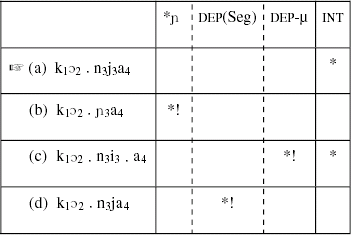
Candidate (3d) is identical to candidate (3a) except that now the [j] comes from insertion rather than from decomposition (hence no integer on j). This output violates dep(Seg) but does not violate int because there is no decomposition. Since candidate (3a) is the desired output, int must be ranked lower than the other constraints in (3ii). Candidate (3c) is eliminated by dep-μ because the vowel [i] has a mora that comes from insertion.Footnote 9
The analysis of konj+a is far from being complete. In what follows, I look at three further issues: locality, the direction of decomposition, and the emergence of the unmarked nasal.
With regard to the problem of locality, the generalization is that nasal decomposition is strictly local, that is, [n1] and [j1] from /ɲ1/ are always adjacent in the desired output candidate. In the case of Slovene, this means that /ɲ1/ decomposes into [n1j1]. In Upper Sorbian (section 2) and Polish (section 3), the sequencing of the correspondents is reversed in the desired candidate: /ɲ1/→[j1n1]. However, in none of the cases analysed here can [j1] or [n1] move to a different locus in the word. That is, /k1ɔ2ɲ3+a4/ does not have outputs such as *[k1j3ɔ2n3a4], *[k1n3ɔ2j3a4], and the like as its surface representation.Footnote 10 Notice that syllabification constraints such as *complexOnset (no complex onsets) cannot be relevant here because the optimal output, [kɔ.nja], has a complex onset. The exclusion of the undesired output, *[k1j3ɔ2n3a4], follows from Output-contiguity (Kenstowicz Reference Kenstowicz, Davison, Maier, Silva and Yan1994, McCarthy & Prince Reference McCarthy, Prince, Beckman, Dickey and Suzanne1995), which prohibits intrusion: here [j3] has intruded between [k1] and [ɔ2].
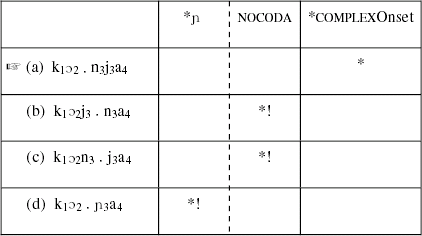
The sequencing of correspondents in the decomposition, specifically, the fact that Slovene decomposes /ɲ1/ into [n1j1] rather than [j1n1], follows from the ranking of syllabification constraints. The selection of the attested output, [kɔ.nja], over the unattested [kɔj.na] (or, for that matter [kɔn.ja]) shows that nocoda (syllables should not have codas) is ranked higher than *complexOnset. This is in keeping with the general syllabification pattern of Slovene, which maximizes onsets – for example, dekla ‘maid’ is syllabified de.kla (Bajec et al. Reference Bajec, Kolarič and Rupel1956 and my fieldwork). Furthermore, since we witness decomposition in the onset, *ɲ must outrank *complexOnset, so that [kɔ.ɲa] is worse than [kɔ.nja]. This fragment of the analysis is summarized in tableau (4).
(4) /k1ɔ2ɲ3+a4/→[k1ɔ2.n3j3a4]
Recall from the earlier discussion that one of the principles of decomposition is the preservation of the input features in the corresponding surface segments, a job that is entrusted to ident constraints. According to McCarthy & Prince (Reference McCarthy, Prince, Beckman, Dickey and Suzanne1995), ident(Feature) constraints demand bidirectional agreement between correspondents.
(5) ident(F):Correspondent segments have identical values for the feature F.
Viewed from the perspective of ɲ-decomposition, the relevant constraints are ident([+nasal]), ident([+high]), and ident([−back]); the latter two subsume the palatalization features [+high, −back] and hence will jointly be called ident(Pal) (Rubach Reference Rubach2003).
- (6)
(a) ident([+nasal]):Correspondent segments in the input and the output are [+nasal].
(b) ident(Pal):Correspondent segments in the input and the output are ([+high, −back]).
These constraints are bidirectional in the sense that if, looking e.g. at (6a), [+nasal] is found on the input segment, then it must exist on the output segment; and conversely, if [+nasal] is found on the output segment, then it must also exist on the input segment.
Tableau (7) serves to illustrate the role played by the constraints in (6). The ranking *ɲ>>int drives decomposition. The icon ☹ denotes the desired candidate that has lost the race; the left-pointing hand ☜ shows the incorrect winner.
(7) /k1ɔ2ɲ3+a4/:failed evaluation
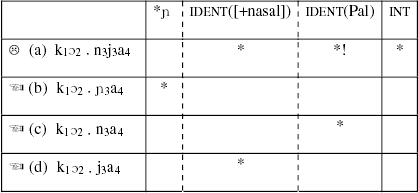
Candidate (7a), the desired output, violates ident([+nasal]) on the [j3] part of the [n3j3] correspondent of /ɲ3/: [j3] is not a nasal and it is a correspondent of /ɲ3/. Candidates (7b–d) have not undergone decomposition, so they do not violate int. However, candidate (7d) has [j3] as the correspondent of /ɲ3/, so it violates ident([+nasal]). Candidate (7b) is excluded because it retains /ɲ/.
The assessment of ident(Pal) violations proceeds along the same lines as the assessment of ident([+nasal]) violations. Candidate (7a) violates ident(Pal) on the [n3] part because [n3] is not [+high, −back] while its input correspondent /ɲ3/ is palatalized. Similarly, candidate (7c), which has circumvented *ɲ by depalatalization since [n3] is the correspondent of /ɲ3/, yields a violation of ident(Pal).
The result of the evaluation in (7) is incorrect: candidates (7b), (7c) and (7d) tie. This ambiguity could be solved by assuming that *ɲ, ident([+nasal]) and ident(Pal) are ranked vis-à-vis one other; but the effort is pointless since neither of these candidates is the desired output. The problem is that there is no ranking of the constraints in (7) that can make candidate (7a), the desired output, win out over candidates (7c) and (7d) because (7a) has a superset of the violations of both (7c) and (7d).
The problem encountered in (7) is completely general and is an inherent part of decomposition. Thus, the Slovak diphthongization mentioned earlier, which splits /æ:/ into [ia], violates ident([+low]) on the [i] part and ident([−back]) on the [a] part of the diphthong. The competing candidates [i:] and [a:] fare better than [ia] since [i:] violates ident([+low]) but not ident([−back]) whereas [a] violates ident([−back]) but not ident([+low]).
In sum, the generalization is that the decomposition candidate will always have a superset of the violations of the competitors that have not undergone decomposition because it incurs ident violations for each of the two segments. Therefore, the current theory would make a prediction that decomposition (here /ɲ1/→[j1n1]) should never be optimal and that simplification (/ɲ/→[n] or /ɲ/→[j]) should always be preferred. The prediction is incorrect, as this article shows.
The source of the problem is the nature of the ident(Feature) constraints (ident(F) henceforth), in particular, the fact that these constraints are bidirectional. However, if we assume with Pater (Reference Pater, Kager, Hulst and Zonneveld1999) that ident constraints are unidirectional, the difficulties encountered in the analysis of decomposition disappear.Footnote 11 The constraints in (6) are now reformulated as follows.
- (8)
(a) ident([+nasal]):[+nasal] on an input consonant must be preserved as [+nasal] on an output correspondent of that consonant.Footnote 12
(b) ident(Pal):[+high, −back] on an input consonant must be preserved as [+high, −back] on an output correspondent of that consonant.
Stated in this way, ident(F) constraints are unidirectional I(nput)→O(utput) constraints.Footnote 13ident([+nasal]) is satisfied by [n1j1] derived from /ɲ1/ because [+nasal] is preserved in the output. That is, [+nasal] has not been lost as a feature because it survives on [n1]. The fact that [j1] in [n1j1] does not carry [+nasal] is irrelevant because [n1], which, like [j1], is a correspondent of /ɲ1/, is [+nasal]. Similarly, ident(Pal) is satisfied by [n1j1] because [+high, −back] is preserved faithfully in [j1], and its absence in [n1] is irrelevant.Footnote 14
With this new understanding of ident(F) constraints, we can now reconceptualize and reassess the violations of ident([+nasal]) and ident(Pal) presented earlier in (7).
(9) /k1ɔ2ɲ3+a4/→[k1ɔ2.n3j3a4]
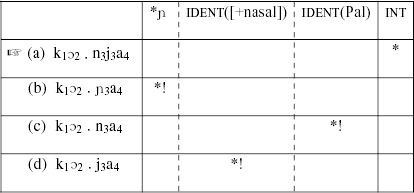
The result is correct because (9a) is indeed the attested surface form.
A further question in the analysis of konj+a is how to make sure that /ɲ/ decomposes into [nj] rather than into some other sequence of segments – for example, [nl']. Here [l'] is palatalized and hence carries the features [+high, −back], so these features are preserved in the surface representation in the candidate [k1ɔ2n3l'3a4], the wrong form, just as successfully as in the candidate [k1ɔ2n3j3a4], the attested form. Furthermore, both candidates satisfy *ɲ, which is the driver for decomposition.
In sum, the candidates [k1ɔ2n3j3a4] and [k1ɔ2n3l'3a4] from the input /k1ɔ2ɲ3+a4/ tie because they both satisfy the constraints that we have developed so far: *ɲ, ident([+nasal]) and ident (Pal). Specifically, ident([+nasal]) is satisfied on the [n3] part in both candidates while ident(Pal) is satisfied on the [j3] in [k1ɔ2n3j3a4] and on the [l’3] in [k1ɔ2n3l'3a4] because [j3] and [l’3] both preserve the features [+high, −back] from the input /ɲ3/.
The source of the problem is easily identified: the undesired candidate [k1ɔ2n3l'3a4] has the feature [+lateral] that is not found in the input /ɲ3/. To capture this discrepancy, ident(F) constraints must be able not only to match inputs with outputs (i→o), as in (8), but also outputs with inputs (o→i), a suggestion that is due to Pater (Reference Pater, Kager, Hulst and Zonneveld1999). The relevant constraint is stated in (10).
(10) O→Iident([+lateral]):[+lateral] on an output consonant must be found on the input correspondent of that consonant.
Now the tie is resolved in favour of the desired candidate [k1ɔ2n3j3a4].Footnote 15 The ranking of O→Iident([+lateral]) in (11) is not essential.
(11) /k1ɔ2ɲ3+a4/→[k1ɔ2n3j3a4]
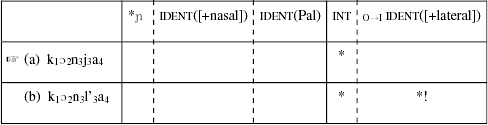
Postulating O→Iident constraints fits well into the architecture of correspondence OT in both conceptual and formal ways. Conceptually, it retains the idea of matching correspondents. Formally, it joins the class of o→i constraints that OT has anyway: o-contiguity and the dep family. Notice that, technically, bidirectional ident(F) constraints of the classic type are able to penalize the addition of features and hence O→Iident(F) constraints are not absolutely necessary; but, given that I→Oident(F) constraints are indispensable, the bidirectionality of ident(F) is unmotivated and should be eliminated by Occam's Razor. I conclude that ident(F) constraints in OT are of two types: i→o, mandating the preservation of a feature, and o→i, penalizing the addition of a feature. In sum, ident constraints are unidirectional. This conclusion is based on the argument from decomposition, which is more compelling than the argument presented originally in Pater (Reference Pater, Kager, Hulst and Zonneveld1999).
In his study of NC effects in Austronesian, Pater (Reference Pater, Kager, Hulst and Zonneveld1999) claims that place assimilation cum stop deletion (as in Indonesian, where, for instance, /N+p/ maps to [m]) should be analysed as coalescence, which thereby constitutes an argument for unidirectional ident constraints. The analysis is that [m] preserves the properties of both input segments by retaining the nasality of /N/ and inheriting the place of articulation from /p/. We thus witness coalescence: /N1+p2/→[m1,2]. Crucial in the analysis is ident([nasal])Footnote 16 because it ensures that /N1+p2/ maps to [m1,2] and not to [p1,2]. But bidirectional ident([+nasal]) is violated in the desired winner [m1,2] because the output nasal has /p/ as its input correspondent. This violation, however, will not be assessed if ident([nasal]) is a unidirectional i→o constraint since the input [nasal] has a nasal as its output correspondent.
This analysis is illuminating; but the argument for unidirectional constraints is crucially based on the principle of strict parallelism assumed by standard OT, which prohibits derivational stages of evaluation.
Pater's (Reference Pater, Kager, Hulst and Zonneveld1999) argument cannot be upheld in a version of OT that admits derivational levels (Kiparsky Reference Kiparsky1997, Reference Kiparsky2000; Rubach Reference Kiparsky1997, Reference Rubach2000a, Reference Rubachb; and others). In this theory, /N+p/ maps to /mp/ at level 1 due to the high-ranked max(Seg) (no deletion) and the constraint mandating nasal assimilation. *nc banning clusters of nasals and voiceless stops is low-ranked at this level. At level 2, *nc is reranked above max(Seg), so the input /mp/ has [m] as its optimal output.Footnote 17
In contrast, the adoption of derivational OT does not affect the argument from decomposition for unidirectional ident constraints. A split of one segment into two by definition cannot result in the full identity of both correspondents or else the split would not be identifiable. The relationship between the input segment and its output correspondents can then be assessed correctly only if ident constraints are unidirectional, as the preceding discussion has shown.Footnote 18
Returning to the data in (1), we note that /ɲ/ is not decomposed in the coda, as in konj [kɔɲ] ‘horse’ (nom.sg.) and konj+sk+i [kɔɲski] (Adj.). The retention of [ɲ] in the optimal outputs is enforced by *complexCoda, which must dominate *ɲ, as shown for konj in (12i) and for konj+sk+i in (12ii).Footnote 19
- (12)
i /k1ɔ2ɲ3/→[k1ɔ2ɲ3] (no change)
ii /k1ɔ2ɲ3+s4k5+i6/→[k1ɔ2ɲ3.s4k5i6] (no change)
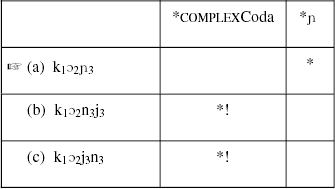
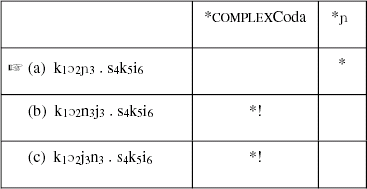
The ban on complex codas in (12) does not mean that Slovene has no complex codas; such codas are indeed attested, for example, gost [-st] ‘guest’. The generalization is that complex codas are attested if the segments that constitute them come from the underlying representation. That is, deletion is not a permitted strategy for avoiding complex codas – technically, max(Seg)>>complexCoda.
In (13), I summarize the rankings of constraints that the analysis of decomposition has revealed.
- (13)
(a) *ɲ>>int drives decomposition; see (3ii).
(b) *ɲ>>*complexOnset because decomposition is better than creating complex onsets; see (4).
(c) dep-μ>>*ɲ since it is better to retain /ɲ/ in the surface representation than to decompose it into [ni]; see Footnote footnote 9.
(d) ident([+nasal]), ident(Pal)>>int because decomposition is preferred to simplification; see (9).
(e) nocoda>>*complexOnset because onsets are maximized; see (4).
(f) *complexCoda>>*ɲ because /ɲ/ is not decomposed in the coda; see (12).
A reviewer asks whether the [ɲ] – [nj] alternations could not be analysed as derivable from underlying /nj/ rather than from /ɲ/.Footnote 20 In this scenario, Slovene would exhibit coalescence, /nj/→[ɲ] in the coda, rather than decomposition, /ɲ/→[nj] in the onset. The decomposition would then be only diachronic, but not synchronic. (Historically, there is no doubt that [ɲ] changed into [nj] and not the other way round (Toporišič Reference Toporišič1978).)
A synchronic analysis of the [ɲ] – [nj] alternations as coalescence must treat [j] as an underlying segment that is different from /i/. But this is a problem. In autosegmental terms, [j] is a melodic [i] vowel that occurs in the onset or in the coda. This fact cannot be encoded in the underlying representation because syllabification is not distinctive. The distinction between underlying /i/ and underlying /j/ would then have to be made in moraic terms. In contrast to /i/, /j/ would not have a mora in the underlying representation, i.e. it would be a floating vocalic segment.
The problem with this analysis is that underlying /j/ would then be indistinguishable from a yer, even though its pattern of behaviour is different. In the Slavic languages, yers are vowels that alternate with zero, for instance, pes ‘dog’ (nom.sg.) – ps+a (gen.sg.) in Slovene. The descriptive generalization is that yers surface as vowels when they are in the last syllable of the word (pes) or when they are followed by a yer later in the word (Lightner Reference Lightner1965), as in pes+ek (dimin., nom.sg.) – pes+k+a (gen.sg.). The current widely accepted treatment of the yers is to represent them as floaters in the underlying representation (Rubach Reference Rubach1986, Kenstowicz & Rubach Reference Kenstowicz and Rubach1987). The problem with representing j as a floater is that j does not show the behaviour that characterizes yers. First, it does not surface in the final syllable as a vowel and, second, it does not trigger yer vocalization in the preceding syllable, compare ogenj [ɔ:gəɲ] and not *[ɔ:gəɲi] ‘fire’ (nom.sg.) and ognj+a (gen.sg.): [ɔ:gnja] and not *[ɔ:gənja]. I conclude that the [ɲ] – [nj] alternations in Slovene should be treated as exhibiting decomposition rather than coalescence.
Finally, it might be noted that the pattern of ɲ-retention and ɲ-decomposition in Slovene is unexpected from the point of view of markedness. The marked structure [ɲ] is retained in the coda and simplified in the onset. This is exactly the reverse of what markedness theories would predict: onsets are known to tolerate greater markedness than codas, a generalization that is documented by Upper Sorbian, which is considered in the following section.
2. Upper Sorbian
Upper Sorbian, known also as Upper Lusatian, is a minority Slavic language spoken in the eastern part of Germany in the area close to the German–Polish border. Its phonology is in many ways similar to that of Polish, but the facts of ɲ-decompositionFootnote 21 are different. (Polish will be discussed in the next section.)
(14) kamjenj+a [kam'ɛɲa] ‘stone’ (masc. gen.sg.)
vs. kamjeńFootnote 22 [kam'ɛjn] (nom.sg.)
konj+a [kɔɲa] ‘horse’ (masc. gen.sg.)
vs. kóń [kojn] (nom.sg.)
danj+e [daɲɛ] ‘interest’ (fem. gen.sg.)
vs. dań [dajn] (nom.sg.)
bróžnj+e [brožɲɛ] ‘barn’ (fem. gen.sg.)
vs. bróžeń [brožɛjn] (nom.sg.)
wanj+a [waɲa]Footnote 23 ‘bath-tub’ (fem. nom.sg.)
vs. wań+čk+a [wajnčka] (diminutive)
tun+i [tuɲi]Footnote 24 ‘cheap’
vs. tuń+š+i [tujnši] ‘cheaper’
lon+i [lɔɲi] ‘last year’ (Adv.)
vs. loń+š+i [lɔjnši] ‘last year’ (Adj.)
The facts of nasal decomposition are reported in the sources on Upper Sorbian (Wowčerk Reference Wowčerk1955, de Bray Reference de Bray1980, Fasske Reference Fasske1990, Schuster-Šewc Reference Schuster-Šewc1996) and they have been confirmed by my native-speaker consultants.
The data in (14) show a pattern of ɲ-decomposition that is the exact mirror image of Slovene. Both Upper Sorbian and Slovene obey ident(Pal), but Slovene retains [ɲ] in the coda and decomposes it into [nj] in the onset while Upper Sorbian retains [ɲ] in the onset and decomposes it into [jn] in the coda.
Given that [ɲ] alternates with [jn], the question is whether the underlying representation is /ɲ/ and we witness decomposition, /ɲ/→[jn], in the coda, or whether the underlying representation is /jn/ and we witness coalescence, /jn/→[ɲ], in the onset. The answer is clear: the coalescence option is flawed empirically, so the alternation [ɲ] – [jn] must be analysed as decomposition.
The coalescence analysis would have to assume that /jn/ turns into [ɲ] when the nasal is in the onset, hence the putative /kɔjn+a/ ‘horse’ (gen.sg.) coalesces to [kɔɲa]. But such coalescence cannot be correct because Upper Sorbian has words that constitute a contrast to the putative /kɔjn+a/→[kɔɲa], for instance, spokojn+y [spɔkɔjnɨ] ‘quiet’, which does not show coalescence. Similarly, dań [dajn] ‘interest’ (nom.sg.) – danj+e [daɲɛ] (gen.sg.) cited in (14) contrasts with kombajn [kɔmbajn] ‘threshing machine’ – kombajn+y [kɔmbajnɨ] (nom.pl.) and kombajnj+e [kɔmbajɲɛ].Footnote 25 I conclude that the data cited in (14) must be analysed as instances of decomposition, /ɲ/→[jn], in the coda.
The scenario of the analysis is as follows. The driver for decomposition is the familiar segment inventory constraint *ɲ, which is ranked above int, so that decomposition is preferred to ɲ-retention. The fact that /ɲ/ is preserved in the onset and decomposed in the coda is a matter of either a positional markedness constraint that prohibits [ɲ] in the coda, or a positional faithfulness constraint that calls for the retention of /ɲ/ in the onset. The Upper Sorbian data are a mirror image of the Slovene data, but the situation is complicated further by the fact that in some words Upper Sorbian prefers simplification (depalatalization) to decomposition, as shown by the examples in (15).
(15) ćernj+a [čɛrɲ+a] ‘thorn’ (masc. gen.sg.) vs. ćerń [čɛrn] (nom.sg.)
škórnj+a [škorɲ+a] ‘shoe’ (masc. gen.sg.) vs. škórń [škorn] (nom.sg.)
In sum, Upper Sorbian, unlike Slovene, shows three patterns of dealing with /ɲ/: ɲ-retention in onsets, ɲ-decomposition in some codas and ɲ-simplification (depalatalization) in some other codas. I begin the analysis with ɲ-depalatalization, since it establishes an important ranking of *ɲ>>ident(Pal) that will limit the options of analysis for the remaining two patterns.
The rationale for simplification (depalatalization), /ɲ/→[n], in (15) is clear. Since [ɲ] is prohibited by *ɲ and hence the candidate [č1ɛ2r3ɲ4] from /č1ɛ2r3ɲ4/ cannot be optimal, the strategy would be to decompose /ɲ/ into [jn]. But then [j] would be trapped between two consonants: [č1ɛ2r3j4n4]. This placement of [j] in the coda violates the Sonority Sequencing Generalization (16), discovered originally by Jespersen (Reference Jespersen1904), because [r], which is less sonorous than [j], is closer to the nucleus than [j].
(16) sonority sequencing generalization (ssg):
Segments in syllable margins that are closer to the nucleus have greater sonority than segments that are further away from the nucleus.
The analysis of /č1ɛ2r3ɲ4/ in terms of decomposition cannot be improved by assuming that Upper Sorbian decomposes /ɲ/ into [nj] rather than [jn]. The candidate exhibiting this decomposition, [č1ɛ2r3n4j4], violates ssg as well: [j] is further away from the nucleus than both [n] and [r]. The option of moving [j] before [r] in order to satisfy ssg exhibited by the candidate [č1ɛ2j4r3n4] violates o-contiguity, running afoul of the exceptionless generalization that decomposition is strictly local (see section 1). This discussion is summarized by the evaluation of ćerń /čɛrɲ/ ‘thorn’ in (17).
(17) /č1ɛ2r3ɲ4/→[č1ɛ2r3n4]
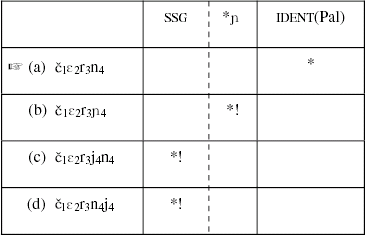
A comparison of candidates (17a), the desired winner, and (17b) establishes the ranking *ɲ>>ident(Pal). Similarly, we need ssg>>ident(Pal) in order to exclude candidates (17c–d).
Returning to the data in (14), we observe that int must be ranked low because decomposition occurs where syllabification (ssg) permits it. This is exemplified in (18) by the evaluation of the noun kamjeń [kam'ɛjn] ‘stone’ (18i) and of the adjective tuń+š+i [tujnši] ‘cheaper’(18ii). A comparison of candidates (18a) and (18c) in both evaluations provides the ranking ident(Pal)>>int. Since ident(Pal) is ranked below *ɲ, int must also be below *ɲ. Furthermore, the desired winners show complex codas, so *complexCoda must be ranked below *ɲ and ident(Pal).
- (18)
i. /k1a2m'3ɛ4ɲ5/→[k1a2.m'3ɛ4j5n5]Footnote 26
ii. /t1u2ɲ3+š4+i5/→[t1u2j3n3.š4i5]
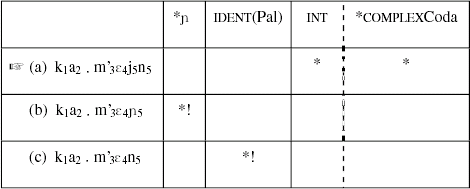
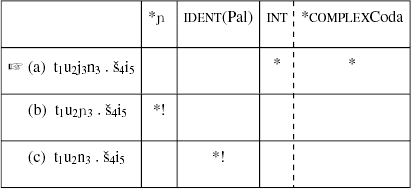
Looking at the data in (14), the generalization is that /ɲ/ is retained as [ɲ] in onsets. Thus, kamjenj+a /k1a2m'3ɛ4ɲ5+a6/, the gen.sg. of kamjeń ‘stone’, has the surface form [kam'ɛɲa] rather than [kam'ɛnja]. The absence of decomposition in the onset can be ascribed to *complexOnset>>*ɲ, as shown in (19).
(19) /k1a2m'3ɛ4ɲ5+a6/→[k1a2.m'3ɛ4.ɲ5a6] (no change)
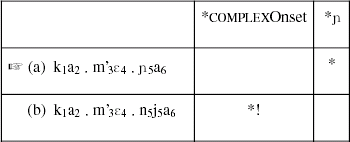
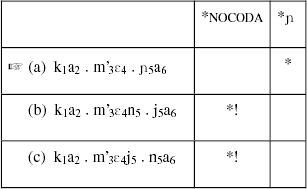
Not all avenues for the undesired decomposition of /k1a2m'3ɛ4ɲ5+a6/ have been closed yet. In particular, the [n5] segment in the [n5j5] string in (19b) could be reassigned to the coda, yielding [k1a2.m'3ɛ4n5. j5a6], which is outside the jurisdiction of *complexOnset. Alternatively, /ɲ/ could decompose into [jn] rather than [nj], which also circumvents *complexOnset.Footnote 27 These avenues for decomposition are closed by *nocoda, which outranks *complexOnset anyway because Upper Sorbian exhibits onset maximization.Footnote 28
(20) /k1a2m'3ɛ4ɲ5+a6/→[k1a2.m'3ɛ4.ɲ 5a6] (no change)
The decomposition exemplified in (19) and (20) is not the only option for circumventing *ɲ. The other option is the simplification of /ɲ/ to a plain nasal [n], whereby /ɲ/ simplifies in the sense that it loses palatalization, as shown earlier in (17). The ranking *ɲ>>ident(Pal), established in (17), gives the wrong result in the evaluation of kamjenj+a ‘stone’ (gen.sg.).
(21) /k1a2m'3ɛ4ɲ5+6/:failed evaluation
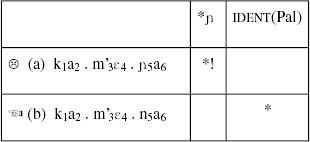
The problem revealed by (21) is that depalatalization occurs in the onset, which runs counter to the attested facts. The correct generalization is that palatalization is preserved in onsets but lost in codas. This generalization can be expressed in either of the following two ways. The first scenario is to postulate a coda condition type of constraint (Itô Reference Itô1986) that bans [ɲ] in the coda (positional markedness). In this scenario, *ɲ)Coda dominates ident(Pal), so palatalization is lost in the coda. The constraint *ɲ is ranked below int. With the ranking *ɲ)Coda>>int>>*ɲ, kamjenj+a /kam'ɛɲ+a/ emerges with the faithful candidate [kam'ɛɲa] as the winner, the desired result. The reason is that [ɲ] is in the onset, so *ɲ)Coda is mute in this evaluation. In contrast, kamjeń /kam'ɛɲ/, tuń+š+i /tuɲ+š+i/ as well as ćerń /čɛrɲ/ are within the purview of *ɲ)Coda, so the candidate with [ɲ] cannot win. ident(Pal)>>int leads to decomposition in [kam'ɛjn] and [tujnši]. However, /čɛrɲ/ cannot decompose, an effect of the undominated ssg in (17).
The second scenario is to use the segment inventory constraint *ɲ as the driver for the loss of palatalization in the coda; but then we will need to make sure that *ɲ does not have adverse consequences for onsets where we do want to keep palatalization. In particular, palatalization must be protected in the onset (positional faithfulness). In what follows, rather arbitrarily, I assume a positional faithfulness scenario.
It has long been known that onsets are special in the sense that they admit more marked structure than codas. This generalization, due to Trubetzkoy (Reference Trubetzkoy1939), has been incorporated into OT as positional faithfulness (Beckman Reference Beckman1997, Casali Reference Casali1997). Relevant to our analysis is the following constraint.
(22) ident(Pal)Onset:[+high, −back] on an input consonant must be preserved as [+high, −back] on an output correspondent of that consonant in the onset.
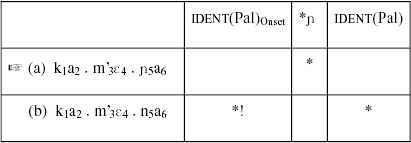
Since palatalization is never lost in the onset in Upper Sorbian, ident(Pal)Onset is an undominated constraint. It protects [ɲ] in the onset, leaving to *ɲ the enforcement of decomposition in the coda. The failed analysis in (21) is now corrected as follows.
(23) /k1a2m'3ɛ4ɲ5+a6/→[k1a2m'3ɛ4.ɲ5a6] (no change)
The summary tableaux for kamjenj+a ‘stone’ (gen.sg.) and kamjeń (nom.sg.) repeat the ranking relations established in this section. The argument for *ɲ>>ident(Pal) is not visible in these data, so it is carried over from the evaluation in (17), where it was made for the derivation of [č1ɛ2r3n4] from /č1ɛ2r3ɲ4/ ‘thorn’.
- (24)
i. /k1a2m'3ɛ4ɲ5+a6/→[k1a2.m'3ɛ4.ɲ5a6]
ii. /k1a2m'3ɛ4ɲ5/→[k1a2.m'3ɛ4j5n5]
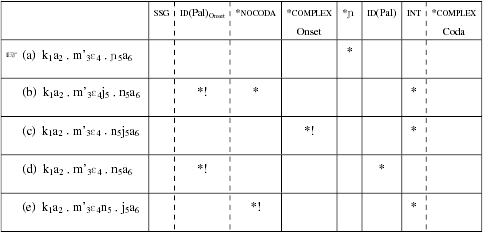
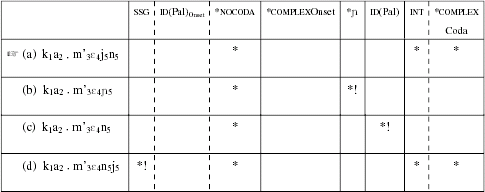
To summarize, Upper Sorbian and Slovene show two different patterns in their handling of /ɲ/, i.e. two different manifestations and distributions of the three treatments of /ɲ/: ɲ-retention, ɲ-decomposition and ɲ-depalatalization (ɲ→n). Generating these patterns is a matter of resolving the tension between *ɲ and ident(Pal)/ident(Pal)Onset. The resolution is different in Slovene and Upper Sorbian. The outcome depends on the ranking of the driver constraint *ɲ vis-à-vis the syllabification constraints. Polish, discussed in the next section, documents a new type of decomposition: nasal assimilation is the driver constraint and *ɲ is not active.
3. Polish
Polish exhibits alternations between [ɲ] on the one hand, and [j] plus a nasal consonant (in this order) on the other, which makes Polish similar to Upper Sorbian. However, the distributional facts are different.
- (25)
(a) bani+a [baɲa] ‘keg’ (fem. nom.sg.) – bań+k+aFootnote 29 [bajηka] (dimin.)
koniec [kɔɲɛts] ‘end’ (masc. nom.sg.) – końc+a [kɔjntsa] (gen.sg.),
kończ+y+ć [kɔjɳčɨtɕ] ‘to end’, where [ɳ] is a postalveolar nasal
hanieb+n+y [xaɲɛbnɨ] ‘shameful’ – hańb+a [xajmba] ‘shame’ (fem. nom.sg.)
(b) garniec [garɲɛts] ‘pot’ (masc. nom.sg.) – garnc+a [garntsa] (gen.sg.)
(c) koń [kɔɲ] ‘horse’ (masc. nom.sg.)
koń+mi [kɔɲm'i] (instr.pl.)
cierń [tɕɛrɲ] ‘thorn’
There is no doubt that the pattern of [ɲ] – [jm]/[jn]/[jη] alternations is a matter of decomposition, /ɲ/→[j] plus a nasal, rather than of coalescence, /jN/→[ɲ]. The latter option is not viable because Polish exhibits contrasts between [ɲ] and [jɲ], [jn] as well as [ɲj].
- (26)
(a) bani+a [baɲa] ‘keg’ (fem. nom.sg.), bani+e [baɲɛ] (nom.pl.)
(b) fajn+a [fajna] ‘nice’ (fem. nom.sg.), fajni+e [fajɲɛ] ‘nicely’
(c) mani+a [maɲja] ‘obsession’ (fem. nom.sg.), mani+e [maɲjɛ] (nom.pl.)
If the [ɲ] in (26a) were to be derived from /jn/, then bania would have to have the representation /bajn+a/, which, in the relevant ways, would make it identical to the representation /fajn+a/ in (26b). The problem is that there is a surface difference between these two words: we see [ɲ] in bania but [jn] in fajna. The adverb fajni+e [fajɲɛ] ‘nicely’ shows that /j/ is not absorbed into the nasal under palatalization.Footnote 30 Finally, (26c) shows that deriving [ɲ] from /nj/ (in this order) would also be difficult: the /nj/ of the putative /banja/ ‘keg’ would have to absorb the /j/ but the absorption would have to be blocked for words such as those in (26c), since the /j/ of the putative /manja/ ‘obsession’ is found in the surface representation [maɲja]. Furthermore, the morphological behaviour of bani+a and mani+a is different – for instance, the gen.pl. forms are bań [baɲ] and mani+i [maɲji], respectively – which indicates that the underlying representations must be different as well. I conclude that the [ɲ] – [jm]/[jn]/[jη] alternations in (25) must be analysed in terms of decomposition and not in terms of coalescence.
The distribution of [ɲ] and the decomposed sequences of [j] plus nasal in (25) exhibits a pattern that is similar but not identical to the pattern found in Upper Sorbian. As in Upper Sorbian, /ɲ/ is retained as [ɲ] in onsets ((25a) – the words on the left) and it depalatalizes to [n] between consonants (25b). But in contrast to Upper Sorbian, [ɲ] also occurs at the end of the word and before consonants (25c). Nasal decomposition derives [j] and a nasal consonant that assumes the place of articulation of the following stop (more precisely: stop or affricate, but I will use the general term ‘stop’). This decomposition is well documented in the literature (Benni 1915/Reference Benni1964, Biedrzycki Reference Biedrzycki1963, and others) and in my fieldwork.Footnote 31
The fact that [ɲ] is found in both onsets and codas indicates that the driver for decomposition is not simply *ɲ. Rather, decomposition is driven by nasal assimilation. This assertion is based on three observations. First, all instances showing ɲ-decomposition also show nasal assimilation for the nasal consonant. Second, ɲ-decomposition is found only before stops, which is exactly the environment in which nasal assimilation has always been assumed to apply.Footnote 32 Third, decomposition does not occur in [ɲtɕ] and [ɲdž] clusters (27c), that is, in clusters that already satisfy nasal assimilation because [ɲ] and [tɕ dž] are both prepalatal. The facts referring to nasal assimilation are illustrated in (27).
- (27)
(a) Labials:
temp+o [tɛmpɔ] ‘tempo’skąp+y [skɔmpɨ] ‘mean’
kumpel [kumpɛl] ‘buddy’tęp+y [tɛmpɨ] ‘dense’
(b) Non-palatal coronals:
tętent [tɛntɛnt] ‘hoof-beats’bandaż [bandaš] ‘dressing’
tęcz+a [tɛɳča] ‘rainbow’mącz+n+y [mɔɳčnɨ] ‘flour’ (Adj.)
(c) Prepalatals:
wszędzie [fšɛɲdžɛ] ‘everywhere’cięciw+a [tɕɛɲtɕiva] ‘string’
kanc+ik [kaɲtɕik] ‘edge’ (dimin.)kędzior [kɛɲdžɔr] ‘lock of hair’
(d) Velars:
bank [baηk] ‘bank’dżungl+a [džuηgla] ‘jungle’
punkt [puηkt] ‘point’pęk [pɛηk] ‘bunch’
A general scenario for the analysis of decomposition is as follows. nasal assimilation penalizes clusters of prepalatal [ɲ] and a stop with a place of articulation that is other than prepalatal; hence bań+k+a, the diminutive from bani+a ‘keg’ cited in (25a), cannot surface with [ɲk]. The pressure from nasal assimilation might have led to simplification by depalatalizing the nasal, /ɲ/→[n], but this strategy is reserved for instances in which /ɲ/ is trapped between consonants (see below). In all other cases, the strategy is to preserve both the nasal and the palatalization properties of the input /ɲ/. The result is that /ɲ/ decomposes into [j] and a nasal consonant that agrees in the place of articulation with the following stop, hence /baɲka/→[bajηka]. The fact that /ɲ/ decomposes into [jη] rather than [ηj] is a matter of permissible syllabification that is regulated by the sonority sequencing generalization (ssg) stated in (16). Consequently, [banjka] cannot be the correct output form.
Yet another conceivable scenario, with /ɲ/ changing into [ni], is not viable because consonants have no mora in their underlying representation and hence cannot spawn a vowel. Therefore the mora on the [i] of [ni] would have to come from insertion; but insertion of moras is prohibited by the high-ranking dep-μ.
The simplification of /ɲ/ to [n] is found between consonants, where decomposition is impossible because it would produce incorrect syllabification, an option that is ruled out by ssg. Consequently, garnc+a, the gen.sg. of garniec [garɲɛts] ‘pot’, surfaces as [garntsa] rather than as [garnjtsa]. As in the case of bańka, an output with a vowel, [garnitsa], is penalized by dep-μ.
The details of the analysis are as follows. I begin with nasal assimilation and then proceed to the analysis of decomposition, /baɲka/→[bajηka], and of simplification by depalatalization, /garɲtsa/→[garntsa].
nasal assimilation, which is illustrated by the data in (27), is stated as an ‘agree’ constraint.
(28) nasal assimilation (na):Nasals and stops must agree in place.
nasal assimilation does not affect underlying labials since [m] remains unassimilated in words such as komtur ‘Teutonic commander’ and Kamczatka ‘Kamchatka’. This well-known restriction, expressed traditionally by excluding labials as inputs to the rule, is stated as an ident constraint.
(29) ident(Lab):labial on the input consonant must be preserved as labial on an output correspondent of that consonant.
Polish nasal assimilation is regressive. Thus, underlying /bank/ has [baηk] rather than *[bant] as the attested output form. This directionality of assimilation must be accounted for. Notice that it cannot be assumed to follow from ident(Place)Onset.
(30) ident(Place)Onset:place on the input consonant must be preserved as place on an output correspondent of that consonant in the onset.
The reason is that the relevant cluster in bank is contained wholly in the coda.
The generalization governing the directionality of nasal assimilation is the one that has always been assumed in the past (see Footnote footnote 32): nasals assimilate to stops and not vice versa. This is expressed by an ident constraint.
(31) ident-stop(Place):place on the input stop must be preserved as place on an output correspondent of that stop.
When ranked above the generic ident(Place), (31) selects [baηk] over *[bant], which is correct. Interestingly, ident(Place)Onset also plays a role. This is visible in words such as sukn+o [suknɔ] ‘cloth’, where /n/ remains unassimilated. Examples such as ścięgn+o [ɕtɕɛηgnɔ] ‘tendon’ show both an assimilated nasal and an unassimilated nasal: [η] and [n], respectively. The unassimilated [n] occurs prevocalically and is thus in the onset. It is therefore within the purview of ident(Place)Onset, which must be ranked above nasal assimilation.
A formal analysis of ɲ-decomposition is now clear. The high-ranking nasal assimilation prohibits unassimilated [ɲ] plus stop clusters and thus bans *[baɲka] as the optimal output from bań+k+a /baɲ+k+a/Footnote 33 ‘keg’ (dimin.). Since ident(Pal) is high, the satisfaction of nasal assimilation cannot be achieved by simple place assimilation: ɲ→η, *[baηka]. The solution is to decompose /ɲ/ into [j], which satisfies ident(Pal), and a nasal that assimilates to the stop, thereby satisfying nasal assimilation. The attested surface form is [bajηka] with decomposition, which means that int, prohibiting decomposition, is low-ranked. ssg regulates the sequencing of the [j] and the nasal in the output form: *[baηjka] is not an option because [j] cannot be syllabified. dep-μ penalizes /ɲ/→[ni].
This discussion is summarized in (32), which evaluates bańka ‘keg’ (dimin.).
(32) /b1a2ɲ3+k4+a5/→[b1a2j3η3.k4a5]
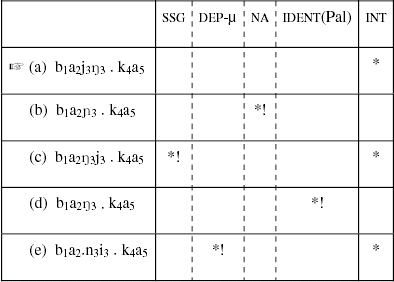
As documented by the data in (25), decomposition does not occur in onsets and codas that do not fall within the purview of nasal assimilation. Thus, we find [ɲ] in koni+a [kɔɲa] ‘horse’ (gen.sg.) and in koń [kɔɲ] (nom.sg.), an effect of int>>*ɲ.
Finally, as in Upper Sorbian, ident(Pal) is overridden in instances in which /ɲ/ cannot decompose without violating ssg. The solution here is to assimilate the nasal at the cost of violating ident(Pal). In (33), I look at garnc+a, cited earlier in (25b). The evaluation shows that ident(Pal) is ranked below ssg, dep-μ and na because candidate (33a) must win out over candidates (33b–d).
(33) /g1a2r3ɲ4ts5+a6/→[g1a2r3n4.ts5a6]
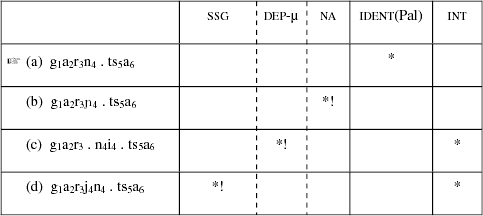
The effect in (33) is the same as in Upper Sorbian: ɲ→n. However, the driver constraint is different. In Upper Sorbian, it is *ɲ that leads to the depalatalization in ćerń [čɛrn] ‘thorn’. In contrast, Polish has [ɲ] in the corresponding word: cierń [tɕɛrɲ] ‘thorn’ because [tɕɛrɲ] does not violate nasal assimilation. Depalatalization occurs in (33) because /ɲ/ occurs before /ts/: this activates nasal assimilation and decomposition is thwarted by the preceding /r/. The effect is ɲ→n.
To conclude, I have identified two driver constraints for ɲ-decomposition: *ɲ (Slovene and Upper Sorbian) and nasal assimilation (Polish).
4. Further issues
This section addresses two issues: first, the implications of unidirectional ident constraints for comparative markedness and, second, the relation between decomposition and max(Feature) theory.
4.1 Comparative markedness
The significance of unidirectional ident constraints has not been appreciated in the OT literature to date, which might be due to the fact that the evidence adduced in their favour has not been particularly compelling. In particular, if such constraints are taken seriously, then the empirical foundation of comparative markedness (McCarthy Reference McCarthy2003) is weakened because some (though not all) of the processes recruited by McCarthy to substantiate his theory yield to straightforward reanalysis. Below I look briefly at two examples: place assimilation in Sri Lankan Portuguese Creole and glottalization in Yawelmani Yokuts.
In Sri Lankan Portuguese Creole, labials and dorsals assimilate in place but coronals do not (the data from McCarthy Reference McCarthy2003, based on Hume & Tserdanelis 2002).
(34) Sri Lankan Portuguese Creole
(a) /mη/ undergo nasal assimilation:
/ma:m+su/→[ma:nsu] ‘hand’ (gen.sg.)
/ma:m+pə/→[ma:mpə] ‘hand’ (dat.sg.)
/ma:m+ki/→[ma:ηki] ‘hand’ (verbal noun)
/mi:tiη+su/→[mi:tinsu] ‘meeting’ (gen.sg.)
/mi:tiη+pə/→[mi:timpə] ‘meeting’ (dat.sg.)
/mi:tiη+ki/→[mi:tiηki] ‘meeting’ (verbal noun)
(b) /n/ resists nasal assimilation:
/si:n+su/=[si:nsu] ‘bell’ (gen.sg.)
/si:n+pə/=[si:npə], not *[si:mpə] ‘bell’ (dat.sg.)
/si:n+ki/=[si:nki], not *[si:ηki] ‘bell’ (verbal noun)
The question is how to block coronal /n/ from undergoing nasal assimilation.
McCarthy's (Reference McCarthy2003) answer to this question is to extend standard OT by introducing a new subtheory called comparative markedness. According to this theory, all markedness constraints appear in two guises: OM, which evaluates ‘old’ markedness, and NM, which evaluates ‘new’ markedness. The determination whether the markedness is ‘old’ or ‘new’ is made by comparing the given candidate to the FFC (fully faithful candidate), which is equivalent to the input form except for the addition of non-distinctive structure, such as syllabification. A markedness violation is ‘old’ if it exists in the FFC; otherwise it is ‘new’.
McCarthy asserts that the markedness constraint that is relevant for the evaluation of the data in (34) is *lab/dors (don't be a labial or a dorsal). Given comparative markedness, we are in fact looking at two independent constraints: N*lab/dors and O*lab/dors. The distinction is crucial, as the following tableaux cited from McCarthy (Reference McCarthy2003) demonstrate.
- (35)
i. /ma:m+su/→[ma:nsu]
ii. /ma:m+ki/→[ma:ηki]Footnote 34
iii. /si:n+pə/→[si:npə]
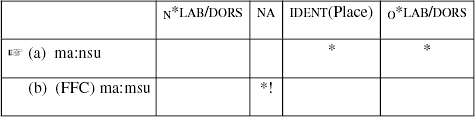
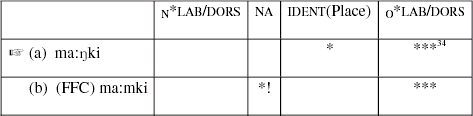
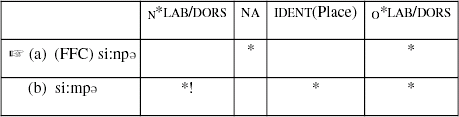
The reason why the candidates in (35i) and (35ii) do not violate N*lab/dors is that the input representation has /m/ before the obstruent, hence a labial, so the output containing [m] (35i–b) or [η] (35ii-a) due to nasal assimilation does not have a new labial or a new dorsal. In fact, /ma:m+ki/→[ma:ηki] in (35ii-a) has created a new dorsal since the [η] does not exist in the FFC (35ii-b); but this dorsal does not count as ‘new’ because McCarthy has collapsed the classic OT constraints *lab and *dors into one constraint *lab/dors, so a dorsal derived from a labial and a labial derived from a dorsal count as ‘old’ and not as ‘new’. If the constraints had not been collapsed, then /m/→[η] in (35ii-a) would violate N*dors and hence the desired winner in (35ii-a) would lose to the undesired contender in (35ii-b), the wrong result.
In contrast to the inputs in (35i–ii), which contain a labial, the input in (35iii) has a coronal. The losing candidate in (35iii-b) is therefore eliminated by N*lab/dors because /si:n+pə/→[si:mpə] creates a new labial, i.e. a labial that does not exist in the FFC [si:npə].
McCarthy's analysis is successful, but the success is achieved at a high cost. Not only do we have a new constraint *lab/dorsFootnote 35 but this constraint as well as all markedness constraints appear in two versions: NM and OM. In effect, the number of markedness constraints in OT has been doubled.Footnote 36
McCarthy's analysis cannot be recast in terms of the ident constraints of standard OT. The reason is that these constraints are bidirectional. Bidirectional ident(Coronal) can successfully block nasal assimilation in (35iii) because it is violated by the undesired candidate (35iii-b), [si:mpə], since the /n/ in the input /si:n+pə/ has [m] rather than [n] as its correspondent in the output. However, the problem is that bidirectional ident(Coronal) wrongly eliminates the desired winner in (35i-a), [ma:nsu], because the [n] in this output has /m/ rather /n/ as its correspondent in the input /ma:m+su/.
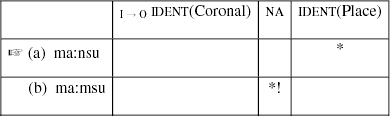
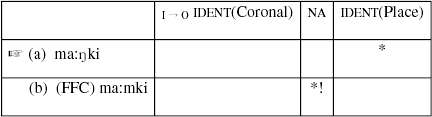
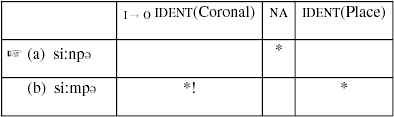
The problem encountered by bidirectional constraints disappears if ident constraints are unidirectional, as this article proposes. The relevant constraint in (35) is I→Oident(Coronal).Footnote 37
(36) I→Oident(Coronal):coronalFootnote 38 on an input consonant must be preserved as coronal on an output correspondent of that consonant.
I→Oident(Coronal) is mute on inputs that do not have a coronal, hence on /ma:m+su/ and /ma:m+ki/, so the standard ranking na>>ident(Place) derives the correct result. In (37i–iii), I re-present the evaluations from (35i–iii), now recast in terms of I→Oident(Coronal).
- (37)
i. /ma:m+su/→[ma:nsu]
ii. /ma:m+ki/→[ma:ηki]
iii. /si:n+pə/→[si:npə] (no change)
According to McCarthy (Reference McCarthy2003), further evidence for comparative markedness can be drawn from Yawelmani Yokuts, which has a morphologically conditioned glottalization process described and analysed by Newman (Reference Newman1944) and Archangeli & Pulleyblank (Reference Archangeli and Pulleyblank1994). The process applies to postvocalic sonorants, but not to obstruents. For example, the roots c'um and ʔilk occur with glottalized [m'] and [l'] when the suffix aahin is added: c'oom'+aahin ‘devour’ and ʔil'k+aahin ‘sing’. Obstruents resist glottalization, hence we see [g] rather than [g'] in hogn+aahin ‘float’.Footnote 39 Yet, glottalized obstruents exist in Yawelmani Yokuts, as in the root c'um /ts'um/ itself cited earlier. The generalization is clear: glottalized obstruents found in the surface representation all come from the underlying representation but not from an active glottalization process.
Translated into the terminology of comparative markedness, the generalization is that ‘old’ [constricted glottis] ([cg] henceforth) on obstruents is permitted but ‘new’ [cg] is prohibited. The prohibition is expressed in McCarthy's analysis as the high-ranking constraint NObstr([cg]), which prohibits ‘new’ [cg] on obstruents. OObstr([cg]), not mentioned by McCarthy, must be ranked low, specifically, below ident([cg]), so that the [cg] on an obstruent in the input can surface on that obstruent in the optimal output candidate.
Recasting McCarthy's analysis in terms of unidirectional ident constraints is a simple matter. Active in the phonology of Yawelmani Yokuts is the O→Iident-obstr([cg]) constraint, which prohibits the addition of [cg] on an obstruent. Specifically, the constraint is violated if a glottalized obstruent in the output does not correspond to a glottalized obstruent in the input. This happens in instances in which [cg] has been added by a glottalization process. For example, the candidate ho[g']n+aahin from the input ho/g/n+aahin ‘float’ violates O→Iident-obstr([cg]) since [g'] has a non-glottalized /g/ as its correspondent in the input. Glottalized obstruents that come from the underlying representation, as in the root c'um /ts'um/ cited earlier, do not violate O→Iident-obstr([cg]) because the glottalized segment in the output, here the [ts'] of the optimal candidate [ts'um], does have a glottalized correspondent in the input, here the /ts’/ in the underlying representation /ts'um/.
In sum, place assimilation in Sri Lankan Portuguese Creole and glottalization in Yawelmani Yokuts demonstrate that unidirectional ident constraints can draw support from processes that have nothing to do with decomposition.Footnote 40 This observation, coupled with the fact that such constraints are indispensable in decomposition, leads to the conclusion that they should be taken seriously and recognized as legitimate analytic tools in OT.
4.2 max(Feature)
A reviewer asks whether the unidirectional ident constraints proposed in this article might not be better treated as max(Feature) constraints. That is, instead of a constraint ident(Pal), which mandates the preservation of the palatalization features in an output correspondent, we should postulate a max(Pal) constraint, which mandates the retention of the palatalization features somewhere in the output candidate. The answer to the reviewer's query is negative: the facts of decomposition analysed in this article cannot be reanalysed in terms of max(Feature) theory, specifically, in terms of max(Pal).
Recruiting max(Feature) theoryFootnote 41 for the purposes of analysing decomposition is undesirable from both a theoretical and an empirical perspective. On the theoretical side, max(Feature) theory constitutes a significant extension of OT by introducing a new class of constraints that treat features as entities, in addition to the standard constraints that treat segments as entities. This is a major change, whose effect is that the number of constraints is increased dramatically. On the empirical side, the use of max(Feature) to account for decomposition is inadequate and leads to the wrong results, as I demonstrate below.
From the point of view of this analysis, the fundamental difference between ident(F) and max(F) is that the former specifies the locus in the output where the F occurs while the latter does not. ident(F) requires that F must occur in an output correspondent of the input segment. In contrast, max(F) is satisfied if F is found somewhere in an output candidate, regardless of whether it occurs on the correspondent segment or on some other segment. With this difference between ident(F) and max(F) in mind, we return to the Polish data in (25). Specifically, we look at hańb+a ‘shame’ and its derivatives.
From the point of view of max(Pal), [xajmba], the attested surface form, is not the only viable candidate from the input /xaɲb+a/. In [xajmba], max(Pal) is satisfied by [j], which carries the [+high, −back] features that max(Pal) calls for. But these features are also present in the candidate [x'amba], where [x'] is palatalized. In order to exclude this candidate, the analysis must be complicated by activating a root faithfulness constraint that prohibits the palatalization of a root-internal segment, which would be ident-C([+back])Root in Rubach's (Reference Rubach2003) analysis of palatalization. When ranked above int, this constraint will make [x'amba] less optimal than [xajmba] because ident-C([+back])Root is violated by [x'] since [x'], derived from underlying /x/, is in the root [x'amb] and it is [−back].
Problematic for max(Pal) is the verb hańb+i+ć ‘bring shame’, where the input /xaɲb+i+tɕ/ has [xajmb'itɕ] as its attested surface form. In addition to [j], there are two other segments that carry the [+high, −back] features required by max(Pal): [b'], a palatalized labial stop, and [tɕ], a prepalatal affricate. Of these two, [b'] is part of the root morpheme, so ident-C([+back])Root is violated. Worse, max(Pal), which by definition does not specify the locus where [+high, −back] should be found in the output, cannot distinguish between [xajmb'itɕ], the attested surface form, and [xamb'itɕ], the incorrect output. In contrast, ident(Pal) is violated by [xamb'itɕ] because [m] is all that ident(Pal) looks at, since only [m] and no other segment in [xamb'itɕ] is the correspondent of the input /ɲ/. The [m] is not [+high, −back], so [xamb'itɕ] loses to [xajmb'itɕ], which has [jm] as the correspondent of /ɲ/ and thereby satisfies ident(Pal). I conclude that an analysis that employs max(Pal) cannot deliver the correct result and that ident(Pal), a unidirectional input→output constraint, is necessary.
5. Conclusion
Decomposition of the prepalatal nasal /ɲ/ yields non-palatalized dental [n] and [j] as surface correspondents. The occurrence of [j] is exactly what we would expect. Since palatalization is the superimposition of the i features [+high, −back] on the consonant, palatal decomposition should have the effect of deriving [i] in the surface representation. The fact that we see [j] rather than [i] in decomposition is a matter of syllabification. Schematically, if /ɲa/ were to decompose into [ni.a], then the [a] syllable would have no onset. Similarly, if /aɲ/ were to decompose into [a.in], then the [i] syllable would have no onset. Such strings violate onset and dep-μ. They are not optimal because the generalization is that decomposition is an ‘emergence of the unmarked’ effect (Struijke Reference Struijke2000). The extent to which the structure resulting from decomposition is unmarked depends on the interaction of constraints. Thus, /ɲa/→[nja] creates a complex onset while /aɲ/→[ajn] creates a complex coda; but this is better than [ni.a] and [a.in], which violate onset and dep-μ.
The emergence of the unmarked strategy is the reason why /ɲ/ decomposes into [n] rather than into [m] or [η] in the consonantal part of the output, although this picture is obscured by nasal assimilation if /aɲ/ is followed by a stop, for instance, /aɲk/→[ajηk].
From the point of view of the distribution of [ɲ] and [nj]/[jn], Slovene and Upper Sorbian are mirror image languages. In Slovene, [ɲ] occurs in the coda while [nj] is found in the onset. In Upper Sorbian, the reverse is true: [ɲ] occurs in the onset while [jn] is found in the coda. Polish has [ɲ] in both onsets and codas, with [jm], [jn] and [jη] occurring before stops, an effect of nasal assimilation.
If a language permits decomposition, then it does so in an exceptionless manner, as this study has shown. To be sure, under unfavourable circumstances the effect of decomposition can fail to appear in the surface representation. This happens when /ɲ/ is trapped between consonants or a consonant and a word boundary. The occurrence of [j] is then impossible because [j] would violate ssg if it were to be syllabified. Alternatively, [j] might be left unparsed, but this is not an option if parse(Seg) is high-ranked. Under these unfavourable circumstances, the strategy is to depalatalize /ɲ/ to [n]: /ɲ/→[n]. Thus, in Polish we see /garɲts+a/→[garntsa], with *[garjntsa] and [*garnjtsa] being the banned outputs, and in Upper Sorbian /čɛrɲ/→[čɛrn], with *[čɛrjn] and *[čɛrnj] being the banned outputs. The option of moving [j] to a more favourable site in the string, for instance, *[gajrntsa] or [čɛjrn], is never taken, because, as this study has shown, decomposition is always strictly local.
There are two driver constraints for decomposition: the segment inventory constraint *ɲ and nasal assimilation. While segment inventory constraints as drivers of decomposition (though not of nasal decomposition) have been identified in the earlier literature (Struijke Reference Struijke2000, Rubach Reference Rubach2003), the role of place assimilation in this process is a new finding. Specifically, *ɲ drives decomposition in Slovene and Upper Sorbian. In Polish, ɲ-decomposition is driven by nasal assimilation. The fact that *ɲ has no effect in Polish is unsurprising because, of the languages considered here, Polish has the richest system of prepalatals: [ɲ tɕ dž ɕ ž].
From a theoretical perspective, decomposition contributes to the understanding of ident constraints in OT. It provides evidence for the thesis that they should be unidirectional, as proposed originally by Pater (Reference Pater, Kager, Hulst and Zonneveld1999). The reason is that decomposition cannot satisfy classic bidirectional ident constraints because, by definition, decomposed segments do not each carry all the features of the input segment. If they did, there would be no point for a language to permit decomposition in the first place. Yet, decomposition needs to be controlled by ident constraints in order to capture the generalization that it is always minimal, in the sense that it departs from the input segment by defaulting to the closest unmarked representation that preserves the properties of the input segment. This generalization is readily captured by I→Oident and O→Iident constraints but not by the classic bidirectional ident constraints of McCarthy & Prince (Reference McCarthy, Prince, Beckman, Dickey and Suzanne1995). Finally, unidirectional ident constraints weaken the evidence for comparative markedness, as section 4 has shown.


