Introduction
Theory is not separate from practice. Theory is reflection, critique, performance, a theatre for action, an act and object of contemplation: these are aspects of the same material process, the theoretical practice of archaeology. (Shanks & Tilley Reference Shanks and Tilley1987: 25)
This quote encapsulates the ideas that were central to the growth of archaeological theory in the late 1980s, during which time interpretative archaeology emerged—that is, an archaeology in which subjectivity is recognised in interpretations, understanding that there is no objective truth about the past. Shanks and Tilley (Reference Shanks and Tilley1987) advanced the view that archaeology should be a critical social science opposed to processualism. Over the years since the publication of this seminal work, interpretative archaeology has expanded into other research areas, such as symmetrical archaeology or anthropology's ontological turn—particularly in English-speaking countries (see Olsen Reference Olsen2010; Hodder Reference Hodder2011; Alberti Reference Alberti2016). Such theoretical turns notwithstanding, there are questions that remain unanswered: Has the full potential of critical archaeology been effectively realised? And, how can this theoretical framework be applied more effectively in the specific context of Latin American archaeology?
In Latin America, interpretative archaeology was adopted in the 1990s under the aegis of ‘post-processualism’—that is, an approach to archaeology that pushed against the prevailing culture-history and processual perspectives by focusing on disciplinary self-reflection and social theory. One of interpretative archaeology's main contributions at this time was its treatment of archaeological knowledge as a narrative about the past that had a political import in the present (Hodder Reference Hodder1986; Shanks & Tilley Reference Shanks and Tilley1987). From our perspective, however, the critical role of interpretative archaeology at both the global and practical level has not been fully realised.
There are at least two factors behind interpretative archaeology's failure to fulfil its self-proclaimed destiny as a critical science. The first is that one of its main postulates—the notion that there is no such thing as ‘the past’, but rather multiple narratives about the past—was decoded in ‘multiculturalist’ terms (Hodder Reference Hodder1991, Reference Hodder1999). Multiculturalism has been criticised because it assimilates Indigenous notions as alterities or minorities, thus neutralising their decolonising drive (Gnecco Reference Gnecco2009; Rivera Cusicanqui Reference Rivera Cusicanqui2010). The multiculturalist premise also permitted the reproduction—albeit in a veiled manner—of an unequal relationship between the hegemonic centre, which develops archaeological theory, and ‘consumers’ of theory on the periphery (see Politis (Reference Politis2003) and responses in Politis et al. Reference Politis2006; Gnecco Reference Gnecco, Shepherd, Gnecco and Haber2016). The second factor relates to this power asymmetry and interpretative archaeology's call for the ‘democratisation’ of archaeology. This call has been mostly ignored, as shown by the fact that Indigenous communities and the general public rarely participate in archaeological interpretation (Vaquer Reference Vaquer2013a). Other theoretical proposals have emerged in reaction to these shortcomings of interpretative archaeology, such as Shepherd et al.'s (Reference Shepherd, Gnecco and Haber2016) ‘decolonised and undisciplined’ archaeology.
As Latin American archaeologists, our perspective and research questions are different, due to the historical and political context of our praxis (e.g. Curtoni Reference Curtoni, Borrazo and Borrero2009; Salerno Reference Salerno2012; Haber Reference Haber and Wassilowsky2013). In the Andean region in particular, archaeological praxis is intertwined with the relationships between the research team and local communities. The line that separates archaeological work and ethnography is often blurred, and narratives about the past constructed by Andean archaeologists are always challenged by local community members, whose interests do not necessarily coincide with those of incoming researchers.
If the original vision of interpretative archaeology as a critical social science is to become a reality, we must consider the diverse narratives about the past and the different interests that underlie them. Thus, we propose to build an archaeology grounded in both local and scientific epistemes, to generate pasts and project alternative futures that can dialogue and interact with scientific logic as equals. In other words, we seek to build a ‘dialogical archaeology’ (as proposed by Flores & Acuto Reference Flores and Acuto2015). In fact, a dialogical approach to archaeology is also a stated objective of Latin American social archaeology (see synthesis by Tantaleán & Aguilar Reference Tantaleán and Aguilar2013). Although the overall aims of this school of thought are akin to our own, Latin American social archaeology is based on the dialectical philosophy of Marxism, and its objective is to synthetise the ‘other’ using categories that totalise the particularities found between diverse contexts of archaeological praxis (e.g. ‘the peasantry’). In contrast, our proposal rests on dialogue-based hermeneutics, using a ‘weave of logic’ as a heuristic tool.
Hermeneutical archaeology as critical science
The basic tenet of hermeneutical archaeology is that the epistemological relationship between past and present is one of interpretation (Shanks & Tilley Reference Shanks and Tilley1987; Hodder Reference Hodder1991; Thomas Reference Thomas and Hodder2001; Vaquer Reference Vaquer2015). Heidegger (Reference Heidegger2012) and Gadamer (Reference Gadamer2003) refer to the place of the interpreter as the ‘hermeneutical situation’, comprising two elements: prejudices and interests. On one hand, interpretation does not occur ex nihilo: it takes place in a milieu of subjective predispositions, or pre-judgments, towards that which is to be interpreted. On the other hand, interpretation is mediated by subjective interests that shape the questions guiding the interpretative process. Thus, interpretation involves a dialogue between the present (hermeneutical situation) and the past (tradition), establishing a mutual relationship that is circular in nature and cannot be reduced to a one-way process in which an active subject interprets a passive object. In this sense, interpretation is a ‘dialogue’, where different hermeneutical situations develop narratives about the past that are functional to their particular interests.
The concept of the hermeneutical situation is germane to dialogical archaeology, as it places the interests that drive interpretations within a social force field (sensu Bourdieu Reference Bourdieu1977), in which each diverse group within a community struggles to situate their own interpretation. In turn, the interests of different hermeneutical situations are simultaneously the product of, and generate impacts on, present social situations.
It is worth noting that hermeneutics, as a ‘science of interpretation’, cannot be reduced to a post-modern ‘anything goes’, as has been argued by some of its critics (e.g. Criado Boado Reference Criado Boado2006; Aguilar Díaz & Tantaleán Reference Aguilar Díaz and Tantaleán2008). We have previously posited that, in order to fulfil their critical social function, interpretations of the past must operate from the centre of a triangle that comprises three traditions (Vaquer Reference Vaquer2013b). The first is the academic tradition, understood as the state of the scientific field at a specific moment in time that sets the conditions towards interpretative possibilities. The second is material culture as ‘data’, which must be coherent and consistent with our interpretations. The third and final component of the triangle is local tradition, comprising local narratives about the past that work as the ‘ethical compass’ for interpretations.
While Gadamer's (Reference Gadamer2003: 377) approach to interpretation was to achieve a ‘fusion of horizons’, we propose to engage in interpretations of the past in the form of a dialogue sensu Bachtín (Mancuso Reference Mancuso2005; Todorov Reference Todorov2012; for a description of the application of this concept to archaeology, see Joyce et al. Reference Joyce2002) that is fundamentally different from Gadamer's (Reference Gadamer2003) fusion and dialectical synthesis. By seeking to solve contradictions in the form of a synthesis, dialectics totalises alterity, meaning that alterity becomes intelligible at the cost of losing its singularity (Lévinas Reference Lévinas2002; Dussel Reference Dussel2008). The hermeneutical archaeology that we propose does not try to dilute tensions arising from conflicting narratives. Instead, taking the asymmetries between narratives as a given, our approach seeks to illuminate and inhabit these contradictions in a way that is best expressed by the Aymara concept of ch'ixi, as used by Rivera Cusicanqui:
[that which is] ch'ixi combines the indigenous world with its opposite, [allowing] the parallel coexistence of multiple cultural differences that do not fuse together, but instead antagonize or complement each other. Each [cultural difference] reproduces itself from a remote past and relates to the others in a contentious way. (Rivera Cusicanqui Reference Rivera Cusicanqui2010: 70; translation by the authors)
Thus, we propose to embrace the inherent incommensurability and asymmetry among different interpretations of a phenomenon in order to bring them all to the foreground. We also understand that dialogical archaeology is an ongoing process, the outcome of which is always unknown and inherently dynamic. Unlike dialectical approaches, where contradictions are resolved in a synthesis, dialogue inhabits and builds on contradictions, but does not attempt to reach a resolution. Therefore, a dialogue among different epistemes does not resemble a closed circle, but rather, a spiral that closes in on itself and modifies the initial hermeneutical situations. Our emphasis is on differences in interpretations that are the product of the spiral's cycles. This process does not lead to a fusion of horizons, but to a (dynamic) state, where each of the horizons can be distinguished from the rest.
Our methodological stance is one of pragmatism: we do not seek to anticipate interpretations or the dialogues among them, since they are defined by practice (i.e. the concrete effects that these interpretations and dialogues produce). A pragmatist perspective implies that there are no ‘recipes’ or pre-conceived ways to engage in epistemological dialogue. At the same time, pragmatism demands a localist position that considers the development of power relations at a micro-social scale, despite the potentially wider scope of their impact. Power and agency are inherent capabilities of all social actors (Giddens Reference Giddens1998), and the power wielded in the social field can be drawn from different types of capital (Bourdieu Reference Bourdieu1977).
Case study
Setting
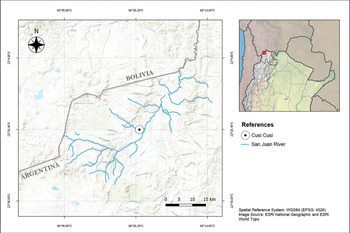
For more than 10 years, our research team has been working in the Cusi Cusi micro-region (Puna of Jujuy, Argentina), located at approximately 3800m asl in the upper basin of San Juan River (Figure 1). The climate is characterised by a dry season followed by a humid season, with a wide temperature range. The largest settlement in this micro-region is Cusi Cusi, a town predominantly of llama-herders (Lama glama), although some individuals practise small-scale agriculture. The local community has repeatedly expressed an interest in documenting and preserving not only their traditional, pastoralist way of life, but also local narratives about the history of their town (Vaquer et al. Reference Vaquer, de Murat and di Tullio2020).
Map of the study area, the Cusi Cusi micro-region, located at the upper basin of San Juan River, Puna of Jujuy, Argentina (figure by L. Pey).

The interpretative model we have developed for the area identifies several logics, whose associated practices have affected the landscape in different ways (Vaquer & Cámera Reference Vaquer and Cámera2018). Although current Cusi Cusi inhabitants recognise themselves as herders, there is archaeological evidence for agricultural and agro-pastoralist activity in the area since at least the Late Regional Developments Period (Período de Desarrollos Regionales Tardío, AD 1200–1450). Thus, there are a minimum of three different logics, with their corresponding material correlates, present in the local landscape: the agricultural, the pastoralist and the agro-pastoralist logics. Some are still active today (pastoralist and agricultural), while others have been abandoned (agro-pastoralist). This is, of course, our interpretation of the local landscape as non-local archaeologists.
Broadly speaking, there are two narratives or interpretations of the landscape that derive from particular hermeneutical situations and traditions. Therefore, we have approached the study of the local agricultural landscape from two different perspectives, as illustrated by the case of the Huayatayoc archaeological site presented in the following section.
Huayatayoc or ‘the place of huallatas’
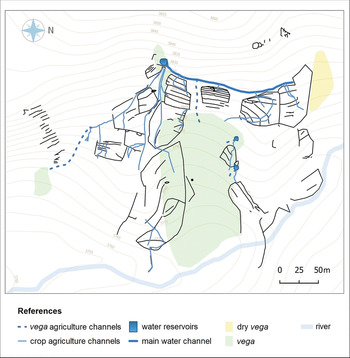
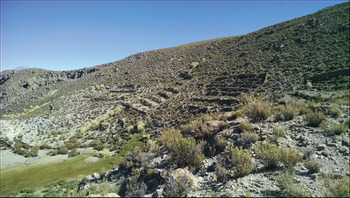
The site of Huayatayoc is located on an artificial vega—a regional name for grassy, high-altitude wetlands—and comprises a series of agricultural terraces (andenes), which are no longer in use, as well as a few corrals (Figures 2 & 3). Previous studies categorised Huayatayoc as an agricultural site associated with the Inka Period (AD 1450–1536), based on the characteristics and technical complexity of its terraces (De Feo et al. Reference De Feo, Fernández, Raviña, Tamagnini and Mendonça2004). As explained below, however, this interpretation does not embrace the totality of the site's temporality, nor the meanings and practices that it embodies.
Huayatayoc site plan (figure by L. Pey).

Agricultural terraces (andenes) in Huayatayoc (photograph by L. Pey).

Our team has conducted aerial and ground surveys of the Huayatayoc area, as well as a detailed elevation and architectonic survey of the site's structures. We also conducted non-directive or unstructured interviews (Guber Reference Guber2001) with members of the family who have been living at the site for at least four generations (approximately 100 years).
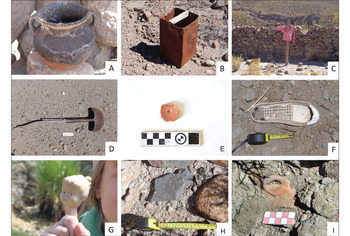
Ground survey of the surfaces within the structures revealed a range of objects from different temporalities, including scarecrows (still standing), fragments of dacite foot-plough blades and hoes, deteriorated shoe soles, ceramic loom weights, whole metal and ceramic pots, worn-out metal spades and many ceramic sherds (Figure 4). The latter can be assigned to typological groups dating to different periods and coming from neighbouring regions (i.e. Yavi, Loa, Casabindo and Mallku).
Examples of surface material recovered from Huayatayoc structures: A) vessel; B) instrument used for the venting of quinoa; C) scarecrow; D) metal shovel with handle; E) phiraru or tortero (ceramic loom weight); F) deteriorated shoe sole; G) doll head; H) dacite foot-plough blade or hoe fragment; I) Yavi pottery fragment (photographs and collation by L. Pey).

Spatial and architectural analyses reveal that the walls of these structures were built using three different methods. Although we have not been able to obtain absolute dates, spatial and stratigraphic relationships enable us to interpret the building sequence in relative terms (Pey Reference Pey2020b). Along with wall construction methods, the overall structure of productive spaces also changed over time to increase the availability of pasture for livestock (i.e. llamas) or for farming microthermal crops such as quinoa (Chenopodium quinoa).
A holistic evaluation of this evidence reveals Huayatayoc to be an archaeological site with a complex history that includes several episodes of occupation and reoccupation, and where different productive logics (agricultural vs pastoralist) were prioritised—at least in spatial terms—at different points in time (Pey Reference Pey2020a, Reference Pey2020b). Far from being a site anchored to a particular time frame, Huayatayoc is a point in the landscape that condenses different times, spaces and places in a dynamic manner (for a similar perspective, see Holtorf Reference Holtorf1998). Since its initial construction during the Regional Developments Period II (AD 1200–1450), Huayatayoc has been a meaningful place (sensu Thomas Reference Thomas and Hodder2001) that bonds the landscape with the people that dwell in it. Huayatayoc's irrigation system is still active today and supplies water to the main vega that Exaltación, the father of the family who currently owns the land, uses to feed his llama herd—a practice that has been described as ‘vega agriculture’ (Palacios Ríos Reference Palacios Ríos and Ochoa1977).
Huayatayoc (in Quechua) or Huayatani (in Aymara) means ‘the place of huayatas’, in an allusion to the birds (Chloephaga melanoptera) that congregate in this place. This vega, known locally as ciénego, is maintained and nurtured by Exaltación, who is well aware of the value of this type of wet oasis in such a dry environment. Accordingly, the family has modified the layout of the irrigation system and redirected the main water channel through a series of smaller channels. The main channel was originally used to water crops. The family members recognise that the site was built by the abuelos (‘grandparents’, meaning direct ancestors) upon an earlier antigal (a place built by people or ‘beings’ from the past), of which some walls still survive. They consider the estanques (water reservoirs) to be very old, and the water they contain is not deemed suitable for drinking. The family also advise against touching this water, as it can make people ill, especially children. This theme of waterborne illness has also been documented by Gose (Reference Gose2004) in the agricultural community of Huaquirca in Peru.
The local people also say that the remains of a body were found at the headwaters of the main irrigation channel. This body belonged to a chullpa, a being that used to dwell in this place in the distant past, when “the times were different” (E. Quispe, pers. comm.). In Andean narratives, chullpas (also known as gentiles or antiguos (‘the ancients’); Cruz Reference Cruz2005; Villanueva Criales et al. Reference Villanueva Criales, González and Rocabado2018) were short, wild or uncivilised non-humans that lived in the world when it was still dark and its contours were ill-defined. They were able to talk to plants and animals, and to move and shape large boulders using only words. Unlike abuelos, chullpas are not considered to be ancestors: they are the epitome of Andean alterity.
Until at least 30 years ago, the tasks within the pastoralist calendar were combined with agricultural duties. In the past, work in the chakra (crop fields) was accompanied by other activities, such as weaving. Both women and men could weave or knit, but the weaving of large textiles on the loom was reserved for the abuelo (‘grandfather’, meaning a senior male family member), whereas smaller textiles were knitted by women using hand-held needles, while they tended their animals (R. Quispe, pers. comm.).
At some point in Huayatayoc's history, the land on which it stands was divided among family members, and several perimeter walls (pirkas) were erected (E. Quispe, pers. comm.). Apart from territorial divisions, there were also distinct sectors allocated to different crops, the most recent of which were potatoes and beans. One generation back, these lands were used to grow onions, carrots and potatoes, and earlier still, oca and quinoa. Agriculture is very labour-intensive, and due to a lack of interest of the younger generation for this way of life, farming has been abandoned (E. Quispe, pers. comm.).
Discussion: Huayatayoc as a woven fabric
The previous section recounted two stories about Huayatayoc: our narrative, from a scientific point of view, and that of the Quispe family, who are the current owners of the land. These narratives are articulated on the bases of different interests that constitute two distinct hermeneutical situations.
Diverging interests notwithstanding, there has always existed a middle ground from which a dialogue could be established. We consider this middle ground to be best represented as a woven fabric, and we propose to conceptualise the local landscape as a complex woven textile (apsu, in Quechua) (Pey Reference Pey2020a). Sites such as Huayatayoc result from the activities of diverse agents through time, many of which operate under different logics. These practices leave a material imprint that can later be recovered and re-signified for the development of new activities. Thus, the landscape can be interpreted as a weave of diachronic practices (and their guiding logics), a fabric that is still being woven today—including by our own activities during habitation of this landscape over the course of our archaeological fieldwork (Ingold Reference Ingold2000).
We also view the local landscape as a fabric with multiple ‘weaving layers’ of interpretation. This approach does not seek to complement or fuse our interpretations with those of local inhabitants, nor do we regard the local people as mere informants or the providers of data useful for our research. From this perspective, local inhabitants are agents in the weaving of the landscape and narratives about the past, as are we. Both narratives—the local and the scientific—identify and intertwine ‘threads’ that project backwards in time, to the deepest end of the loom. Thus, if we do not consider and make visible the entire range of its interpretative components, the ‘weave’ of the Andean landscape is rendered loose, disconnected and unstable.
As archaeologists, we approach the archaeological site of Huayatayoc from a certain perspective: one that comprises not only our professional and personal interests, but also the obligations arising from our affiliation with a research institution (and, during the writing of this article, experiencing the COVID-19 pandemic). Moreover, interests and motivations also differ between the authors, due to our distinct situations within the academic field: the first author is the leader of our research team, while the second author was completing her PhD. The conception of this article itself implies a first instance of dialogue between the authors’ pre-judgements and interests.
There are also different interests within the Quispe family concerning Huayatayoc, since the situation is different for Exaltación—pater familiae with responsibility for the estate—than it is for his four children. Although at first glance their interests might seem primarily financial/economic, the site also plays a symbolic role as a ‘condenser’ of family history, both in family narratives and in the landscape. This relationship network situates the struggle for economic and symbolic power, and conditions its dynamics in specific ways.
Power relations are contextual and they operate at diverse scales. The interests of concerned parties are often at odds with each other; we believe that it is essential to bring these oppositions to light. In our case, despite having a work permit issued by the provincial government and endorsed by the local Indigenous community, we also require permission from local landowners before we can conduct fieldwork. Occasionally, they have denied us said permission, and we have respected their decision. Achieving our fieldwork goals hinges on the results of ongoing negotiations and agreements with local people, which must be renewed every season. In some of our field excursions, we were asked to leave Huayatayoc, as our presence was disturbing Don Exaltación's llamas. This disturbance caused the herd to disperse to other fields, causing conflicts between Don Exaltación and his neighbours. Thus, our presence on the site was contingent on continuous dialogue and negotiation, and we learned that our fieldwork had to adapt to the demands of the pastoralist way of life.
As a critical science, archaeology can make an important contribution to the symbolic and material wellbeing of local communities, insofar as it is approached in a manner that is respectful of local interests and does not seek to impose our own interests as non-local researchers. Cusi Cusi has not experienced institutionalised political struggles, as has been the case in other contexts (e.g. among Diaguita-Calchaqui peoples; Flores & Acuto Reference Flores and Acuto2015). The development of political awareness is a long process, especially for communities whose interests are divided by religious, political and/or inter-generational differences (Vaquer et al. Reference Vaquer, de Murat and di Tullio2020).
Our experience has proven the need for local communities to develop their own interest in our work, to appropriate the process and results of our scientific endeavour as their own. Initially, we noticed that some members of the community—particularly young and middle-aged people—focused their attention on the potential of scientific interpretations of the past in promoting tourism. Dialogues with institutions and older members of the community, however, also revealed an interest in creating a lasting record of the pastoralist way of life that, in their view, is being lost (Vaquer et al. Reference Vaquer, de Murat and di Tullio2020). Consequently, after more than 10 years of working in this area, the local community has come to associate our work with the recording of the town's pastoralist identity, and to view our involvement as a means towards making these practices visible as communal, symbolic resources. This concern for the pastoralist way of life emerged from within the community itself; it was not forced upon them by our own episteme. Although it is sometimes challenging to reach common ground, we believe that local interests should guide scientific research, not the other way around. Multiple narratives about the past are constructed on the basis of diverse and often conflicting interests. The power relationships that support these narratives are embedded in dynamic, contextual, ever-changing matrices. There is no monopoly on narratives about the past, or on the means to develop such narratives: these interpretations operate at multiple levels and within diverse settings.
Final thoughts
With this article, we invite the reader to reflect upon certain elements of archaeological practice, of which the first is the need to acknowledge the geopolitical specificities of research settings and to adapt our research practices accordingly. In this sense, our ‘woven fabric’ metaphor is applicable not only to the Huayatayoc landscape, but also to the wider practice of Latin American archaeology. The meanings embodied in material culture are intertwined and coexist simultaneously and dialogically within different interpretations—much like the weft and warp in a woven fabric; as in Andean textiles, the whole is greater than the sum of its parts. Interpretative tools must be adapted to local contexts for archaeology to be able to address local problems and generate concrete, meaningful outputs for the communities with which we work.
Part of this process implies the adoption of tools and categories from epistemes other than the Western scientific in order to open up the past to multiple interpretations. In opposition to multiculturalism, we propose a double process: first, to cast a critical eye on the loci of interpretative enunciation and the interests on which they rest; and second, a dialogical construction of knowledge, where interpretative horizons can be allowed to coexist in tension. The allowance of tension is essential, as it is a necessary outcome of the intrinsic dynamism of interpretation, which is a never-ending process. Similarly, the outcomes of dialogue in the terms proposed in this article—the interaction of diverse ch'ixi logics—are unpredictable and undergo constant change, following the ebb and flow of the social force fields in which this dialogue takes place.
We are aware that there are obstacles on the path to implementing a dialogical archaeology. Discourses about the past are often monopolised and directed by our voices as researchers (as in the case of this article). Scientific literature is particularly unfavourable to polyphony (Mancuso Reference Mancuso2005). Furthermore, the development of political awareness takes time, for all parties involved. Our work has slowly, but progressively, incorporated the views of Cusi Cusi communities and individuals. We have also asked them to be our co-authors on scientific papers, though they have yet to take up this offer, and they may never be interested in adapting to our schedules and formats. Perhaps it is these formats that need adapting (why should we always strive to fit an academic model?)—at least for works that are truly developed in co-authorship.
We are also aware that the past is narrated not only through discourse, but also by our practices. Hence, we take an ethnographic perspective that is as relevant to our work as it is to our archaeological approach. We develop and undertake interviews and participant observations that enable a more thorough and thoughtful understanding, and documentation of different ways to narrate the past. We have described, for example, how women's narratives about the past are constructed through the cooking of meals that mark pastoralist identity, such as kalapurca (Carreras & Pey Reference Carreras and Pey2019). In the case of Huayatayoc, our ethnographic and archaeological perspectives have given us insight into how its current inhabitants consciously weave a multi-temporal landscape. We have recorded this process not only in their discourse, but also as it is presented in the material realm of built pirkas and andenes. Different construction modes coexist in these structures, representing different logics and moments in the site's history. At the architectonic level, the objective is not to obscure, but rather to highlight these differences. Thus, the construction and reconstruction of walls is also a narrative about the local past.
Finally, it is our argument that, despite being a Western conceptual tool, a hermeneutical approach can be used to generate a dialogue that puts into contention different interpretations, including our own. The ‘hermeneutical situation’ concept explored in this article highlights the interests that underpin interpretations. From this perspective, interests are understood as fundamental components in the weaving of landscapes and narratives, and not merely as limiting factors. The more interests are visible in the narratives, the more colourful our fabrics will be.
We firmly believe that analytical categories are created to be destroyed, not reaffirmed, in a process that involves the constant presence of alterity. The concept of dialogue and the coexistence of different epistemes constantly draw attention to the limits of our concepts and categories. What is Huayatayoc? Is it an archaeological site or an active vega? Was it built by the societies that inhabited Cusi Cusi during the Regional Developments Period, or by the abuelos or the chullpas? Is it an agricultural or a pastoralist site? Our work shows that it is all these things at once. Huayatayoc is a fabric made by the weaving of practices and narratives, in which the sum of its parts is more than the whole. It is both then and now, past and present and, above all, future—a future that we want to build through dialogue.
Acknowledgements
We wish to thank the people who participated in the field and laboratory work and all those who have engaged in this dialogue: the Orqo Runas Indigenous Community and the Cusi Cusi Municipal Commission; Kevin Lane, for his useful comments on an early draft of this work; Malena Pirola for her assistance in the English translation; and the three anonymous reviewers, whose observations contributed to improving the manuscript. Most of all, we thank the Quispe family for sharing their land, their stories and the challenges of archaeology.
Funding statement
This research received no specific grant from any funding agency or from commercial and not-for-profit sectors.
Supplementary Material
The supplementary material for this article can be found at https://doi.org/10.15184/aqy.2021.162