Introduction
Advance care planning (ACP) consists of written preferences for care at the end of life. ACP usually includes documentations of patients' preferences for care and a designation of a surrogate decision maker for instances in which the patient is no longer capable of making an informed decision. ACP is specifically designed to ensure that patients' preferences are fulfilled even when these preferences can no longer be directly stated. In these cases, a surrogate decision maker is expected to make decisions based on the substituted judgment standard, which reflect patients' wishes and preferences, if he or she were capacitated (Emanuel and Emanuel, Reference Emanuel and Emanuel1992).
In the early stages of dementia or mild cognitive impairment (MCI), patients are capable of making informed decisions (Derse, Reference Derse1999). However, as many as 80% of those with MCI will eventually develop dementia (Petersen, Reference Petersen2003), most often of the Alzheimer's type, a chronic progressive disease, which at its latest stages results in loss of decision-making capacity and death (Kim et al., Reference Kim, Karlawish and Caine2002). In these late stages, a surrogate decision maker is often assigned in order to ensure that patient's end-of-life preferences are fulfilled. Reliance on surrogates carries the assumption that they can articulate patient's preferences accurately (Emanuel and Emanuel, Reference Emanuel and Emanuel1992). To date, there is considerable debate about the adequacy of this method, given past research that has shown that surrogates are more likely to report their own end-of-life preferences than those of the patient, even after an explicit discussion of the topic (Coppola et al., Reference Coppola, Ditto, Danks and Smucker2001; Shalowitz et al., Reference Shalowitz, Garrett-Mayer and Wendler2006; Mantravadi et al., Reference Mantravadi, Sheth, Gonnering and Covert2007).
The present study was designed to evaluate concordance between older adults with dementia or MCI and their spouses concerning two potential scenarios requiring a decision about life-sustaining treatments. Our study is unique in that it focuses on older adults with MCI and dementia, a population that has received considerable attention (Gjerdingen et al., Reference Gjerdingen, Neff, Wang and Chaloner1999; Chen et al., Reference Chen, Wang, Lu and Fuh2002; Kwok et al., Reference Kwok, Twinn and Yan2007; Triplett et al., Reference Triplett2008; Black et al., Reference Black2009), but whose preferences versus those of a surrogate have not been as thoroughly evaluated. Moreover, in contrast to the majority of previous research that has relied on various informants as surrogates (Fagerlin et al., Reference Fagerlin, Ditto, Danks, Houts and Smucker2001; Marks and Arkes, Reference Marks and Arkes2008), this study has the advantage of relying solely on the patient's spouse as a potential surrogate. Given the fact that in married couples, the spouse is most likely to be the designated surrogate and that if no designation is made in advance by the patient, the spouse, if alive, is most often the one assigned to make healthcare decisions for the patient (American Medical Directors Association, 2003), our study has the potential to provide an important addition to past research.
Methods
Participants and procedure
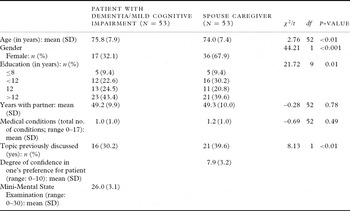
The study was conducted in two psychogeriatric clinics situated in the central and southern regions of Israel. All consecutive new referrals for cognitive evaluation who were married, over the age of 65, and had a cognitive diagnosis of either MCI (Winblad et al., Reference Winblad2004) or dementia (American Psychiatric Association, 2000) at the time of initial evaluation were eligible to participate in this study. A total of 106 respondents (53 couples) participated in this study. Table 1 outlines the demographic and clinical characteristics of the sample. Patients were more likely to be male (67.9%) and older than spouses. Patients were more educated than spouses and less likely to report talking about end-of-life issues when compared with spouses. The sample was relatively well educated, with most patients and spouses having high school education or higher.
Demographic and clinical characteristics of the sample

Note: Chi-square analyses were conducted for categorical variables and t-tests for dependent variables were conducted for continuous variables; SD = standard deviation.
All interviews were conducted by experienced research assistants, face to face at the respondents’ home or preferred location. All participants signed an inform consent. In order to ensure independence in patients' and spouses’ responses, partners were interviewed separately. The study was approved by the Helsinki Ethical Committee.
Case vignettes
The vignettes were selected to represent common scenarios of relevance to end-of-life decision making (Shalowitz et al., Reference Shalowitz, Garrett-Mayer and Wendler2006). A yes–no response format was employed because in real life, a clear-cut yes–no decision has to be made. The first scenario depicted a hypothetical scenario of severe dementia and the second that of a state of coma. For both scenarios, respondents were asked about their preferences concerning life-sustaining treatment, such as cardiopulmonary resuscitation or mechanical ventilation, as well as their preferences for artificial feeding. Patients were asked to report their preferences concerning each of these vignettes. In addition, spouses were asked to report their own preferences as well as what they predicted to be the preferences of the patients concerning these vignettes. A total score, indicating the total number of “yes” responses for the various scenarios, was calculated, with a higher score indicating a greater preference toward interventions. Range for a total score based on all scenarios was 0–4. A difference between the preference score for patients and spouses was also calculated. The interview guide concerning the four possible scenarios is provided in Appendix 1.
Demographics
We collected data regarding age, gender, education, number of medical conditions diagnosed by a physician (e.g. diabetes, high blood pressure, heart failure; range 0–17), Mini-Mental State Examination score (Folstein et al., Reference Folstein, Folstein and McHugh1975), whether the topic of end-of-life preferences had been previously discussed, and the degree of certainty in patient's preferences based on the self-report of each partner separately.
Statistical analysis
A descriptive statistical analysis was performed. We compared three types of preferences, namely that of the patient, that of the spouse with regard to the patient, and that of the spouse concerning themselves. We used chi-square analysis for categorical variables and repeated measures ANOVAs, followed by t-test for dependent samples for continuous variables. Intraclass correlations (ICCs) on the total preference scores were calculated to evaluate the degree of agreement between and within parties. Finally, bivariate mix-methods models were conducted, with the difference between patients' preferences and spouses’ preferences for patients as the outcome variable and each of the demographic variables as potential correlates.
Results
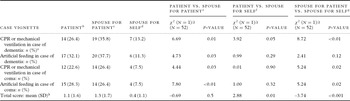
Table 2 presents patients' preferences, spouses’ preferences for patients, and spouses’ preferences for themselves. There were significant differences across the three conditions: F(51,2) = 7.4, p < 0.001. With regard to the total preference score, there were no significant differences between patients' preferences and spouses’ preferences for the patients, suggesting the spouses were moderately accurate when asked to predict patients' preferences. In contrast, there were significant differences between patients' preferences and spouses’ preferences, with patients being significantly more likely to prefer additional treatments than their spouses. There were also significant differences between spouses’ preferences for patients and their preferences for themselves, with spouses being more likely to prefer more treatment for the patients than for themselves.
Preferences for life-sustaining treatments reported by patients and spouses for patients by case vignette

a n (%): frequencies and percentages of “yes” responses to each of the four scenarios.
b Patient: Patient's preference for him/herself.
c Spouse for patient: Spouse's prediction of patient's preference.
d Spouse for self: Spouse preference for him/herself.
e Patient vs. spouse for patient: Patient's preference vs. spouse's prediction of patient's preference.
f Patient vs. spouse for self: Patient's preference vs. spouse's preference for self.
g Spouse for patient vs. spouse for self: Spouse's prediction of patient's preference vs. spouse's preference for self.
h Total score: The total of “yes” responses (i.e. want treatment) to the four vignettes presented to respondents; range, 0–4.
Note: Chi-square analyses were conducted for categorical variables; t-tests for dependent variables were conducted for continuous variables; SD = standard deviation; CPR = cardiopulmonary resuscitation.
Consistently, the ICC indicated moderate agreement between patients' preferences and spouses’ preferences for patients (ICC = 0.42), lower degrees of agreement between patients' preferences and spouses’ preferences for themselves (ICC = 0.17) and low to moderate agreement between spouses’ preferences for patients and spouses’ preferences for themselves (ICC = 0.34).
A similar picture was evident when data were analyzed according to vignettes (Table 2). The results demonstrate a significant relationship between patients' preferences and spouses’ preferences for patients for each of the four scenarios. When spouses stated their preferences for themselves, analyses were not significant, indicating a lack of a relationship between patients' preferences and spouses’ preferences for themselves. With the exception of artificial feeding in the case of dementia, there were significant associations between spouses’ preferences for the patients and for themselves.
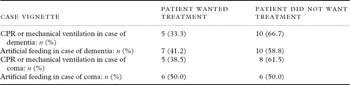
Table 3 demonstrates patients' preferences, when the spouse made erroneous prediction for the patient. When making an error in prediction, with the exception of artificial feeding in the case of coma, spouses were more likely to ask for more treatment than patients would have liked.
Patient's preferences when spouse's preferences for patient were incorrect

Note: n (%) indicates the frequencies and percentages of spouses who incorrectly stated yes – patients would have liked to have treatment vs. patients' actual preferences for treatment by each of the four scenarios; CPR = cardiopulmonary resuscitation.
In an additional sensitivity analysis, none of the demographic variables (e.g. age, gender, number of years together, whether the topic was previously discussed) were significantly associated with the difference between patients' and spouses’ preferences for patients (results are available upon request).
Discussion
The present study evaluated patients' and spouses’ congruence with regard to end-of-life preferences. The most notable finding is the moderate concordance between patients' preferences and spouses’ preferences for patients, compared to a low degree of agreement between patients' preferences and spouses’ preferences for themselves. The findings that spouses are less likely to prefer treatments when compared to patients, but tend to ask for more treatment for patients should also be noted.
Similar to a meta-analysis on the topic (Shalowitz et al., Reference Shalowitz, Garrett-Mayer and Wendler2006), about one-third of the sample made inaccurate predictions about patients' preferences. Past research has found that informants tend to project their own preferences, rather than truly state patients' preferences (Fagerlin et al., Reference Fagerlin, Ditto, Danks, Houts and Smucker2001). The present study, in contrast, found no evidence for projection. Results show that spouses are moderately accurate in predicting patients' preferences and that their predictions for patients' preferences are closer to patients' preferences than to their own preferences. The difference between the present result and previous research may be explained by the fact that our study relied on a homogenous group of spouses, rather than on adult children or other family members, who might be less informed about patients' preferences.
Patients were more likely to prefer treatments when compared to spouses. Past research has shown that individuals with cognitive impairment are more likely to prefer various end-of-life treatments when compared to cognitively intact individuals (Fazel et al., Reference Fazel, Hope and Jacoby2000). Three possible explanations for this association were postulated by the authors. First, cognitive impairment might limit patients' ability to understand the consequences of their preferences or lead to impulsive decisions. Second, people with cognitive impairment might put a higher value on their life than those without such an impairment who respond to a completely hypothetical situation. Finally, in order to overcome the heightened vulnerability associated with cognitive impairment, patients might be more compliant with medical treatments (Fazel et al., Reference Fazel, Hope and Jacoby2000). A complementary explanation for the present findings is that spouses, as a result of their caregiving experiences, may place a lower value on life in the face of severe conditions such as end-stage dementia or coma. Alternatively, it is important to note that most spouses were female, suggesting that gender may play a role in shaping the individual's end-of-life preferences, especially since past research has shown that patients who desire more care are likely to be male (Gramelspacher et al., Reference Gramelspacher, Zhou, Hanna and Tierney1997).
We also found that when making an inaccurate prediction, spouses were more likely to ask for treatment for the patients, rather than opting for no intervention. This is understandable given the irreversible nature of an error on the side of no further treatments. Given the differences in preferences between patients and spouses, with patients asking for more treatment when compared to spouses, this may also account for the relative moderate concordance between patients' preferences and spouses’ preferences for patients.
Finally, none of the demographic variables examined in the present study was associated with the difference between patients' preferences and spouses’ preferences for patients. This is highly consistent with past research, which has largely failed to identify potential predictors of incongruence between patients' preferences and informants’ preferences stated for the patients (Marks and Arkes, Reference Marks and Arkes2008). Consistent with previous studies, even such factors as the level of confidence in one's prediction or whether or not the topic was previously discussed (Coppola et al., Reference Coppola, Ditto, Danks and Smucker2001; Fagerlin et al., Reference Fagerlin, Ditto, Danks, Houts and Smucker2001; Moorman et al., Reference Moorman, Hauser and Carr2009) were not associated with the accuracy of the prediction made.
Despite its notable strengths, the present study has several limitations that should be noted. First, this is a cross-sectional analysis that does not allow for inferences about cause and effect. Past research has shown that preferences vary across time and across scenarios (Houts et al., Reference Houts, Smucker, Jacobson, Ditto and Danks2002; Shalowitz et al., Reference Shalowitz, Garrett-Mayer and Wendler2006). The limited scope of this study suggests that our results should be viewed as preliminary. Finally, the difference that we found between patients' and spouses’ reports concerning previous discussion of end-of-life preferences might be related to the memory impairment of the patients' group, and thus may not be a valid question to ask from this group. Nevertheless, the present study is unique because of its focus on older adults with MCI or mild dementia, as well as the focus on spouses rather than on various other family members. Results demonstrate moderate agreement between patients' preferences and spouses ‘preferences for patients, but no evidence for projection. The study shows significant differences in end-of-life preferences between older adults with MCI or mild dementia and their spouses.
Implications for practice
The majority of research on the topic of end-of-life preferences was conducted in Europe, Canada, or the USA. This study is innovative because it depicts a society in transition. Israel is located in the Middle-East and is highly influenced by more traditional values, such as the preservation of life even at the expanse of one's quality of life. Nevertheless, there have been some changes in recent years. For instance, in 2005, a new Israeli legislation was issued, allowing individuals the choice not to use life-sustaining treatments in terminal conditions (Steinberg and Sprung, Reference Steinberg and Sprung2006). Although the legislation was issued several years ago, it is still unclear how often people rely on it. This study provides a first glimpse into the preferences of older Israeli couples in a new era, when choice is given by law. Our results show that at least hypothetically, a substantial number of older adults opts for no intervention when provided with a choice. These findings should be taken into consideration by healthcare providers who should be encouraged to allow older adults to decide about their end-of-life treatments. Further research regarding the actual implementation of the new legislation in Israel is much needed. Our findings also show that about one-third of respondents did not discuss their end-of-life preferences with their spouse. Given the important role that spouses often take toward the end of life as patients' surrogates, providers should strive to facilitate open discussion among parties. Because, as in past research (Fagerlin et al., Reference Fagerlin, Ditto, Danks, Houts and Smucker2001), whether or not the topic was previously discussed was not associated with the degree of concordance between patient and spouse, a more structured form of communication about end-of-life preferences in the form of written advance directives might be warranted.
Conflict of interest
None.
Description of authors' roles
L. Ayalon developed the concept of the study, analyzed the data, and wrote the paper; Y. G. Bachner, T. Dwolatzky, and J. Heinik provided access to the data and assisted in critical revision of the paper.
Appendix 1
Case vignettes presented to respondents
These questions are part of a study on the preferences about treatments. These questions are hypothetical and may not be related to your current or future condition.
-
1. We would like to learn about your preferences about future treatments if you had Alzheimer's disease in its late stages, when you are no longer capable of making your own decisions. Please indicate in a yes/no response whether you would have liked:
-
• to have life-sustaining treatments, such as a connection to a defibrillator in case of a heart attack or a connection to a mechanical ventilator.
-
• to be artificially fed (e.g. through a peg) if this was the main method that kept you alive.
-
-
2. We would like to learn about your preferences about future treatments if you were in a coma (unconscious for a long period of time). Please indicate in a yes/no response whether you would have liked:
-
• to have life-sustaining treatments, such as a connection to a defibrillator in case of a heart attack or a connection to a mechanical ventilator.
-
• to be artificially fed (e.g. through a peg) if this was the main method that kept you alive.
-