Introduction
The polyandrous mating system of the European honey bee, Apis mellifera Linnaeus (Hymenoptera: Apidae), is unique among domesticated animals (Koeniger Reference Koeniger1990; Tarpy and Page Reference Tarpy and Page2000). Young queens make one to three nuptial flights to a drone congregation area (Tarpy and Page Reference Tarpy and Page2000; Schlüns et al. Reference Schlüns, Moritz, Neumann, Kryger and Koeniger2005). A study by Baudry et al. (Reference Baudry, Solignac, Garnery, Gries, Cornuet and Koeniger1998), reported the presence of thousands of drones from 238 colonies in a single day at the congregation area. On average, 14 drones mate with the queen and then die (Estoup et al. Reference Estoup, Garnery, Solignac and Cornuet1995). Once she has mated, the queen returns to the hive with ~80–90 million spermatozoa in her lateral oviducts (Woyke Reference Woyke1962). An average of 4–7 million spermatozoa received over the course of all matings reaches the spermatheca (Laidlaw and Page Reference Laidlaw and Page1984), where they are stored until used by the queen (Roberts and Mackensen Reference Roberts and Mackensen1951; Woyke Reference Woyke1962). In recent years, high numbers of deficient queens, i.e., with incidence of early supersedure, unexplained death, premature drone egg laying, or interruption of egg laying, have been reported worldwide (Camazine et al. Reference Camazine, Cakmak, Cramp, Fisher, Frazier and Rozo1998; Rhodes Reference Rhodes2008; vanEnglesdorp and Meisner Reference vanEngelsdorp, Hayes, Underwood and Pettis2010). Epidemiological surveys from the United States of America and Canada have identified poor queen quality as one of the main concerns for the honey-bee industry (vanEngelsdorp et al. Reference vanEngelsdorp, Hayes, Underwood and Pettis2010, Reference vanEngelsdorp, Hayes, Underwood and Pettis2011; vanEngelsdorp and Meisner Reference vanEngelsdorp and Meisner2010). According to Tarpy et al. (Reference Tarpy, Keller, Caren and Delaney2012) the quality of commercially produced queens is linked to the production of large amounts of viable brood and the mating health of a queen can be assessed by investigating how well a queen was mated. These researchers found that queens had an average of 4.37 million stored sperm in their spermathecae with an average viability of 83.7%.
Their results also showed significant variations in viable sperm in the spermatheca of commercially produced queens in the United States of America, with some queens having less than 20% live sperm. In Australia, Rhodes et al. (Reference Rhodes, Harden, Spooner-Hart, Anderson and Wheen2010) investigated sperm quality of honey-bee drones and found a low number of mature drones and a relatively low average number of sperm per drone. They suggested poor drone reproductive qualities may contribute to the low number of sperm in the spermatheca of commercially produced queens.
Multiple factors have been found to affect mating health of queens: rearing conditions or queen age at mating can affect the number of sperm migrating to the spermatheca (Cobey Reference Cobey2007). Moreover, the mating success of queens has been linked to male numbers and sperm quality at the drone congregation area (Cobey Reference Cobey2007; Nur et al. Reference Nur, Seven-Cakmak, Ustuner, Cakmak, Erturk and Abramson2012). Several studies have shown that drone age, rearing date and genetic origin affect semen properties (Woyke and Jasinski Reference Woyke and Jasinski1978; Locke and Peng Reference Locke and Peng1993; Zaitoun et al. Reference Zaitoun, Al-Ghzawi and Kridli2009). Woyke and Jasinski (Reference Woyke and Jasinski1978) showed that the number of spermatozoa entering the spermatheca of inseminated queens tends to decrease as drone age increases; 4097 million spermatozoa were found in queens’ spermatheca inseminated with semen from two-week old drones, compared to 3175 million in queens inseminated with semen from nine-week old drones. Zaitoun et al. (Reference Zaitoun, Al-Ghzawi and Kridli2009) found that colonies produced drones from February to July in the semiarid conditions of Jordan. They also found that drones reared in May (swarming period) weighed more and had the highest sperm counts, higher fertility levels (defined as the presence of semen after manual eversion of drones) as well as less sperm abnormalities than drones sampled during the rest of the year. Drone genetics seem to influence most aspects of sperm production and properties (Rhodes et al. Reference Rhodes, Harden, Spooner-Hart, Anderson and Wheen2010), including semen volume and number of sperm produced by each drone.
In northern climates such as that of eastern Canada, beekeeping is characterised by a long overwintering period, followed by one of the shortest active seasons for the honey bee (May to September) around the world. The races commonly bred have been selected for several features essential for high survival rates in this climate. To our knowledge, no information on drone reproductive qualities in northern climates exists, despite the particularities of these environmental conditions.
During summer beekeeping season of 2013, we actively sampled drones from honey-bee colonies. The aim of this study was to evaluate semen quality of drones with different genetic origins, at different ages and at different seasonal breeding periods. Differences in semen production and sperm qualities are expected in relation to these variables. Our prediction was that sperm from young drones would be of highest quality during the swarming period.
Materials and methods
Drone rearing and sampling
This study was conducted at the Centre de Recherche en Sciences Animales de Deschambault (CRSAD, Deschambault, 46°40'26.85''N, 71°54'54.39''W), Québec, Canada. Mature drones were obtained from honey-bee colonies with open-mated queens belonging to two different lines: hybrid Italian stock n=4 colonies (Rustique Apiculture, Saint-Camille, Québec, Canada) and Buckfast stock n=4 colonies (Keld Branstrup, Ruds Vedby, Denmark). All colonies were fed sucrose syrup 1:1 and protein supplement patties (Global Patties Inc., Airdrie, Alberta, Canada; standard 15% pollen patty) during April before the beginning of drone rearing.
Six successive batches of drones were bred during the 2012 beekeeping season (1 and 14 May, 12 and 20 June, 18 and 28 July). Drones were obtained by isolating each queen for 48 hours within a queen exclusion cage which allowed nurse bees to feed the queen freely. Each cage held a drone brood cell frame placed in the centre of the brood chamber. After this period, queens were freed from the excluder cage and drone broods were removed and replaced in the centre of the brood chamber. Upon emergence, 300 young drones were marked with a water-based Uni Poscapen (Mitsubishi Pencil Co. Ltd., Tokyo, Japan) on their upper thorax and returned to their respective colonies. Different colours were used to distinguish different drone cohorts within each colony. Marked drones were released in the honey super and prevented from leaving their colony by placing a queen excluder between the brood chamber and the honey super, which allowed workers to move freely between the two, while confining drones to the honey super.
Thirty marked drones were collected at 14, 21, and 35 days after emergence for semen analysis. When captured, drones were kept alive in a flight cage with young nurse bees and a small incandescent light until evaluation (within one hour). In this cage, drones were able to fly and defecate, which helps initiate semen ejaculation (Collins Reference Collins2004).
Semen volume
Semen collection was accomplished by manual eversion of sexual organs as described by Woyke (Reference Woyke2008). We selected this technique because it has been used in several studies assessing properties of drone semen (Collins and Donoghue Reference Collins and Donoghue1999; Rhodes et al. Reference Rhodes, Harden, Spooner-Hart, Anderson and Wheen2010; Gençer and Kahya 2011; Nur et al. Reference Nur, Seven-Cakmak, Ustuner, Cakmak, Erturk and Abramson2012) and is also commonly practiced for semen collection in instrumental insemination of honey-bee queens (Mackensen and Tucker Reference Mackensen and Tucker1970; Harbo Reference Harbo1985).
An initial vertical pressure on the head of the drone with the thumb and index finger produced partial eversion of the endophallus. Subsequent horizontal pressure from the anterior to the posterior of the abdomen resulted in full eversion of the genitals. In mature drones, semen is cream-coloured and found at the tip of the genitalia on a bed of white mucus. Using a Harbo Large Capacity Syringe (GS 1100; Fisher Scientific, Ottawa, Ontario, Canada), semen was collected from five drones in each colony for each combination of drone breeding date and age. Semen was collected only from drones producing at least 0.2 μL (the minimum amount required for the syringe) and volume was recorded to the nearest 0.1 μL. Care was taken to avoid mucus collection. Semen from each drone was stored in a separate glass capillary tube until sperm quality analysis could be performed later on the same day; i.e., within 12 hours of collection.
Sperm count
Sperm count was conducted using a Neubauer Improved Haemacytometer, BS.748 (Hawksley Technology, Lancing, United Kingdom, depth 0.1 mm, 1/400 mm2). A semen volume of 0.2 μL was diluted in 1.5 mL Tris buffer in a sterile Eppendorf and gently mixed by inversion (dilution factor=7500). Sperm were counted in five squares (0.1 mm3=0.1 μL) at the four corners and centre of each end of the haemocytometer, and counts were repeated three times (with new slide preparations) under a light microscope at 400× magnification for a total number of sperm in 15 squares for each drone. To obtain sperm numbers per drone, the following formula was applied:
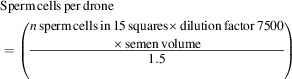 $$\eqalign{{\rm Sperm}\,{\rm cells}\,{\rm per}\,{\rm drone} \cr =\left( {{\displaystyle{n\,{\rm sperm}\,{\rm cells}\,{\rm in}\,{\rm 15}\,{\rm squares}{\times}{\rm dilution}\,{\rm factor}\,{\rm 75}00 \atop{\times}{\rm semen}\,{\rm volume}} \over {1.{\rm 5}}}} \right)$$
Sperm viability
Sperm viability was assessed the day of semen collection using a Live/Dead Sperm Viability Kit (L-7011; Life Technology Inc., Burlington, Ontario, Canada) and a modified version of the method used by Collins and Donoghue (Reference Collins and Donoghue1999). For each drone pool, we used 0.2 µL of semen for the sperm count; the rest of the semen was diluted for the viability test in an individual Eppendorf containing 40 μL Tris buffer and mixed gently. After allowing SYBR-14 and propidium iodide to thaw and come to room temperature, 1.5 μL of SYBR-14 was added to the semen dilution, mixed and allowed to stain 10 minutes. An additional 1.5 μL was added, mixed and allowed to stain 10 more minutes. In a separate analysis of each individual semen sample, 1.5 μL of stained semen solution was diluted in 1.5 μL Tris buffer and mixed gently. A drop of this solution was placed on a slide preparation and sperm viability was assessed using a Zeiss Observer Z1 microscope equipped with fluorescence filters. For each slide, five different fields of view were observed (200×), photographed and saved. Five slides of coloured semen were prepared per drone. Each spermatozoid was scored as either alive (green), or, if sperm had lost membrane integrity, dead (red). For each drone, the mean viability percentage was obtained from the five slides.
Statistical analysis
The probabilities of semen presence after manual eversion were compared across drone genetic lines, breeding dates and drone ages using a mixed logit model with repeated measures. Measurements were taken from drones across all breeding dates and drone ages in each colony, the latter being the experimental units for drone genetic lines. We integrated this variability between colonies by using data on individual drones instead of means data for each colony, and added a 4th error term in the model (four error terms: line, rearing date, age and sampling error, which integrate the variability of pseudo repetitions). Values of semen volume, sperm count, and sperm viability were analysed using a mixed Ancova model with the same repeated measurements. For each response variable, the best transformation was chosen among the Box-Cox family to meet the assumptions of the model. In the particular case of sperm viability, angular transformation was chosen, the recommended transformation for percentage variables (Sokal and Rohlf Reference Sokal and Rohlf1995).
When a significant effect was found in any analysis, multiple comparisons were performed using the protected Fisher’s least significant difference method. The normality assumption was tested using the Shapiro–Wilk’s statistic, while the homogeneity of variances was verified using traditional residuals plots. All analyses were performed at the 0.05 level of significance, and models were adjusted to data using SAS software (release 9.4; SAS Institute Inc., Cary, North Carolina, United States of America) via the Glimmix and Mixed procedures.
Results
Drone rearing
Drones were bred in six batches for each colony between 1 May 1 and 28 July 2012. Since drones from the 28 July cohort reached the age of 14 days in September, when colonies expulse drones in preparation for overwintering, too few were available for evaluation, and the cohort was excluded from statistical analyses. Also, a colony in the hybrid Italian stock (Québec line) died at the beginning of the experiment. Initial analysis showed no significant difference between genetic lines for all variables, thus colonies from both lines were pooled for added statistical strength. While the experiment had a total of 105 treatment combinations (7 colonies×5 breeding dates×3 drone ages), observations were only available for 72 of them, mainly due to poor rearing success in the first rearing cohort of both genetic lines. Several variance components of the model that were estimated to 0 were removed from the model. Because of the missing data pattern and problems with estimation of some variance components, degrees of freedom were estimated using the Kenward-Roger method (Kenward and Roger Reference Kenward and Roger1997).
Manual eversion
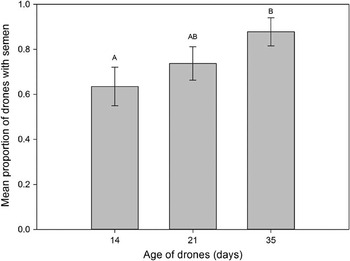
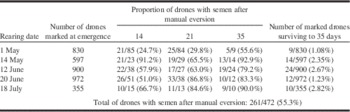
We sampled and manually everted 472 marked drones from May to August 2012. Of these drones, 55.3% produced a sufficient amount of semen to be collected with the Gilmont syringe and were used for semen evaluation (Table 1). Statistical analysis showed that the proportion of drones releasing semen after manual eversion was dependent on drone age (F(2, 450)=3.94; P=0.020; Fig. 1). The interaction between drone age effect and breeding date effect was non-significant (F(8, 450)=1.93; P=0.054). Multiple comparisons made to evaluate the significant effect of drone age showed that fewer 14-day old drones produced at least 0.2 μL of semen (63.5±8.5%) than 35-day old drones (87.8±6.2%).
Mean proportion of drones with semen at the tip of the endophallus after manual eversion for the three ages (in days) (±SE). Different letters indicate significant difference (F(2, 450)=3.94; P=0.020).

Number of drones marked at emergence and proportion of drones with semen after manual eversion at various ages.

Semen volume
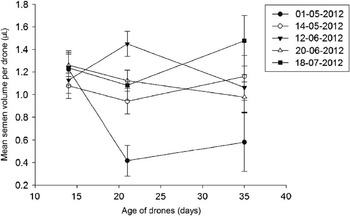
For drones that released semen after manual eversion (n=261 or 55.3% of total drones sampled), the mean semen volume was 1.01±0.03 μL, ranging from 0.4 to 2.4 μL. Results showed that semen volume was influenced by the combined effect of drone age and breeding date (F(8, 15.7)=2.97; P=0.031; Fig. 2). At 14 and 35 days old, there was no difference in semen volume throughout the drone rearing season (F(4, 21)=0.44; P=0.776 and F(4, 15.1)=2.25; P=0.112, respectively).
Mean semen volume per drone (μL) for the three different ages (in days) and five rearing dates (±SE) (F(8, 15.7)=2.97; P=0.031).

Sperm count
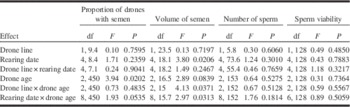
Of the total number of drones with semen after eversion (n=261), 177 produced at least 0.2 μL of semen. These drones had an average total sperm count of 1.80±1.65 million (range 0.008–7.77) spermatozoa. There was no significant effect of any source of variation on sperm count (Table 2.)
Results of the single factor ANOVA with repeated measurements for proportion of drones with semen, volume of semen, sperm count per drone, and sperm viability.

ANOVA, analysis of variance.
Sperm viability
The mean percentage of sperm viability was 64.2±1.07% (range 36.79–86.66). There was no observable effect of drone line (F(1, 128)=0.49; P=0.485), breeding date (F(4, 128)=0.43; P=0.788) or drone age (F(2, 128)=0.31; P=0.736) on sperm viability (Table 2).
Discussion
The purpose of this study was to assess the drone semen quality of different genetic lines, at different ages and reared at several periods during the beekeeping season in Québec, Canada. Our data showed that age, and rearing date have an impact on semen volume but not on sperm count or viability. One key finding of this study is that a large proportion of mature drones failed to release semen by manual eversion, as previously observed by Rhodes et al. (Reference Rhodes, Harden, Spooner-Hart, Anderson and Wheen2010).
We did not find differences in measured variables between the two genetic lines. Rhodes et al. (Reference Rhodes, Harden, Spooner-Hart, Anderson and Wheen2010) examined the influence of genetics on semen production in the honey bee and found differences in semen volume between lines. They were even able to identify a line of drones producing higher volumes of semen. This observation is interesting for honey-bee breeding because adequate queen fecundation is dependent on the volume of semen produced by each drone, and migration of sperm into the spermatheca is dose dependent (Cobey Reference Cobey2007). Furthermore, a drone’s number of descendants is maximised by semen production (Schlüns et al. Reference Schlüns, Schlüns, van Praagh and Moritz2003). The four major Québec queen breeders maintain between four and six different maternal lines and there is an unknown number of lines coming from queen imports from Hawaii, New Zealand, Chile, and California. We selected only two honey-bee lines available from among those in our breeding programme (10–14), and we recommend that more research be conducted on a wider range of honey-bee lines in order to verify whether honey bees could be bred for higher drone fertility.
Sexual maturation of drones is attained at the age at which sperm has completed migration from the testes to the seminal vesicles and when mucus glands are fully developed (Rhodes Reference Rhodes2008). In our study, the higher proportion of 35-day old drones with semen after manual eversion compared with 14-day-old drones (respectively 87% and 64%) shows that not all 14-day-old drones can expulse semen after manual eversion. According to several authors who used this technique, drones aged 10–21 days are mature, and semen properties are most suitable for queen insemination (Woyke and Jasinski Reference Woyke and Jasinski1978; Harbo and Williams Reference Harbo and Williams1987). Nevertheless, our findings indicate that a large proportion of young drones do not release semen through manual eversion. The efficiency of the technique in the case of young drones requires further investigation, particularly in commercial queen breeding open-mating areas, where there is a greater natural variety of drones.
In-hive drone containment and its impact on semen expulsion also require further investigation. In our study, only a small proportion of marked drones survived 35 days in confined hives (from 0–2.82%), as observed by Rhodes et al. (Reference Rhodes, Harden, Spooner-Hart, Anderson and Wheen2010). Under field conditions, the estimated life span of A. mellifera drones is 20–40 days (Page and Peng Reference Page and Peng2001). The confinement of drones during the rearing period could have reduced drone survival through flight deprivation and absence of defecation during their development as suggested by Laidlaw (Reference Laidlaw1979). In our study, drones were able to fly and defecate only when removed from rearing colonies and placed within the flight cage. Due to the cumulative effect of these disturbances, only a few of the 35-day-old drones were available for semen analysis.
We found that only a low proportion of drones, 53%, produced the 0.2 µL of semen required for collection and analysis. Rhodes et al. (Reference Rhodes, Harden, Spooner-Hart, Anderson and Wheen2010) and others (Collins and Pettis Reference Collins and Pettis2001; Andersen Reference Andersen2004) found a similarly low proportion of drones (40.6%) aged 14–35 days with sufficient semen production for analysis, and expressed doubts about the capability of these drones to mate with a queen in nature. Woyke (Reference Woyke2008) studied manual eversion and suggested that the pressure inside the partly everted endophallus is probably too weak to provoke further eversion and release of semen for drones arrested at the partly everted stage but did not find drones showing a total eversion without releasing semen. This phenomenon requires further investigation to determine whether drones not releasing semen after manual eversion are able to mate with the queen, and if so, whether semen is transferred into the oviducts. The effect of age on proportion of drones with semen may also be due to a bias in sampling. Only a few drones survived to 35 days, and we could expect that these were the fittest individuals. The higher proportion found with semen may be due to the fact that the strong individuals who survived longer may also be those with the highest proportion having semen.
The mean sperm count we measured (1.80±1.65 million) was highly variable and within the range obtained in several previous studies (Andersen Reference Andersen2004; Koeniger et al. Reference Koeniger, Koeniger and Pechhacker2005; Rhodes et al. Reference Rhodes, Harden, Spooner-Hart, Anderson and Wheen2010; Gençer and Kahya Reference Gençer and Kahya2011; Nur et al. Reference Nur, Seven-Cakmak, Ustuner, Cakmak, Erturk and Abramson2012). Because of this variance, a higher number of sampled drones and a second year of data could have provided us with more accurate information on the influence of drone age on sperm number.
Based on our findings, the proportion of drones with semen after manual eversion seems to fluctuate during the beekeeping season in eastern Canada. This variability has also been observed in Australia (Rhodes et al. Reference Rhodes, Somerville and Harden2004) and in Jordan (Zaitoun et al. Reference Zaitoun, Al-Ghzawi and Kridli2009). We found lower proportions of drones with semen in early May and mid-June (respectively 43% and 72%). Interestingly, semen volume was also lowest at these two breeding dates. We speculate that changes in the active season of semen production might be explained by the same factors affecting drone production. A honey-bee colony regulates male production throughout the growing season according to environmental factors such as colony size and food availability (Lee and Winston Reference Lee and Winston1987; McNally and Schneider Reference McNally and Schneider1994; Boes Reference Boes2010). Because drones are more costly for the colony to produce than workers (Seeley Reference Seeley2002; Hrassnigg and Crailsheim Reference Hrassnigg and Crailsheim2005), colonies reduce drone production during a period in which limited resources are available in their environment (Rowland and McLellan Reference Rowland and McLellan1987). Honey bees rarely face a total dearth of pollen in their environment, but are rather confronted with variability of pollen resources, abundance, type and diversity across both time and space (Di Pasquale et al. 2013). In early May in Québec, honey bees can benefit from several blooming shrubs and trees, as well as a few indigenous wild plant sources of pollen and nectar, including the ubiquitous dandelion (Taraxacum Wiggers, Asteraceae). However, the pollen and nectar of the majority of melliferous plants are available only in June and July in Québec (Chabot Reference Chabot1948), and only 32 of the 143 main melliferous species flower during May, compared with 64 in June and 88 in July. None of the crops considered important melliferous plants for the honey bee, such as alfalfa (Medicago sativa Linnaeus, Fabaceae), white clover (Trifolium repens Linnaeus, Fabaceae) or buckwheat (Fagopyrum Miller, Polygonaceae), flower in May. Resource availability for honey-bee colonies could have influenced drone’s production of semen during the season, and further research on dietary effects on drones is needed. In this regard, it is important to note that we encountered great difficulty rearing drones in early spring and late summer. Apparently, even if drone production is forced by caging a queen in a drone frame, workers will not rear drones when there is a shortage of resources, especially pollen, which can lead workers to cannibalise the brood (Schmickl and Crailsheim Reference Schmickl and Crailsheim2001), a phenomenon we observed with drones from the first breeding date (1 May).
Results obtained for sperm viability are of concern due to the generally low rates found (mean 64.2±1.07%) throughout the active season. Previous studies on drone sperm viability have shown means ranging between 70% and 90% (Locke and Peng Reference Locke and Peng1993; Rhodes Reference Rhodes2008; Nur et al. Reference Nur, Seven-Cakmak, Ustuner, Cakmak, Erturk and Abramson2012). According to Collins (Reference Collins2000), queens inseminated with semen with 42.5% sperm viability resulted in reduced numbers of worker brood. Many factors could have contributed to reduced sperm viability: drone semen is sensitive to bacterial infection (Andere et al. Reference Andere, Monteavaro, Palacio, Catena, Rodriguez and Collins2011), and contamination can significantly reduce its viability (Locke and Peng Reference Locke and Peng1993). Collins (Reference Collins2004) also found that the act of collecting semen in a syringe can injure sperm and reduce its viability. Stürup et al. (Reference Stürup, Baer-Imhoof, Nash, Boomsma and Baer2013) found that drones exposed to a slight temperature increase from 35 °C to 39 °C resulted in reduced sperm viability. Even semen samples evaluated shortly after collection may have been damaged or contaminated, thereby reducing viability. The possible impact of the generalised poor sperm viability observed here on queen fertility problems identified by the industry also requires closer investigation.
In conclusion, this study demonstrated that semen volume of drone honey bees in eastern Canada fluctuates during the short beekeeping season, and that drones reared in spring (May) show the lowest fertility levels. We recommend that queen breeders test drones for semen quality, to ensure mating with the highest possible reproduction levels at commercial queen bee mating apiaries.
Acknowledgements
This project was funded by Agriculture and Agri-Food Canada via the Canadian Agricultural Adaptation Programme (PCAA). The authors would like to thank the entire beekeeping staff of the Centre de recherche en sciences animales de Deschambault: Michaël Benoît, Martine Bernier, Émile Houle, Georges Martin, and Sylvain Gingras. We would also like to thank Segolène Maucourt for field and laboratory assistance, and Gaétan Daigle for help with statistical analysis. Centre SÈVE (Centre de recherche interinstitutionel en sciences du végétal) and a Natural Sciences and Engineering Research Council of Canada discovery grant provided financial support to A. Rousseau, for which they are grateful.