The modern management of bipolar disorder (BD) includes a number of pharmacological agents that significantly improve both the psychiatric symptoms and quality of life of many patients. Despite this, time and again, research shows significant issues with medication adherence amongst this patient group. When these non-adherence data are analysed, it becomes evident that while the medications prescribed for BD improve symptoms, they cause a range of side effects that vary between mild and severe. Further, though much effort is placed on improving the overall safety and severe side effects of medications, it is often those that impair social and occupational function that impact on the decision to cease medication. One side effect common to many of the mood stabilising agents used in the treatment of BD is tremor. For example, lithium use has been associated with significant reporting of tremor in up to 65% of patients Reference Gelenberg and Jefferson(1). More striking is the finding of one study in which 32% of BD patients treated with lithium had non-adherence because of tremor Reference Morgan and Kapil(2). It is notable that while tremor is most frequent with lithium treatment, both valproate and lamotrigine are also associated with significant tremor albeit the incidence is lower (25 and 4%, respectively) Reference Gelenberg and Jefferson(1,Reference Arbaizar, Gomez-Acebo and Llorca3).
Postural tremor is the most common form of tremor associated with mood stabilising medications. Postural tremor is produced when an individual holds a posture against gravity (e.g. raising an arm). Most commonly patients taking mood stabilisers report difficulties with the hands, arms and jaw. Importantly, this impacts on a range of important occupational and social activities including drinking, eating and handwriting. In order to manage tremor, it is first vital for the clinician to both ask and objectively have an opportunity to observe the tremor. For example, a patient reporting significant difficulty with handwriting might be encouraged to bring in a sample of their writing both before having started medication and after, to contrast the level of impairment. This gives the clinician an opportunity to assist the patient in accommodating to their work tasks and also creates an open therapeutic dialogue for challenging any catastrophic beliefs about perceived impairments. In either case, the acknowledgement of the patient's experience and shared attempts to solve the problem of these difficulties are likely to both strengthen the therapeutic alliance and reduce the risk of non-adherence. As always, it is important to remember that before managing a side effect, it is worthwhile investigating it fully. In particular:
-
1 Tremor may indicate a risk of lithium toxicity, adverse reaction to anticonvulsants or inappropriately high dose.
-
2 Significant tremor may require neurological follow-up and indicate underlying pathology.
A number of excellent previous reviews have investigated the pharmacological treatment of psychopharmacological-induced postural tremor. The aim of this report is to introduce a more biopsychosocial approach to the management of tremor that works through the collaborative efforts of both the clinician and patient. In order to show these concepts clearly a sample of biological, psychological and simple social approaches (based loosely on occupational therapy techniques) are highlighted.
Biological and pharmacological approaches to mood stabiliser-induced postural tremor
Thankfully, many cases of severe tremor associated with mood stabiliser medications can be successfully controlled by pharmacological means. These medications are important but are not the only pharmacological considerations when assessing the management of mood stabiliser-induced postural tremor.
The most beneficial pharmacological interventions for mood stabiliser-induced postural tremor include the β-adrenergic blockers (such as propranolol). These medications are used in cases of more severe tremor and are superior as compared to benzodiazepines because of their lack of dependence, tolerance and addiction Reference Arbaizar, Gomez-Acebo and Llorca(3). Recent research indicates further adjunctive benefits with vitamin B6 Reference Miodownik, Witztum and Lerner(4) which has proven safe for use as add-on therapy with mood stabilising agents.
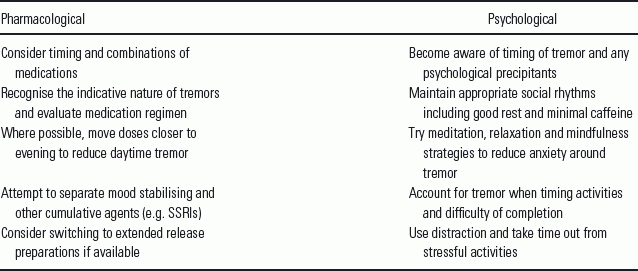
A range of pharmacological agents the patient consumes may significantly impact upon mood stabiliser-induced postural tremor. These include a wide range of other psychotropic medications Reference Arbaizar, Gomez-Acebo and Llorca(3) (of particular relevance are the selective serotonin reuptake inhibitors (SSRIs), which are commonly co-prescribed). While little can be done about the necessity to use these medications in treatment, the clinician and patient can collaborate to reduce use of other pharmacological agents (e.g. see Table 1). Caffeine is noted to have a particularly negative effect on tremors seen in a number of studies assessing lithium. Similarly, nicotine in combination with mood stabilisers may increase risk of significant postural tremor. Finally, a range of illicit substances [such as 3,4-Methylenedioxymethamphetamine (active compound in Ecstasy) (MDMA) and cocaine] are associated with postural tremor and may interact to increase this side effect in mood stabiliser medicated patients. As these illicit drugs are significant risk factors for worsening BD, highlighting to patients that their tremor may be worsened by these drugs, provides a framework for clinicians to challenge these self-destructive behaviours.
Strategies to reduce mood stabiliser-induced postural tremor

Psychological techniques to minimise mood stabiliser-induced postural tremor
One of the main psychological contributors to the increased experience of tremors is psychological distress or anxiety. In this respect, it is worth re-iterating to the patient the relationship between the hypothalamic–pituitary adrenal axis and adrenergic innervation (i.e. increased stress leads to increased adrenalin which in turn leads to increased tremor) and the impact this has on the tremor. The overall aim of the psychological management of tremor is to reduce the overall anxiety in the patient. Table 1 includes some of these psychological strategies.
Another important psychological and physical predictor of increased postural tremor with these medications is sleep difficulties and deprivation. It is widely known that circadian dysregulation is an important precipitant and symptom of BD. In addition, sleep disturbance appears to increase the incidence and severity of tremor. Any psychological treatment of BD should highlight the importance of both stress minimisation and regulating sleep patterns Reference Yatham, Kennedy and O’Donovan(5). Highlighting the tremor minimising effects of these interventions may further assist with engagement in these strategies.
Social and occupational management of postural tremor
As always, the social and occupational management of side effects is also reliant illness an exercise in skilled juggling, it upon the necessary pharmacological, physical and psychological management of the side effect. For example, individuals treated with lithium who experience pronounced hand tremors while dining may choose to avoid caffeinated- or numerous alcohol-based drinks (as alcohol may be dehydrating, thus increasing plasma lithium levels and tremors). A further example could include a student attempting to maintain a good sleep rhythm while studying for examinations to reduce tiredness, anxiety and associated tremor to improve tremor during examinations.
Behavioural strategies to reduce some examples of specific mood stabiliser associated postural tremor include resting or supporting the arm while drinking beverages (either on a table or using the other arm or hand), holding extremities closer to the body to increase control; using rubber pen grips and ergonomic keyboards to improve writing and typing skills and finally timing fine motor activities as close as possible to the next medication dose to increase control.
These few examples of management strategies are intended as a guide and it is only through the collaborative work of the clinician and patient that effective and individualised management strategies can be developed. While the multitude of symptomatic, therapeutic and pharmacological management issues in treating BD make the management of this seems unrealistic to expect clinicians to add yet another ball. However, by re-contextualising the importance of empathising with a patient in being unable to occasionally share a coffee with friends or eat in a café, we increase not only the chance of patients adhering to medication, but also engaging them in the business of meaningful recovery.