INTRODUCTION
The southern elephant seal (Mirounga leonina) is the largest pinniped recognized to date (Jefferson et al., Reference Jefferson, Leatherwood and Webber1993). These huge predators have a widely circumpolar distribution and breeding sites near the subantarctic convergence. Despite the existence of several small breeding populations in subantarctic islands, the most important and abundant breeding groups of this species are located in South Georgia (Southern Atlantic Ocean—54°17′S 36°42′W), Kerguelen-Heard (South Indian Ocean—49°21′S 70°12′E) and Macquarie Islands (South Pacific Ocean—54°30′S 158°57′E) (Reeves et al., Reference Reeves, Stewart, Clapham and Powell2002). Additionally, in South America exists a genetically distinct small population at Península Valdés, Argentina (Slade et al., Reference Slade, Moritz, Hoelzel and Burton1998; Hoelzel et al., Reference Hoelzel, Campagna and Arnbom2001).
Southern elephant seals breed in the austral spring, from early September to mid-November, and they spend most time of the year at sea (Le Boeuf & Laws, Reference Le Boeuf, Laws, Le Boeuf and Laws1994).
The global population of M. leonina is estimated between 664,000 and 740,000 animals distributed in 14 breeding stocks (McMahon et al., Reference McMahon, Bester, Burton, Hindell and Bradshaw2005). The conspicuous appearance of these seals and the marked dimorphism make the identification of the species and the sex determination quite easy. Vagrant southern elephant seals have been recorded in several locations far from their traditional breeding areas (Pinedo et al., Reference Pinedo, Rosas and Marmontel1992; Reeves et al., Reference Reeves, Stewart, Clapham and Powell2002). Their unexpected presence has been reported on the coast of central Chile, South Africa, New Zealand, Tasmania, Australia and Angola (Reeves et al., Reference Reeves, Stewart, Clapham and Powell2002). Vagrants of this species have even been recorded in the northern hemisphere (Johnson, Reference Johnson1990). In Brazilian waters, this species has been occasionally recorded in Rio Grande do Sul, Santa Catarina, Paraná, São Paulo, Rio de Janeiro, Bahia, Sergipe and Fernando de Noronha Island (Lodi & Siciliano, Reference Lodi and Siciliano1989; Pinedo, Reference Pinedo1990; Pinedo et al., Reference Pinedo, Rosas and Marmontel1992; Simões-Lopes et al., Reference Simões-Lopes, Drehmer and Ott1995; Magalhães et al., Reference Magalhães, Hassel, Venturotti and Siciliano2003; Bastos et al., Reference Bastos, Norberto, Maia-Nogueira and Guimarães2006).
The nectonic pattern of M. leonina, the environmental variables such as wind and ocean currents and population growth (e.g. Peninsula Valdés population, Argentina) could influence the dispersion of some specimens to very distant regions far from its breeding grounds (Bastida & Rodríguez, Reference Bastida and Rodríguez2003; Magalhães et al., Reference Magalhães, Hassel, Venturotti and Siciliano2003). The monitoring of the ‘unexpected occurrence’ of M. leonina in several places could be important for future investigation of an ecological pattern involved in the dispersion of this seal. The aim of this paper is to add non-published data and review the occurrence of this large seal along the Brazilian waters.
MATERIALS AND METHODS
The records of southern elephant seals presented in this paper were obtained from personal observations, abstracts from scientific meetings, newspapers, theses, television news and scientific papers. Material acquired from these new sightings, such as photographs and reliable information were examined to determine important data for this study, such as localities of the occurrence, sex, body length and possible threat for this species on the Brazilian coast. In one record made in Sergipe State, north-eastern Brazil (Serra et al., Reference Serra, Hubner and Dórea-Reis2000), it was not possible to access the exact date of the occurrence, only the sex (male); therefore the data were only used for the analysis of the geographical occurrence and sex-ratio of the seals. In order to detect possible trends in latitudinal dispersion of this species along the south-west Atlantic coast we grouped the records according to the coastal States of Brazil. The date of the occurrence was obtained to verify seasonal influence of the distribution of this large seal north of their breeding colonies. In this study we also examined the sex-ratio of the southern elephant seals found on the Brazilian coast. The total body length was used to estimate sexual maturity of the seals. Males measuring less than 400 cm of body length were interpreted as being sexually immature; females with body length less than 250 cm were suggested to be immature seals, according to Jefferson et al. (Reference Jefferson, Leatherwood and Webber1993).
It is important to note that some records of animals from the same sex and with similar body length in close localities in a same season/year could represent double counting. Because of the methodology of data collection presented here it was not possible to access photographs or other material for individual identification on some occasions. The double counting problem could have happened on two occasions: in June and July 1997 (Silva, Reference Silva2004) and on 21 June 2002 and 29 July 2002 (Sanctis et al., Reference Sanctis, Souza and Alvarenga2002; Magalhães et al., Reference Magalhães, Hassel, Venturotti and Siciliano2003).
RESULTS AND DISCUSSION
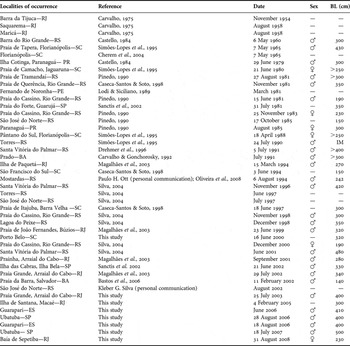
From 1954 to 2008 we compiled 46 records of M. leonina distributed in eight Brazilian coastal states (Table 1; Figure 1). We presented eight non-published records which represent 17.4% of all the records for the Brazilian coast. Unexpectedly, the records did not show a clear pattern of decrease from high to low latitudinal coastal States. Obviously, the State coastline does not have the same length and the non-systematic data collection could influence the observation of the latitudinal view. Nevertheless, the Rio de Janeiro State alone showed ten records, representing 21.7% of the southern elephant seals recorded in this study.
Location of occurrence of the southern elephant seals (Mirounga leonina) specimens recorded along the Brazilian coastal states from 1954 to 2008. Abbreviations: RS, Rio Grande do Sul State; SC, Santa Catarina State; PR, Paraná State; SP, São Paulo State; RJ, Rio de Janeiro State; ES, Espírito Santo State; BA, Bahia State; SE, Sergipe State; FNA, Fernando de Noronha Archipelago.

Records of southern elephant seals (Mirounga leonin a) found along the Brazilian coast between 1958 and 2008. Abbreviations: RS, Rio Grande do Sul State; SC, Santa Catarina State; PR, Paraná State; SP, São Paulo State; RJ, Rio de Janeiro State; ES, Espírito Santo State; BA, Bahia State; BL, body length; IM, immature.

From 32 sexed southern elephant seals, 81.2% (N = 26) were males and 18.7% (N = 6) were females. Fourteen seals could not be sexed. Southern elephant seals occurred in almost all months. Females are rarely sighted far from their colonies, and disperse less than males. Lewis et al. (Reference Lewis, Campagna, Marin and Fernandez2006) found that 88.4% of the sexed (N = 137) southern elephant seals found out of the colonies in South America were males, and only 11.6% (N = 18) were represented by females. From 31 seals with body length information, 61.3% (N = 19) were classified as immature and 38.7% as mature. From the reviewed data of the occurrences of M. leonina on the coast of South America in non-breeding localities, Lewis et al. (Reference Lewis, Campagna, Marin and Fernandez2006) found that 88.3% (N = 173) were immature and 11.7% (N = 23) were mature individuals.
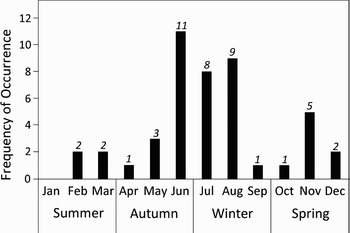
No individual was observed in January, and most seals were recorded in June when 11 specimens were found, representing 24.4% of the total. In the summer there were only 4 records contrasting with autum and winter that showed respectively 15 and 18 records (Figure 2).
Frequency of occurrence of the southern elephant seals (Mirounga leonina) along the Brazilian coast, in the period 1954–2008 by seasons.

Southern elephant seals have been recorded in several areas far from their traditional breeding locations (King, Reference King1983; Lodi & Siciliano, Reference Lodi and Siciliano1989; Jefferson et al., Reference Jefferson, Leatherwood and Webber1993; Magalhães et al., Reference Magalhães, Hassel, Venturotti and Siciliano2003; Muelbert et al., Reference Muelbert, Robaldo, Martínes, Colares, Bianchini and Setzer2003; Lewis et al., Reference Lewis, Campagna, Marin and Fernandez2006). Indeed, historical records have shown the presence of this large seal in some unusual locations, such as at the St Helena coast (16°01′S 05°42′W) in 1655 and 1819, at Chagos Archipelago (Indian Ocean—06°13′S 72°02′E) in 1786, and at Juan Fernandez Islands (Chile—33°38′S 78°51′W) in 1683 (King, Reference King1983) as well as at Fernando de Noronha Archipelago (3°51′S 32°25′W) (Lodi & Siciliano, Reference Lodi and Siciliano1989).
The occurrence of this species in non-breeding locations has received special attention and some hypothetical explanations have been postulated. Ross (Reference Ross1969) suggested that the southern elephant seals recorded in South Africa are originally from the Prince Edward Islands (46°50′S 37°50′E) and presumed that the animals have been carried northwards helped by the Benguela Current. King (Reference King1983) suggested that the elephant seals recorded on the New Zealand and Australian coasts probably were originated from the Macquarie or Campbell Island population. Muelbert et al. (Reference Muelbert, Robaldo, Martínes, Colares, Bianchini and Setzer2003) monitored two young southern elephant seals in Elephant Island (61°13′S 55°23′W, Antarctica) through satellite tags. One of the marked seals moved to King George Island and the other failed tag communication. These authors suggested that these seals from King George Island dispersed to Elephant Island (about 195 km in a straight line) searching for suitable places to forage, which could be the explanation for several other unusual occurrences of this species. A sub-adult male M. leonina tagged on the coast of Sea Lion Island (52°26′S 59°07′W) was recorded on Gough Island (40°18′S 09°56′W), about 4000 km away.
Southern elephant seals born and tagged at Península Valdés, Argentina, are frequently found moulting or reproducing far from their breeding grounds, approximately 120 km from their breeding location. However, some southern elephant seals could even disperse more than 1000 km from Patagonia, at the Malvinas/Falkland Islands (Campagna & Lewis, Reference Campagna and Lewis1992; Lewis et al., Reference Lewis, Campagna and Quintana1996). Hindell & McMahon (Reference Hindell and McMahon2000) reported extreme movement (about 5200 km) of a branded juvenile female M. leonina from Macquarie (54°37′S 158°52′E) to Peter 1 Island (68°50′S 90°35′W) in 1999. Fabiani et al. (Reference Fabiani, Hoelzel, Galimberti and Muelbert2003) used mtDNA haplotypes to infer the putative source populations of individuals of M. leonina of unknown origin. These authors showed evidence of male-mediated genetic dispersal over a geographical range of about 8000 km. Based on a tagging study and haplotype comparisons, the authors found that an adult male of elephant seal that was born in Macquarie Island had lately bred on the Falkland Islands. The authors suggested that the southern elephant seal dispersed around Antarctica with the West Wind Drift to other breeding grounds.
Magalhães et al. (Reference Magalhães, Hassel, Venturotti and Siciliano2003) reported the presence of two immature males M. leonina on the beaches of Arraial do Cabo, south-eastern Brazil. These authors suggested that these records could be related to erratic movements possibly associated with population increase on their breeding grounds. Silva (Reference Silva2004) studied the occurrences of M. leonina along the Brazilian coast and evaluated the presence of this species along the southern region of Brazil. This author indicated that the erratic occurrence of southern elephant seals along the Brazilian coast is influenced by the Falkland/Malvinas Current and also by their nectonic movements. This hypothesis has been previously postulated by Castello & Pinedo (Reference Castello and Pinedo1977).
As mentioned by Magalhães et al. (Reference Magalhães, Hassel, Venturotti and Siciliano2003), one of the main reasons for the erratic movements of southern elephant seals could be attributed to the population growth of some colonies. Indeed, the continental colony of the species located in Península Valdés has shown clear evidence of growth and this could be the origin locality of the most of the seals presented in this paper.
Most records of M. leonina along the Brazilian coast were grouped in late autumn and winter which suggests that the intrusion of the Falkland/Malvinas Current, stronger in winter, might have an important role in the dispersal of the specimens found along the South American coast. The Falkland/Malvinas Current probably also has influence on the occasional distribution of many other pinniped species along the Brazilian, including the subantarctic fur seal (Arctocephalus tropicalis), Antarctic fur seal (A. gazella) and crabeater seal (Lobodon carcinophaga), as mentioned by different authors (Castello & Pinedo, Reference Castello and Pinedo1977; Pinedo, Reference Pinedo1990; Oliveira et al., Reference Oliveira, Danilewicz, Martins, Ott, Moreno and Caon2001, Reference Oliveira, Machado, Alievi and Wurdig2006; Moura & Siciliano, Reference Moura and Siciliano2007).
Both males and females of southern elephant seal can swim to different areas of the sea to forage, and during the non-breeding season, these seals could even reach great distances far from their breeding locations (Hindell & McMahon, Reference Hindell and McMahon2000; Fabiani et al., Reference Fabiani, Hoelzel, Galimberti and Muelbert2003; Muelbert et al., Reference Muelbert, Robaldo, Martínes, Colares, Bianchini and Setzer2003). Food searching could be the main reason for the presence of these seals far from the breeding grounds. Mirounga leonina specimens recorded in Brazilian waters, if they present erratic movements or not, could have reached the areas searching for food. This could be suggested by the presence of a seal that remained in the rich upwelling waters of Rio de Janeiro State, with a healthy appearance, from July up to November 2002 (Magalhães et al., Reference Magalhães, Hassel, Venturotti and Siciliano2003). However, the information about the feeding habitat of southern elephant seals far from their breeding grounds is almost non-existent. In Brazil, the only data available for the species were obtained from the analysis of a stomach content of an immature male found dead in Rio Grande do Sul in August 1994 (P.H. Ott, personal communication). Remains of three oceanic cephalopod species were found in the stomach of this specimen, indicating an offshore foraging behaviour of the species in the area (Oliveira et al., Reference Oliveira, Ott, Malabarba, Reis, Peracchi and dos Santos2008).
According to the study of Lewis et al. (Reference Lewis, Campagna, Marin and Fernandez2006) most of the southern elephant seals sighted on the Pacific and Atlantic coasts of South America are from the Península Valdés population, on the Argentina coast. Indeed, the potentiality to swim long distances together with the lack of physical barriers and currents moving northwards (Falkland/Malvinas Current) could help the dispersion of these seals to different areas along South America.
ACKNOWLEDGEMENTS
The authors would like to thank the researches who contributed with records presented in this paper. Thanks go to the research team of Oceanites (GEMM-Lagos) and also to Dr Kleber G. Silva and Dr Paulo H. Ott for the important data and suggestions for this study. We thank the fishermen and lifeguards from Cabo Frio, Saquarema and Búzios for their contribution with important information on pinniped records. We also thank the anonymous referees for their input to the manuscript.