Introduction
Goethite and hematite are common constituents in lateritic soils, sediments, and rocks (Berner, Reference Berner1969). Goethite and hematite crystals are based on hexagonal closest-packed (hcp) oxygen lattices. The stacking sequence repeats every two layers (ABAB–-); in hematite, Fe3+ cations occupy one-half to two-thirds of the available octahedral sites. Channels are formed by the rows of empty sites and are occupied by protons of the two hydroxyl groups in goethite. Goethite (α-FeOOH) has an orthorhombic unit cell with the axes a = 4.608 Å, b = 9.956 Å, and c = 3.021 Å (Schwertmann & Taylor, Reference Schwertmann, Taylor, Dixon and Weed1989) and belongs to the space group Pbnm (#62), with four repeat formula units per unit cell (Ghose et al., Reference Ghose, Waychunas, Trainor and Eng2009; Gonalez et al., Reference Gonalez, Sagarazu and Villalba2000). The position of Fe3+ cations in hematite repeats every three layers (ABCABC––); the unit cell (i.e. the c axis in the hexagonal crystal system) corresponds to a six-layer period (Gonalez et al., Reference Gonalez, Sagarazu and Villalba2000). Hematite (α-Fe2O3) has a hexagonal unit cell with a = 5.034 Å and c = 13.752 Å (Schwertmann & Taylor, Reference Schwertmann, Taylor, Dixon and Weed1989) and space group R
 c (#167), with six formula units per unit cell (Gonalez et al., Reference Gonalez, Sagarazu and Villalba2000).
Several different methods are used to prepare goethite and hematite. Goethite can be prepared from an Fe3+ system, including alkaline or acid or cysteine/2-line ferrihydrite from Fe2+ system, which produces acicular or lath-shaped goethite. Hematite can be prepared from the fast hydrolysis of Fe(NO3)3 .9 H2O in HNO3 acid, FeCl3 .6 H2O salt with HCl, or Fe(ClO4)3 .9 H2O near 100°C, from which diamond-shaped unidimensional crystals of 70–100 nm were observed (Cornell & Schwertmann, Reference Cornell and Schwertmann2003; Schwertmann & Cornell, Reference Schwertmann and Cornell2000). Hematite prepared from 2-line ferrihydrite formed small platelets or spindle-type crystals. The ferrihydrite was named by Chukhrov et al. (Reference Chukhrov, Zvyagin, Ermilva and Gorshkov1973). In addition to the previous methods, crystalline α-FeOOH (i.e. lath and twining goethite) can be prepared by four methods: (1) a 0.001 M Fe(ClO4)3 with NaHCO3/Fe = 0.25 solution aged at room temperature for 10 y formed lath- and star-shaped goethite; (2) 0.01 M Fe(ClO4)3 and 0.0002 M HClO4 solutions were aged at room temperature for 13 y and produced star-shaped goethite; (3) 0.05 M Fe(ClO4)3 solution aged at room temperature for 14 y formed K- and X-shaped intergrowth of goethite (Hsu, Reference Hsu1973; Hsu & Marion, Reference Hsu and Marion1985; Wang, Reference Wang1987); and (4) acicular and star-shaped goethite were prepared at pH (12–13) and heated at 70°C for up to 72 h (Atkinson et al., Reference Atkinson, Posner and Quirk1968; Barron et al., Reference Barron, Galves, Hochella and Torrent1997; Cornell & Mann, Reference Cornell and Mann1983; Cornell & Schwertmann, Reference Cornell and Schwertmann2003; Schwertmann & Cornell, Reference Schwertmann and Cornell2000).
Earlier research reports indicated that the formation of α-FeOOH and α-Fe2O3 can be determined by several factors: temperature, pH, Fe3+ concentration, anionic species, hydrolysis rate, nucleation, particle size, etc. Inconsistencies in the earlier literatures, however, indicated that these factors could be interrelated. Goethite and hematite were prepared at various temperatures between 5 and 165°C (Schwertmann & Cornell, Reference Schwertmann and Cornell2000). While hematite was favored to form at higher temperatures and high Fe(ClO4)3 concentrations under acidic conditions; goethite was favored at low temperatures with low iron concentrations (Wang & Hsu, Reference Wang and Hsu1980).
In addition to the individual formation of goethite or hematite, transformation from goethite to hematite was evaluated in the following studies. Hematite is known to transform from goethite through dehydration (Naono et al., Reference Naono, Nakai, Sueyoshi and Yagi1987; Weidler et al., Reference Weidler, Hug, Wetche and Hiemstra1998). The microstructure of hematite was studied by high-resolution electron microscopy (HRTEM) (Watari et al., Reference Watari, Delangnette, Van Landuyt and Amelinckx1979, Reference Watari, Delangnette, Van Landuyt and Amelinckx1983), which was formed by the dehydration of goethite. The topotactic relationship between goethite and hematite should be (100)G//(001)H (Van Oosterhout, Reference Van Oosterhout1960), where the directions [001], [100], and [010] of goethite became the directions [001], [010], and [210] of hematite. Due to the close relationship between the two crystalline structures, different slip mechanisms can be proposed favoring the phase transformation. Phase transformation into hematite particles was found to be epitaxial on goethite (Lin et al., Reference Lin, Liang, Lim, Meeling, Zhang, Tan and Shiqiang2014) and re-precipitation in the process of hematite formation (Cornell et al., Reference Cornell, Posner and Quirk1974). The evolution of the microstructure of hematite derived from synthetic goethite over a wide temperature range (400–1100°C) has been investigated systematically using powder X-ray diffraction (XRD) and transmission electron microscopy (TEM) (Kryukova et al., Reference Kryukova, Tsybulya, Solovyeva, Sadykov, Litvak and Andrianova1991). Based on the structure refinements of XRD patterns and TEM investigations, Jiang et al. (Reference Jiang, Stahl, Nielsen and Costa2000) illustrated that the non-uniform X-ray line broadening effect is caused by the plate-like shape of the hematite crystal. A phase transformation of synthetic goethite, heated above 250°C, led to the appearance of hematite (Saito et al., Reference Saito, Kunisada, Nomura, Sakaguchi and Akiyama2016).
Morphological changes when goethite transformed to hematite were also observed using TEM and HRTEM investigations. In situ analysis of mineral dehydroxylation, which was affected by the electron beam, was studied using HRTEM. The transformation of hematite from goethite has been discussed but the coexistence of goethite and hematite crystals and their intergrowth relationship have not previously been evaluated in depth.
The present study aimed to review how to prepare and characterize the intergrowth between goethite and hematite crystals, including how to improve the ability to interpret the SAED pattern of the crystal epitaxial relationship between three sets of (100) goethite twinning crystals associated with the (001) orientation of the hexagonal prism of hematite.
Materials and Methods
Formation of Goethite and Intergrowth of Goethite Crystals
Usually, goethite particles elongate in the [100] a direction, are needle-like, and contain intergrowths of goethite twins with varied shapes of the (210) plane. Goethite twins were precipitated from iron salt solutions at 25°C and pH 4, the product of which consisted of 2 or 3 lath-shaped goethite twins. The star-shaped goethite twins were prepared at [OH] = 0.3 mol L−1 aged at 70°C. Epitaxial twins consist of a hematite center with outgrowths of acicular goethite. Large goethite twinning particles with well developed {101} and {210} terminal faces were reported by Schwertmann and Pfab (Reference Schwertmann and Pfab1994) as having produced vanadium goethite twinning. The 2-line ferrihydrite was observed as a result of production with addition of 0.3 M KOH and heated at 70°C (Schwertmann & Murad, Reference Schwertmann and Murad1983; Schwertmann et al., Reference Schwertmann, Stanjek and Becher2004). Polymeric star-shaped goethite twinning was produced in 0.3 M alkaline media aged at high temperature (i.e. 70°C), and is quite common along the a direction. Epitaxial goethite twins occurred (Cornell & Giovanoli, Reference Cornell and Giovanoli1985; Schwertmann et al., Reference Schwertmann, Stanjek and Becher2004) and transformed from ferrihydrite (Chukhrov et al., Reference Chukhrov, Zvyagin, Ermilva and Gorshkov1973) in both acid and alkaline media. However, star-shaped goethite twins are produced only under high-pH conditions. Outgrowths of goethite developed in the [100] direction (a axis) and terminated in the [210] faces due to phosphorus (P) adsorption (Barron et al., Reference Barron, Galves, Hochella and Torrent1997). The (021) plane is a termination plane, which is parallel to the a axis of hematite; goethite (001) is parallel to the (001) plane of hematite. Different types of goethite twins can be predicted with variations in synthetic conditions (Atkinson et al., Reference Atkinson, Posner and Quirk1968).
Methods to Prepare the Intergrowth of Goethite and Hematite
Formation of Goethite and Hematite with Fe Solution Aged at 70°C
In general, the Fe(ClO4)3 with HClO4 solutions can be prepared and aged at 70°C. The Fe solution samples were monitored for their hydrolysis and precipitates of Fe oxide during the aging period. The chemical determinations, including the H+ and OH– concentrations and solution pH, calculation of (Fe3+)(OH–)3 solubility products (K sp ), amorphous and total polymeric iron(III) hydroxides (%), XRD analysis, TEM and HRTEM investigations, bright and dark field imaging, and SAED patterns of particles were described in detail by Hsu (Reference Hsu1973), Hsu and Wang (Reference Hsu and Wang1980), Wang and Hsu (Reference Wang and Hsu1980), and Wang et al. (Reference Wang, Greenhut and Hsu1981). The chemicals were supplied by G.F. Smith Co. (Portland, Oregon, USA). The present study used 0.1 M Fe(ClO4)3 with and without the addition of HClO4 (i.e. HClO4/Fe molar ratio of R = 0, 0.6, 0.8). A series of 0.004 M Fe(ClO4)3 solutions with R values of 4–10 aged at 70°C as examples were used to describe the Fe hydrolytic behavior and Fe oxide precipitates under the perchlorate acid system.
Results and Discussion
Hydrolytic Behavior of 0.1 M Fe(ClO4)3 Solution (R = 0, 0.6, 0.8) Aged at 70°C
The initial pH, turbidity, and solubility products (Fe3+)(OH–)3 of the sample with R = 0 were: 1.42, < 0.1 JTU (Jackson Turbidity Unit), and 10–38.6, respectively. After a 6-h induction period (IP), the sample solution was aged at 70°C, and the solution turned rapidly from a clear solution (i.e. a light reddish color) into a turbid suspension, began secondary hydrolysis and polymerization, and gradually Fe precipitates were formed. Thus, hydrolytic products of Fe precipitates settled to the bottom of the glass container. The pH values of Fe solution samples and amounts of polymeric ‘Fe(III) hydroxides’ decreased gradually the solution pH and increased polymeric ‘Fe(III) hydroxides’ with prolonged aging until 75% of the Fe(III) was polymerized (i.e. 20 days) (Hsu & Wang, Reference Hsu and Wang1980). Meanwhile, with R = 0.6 or 0.8 in a 0.1 M Fe(ClO4)3 solution, the initial (Fe3+)(OH–)3 solubility products were close to 10–40.5 or 10–40.7, and increasing HClO4 concentrations decreased the solution’s initial and final pH and extended their IPs to 40 and 63 days, respectively. The XRD patterns of these Fe precipitates showed highly crystalline hematite only.
X-ray Analysis
Suspensions from the sample were collected for XRD analysis as soon as the Fe solution became turbid (i.e. 6 h) for the 0.1 M Fe(ClO4)3 solution (R = 0) aged at 70°C. The XRD analysis showed the d spacings for goethite at 2.44, 2.58, 2.69, and 4.18 Å. Then, the Fe solution began to appear polymerized shortly after the IP of the secondary hydrolysis; the d spacings of hematite at 2.51, 2.69, and 3.67 Å and the amount of hematite increased gradually with prolonged aging (Hsu & Wang, Reference Hsu and Wang1980). The initial XRD reflection peak intensities of goethite were relatively weak compared to the reflection peak intensities of hematite after 20 days of aging, but no further change in relative goethite and hematite XRD reflection peak intensities was observed after the same amount of time. This result indicated that hematite was the only major product developed at the later aging stage. Thus, goethite precipitates formed first, and hematite formed later.
For the initial solubility products [(Fe3+)(OH–)3] of a sample solution, K sp is a key factor in the final hydrolytic precipitates of α-FeOOH and α-Fe2O3 (Hsu, Reference Hsu1973; Hsu & Marion, Reference Hsu and Marion1985). Based on the K sp of goethite and hematite, the relative abundance of Fe-oxide species should be interpreted as being governed by the solution (Fe3+)(OH–)3 solubility products with respect to the K sp of goethite and hematite (i.e. K sp close to 40 and 42), respectively. Schematic demonstration of the impact of the initial solution solubility products [(Fe3+)(OH–)3] on the development of goethite and hematite with respect to their K sp values was illustrated in detail earlier (Hsu & Wang, Reference Hsu and Wang1980).
TEM Investigations
For the TEM investigations, samples were collected from the 0.1 M Fe(ClO4)3 solution (R = 0) aged at 70°C. A suspension sample aliquot was diluted to the Fe concentration of ~0.02%; then, the precipitates were dispersed by ultrasonication. A Siemens Model I transmission electron microscope (Berlin, Germany) was used for this study. A drop of Fe suspension was placed onto a copper grid (3.05 mm in diameter, 300 mesh), coated with formvar film and dried at 25°C.
TEM images of samples collected from the 0.1 M Fe(ClO4)3 solution (R = 0) aged at 70°C for 1 day contained various amounts of lath- and star-shaped goethite particles (i.e. 0.5 µm in size), which were overlain by poorly hexagonal-shaped plates of hematite (Hsu & Wang, Reference Hsu and Wang1980). Hexagonal plates of hematite covered nearly all lath-shaped and star-shaped goethites and increased in quantity after Fe solution aging for 20 days (Hsu & Wang, Reference Hsu and Wang1980). The existence of lath- or star-shaped goethite and hexagonal plates of hematite has been well documented after a 20-day aging period with no significant change. This result suggests the formation of goethite in the early hydrolytic stages and hematite in the later stage of the aging period, and goethite acts as a template surface to be overlain by a hexagonal hematite prism at a later stage. The relative proportions of α-FeOOH and α-Fe2O3 are governed mainly by the solution environments, especially the initial (Fe3+)(OH–)3 solubility products and Fe solution pH, with respect to the K sp values of goethite and hematite, instead of the speciation of nuclei. Hematite was suggested to act as a nucleus for the formation of goethite, but no evidence was provided in support of this assertion (Wefers, Reference Wefers1966).
Hydrolytic Behavior of 0.004 M Fe(ClO4)3 Solutions Aged at 70°C
A series of 0.004 M Fe(ClO4)3 solution samples with various R values of 4–10 and aged at 70°C was studied. The addition of HClO4 decreased the initial pH and amount of (Fe3+)(OH–)3 solubility products and extended its secondary hydrolysis and IP. For example, with the addition of HClO4 concentrations of R = 4–10, the initial solution pH decreased from 1.79 to 1.38, and the final (i.e. aged for 111 days) solution pH decreased from 1.49 to 1.20. The IP of these Fe solutions extended from 6 h to 19 days. The K sp values increased from 39.3 to 40.4, and amorphous Fe(III) hydroxide (%) and total polymeric Fe(III) hydroxide (%) decreased from 0.35 to 0.08 and from 99.5 to 93, respectively, with respect to the initial and final aging periods (i.e. 111 days) (Hsu & Wang, Reference Hsu and Wang1980). After the secondary hydrolysis and polymerization were initiated and reached equilibrium, ~99% of the total polymeric Fe(III) hydroxide R = 4, 6, 8, or 10 samples and 93% of the total Fe(III) were observed in all samples throughout the polymerization process. All sample solutions progressed rapidly and reached equilibrium. The final (Fe3+)(OH–)3 solubility product was calculated to be ~ 10–42. The XRD patterns showed that both goethite and hematite were present, but hematite had a more intense XRD reflection than that of goethite, and it increased with increasing HClO4 concentrations. The TEM images also showed that the hexagonal prism of hematite grew on top of star-shaped goethite (Fig. 1a, b). The other type of hematite particles appeared to be irregular hexagonal plates with four sides of equal length and two shorter sides (Fig. 1b). These species of intergrowth of goethite and hematite particles also increased markedly with increasing addition of HClO4 and prolonged aging at 70°C (i.e. 111 days).
TEM images of Fe oxide particles observed from three 0.004 M Fe(ClO4)3 solutions aged at 70°C for 111 days with a R = 6 and b R = 8 or 10

HRTEM Investigations and SAED Patterns
Representative particles of star-shaped goethite overlain by hexagonal prisms (i.e. hematite) were investigated by HRTEM (JEM 200-kV, Tokyo, Japan). The HRTEM sample preparation was approximately identical to that of TEM, but the sample was coated with a carbon film and dried at room temperature. The HRTEM investigations included both bright- and dark-field images, and SAED patterns of star-shaped goethite particles overlain with the hexagonal prism of hematite were reported by Wang et al. (Reference Wang, Greenhut and Hsu1981). These goethite crystals had identical SAED patterns except for the difference in diffraction spot intensity. The index of the SAED pattern and TEM images of the star-shaped goethite twin crystal had a (100) plane. Two sets of lath-shaped goethites formed as X-shaped goethite twin crystal and have included angles at 60° and 120o, and shared with (011) plane. The bright- and dark-field images further support the interpretation of three sets of goethite formed a star-shaped goethite twin on the same plane and not on the stacking arrangement of the intergrowth of goethites.
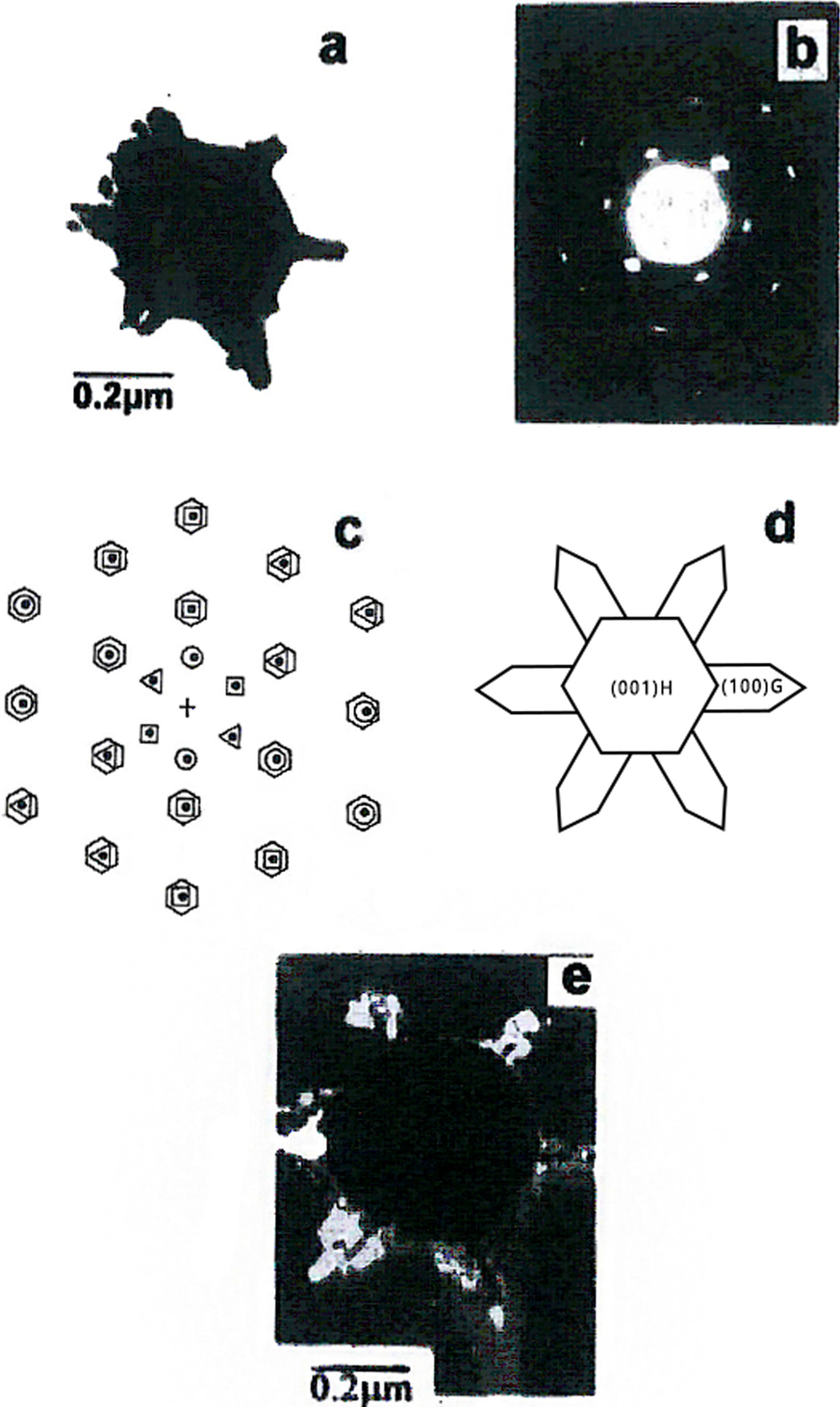
For further study, a 0.004 M Fe(ClO4)3 and 0.04 M in HClO4 solution (R = 10) aged at 70°C was prepared. The reaction products were goethite and dominant hematite (Hsu & Wang, Reference Hsu and Wang1980). Transmission electron micrographs also showed that the hematite in this 0.004 M Fe(ClO4)3 solution sample (R = 10) observed two different growth habits: an irregular hexagonal plate of hematite particles appeared to have four sides of equal length and two considerably shorter sides. The second type of particle appeared to be a hexagonal plate of hematite underlain by star-shaped goethite (Fig. 2a); the SAED pattern of this particle is presented in Fig. 2b.
TEM investigations of a hexagonal plate-shaped hematite grown on star-shaped goethite a with a bright field image. b SAED pattern of the hexagonal hematite plate grown on star-shaped goethite twinning crystals. c Indexing of the SAED pattern. ⬡ refers to hematite in the (001) orientation. ○, Δ, and □ refer to three lath-shaped sets of goethite crystals in the (100) orientation, with 60° between neighboring pairs of goethite crystals in part b. d Each of three sets of lath-shaped goethite crystals has its (100) plane parallel to this basal plane and rotated at 60°, which is associated with the (001) plane of hexagonal-prism hematite. e Dark field image of star-shaped goethite and hexagonal plate hematite, selected diffraction spot at (020) goethite; most of the lath-shaped goethite crystals lit up, whereas the hexagonal plate of hematite at the center remained dark

The simplest interpretation assumes the specimen to be composed of the (001) orientation of hematite and three lath-shaped (i.e. star-shaped) intergrowths of goethite crystals in the (100) orientation, to have a 60° angle between three neighboring lath-shaped goethite crystals. This is based on the ideal electron diffraction patterns for the (100) goethite and (001) hematite (Hirsch et al., Reference Hirsch, Howie, Nicholson and Whelan1977). The indexed SAED pattern shows that the hematite crystal has a basal plane (001) parallel to the micrograph and diffraction pattern (Fig. 2c). The diffraction spots nearest to the origins were indexed to be (020) and (0
 0), which relate to the 4.98 Å basal spacing of goethite (JCPDS 17–536). A composite of the hematite diffraction patterns is shown in Fig. 2b. The six peripheral diffraction spots are indexed as (061), 1.453 Å of goethite associated with (300), 1.452 Å of hematite, and the middle sets of six diffraction spots refer to (021), 2.58 Å of goethite associated with (110), 2.51 Å of hematite (JCPDS 13–534) (Fig. 2b, c). Each of the three sets of lath-shaped goethite crystals has its (100) plane parallel to this basal plane and rotated at a 60° angle and is associated with (001) hematite (Fig. 2d). This is only a simple interpretation of the SAED pattern, which illustrated the relationship between goethite and hematite and its crystal growth. Furthermore, this interpretation is consistent with the morphological observation of three lath-shaped goethites at a 60° angle radiating from the hexagonal vertices (i.e. hematite).
To verify the indexing of goethite and hematite, the SAED spots located nearest to the origins and indexed to goethite (020) were selected for examination by dark field electron microscopic imaging. When the electron beam was directed to the (020) diffraction spot of goethite, most of the lath-shaped goethite crystals lit up, whereas the hexagonal plate (i.e. hematite) at the center remained dark (Fig. 2e). This observation further confirmed that the star-shaped goethite is quite stable under the HRTEM high-energy electron beam, which helps interpret its SAED pattern with double diffraction spots. The fact that only most of a lath-shaped goethite lit up in the dark field images indicates that the entire structure is highly defective. The SAED of the other irregular hexagonal particles in Fig. 2b was indexed to be hematite in the (211) orientation (Wang et al., Reference Wang, Greenhut and Hsu1981).
Hematite grew preferentially with its hexagonal basal planes parallel to (100) goethite (Schwiersch, Reference Schwiersch1933). The intergrowth plane is an oxygen layer common to both lattices. The intergrowth of goethite and hematite was also demonstrated (Wefers, Reference Wefers1966). Wefers (Reference Wefers1966) also suggested that hematite developed first and subsequently acted as a nucleus for the development of goethite. In highly supersaturated solutions, under equal growth conditions, goethite developed under hexagonal hematite (100) prism surfaces and star-shaped crystals. Nevertheless, Wefers (Reference Wefers1966) did not present further experimental evidence of the progress of crystal growth. However, other authors clearly showed that goethite developed prior to hematite, and (100) goethite crystals radiated (star-shaped) under the (001) prism surface of the hexagonal hematite plate (Hsu & Wang, Reference Hsu and Wang1980; Wang et al., Reference Wang, Greenhut and Hsu1981).
The size of star-shaped goethite twins associated with hexagonal hematite is ~0.5 µm (Figs. 1, 2), which is < 1 µm and > 0.2 µm. SAED occurs as a hexagonal pattern (Fig. 2b, c). Thus, the twins exhibit pseudo-hexagonal symmetry with “interpenetrated” angles of ~120° and are not shown as “contact” twins (Cornell & Mann, Reference Cornell and Mann1983). According to Atkinson et al. (Reference Atkinson, Posner and Quirk1968), Cornell and Mann (Reference Cornell and Mann1983), and Barron et al. (Reference Barron, Galves, Hochella and Torrent1997), the (021) faces have the greatest concentration of connected hydroxyls and preferentially adsorbed phosphate and grew slowly, thus keeping the star arrows short relative to their crystal width, forming a terminated edge. It may be correlated with the formation of X-, K- and star-shaped goethite twins. The real mechanism of termination for the intergrowth of goethite twin crystals remains obscure and merits further, in-depth study.
Schematic Diagram of the Epitaxial Relationship between Three Sets of Intergrown (100) Goethite Crystals Associated with the (001) Orientation of Hexagonal Hematite Prisms
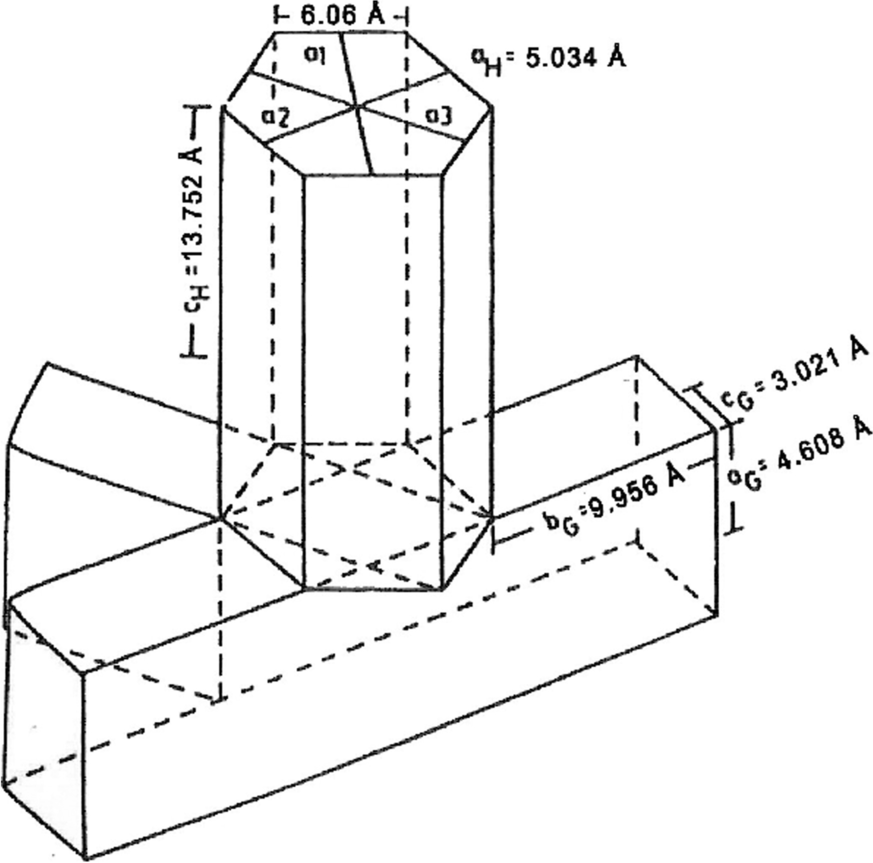
The proposed schematic diagram (Fig. 3) of the epitaxial relationship between three sets of (100) goethite crystals acting as a template onto which the (001) plane of hexagonal hematite prisms are overlaid shows a rectangular plane that represents goethite resting on the (100) plane. All oxygen atoms are located at Z = ± 1/4 in hematite and at X = ± 1/4 in goethite. The goethite lath axis is generally understood to lie parallel to the z axis. Thus, the proposed scheme implies that the z axis of goethite bisects the angle between the a1 and –a3 axes of hematite. Lath-, X-, K-, and star-shaped goethite crystals were prepared and examined. The results indicated that the three sets of lath-shaped goethite crystals are planar, and the model proposes that epitaxial crystal growth of the (001) plane of hematite formed later and overlaid the (100) goethite surface plane.
Schematic diagram of the epitaxial relationships among three sets of the (100) orientations of goethite and (001) hexagonal prisms of hematite

Recently, the stereoscope viewer, Oak Ridge Thermal Ellipsoid Plot (ORTEP), and CrystalMaker software were deployed for further study of the epitaxial relationship between (100) goethite and (001) hematite and to assess the correctness of Fig. 3. The ORTEP is a software program used for the visualization and analysis of crystal structures and was developed by the Oak Ridge National Laboratory (ORNL), Tennessee, USA. CrystalMaker is a software program that is designed to help scientists visualize and manipulate crystal structures in 3D and was developed by CrystalMaker Software Limited, Oxford, UK.
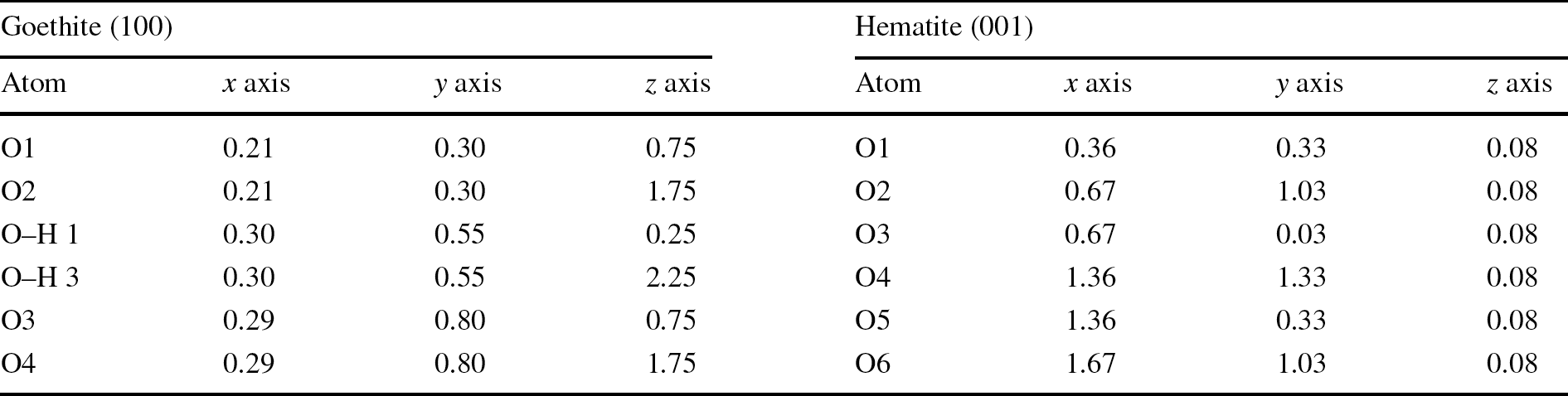
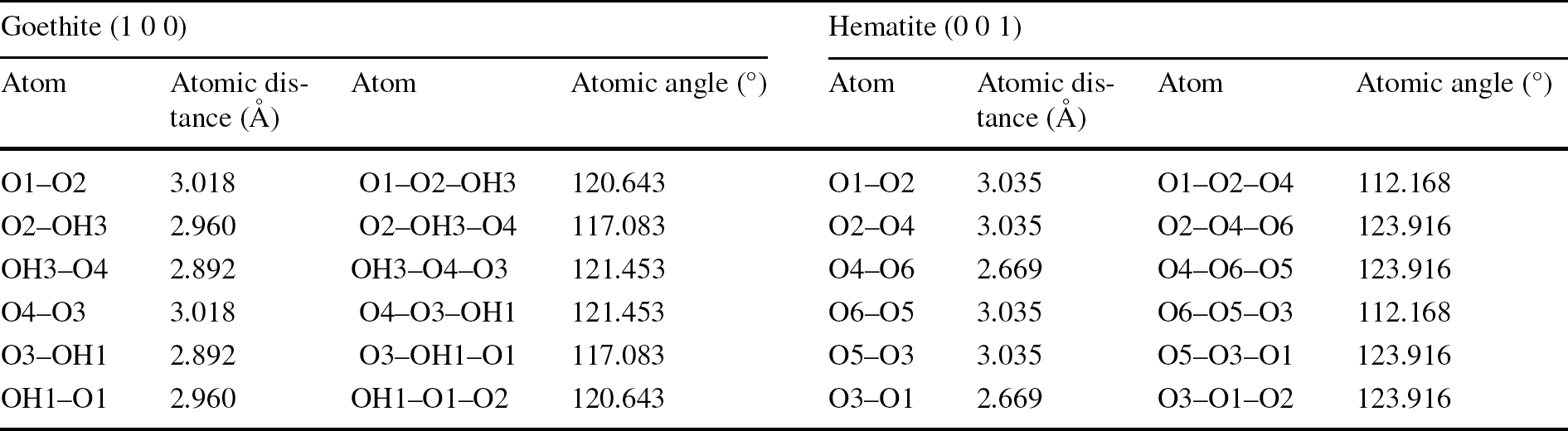
Crystallographic data of goethite and hematite obtained from the American Mineralogist Crystal Structure Database (AMC, cif) was input into ORTEP or CrystalMaker software. A pseudo-hexagonal oxygen was shown on the (100) orientation of goethite and a hexagonal oxygen on the (001) orientation of hematite (Fig. 4a, b). The atom positions and other atomic information for (100) goethite and (001) hematite lattice planes are listed in Table 1. All of the atom positions and atomic information, including distances and angles of the pseudo-hexagonal oxygen on the goethite (100) lattice plane, are quite different from the hexagonal oxygen on the hematite (001) lattice plane (Table 2).
The configuration of pseudo-hexagonal oxygen on the a (100) goethite and b hexagonal (001) hematite lattice planes

Atom positions (unit distances) of pseudo-hexagonal oxygen on goethite (100) and hexagonal hematite (001) lattice planes

Atomic information for pseudo-hexagonal oxygen on goethite (100) and hexagonal hematite (001) lattice planes

Areas of pseudo-hexagonal oxygen of goethite and hematite are 12.48 Å2 and 18.02 Å2, respectively
The area of pseudo-hexagonal oxygen of goethite is 12.48 Å2 , which is much smaller than that of hexagonal oxygen of hematite (i.e. 18.02 Å2) (Table 2). No atom positions or atomic information (i.e. distances and angles) of the pseudo-hexagonal (100) goethite coincided with those of hexagonal (001) hematite lattice planes. The inference is, thus, that Fe(ClO4)3 and the addition of HClO4 aged at 70°C for 20 days consisted of star-shaped intergrowths of goethite overlain by hexagonal prisms of hematite particles. The epitaxial relationship among the three sets of (100) goethite formed at the initial aging stage, and then the Fe solubility product in solution decreased slowly as the hexagonal (001) orientation of hematite was formed. The star-shaped (100) goethite crystals act as template surfaces; the hexagonal prism represents hematite (001) overlaid on the (100) goethite surface plane (Figs. 1, 2a, d, e). This may have been caused by the highest concentration of Fe connected with singly coordinated hydroxyls along the pseudo-hexagonal (100) goethite lattice plane (Fig. 4a, i.e. OH1 and OH3).
Conclusions
Goethite crystals can be formed as lath-, X-, K-, or star-shaped on the (100) orientation with various concentrations of Fe(ClO4)3 and the addition of HClO4 solution in samples aged at room temperature for a long period of time. Two or three sets of the lath-shaped goethite shared the (011) plane to form goethite twins with ‘interpenetrated’ crystal growth. Appropriate concentrations of Fe(ClO4)3 and the addition of HClO4 solution, followed by aging at 70°C for 20 days produced star-shaped goethite intergrowth, which was overlain by hexagonal prisms of hematite particles. The epitaxial relationships among three sets of (100) goethite and the (001) orientation of the hexagonal prism of hematite was constructed. The schematic diagram shows that hexagonal prisms represent hematite resting on its (001) orientation, which is overlain on the (100) star-shaped goethite, which acts as a template surface plane. The mechanism of termination of the formation of X-, K-, and star-shaped goethite twins is not well known and merits further, in-depth study.
Acknowledgements
The authors thank the Department of Agricultural Chemistry, National Taiwan University, for logistical support and laboratory assistance. They also thank Mr Wei Lin Liu, Department of Agricultural Chemistry, NTU and Professor C. Chachi Ou who operated the stereoscope viewer software ORTEP and CrystalMaker to explore the configuration of oxygen atoms on the pseudo-hexagonal (100) goethite and hexagonal (001) hematite lattice planes. Special thanks also to Professor Y.M. Chen of the same department for his technical assistance. The authors dedicate this paper to Professors P.H. Hsu, Rutgers University, New Brunswick, New Jersey, USA and K.H. Houng, National Taiwan University, Taipei, Taiwan.
Authors' Contributions
All authors contributed to the study conception and design. Material preparation, data collection, data analysis and revision of figures were performed by Ming Kuang Wang, Puu-Tai Yang, Tsung-Ju Chuang, C. Chachi Qu and Shan Li Wang. The first draft was prepared by Professor Ming Kuang Wang, helped by Professor C. Chachi Ou. All authors commented on drafts of the manuscript and approved the final version.
Funding
Not applicable.
Data Availability
The datasets used and/or analyzed during the current study are available from the corresponding author on reasonable request.
Declarations
Ethics Approval and Consent to Particpate
Written informed consent for publication of this paper was obtained from all authors. The manuscript does not report on or involve the use of any animal or human data or tissue. A copy of the written consent is available for review from the Editor-in-Chief of this journal.
Competing Interests
The authors declare that they have no known competing financial interests or personal relationships that could have appeared to influence the work reported in this paper.