Introduction
Bipolar depression is the most notable aspect of bipolar disorder (BD) as bipolar patients experience depressive symptoms three times more frequently than manic symptoms during their lifetime Reference Post, Denicoff and Leverich(1). Bipolar depressive episodes are associated with psychosocial impairment and a high suicide risk Reference McQueen, Young and Robb(2). The recurrence of depressive episodes seems to be the rule in BD, but scarce data support the consistency of symptoms through successive depressive episodes in bipolar patients Reference Perlis, Ostacher and Uher(3).
Some authors described a tendency towards the stability of symptoms across consecutive episodes in recurrent unipolar depression. Young et al. Reference Young, Fogg and Scheftner(4) described that, for patients whose depressive episodes were similar in intensity, the constellations of symptoms were similar between one episode and the subsequent one. Coryell et al. Reference Coryell, Winokur, Shea, Maser, Endocott and Akiskal(5) used a naturalistic approach and found that the psychotic, endogenous and agitated/retarded subtypes were the most stable in subsequent episodes of recurrent depression (60.0, 63.8 and 52.8%). Nierenberg et al. Reference Nierenberg, Pava and Clancy(6) described a moderate stability of clinical features across the index and the subsequent episodes in atypical depression.
Some studies suggested that atypical features may predict bipolar depression Reference Perugi, Akiskal and Lattanzi(7,Reference Akiskal and Benazzi8), while other authors proposed that melancholy features might be its ‘hallmark’Reference Mitchell, Wilhelm and Parker(9). If a clinical profile can be described as indicative of bipolar depression, it should be stable over time, which would strengthen the concept of a specific bipolar depressive subtype. Alternatively, if a substantial proportion of bipolar patients have a different symptomatic profile in recurrent depressive episodes, then the bipolar depressive syndrome may be viewed as a polymorphic phase of BD that is not stable over time Reference Nierenberg, Pava and Clancy(6). Recently, Perlis et al. Reference Perlis, Ostacher and Uher(3) examined data from 3750 individuals with bipolar I and II disorders during a 2-year follow-up and found that symptoms such as suicidality, mood, psychomotor and neurovegetative symptoms were stable across two successive episodes.
This study compared the variability of patterns of depressive symptoms between two consecutive episodes in a sample composed only of BD type I out-patients from 1997 to 2007.
Materials and methods
Subjects
Individuals with BD type I seen in the Outpatient Service of Programa de Transtorno Bipolar (PROMAN), Instituto de Psiquiatria, Hospital das Clínicas da Faculdade de Medicina da Universidade de São Paulo (IPQ-HCFMUSP) (Bipolar Disorder Program, Institute of Psychiatry, School of Medicine, University of São Paulo), Brazil, were selected for this study. All patients admitted to the Service fulfil a Consent Form in which is specified that all collected data may be used for research.
Methods
Prospectively collected data of 10-year follow-up of 136 subjects was reviewed. All patients had a baseline diagnosis of BD type I according to the Diagnostic and Statistical Manual of Mental Disorders, 4th Edition (DSM-IV) (10) criteria confirmed by the Structured Clinical Interview for DSM Disorders (SCID) Reference First(11). As inclusion criteria, depressive episodes had to meet DSM-IV criteria, and total scores on Hamilton Depression Rating Scale (HDRS)-31 items had to be greater than 12 Reference Hedlung and Vieweg(12). The index and the subsequent depressive episodes of each patient were identified. Depressive episodes should have been separated by at least an 8-week remission interval or a manic/mixed/hypomanic episode. Exclusion criteria were current manic/hypomanic episode or total scores on Young Mania Rating Scale Reference Young, Biggs, Ziegler and Meyer(13) greater than 8, and/or individual scores greater than 0 in items 1 and/or 2. Raters were trained psychiatrists with a high inter-rater reliability (κ = 0.89).
Statistical analysis
A binomial test was used to evaluate HDRS-31 items of the index and subsequent episodes. The binomial test considers two possibilities: whether the subject kept or changed the score. The subject had a significant probability to change the score if the percentage of ties were <50% and a significant probability to keep the score if the percentage of ties were >50%. The correlation of the HDRS item scores between the first and second episodes were determined using the Spearman coefficient. The software used was SPSS 15.0. The level of significance was set at α = 0.05.
Results
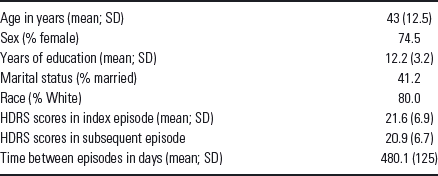
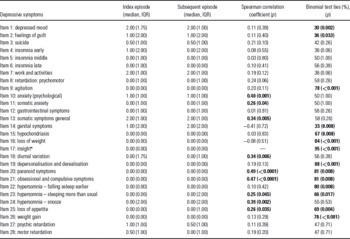
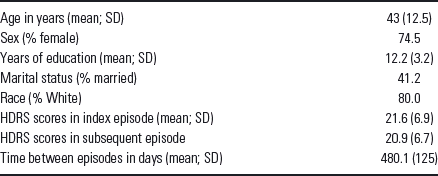
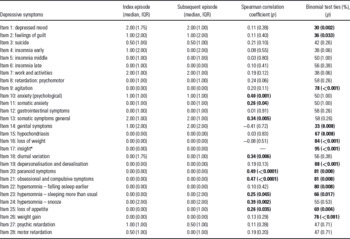
Sixty-four patients had at least two depressive episodes in the course of the follow-up and were included in the study. Clinical and demographic characteristics are described in Table 1. Mean HDRS-31 total score of the index episode was 21.6 and of the subsequent episode 20.9, and this difference was not statistically significant. The binomial test showed that the symptoms with a significant probability to change were depressed mood, feelings of guilt and genital symptoms and the symptoms with a significant probability to keep stable across the two episodes were agitation, hypochondriasis, loss of weight, insight, depersonalisation and derealisation, hypersomnia (falling asleep earlier) and weight gain. The symptoms with a statistically significant correlation between the index and subsequent depressive episodes were psychological anxiety, somatic anxiety, somatic symptoms, diurnal variation, compulsive symptoms, hypersomnia (snooze) and helplessness. Finally, the symptoms with a significant result regarding stability in both tests (Spearman correlation and probability to keep the score according to binomial tests) were paranoid symptoms, obsessive–compulsive symptoms, loss of appetite and hypersomnia (sleeping more than usual). No symptoms had significant results in both tests regarding the probability to change (Table 2).
Clinical and demographic characteristics of the sample
HDRS, Hamilton Depression Rating Scale.
Index and subsequent depressive episode median, interquartile range (IQR), Spearman correlation coefficient median and binomial test
* all patients scored 0 in the 2nd episode; bold values = significant values.
Discussion
This study evaluated the stability of different depressive symptoms across two successive episodes in patients with BD type I. The results support the notion that bipolar depression may have a relative inconstant symptomatic pattern from one episode to another, although some symptoms identified in the index episode were likely to be found in the subsequent one.
The fact that some symptoms tend to remain stable across different episodes may suggest the existence of specific subgroups of bipolar depression. In the study conducted by Perlis et al. Reference Perlis, Ostacher and Uher(3), neurovegetative symptoms were stable across two successive episodes. The results of our study go in the same direction as, in our sample, hypersomnia and loss of appetite were some of the symptoms that tended to remain stable from one episode to the following. However, the study conducted by Perlis et al. Reference Perlis, Ostacher and Uher(3) used the DSM criteria to evaluate the symptomatic profile of depressive episodes, while in our study we analysed a broader range of symptoms (HDRS-31 items).
This study has some limitations. First, our sample was enrolled at a specialised unit for treatment of BD type I and may not necessarily represent the whole population with this disorder. Second, although HDRS has been largely used in clinical practice in the evaluation of bipolar patients, its psychometric properties may fail to capture the phenomenological nuances of bipolar depression, as it is based on and skewed towards the characteristics of unipolar depression (Reference Berk, Malhi, Cahill, Carman, Pavlovic, Hawkins, Tohen and Mitchell14–Reference Hamilton17). Third, the sample size limited subgroup analysis, and some confounding variables, such as number of previous episodes, were not controlled. Fourth, the medication used and its side effects that might influence the expression of specific symptoms such as hypersomnia, weight gain and genital symptoms were not controlled as well.
In conclusion, the evaluation of the variability of HDRS item scores in patients with BD type I in successive episodes indicates that bipolar depression is characterised predominantly by heterogeneity of symptoms that appear in different constellations from one episode to the next. Paranoid symptoms, obsessive–compulsive symptoms, loss of appetite and hypersomnia tended to be present and stable in two consecutive episodes. However, the moderate correlations of the symptoms across two depressive recurrences suggest that the clinical presentation of bipolar depression is not predicted by the symptom profiles of previous episodes.