


INTRODUCTION
Schistosomiasis japonica is a snail-transmitted parasitic disease that has existed in mainland China for over 2000 years (Zhang et al. Reference Zhang, Carpenter, Lynn, Chen, Bivand, Clark, Hui, Peng, Zhou, Zhao and Jiang2009b; Zhou et al. Reference Zhou, Bergquist, Leonardo, Yang, Yang, Sudomo and Olveda2010). It remains a major public health problem in China (Peng et al. Reference Peng, Tao, Clements, Jiang, Zhang, Zhou and Jiang2010; Zhou et al. Reference Zhou, Bergquist, Leonardo, Yang, Yang, Sudomo and Olveda2010) and the total number of infected people in 2004 was still around 726 000 (Zhou et al. Reference Zhou, Guo, Wu, Jiang, Zheng, Dang, Wang, Xu, Zhu, Wu, Li, Xu, Chen, Wang, Zhu, Qiu, Dong, Zhao, Zhang, Zhao, Xia, Wang, Zhang, Lin, Chen and Hao2007). The extensive habitat of Oncomelania hupensis (the sole intermediate host of Schistosoma japonicum), decreased compliance rate, and the unsustainable effects of chemotherapy, reduced financial supports, frequent floods and climate change have resulted in the rebound of epidemics in many areas of China, even in the places where it met the criteria of transmission interruption (Zhang et al. Reference Zhang, Carpenter, Chen, Clark, Lynn, Peng, Zhou, Zhao and Jiang2008, Reference Zhang, Clark, Bivand, Chen, Carpenter, Peng, Zhou, Zhao and Jiang2009a). Hence, the importance of a sustainable control strategy for schistosomiasis has been frequently emphasized (Utzinger et al. Reference Utzinger, Bergquist, Shu-Hua, Singer and Tanner2003, Reference Utzinger, Raso, Brooker, De Savigny, Tanner, Ornbjerg, Singer and N'Goran2009), which is a great challenge for China's current schistosomiasis control. The identification of high-risk regions of schistosomiasis is always an important first step for an effective and sustainable strategy (Zhang et al. Reference Zhang, Clark, Bivand, Chen, Carpenter, Peng, Zhou, Zhao and Jiang2009a, Reference Zhang, Carpenter, Lynn, Chen, Bivand, Clark, Hui, Peng, Zhou, Zhao and Jiangb) and many spatial statistical methods have been explored with this objective in mind. Among others, the approach of kernel density estimation (KDE) has attracted much attention because of its minimal assumptions on the underlying data structure and flexibility of application (Bithell, Reference Bithell1990, Reference Bithell1991; Kelsall and Diggle, Reference Kelsall and Diggle1995a, Reference Kelsall and Diggleb). As an example, Galvao and coworkers used the technique of KDE to compare the spatial pattern of Schistosoma mansoni before and after treatment with different doses of praziquantel (Galvao et al. Reference Galvao, Favre, Guimaraes, Pereira, Zani, Felipe, Domingues, Carvalho, Barbosa and Pieri2010). However, understanding the spatial variation of disease risk per se requires the researcher(s) to not only examine the spatial distribution of disease ‘cases’, but also the distribution of the at-risk individuals (the ‘controls’) in order to adjust for any natural non-homogeneity in the underlying population (Zhang et al. Reference Zhang, Clark, Bivand, Chen, Carpenter, Peng, Zhou, Zhao and Jiang2009a; Davies and Hazelton, Reference Davies and Hazelton2010). This motivated the development of the KDE-based spatial relative risk function (sRRF) for spatial case-control designed studies (Bithell, Reference Bithell1990, Reference Bithell1991). Many successful applications in spatial epidemiology of KDE-based sRRF have been reported, e.g. motor neurone disease (Sabel et al. Reference Sabel, Gatrell, Loytonen, Maasilta and Jokelainen2000), biliary cirrhosis (Prince et al. Reference Prince, Chetwynd, Diggle, Jarner, Metcalf and James2001), childhood leukaemia (Wheeler, Reference Wheeler2007) and Aujeszky's disease (Berke and Grosse Beilage, Reference Berke and Grosse Beilage2003). In the field of schistosomiasis, Zhang et al. were the first to apply the KDE-based sRRF to assess the risk of S. japonica in the Guichi region of Anhui province in China (Zhang et al. Reference Zhang, Clark, Bivand, Chen, Carpenter, Peng, Zhou, Zhao and Jiang2009a).
Historically, most implementations of the sRRF have made use of a fixed bandwidth or smoothing parameter in kernel estimation of the densities, where the amount of smoothing applied to the estimator is constant, regardless of location. It is generally well understood that spatial distributions of human populations tend to be quite heterogeneous due to common geographical features (towns, rivers, etc.). This spatial variation means that it is worth utilizing a potentially beneficial adaptive approach. One such adaptive KDE approach, first discussed in depth by Abramson (Reference Abramson1982), assigns less smoothing to densely clustered observations in order to preserve spatial detail where there is an abundance of data, and allocates more smoothing to isolated observations in an effort to avoid assigning undue density ‘height’ to areas where we do not have as much information. The adaptive KDE-based sRRF was first investigated by Davies and Hazelton (Reference Davies and Hazelton2010), who found both theoretical and practical advantages over the fixed KDE-based sRRF, and has found a successful application in a study about subclinical Salmonella infection in finisher pig herds (Benschop et al. Reference Benschop, Hazelton, Stevenson, Dahl, Morris and French2008).
The present study aims to apply this novel approach of adaptive KDE-based sRRF to detect high-risk regions of schistosomiasis in the Guichi region of China, and compare it with the method of fixed KDE-based sRRF. Generally, the obtained results can shed lighton rational applications of adaptive KDE-based sRRF to identify disease-risk regions. Specifically, the results can aid in the design of more efficient schistosomiasis control strategies in the local region.
MATERIALS AND METHODS
Data sources
The study site was the Guichi region of Anhui province in eastern China and the study design was spatial case-control. Acute schistosomiasis cases from permanent residents between 1 January 2001 and 31 December 2006 were retrospectively collected from local schistosomiasis-specific hospitals and village-level clinics. The same number of controls was randomly chosen to represent the background at-risk population pattern using the sampling approach of the probability proportion to size. All the spatial coordinates of cases and controls were first obtained in the field using the hand-held global positioning system (GPS) (MobileMapper, Thales Navigation, Inc., USA) and then the spatial analysis database for schistosomiasis was created using the ArcGIS9.2 software (Environmental Systems Research Institute, Redlands, CA, USA). See our previous reports for detailed descriptions of the study area and the database (Zhang et al. Reference Zhang, Carpenter, Chen, Clark, Lynn, Peng, Zhou, Zhao and Jiang2008, Reference Zhang, Clark, Bivand, Chen, Carpenter, Peng, Zhou, Zhao and Jiang2009a).
Statistical analysis
Let x 1, x 2,…, x n1 denote the coordinates of n 1 schistosomiasis cases in Guichi region. The (bivariate) kernel density estimate thereof is written as (Davies and Hazelton, Reference Davies and Hazelton2010),
 $$\hat f\,(x) = \displaystyle{1 \over {n_1}} \sum\limits_{i = 1}^{n_1} {\displaystyle{1 \over {h(x_i )^2}}} \, K\left( {\displaystyle{{x - x_i} \over {x_i}}} \right)$$
where K is a radially symmetrical probability density function (the kernel) and h(·) is the bandwidth or smoothing parameter controlling the smoothness of the density estimator.
The bivariate Gaussian kernel is implemented for the current analysis, as the infinite tails of this function are useful in areas with sparse data. For the fixed-bandwidth approach, h(·)=h fix (i.e. simply a scalar constant). We defined the bandwidth function of the adaptive kernel estimator as (Terrell, Reference Terrell1990; Davies and Hazelton, Reference Davies and Hazelton2010),
 $$h(u) = h_0 \left\{ {\,f\,(u)^{1/2} \left( {\prod\limits_{i = 1}^{n_1} {\,f\,(x_i )^{ - 1/2}}} \right)^{1/n_1}} \right\}^{ - 1} $$
where h 0 is the global bandwidth. In practice we must replace the unknown density function f in equation (2) with a pilot estimate  $\bar f$, which is itself a fixed-bandwidth kernel estimate of the observed data with smoothing parameter
 $h_{{\rm fix}} = \bar h$; referred to as the pilot bandwidth.
Now let y 1, y 2,…, y n2 denote the coordinates of n 2 sampled controls. Conditional on the sample sizes of n 1 cases and n 2 controls, the sRRF is defined as the density ratio of cases and controls (Bithell, Reference Bithell1990),
 $$\hat r(x) = \log \, \displaystyle{{\hat f\,(x)} \over {\hat g(x)}}$$
where,  $\hat f$ and
 $\hat g$ are the kernel estimates from equation (1) of the case and control data, respectively (either fixed or adaptive). The density ratio is transformed to the log scale in order to make symmetrical the treatment of the two estimates and stabilize numerical results (Kelsall and Diggle, Reference Kelsall and Diggle1995a, Reference Kelsall and Diggleb). Owing to the fact that the data have been collected with respect to a finite geographical region, we also employ edge-correction techniques described by Diggle (Reference Diggle1985) (fixed) and Marshall and Hazelton (Reference Marshall and Hazelton2010) (adaptive) for $\hat f$ and $\hat g$ to reduce the boundary biases.
In terms of assigning the bandwidths, we use a common fixed bandwidth (i.e.  $h_{{\rm fix},(\hat f)} = h_{{\rm fix},(\hat g)} = h_{{\rm fix}} $) for the fixed KDE-based sRRF, and a common global bandwidth
 $h_{0,(\hat f)} = h_{0,(\hat g)} = h_0 $ for the adaptive KDE-based sRRF. This is due to a resulting first-order bias cancellation in areas where f≅g (Kelsall and Diggle, Reference Kelsall and Diggle1995a). The pilot bandwidths in the adaptive KDE-based sRRF, however, are computed separately for the case and control data in order to assist in preserving any specific detail of use for the pilot densities and variable bandwidth calculations.
In the examination of the adaptive KDE-based sRRF, Davies and Hazelton (Reference Davies and Hazelton2010) made use of 2 data-driven bandwidth selection methods for estimation of the fixed, global and pilot bandwidths. The first, based on an ‘oversmoothing’ principle described by Terrell (Reference Terrell1990), was elected due to its potential to control excess variability in the estimated densities. We refer to it as ‘OS’. The second is the least-squares cross-validation (LSCV) approach as described by Bowman and Azzalini (Reference Bowman and Azzalini1997). We repeated these calculation methods for analysis of the schistosomiasis data, with h fix←OS in the fixed KDE-based sRRF (based on the pooled case-control coordinates), and h 0←OS (again based on the pooled case-control data) and  $\bar{h} _{(\hat f)} \leftarrow {\rm LSCV}$,
 $\bar h _{(\hat g)} \leftarrow {\rm LSCV}$ (based on the case and control data, separately) in the adaptive KDE-based sRRF.
The risk functions estimated by equation (3) are simply point estimates of the observed (log-) risks. Naturally, it is of interest to be able to distinguish any statistically significant risk regions from non-significant risk regions. To avoid an over-interpretation of the results, tolerance contours based on a pointwise p-value surface (and drawn at a significance level of α=0·05) were applied from the statistical test searching for elevated risk (i.e. with respect to the hypotheses H 0=r(x)=0; H 1 : r(x)>0, where r denotes the ‘true’ log-risk surface).
Two different approaches were used to obtain the p values in each point. The first method is the Monte-Carlo (MC) randomization test based on permutations of the case-control labels in each point (Kelsall and Diggle, Reference Kelsall and Diggle1995a, Reference Kelsall and Diggleb). First, the case and control location data are pooled; then n 1 points were re-sampled without replacement to represent the simulated cases and the remaining n 2 points were used as the simulated controls. The fixed and adaptive KDE-based sRRF was then repeatedly applied on these simulated datasets. The whole process was replicated 999 times to obtain the simulated risk values (r*1(x), r*2(x),…, r*999(x)). For each point, we get 1 observed  $\hat r(x)$ and 999 simulated r*i(x), so the p-value at each point based on MC method was obtained by the formula,
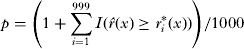 $$p = \left(1 + \sum\limits_{i = 1}^{999} {I(\hat r(x) \ge r_i^* (x))} \right)/1000$$
where, I( ) is the indicator function. The second method is the z-test statistic-based asymptotic normality test (ASYN) introduced by Hazelton and Davies (Reference Hazelton and Davies2009) for the fixed KDE-based sRRF and Davies and Hazelton (Reference Davies and Hazelton2010) for the adaptive KDE-based sRRF. In this approach, the authors exploited approximations to the variances of the fixed and adaptive KDE-based sRRF in order to construct test statistics z(x) at each location x. The p-value surface is then computed easily with respect to the aforementioned hypotheses, as under the asymptotic theory of the kernel estimator z(x)∼N(0,1), where N(0,1) denotes the standard normal distribution. The authors found this technique to be significantly computationally cheaper than the MC method (especially for large datasets), and it also seemed to avoid some instability in the resulting tolerance contours.
To further investigate the variation of estimated risks, the point-wise standard error (s.e.) surfaces was generated for both MC and ASYN approaches, empirically over the iterated results for the former and via the asymptotic variance for the latter.
For the sensitivity analysis, different bandwidths (based on halving and doubling the appropriate OS or LSCV bandwidths) for adaptive and fixed KDE-based sRRF were also used and are displayed in the Supplementary appendix (online version only) as laid out in Table 1. For each of the various bandwidth combinations, MC and ASYN tests were applied to obtain the corresponding p-value and s.e. surfaces for delineating the significant schistosomiasis risk subregions and associated variation.
Different bandwidths used for the sensitivity analysis

All computations and images were produced in the R software (Davies et al. Reference Davies, Hazelton and Marshall2011).
RESULTS
In total, 83 acute schistosomiasis cases were collected and 83 controls were sampled for the schistosomiasis dataset, which is described elsewhere (Zhang et al. Reference Zhang, Carpenter, Chen, Clark, Lynn, Peng, Zhou, Zhao and Jiang2008, Reference Zhang, Clark, Bivand, Chen, Carpenter, Peng, Zhou, Zhao and Jiang2009a). Here, only the results from adaptive KDE-based sRRF and its comparisons with fixed KDE-based sRRF are reported.
Figure 1 shows the estimated values of adaptive and fixed KDE-based sRRF using the automatically determined optimum bandwidths, and the significant tolerance contours from asymptotic normality and MC tests were superimposed upon the density maps. The adaptive KDE-based sRRF estimated higher risks on the high-risk regions (e.g. significant risk regions) and lower risks on the low-risk regions (e.g. nonsignificant risk regions) than the fixed KDE-based sRRF.
Spatial relative risk functions of schistosomiasis using fixed and adaptive KDE, and with 5% significant tolerance contours computed using the MC and ASYN methods. The cases and controls are displayed as dots and triangles, respectively.

For the fixed bandwidth contours, we observed little difference for the contours corresponding to the ASYN and MC methods of computation. Two clear subregions of interest were identified, one on the northern border where the Qiupu River feeds into the Yangtze River, and the other in the southeastern corner. The ASYN and MC contour methods for the adaptive KDE-based sRRF, however, are more distinct. The adaptive-surface ASYN contours track the cases falling along the Qiupu River for a considerable distance. In addition to this, the contours seem to highlight 3 other areas. One, in the southeastern region, approximately matches the location of the southeastern significant region on the fixed KDE-based sRRF plots. The other two, initiatedin one instance by a single case of schistosomiasis, should be interpreted with caution. It must be kept in mind that the ASYN method relies on asymptotic properties, and the sample size in this application may need to be increased in order to confirm the existence of the additional ‘hotspots’. This view is supported by MC contours for the adaptive KDE-based sRRF – they are less sensitive to isolated case observations for the relatively small sample size.
These interpretations warrant the inspection of the variability observed in the risk surfaces with respect to the tests of significance. Figure 2 depicts the pointwise s.e. surfaces of the sRRF obtained during the tests for significance of risk for the adaptive and fixed KDE-based smoothing approaches. Comparing the fixed and adaptive variation surfaces for the ASYN test, we note a similar pattern in that the lowest variation occurs in the interior of the region, with variation increasing near the border. This can be expected, as edge-correction can affect the performance of the risk estimator in these areas. We also note that the fixed ASYN variation reaches larger values than the adaptive ASYN variation. This can, at least in part, be attributable to the asymptotic variance stabilization for the adaptive KDE-based sRRF; this does not occur for the fixed KDE-based sRRF. This is encouraging, as it indicates that the asymptotic properties seem to be realized to at least a minimal degree for even the relatively small sample size in this application. The fixed and adaptive surface variations for the MC tests are a different story. While in both cases the MC variation is larger than the variation in their ASYN counterparts, here the adaptive MC s.e.s are much larger than the fixed MC values. A possible explanation is that the adaptive KDE-based sRRF generates higher peaks and lower troughs in the case/control density estimates than the fixed KDE-based sRRF, and when the random case/control permutations are performed for the MC tests, it is these higher peaks and lower troughs that drive the variation up in the adaptive KDE-based sRRF.
Point-wise s.e. surfaces of the spatial relative risk functions in Fig. 1 (data and contours contained). MC s.e.s are empirical, ASYN s.e.s are theoretical.
The results of sensitivity analysis using different bandwidths (as given in Table 1) (images given in the Supplementary appendix, Online version only) show that the fixed and adaptive KDE-based sRRF significance tests were both affected by the bandwidths. Examination of the differences in contour appearance between the bandwidths for the fixed KDE-based sRRF (Supplementary appendix Figs S1–S8 and Figs S9–S16, Online version only) shows that even halving and doubling the OS bandwidth had only a minimal impact on the identified significant regions. The impact of varying the pilot and global bandwidths for the adaptive KDE-based sRRF is more pronounced, although this is to be expected given the small sample size. Overall, the adaptive MC contours were more resistant to bandwidth change than the ASYN contours. Again, the small sample sizes could well be affecting the validity of the asymptotics here. For both adaptive ASYN and MC contours, altering the global bandwidth was more important than changing the pilots (e.g. Supplementary appendix Figs S1–S2 and Figs S3–S4, Online version only). However, in the event of a small global bandwidth for example, large pilots can help stabilize the surface and contours (e.g. comparing the adaptive surfaces in Supplementary appendix Figs S1–S2 and Figs S5–S6, Online version only). The variation of the tests was consistently higher for the MC test compared with the ASYN test for both smoothing regimens. For the ASYN tests only, the s.e.s reached markedly higher values for the fixed surfaces in Supplementary appendix Figs S1–S10 (Online version only); these maximums were only slightly lower for the fixed surfaces in Supplementary appendix Figs S11–S16 (Online version only). This means that even with excessive over-smoothing in the fixed surfaces to minimize variability, the adaptive surfaces (with less smoothing and hence less bias) still appear to provide competitive values of variability.
DISCUSSION
Kernel density estimation is a nonparametric and popular approach to identify high-risk regions of disease (Zhang et al. Reference Zhang, Clark, Bivand, Chen, Carpenter, Peng, Zhou, Zhao and Jiang2009a; Davies and Hazelton, Reference Davies and Hazelton2010). This technique has been explored in the field of schistosomiasis (Zhang et al. Reference Zhang, Clark, Bivand, Chen, Carpenter, Peng, Zhou, Zhao and Jiang2009a; Galvao et al. Reference Galvao, Favre, Guimaraes, Pereira, Zani, Felipe, Domingues, Carvalho, Barbosa and Pieri2010). This study was the first to apply the newly developed adaptive KDE-based sRRF to identify and highlight areas of elevated schistosomiasis risk, which is helpful in guiding rational disease control strategies and in allocating resources effectively (Brooker et al. Reference Brooker, Leslie, Kolaczinski, Mohsen, Mehboob, Saleheen, Khudonazarov, Freeman, Clements, Rowland and Kolaczinski2006; Zhang et al. Reference Zhang, Clark, Bivand, Chen, Carpenter, Peng, Zhou, Zhao and Jiang2009a). The results also provide some useful guidance on using this approach effectively in a wider sense.
It is generally accepted that the amount of smoothing (for either fixed or adaptive KDE) is of paramount importance in the ‘quality’ of our estimate in terms of its proximity to true (unknown) density. While it has been observed that benefits such as reduced bias and variance stabilization for the adaptive version of the relative risk estimator can be realized in practice (Davies and Hazelton, Reference Davies and Hazelton2010), there are difficulties in terms of now needing to choose multiple ‘initial’ values in the form of pilot and global bandwidths. Also, as many of the theoretical properties have been examined by large-sample approximations, small sample sizes can have the potential for an obviously detrimental effect on estimate and testing quality. While we note that the adaptive KDE-based sRRF has a better ability than the fixed KDE-based sRRF to depict the heterogeneity of risk regions, due to the apparent instability of the adaptive risk function for small ‘case’ sample sizes observed in the sensitivity imagery, we do not recommend its use for numerator sample sizes of less than, say, 100. It would be interesting to investigate further, with the help of pre-defined problem scenarios, how varying the pilot and global bandwidth impacts ‘performance’ statistics such as integrated square errors with respect to spatial relative risk surfaces.
Two methods of testing were used to identify the significant high-risk regions of schistosomiasis. The ASYN test was better than the MC test in terms of generally lower variation for both adaptive and fixed KDE-based sRRF. The result of the ASYN test of adaptive KDE-based sRRF seemed to be more rational considering the detected high-risk regions of schistosomiasis. For example, schistosomiasis is a waterborne disease, so the shape for schistosomiasis risk regions close to the Qiupu River should be along the direction of water flows, which is clearer for the detected Northern risk region of schistosomiasis (see Fig. 1). However, the adaptive surfaces and corresponding tolerance contours appeared more sensitive to varying the originally defined OS and LSCV bandwidths due to the relatively small samples (refer to the imagery in the Supplementary appendix, Online version only). So, we suggested combining the results of the ASYN test from fixed and adaptive KDE-based sRRF to draw a conclusion. The idea that different spatial statistical methods should be used to identify disease-risk regions was previously suggested by Ward and Carpenter (Reference Ward and Carpenter2000) and Zhang et al. (Reference Zhang, Carpenter, Chen, Clark, Lynn, Peng, Zhou, Zhao and Jiang2008) for the reason that the spatial pattern of disease risk may be very complicated in reality. We may conclude that 2 common risk regions in the Northern and Southeast parts were ‘true’ risk regions of Guichi region and effective measures should be taken immediately to control schistosomiasis there; while 2 different risk regions in the Northeast and West could be regarded as ‘potential’ risk regions of schistosomiasis that should be monitored closely, which is consistent with previous reports (Zhang et al. Reference Zhang, Carpenter, Chen, Clark, Lynn, Peng, Zhou, Zhao and Jiang2008, Reference Zhang, Clark, Bivand, Chen, Carpenter, Peng, Zhou, Zhao and Jiang2009a, Reference Zhang, Carpenter, Lynn, Chen, Bivand, Clark, Hui, Peng, Zhou, Zhao and Jiangb).
Adaptive KDE-based sRRF is, in essence, an approach of KDE, so kernel function is not so important based on previous studies (Kelsall and Diggle, Reference Kelsall and Diggle1998; Davies et al. Reference Davies, Hazelton and Marshall2010) and the conventional bivariate Gaussian kernel was used in this study. But, bandwidth selection and edge effects are two critical issues that were always discussed. A larger bandwidth tends to result in a smoother surface, and thus certain features in the data may not be captured; while a smaller bandwidth will get more local peaks and troughs, which is also not helpful for detecting the spatial variation in risk as a whole (Vieira et al. Reference Vieira, Webster, Aschengrau and Ozonoff2002; Zhang et al. Reference Zhang, Clark, Bivand, Chen, Carpenter, Peng, Zhou, Zhao and Jiang2009a). Edge effects are caused by the unrecorded cases outside the studied region, so bias is possible and sometimes serious for the places close to the boundaries. Interested readers are encouraged to see the discussions in our previous reports (Zhang et al. Reference Zhang, Clark, Bivand, Chen, Carpenter, Peng, Zhou, Zhao and Jiang2009a). Here, we just point out two future research questions related to the adaptive KDE-based sRRF. One question concerns the impact of bandwidths on the adaptive KDE-based sRRF. It has three different bandwidths and is more complicated than the fixed KDE-based sRRF (1 bandwidth), so determining their relative impact on the adaptive KDE-based sRRF is useful for better understanding its performance caused by bandwidths and applying it more effectively. A series of well-designed simulations is needed to illuminate this issue. Another question is about the method used to correct the edge effects of adaptive KDE-based sRRF. This study used the newly developed edge correction method, which is the only available approach that can be used for the adaptive KDE-based sRRF. Some new methods to correct the edge effects for the adaptive KDE-based sRRF need to be developed and an evaluation of the effectiveness of these edge correction methods should be conducted.
In summary, we have conducted the first study applying the adaptive KDE-based sRRF to identify high-risk regions of schistosomiasis, and comparisons of the results between it and the fixed KDE-based sRRF were performed. Our application of adaptive kernel estimation of relative risk and associated significance tests has shed new light not only on the ‘hotspots’ for schistosomiasis in Guichi region, but also where we expect the novel statistical methodology to perform well and where it may struggle. While both fixed and adaptive KDE-based sRRF were shown in this example to possess advantages and disadvantages, we conclude that simultaneous application of the two approaches could warrant the best possible identification of high-risk regions of disease.
ACKNOWLEDGEMENTS
We sincerely thank the staff from Guichi Station of Schistosomiasis Prevention and Control for their help on data collection and field management, without whose cooperation this project would not have been possible.
FINANCIAL SUPPORT
Z.J.Z and Q.W.J. were supported by the Important National Science and Technology Major Programme (grant numbers: 2012ZX10004-220 and 2008ZX10004-011), the National Natural Science Foundation of China (grant numbers: 81102167 and 81172609), Specialized Research Fund for the Doctoral Programme of Higher Education, SRFDP (grant number: 20110071120040) and A Foundation for the Author of National Excellent Doctoral Dissertation of PR China (FANEDD) (201186). T. M. D. was funded by a Top Achiever's Doctoral Research Scholarship (New Zealand Tertiary Education Commission).



