Significant outcomes
rs1042044 is significantly associated with reward learning and anhedonia.
No association between putative GLP-1R polymorphisms and depression diagnosis has been found.
Further studies are needed to evaluate the role of GLP-1R polymorphisms in the course and severity of reward-related disorders.
Limitations
This study has a relatively small sample size for the reward learning analysis.
Depression is a multifactorial diagnosis and we could not consider other environmental variables in the analysis for depression.
Introduction
Mood disorders are one of the most costly and debilitating psychiatric conditions worldwide, and are associated with impairments, as disrupted reward processing. Patients with mood disorders show deficits in reward learning and they present with anhedonia (Sharma et al., Reference Sharma, Ligade, Sharma, Shukla, Elased and Lucot2015; Lewandowski et al., Reference Lewandowski, Whitton, Pizzagalli, Norris, Ongur and Hall2016). Reduced reward sensitivity is also considered a core feature of depression (Nusslock & Alloy, Reference Nusslock and Alloy2017). Disrupted reward learning correlates with mood fluctuations (Peterson et al., Reference Peterson, Lotz, Halgren, Sejnowski and Poizner2011) and predicts persistence of depressive symptoms (Vrieze et al., Reference Vrieze, Pizzagalli, Demyttenaere, Hompes, Sienaert, de Boer, Schmidt and Claes2013). However, altered reward processing is not unique to mood disorders as major depressive disorder (MDD), since it has emerged also in schizophrenia (SZ) spectrum disorders, substance use disorders and other behavioural addictions (Luijten et al., Reference Luijten, Schellekens, Kuhn, Machielse and Sescousse2017).
Dopaminergic signalling and frontostriatal circuits have been hypothesised to play an essential role in the reward system. However, reward processing includes pleasure, motivation, satiety, salience and even trust that are modulated by various neuromodulators (Dichter et al., Reference Dichter, Damiano and Allen2012). Also, reward prediction, evaluation and learning contribute to reward processing and they are suggested to have different neuroanatomical correlates that may be specifically targeted by specific neuromodulators (Delgado et al., Reference Delgado, Miller, Inati and Phelps2005). Therefore, it is essential to understand the other neuromodulators that take part in reward processing which may ultimately yield better treatment targets and neuropathological markers (Gold et al., Reference Gold, Blum, Febo, Baron, Modestino, Elman and Badgaiyan2018). As one of these neuromodulators, glucagon-like peptide-1 (GLP-1) is likely to play a role in modulating reward circuitry. Current evidence links GLP-1 with food-related reward (Skibicka, Reference Skibicka2013), social reward (Clark-Elford et al., Reference Clark-Elford, Nathan, Auyeung, Voon, Sule, Müller, Dudas, Sahakian, Phan and Baron-Cohen2014), stress (Rinaman & Rothe, Reference Rinaman and Rothe2002) and despair-like behaviours (Sharma et al., Reference Sharma, Ligade, Sharma, Shukla, Elased and Lucot2015; Anderberg et al., Reference Anderberg, Richard, Hansson, Nissbrandt, Bergquist and Skibicka2016).
GLP-1 is an incretin hormone secreted by intestinal cells in response to food consumption. Its main role has been explored for peripheral blood glucose level regulation and control of type 2 diabetes mellitus (Aroda, Reference Aroda2018). On the other hand, GLP-1 can also be produced centrally by neurons of the nucleus tractus solitarius and microglia (Kappe et al., Reference Kappe, Tracy, Patrone, Iverfeldt and Sjoholm2012) by cleavage of preproglucagon and act through GLP-1 receptors (GLP-1Rs) in the brain (GLP-1R).
Critically, GLP-1Rs are widely expressed in reward-related regions, such as the hypothalamus, amygdala, nucleus accumbens, paraventricular nucleus, ventral tegmental area, locus coeruleus and brainstem (Heppner et al., Reference Heppner, Kirigiti, Secher, Paulsen, Buckingham, Pyke, Knudsen, Vrang and Grove2015), and have been found to modulate food-related activation in the insula and putamen (Farr et al., Reference Farr, Sofopoulos, Tsoukas, Dincer, Thakkar, Sahin-Efe, Filippaios, Bowers, Srnka, Gavrieli and Ko2016). All GLP-1Rs are stimulatory G protein coupled and when activated, they cause increases in cAMP and intracellular calcium, activate protein kinase A and induce gene transcription (Drucker, Reference Drucker2006). These receptors are expressed in both dendrites and synapses of neurons, in addition to glial cells (Chowen et al., Reference Chowen, de Fonseca, Alvarez, Navarro, Garcia-Segura and Blazquez1999). Evidence from animal and molecular studies suggests that they may have a role in reward processing and neuroprotection. Overexpression/upregulation of GLP-1R or modulating GLP-1R functions by using pharmaceutical agents that can pass the blood–brain barrier promotes learning of spatial tasks, memory formation, synaptic plasticity, neurite outgrowth and neurogenesis (Erbil et al., Reference Erbil, Eren, Demirel, Kucuker, Solaroglu and Eser2019).
Animal studies also support a role of GLP-1 with reward responses and depression. Activation of GLP-1R reduces cocaine-mediated behaviours and modulates substance use through regulating dopamine release (Hernandez et al., Reference Hernandez, O’Donovan, Ortinski and Schmidt2019) and corticosterone levels through corticotropin releasing hormone (CRH) function in the hypothalamus–pituitary–adrenal (HPA) axis (Zheng et al., Reference Zheng, Reiner, Hayes and Rinaman2019). More specifically, GLP-1R knock-down rats showed prolonged corticosterone levels after stress induction (Zheng et al., Reference Zheng, Reiner, Hayes and Rinaman2019) and administration of exendin-4, which is a GLP-1R agonist, increased plasma levels of ACTH (Malendowicz et al., Reference Malendowicz, Nussdorfer, Nowak, Ziolkowska, Tortorella and Trejter2003) and corticosterone in plasma of rats (Malendowicz et al., Reference Malendowicz, Nussdorfer, Nowak, Ziolkowska, Tortorella and Trejter2003; Krass et al., Reference Krass, Rünkorg, Vasar and Volke2012) and mice (Krass et al., Reference Krass, Volke, Rünkorg, Wegener, Lund, Abildgaard, Vasar and Volke2015), suggesting a role of GLP-1 on regulating HPA axis. GLP-1 neurons synapse on CRH neurons of paraventricular nucleus (Sarkar et al., Reference Sarkar, Fekete, Legradi and Lechan2003) and restraint stress in mice changes GLP-1 function (Williams et al., Reference Williams, Lilly, Edwards, Yao, Richards and Trapp2018). Prenatal stress reduces GLP-1R levels in hippocampus and hypothalamus (Detka et al., Reference Detka, Ślusarczyk, Kurek, Kucharczyk, Adamus, Konieczny, Kubera, Basta-Kaim, Lasoń and Budziszewska2019). GLP-1 levels alter glutamatergic transmission and excitotoxicity (Koshal et al., Reference Koshal, Jamwal and Kumar2018), and increased GLP-1R levels improve neurogenesis and decrease cell loss in hippocampal area (Erbil et al., Reference Erbil, Eren, Demirel, Kucuker, Solaroglu and Eser2019). Decreased hippocampal neurogenesis, neuronal atrophy and synaptic loss in the hippocampus represent key neurobiological findings of stress-related disorders and anhedonia (Duman & Aghajanian, Reference Duman and Aghajanian2012). Chronic central administration (Anderberg et al., Reference Anderberg, Richard, Hansson, Nissbrandt, Bergquist and Skibicka2016) or injection (Sharma et al., Reference Sharma, Ligade, Sharma, Shukla, Elased and Lucot2015) of GLP-1 agonists decreases despair-like behaviour and has an antidepressant-like effect measured by mobility in forced swim test in rats, although two studies found no change in anxiety (assessed using light-dark box) and mobility (assessed using forced swim test) after acute (Krass et al., Reference Krass, Rünkorg, Vasar and Volke2012) or 2-week (Krass et al., Reference Krass, Volke, Rünkorg, Wegener, Lund, Abildgaard, Vasar and Volke2015) treatments of GLP-1 agonist administration in mice. GLP-1 changes serotonin turnover in the amygdala (Anderberg et al., Reference Anderberg, Richard, Hansson, Nissbrandt, Bergquist and Skibicka2016) and affects basal serotonin levels (Brunetti et al., Reference Brunetti, Orlando, Recinella, Leone, Ferrante, Chiavaroli, Lazzarin and Vacca2008). GLP-1 also acts on oxytocin and NPY neurons, which regulate social rewards and resilience to stress (Clark-Elford et al., Reference Clark-Elford, Nathan, Auyeung, Voon, Sule, Müller, Dudas, Sahakian, Phan and Baron-Cohen2014).
These preclinical findings highlight the effects of GLP-1 on reward circuitry, depressive behaviours and stress, suggesting that GLP-1 is a promising candidate for modulating reward learning in humans. However, as evidence from animal studies on the effect of GLP-1 on neuroprotection and reward responses is accumulating, there is limited human research testing its relationship with depressive episode and reward learning. In humans, GLP-1R polymorphisms may modulate basal GLP-1 levels (de Luis et al., Reference de Luis, Aller, Izaola and Bachiller2015), and importantly, a recent post-mortem study found that, compared to healthy controls, patients with MDD diagnosis had decreased GLP-1R expression in the dorsolateral prefrontal cortex and hippocampus, even when adjusting for age, sex, treatments, substance use and body mass index (Mansur et al., Reference Mansur, Fries, Trevizol, Subramaniapillai, Lovshin, Lin, Vinberg, Ho, Brietzke and McIntyre2019).
Aims of the study
Building on this knowledge, in the current study, we first aimed to assess the association of GLP-1R polymorphisms with reward learning in a case-control sample, using a well-established laboratory-based task, the probabilistic reward task (PRT). Reward learning includes processes that shape the experience-dependent learning that guides future behaviours, and is used to assess how participants modulate their behaviour as a function of rewards (Pizzagalli et al., Reference Pizzagalli, Jahn and O’Shea2005). Total response bias measured by PRT is used to capture reward learning. We predicted that GLP-1R polymorphisms modulated response bias in PRT, regardless of a psychiatric diagnosis. Secondly, we tested the effect of GLP-1R polymorphisms on a subjective measure of anhedonia (Rizvi et al., Reference Rizvi, Pizzagalli, Sproule and Kennedy2016) using the Snaith-Hamilton Pleasure Scale (SHAPS) (Snaith et al., Reference Snaith, Hamilton, Morley, Humayan, Hargreaves and Trigwell1995; Rizvi et al., Reference Rizvi, Pizzagalli, Sproule and Kennedy2016). SHAPS probes the capacity to experience pleasure over the past few days. In the association analyses, we adjusted for clinical measures that could be the potential moderators of response bias, such as the General Distress related to Anxiety (GDA) and Anxious Arousal (AA) subscales of the Mood and Anxiety Symptom Questionnaire (MASQ), the Montgomery Asberg Depression Rating Scale (MADRS), Positive and Negative Symptom Scale (PANSS) and the Young Mania Rating Scale (YMRS). Lastly, we tested the effect of putative GLP-1R polymorphisms linked to response bias with lifetime depression diagnosis by examining the association of GLP-1R polymorphisms with depression diagnosis using summary statistics from the GWAS of MDD from the Psychiatric Genomics Consortium (PGC) (Wray et al., Reference Wray, Ripke, Mattheisen, Trzaskowski, Byrne, Abdellaoui, Adams, Agerbo, Air, Andlauer and Bacanu2018).
Materials and methods
Association of GLP-1 polymorphisms with reward learning and anhedonia
In order to assess the effect of GLP-1R polymorphisms on reward learning, we first analysed each GLP-R polymorphism’s impact on reward learning using data from a case-control cohort from McLean Hospital (Hall et al., Reference Hall, Chen, Cohen, Spencer, Levy, Öngür and Smoller2015; Lewandowski et al., Reference Lewandowski, Whitton, Pizzagalli, Norris, Ongur and Hall2016). For a stringent test, analyses were corrected for possible moderator variables that could affect reward learning. As reward learning dysfunction is found across diagnostic boundaries, including MDD, bipolar disorder (BPD) and SZ (Pizzagalli et al., Reference Pizzagalli, Iosifescu, Hallett, Ratner and Fava2008; Whitton et al., Reference Whitton, Treadway and Pizzagalli2015) diagnoses, our study cohort included patients with mood disorders, psychotic disorders and healthy controls.
Participants
Data from 264 participants [100 healthy controls and 164 patients; 126 females (47.7%), 138 males (52.3 %)] were available for analyses. All subjects were assessed using the Structured Clinical Interview for DSM-IV (Allen, Reference Allen1998). Patients were recruited through the SZ and BPD program at McLean Hospital. Of the 164 patients who had a history of lifetime psychotic episode, 70 were diagnosed with a SZ spectrum disorder, 92 with bipolar disorder and 2 with a MDD. Patients were included if they had no substance abuse (excluding nicotine) in the preceding 6 months or dependence in the preceding 12 months and no history of seizures or ECT treatment in the preceding 12 months. The control sample was recruited through local advertisements. Additional inclusion criteria for controls were no current or past history of psychotic disorder, bipolar disorder or SZ, no affective disorder in the preceding 12 months, no substance abuse in the preceding 12 months or previous chronic dependence, and no first-degree relative with a history of psychosis or bipolar disorder. All subjects self-reported European ancestry, which was confirmed based on principal component analyses of genotype data. All participants were between 18 and 69 years old (range: 18–69, mean ± SD: 38.8 ± 13.8) with no known neurological disorder, no prior head injury with loss of consciousness, normal hearing confirmed by audiometry and normal intellectual ability based on the North American Adult Reading Test or years of education (high school level or higher). As dysfunction of reward learning is found transdiagnostically (Pizzagalli et al., Reference Pizzagalli, Iosifescu, Hallett, Ratner and Fava2008; Whitton et al., Reference Whitton, Treadway and Pizzagalli2015), analyses used case-control status as a moderator variable, instead of splitting into diagnostic groups. This study was approved by McLean Hospital Institutional Review Board. All subjects provided a written informed consent and procedures were in accordance with the Declaration of Helsinki.
Evaluation of reward learning
The PRT was used to derive an objective measure of reward learning and has been described in detail (Pizzagalli et al., Reference Pizzagalli, Jahn and O’Shea2005; Pizzagalli et al., Reference Pizzagalli, Iosifescu, Hallett, Ratner and Fava2008). The task includes 3 blocks with 100 trials each. In each trial, participants are shown a face with a long (13 mm) or short (11.5 mm) mouth and instructed to decide whether the mouth was long or short, as quickly and accurately as possible. They are further instructed that correct responses would be followed by a monetary reward (‘Correct. You won 20 cents’) but that not every correct answer would be followed by a monetary reward. Unbeknownst to participants, one stimulus is rewarded three times more frequently than the other, which induces a response bias, that is, a preference for the stimulus paired with more reward in the past. Using signal-detection theory, performance can be decomposed into response bias and discriminability. Response bias measures subject’s preference for the response paired with the more frequent reward and discriminability measures how well the participant can differentiate between two very close visual stimuli. Here, we used total response bias scores as the major outcome variable to detect reward learning.
Self-Report measurement of anhedonia and other psychiatric symptom scales
All participants were also evaluated with clinical scales to control for other variables that could moderate reward responses and anhedonia, and to document the clinical status of the patients. The SHAPS was used to assess subjective anhedonia (Snaith et al., Reference Snaith, Hamilton, Morley, Humayan, Hargreaves and Trigwell1995). While scoring, the answer of each item of SHAPS scale was converted to binary categories (0 and 1), so that the total score ranged between 0 and 14 and higher scores indicated higher anhedonia. Participants with scores higher or equal to 3 in SHAPS score were recategorised as the anhedonic group (Snaith et al., Reference Snaith, Hamilton, Morley, Humayan, Hargreaves and Trigwell1995; Franken et al., Reference Franken, Rassin and Muris2007).
The GDA and AA subscales of the MASQ were used to assess anxiety symptoms. The MADRS was used to assess depression severity. PANSS scales were used to evaluate symptoms related to psychosis, and the YMRS was used to evaluate (hypo)manic symptoms.
Selection of GLP-1R polymorphisms and genotyping procedure
The sample reported in this study was part of a larger genome-wide association study (GWAS) previously published (Hall et al., Reference Hall, Chen, Cohen, Spencer, Levy, Öngür and Smoller2015). GLP-1 gene lies in the 6p21.2. Results from previous genetic studies on the role of GLP-1R polymorphisms revealed associations with peripheric effects such as weight loss after obesity surgery (de Luis et al., Reference de Luis, Pacheco, Aller and Izaola2014a), insulin resistance and obesity complications (Sathananthan et al., Reference Sathananthan, Dalla Man, Micheletto, Zinsmeister, Camilleri, Giesler, Laugen, Toffolo, Rizza, Cobelli and Vella2010; de Luis et al., Reference de Luis, Pacheco, Aller, Izaola and Bachiller2014b), as well as central effects as antipsychotic response (Ramsey & Brennan, Reference Ramsey and Brennan2014) and stress and cortisol responses (Sheikh et al., Reference Sheikh, Dougherty, Hayden, Klein and Singh2010). We reviewed the current literature for GLP-1R single nucleotide polymorphisms (SNPs) and found nine SNPs in the GLP-1R gene, which are not in linkage disequilibrium, for an association analysis and seven could be genotyped in our sample: rs10305420, rs10305421, rs1042044, rs6923761, rs587654, rs761386 and rs10305492. Of the seven SNPs examined here, rs10305420 and rs1042044 were genotyped and remaining were imputed by author CHC, since the polymorphism was not included in the CHIP. Genotype imputation was performed using a two-step pre-phasing and imputation procedure implemented in SHAPEIT (O’Connell et al., Reference O’Connell, Sharp, Shrine, Wain, Hall, Tobin, Zagury, Delaneau and Marchini2016) and IMPUTE2 (Howie et al., Reference Howie, Marchini and Stephens2011) on a total of 1293 psychosis patients and 381 healthy controls collected at McLean Hospital that included the samples described above (Hall et al., Reference Hall, Chen, Cohen, Spencer, Levy, Öngür and Smoller2015). We divided the genome into 3 Mb partitions and performed pre-imputation quality control and imputation with the default parameters of the software. The pre-imputation quality control filters include discordant sex information, missing genotype rate per individual, heterozygosity rate, call rate per SNP and deviation from Hardy–Weinberg equilibrium. We used phased haplotypes from the full 1000 Genomes Project dataset (Altshuler et al., Reference Auton, Abecasis, Altshuler, Durbin, Bentley, Chakravarti, Clark, Donnelly, Eichler and Flicek2015) as the imputation reference panel.
Statistics
Genotypes of GLP-1R polymorphisms were compared for the mean response bias scores in the PRT and anhedonia scores measured by SHAPS scale, using Mann Whitney U test for dominant models. The anhedonic group defined based on SHAPS score was then compared to non-anhedonic group for the distribution of the significant dominant genotype, using chi-square test. Next, to control for possible moderator variables that could have an effect on response bias, a multivariate linear regression model was used. In the first model, age, sex, discriminability in the PRT task and case-control status were included, in addition to the SNP genotype (in dominant model) found to be significantly associated with response bias. Recent literature points that episodic memory and other cognitive features, in addition to negative symptoms may affect reward learning (Wimmer et al., Reference Wimmer, Braun, Daw and Shohamy2014; Lewandowski et al., Reference Lewandowski, Whitton, Pizzagalli, Norris, Ongur and Hall2016). In the second model, instead of case-control status, clinical variables that may affect response bias such as GDA and AA subscales of MASQ, YMRS, PANSS total and MADRS were also included in the model, to control possible associations for moderator variables as cognitive and negative symptoms (Wimmer et al., Reference Wimmer, Braun, Daw and Shohamy2014; Lewandowski et al., Reference Lewandowski, Whitton, Pizzagalli, Norris, Ongur and Hall2016).
P values were not corrected for multiple comparison after the first-level analysis (Mann Whitney U test); however, the significance of associated SNPs was further tested for their association with response bias in the second-level analysis of regression models. In addition, the association signals found were tested using an independent cohort of patients with depression diagnosis and controls from PGC MDD dataset, as described below.
Association of the putative GLP-1R polymorphisms linked to response bias with depression diagnosis
We attempted to replicate the diagnostic analyses and test the association of significant SNPs linked to response bias, with MDD in a genome-wide meta-analysis of 75 607 cases and 231 747 controls assembled from 7 different cohorts as part of the PGC (Wray et al., Reference Wray, Ripke, Mattheisen, Trzaskowski, Byrne, Abdellaoui, Adams, Agerbo, Air, Andlauer and Bacanu2018). The design and quality control performed as part of the PGC have been extensively described elsewhere (Wray et al., Reference Wray, Ripke, Mattheisen, Trzaskowski, Byrne, Abdellaoui, Adams, Agerbo, Air, Andlauer and Bacanu2018). Briefly, individual genotype data for each of the participating cohorts were processed using the PGC ricopili pipeline to ensure standardised quality control, phasing and imputation protocols across all datasets. Initially, SNPs were excluded for excessive missingness (>0.05), differential missingness between cases and controls, deviations from expected autosomal heterozygosity and violations of Hardy Weinberg equilibrium (p < 10−6 in controls and p < 10−10 in cases). Samples with excessive missingness (>0.02) and outliers in ancestry were excluded. Pre-phasing and genotype imputation were performed using SHAPEIT/IMPUTE2 with a chunk size of 3 Mb and default parameters with the 1000 genomes phase 3 release as reference haplotypes. Post-impute quality control included selecting SNPs with high INFO (>0.8) scores and low missingness (<1%). This yielded a sample size of 75 607 MDD cases and 231 747 controls and 9.6 million high-quality markers to be used for meta-analysis.
The diagnostic criteria used in each of the individual cohorts were carefully analysed by the PGC, and phenotype compatibility between cohorts was ensured by computing genetic correlations using common variants between each pair of individual cohorts and genetic risk prediction analyses.
Results
Association of GLP-1 polymorphisms with reward learning and anhedonia
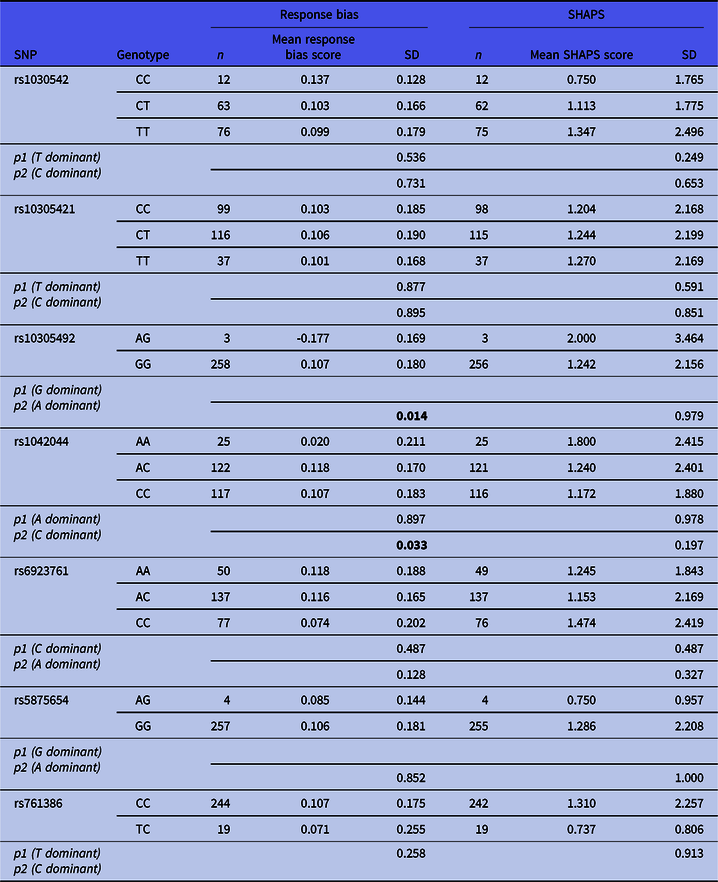
The A allele in rs10305492 was significantly associated with decreased response bias in the PRT, and the C allele in rs1042044 was significantly associated with increased response bias in a dominant model. Other SNPs in GLP-1R were not associated with response bias or SHAPS scores (p > 0.05) (Table 1).
Mean response bias in PRT and SHAPS scores for each GLP-1R SNP’s genotype
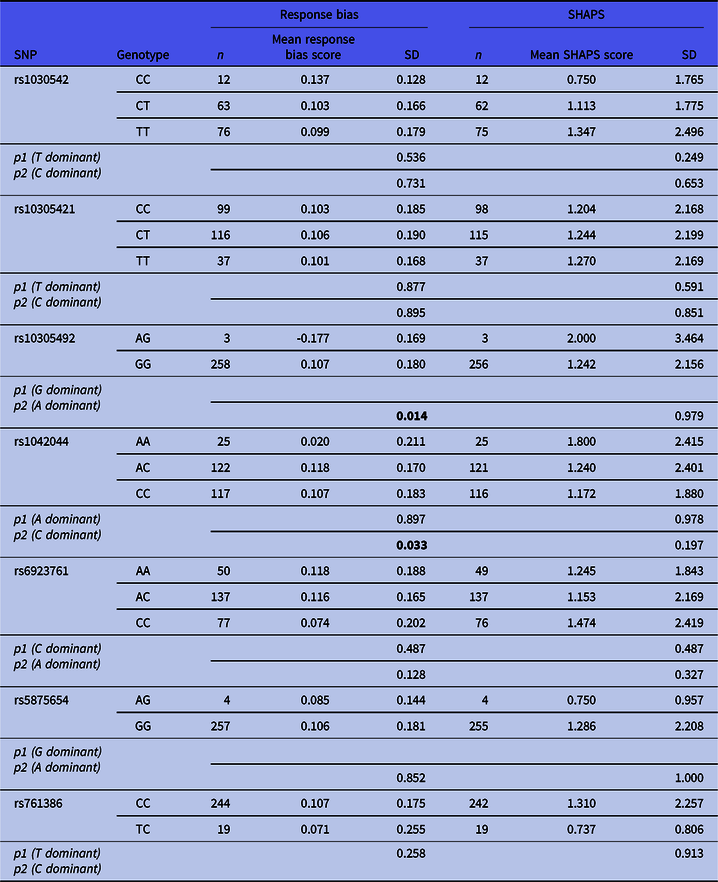
The boldface are significance at p < 0.05.
C dominant model (CC and AC genotypes) in rs1042044 showed significantly lower anhedonia phenotype, compared to AA genotype (χ 2 = 5.2, p = 0.02), based on the SHAPS scores. AG genotype in rs10305492 was not significantly different in the distribution of anhedonia phenotype, when compared to GG genotype in rs10305492 (χ² = 0.69, p = 0.4).
GLP-1R polymorphisms and moderator variables of response bias
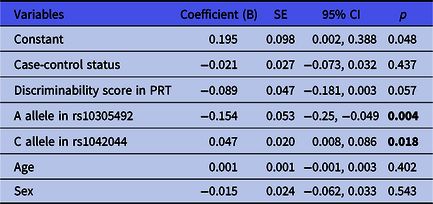
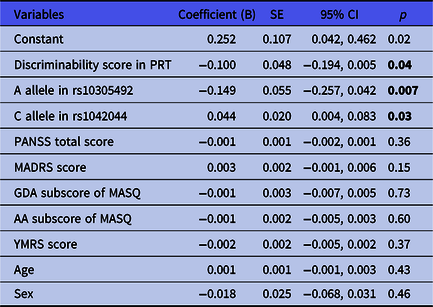
A multivariate linear regression was carried out to investigate whether age, gender, case-control status, discriminability, having A allele in rs10305492 and C allele in rs1042044 significantly predicted response bias. The results of the regression indicated that the model explained 7.8% of the variance and that the model was a significant predictor of response bias scores [(F(6,233)=3.28, p = 0.004]. While A allele in rs10305492 (B = −0.1, p = 0.004) and C allele in rs1042044 significantly predicted response bias scores (B = 0.47, p = 0.018), age, sex, discriminability in PRT and case-control status did not (Table 2). In a second model where we added clinical variables, such as GDA, AA subscale of MASQ, YMRS, PANSS total and MADRS scores as covariates, instead of the case-control status, the results of the regression indicated that the model explained 9.4% of the variance and was a significant predictor of response bias [(F(10,222) = 2.3, p = 0.014]. While discriminability (B = −0.1, p = 0.04), A allele in rs10305492 (B = −0.15, p = 0.007) and C allele in rs1042044 (B = 0.044, p = 0.03) significantly predicted response bias scores, none of the clinical scales, age and sex were a significant predictor of response bias (Table 3). When only A allele in rs10305492 and C allele in rs1042044, defined as dominant alleles, were included in the model to predict response bias, the model explained 5.2% of the variance [(F(2,258) = 7.04, p = 0.001].
Association of A allele in rs10305492 or C allele in rs1042044 with response bias in PRT when controlling for case-control status, discriminability in PRT, age and sex

The boldface are significance at p < 0.05.
Association of A allele in rs10305492 and C allele in rs1042044 with response bias in PRT when controlling for discriminability in PRT, GDA subscale of MASQ, AA subscale of MASQ, YMRS, MADRS and PANSS total scores, age and sex

The boldface are significance at p < 0.05.
Association of the putative GLP-1R polymorphisms linked to response bias with depression diagnosis
The analysis of PGC MDD data as described in Sect. 2.2 showed no statistical association between the loci rs1042044 or rs10305492 and depressive disorder. The effect sizes and p-values from the association tests are shown in Table 4.
Association of GLP-1R polymorphisms linked to response bias with depression in PGC depression GWAS, 2018 excluding 23andMe

Discussion
To our knowledge, this study is the first study to assess the impact of GLP-1R polymorphisms on response bias in a reward learning task, anhedonia and depression phenotypes in humans.
The A allele in rs10305492 was significantly associated with decreased response bias in a dominant model (Table 1). However, as observed in many populations, A allele has a lower frequency (around 1–2%) compared to G allele [database of SNPs (dbSNPs). Bethesda (MD): National Center for Biotechnology Information, National Library of Medicine. Available from: http://www.ncbi.nlm.nih.gov/SNP/]. Here, we did not exclude this SNP in our analyses because it has been identified to be significantly associated with fasting glucose in several large-scale genetic studies (Wessel et al., Reference Wessel, Chu, Willems, Wang, Yaghootkar, Brody, Dauriz, Hivert, Raghavan, Lipovich and Hidalgo2015) and is implicated to play an important role in modulating glucose levels, diabetes and cardiovascular risk (Scott et al., Reference Scott, Freitag, Li, Chu, Surendran, Young, Grarup, Stancáková, Chen, Varga and Yaghootkar2016). The neurobiology of diabetes might be related to certain psychiatric disorders, and GLP-1R polymorphisms might also affect insulin physiology both in the brain and in the periphery. Therefore, rs10305492 could be one of the major shared pathways between peripheric and central effects of GLP-1. However, in our sample, only three individuals carried the A allele, consistent with the expected frequency. As such, it is possible for our results about rs10305492 to be false positive and the association of rs10305492 with reward learning needs to be validated in larger populations. Accordingly, this finding will not be further discussed or interpreted.
Our findings suggest that among GLP-1R SNPs, rs1042044 showed an association with reward learning and anhedonia in a cross-diagnostic sample of individuals with SZ and mood disorders (mainly, bipolar spectrum disorders), after controlling for possible confounding effects (Tables 1, 2 and 3). However, this effect was small and it was not associated with depression diagnosis in the PGC sample. Also, our analysis for the first step (Table 1) was not corrected for multiple comparisons, but the association was still significant in the regression models.
GLP-1-related SNPs were not reported among the SNPs that reached a genome-wide significance for the association with anhedonia, but significant SNPs on different locations of chromosome 6 were identified in previous published GWASs for anhedonia (Ren et al., Reference Ren, Fabbri, Uher, Rietschel, Mors, Henigsberg, Hauser, Zobel, Maier, Dernovsek and Souery2018; Ward et al., Reference Ward, Lyall, Bethlehem, Ferguson, Strawbridge, Lyall, Cullen, Graham, Johnston, Bailey and Murray2019). Different measurement methods for anhedonia and clinical features of the cohorts may account for the negative findings. The measure of anhedonia employed in Ward et al. was based on a single question from a depression screening instrument within the preceding 2 weeks. The measure of anhedonia employed in Ren et al. was based on a composite ‘baseline interest-activity’ score, derived from anhedonia-related items in the Montgomery-Asberg Depression Scale, Hamilton Depression Scale and Beck Depression Inventory. Moreover, our study cohort included patients with psychotic disorders whereas the study cohort in Ward et al. was drawn from healthy individuals with high-socioeconomic status and education level and the study cohort in Ren et al. was drawn from individuals with unipolar depression diagnosis. Independent replication of association between anhedonia and reward-based phenotypes is warranted in future studies to validate our results.
A allele in rs1042044 has been previously related to altered antipsychotic responses (Ramsey & Brennan, Reference Ramsey and Brennan2014) and homozygous C allele was related to higher morning cortisol levels (Sheikh et al., Reference Sheikh, Dougherty, Hayden, Klein and Singh2010), which highlights a possible modulatory role of GLP-1 on HPA axis regulation and dopaminergic pathways. We hypothesise that C allele in rs1042044 might be modulating GLP-1R expression, function or distribution in the brain. While this genotype might modulate neurobiological responses to rewards and stress, it did not appear to increase vulnerability for depression per se.
Notably, activation of GLP-1R in human brain changes glucose utilisation in food-related reward areas, including the insula, striatum, orbitofrontal cortex, amygdala (Daniele et al., Reference Daniele, Iozzo, Molina-Carrion, Lancaster, Ciociaro, Cersosimo, Tripathy, Triplitt, Fox, Musi and DeFronzo2015) and globus pallidus (Suchankova et al., Reference Suchankova, Yan, Schwandt, Stangl, Caparelli, Momenan, Jerlhag, Engel, Hodgkinson, Egli and Lopez2015), and this expression was related to altered responses to food or monetary rewards. However, comparisons with prior studies are limited, since they mainly focused on food reward, instead of anhedonia. GLP-1R might modulate hypothalamic responses related to satiety and food intake (Schlogl et al., Reference Schlögl, Kabisch, Horstmann, Lohmann, Müller, Lepsien, Busse-Voigt, Kratzsch, Pleger, Villringer and Stumvoll2013). It may affect substance use development (Erreger et al., Reference Erreger, Davis, Poe, Greig, Stanwood and Galli2012) without altering mood, as evidenced by a study linking GLP-1R 168Ser allele in s6923761 with higher alcohol consumption in humans (Suchankova et al., Reference Suchankova, Yan, Schwandt, Stangl, Caparelli, Momenan, Jerlhag, Engel, Hodgkinson, Egli and Lopez2015).
Growing evidence indicates that depression is a heterogenous diagnosis with multifactorial aetiology. Multiple independent genetic variants take part in its development (Mistry et al., Reference Mistry, Harrison, Smith, Escott-Price and Zammit2018; Wray et al., Reference Wray, Ripke, Mattheisen, Trzaskowski, Byrne, Abdellaoui, Adams, Agerbo, Air, Andlauer and Bacanu2018; Howard et al., Reference Howard, Adams, Clarke, Hafferty, Gibson, Shirali, Coleman, Hagenaars, Ward, Wigmore and Alloza2019), in addition to multiple environmental factors, affecting various regions in the brain (Howard et al., Reference Howard, Adams, Clarke, Hafferty, Gibson, Shirali, Coleman, Hagenaars, Ward, Wigmore and Alloza2019) and multiple cellular and molecular pathways (Pitsillou et al., Reference Pitsillou, Bresnehan, Kagarakis, Wijoyo, Liang, Hung and Karagiannis2019). It is possible that rs1042044 is linked to reward processing phenotype specifically, consistent with preclinical findings about GLP-1 on reward circuitry. This effect in turn may modulate the propensity of development of anhedonia (described below). In rodents, GLP-1Rs are expressed in the mesolimbic reward pathway (Skibicka, Reference Skibicka2013) and evidence from preclinical studies shows that activation of GLP-1 may decrease despair-like behaviour in the long term (Anderberg et al., Reference Anderberg, Richard, Hansson, Nissbrandt, Bergquist and Skibicka2016). However, most of the studies on animals focused on addictive behaviours and found that administration of GLP-1 agonists decreases cocaine and amphetamine seeking behaviour, consumption doses and substance-induced behaviours (Graham et al., Reference Graham, Erreger, Galli and Stanwood2013; Tuesta et al., Reference Tuesta, Chen, Duncan, Fowler, Ishikawa, Lee, Liu, Lu, Cameron, Hayes and Kamenecka2017). The pathways that GLP-1 uses in nucleus accumbens and ventral tegmental area could be mainly linked with food, substance and monetary-related reward, instead of other vegetative and mood-related symptoms of depression.
This study has several limitations, including relative small sample size, uncorrected p values for the first step of statistical analysis and limited statistical power for the reward learning analysis. Diagnoses assessed are both multifactorial and polygenic, and we probed putative relationship of a group of SNPs at GLP-1R without controlling for the polygenic risk score for other genes. Still, a reliable effect of GLP-1R polymorphisms on reward learning and anhedonia emerged.
In conclusion, our findings suggest a possible association of rs1042044 with reward learning and anhedonia. However, we could not find an association with depression diagnosis. Further studies with larger sample size are needed to replicate our findings and to evaluate the role of GLP-1R polymorphisms in the course and severity of reward-related disorders.
Acknowledgements
We gratefully thank Dr. Hande Kandemir for her help in search of literature for the list of GLP-1 SNPs and Dr. Mehmet Gonen for his help about statistical analysis.
Authors contributions
All authors contributed substantially to either conception and design, or acquisition of data or analysis and interpretation of data. Data from McLean hospital have been provided by MHH and imputed for missing genetic data by CYC. Statistical analysis for McLean data has been conducted by HYE, and statistical analysis of PGC-MDD data has been conducted by VA. HYE wrote the draft and all authors contributed substantially to drafting the article or revising it critically for important intellectual content, and all authors approved the final version to be published.
Financial support
DAP was partially supported by National Institute of Mental Health (NIMH) grant no. R37 MH068376. DO was supported by grant no. K24MH104449. MHH was supported by NIMH grant no. 5R01MH109687. The funder has no role in the design and conduct of the study; collection, management, analysis and interpretation of the data; preparation, review or approval of the manuscript; or the decision to submit the manuscript for publication. iPSYCH is funded by the Lundbeck Foundation (grant nos. R102-A9118 and R155-2014-1724).
Conflict of interest
Over the past 3 years, DAP has received consulting fees from BlackThorn Therapeutics, Boehringer Ingelheim, Compass, Takeda and an honorarium from Alkermes for activities unrelated to the current research. Dr. Pizzagalli has a financial interest in BlackThorn Therapeutics, which has licensed the copyright to the PRT through Harvard University. Dr. Pizzagalli’s interests were reviewed and are managed by McLean Hospital and Partners HealthCare in accordance with their conflict of interest policies. DO served on a scientific advisory board for Neurocrine Inc on 12/2016.
Ethical standards
This study was approved by McLean Hospital Institutional Review Board. All subjects provided a written informed consent and procedures were in accordance with the Declaration of Helsinki.
The authors assert that all procedures contributing to this work comply with the ethical standards of the relevant national and institutional committees on human experimentation and with the Helsinki Declaration of 1975, as revised in 2008.