Introduction
In an era of widespread and improved access to high-quality technology, evidence shows that the quality of radiation therapy delivery has been improved.Reference Chan, Islam, Rosewall, Jaffray, Easty and Cafazzo 1 The use of oncology information systems (OIS) or record and verify systems (RVs) resulted in accurate information and efficient management of data.Reference Mandal, Asthana and Aggarwal 2 This has impacted quality and safety issues in radiation oncology.Reference Kirkpatrick, Light and Walker 3 , Reference Shakeshaft, Perez, Tremethick, Ceylan and Bailey 4 The commonly used RV technologies in radiation therapy include MOSAIQ (IMPAC Medical Systems, Sunnyvale, CA, USA) and Aria (Varian Medical Systems, Palo Alto, CA, USA). More broadly, these technologies have impacted conventional radiation therapy treatments as well as more specialised radiation therapy techniques. In contrast, evidence shows that record and verify systems and other newer technologies that have been developed to ensure accurate delivery radiation therapy can create new sources of error.Reference Macklis, Meier, Barrett and Winehouse 5 – Reference Marks, Light and Hubbs 9 In addition, evidence suggest that radiation therapists, if not properly informed, could be naturally inclined to relax their attention due to an ‘excessive reliance’ on technology, which could contribute to an increased error rate. 10
In clinical environments radiation therapists use RV systems as quality assurance (QA) tools. 10 They check the approval status of a treatment plan, planning images, verify the setup isocentre with the planning images and verify the linear accelerator parameters for each beam.Reference Chan, Islam, Rosewall, Jaffray, Easty and Cafazzo 1 What is at stake, is the need to improve radiation therapist’s competencies in their use of radiation therapy technologies. Recent reports suggest the need to improve interaction between users and radiation therapy technologies.Reference Chan, Islam, Rosewall, Jaffray, Easty and Cafazzo 1 , 10
Newer technologies in the form of real-world and virtual reality technologies have been embraced, fundamentally shifting learning in radiation therapy teaching and learning contexts. 10 , Reference Bridge, Gunn and Kastanis 11 These technologies can ensure improved knowledge and skills that can potentially impact radiation therapists’ capabilities.Reference Bridge, Gunn and Kastanis 11 – Reference Montgomerie, Kane, Leong and Mudie 13 Hence, the potential for RV technologies to reduce errors by supporting the existing quality and safety mechanisms in radiation therapy through authentic teaching is a justifiable position. LaurReference Laur 14 defined authentic learning as bringing the real world into the classroom and adds that authentic learning experiences are purpose driven and increase engagement due to purpose, need and meaning.
An apparent paucity of evidence on the use of record and verify systems as pedagogical tools in radiation therapy teaching and learning contexts exists. This review addresses the rationale for its implementation and integration into teaching environments and explores the pedagogical benefits supported by educational theory.
Background
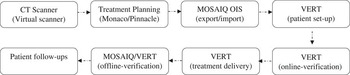
The Queensland University of Technology (QUT) Bachelor of Radiation Therapy program has embedded MOSAIQ v2.62 radiation oncology information system in radiation therapy teaching and learning. A strategic alignment exists between clinical radiation therapy teaching, treatment planning, MOSAIQ and other three-dimensional (3D) virtual reality (VR) applications such as the virtual environment for radiation therapy training (VERT) and the novel medical imaging reality suite (MedspaceVR). Figure 1 illustrates the simulated clinical workflow at QUT and how MOSAIQ integrates into this workflow. Current evidence highlights that this simulation of the clinical workflow in radiation therapy is an effective way of providing an authentic learning pathway towards learning outcomes required for clinical practice.Reference Bridge, Gunn and Kastanis 11
Simulation of clinical workflow in teaching and learning at Queensland University of technology (QUT). Abbreviations: VERT, virtual environment for radiation therapy training; CT, computed tomography.

The rationale for embedding RVs
Traditionally, student radiation therapists develop skills in the use of RVs during scheduled clinical placements. Particularly for safety reasons and lack of competence, restrictions exist in regards to students exposure in modifying patient data or information. This creates a barrier to learning and presents an opportunity to embed RVs in university settings where students can safely interact with the technology without fear of making errors that could impact on a patient’s care.
Several authors suggest that pedagogical designs be sensitive and adaptive to the changing requirements of the teaching and learning context.Reference Eady and Lockyer 15 – 17 Embedding technology in radiation therapy education provides lecturers with the opportunity to design meaningful learning experiences that are immersive with radiation therapy technology. However, CubanReference Cuban and Ebray 16 argues that just by making the technology available in teaching and learning contexts does not mean that it will be used effectively. Eady and LockyerReference Eady and Lockyer 15 suggest that it is time to rethink the concept of integrating technology into the curriculum and instead aim to embed into pedagogy, to support the learning process. In addition, there is emphasis on how the academics draw upon their expertise and experience in what to teach and how to teach it. 17 Some authors highlight that one of the key elements in effective pedagogical designs is to employ a critical pedagogical stance.Reference Edwards-Groves 18 , Reference Feenberg and Jan 19 Therefore, an evaluation of the learning gains from RV technology becomes an important issue before its implementation into teaching and learning environments.
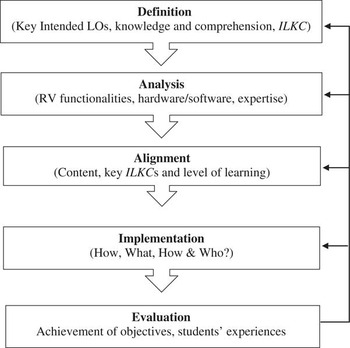
The ultimate goal of implementing real world technologies such as treatment planning and RVs in academia should be to exploit the pedagogical enhancements and potential improvement in the skills students can potentially gain. To achieve these goals, the implementation must be done using a well thought out methodology focusing on both pedagogy and content.Reference Okojie, Olinzock and Okojie-Boulder 20 The implementation of RV technology should also benefit from a critical analysis of the system’s capabilities, consideration of the learning outcomes, knowledge or comprehension as well as support from educational theories. Figure 2 shows some key pedagogical considerations in the implementation process at QUT.
Key pedagogical considerations in the implementation process. Abbreviations: ILKC, intended learning outcomes, knowledge and comprehension; RV, record and verify systems.

Analysis of the system’s capabilities
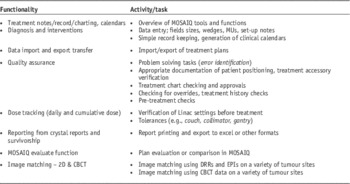
An important step in critical pedagogical analysis of teaching technology is to review the RV technology capabilities.Reference Okojie, Olinzock and Okojie-Boulder 20 These depend on the brand, version and whether a licence is purchased to support all system functionalities. The tasks designed depend on the capabilities of the technology. With MOSAIQ OIS, the tasks vary from simple manual entry of clinical data to complex image matching activities using cone beam computed tomography (CBCT) datasets. Table 1 provides a more comprehensive list of tasks that can be designed using MOSAIQ.
MOSAIQ functionalities and sample teaching and learning tasks at undergraduate teaching

Abbreviations: CBCT, cone beam computed tomography; QCL, quality checklists; 2D, two-dimension; QA, quality assurance; MU, monitor units; DRR, digitally reconstructed radiographs; EPIs, electronic portal images.
There are several potential improvements to the skills and capabilities of radiation therapy students for the implementation of RVs. KirkpatrickReference Kirkpatrick, Light and Walker 3 argues that RVs must facilitate communication within the department and throughout the organization. Therefore, it is essential that students learn how to record treatment notes, schedule treatments and develop treatment calendars. In a teaching institution with treatment planning systems, students can learn how to import and export treatment plans. In addition, lecturers can use MOSAIQ to teach QA concepts to students. As indicated in Table 1, MOSAIQ has the capability for image matching using digitally reconstructed radiographs (DRRs) and electronic portal images (EPIs). The 3D image matching using CBCT data can also immensely impact learning through the consolidation of image matching knowledge and skills students acquire during clinical placements.
Other desirable features for teaching are the ability to check the approval status of a treatment plan, verify the setup isocentre with the planning images and verify the linear accelerator parameters for each beam. As suggested by Laur,Reference Laur 14 bringing the real world into classroom learning is authentic learning. However, proper implementation must be supported by educational theory.
Educational theory
Constructive alignment
Literature suggest that there is no blueprint for technology integration but there is a recommendation to link technology for instruction to all levels of pedagogical processes and activities.Reference Okojie, Olinzock and Okojie-Boulder 20 However, it is important to ensure the teaching and learning activities designed are applied at the correct level of learning; with coherence between the assessment, teaching strategies and intended learning outcomes in an educational programme. BiggsReference Biggs and Tang 21 used the term ‘constructive alignment’ to describe the notion that the learner constructs his or her own learning through relevant learning activities. Creating a learning environment to support these learning activities appropriate to achieve the desired learning outcomes is an important task and will ensure improved teaching outcomes in the radiation therapy programmes. Literature demonstrates how this alignment can be achieved in radiation therapy pedagogy. 22 The intended learning outcomes, key knowledge and comprehension and application of knowledge in various competencies can be aligned to the tasks performed. An example is alignment of a ‘treatment verification’ clinical radiation therapy competence to the learning activities which can be designed to match MOSAIQ’s capability of 2D and 3D image matching. Establishing a link between the radiation therapist roles and improved teaching at university through the use of authentic technology would be useful.
Blooms taxonomy and the SAMR model
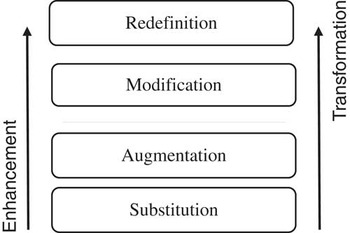
In addition to constructive alignment, the modified Bloom’s taxonomyReference Anderson, Krathwohl and Airasian 23 has been used widely in curriculum development. It is built on the premise that one cannot apply or evaluate something until they understand it. Therefore, higher level is dependent on having acquired the prerequisite knowledge and skills at lower levels. This fundamental concept can be used in evaluating the application of RVs in teaching environments. An example of how technology can be applied correctly in teaching and learning is demonstrated by the works of Heppell.Reference Heppell 24 He applied the Ruben Puentedura’s SAMR ModelReference Miyata 25 (as shown in Figure 3) in conjunction with Bloom’s taxonomy as a pedagogical lens to effectively apply technology in educational settings.
Application of the Ruben Puentedura’s SAMR Model.Reference Heppell 24 , Reference Miyata 25

This model can easily be used to review the application of RVs in radiation therapy education. For instance, in higher levels of learning, significant task design that enables transformation can be designed. Whereas at lower levels the aim could be to augment teaching by demonstration of functionality.
Pedagogical benefits
Student engagement and communication
In contrast to traditional approaches to teaching and learning, literature suggests that students are engaged in the classroom through the use of technology. Therefore, one of the potential benefits of using MOSAIQ is improvement in student engagement. TintoReference Tinto and Pusser 26 highlights the importance of ensuring that students are actively engaged in learning with other students in the classroom. Several studies also show student engagement and success are important considerations in teaching and learning.Reference Eady and Lockyer 15 , Reference Hart, Hammer, Collins and Chardon 27 , Reference Welte 28 The ability to communicate through the use of technology is key to student engagement. Michele and LoriReference Eady and Lockyer 15 argue that students need to be efficient communicators who can competently discuss topics with others and effectively share their ideas in many forms and for different purposes. HartReference Hart, Hammer, Collins and Chardon 27 and WelteReference Welte 28 suggest that real-world student engagement is promoted through the use of real-life examples, which provide the students with knowledge and skills when exposed to real clinical setting activities. Perhaps one of the innovative ways to use RV technology in radiation therapy education is to make sure that students gain confidence, which is self-monitored through repeated use of tools in the RV technology.
Authentic learning and assessment
Evidence suggests that learning favours activities that are carried out in authentic environments, with pedagogical strategies that model authentic, real world tasks.Reference Sambell, McDowell and Montgomery 29 RV technology as real-world tools, can benefit both learning and assessment design in radiation therapy as contemporary learning is driven by effective assessment and feedback. The use of MOSAIQ can transform assessment through diversification of guided critical reflection assessments in areas such as QA, 2D and 3D image matching. There appear to be clear benefits in terms of the potential ability to transform assessment in radiation therapy by utilising the system functionality (Table 1). Thus, RV systems used appropriately in teaching can provide the opportunity for flexibility in designing authentic assessments.
Employability
One of the potential benefits of embedding RV technology is enhancing employability of the radiation therapist graduates. Literature highlights that, contrary to what the term employability suggest, the emphasis is on ‘ skills’ or ‘ability’ and less on ‘employ’.Reference Cuban and Ebray 16 Harvey (2003)Reference Harvey 30 also suggest that in employability the emphasis is on developing critical, reflective abilities, with a view to empowering and enhancing the learner. Literature also highlights that employability is linked to capability and confidence,Reference Little 31 , Reference Bourner and Millican 32 these are important skills in radiation therapy. Arguably, students equipped with attributes and techniques such as image verification and QA, can have a safer transition to clinical practice upon qualifying as radiation therapists.
Benefits to professional practice
It is important that students are provided with facilities and resources sufficient in quality and quantity to enable the attainment of the required graduate capabilities for professional registration. In Australia, the Medical Radiation Practice Board (MRPBA) 33 provides the domains for the professional capabilities specific to radiation therapists. In addition, the Australian Society of Medical Imaging and Radiation Therapy 34 addresses the professional practice standards where a demonstration of understanding of components and functional relationships of the systems and the transfer of information is required (3b; E5, indicator 2–3). In the United Kingdom, the Health and Care Professions Council’s standards of proficiency also include the ability to be able to verify treatment parameters ensuring optimal radiotherapy prescription delivery. 35 The ability to demonstrate these competences through the use of MOSAIQ in university settings could be beneficial.
Challenges and barriers
In general, barriers to the use of technology in pedagogy include; lack of resources, lack of knowledge on how to use the technology, as well as the lecturer’s attitudes and beliefs. The lecturer’s knowledge of the RV technology is also an important factor as is its implementation into teaching and learning. Literature highlights that lecturers tend not to use the technology if they are frustrated that a system does not work properly or when there is a lack of technical support.Reference Hew and Brush 36 This suggests the need for continuous software support from the vendor. Another challenge is that of limited time to review and learn about new technology tools.Reference Hew and Brush 36 Radiation therapy lecturers often have the opportunity to build skills they need through the vendor supported training, online forums and through the support from clinical staff who use the clinical tools routinely.
There were number of information technology (IT) considerations during the implementation phase. At QUT there was need for the IT staff, the vendors and the lecturers to communicate frequently to ensure that the installation was complete correctly. The presence of other technologies such as treatment planning systems from different vendors requires networking considerations for ease of plan transfer between the systems. Lastly, the use of RV technology such as MOSAIQ with image matching capability, requires large amounts of a variety of anonymised clinical datasets required for teaching. Ensuring that there are enough DRRs, EPIs and CBCT data for image matching in a non-clinical environment can be challenging.
Conclusion
For the application of safe and effective pedagogical agendas in radiation therapy, it is essential to embed real-world capabilities. The use of RVs is capable of supporting transformation in radiation pedagogy. The increased knowledge and hands-on skills at undergraduate levels, in areas such as image matching and QA can be powerful tools to drive the issues of quality and safety in radiation therapy practice. A strategic alignment between the existing treatment planning and virtual reality technologies, such as VERT, to key learning outcomes is expected to make a substantial contribution to the development of meaningful student outcomes. There are several practical considerations in the implementation stages. Despite these concerns, the use of the MOSAIQ oncology information system has several pedagogical benefits. Research is required to evaluate its impact on student learning as well as other potential benefits to professional practice.
Acknowledgements
The author acknowledges the colleagues at the Queensland University of Technology for their support.
Financial support
This review article received no grant from any funding agency, commercial or not-for-profit sectors.
Conflicts of Interest
None.