The move toward including multiple levels of analysis in developmental science reflects the conviction, increasingly supported by empirical evidence, that identifying the links between different levels of analysis (e.g., gene, neural circuit, and behavior) will improve our understanding of mechanisms in behavior and our ability to change the course of development through intervention. Developmental behavioral science has a long-standing interest in multiple levels of analysis (Cicchetti & Blender, Reference Cicchetti and Blender2006; Lynch, Manly, & Cicchetti, Reference Lynch, Manly and Cicchetti2015; Shenk, Griffin, & O'Donnell, Reference Shenk, Griffin and O'Donnell2015). The real goal of these efforts is not to “reduce” behavioral phenotypes to biological measures and so render behavioral description superfluous; rather, the aim is to integrate biological models and behavioral phenotypes because of the promise for advancing and refining models of causation and treatment.
The current study adopts the multiple levels of analysis approach and expands this research in two novel directions. First, we consider the links between the immune and neuroendocrine systems and temperament phenotypes. Second, we assess these links from early infancy as part of a prospective longitudinal study. We do this in a sample of infants in families at elevated psychosocial and demographic risk, and in a research design that oversampled for maternal prenatal anxiety, which has been shown to predict a range of temperament and behavioral outcomes (Bergman, Sarkar, O'Connor, Modi, & Glover, Reference Bergman, Sarkar, O'Connor, Modi and Glover2007; Davis et al., Reference Davis, Glynn, Schetter, Hobel, Chicz-Demet and Sandman2007; Huizink, de Medina, Mulder, Visser, & Buitelaar, Reference Huizink, de Medina, Mulder, Visser and Buitelaar2002).
A starting point for this line of research is the effort to draw reliable connections between significant behavioral phenotypes and specific biological markers that are robust across social contexts and maturation. To date, many such associations have been reported, although most are only modest in degree (see below). That may reflect the “true” modest magnitude of the link between behavioral phenotypes and biological markers after accounting for such matters as errors of measurement, design, and analysis. Alternatively, it may be that the levels of analysis so far incorporated incompletely specify the nature of biology–brain–social context–behavior patterns. That is, many studies target a single biological system or molecule, rely on a single method of biological data capture, and/or analyze a single time point. We address this limitation in our study of temperament by targeting multiple markers from the immune and neuroendocrine systems on two assessment occasions in infancy.
We focus on the temperament dimensions of fear and anger. That is based on the substantial evidence that these phenotypes can be reliably assessed in infants from multiple methods of assessment (Gagne, Van Hulle, Aksan, Essex, & Goldsmith, Reference Gagne, Van Hulle, Aksan, Essex and Goldsmith2011; Rothbart, Reference Rothbart1988). In addition, longitudinal evidence indicates that early emerging individual differences in fear and anger may, at the more extremes, forecast significant behavioral disturbance (Colder, Mott, & Berman, Reference Colder, Mott and Berman2002; Kagan, Reznick, & Snidman, Reference Kagan, Reznick and Snidman1987).
Research on the biological bases underlying fearfulness in infants and young children focuses on the neuroendocrine system, with particular emphasis on cortisol, a downstream product of the hypothalamus–pituitary–adrenal (HPA) axis. For example, in their study of preschoolers, Talge, Donzella, and Gunnar (Reference Talge, Donzella and Gunnar2008) found that fearful temperament was associated with cortisol reactivity; other studies (Fortunato, Dribin, Granger, & Buss, Reference Fortunato, Dribin, Granger and Buss2008) also suggest that cortisol is associated with negative affect and withdrawn behavior. Elevated or, more generally, altered cortisol levels and function also figure in research on the biological bases of the closely related phenotype of behavioral inhibition (Kagan et al., Reference Kagan, Reznick and Snidman1987). The association between fear-related phenotypes and cortisol measures in young children may be complex, however, and depend on fear intensity (Buss, Davidson, Kalin, & Goldsmith, Reference Buss, Davidson, Kalin and Goldsmith2004; Kiel & Kalomiris, Reference Kiel and Kalomiris2016), and the context in which fear is assessed (Tout, de Haan, Campbell, & Gunnar, Reference Tout, de Haan, Campbell and Gunnar1998). The above studies vary widely in the measurement of fearful temperament and cortisol; nonetheless, they imply a reliable, if modest, association between this behavioral phenotype and the neuroendocrine system from early childhood. Other affective and behavioral dimensions such as anger and sadness and distress to limitations have attracted less attention in research on neuroendocrine functioning in infants (Gunnar, Larson, Hertsgaard, Harris, & Brodersen, Reference Gunnar, Larson, Hertsgaard, Harris and Brodersen1992; Lewis, Ramsay, & Sullivan, Reference Lewis, Ramsay and Sullivan2006); research on these dimensions remains exploratory. We extend research on the neuroendocrine correlates of temperament by assessing the associations between cortisol reactivity and fear and anger on two occasions in infancy.
A far more novel feature of the current study is its focus on markers of immune function and infant behavior. Evidence for immune correlates of behavior in young children is minimal, but research of this kind is anticipated by several lines of investigation. One is the substantial experimental animal work demonstrating the multiple and complex ways in which components of the immune system may shape normal and abnormal brain and behavioral development (Cunningham, Martinez-Cerdeno, & Noctor, Reference Cunningham, Martinez-Cerdeno and Noctor2013; Paolicelli et al., Reference Paolicelli, Bolasco, Pagani, Maggi, Scianni, Panzanelli and Gross2011; Stevens et al., Reference Stevens, Allen, Vazquez, Howell, Christopherson, Nouri and Barres2007; Yirmiya & Goshen, Reference Yirmiya and Goshen2011). Human studies investigating associations between the immune system and brain and behavior phenotypes are limited in scope, but are rapidly increasing in number. In adults, there is a growing literature associating immune function, especially the production of pro-inflammatory cytokines such as interleukin-6 (IL-6), with a range of behavioral phenotypes including personality dimensions (Chapman et al., Reference Chapman, Khan, Harper, Stockman, Fiscella, Walton and Moynihan2009; Sutin et al., Reference Sutin, Terracciano, Deiana, Naitza, Ferrucci, Uda and Costa2010) or psychiatric syndromes such as depression (Howren, Lamkin, & Suls, Reference Howren, Lamkin and Suls2009). Far less common, and more difficult to summarize, are studies measuring specific immune markers and behavioral phenotypes in pediatric samples; behavioral phenotypes attracting particular attention include depression (Mills, Scott, Wray, Cohen-Woods, & Baune, Reference Mills, Scott, Wray, Cohen-Woods and Baune2013; O'Connor, Moynihan, Wyman, et al., Reference O'Connor, Moynihan, Wyman, Carnahan, Lofthus, Quataert and Caserta2014; Yirmiya et al., Reference Yirmiya, Pollak, Morag, Reichenberg, Barak, Avitsur and Pollmacher2000) and autism (Al-Ayadhi & Mostafa, Reference Al-Ayadhi and Mostafa2012; Ashwood et al., Reference Ashwood, Krakowiak, Hertz-Picciotto, Hansen, Pessah and Van de Water2011) as well as a number of specific syndromes (Swedo, Reference Swedo2002). Although still speculative and lacking causal specificity, human studies on immune markers and behavioral phenotypes in pediatric and adult samples have a solid foundation in the field of psychoneuroimmunology, which has documented robust connections between psychological processes, the nervous system, and the immune system (Ader & Cohen, Reference Ader and Cohen1975). The current study adds to this line of research by examining associations between a profile of cytokines and temperament in infants.
A further reason for incorporating the immune system in studies of behavioral development is its close connection with biological systems that are routinely considered in behavioral studies, such as the neuroendocrine system. There are, by nature, bidirectional and regulatory associations between the immune and neuroendocrine systems: cytokines are able to stimulate the HPA axis (Mastorakos, Chrousos, & Weber, Reference Mastorakos, Chrousos and Weber1993), and glucocorticoids may inhibit inflammatory responses (Waage, Slupphaug, & Shalaby, Reference Waage, Slupphaug and Shalaby1990). Consequently, focusing on one system may lead to misspecified associations between behavior and biology. Moreover, several mechanisms connecting the immune and the neuroendocrine systems have special relevance for development and psychopathology. For example, one hypothesized effect of chronic stress is glucocorticoid resistance within the immune system. This describes a process by which chronic stress and attendant chronic elevated glucocorticoid exposure leads to decreased receptor sensitivity, resulting in reduced anti-inflammatory effects of glucocorticoids; the result is persisting inflammation (Avitsur, Stark, & Sheridan, Reference Avitsur, Stark and Sheridan2001). This model, which has been studied in nonhuman primates (Sapolsky, Alberts, & Altmann, Reference Sapolsky, Alberts and Altmann1997) and humans (Heim, Newport, Mletzko, Miller, & Nemeroff, Reference Heim, Newport, Mletzko, Miller and Nemeroff2008; Miller, Gaudin, Zysk, & Chen, Reference Miller, Gaudin, Zysk and Chen2009), illustrates how an integrated, multiple-system model may provide insights into the origins of behavioral phenotypes.
Another way in which we extend existing research is by studying very young children and adopting a developmental framework. A majority of studies linking biological systems such as the immune system and behavior focus on adults, with a heavy concentration on older adults and high-stress settings (Friedman, Karlamangla, Almeida, & Seeman, Reference Friedman, Karlamangla, Almeida and Seeman2012; Loucks, Berkman, Gruenewald, & Seeman, Reference Loucks, Berkman, Gruenewald and Seeman2006; Seeman, Epel, Gruenewald, Karlamangla, & McEwen, Reference Seeman, Epel, Gruenewald, Karlamangla and McEwen2010). What is unresolved from these studies is the extent to which immune and neuroendocrine correlates of behavior arise only after prolonged stress exposure or “wear and tear” on the body. That is, it is unknown when in development reliable associations exist between immune and neuroendocrine systems and behavior and health outcomes. That is an important developmental question because it has implications for studying mechanisms. If, for example, reliable and robust associations are evident only from late adolescence, then that may imply that the association arises through some other mechanism, such as protracted stress exposure and glucocorticoid resistance. Alternatively, evidence of early-emerging associations between immune and neuroendocrine markers and behavioral phenotypes would imply a more direct connection between biological systems and behavior.
There are comparatively few studies linking behavioral phenotypes to biological markers from one or multiple biological systems in very young children. Associations between caregiving quality and cortisol provide one important example (Ahnert, Gunnar, Lamb, & Barthel, Reference Ahnert, Gunnar, Lamb and Barthel2004; Warren et al., Reference Warren, Gunnar, Kagan, Anders, Simmens, Rones and Sroufe2003); studies of emotional development (Gunnar & Nelson, Reference Gunnar and Nelson1994) and cognitive development (Finegood, Wyman, O'Connor, Blair, & Family Life Project Investigators, Reference Finegood, Wyman, O'Connor and Blair2017) are more rare. Studies of significant behavioral phenotypes and immune markers in infants are relatively unknown. The current study is one of the first to examine associations between important markers of immune and behavioral development from infancy.
Method
Sample and procedures
The current study is part of a larger prospective longitudinal study of prenatal maternal anxiety and child health outcomes. Pregnant women attending a university obstetrics clinic were approached to participate in a study on mood in pregnancy and child development. The clinic serves a disproportionate percentage of low-income, urban, minority women. Inclusion criteria were as follows: 20–34 years of age, no current or history of psychotic illness, a normal medical risk pregnancy (as determined by obstetrics clinic staff and physicians following an extensive intake assessment and including information collected throughout pregnancy), and ability to communicate in English. We estimated that approximately 627 of the 1,209 who were approached and found eligible expressed an interest in participating in the study. Women were screened using the Penn State Worry Questionnaire (PSWQ; Behar, Alcaine, Zuellig, & Borkovec, Reference Behar, Alcaine, Zuellig and Borkovec2003; Meyer, Miller, Metzger, & Borkovec, Reference Meyer, Miller, Metzger and Borkovec1990) to oversample women with significant prenatal anxiety. The screening was administered at the initial clinic visit, usually within 8–12 weeks gestation. Women scoring above 45 on the PSWQ and a subset of women scoring below that score were invited to participate in the study. Two hundred and ten women were initially recruited, but 12 women were subsequently excluded based upon data collected later indicating abnormality or a clinically elevated risk pregnancy (e.g., miscarriage, severe prematurity, significant medical complication, or significant substance use in pregnancy).
Women were assessed using a combination of clinical interviews and questionnaires from midpregnancy; three postnatal assessments were conducted with the mother and child when the child was approximately 2 months (n = 133; M = 1.91, SD = 0.98), 6 months (n = 123; M = 6.50, SD = 1.49), and 17 months of age (n = 113; M = 17.46, SD = 2.74) of age. Analyses for the current study focus on the data collected at the latter two postnatal visits because it is at these visits that we collected temperament data.
Postnatal visits were conducted at a hospital-based clinical research center. Usually within 30 min of arrival to the clinic, a physical assessment of the baby was conducted by a research nurse. The assessment involved undressing the baby for weight measurements; height, head circumference, pulse, and temperature were also recorded; and a venipuncture for a blood sample was performed at the end of the physical exam. The exam was conducted by two to three staff, and the mother was present; the exam typically lasted 15–20 min. Prior to the start of the procedures, a saliva sample was collected from the baby to assess prestress cortisol; poststress saliva samples were collected 15 min and 30 min following the completion of the physical assessment procedures. The observational assessment of temperament was conducted later in the visit, after the physical assessment and collection of neuroendocrine and immune function data. Interview and questionnaire assessments were also conducted near the end of each visit; questionnaires were read aloud to the mother in an interview format to avoid problems in literacy and to ensure understanding of the questions.
Mothers provided written informed consent to participate; the study was approved by the local institutional review board. Mothers were compensated for their participation; transportation was provided if necessary
Measures
Observational measures of temperament
Observer ratings of infant temperament was based on the Laboratory Temperament Assessment Battery—Locomotor Version (Lab-TAB; Goldsmith & Rothbart, Reference Goldsmith and Rothbart1999). The Lab-TAB is a leading observational measure of childhood temperament, with considerable support for its validity and clinical and predictive value (Rothbart, Derryberry, & Hershey, Reference Rothbart, Derryberry, Hershey, Molfese and Molfese2000). We administered select fear, anger/frustration, and joy/pleasure tasks, in that order, at both assessments. At the 6-month assessment, we administered two fear episodes (unpredictable mechanical toy and stranger approach), an anger-frustration episode (unobtainable toy), and the joy/pleasure episode (puppet game). At the 17-month assessment, we administered two fear episodes (remote-controlled spider and unpredictable mechanical toy), an anger/frustration episode (arm restraint), and a joy/pleasure episode (puppet game). Episodes were carried out according to procedures described in the manual; coders blind to identifying information rated infant behaviors from videotape. For fear, mean ratings across the three trials (prorated if not all trials were conducted because of significant child distress on the first or second trial) were coded for facial fear, bodily fear, escape behavior, and distress vocalizations; each of the four areas was standardized and averaged to create a composite measure, that is, across trial and coded feature. At both the 6- and 17-month assessments, a fear composite was created by combining the two individual fear episodes (e.g., at 17 months, from the remote-controlled spider and unpredictable mechanical toy). For anger/frustration, infant behavior on each trial (prorated if not all trials were conducted) was coded for signs of anger/frustration in facial expression, physical struggle, and vocalizations; mean scores for each behavioral rating were then standardized and averaged to create a composite measure across trial and coded feature. The joy/pleasure puppet game task was administered after the fear and anger/frustration tasks principally to provide a more positive interaction experience at the end of the assessment; data from this task are not presented. Missing observational temperament data occurred because of problems in administration or because the child did not return to a “baseline” state. Observational ratings were conducted from videotape by raters blind to child and parent data; a second observer independently rated a randomly selected sample of 25 tapes. Intraclass correlations were 0.70 or higher for the fear and anger/frustration behaviors and composites.
Parent-reported temperament
At both the 6- and 17-month assessments, parents completed the 191-item Infant Behavior Questionnaire—Revised (IBQ-R; Gartstein & Rothbart, Reference Gartstein and Rothbart2003), a widely used parent-report measure of temperament in infants and young children. Behavioral descriptors were rated on a 7-point Likert scale; 14 subscales were created following the standard scoring, and each was considered. In addition, given that a negative affect factor has emerged in multiple studies from diverse samples (Enlow, White, Hails, Cabrera, & Wright, Reference Enlow, White, Hails, Cabrera and Wright2016; Lusby, Goodman, Yeung, Bell, & Stowe, Reference Lusby, Goodman, Yeung, Bell and Stowe2016), we created a negative affect factor from distress to limitations, fear, sadness, and rate of recovery (reverse scored) subscales for additional analyses. The α for this negative affect factor was 0.72 at 6 months and 0.71 at 17 months. Factor structure of the other scales is less consistent, and so we did not attempt data reduction but retained the remaining scales for exploratory analyses.
Immune function measures: Circulating cytokines
Circulating cytokines were assessed using Milliplex MAP high-sensitivity human cytokine magnetic beads (Millipore, Billercia, MA) in conjunction with the Bio-Plex 200 (Bio-Rad, Hercules, CA) Luminex platform, as per manufacturer's instructions, to quantify circulating cytokines using 50–100 μl of serum. Magnetic beads coated with antibodies were washed in a 96-well plate using a magnetic plate washer. Serum samples diluted 1:2 with serum matrix (provided) along with the kit standards and controls were then added. All subject samples were run in duplicate when possible (if sufficient volume was available). The plate was incubated overnight at 4 °C on an orbital plate shaker then the beads were washed followed by the addition of biotin-conjugated detection antibody. After incubating and shaking at room temperature for 60 min, streptavidin-phycoerythrin was added, and the plate was incubated with further shaking for an additional 30 min. The beads were washed, resuspended, and streamed through the lasers in the Bio-Plex 200. Data were analyzed using the Bio-Plex Manager software, version 4.1 (Bio-Rad). The minimum detectable concentration with this kit is 0.34 pg/ml; we recoded values below the limit of detection to the midway point between zero and the limit of detection. A panel of nine cytokines was chosen based on prior research and in order to provide a comparatively broad coverage of pro- and anti-inflammatory cytokines: IL-1β, IL-2, IL-4, IL-6, IL-8, IL-10, IL-12, tumor necrosis factor (TNF)-α, and interferon (IFN)-γ. Following convention, cytokine values were natural log-transformed prior to analysis.
Neuroendocrine marker: Cortisol reactivity
Parents were instructed to restrict food and drink for the child at least 30 min prior to the study visit. At both infant assessments, the neuroendocrine measure was cortisol reactivity to physical assessment and venipuncture. This was based on a cortisol sample prior to and 15 and 30 min after the completion of the physical procedures. The physical assessment was conducted usually 30 min or more after arrival at both infant assessment visits. The procedures carried out at the physical assessment were identical at both study visits. The timing of the clinic visits varied somewhat, inevitably because of the availability of the clinic and particular needs of the family, but clustered in the morning or early afternoon. Time of assessment was recorded and considered as a covariate in analyses below. Infant saliva was collected using sorbettes and stored at –20 °C until assay. Testing was conducted using a commercially available assay (Salimetrics, State College, PA) and run in duplicate where possible; inter- and intra-assay variation were <4% and 7%, respectively. Cortisol values that were extreme (>4 SD above the mean) or exceeded the high limit of detection of the assay kits were eliminated. Once these extreme cases were removed, cortisol data at each assessment point were quasi-normally distributed; nonetheless, data were natural log-transformed. Given that the cortisol sampling was conducted with respect to a stressor, our primary cortisol measure is reactivity defined by the area under the curve with respect to increase (AUCi; Pruessner, Kirschbaum, Meinlschmid, & Hellhammer, Reference Pruessner, Kirschbaum, Meinlschmid and Hellhammer2003).
Covariates
Several sets of covariates were included on an exploratory basis. Prenatal covariates included prepregnancy body mass index, maternal smoking (given the low frequency of use this was coded as any or no use), and alcohol intake in pregnancy (given the low frequency of use this was coded as any or no use). Given that the design included oversampling for prenatal anxiety, we include maternal self-reported anxiety on the PSWQ (Meyer et al., Reference Meyer, Miller, Metzger and Borkovec1990), a 16-item index of worry with considerable evidence for reliability and validity. Perinatal covariates included pregnancy complications (composite index based on obstetrician review), evidence of chorioamnionitis from medical record, mode of delivery, birth weight, gestational age, and breast-feeding history (any breast-feeding at neonatal period, 2 months, and 6 months postnatal). Sociodemographic indicators, collected in pregnancy, included maternal age, maternal education (total number of years), Medicaid status, marital status, and race/ethnicity (coded minority/nonminority). Child sex, temperature, and time of the visit were also included as possible covariates.
Data analysis
After describing the sample, we report a series of preliminary analyses on the immune and neuroendocrine and temperament measures. Associations between immune and neuroendocrine measures and temperament are then provided. The confounding effects of covariates on the associations between biological and temperament measures are then discussed. Partial correlation and regression analyses are used to examine the overlapping versus independent associations between immune and neuroendocrine measures, and to consider the possible confounding effect of covariates.
Analyses of infant temperament focus on the observational measures; analyses of parent-reported temperament, which are known to be subject to significant respondent bias, are considered secondary. Given that the cortisol sampling was conducted with respect to the physical assessment and blood draw, our measure of neuroendocrine function is cortisol reactivity, which was defined according to the AUCi, that is, the amount of change in cortisol from the preexam measure to the measures collected at 15 and 30 min following the completion of the assessment. Following Pruessner et al. (Reference Pruessner, Kirschbaum, Meinlschmid and Hellhammer2003), AUCi was computed using the trapezoid formula. Analyses of AUCi also consider prestress measure and time of assessment. Our assessment of immune function was limited to a panel of nine cytokines collected from serum. Given the more exploratory nature of the immune analyses, we did not make corrections for multiple testing a priori and neither did we specify a priori which cytokines would be most reliably associated with infant temperament. Finally, the focus of analyses is the concurrent associations between immune and neuroendocrine and behavioral data at the 6-month and 17-month assessments. We did not specify a priori predictions concerning longitudinal change between behavioral and biological measures, and comparatively little is known about the stability of these measures in this age period; accordingly, longitudinal analyses are considered exploratory.
Results
Preliminary analyses
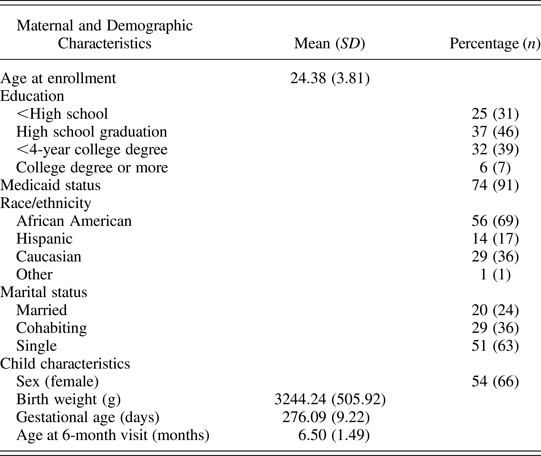
Of the original sample of 198 recruited in pregnancy, a clinic visit was conducted on 123 infants at 6 months; visits were conducted on 113 infants at a subsequent visit when the infants were, on average, 17 months old. Children who were assessed at these postnatal visits did not differ from those who were not seen on key markers assessed at the fist prenatal visit, including socioeconomic status (maternal education and Medicaid status), prenatal maternal anxiety, prenatal risk (smoking or alcohol use in pregnancy), or race/ethnicity. Descriptive data for the sample are provided in Table 1.
Sample characteristics

Note: Maternal and demographic characteristics are based on information at enrollment. Information is provided for those infants with a 6-month visit (n = 123).
Of the infants seen at the 6-month visit, sufficient cortisol data to calculate AUCi (i.e., a prestress and at least one poststress sample) were available on 107 (57% exhibited a positive value, i.e., an increase from pre- to poststress). Analyses of the three time points indicated that there was an overall increase in cortisol from pre–blood draw to 15- and 30-min post–blood draw (raw means: M = 4.55, SD = 6.00; M = 5.60, SD = 6.67; and M = 6.12, SD = 7.64, respectively); however, the within-subjects effect of time (sample) was not significant in a repeated-measures analysis of variance, F (2, 182) = 1.92, p = .15. At the 17-month visit, sufficient cortisol data to calculate AUCi were available on 98 infants (60% exhibited a positive value). Analyses of the three timepoints indicated an overall increase in cortisol from pre–blood draw to 15- and 30-min post–blood draw (raw means: M = 4.02, SD = 8.92; M = 6.24, SD = 16.58; and M = 6.46, SD = 13.31, respectively), but the within-subjects effect of time (sample) was not significant in a repeated-measures analysis of variance, F (2, 180) = 1.47, ns. For a small minority of children at each assessment (12.8% at 6 months, 15.6% at 17 months), mothers refused the venipuncture (although they had consented to it previously). For these cases, AUCi was calculated for the physical assessment without the venipuncture. Analyses indicated that at neither assessment visit was there a significant mean difference in AUCi between those infants who had a physical assessment with venipuncture and those infants who received only the physical assessment; furthermore, associations between cortisol reactivity and temperament (see below) were unaffected by the inclusion of venipuncture status as a covariate. Accordingly, all infants with an AUCi were included in the analyses below.
There were more missing data for the immune function data because of insufficient volume for cytokine testing (blood volume was used initially for other testing, and so not all those completing a blood draw had sufficient volume remaining for cytokine assays), draw failure, or blood draw refusal. Sufficient sample for cytokine analyses was available for 74 children at 6 months and 67 children at 17 months.
Observational temperament measures of fear and anger/frustration were not significantly correlated at either assessment (rs < .2). Concurrent correlations between parent-reported and observational measures of temperament were also small and nonsignificant; one exception was a significant negative correlation between observed anger/frustration and the parent-reported negative affect factor (composed of distress to limitations, fear, sadness, and reverse-coded rate of recovery) subscales at 17 months (r = –.40, p < .01). As a result, observer-reported and parent-reported temperament measures are examined separately in relation to immune and neuroendocrine markers. There was no consistent evidence that prenatal, perinatal, and sociodemographic covariates were significantly associated with observational measures of temperament at both occasions. Significant associations between covariates and parent-reported temperament according to the negative affect factor on the IBQ-R were somewhat more common, but none was significant at both the 6- and 17-month assessments. For example, maternal self-reported prenatal anxiety on the PSWQ at 32 weeks gestation predicted parent-reported negative affect factor on the IBQ-R at 6 months, r (103) = –.34, p < .01, but not at 17 months, r (93) = .09, ns. These preliminary analyses indicate that the covariates are unlikely to confound analyses of temperament; we return to this issue in sensitivity analyses below.
At the 6-month assessment, cortisol AUCi was not significantly associated with time of the visit or prestress cortisol levels (rs < .10, ns). At the 17-month assessment, AUCi was not associated with time of visit, r (98) = .00, but was significantly associated with the prestress cortisol level, r (98) = –.46, p < .01. Prestress (i.e., cortisol sample prior to physical assessment) but not time of visit was therefore considered further in analyses of temperament.
None of the infants at the 6- or 17-month assessment had an elevated temperature at the clinic assessment; temperature was unrelated to immune or cortisol measures and was therefore dropped from further consideration. The cytokines measures were moderately to highly intercorrelated within each assessment; for example, the average pairwise correlation among the 36 correlations at the 17-month assessment was r = .59. No evidence of a significant sex difference was found at either assessment for AUCi, the cytokines, or observer-reported or parent-reported temperament.
The final preliminary analysis indicated very limited evidence of an association between the cytokines and cortisol reactivity. At the 6-month assessment, cortisol reactivity was not significantly associated with any of the cytokines. At the 17-month assessment, cortisol reactivity was significantly associated only with IL-4, r (63) = .25, p < .05. Associations between cytokines and individual cortisol measures (i.e., pre- and poststress) were also nonsignificant; for example, at 17 months, the strongest association detected was between prestress cortisol and IL-1β, r (60) = –.19, p = .14.
Immune and neuroendocrine markers and infant temperament
6 Months
Correlation analyses indicated limited evidence of immune and neuroendocrine correlates of infant temperament at 6 months. For the observer-rated measures, one significant association was detected: observer-rated anger/frustration was significantly associated with cortisol reactivity according to the AUCi metric, r (86) = .22, p < .05. Parent-reported temperament was not significantly associated with immune or neuroendocrine markers at the 6-month assessment.
17 Months
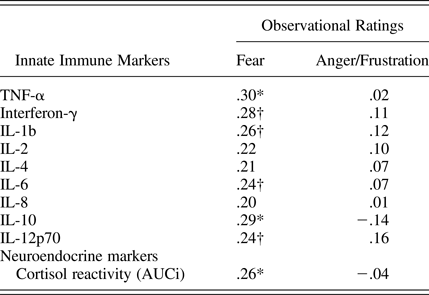
Clear evidence of reliable associations between immune and neuroendocrine markers and temperament was found at the 17-month assessment. Correlations are presented in Table 2. The magnitude of associations across the panel of nine cytokines was generally similar; two were significant at p < .05 (IL-10, TNF-α) and four more were significant at p < .10 (IL-6, IL-1β, IL-12, IFN-γ). The overall positive association implies that fear was associated with a general activation of the innate immune system. In contrast to the findings for fear, there was no consistent evidence of an association between immune markers and anger/frustration (Table 2). The association between temperament and innate immune activation did not extend to parent-reported temperament. For none of the nine cytokines assessed was there a significant association with parent-reported factors on the IBQ-R, including the negative affect factor.
Bivariate associations between observed temperament and immune function and cortisol measures (17 months)
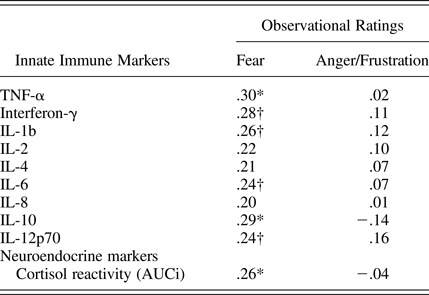
Note: IL, interleukin; AUCi, area under the curve with respect to increase. For cytokine Ns = 50 and 43; for AUCi ns = 73 and 64.
†p < .10. *p < .05.
Given the moderate and consistent positive associations between cytokines and fear, we examined if the correlations with fear reported in Table 2 indicated nonoverlapping effects. This was not the case. For example, the correlation between TNF-α and fear was no longer significant when controlling for IL-10 in a partial correlation analysis.
Shown in Table 2 is the significant association between observer-rated fear and cortisol reactivity as measured by cortisol AUCi: children who were rated by observers as high on fear in the Lab-TAB assessment tended to exhibit greater cortisol reactivity to the physical exam stressor. As noted, the AUCi was significantly associated with prestress cortisol levels. Therefore, a partial correlation analysis was run examining the association between observer-rated fear and AUCi controlling for prestress cortisol; covarying prestress cortisol did not substantively change the association between fear and AUCi, which remained significant at p < .05 (prestress cortisol was not significantly associated with fear). Cortisol AUCi was not significantly associated with anger/frustration. In addition, cortisol reactivity measured with AUCi was not significantly associated with parent reports on the IBQ-R.
The significant association between the cytokines TNF-α and IL-10 and fear was largely independent of the association between cortisol reactivity and fear. In a regression model in which fear at 17 months was the dependent variable, TNF-α remained a significant predictor (B = 0.44, SE = 0.22, p < .05); AUCi was no longer significant at p < .05 in the regression model, but was only marginally weaker in effect (B = 0.16, SE = 0.09, p = .07). A similar pattern emerged when IL-10 was used as the immune function variable. In a regression model, IL-10 and cortisol reactivity were both associated with fear at 17 months, although in both cases the effect was marginally weaker than p < .05 (for IL-10, B = 0.27, SE = 0.13, p = .056; for AUCi, B = 0.16, SE = 0.09, p = .08). We conclude that the association between fear and immune markers is largely independent of its association with cortisol reactivity.
Longitudinal analyses
There was significant stability of individual differences in parent-reported temperament over the nearly 1 year separating the two postnatal visits (e.g., for the negative affect factor, r = .57, p < .001). However, we did not find significant stability in observer-reporter temperament from 6 to 17 months; for both fear and anger/frustration, correlations between assessment were <.20. Neither was there significant stability in AUCi. There was considerably more evidence of stability of individual differences in innate immune measures, and were most notable for IFN-γ, IL-6, and IL-8 (rs > .50). Inspection of the cross-wave correlations between immune and neuroendocrine measures and temperament indicated no general trends or apparent patterns and, in the absence of a priori hypotheses, we conclude no reliable cross-wave associations between biological markers and infant temperament.
Supplementary analyses
A series of sensitivity analyses were carried out to determine the robustness of the correlations presented in Table 2. For none of the significant associations in Table 2 was there a perinatal or sociodemographic covariate (listed above, including prenatal maternal anxiety) that significantly or materially mediated the association. In addition, AUCi is one way of analyzing the cortisol data, but there are others. We reanalyzed the cortisol data using a repeated-measures analysis in which cortisol was the dependent variable; time (prestress, 15-min poststress, and 30-min poststress) was a within-subjects factor, and fear was a between-subjects factor; time of visit was included as a covariate. Consistent with the AUCi analyses already presented, the repeated-measures analysis results indicated a significant Time × Fear interaction, F (2, 59) = 3.66, p < .05, which indicated that the effect of fear was detected on the poststress cortisol measures and not the prestress cortisol measure. Finally, the sample size meant that we had very limited power to detect interactions between immune measures and cortisol reactivity and infant temperament, or a moderating role of perinatal or sociodemographic covariates.
Discussion
We employed a multiple levels of analysis approach to examine immune and neuroendocrine markers of temperament in infancy in a comparatively high-risk sample according to psychosocial indicators and maternal prenatal anxiety. Using a well-validated observational protocol for assessing temperament, we found reliable and nonoverlapping associations between immune and neuroendocrine markers and fear in infants at approximately 17 months of age. The most novel finding is that fear was associated with a general pattern of innate immune activation. Although less novel than the immune results, the finding that infants judged as more fearful exhibited greater HPA axis arousal is notable because prior studies demonstrating such an effect were typically on older children. We discuss the study limitations and the limited nature of the findings before considering their implications for development and psychopathology.
Limitations
An important first limitation of the study concerns the particular measures of immune and endocrine markers. Immune function measures were limited to a panel of cytokines from which we assayed circulating peripheral levels. The innate cytokine panel is a reasonable target, particularly given the immune and behavior research in samples of older individuals, but it is nonetheless a limited manner of indexing the immune system. Similarly, the measure of neuroendocrine function was cortisol reactivity to a lab stressor. Other approaches for assessing the neuroendocrine system have also been proposed, and these alternative approaches may have yielded a different pattern of results. Replication and extension to measures beyond circulating cytokines and cortisol reactivity are warranted. Second, although the study is one of the rare examples to include immune markers and well-characterized behavioral phenotypes in infancy, the sample size was modest, and this limited our ability to examine complex interactions between immune and neuroendocrine markers. Missing data because of insufficient blood volume and other factors common to research on high psychosocial risk samples and young children may be especially consequential where effect sizes are not anticipated to be large. Third, despite the longitudinal design, our findings do not provide clues as to the direction of effects or causality more broadly; our study design does not allow us to determine if infant fear is a cause or a consequence of innate immune activation, or if the association is at all causal. Fourth, the sample is ethnically diverse and at high psychosocial risk; it is not known if the findings are particular to this population. Set against these limitations are several strengths of the study, including detailed measures of multiple cytokines from serum; cortisol reactivity to a single, standard laboratory stressor; observational measurement of temperament; and a longitudinal research design.
Biological markers and infant temperament
There was apparent specificity of, or limits to, the associations between immune and neuroendocrine markers and infant temperament. Significant associations were specific to observer-rated temperament. Why we did not also find associations with parent-reported temperament is not clear. Discordant results for observer- and parent-rated temperament may simply be because the former was based on a focused assessment in a controlled context whereas the latter reflects an aggregation of impressions over a wide time period and across many settings. The lack of convergence between observer-rated and parent-rated temperament is well known (Kochanska, Coy, Tjebkes, & Husarek, Reference Kochanska, Coy, Tjebkes and Husarek1998; Seifer, Sameroff, Barrett, & Krafchuk, Reference Seifer, Sameroff, Barrett and Krafchuk1994), and may be particularly elusive for negative dimensions (Stifter, Willoughby, Towe-Goodman, & Family Life Project Key Investigators, Reference Stifter, Willoughby and Towe-Goodman2008). Biases in parent-reported temperament are also extensively documented (Vaughn, Bradley, Joffe, Seifer, & Barglow, Reference Vaughn, Bradley, Joffe, Seifer and Barglow1987). An alternative explanation for the discrepant result is that the affective dimensions captured by observer and parent reports may not be equally influenced by immune and neuroendocrine processes.
A more substantive limit is that the biomarkers were significantly associated with fear and not with anger/frustration. Although we did find a significant association at 6 months between cortisol reactivity and anger/frustration, this effect was not carried through to the later assessment, and so may not be robust. As noted, given the modest available relevant data, the general lack of association between cortisol reactivity and anger is not obviously consistent or inconsistent with the literature. Descriptive and etiological analyses of temperament in young children support clear distinctions between affective/behavioral dimensions of fear, anger, and other temperament dimensions (Clifford, Lemery-Chalfant, & Goldsmith, Reference Clifford, Lemery-Chalfant and Goldsmith2015). It may be that immune and neuroendocrine factors are more salient to the brain bases of fear. That is congruent with research on the immune mechanisms underlying behavioral phenotypes, reviewed below, which focuses much more on depression and anxiety than externalizing disorders and anger.
Developmentally, the most interesting kind of specificity is the much stronger pattern of associations at 17 months compared with 6 months. What accounts for this developmental change is unclear. Significant normative, and not yet fully explicated, changes in the endocrine and immune systems occur between 6 and 17 months; developmental changes in neural circuitry associated with fear in humans and animals is likely equally substantial (Landers & Sullivan, Reference Landers and Sullivan2012). These sizable developmental changes might account for the lack of stability in observed fear. Lack of stability in fear when first assessed in early infancy is not uncommon (Mills-Koonce et al., Reference Mills-Koonce, Wagner, Willoughby, Stifter, Blair and Granger2015); we may have found more sizable stability had we selected the sample according to more extreme forms of early fear (Fox, Henderson, Rubin, Calkins, & Schmidt, Reference Fox, Henderson, Rubin, Calkins and Schmidt2001). It is not clear how the lack of observed fear comports with the rank-order stability of select cytokines. We cannot rule out the possibility that the inconsistent findings at the two assessments imply an unreliable effect. Nevertheless, the consistent findings across multiple cytokines at 17 months suggest a robust response at least within that assessment.
By far the most novel result is the evidence for an activated innate immune response and infant fear. These results provide some of the earliest developmental evidence supporting a link between established behavioral phenotypes and immune function markers. Studies of infants are rare but may be especially valuable for clarifying the nature of broader conceptual models such as psychoneuroimmunology, for which developmental data and a developmental perspective has been requested but not as yet emphasized in empirical research (Ader, Reference Ader1983; Coe, Reference Coe1996; O'Connor, Moynihan, & Caserta, Reference O'Connor, Moynihan and Caserta2014). Previous analyses from this study indicated that early-emerging individual differences in adaptive immunity, based on antibody response to hepatitis B vaccine, were predicted from maternal prenatal anxiety (O'Connor et al., Reference O'Connor, Winter, Hunn, Carnahan, Pressman, Glover and Caserta2013). Thus, the current results and results from prior analyses indicate that both innate and adaptive immunity in infants may be of interest to developmental research on stress and behavior.
It is significant that the magnitude of effect, and valance, across the panel of nine cytokines was fairly similar. This implies a general immune activation; there are undoubtedly more complex dynamics between and among the cytokines that were undisclosed in our data. For example, TNF-α, which was reliably associated with fear behavior at 17 months, is part of the systemic inflammatory response; it can be produced by many cell types and is itself capable of stimulating other inflammatory response molecules, such as IL-6. These dynamic changes in the immune response could not be captured in a single blood sample, or in consecutive samples roughly 1 year apart. What we are capturing in the cytokine assessment is a narrowly timed slice in the complex cascade of linked effects among the cytokines measured. This is one explanation for the generally positive associations among cytokines at each assessment and a reminder why focusing on one or a limited number of cytokines in health and behavioral research could be misleading. Accordingly, it would be premature to declare that TNF-α has a mechanistically more central or causal association with fear behavior, or that its association with fear can be readily isolated from the broader cytokine cascade.
We did not have direct information on biological mechanisms that may explain the association between larger cytokine concentrations and fear in infants. Perhaps relevant to our results is a large and rapidly expanding literature identifying mechanisms explaining reliable associations between immune activation and a range of psychiatric and neurodevelopmental phenotypes in adults, most notably depression (Raison & Miller, Reference Raison and Miller2011; Slavich & Irwin, Reference Slavich and Irwin2014). Explanations for why the innate immune system may be linked with behavior such as fear may involve several plausible candidate pathways. One is degradation of tryptophan along the kynurenine pathway, which has been implicated in a range of behavioral and neurodevelopmental phenotypes, including depression (Brooks et al., Reference Brooks, Janda, Lawson, Rytych, Smith, Ocampo-Solis and McCusker2017; Jones et al., Reference Jones, Franco, Varney, Sundaram, Brown, de Bie and Brew2015; Raison et al., Reference Raison, Dantzer, Kelley, Lawson, Woolwine, Vogt and Miller2010). This pathway has also been implicated in behavioral and cognitive measures in animal studies of responses to chronic social stress (Fuertig et al., Reference Fuertig, Azzinnari, Bergamini, Cathomas, Sigrist, Seifritz and Pryce2016). This explanation is based on the finding that the lead enzyme in the pathway, indoleamine-2,3-dioxygenase, is stimulated by inflammation (and IFN-γ in particular); as a result, the kynurenine pathway may be upregulated when the immune response is activated. A role for glucocorticoids in this model has also been demonstrated (Brooks et al., Reference Brooks, Lawson, Smith, Janda, Kelley and McCusker2016). Pre-clinical studies also demonstrate plausible actions between serotonin activity and cytokines, and include the finding that IL-1β and TNF-α stimulate serotonin uptake (Zhu, Blakely, & Hewlett, Reference Zhu, Blakely and Hewlett2006). The application of this work to fear in infants is by no means certain, although the potential is clearly intriguing.
Perhaps the broadest interpretation of the findings is the demonstration that the immune system is a(nother) biological system with correspondence with behavior that is evident from infancy. That may be a significant addition to the existing brain and behavior research from infancy and early childhood that has begun to integrate neuroendocrine responses and the sympathetic nervous system (Fortunato et al., Reference Fortunato, Dribin, Granger and Buss2008; Granger et al., Reference Granger, Blair, Willoughby, Kivlighan, Hibel, Fortunato and Wiegand2007). In contrast to other studies assessing multiple biological systems and behavioral phenotypes, we did not find complex or overlapping associations between our neuroendocrine measure, cortisol reactivity, and our immune function measures, peripheral cytokines. The general lack of association between cortisol reactivity and circulating cytokines in infants is difficult to interpret, but may be notable given the established regulatory role of cortisol on inflammation, although little of the prior work was conducted on infants. A lack of significant association in our study may simply reflect the particular way in which we assessed cortisol, or limited statistical power. We did not demonstrate interactions among multiple levels of analyses in this study, but the observation that there are both immune and neuroendocrine correlates of infant temperament underscores the need to move beyond a singular biological focus in behavioral studies.
The final discussion point concerns the fit of the study findings with previous research on maternal prenatal anxiety and child behavior. Maternal prenatal anxiety was significantly associated with parent-reported negative infant affect at 6 months; however, we did not find substantial evidence for a persisting effect of prenatal anxiety on child temperament according to both observational and parent-report methods. That may be a nonreplication of prior work, cited above. Nevertheless, previous studies reporting a link between maternal prenatal anxiety (or stress) and child temperament included children at sizably lower psychosocial risk; there are also differences among studies in the age of children at assessment and the temperament measure employed. In addition, there is emerging evidence that the association between prenatal maternal prenatal anxiety on infant, child, and adolescent behavioral outcomes may be partly moderated by genetic factors (O'Donnell et al., Reference O'Donnell, Glover, Lahti, Lahti, Edgar, Raikkonen and O'Connor2017) or caregiving quality (Bergman, Sarkar, Glover, & O'Connor, Reference Bergman, Sarkar, Glover and O'Connor2008). Perhaps also relevant to the current findings is a previous report that found that caregiving moderated the association between cortisol reactivity to vaccination and parent-reported temperament in infants (Gunnar, Brodersen, Nachmias, Buss, & Rigatuso, Reference Gunnar, Brodersen, Nachmias, Buss and Rigatuso1996). These studies, and others (Bergman, Sarkar, Glover, & O'Connor, Reference Bergman, Sarkar, Glover and O'Connor2010), highlight the need for further research integrating moderating factors, notably caregiving and ambient psychosocial risk, in studies of prenatal risk mechanisms for child health outcomes.
There is substantial interest in and growing evidence for the possibility that early patterns of physiology and neuroendocrine activity might provide a basis for identifying at-risk children from infancy (Laurent, Harold, Leve, Shelton, & Van Goozen, Reference Laurent, Harold, Leve, Shelton and Van Goozen2016). It is not yet clear that findings from the current study have a ready clinical application, however. That will require replication and a stronger mechanistic framework. What is needed are behavioral studies from early childhood that begin to apply ideas derived from studies of immune system–behavior links in adulthood, including, for example “sickness behavior.” In addition, the regular experimental alterations of the infant immune system from immunizations may provide opportunities for studying immune system–behavior associations. Equally interesting, and plausible, is the integration of psychoneuroimmunology methods and ideas into behaviorally focused interventions to promote child mental health. Research of that kind could add substantially to a developmental model of psychoneuroimmunology and provide novel insights for improving child health outcomes.