Introduction
Fear of crime first emerged as an area of academic enquiry in the 1970s and continues to be a major concern for public policy makers in high-income countries (Clark et al. Reference Clark, Kawachi, Ryan, Ertel, Fay and Berkman2009; Clemente and Kleinman Reference Clemente and Kleinman1976). Crime and violence themselves have direct and usually substantial effects on the health and wellbeing of individuals, including older people (Schuller Reference Schuller2006). The potential effects of fear itself may be less tangible and less direct, but there is a growing body of evidence that that they can still be substantial. For example, Bowling (Reference Bowling2005) and Scharf, Phillipson and Smith (Reference Scharf, Phillipson and Smith2005) both show that feeling safe in the local neighbourhood is a key determinant of quality of life for older people in the United Kingdom (UK). Numerous studies show that fear of crime can affect behaviour, such as limiting personal mobility and social participation outside the home, and that this is detrimental to aspects of health and quality of life (Clark et al. Reference Clark, Kawachi, Ryan, Ertel, Fay and Berkman2009; Stafford, Chandola and Marmot Reference Stafford, Chandola and Marmot2007). Fear of crime may also be associated with depression and poor mental health (Green, Gilbertson and Grimsley Reference Green, Gilbertson and Grimsley2002; Whitley and Prince Reference Whitley and Prince2005).
Within the literature on fear of crime, there is disagreement about the extent to which older people are especially susceptible to fear and to its effects. Some studies claim that older people experience higher levels of fear than people at other ages (Chivite-Matthews and Maggs Reference Chivite-Matthews and Maggs2002; Harris Reference Harris1975; Pantazis Reference Pantazis2000). However, an increasing number of studies challenge this view, observing that old age is not significantly associated with fear, especially when the effects of other factors, such as gender and income, are also taken into account (Chadee and Ditton Reference Chadee and Ditton2003; Ferraro and LaGrange Reference Ferraro and LaGrange1992; Greve Reference Greve1998).
Published research on fear of crime among older people is almost entirely located in high-income countries.Footnote 1 Yet low- and middle-income countries (LMICs) contain a growing majority of the world's older population and in many cases are affected by levels of crime and violence that match or exceed those of high-income countries.Footnote 2 This paper provides the first comparative study of the determinants and potential consequences of fear of crime among older people in six diverse LMICs: China, Ghana, India, Mexico, Russia and South Africa.Footnote 3
Conceptual framework
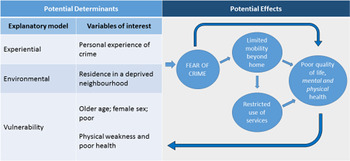
Figure 1 sets out the conceptual framework for this study, including different explanatory models for crime fear and hypothesised associations and effects, drawing on the wider literature. There are a number of explanatory models for predicting rates of crime fear among older people and populations in general. According to the Experiential Model, crime fear is closely related to actual levels of risk and experiences of crime faced by individuals (Hale Reference Hale1996; Stafford and Gale Reference Stafford and Gale1984). In the criminological literature there is disagreement about the strength of this effect, and most studies demonstrate that the relationship between fear and experience is not linear and, in some cases, is quite weak (Hale Reference Hale1996). The General Vulnerability Model of crime fear focuses on the effects of individual attributes associated with physical vulnerability (such as being female or old) or with aspects of social vulnerability (such as being poor, having little education or belonging to an ethnic minority) (Kennedy and Silverman Reference Kennedy and Silverman1985; Stiles, Halim and Kaplan Reference Stiles, Halim and Kaplan2003). Thirdly the Environmental Model focuses on how individuals perceive the riskiness of their local environments. This model, more popularly known as the ‘broken windows syndrome’, observes that local conditions such as public drunkenness and graffiti create a perception of social disorder and hence generate fear, independently of actual levels of risk and personal attributes (Taylor Reference Taylor2001; Villareal and Silva Reference Villareal and Silva2006).
Conceptual framework for potential determinants and effects of fear of crime
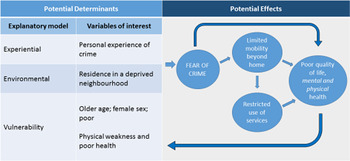
Fear of crime can have a number of potential effects on older people, either directly or through more complex pathways, as set out in Figure 1. Fear may discourage mobility outside the home, which in turn influences social networks and social capital, both of which have been shown to have significant effects on health and quality of life (Litwin and Shiovitz-Ezra Reference Litwin and Shiovitz-Ezra2011; Nyqvist et al. Reference Nyqvist, Forsman, Giuntoli and Cattan2013). Also, limited activity outside the home may lead to lower levels of exercise, which can affect health and quality of life (Legh-Jones and Moore Reference Legh-Jones and Moore2012). There is no published research which evaluates these potential indirect effects of fear on older people in LMICs.
Poor physical and mental health may be both an outcome and a contributing factor to crime fear, so that any associations could be either cause, effect or a combination of both. For example, depression may result from fear of crime but may also increase susceptibility to this fear. Whilst numerous studies have reported associations, both for older people and for adults in general, they are usually unable to establish the relative importance of cause and effect (Bowling Reference Bowling2005; Green, Gilbertson and Grimsley Reference Green, Gilbertson and Grimsley2002; Stafford, Chandola and Marmot Reference Stafford, Chandola and Marmot2007; Whitley and Prince Reference Whitley and Prince2005). Longitudinal data offer some opportunity for specifying effects and this has been done to a limited extent in a survey of UK civil servants (Stafford, Chandola and Marmot Reference Stafford, Chandola and Marmot2007). In the absence of longitudinal data, an alternative way to tease apart cause and effect is to examine interactions between health and quality of life, on one hand, and frailty, on the other. If frailty is associated with fear of crime, this is more likely to be as a determinant rather than a consequence, since fear of crime is unlikely to affect outcomes such as continence or grip strength. Frailty is also closely associated with poor health status, quality of life and limited mobility (both as a cause and consequence). The Vulnerability Model suggests that poor health leads to fear through its associations with weakness and dependency (i.e. frailty). As such, taking into account the effect of frailty on these outcomes may partly cancel out any potential effect of poor health status, generating higher levels of fear. If fear is associated with poor health, regardless of frailty, this is suggestive that poor health is at least in part a consequence of fear rather than vice versa.
Methods and design
This study uses newly available quantitative data from the World Health Organization (WHO) Study on Global AGEing and Adult Health (SAGE), which include detailed information on health behaviours, use of health services and health outcomes, as well as a varied set of socio-economic items. SAGE comprises nationally representative household surveys for people aged 50 or older in six countries: the People's Republic of China, Ghana, India, Mexico, the Russian Federation and South Africa, conducted between 2008 and 2010. Across these six countries, the total SAGE study population comprises 35,125 people aged 50 years or older. SAGE sampling methods are based on the design developed for the 2003 World Health Survey where a probability sampling design was employed using multi-stage, stratified, random cluster samples.Footnote 4 The primary sampling units were stratified by region and location (urban/rural) and, within each stratum, enumeration areas were selected.Footnote 5
SAGE is not a specialist crime survey and does not contain a large number of items specifically related to different kinds of crime, as would be the case in a customised survey (Acierno et al. Reference Acierno, Rheingold, Resnick and Kilpatrick2004). SAGE contains two questions on fear of crime and one on actual household experiences. The first is: ‘In general, how safe from crime and violence do you feel when you are alone at home?’ This is a standard and, presumably, tried and tested item in crime surveys (Statistics Canada 2005). In the context of the SAGE survey, particular care is needed when interpreting responses to this item. The specification that the older person be alone at home automatically excludes fear of crime and violence that may be perpetrated on older people by another family member. It is understandable that SAGE chose to exclude items explicitly related to domestic abuse, since this would have raised serious ethical challenges for a non-specialist survey. As a result, it is important not to read off this item as a comprehensive indication of how safe older people may or may not feel in their own homes. Second, for many older people, perhaps more so in SAGE countries than in high-income ones, being alone at home may be a very rare experience, if it happens at all. For these older people, responses will be based on a hypothetical experience of being alone, rather than actual experience, which is likely to reduce the robustness of the response.
The second SAGE item on fear of crime is: ‘How safe do you feel when walking down your street alone after dark?’ Again, this item is widely used in specialist crime surveys, but raises particular challenges when applied specifically to older people. Ferraro and LaGrange (Reference Ferraro and LaGrange1992) note that in many cases fear of being on the street alone may be unrelated to crime, reflecting concerns such as falling over alone in an unlit street.Footnote 6 This may be particularly important in the urban environments of the SAGE countries, since these are generally more physically hazardous than those in high-income countries (UN Habitat 2007). As with the item on being home alone, for many older people going out alone after dark will be a hypothetical scenario and so responses will not be based on actual experiences.
Additionally, SAGE includes one item on actual experiences of crime: ‘In the last 12 months, have you or anyone in your household been the victim of a violent crime, such as assault or mugging?’ The survey does not specify which person in the household had this experience and does not include items on other forms of crime, such as non-violent crime.
Whilst the SAGE data on fear of crime have some evident limitations and should be interpreted with care, the survey does have some important strength compared to specialist crime surveys. Its many items on health, quality of life, wellbeing and behaviour offer the potential to analyse a much larger number of potential determinants and consequences of fear than is the case in crime surveys. This includes the construction of a frailty index based on 36 items.Footnote 7 Second, the large sample size and the systematic collection of data for six countries offer important opportunities for comparative analysis and increase the power of statistical analysis. Given the lack of other studies in this field, analysis of the SAGE data represents a useful first step into new terrain, which will hopefully lead on to more specialist qualitative and quantitative work.
Descriptive statistics were calculated with use of standard methods such as frequencies and percentages for older men and women and for the six SAGE countries, both separately and pooled. Categorical variables are presented as absolute and relative frequencies. Associations between categorical variables were tested by the calculation of the chi-square test. Multivariable logistic regression models were used to estimate the odds ratios (OR) of home and street fear separately for the national and pooled data, after adjusting for gender, age, frailty, residence and wealth quintile. Covariates and confounders were selected based on our previous knowledge of associations in developed countries. Logistic regression models were also applied to identify associations between home fear, street fear on self-rated health, self-rated quality of life and depression adjusting for age, sex and frailty. As certain states and certain categories of respondents were over-sampled, sample weights were used to restore the representativeness of the sample.
Results are presented as OR with 95 per cent confidence intervals (95% CI). The estimation of confidence intervals takes into account design effects due to clustering at the level of the primary sampling unit. We assessed the possibility of multicollinearity between the covariates. In the correlation matrix of covariates, all pair-wise Pearson correlation coefficients were < 0.5, suggesting that multicollinearity did not affect the findings. All analyses were conducted using Stata version 10 (StataCorp, College Station, Texas, USA).
Results
Prevalence and determinants of fear of crime
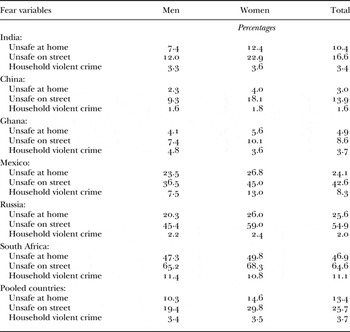
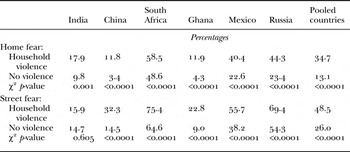
Table 1 presents SAGE responses to the question on feelings of safety at home alone (home fear) and on street alone after dark (street fear), disaggregated for older men and women.Footnote 8 Two general patterns stand out: first older women consistently report higher rates (p < 0.0001) of home and street fear for all six countries; second, there are very large national variations. Among older men, home fear ranged from 2.3 per cent in China to 47.3 per cent in South Africa; among older women, street fear ranged from 10.1 per cent in Ghana to 68.3 per cent in South Africa. Table 1 also presents data on older people's household's experiences of violent crime. These rates are considerably lower (p < 0.0001) than those for fear, although it is likely this discrepancy partly reflects a well-established tendency to under-report substantially actual experiences of crime (Macdonald Reference Macdonald2002). Table 2 shows that there is a clear association between fear of crime and experience of violent crime at the household level. For the pooled data, 34.7 per cent of respondents who reported a household violent crime felt unsafe at home, compared to 13.1 per cent of those who did not report one.
Age-standardised prevalence of home fear, street fear and household experiences of crime/violence among older adults age 50 years and above

Age-standardised prevalence of fear of crime by household experience of violent crime and country

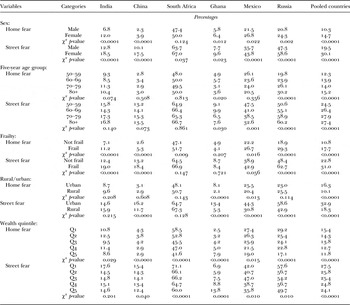
Table 3 presents bivariate analysis for a number of characteristics potentially associated with fear of crime. It shows a consistent significant effect for sex, with older women reporting higher rates of home and street fear in five countries. In the case of South Africa, women also reported higher rates of fear, but it was not statistically significant. This may have been due to the very high overall prevalence of fear in South Africa, which meant that men and women both felt highly exposed. Table 3 shows associations between chronological age and fear of crime for the pooled data, but these are less evident and less consistent at the national level.Footnote 9 Frailty is significantly associated with both home and street fear for the pooled data and for three of the six countries (India, China and Russia). Frailty is also significantly associated with home fear in South Africa and Mexico. In the case of Ghana there was no effect, and frail older people were marginally less likely to report fear than their non-frail counterparts.
Age-standardised prevalence of home and street fear by potential determinants and country

Note: Q1–Q5: quintiles 1 (poorest) to 5 (wealthiest).
Table 3 also presents data on fear of crime for five wealth quintiles of older people, with quintile 1 the poorest and quintile 5 the wealthiest.Footnote 10 This reveals significant associations for both home and street fear for the pooled data, with higher rates for poorer groups. There are also significant associations for home and street fear for five of the six countries, the exception being India where it is only significant for street fear. In all countries, other than Ghana, being in a higher wealth quintile is associated with lower rates of fear. Curiously, in Ghana the opposite occurs, with wealthier groups expressing higher rates of fear. The pooled data show that living in a rural area was associated with significantly lower rates of home and street fear. At the national level, there was a similar pattern of significant associations in Ghana and Mexico. In China and Russia, urban location was significantly associated with street fear, but not with home fear. By contrast, in India and South Africa rural location was associated with higher rather than lower levels of fear.Footnote 11
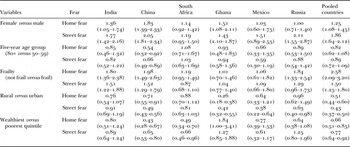
As well as analysing the effects of different potential determinants on an individual basis, it is helpful to consider how these effects may interact. For example, if older age groups in the SAGE samples contain higher proportions of women, the higher rates of street fear for people aged 80 and over reported in Table 3 may potentially be a consequence of sex rather than age per se. We did not, however, find any significant age–sex interaction in the adjusted logistic regression model. Table 4 presents OR for the different potential determinants considered in Table 3, as part of a multivariable model.Footnote 12 For the pooled data all the determinants, other than five-year age group, are shown to have significant effects for both home and street fear. At the national level, the effect of frailty is less consistent, with significant associations with home and street fear for India and China. Frailty is also associated with home fear in the Russian Federation. In the case of China, there are significant associations for all the potential determinants, age included. This in part reflects China's large population and hence large sample size, which increases the power of the statistical analysis. For the other SAGE countries there are fewer significant multivariate associations, suggesting that interactions between specific determinants cancel out their intrinsic effects.
Adjusted odds ratios with 95 per cent confidence intervals for fear, by country

Potential effects of fear of crime
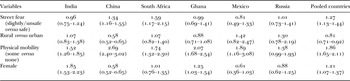
SAGE has several items that refer to mobility and social networking, including: ‘How often in the last 12 months have you gone out of the house/your dwelling to attend social meetings, activities, programmes or events, or to visit friends or relatives'. When considering associations between fear of crime and social networking outside the home, it is important to take into account the effect of a number of potential confounders. The most obvious of these is older people's general capacity to move around, be it inside the home or beyond.Footnote 13 In certain settings, notably South Asia, there are sometimes cultural norms that inhibit the mobility of older women, especially widows (Nayar Reference Nayar2006). Rural or urban location may also have a significant effect on the geographical proximity of social networks and the availability of suitable infrastructure to permit local travel (such as public transport). Table 5 presents the results of a multivariate model which assesses the effect of street fear on socialising outside the home, controlling for these potential confounders. Predictably, older people's physical mobility exerts a significant effect across all the countries, with the marginal exception of Russia. The effect of sex on socialising outside the home varies by country: in India and Ghana female sex is associated with reduced socialising, while in China it is associated with higher rates. This is in line with expectations based on gender relations in later life in these countries (Nayar Reference Nayar2006; Opong Reference Opong2006; Yuan Reference Yuan2011). Street fear is significantly associated with restricted socialising for the pooled data, South Africa and China.Footnote 14 Separate analysis shows that street fear is associated with less frequent use of outpatient health services at the pooled level, when controlling for self-reported health status (OR = 0.88, 95% CI = 0.78–0.98).Footnote 15 This suggests that older people with street fear are less inclined to leave the home to seek health care, even when they consider themselves to be unwell.
Adjusted odds ratios with 95 per cent confidence intervals for never leaving house for social events, visiting friends or relatives, by country

Note: Odds ratios are adjusted for age and sex.
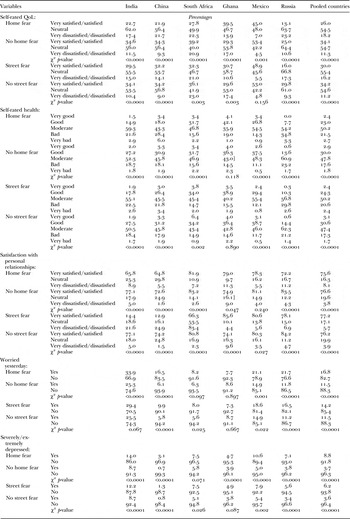
SAGE includes a very large number of items on older people's health and quality of life. Table 6 summarises simple associations between fear and a selection of these items: self-rated quality of life, self-rated health, satisfaction with personal relationships and self-reported depression.Footnote 16 This shows significant associations for home and street fear with all these items for the pooled data and, in almost all cases, for the national data. For example, a higher proportion of older people who reported home fear (18.2%) also reported they were very dissatisfied/dissatisfied with their lives than those who did not (11.3%). Similarly, a higher share of those reporting street fear (24.3%) reported bad/very bad health than those who did not (17.3%), and a higher share of those reporting home fear (8.8%) described themselves as severely or extremely depressed than those who were not afraid (3.7%).
Bivariate analysis between home fear and street fear and health and quality of life (QoL) by country (age-standardised)

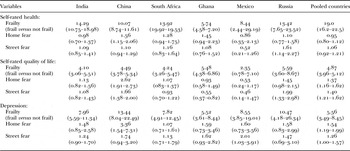
Table 7 presents the results of a multivariate analysis of the effects of home fear, street fear and frailty on self-rated health, self-rated quality of life and depression. For the pooled data, there are significant associations with self-rated quality of life and depression, but not for self-rated general health status. For individual countries, there are fewer significant associations and the direction of effects is not always consistent. As in the other multivariable analyses, there are relatively more significant results for China, due, in part, to its larger sample size. In the case of Ghana, counterintuitively, the data indicate that street fear is associated with higher self-rated quality of life when the effect of frailty is also taken into account.
Adjusted odds ratios with 95 per cent confidence intervals for self-rated health, self-rated quality of life and depression1

Notes: Odds ratios are adjusted for age and sex. 1. To facilitate comparison, home and street fear are in the same table. Their associations were analysed in separate models, rather than jointly.
Discussion
In terms of prevalence of crime fear, variations between the different SAGE countries are larger than variations according to other criteria. There is some evidence that national rates of reported fear of crime are to some extent influenced by cultural factors (Marenin Reference Marenin1997). However, the scale of national variation suggests that this is a genuine effect and this national diversity is in keeping with data on fear in high-income countries.Footnote 17 Another potential explanation for these large national variations could include differences in infrastructure, such as street lighting and well-maintained pavements. However, there are no indications that the conditions of the streets or the safety of public transport are substantially worse in South African or Mexican cities than those of the other SAGE countries (WHO 2004). Additionally, large national variations in street fear could be an artefact of variations in frailty (and hence fear of falling) across the national samples. However, separate analyses of SAGE data do not reveal large national variations in frailty (Harttgen et al. Reference Harttgen, Kowal, Strulik, Chatterji and Vollmer2013). Having excluded these alternative explanations, it is likely that differences in reported rates of street fear are due to actual variations in fear of crime and violence. The very high rates of fear and actual experience reported for South Africa and Mexico are in line with the findings of other studies (Roberts 2008; Vilalta Perdomo Reference Vilalta Perdomo2010).
The findings indicate that the Experiential Model has some validity in predicting fear of crime among older people. The Russian Federation stands out as having high rates of fear, relative to the other SAGE countries, but low levels of actual experience. One reason may be that average household sizes were low for the Russian population (2.6 compared to 4.3 for SAGE as a whole), reducing the number of household members potentially exposed to violent crime.
The findings also offer some support for the General Vulnerability Model of crime fear. The reported association between female sex and fear of crime is in keeping with the findings of other studies of high-income countries (Acierno et al. 2006; Chadee and Ditton Reference Chadee and Ditton2003; Chivite-Matthews and Maggs Reference Chivite-Matthews and Maggs2002; de Donder, Verté and Messelis Reference de Donder, Verté and Messelis2005), as well as in China (Liu et al. Reference Liu, Messner, Zhang and Zhuo2009). However, some studies have questioned the validity (or at least the strength) of this finding, suggesting that men may be less open than women to admitting fear (Sutton and Farrall Reference Sutton and Farrall2005).
Other effects associated with the Vulnerability Model of crime fear, including old age, are less consistently evident in the findings. Early fear of crime studies suggested a close relationship with older ages and this became a conventional wisdom (Harris Reference Harris1975; Pantazis Reference Pantazis2000). However, subsequent research has questioned this effect, suggesting that younger adults, particularly adolescents, have higher levels of fear, in line with a model of victimisation rather than vulnerability (Chadee and Ditton Reference Chadee and Ditton2003). A number of other studies from LMICs have assessed associations with age. Research from China and South Africa found that older people reported lower levels of fear than younger adults (Liu et al. Reference Liu, Messner, Zhang and Zhuo2009; Roberts 2008). A survey of three neighbourhoods in Accra, Ghana found that there was no positive association between older age and fear of crime, and it was suggested that this was because older people were less likely to live alone (Adu-Mireku Reference Adu-Mireku2002).
Most criminological studies treat age as a simple, chronologically defined category, rather than taking a more sophisticated approach. A particular strength of SAGE compared to more specialised crime surveys is that it contains sufficient items on health, function and quality of life to permit the elaboration of a robust frailty index. No other studies have previously assessed the effect of frailty on fear of crime, either in high-income countries or LMICs. The multivariate analysis of determinants of crime fear shows that frailty is a better predictor than is chronological age and so this effect should be included in crime surveys wherever possible.
Numerous other studies of crime fear in high-income countries have reported significant associations with poverty and low income (Acierno et al. Reference Acierno, Rheingold, Resnick and Kilpatrick2004; de Donder, Verté and Messelis Reference de Donder, Verté and Messelis2005). Research from LMICs has reported more varied results. Nalla, Johnson and Hayes-Smith (Reference Nalla, Johnson and Hayes-Smith2011) observe that middle-class Indians report lower levels of fear than wealthier ones, whereas Liu et al. (Reference Liu, Messner, Zhang and Zhuo2009) report an association with poverty in China. It is conceivable that these effects vary according to the nature of the crime being feared, with wealthier groups feeling more at risk of property crime and poorer ones feeling exposed to personal crime. The SAGE data do not offer this level of information and so it is not possible to separate these effects. Generally, fear of crime was more prevalent among poorer quintiles, although the opposite was reported for Ghana. There are no other studies of socio-economic status and fear of crime in Ghana, either for older people or the population in general, and so this finding calls for additional contextual research.
Most studies focused on the ‘broken window syndrome’ explore these environmental effects at the level of individual urban neighbourhoods, implying that they are less important in rural settings (Skogan Reference Skogan1990; Villareal and Silva Reference Villareal and Silva2006). SAGE does not provide data for specific urban neighbourhoods, but comparisons between older people living in urban and rural locations indicate higher rates of fear in urban locations are not a universal national phenomenon and point to important national variations in how geographical determinants of crime fear operate. The assumption that rates of fear are higher in urban settings has been used to justify excluding rural populations in some surveys of crime fear, including two recent studies in India (Nalla, Johnson and Hayes-Smith Reference Nalla, Johnson and Hayes-Smith2011; Help Age India 2011).
The finding that street fear is associated with more limited mobility beyond the home for the pooled data and for South Africa and China is in line with the findings of other studies of older people in high-income countries (Stafford, Chandola and Marmot Reference Stafford, Chandola and Marmot2007; Clark et al. Reference Clark, Kawachi, Ryan, Ertel, Fay and Berkman2009). The finding that older people who report street fear are less likely to use health services has not been assessed in other studies. Whilst this is an issue of particular policy relevance, the robustness of this finding is reduced by lack of significance at the individual country level.
Great care must be taken in attributing cause and effect in the relationship between fear and mobility, health and quality of life. As discussed in the conceptual framework, some limited insights about cause and effect by looking at interactions between health, frailty and fear. This multivariate analysis provides a complex picture, suggesting that fear of crime may affect health and quality of life in some cases, but that this relationship is less consistent and more complex than indicated by the simple bivariate associations.
Conclusions
There is a substantial body of evidence from richer countries that crime and insecurity, both directly and in terms of the fear they generate, can exert an important effect on older people's wellbeing. This issue has been largely neglected in LMICs, where research on older people remains focused on income security and access to health services. This paper is the first systematic analysis of patterns, determinants and potential effects of fear of crime across six diverse national settings. Rates of reported experience and fear vary substantially across countries, with South Africa and Mexico standing out from the SAGE sample. Interestingly, South Africa and, to some extent, Mexico are often portrayed as relatively successful in meeting the welfare needs of older people, largely thanks to their universal pension provision (Licona Alberto Reference Licona Alberto and Huenchuan2013; Lloyd-Sherlock et al. Reference Lloyd-Sherlock, Barrientos, Moller and Saboia2012). It is possible that the wellbeing benefits of generous pensions may be undermined if older people do not feel safe inside or outside their own homes.
Some of the findings presented here are in line with results for studies of individual LMICs or higher-income countries. These include the higher rate of both home and street crime fear among women, even when controlling for other variables. With the exception of Ghana, older people in poorer wealth quintiles also experience higher rates of crime fear, bringing an element of equity into the issue. Generally, urban residence was associated with higher rates of experience and fear, although India stood out as an important exception. This calls into question a tendency to exclude rural locations from crime surveys, perhaps resulting from stereotyped views of crime and fear associated with the environmental social disorder model. The paper indicates that debates about chronological age and fear of crime are somewhat misleading. Drawing on the large number of SAGE items on health and functional status, the paper demonstrates that frailty is by some distance the most important determinant of fear, irrespective of other factors such as age or sex. This finding may be of little surprise for gerontologists, but will be news to mainstream criminologists.
Fear of crime is strongly associated with limited mobility outside the home, and a wide range of undesirable health and quality of life outcomes, but separating out the direction of causality is not easy. When frailty was introduced into a simple multivariate model, these associations were less consistent, particularly at the national level. As such, the findings do not in themselves offer robust evidence that fear of crime leads to depression and poorer health outcomes. Some studies suggest that seeking to separate out the direction of causality may in fact over-simplify potentially complex reciprocal effects. With reference to qualitative data from the UK, Whitley and Prince (Reference Whitley and Prince2005) find a strong association between common mental disorders and fear of crime. They argue that seeking to disentangle cause and effect within this association would be difficult to achieve and is probably misguided. Instead of modelling relationships between fear of crime and mental health in simple, linear terms, they argue that: ‘there is an on-going inter-penetration between fear of crime and mental health with both continuously affecting each other’ (Whitley and Prince Reference Whitley and Prince2005: 1686).
Rather than demonstrate that fear of crime is less influential on older people's health than is sometimes claimed, the lack of significant associations reported by this study may result from the limitations of our study design. While the total sample size was substantial, individual country samples may have been too small to capture significant associations. Also, the SAGE survey only includes a small number of questions related to crime and these have a number of shortcomings. To more effectively explore reasons for the varied experiences across and within the SAGE countries, there is an evident need for richer, qualitative insights to complement this limited set of quantitative data. This will serve to shed light on reasons for unusual national experiences, such as that of Ghana, where fear of crime was associated with higher wealth and, when frailty was taken into account, with higher rates of self-reported quality of life. In addition, there is a need for more in-depth research in specific locations, such as deprived urban neighbourhoods, where older people may be particularly exposed to crime and its effects.
Supplementary Material
To view supplementary material for this article, please visit http://dx.doi.org/10.1017/S0144686X15000513