


1. Introduction
Over the past several decades, policy linkage in the context of piecemeal reforms has been extensively studied in the field of international trade and the environment. Copeland (Reference Copeland1994), which is the first study to explicitly deal with this issue, examines the welfare impact of tariffs and pollution taxes in a small open economy to demonstrate that proportional tariff cuts and proportional removal of all pollution distortions improve the small country's welfare provided that all industries protected by tariffs tend to be heavy polluters. Subsequent literature following Copeland (Reference Copeland1994), such as Beghin et al. (Reference Beghin, Roland-Holst and Van Der Mensbrugghe1997) and Turunen-Red and Woodland (Reference Turunen-Red, Woodland and Woodland2002, Reference Turunen-Red and Woodland2004), mainly focuses on the welfare implications of trade and environmental policies.Footnote 1
While welfare is obviously an important target for policy makers, another important aspect emerges when examining the issue of trade and the environment: market access. For instance, in the recent trade negotiations, there were some concerns about whether policy makers can remove trade restrictions and distortions to ensure that market access for developing countries is not worsened, and whether the introduction of tougher environmental regulations will impede the international trade of goods and services and thereby worsen market access for developing countries. While these issues are gaining greater importance and were in fact reflected in the WTO's latest trade negotiations in Doha,Footnote 2 no attempt has been made to investigate this issue within a formal framework.
The purpose of this paper is to examine how market access and welfare are affected by piecemeal reforms of tariffs and pollution taxes in a small open economy. In particular, we characterize sufficient conditions under which a tariff reform and a pollution tax reform increase the value of the small country's imports. It is shown that uniform proportional cuts in tariffs (known as the UPC rule) that increase welfare do not necessarily improve market access, and the rule of tariff reforms that improves market access (known as the Ju–Krishna rule) does not necessarily increase welfare. A reduction of all pollution distortions proportional to their degree of distortion can be shown to improve both welfare and market access.
Ju and Krishna (Reference Ju and Krishna2000) is the first study to deal with the market access effects of piecemeal tariff reforms. While characterizing sufficient conditions under which a tariff reform improves market access and the link between welfare and market access in response to a tariff reform, their model does not consider pollution and environmental policy, which is the main focus of our study. Anderson and Neary (Reference Anderson and Neary2007) study the same issue in a more general setting, and Kreickemeier and Raimondos-Møller (Reference Kreickemeier and Raimondos-Møller2008) examine the coordinated tariff-tax reforms that improve market access in a small open economy with no environmental externality. Kawahara (forthcoming) introduces a consumption-generated pollution into the model to examine how piecemeal reforms of tariffs on clean imports (defined as ‘environmentally preferable products’) affect a small country's welfare and its value of imports. The present paper examines how a pollution tax reform affects a country's value of imports, and how a tariff reform affects a country's value of imports in the presence of production-generated pollution. Furthermore, we seek to find positive results as to whether a tariff reform and a pollution tax reform can improve both welfare and market access.
The remainder of this paper is organized as follows. The next section describes the model that will be used throughout the analysis and examines the market access effect of tariffs and pollution taxes. The final section concludes the paper.
2. Welfare and market access
The model we use is the one developed by Copeland (Reference Copeland1994). We consider a small open economy that produces N + 1 goods. Let good 0 be the numeraire good on which neither tax nor subsidy is imposed. Let t = (t 1,…,t N ) represent the vector of import tariffs, where t i > 0 if m i > 0 and t i = 0 otherwise for i = 1, …, N. Thus, the domestic price of these non-numeraire goods is related to world price p w : p = p w + t. The production of goods generates K types of pollutants z = (z 1,…,z K ) that negatively affect the utility of the representative consumer u, the behavior of which is summarized by the expenditure function e(p, z, u).Footnote 3 All pollutants are regulated by a set of pollution taxes at rate τ = (τ1,…,τ K ). Thus, the GDP function, which represents the competitive production sector, can be written as g(p, τ).Footnote 4 The application of the envelope theorem yields the compensated demand for goods as c = e p , the supply of goods as y = g p , and the supply of emissions as z = −g τ. We assume that the change in z does not directly affect the compensated demand for goods, that is, e pz = 0.Footnote 5 All vectors are treated as column vectors and a prime (′) is used to denote a transpose.
The equilibrium of our small open economy can be represented by the following set of equations:
 $$e\lpar p\comma \; z\comma \; u\rpar = g\lpar p\comma \; \tau\rpar + t^{\prime}m + \tau^{\prime}z\comma \;$$
 $$m = e_p\lpar p\comma \; z\comma \; u\rpar - g_p\lpar p\comma \; \tau\rpar \comma \;$$
 $$z = -g_{\tau}\lpar p\comma \; \tau\rpar \comma \;$$
where m is the net import demand vector. Assuming that the tax revenue is uniformly distributed to the consumer, equation (1) can be interpreted as the country's budget constraint. Equation (2) defines the net import demand as a difference between the country's demand and supply, and equation (3) recovers the level of pollution from the GDP function. Following Ju and Krishna (Reference Ju and Krishna2000), we define the degree of market access as the value of imports that the country would accept at a particular world priceFootnote 6 :
 $$M = p^{w\prime} {\tilde m}\comma \;$$
where
 ${\tilde m}^i = m^i = e_p^i \lpar p\comma \; z\comma \; u\rpar - g_p^i \lpar p\comma \; \tau\rpar $
if m
i
> 0 and
 i
= 0 otherwise for i = 1, …, N. Equations (1)–(4) can be used to derive equations used to evaluate the welfare and the market access effects of policy reforms. First, totally differentiating (1)–(3) and rearranging give the equation representing the welfare effect of policy reforms derived by Copeland (Reference Copeland1994)Footnote
7
:
 $$\lpar e_u - t^{\prime}e_{pu}\rpar du = \lsqb t^{\prime} m_p + \lpar e_z - \tau\rpar ^{\prime} g_{\tau p}\rsqb dt + \lsqb \lpar e_z - \tau\rpar ^{\prime} g_{\tau \tau} - t^{\prime}g_{p\tau}\rsqb d\tau\comma \;$$
where m p = e pp − g pp is a negative semi-definite matrix. Assuming that all goods are normal, the sign of the coefficient of du on the left-hand side of (5) becomes positive.Footnote 8 Next, totally differentiating (4) and using (5) give the equation representing the market access effect of policy reforms:
 $$dM = \lsqb \lpar p^w + \lambda t\rpar ^{\prime}m_p + \lambda\lpar e_z - \tau\rpar ^{\prime}g_{\tau p}\rsqb dt + \lsqb \lambda\lpar e_z - \tau\rpar ^{\prime} g_{\tau \tau} - \lpar p^w + \lambda t\rpar ^{\prime}g_{p\tau}\rsqb d\tau\comma \;$$
where
 $\lambda = p^{w^{\prime}}e_{pu}/\lpar e_{u}-t^{\prime}e_{pu}\rpar $
is a scalar that satisfies λ∈ (0, 1).Footnote
9
2.1. Tariff reform
Consider a simple tariff reform rule: a reduction of all tariffs by the same proportion dt = −tα, where α > 0. This is known as the UPC rule, and the welfare effect under this sort of tariff reform in the presence of pollution was examined by Copeland (Reference Copeland1994). That is, substituting dt = −tα and dτ = 0 into (5), Copeland, (Reference Copeland1994) obtains the welfare effect of the tariff reform:
 $$\lpar e_u - t^{\prime}e_{pu}\rpar du = -t^{\prime} m_pt \alpha - \lpar e_z - \tau\rpar ^{\prime}g_{\tau p} t\alpha.$$
Copeland (Reference Copeland1994) interpreted the ith element of the term
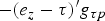 $-\lpar e_{z}-\tau\rpar ^{\prime}g_{\tau p}$
as the pollution damage intensity of industry i, and concluded that if all industries protected by import tariffs were pollution damage intensive, the welfare effect of the tariff reform would become positive.
On the other hand, substituting dt = −tα and dτ = 0 into (6), we obtain the market access effect of the tariff reform:
 $$dM = -\lpar p^w + \lambda t\rpar ^{\prime}m_p t\alpha -\lambda \lpar e_z - \tau\rpar ^{\prime} g_{\tau p} t \alpha.$$
The first term on the right-hand side of (8) represents the effect of tariff reform on the value of imports through the change in import demand. For interpretation, we decompose this term into two effects. The tariff reform changes the domestic price of goods, which affects the demand for imports. On the one hand, this will simply change the value of imports while, on the other, the change in import demand will have an impact on the remaining tariff distortions. This will affect welfare and hence generate an income effect that changes the value of imports. Unlike the welfare effect, the sign of this term is ambiguous and, hence, the UPC rule of tariff reform may not improve market access. In this case, a tariff reform of the type dt = −(p w + λt)α, suggested by Ju and Krishna (Reference Ju and Krishna2000), determines the sign of the first term as being non-negative. The second term represents the effect of tariff reform on the value of imports through the change in pollution. The sign of this term becomes positive if all industries that are protected by import tariffs are pollution damage intensive. The tariff reform in this case corrects the existing pollution distortions, which works in the direction of increasing welfare. This will generate a positive income effect that increases the demand for imports. Thus, we derive the following proposition concerning the market access effect of tariff reform.
Proposition 1
Suppose that all industries that are protected by import tariffs are pollution damage intensive. Then, we have the following.
-
(a) The tariff reform dt = −tα, α > 0, which improves welfare (Copeland Reference Copeland1994), may or may not increase the value of imports. The value of imports increases in the case of a tariff reform of type dt = −tα, α > 0, if all initial tariffs are set at the same ad valorem rates.
-
(b) The tariff reform dt = −(p w + λ t)α, α > 0, which increases the value of imports in the model without pollution (Ju and Krishna Reference Ju and Krishna2000), also increases the value of imports in the Copeland model. A tariff reform of type dt = −(p w + λt)α, α > 0, improves welfare, if all initial tariffs are set at the same ad valorem rates.
Proof: See appendix.
Part (a) in Proposition 1 describes how the UPC rule affects the value of imports. In the Copeland model, the UPC rule increases the value of imports, if (i) all industries that are protected by import tariffs are pollution damage intensive, and (ii) all tariffs are set at the same ad valorem rates. Since (i) is only relevant in the Copeland model, the UPC rule also increases the value of imports under (ii) in the model without pollution. The only difference between the models with and without pollution is the presence of the second term on the right-hand side of (8). As discussed above, this term represents the income effect on the value of imports arising from pollution, and its sign depends on whether the tariff-protected industries are pollution damage intensive. In particular, if tariff-protected industries are not pollution damage intensive, then the sign of this term becomes negative, which decreases the value of imports. That is, the UPC rule that satisfies (ii) and hence increases the value of imports in the model without pollution might rather decrease the value of imports in the Copeland model. A sufficient condition for not decreasing the value of imports is condition (i).
Part (b) describes how the Ju–Krishna rule affects the value of imports and welfare. As demonstrated by Ju and Krishna (Reference Ju and Krishna2000), the Ju–Krishna rule always increases the value of imports in the model without pollution. However, in the Copeland model, a tariff reform generates an income effect arising from pollution. If tariff-protected industries are not pollution damage intensive, then the sign of the income effect becomes negative, which decreases the value of imports. That is, the Ju–Krishna rule that increases the value of imports in the model without pollution might rather decrease the value of imports in the Copeland model. A sufficient condition for the reform not to decrease the value of imports is condition (i). Whether the Ju–Krishna rule increases welfare, irrespective of the existence of pollution, depends on whether the rule coincides with the UPC rule. Since the Ju–Krishna rule is essentially equivalent to the UPC rule under condition (ii), the Ju–Krishna rule increases welfare in the model without pollution. In the Copeland model, we need to have both conditions (i) and (ii) for welfare improvement. In this case, the Ju–Krishna rule increases both welfare and the value of imports.
2.2. Pollution tax reform
Next, consider a simple pollution tax reform rule: a reduction of all pollution distortions proportional to the pollution distortion vector dτ = (e z − τ)α, where α > 0. The welfare effect of this sort of pollution tax reform was also examined by Copeland (Reference Copeland1994). That is, substituting dτ = (e z − τ)α and dt = 0 into (5), Copeland (Reference Copeland1994) obtains the welfare effect of the pollution tax reform:
 $$\lpar e_u-t^{\prime}e_{pu}\rpar du = \lpar e_z-\tau\rpar ^{\prime}g_{\tau\tau} \lpar e_z-\tau\rpar \alpha -t^{\prime}g_{p\tau} \lpar e_z-\tau\rpar \alpha.$$
Using expressions analogous to (9), Copeland (Reference Copeland1994) concluded that, as in the tariff reform, if all tariff-protected industries were pollution damage intensive, the welfare effect of the pollution tax reform would become positive.
On the other hand, substituting dτ = (e z − τ)α and dt = 0 into (6), we obtain the market access effect of the pollution tax reform:
 $$dM = \lambda\lpar e_z - \tau\rpar ^{\prime} g_{\tau \tau} \lpar e_z - \tau\rpar \alpha - \lpar p^w + \lambda t\rpar ^{\prime} g_{p\tau} \lpar e_z - \tau\rpar \alpha.$$
The first term on the right-hand side of (10) represents the effect of pollution tax reform on the value of imports through the change in pollution. The sign of this term is non-negative because of the positive semi-definiteness of g ττ. The pollution tax reform corrects the existing pollution distortions, which works in the direction of increasing welfare. This will generate a positive income effect that increases the demand for imports. The second term represents the effect of pollution tax reform on the value of imports through the change in production. The sign of this term becomes positive if all tariff-protected industries are pollution damage intensive. For interpretation, we decompose this term into two effects. The pollution tax reform typically reduces the output of the polluting industry. On the one hand, this will simply increase excess demand by shrinking production (supply). On the other hand, if these polluting industries are protected by import tariffs, the contraction of the polluting industry also corrects the remaining tariff distortions. This will work in the direction of increasing welfare and hence generate a positive income effect that increases the value of imports. We derive the following proposition concerning the market access effect of pollution tax reform.
Proposition 2
If all industries protected by import tariffs are pollution damage intensive, the pollution tax reform dτ = (e z − τ)α, α > 0, which improves welfare (Copeland, Reference Copeland1994), increases the value of imports.
Proposition 2 shows that, under the relevant correlation condition, a reduction of all pollution distortions proportional to their degree of distortion increases the value of imports. As discussed above, this rule of pollution tax reform also increases welfare. Therefore, as long as the correlation condition is satisfied, a policy maker who properly knows the marginal damage from pollution e z can achieve both welfare improvement and market access enhancement by implementing the pollution tax reform.
3. Concluding remarks
This paper investigated how market access and welfare would be affected by piecemeal reforms of tariffs and pollution taxes in a small open economy. First, we showed that the famous UPC rule that led to welfare improvement also increased the value of imports if all tariffs were set at the same ad valorem rates. Second, we showed that if all industries protected by import tariffs were pollution damage intensive, applying the Ju–Krishna rule of tariff reform would increase the value of imports. If all tariffs were set at the same ad valorem rates, then the Ju–Krishna rule also improved welfare. Finally, we showed that if all industries protected by import tariffs were pollution damage intensive, a reduction of all pollution distortions proportional to their degree of distortion increased both welfare and the value of imports.
When deriving our results, we repeatedly used the condition that all industries protected by import tariffs were pollution damage intensive. Obviously, this condition is a sufficient condition and has been extensively used in the previous literature (Copeland, Reference Copeland1994 and others).Footnote 10 If this condition is not satisfied, the welfare and market access effects depend on the relative magnitude of the positive and negative impacts on remaining distortions from tariffs and pollution taxes. In particular, if all pollution taxes τ are set close to the marginal damage e z , then the negative side effect on pollution distortions arising from the tariff reform becomes smaller and hence the welfare and market access effects of the reform are the same as those in the model without pollution. If, on the contrary, the gap between pollution taxes and marginal damage is very large, the negative side effect arising from the reform would be greater. This paper characterizes the conditions under which these reforms have a positive side effect on the remaining distortions.
Appendix
This appendix describes the proof of Proposition 1. First, consider part (a). To examine the sign of the terms on the right-hand side of (8), we re-express the specific tariff vector t by using the equivalent ad valorem tariff vector s as
 $$t = \left[\matrix{s^1 &0 &\ldots &0\cr 0 &s^2 &\ldots &0 \cr \vdots &\vdots &\ddots &0 \cr 0 &\ldots &\ldots &s^N} \right]\left[\matrix{p^{w1} \cr p^{w2} \cr \vdots \cr p^{wN}} \right]= sp^w\comma \;$$
and use this relationship to rewrite the first term on the right-hand side of (8) as
 $$-\lpar p^w + \lambda t\rpar ^{\prime} m_p t \alpha = -\lpar p^w + \lambda sp^w\rpar ^{\prime} m_p sp^w\alpha.$$
If all ad valorem tariffs are set at an identical level (s i = s* for all i), this can be written as
 $$-\lpar 1 + \lambda s^{\ast}\rpar s^{\ast} p^{w\prime}m_p p^w \alpha \ge 0.$$
Thus, in this case, the market access effect of a tariff reform of type dt = −tα, α > 0, will be positive if all industries that are protected by import tariffs are pollution damage intensive.
Next, consider part (b). Considering (5), a tariff reform of type dt = −(p w + λ t)α, α > 0, improves welfare if
 $$-t^{\prime} m_p \lpar p^w + \lambda t\rpar \alpha + \lpar e_z -\tau\rpar ^{\prime} g_{\tau p} \lpar p^w + \lambda t\rpar \alpha \gt 0.$$
If all ad valorem tariffs are set at an identical level (s i = s* for all i), then the first term on the left-hand side of the above inequality can be written as
 $$-s^{\ast}\lpar 1 + \lambda s^{\ast}\rpar p^{w\prime}m_p p^w \alpha \ge 0.$$
Thus, in this case, the welfare effect of a tariff reform of type dt = −(p w + λt)α, α > 0, will be positive, if all industries that are protected by import tariffs are pollution damage intensive.


