INTRODUCTION
Free-ranging ruminants have to make various decisions when foraging, which concern the site where to forage within a given environment, the time of foraging at a certain forage place before leaving to another, and the plants and plant items to be selected (reviewed by Dumont & Gordon Reference DUMONT, GORDON, ‘t Mannetje, Ramírez-Avilés, Sandoval-Castro and Ku-Vera2003). Thus, the choices made by grazing or browsing herbivores on where to forage preferentially depend on several factors related to the forage itself such as forage quality (Ball et al. Reference BALL, DANELL and SUNESSON2000) or the spatial abundance of the plant species that are preferred (Dumont et al. Reference DUMONT, CARRÈRE and D'HOUR2002). It may also be influenced by external factors such as perceived threat of predation (Shrader et al. Reference SHRADER, BROWN, KERLEY and KOTLER2008), avoidance of areas contaminated with faeces and thus parasites (Hutchings et al. Reference HUTCHINGS, GORDON, KYRIAZAKIS and JACKSON2001), or social factors such as the proximity of herd members (Dumont & Boissy Reference DUMONT and BOISSY2000).
Optimal foraging theory has often been used in explaining or predicting decisions on diets made by foraging animals, basically assuming that the animals are trying to maximize a certain currency, such as energy supply, per unit of time (Pyke et al. Reference PYKE, PULLIAM and CHARNOV1977). The selection for specific nutrients (e.g. Na; Belovsky Reference BELOVSKY1978), the avoidance of deterrent levels of plant secondary metabolites (Bryant et al. Reference BRYANT, REICHARDT and CLAUSEN1992) or attempts to maintain optimal rumen conditions (Cooper et al. Reference COOPER, KYRIAZAKIS and NOLAN1995) might also influence plant selection. However, several other factors might also affect selection behaviour or animal diets. This includes previous experience with the forage (Ganskopp & Cruz Reference GANSKOPP and CRUZ1999) and the familiarity with the environment. In an unfamiliar environment, the social influences could be stronger than the individual forage preferences (Scott et al. Reference SCOTT, BANNER and PROVENZA1996).
In the present study, cattle were used as a model of a generalist large-mammal herbivore. Many studies have dealt with grazing behaviour of cattle on rangelands and pasture, but few studies have considered plant species selection in diverse forest environments of tropical or subtropical regions. The study site for the present study was chosen in the montane forests of southern Bolivia in the Department of Tarija. There livestock systems are mainly based on extensive grazing and represent a source of income for local farmers. Cattle are still traditionally managed in transhumant systems, i.e. the seasonal translocation of the cattle between different types of grazing sites (grasslands and montane forests). In the study area, the climate is characterized by annual variability of temperature and precipitation, which influences the forage amount provided by the grasslands used for grazing in the rainy season. With the beginning of the dry season (April/May) the cattle are transferred to the montane forests until the rainfalls lead to re-growth of forage resources and the cattle are moved back to the grasslands (October/November). Much of the area used for forest grazing (so-called puestos ganaderos) in the study area is situated within the Reserva Nacional de Flora y Fauna Tariquía. This is part of the National System of Protected Areas (SNAP), established to preserve the unique ecosystem of the Bolivian–Tucuman montane forests in Bolivia (Ribera & Liberman Reference RIBERA and LIBERMAN2006).
The objective of the present study was to determine the frequency of selection of plant functional groups by free-ranging Criollo cattle in the Bolivian–Tucuman montane forests, its variation during the dry and the prehumid season, and the plant species more frequently selected by the cattle. According to the common classification of cattle as ‘grass and roughage eaters’ (Hofmann Reference HOFMANN1989) it was hypothesized that the animals would prefer graminoids over non-graminoids which thus would make up the major proportion in plant selection. It was assumed that the cattle would adapt their selection pattern to the seasonal changes in forage on offer, and that the cattle will mainly forage on a limited number of forage plant species.
METHODS
Study sites
The study was conducted in the tropical montane forests of southern Bolivia, Province O'Connor, Department of Tarija. Two study sites were chosen within the Reserva Nacional de Flora y Fauna Tariquía, a protected area of 247000 ha of size, inhabited by some 3000 people and founded in 1989 (Arnold et al. Reference ARNOLD, CHÁVEZ, SALINAS and ZAMORA2000). The reserve including the surrounding buffer zone was grazed by approximately 36000 cattle in 2002 (Alvarez G. Reference ALVAREZ2003). Both study sites are traditionally used as forest grazing areas for cattle by local livestock keepers of the valley of Salinas from April–May to October–November (dry and prehumid season). The study sites Río Tarija (RT, 21°48′S; 64°23′W) and Meringal (M, 21°55′S; 64°17′W), are located about 18 km south-west and 18 km south of the community of Salinas (21°45′S; 64°13′W), respectively. The altitudinal levels ranged from about 900 to 1100 m asl (RT) and 800–950 m asl (M). According to measurements with GPS, the two study sites, where the present study was conducted, comprise about 187 (RT) and 138 ha (M), respectively, and can be classified into two main habitats, whereof 182 and 135 ha were forest (with some small open grassland patches of <1 (RT) and about 3 ha (M)). Areas of 5 (RT) and 3 ha (M) were river and river banks, respectively. It has to be stated that at the end of the observation period a small grassland area at the Meringal study site was burnt occasionally to stimulate herbaceous re-growth. This probably led to more intensive grazing as a consequence to herbaceous re-growth in that small area than it would have been otherwise.
The natural vegetation type of the region can be classified as ‘Boliviano-Tucumano subandean semideciduous and seasonal evergreen vegetation’ (Navarro Reference NAVARRO, Navarro and Maldonado2004). Detailed local climate data of the study sites are lacking. The closest meteorological station was located in the village of Salinas. Short-term estimates, based on meteorological data from 1988 to 1999, are 18.7 °C annual average temperature and 1334 mm annual precipitation (SENAMHI 2006).
Experimental animals
The experimental animals were adult female cattle (3–8 y of age, c. 200–350 kg body weight) of Criollo breed (Bos taurus). This genotype is largely derived from breeds introduced by the Spanish in the 16th century (Vacaflores R. et al. Reference VACAFLORES, DEL CARPIO, CALLA and MOLINA2003). The animals were kept in a suckler-beef type system, i.e. calves accompany cows until being naturally weaned. Only cattle that could be approached closely (1–3 m) by the observer without showing signs of disturbance were included in studying plant selection. In total, 20 adult female animals were employed in the investigation (13 and 7 animals at RT and M, respectively) corresponding to the different herd sizes at the two sites. All animals belonged to local livestock keepers and grazed open grasslands in the Salinas valley during the rainy season before the present study was started.
Measurement of plant selection
In order to determine the plant species selected by the cattle, a method of direct observation with bite counting was applied by modifying the method of Genin et al. (Reference GENIN, VILLCA and ABASTO1994). Due to the highly diverse ecosystem and the difficult field conditions, bite weights and bite sizes could not be determined in an objective and reproducible manner. Therefore plant selection will not completely reflect the actual (dry matter) proportions of the respective plants in cattle diets as bite size probably differed between plant species. Any reference to frequency of selection made here is therefore based on the assumption that bite sizes were similar across plants.
Data were collected in each of the six experimental months (May–November 2005) during four to five successive days during daylight by following one randomly selected experimental animal, which was localized in the morning with the help of field guides. The goal was to obtain at least four independent datasets of functional group data per month and study site (n = 8 per month, i.e. n = 4 per month and study site). The realized replicates differed from that to some extent, as animals that made less than 280 bites during the observation period were excluded from analysis, but a total of 33 datasets (on average approximately three datasets per month and study site) was obtained. Due to the lower forage density on the sites, as compared with pastures, animals were largely dispersed for most of the time when foraging, which excluded a mutual influence on foraging behaviour. While accompanying the cattle, the number of bites per plant species was recorded every 6 min during a 1-min observational period. The remaining 5 min were used to record the following data assessed during the 1-min observation period: (1) the plant species the respective experimental animal browsed on, (2) the number of bites per plant species, (3) the plant parts consumed per plant species in cases that this was obviously distinguishable (e.g. leaf litter, fruits) and (4) the habitat type in which the experimental animal was grazing/browsing. Plant collections were made at both study sites by local botanists in order to obtain fertile specimens of vascular plants for facilitating the later determination of the plant species assessed at the Herbario Nacional de Bolivia in La Paz (LPB), where most of the specimens are stored. Plant species nomenclature follows Tropicos (http://www.tropicos.org).
Characterization of plant cover
For the characterization of plant cover, a point-line method was applied (Bonham Reference BONHAM1989). With the help of a pin, measurement points were assessed every metre along randomly established transects of 100 m. For each area and season a total number of ≥1200 measurement points (May: ≥3200 measurement points) were determined. Data were obtained separately for forest, river bank and open grassland patches at each study site. At the Río Tarija study site, in July 2006, no data for trees in the forest habitat was assessed. Dry matter on offer was not measured. At every measurement point, all plant individuals under and those above the point-line as well as their phenological stage were recorded. Plants, i.e. trees, shrubs and climbers, were considered as accessible to the cattle when leaves were available within a height of ≤2 m. Percentage cover of each plant functional group was calculated by dividing the number of occasions in which the individuals of a respective functional group appeared in the assessment, by the total number of measurement points in the respective month, habitat and study site included in the sampling.
Due to time constraints it was not possible to record the plant cover data at the same time as the selection data. Therefore, in July (approaching the end of the dry season) and November (within the prehumid season) 2006 and in May (shortly after the beginning of the dry season) 2007, i.e. periods climatically corresponding to the respective months in 2005, the plant cover was measured at both study sites. The year 2006 was more humid than 2005 and 2007, with higher rainfalls in the prehumid season. However, rain started earlier in 2005 than 2006 (September instead of October), so we assume that the vegetation was in the same stage of development, although more fresh biomass might have been available in 2006.
Analysis of nutrient and energy concentrations of selected plant species
Plant samples of particular interest (i.e. those found to be preferred in some periods) were collected between May and November in 2005 and 2006 for later standard chemical analyses (AOAC 1997) and estimation of concentrations of energy available to the cattle's metabolism (metabolizable energy; ME). The plant samples were air-dried. The concentrations of dry matter (DM) and ash were measured by using an automatic thermogravimetric determinator (TGA-500, Leco, St. Joseph, MI, USA). Nitrogen concentration of the plant samples was analysed in a C/N Analyser (Analysator CN-2000, Leco), with crude protein (CP) being calculated as 6.25 × N. Ether extract (EE) was measured via extraction with petroleum ether by using a Soxhlet-Extractor (Extraktionssystem B-811, Büchi, Flawil, Switzerland). Neutral detergent fibre (NDF) was measured following Van Soest et al. (Reference VAN SOEST, ROBERTSON and LEWIS1991) using α-amylase and sodium sulphite. Concentrations of ME were calculated by measuring in vitro gas production after 24 h of incubation with rumen fluid obtained from a fistulated Brown Swiss cow fed mainly hay in a Hohenheim Gas Test equipment following the protocol and using the regression St83 of Menke & Steingass (Reference MENKE and STEINGASS1988). All concentrations were related to DM. Organic matter is DM minus ash, non-NDF carbohydrates is the residual fraction. When interpreting the results of these analyses, it has to be considered that previous herbivory, different leaf-to-stem ratios and different conditions of the microhabitat may have influenced the chemical composition of the plants. The nutritional data have therefore to be treated as approximations, as also plant sampling of individual species was done randomly, thus probably not reflecting the whole range in forage quality during the whole time of forest grazing. Additionally, ME was measured with rumen fluid from a cow not adapted to the forest plant species, which has to be taken into account when interpreting the results.
Statistical analysis
Subsequent to confirming that there were no major differences in the results between morning and afternoon assessments, data were summed up across the day. Data obtained on different days from one animal within experimental month were combined to one value. Bites on representatives of individual species/plant functional groups were related to total bites per animal. Data on percentages of total bites (Y) was subjected to analysis of variance (ANOVA) performed by the MIXED procedure of SAS (version 8.2 for Windows; SAS Institute Inc.). The model considered experimental month (A) as fixed effect, and study site (B; Río Tarija and Meringal) as well as animal (C; replicate) as random effects, reading as follows:

Multiple comparisons among means were carried out by multiple t-test. In cases where study site differences generally were not significant, the results obtained at the two study sites were not separately displayed in tables and figures. Data on individual plant species, the frequency of their selection across both study sites and the entire observation period and across all animals (total bites per plant species × 100/total bites recorded) as well as their overall plant cover are compiled in Marquardt (Reference MARQUARDT2009).
RESULTS
Plant cover
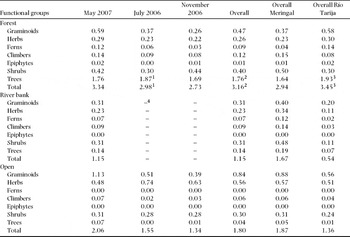
Plant cover was most dense in the forest habitat. River banks and open grassland patches were less densely covered by vegetation, with an overall cover index (CI) of slightly above 1 and less than 2, respectively (Table 1).
Cover index of the plant functional groups (number of individuals of the respective functional group divided by the respective total number of measurement points) across both study sites.

1Only data from Meringal.
2Without data from Río Tarija July.
3Only data from May and November.
4No data available.
Across all measurement dates, the plant cover of the forest areas was dominated by tree species (CI of greater than 1.75), followed by grasses and grass-like species (from here on called ‘graminoids’), and shrubs/subshrubs (from here on called ‘shrubs’). The CI of the herbs was about half that of the graminoids. Both graminoids and shrubs were the predominant plant functional groups found on the river banks (together forming a plant CI of more than 0.6), while the grassland patches were predominantly covered by herbaceous vegetation (graminoids and herbs, CI of 1.4).
Seasonal differences in plant cover were observed especially in the functional group of the graminoids. From May to November, graminoid cover declined by more than half in the forest sites, which was even more pronounced in the open grassland patches. Generally, no big differences in plant cover of the dominant functional groups were found between the two study sites. However, at the Río Tarija study site, ferns and fern allies (referred to as ‘ferns’ in the following) were almost four-fold more abundant than at the Meringal study site, while there climbers made up about twice the contribution to plant cover compared with the Río Tarija study site.
Within the functional group of the trees (determined across both study sites and all seasons), the Myrtaceae made up the highest contribution (32.7% of total tree individuals) to overall tree cover, followed by Fabaceae and Ulmaceae (15.9% and 10.7%, respectively). The dominant tree species found in the assessment of plant cover were Eugenia uniflora and Blepharocalyx salicifolius (16.5% and 9.0% of total tree individuals, respectively). Within the functional group of shrubs, Solanaceae (24.3%) were most frequent, followed by Urticaceae (16.7%). Seguieria aculeata, Urera baccifera and Solanum symmetricum were the dominant species within the shrubs (15.2%, 14.2% and 12.3% of total shrub individuals). The majority of the epiphytes belonged to the Bromeliaceae, and the main contribution to the functional group of graminoids was made up by the Poaceae (93.5%), with Ichnanthus pallens being most abundant (57.7% of total grass individuals). Within the functional group of the ferns, representatives of the Dryopteridaceae and Pteridaceae (38.1% and 19.8%, respectively) were most prevalent, and Phytolaccaceae and Asteraceae were the families that contributed most to overall herb cover, with 36.3% and 20.2% of total herb individuals, respectively. Within these groups, Petiveria alliacea and Elephantopus mollis were found to be most frequent (36.0% and 14.0% of total herbs, respectively). The families Bignoniaceae, Apocynaceae and Hippocrateaceae (24.8%, 21.0% and 19.7% of total climber individuals, respectively) made up the highest contribution to the group of herbaceous and woody climbers (all called ‘climbers’ in the following, percentage data not shown in tables).
Frequency of plant selection by cattle
Overall, 447 different plant species, belonging to 86 different plant families, were recorded in the assessments of both plant cover and plant selection. From May to November and at both study sites, a total of 364 different plant species were selected by the cattle whereof 55 were categorized as belonging to the functional group of the trees, 97 shrubs/subshrubs, 8 epiphytes, 33 graminoids, 19 ferns/fern allies, 88 herbs and 64 climber species. Across all months and both study sites, 14 plant species and, additionally, leaf litter that could not be associated with specific plant species received about 60% of total bites, namely three graminoids, two herbs, one fern, five shrubs and three tree species. Overall, the grass Ichnanthus pallens was subject to the highest frequency of bites.
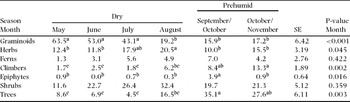
Seasonal changes in the frequency of selection of the different plant functional groups by the cattle in the montane forests are shown in Table 2. Overall, the graminoids made up the largest proportion of the plants selected (34.7%), followed by shrubs (21.9%), trees (17.2%) and herbs (14.5%). Browsing on climbers, ferns and epiphytes was less frequent with 6.2%, 4.3% and 1.1% of total bites on average, respectively (data not shown). Differences between the months were apparent particularly with graminoids (month effect P < 0.001, F = 10.3; ANOVA). Their contribution to the selected plants decreased from nearly two thirds (63.5%) of total bites in May to less than 16% (September/October) and less than 20% (October/November) at the end of the observation period (Table 2). The proportion of herbs selected showed a curvilinear pattern, with values below 16% in the beginning and the end of the observation period and more than 20% in August (month effect P < 0.05, F = 3.22; ANOVA). Frequency of selection of tree parts changed with time (month effect P < 0.01, F = 6.87; ANOVA) from less than 10% from May–July to 35% at the beginning of the prehumid season. The contribution of shrubs did not differ significantly between months. There were also changes (month effect P < 0.05; ANOVA) in the contributions of climbers (F = 7.83) and epiphytes (F = 4.45) to the plants selected by cattle, while this was not significant in ferns. Overall ferns were more frequently selected at the Río Tarija study site (7.0%) than at the Meringal site (1.8%) (data not shown).
Frequency of selection of the different plant functional groups by cattle in 2005 at both study sites (in per cent of total bites per animal in the respective month). Graminoids include grass-like species, ferns include fern allies, and shrubs include subshrubs. Monthly means within a functional group not sharing a common superscript are different at P < 0.05 (multiple t-test). SE = standard error across months.

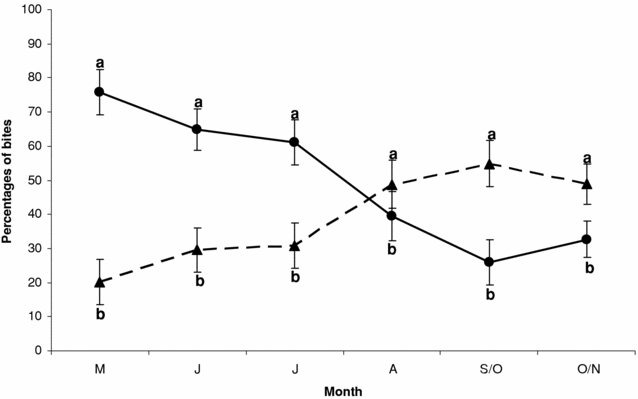
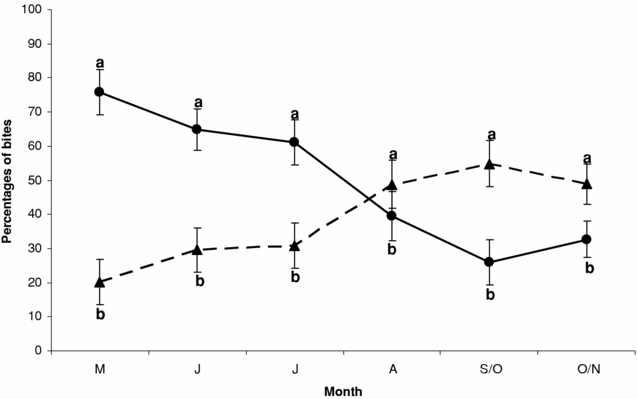
Grouping the main plant functional groups into herbaceous (graminoids and herbs) and woody plant species (trees and shrubs) emphasizes the substantial increase of the selection of woody plants by the cattle (mainly through leaf litter and fruits, see Table 3) from about 20% in May to nearly 60% in September/October (month effect P < 0.01, F = 8.04; ANOVA) (Figure 1). At the same time the proportion of the herbaceous plants declined by a factor of 3 from more than 70% to about 25%, with a slight reversion of the trend found in October/November (month effect P < 0.001, F = 10.5; ANOVA).
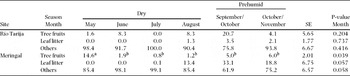
Frequency of selection of tree fruits, leaf litter and green plant parts (‘Others’, from all plant functional groups) by cattle at the Río Tarija and the Meringal study site in 2005 (in per cent of total bites per animal in the respective month). Leaf litter was assigned to the functional group of the trees. Monthly means within rows not carrying a common superscript are different at P < 0.05 (multiple t-test). SE = standard error across months.

Frequency of selection of herbaceous plant species (graminoids and herbs) and woody plant species (shrubs, subshrubs and trees) in 2005 across both study sites (in per cent of total bites per animal in the respective month). Monthly means within plant species group carrying no common superscript are different at P < 0.05 (multiple t-test). Bars represent SE of individual means. Herbaceous plants: month, P < 0.001, F = 10.5 (ANOVA); woody plants: month, P = 0.002, F = 8.04 (ANOVA). The percentages of climbers, epiphytes and ferns are not displayed. –●– herbaceous plants; - - ▲- - woody plants. Observation months: May–August (dry season); S/O = September/October and O/N = October/November (prehumid season).
Seasonal changes also occurred in the frequency of selection of the different plant parts particularly tree fruits and leaf litter during dry season and beginning of the prehumid season (Table 3). At the Río Tarija study site, <10% of tree fruits were selected from May to August, while in September/October tree fruits contributed to about 20% of the bites. Differences between months were significant at the Meringal study site for the tree fruit selection (month effect P < 0.05, F = 4.92; ANOVA), but not at the Río Tarija study site. At the Meringal study site, tree fruits appeared to make up the highest contribution in May (almost 15%), with a slight increase in the prehumid season. It has to be considered that the majority of the fruits selected at the Meringal study site in May derived from a single group of Citrus limetta trees that were planted by humans, thus normally not being available in the natural ecosystem of the montane forests. The tree fruits could be grouped into two categories. Firstly, fresh fruits such as the naturalized Citrus fruits; C. aurantium, C. limetta and, in a very small proportion, C. reticulata, which the cattle generally tended to select more in the first months of the grazing season. Secondly, dry fruits or pods, such as the legumes Enterolobium contortisiliquum or Senna cf. spectabilis, which generally contributed more to the plant selection during the last 3 mo of the observation period. Overall, tree fruits were selected less frequently at the Meringal study site (4.7%) than at the Río Tarija site (7.6%), but this difference was not significant (data not shown). The effect of site on leaf litter selection was significant (site effect P < 0.05, F = 8.06; ANOVA) being overall 11.0% and 1.2% at the study sites Meringal and Río Tarija, respectively (data not shown). The two study sites also differed in leaf litter cover, with CI in July of 0.52 and 0.20 at the Meringal and Río Tarija study sites, respectively (data not shown). At both sites, leaf litter was seldom selected in the first 3 mo of the dry season, but from August onward, and especially in September/October, it made up an increasing (month effect P = 0.06, F = 4.14; ANOVA) part of the plants selected by the cattle at the Meringal study site, reaching 33% of total bites of that month. At the Río Tarija site, leaf litter selection never exceeded 4%.
Nutrient and energy concentrations of selected plant species
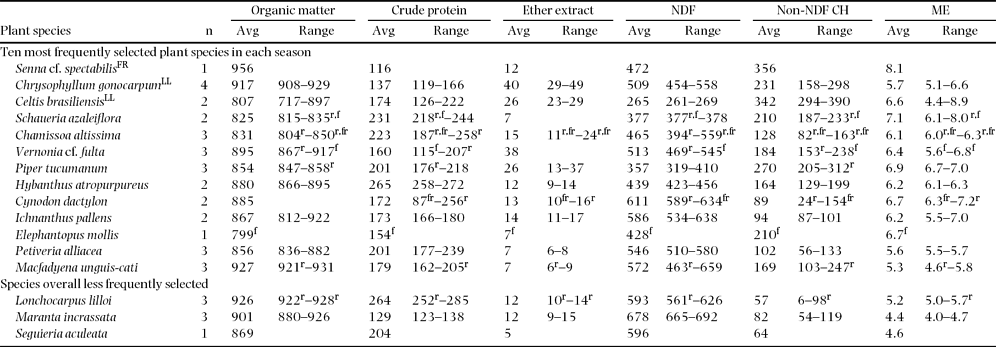
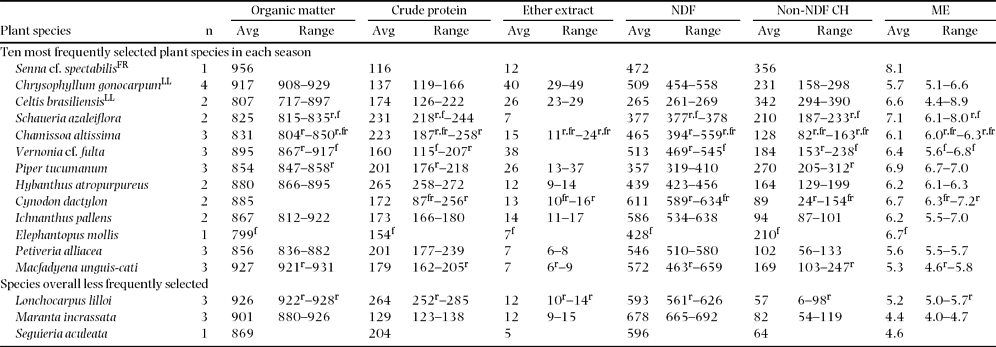
Table 4 shows the nutrient and ME concentrations of the majority of the seasonally most frequently selected plant species and, additionally, of some less frequently selected plant species. The analysed plant species belonging to the group of ten overall most frequently selected plant species in the different sub-seasons (May/June = beginning of dry season; July/August = end of dry season; September–November = prehumid season) had an average ME concentration of about 6.5 MJ kg−1 DM. The highest average value was measured for the fruits of Senna cf. spectabilis (8.1 MJ kg−1 DM). Plant species selected at lower overall frequency tended to have lower ME concentrations. Accordingly, Lonchocarpus lilloi, Maranta incrassata and Seguieria aculeata contained on average <5 MJ ME kg−1 DM. These results have to be considered with care, as just a few less-selected and preferred species were analysed.
Nutrient (g kg−1 dry matter) and energy concentrations (metabolizable energy, MJ kg−1 dry matter) of plant species selected by cattle (either from the group of the 10 seasonally most-selected plant species (beginning of dry season: May/June; end of dry season: July/August and prehumid season: September–November) or from species overall less selected (ranked between 21–40) as collected between May and November in 2005 and 2006. Avg = average value; NDF = neutral detergent fibre; Non-NDF CH = non-NDF carbohydrates; ME = metabolizable energy. LL, leaf litter from the ground (fallen and green leaves for C. brasiliensis);FR, fruits.f, fr, r, sample material contained additionally flowers, fruits or regrowing leaves, respectively. In all other cases sample material contained leaves and stalks.
DISCUSSION
Changes in plant species selection with season
The results of the present study illustrate the high diversity of plant species of Bolivian–Tucuman montane forests, which is also reflected to a great extent in the number of plant species that were found to be selected by the cattle. Some species were selected in each season, while others made their main or exclusive contribution to plant selection in certain seasons. Despite the broad spectrum of different plant species found to be selected by the cattle across the entire time and at both study sites, only a few key species made up a main proportion to overall plant selection. Consistent with other studies (Hirata et al. Reference HIRATA, HASEGAWA, TAKAHASHI, CHOWDAPPA, OGURA, NOGAMI and SONODA2008a, Reference HIRATA, HASEGAWA, TAKAHASHI, CHOWDAPPA, OGURA, NOGAMI and SONODA2008b; Mayer & Huovinen Reference MAYER and HUOVINEN2007), cattle tended to select mainly grasses when available. In a study conducted in a young conifer plantation in Japan the cattle were found to forage in total on 118 species or species groups, while only 10 species or species groups received the majority of the bites, and a grass species was the most-selected plant species (Hirata et al. Reference HIRATA, HASEGAWA, TAKAHASHI, CHOWDAPPA, OGURA, NOGAMI and SONODA2008a). Similarly, in the present study the grass I. pallens received the overall largest number of bites. In general a decrease in the contribution of graminoids to plant selection and an increase in the proportion of woody plants over time were observed. The occurrence and increase of foraging on woody plants by cattle in certain seasons is also known from other studies (Guevara et al. Reference GUEVARA, ESTEVEZ, STASI and MONGE1996, Reference GUEVARA, ESTEVEZ, STASI and MONGE1997; Katjiua & Ward Reference KATJIUA and WARD2006, Moleele Reference MOLEELE1998).
The proportionate increase in the selection of woody plants towards the end of the present study mainly resulted from the inclusion of tree fruits and especially leaf litter. Similarly, leaf litter was an important dry-season forage source for goats and sheep in deciduous woodland areas in the semi-arid tropical region of north-east Brazil (Kirmse et al. Reference KIRMSE, PROVENZA and MALECHEK1987, Pfister & Malechek Reference PFISTER and MALECHEK1986), and for cattle in south-east Botswana (Moleele Reference MOLEELE1998).
The shift observed in the diet of the cattle in the Mendoza plain, Argentina, from grasses to woody plants taking place from the rainy season to the dry season was related to changes in temperature and/or rainfall (Guevara et al. Reference GUEVARA, ESTEVEZ, STASI and MONGE1997) and in the phenology of the grasses, i.e. increasing maturity (Guevara et al. Reference GUEVARA, ESTEVEZ, STASI and MONGE1996). Mature grasses generally contain less CP, phosphorus and soluble carbohydrates than evergreen shrubs (Holechek et al. Reference HOLECHEK, PIEPER and HERBEL1989), and thus have a comparatively low nutritive value. This could also explain why plant species selection was increasingly oriented from graminoids towards other plant functional groups. Moleele (Reference MOLEELE1998) reported higher CP values for woody species analysed than for grasses in a selection study with cattle in south-east Botswana. Consistent with that, in the present study the average concentrations of CP were higher and those of NDF were lower in the shrubs (out of the ten most frequently selected plant species in each subseason) than in the two grasses included in the analysis. Also Hirata et al. (Reference HIRATA, HASEGAWA, TAKAHASHI, CHOWDAPPA, OGURA, NOGAMI and SONODA2008a) found a relatively low CP concentration and dry-matter digestibility in the grasses analysed. Thus, one reason for the animals to ingest woody plants in certain seasons might be their intention to add forage items having a higher nutritive value, such as a higher CP content (Hirata et al. Reference HIRATA, HASEGAWA, TAKAHASHI, CHOWDAPPA, OGURA, NOGAMI and SONODA2008a, Moleele Reference MOLEELE1998). Generally, chemical composition and energy concentration measured in the present study differed within the same plant species, depending, for instance, on phenological stage, leaf-to-stem ratio, age (inclusive green leaves vs. leaf litter) and sampling date.
Potential drivers of selection of distinct plant species
Several factors might have an influence on the selection behaviour of free-ranging herbivores. No conclusions can be made on patch choices and social or external factors that might have exerted an influence on the selection behaviour of the cattle in the present study. As it is not possible to assess and quantify all factors of influence in a natural and diverse environment, only suggestions on forage-related factors as potential drivers of plant selection can be made. Most studies dealing with the optimal foraging theory focus on energy as the ‘currency’ the foraging animal tries to maximize in a given period (Pyke et al. Reference PYKE, PULLIAM and CHARNOV1977). It seems that energy was one of the drivers for the plant selection observed in the present study, as the overall more frequently selected plant species were on average richer in energy than the less selected plant species that were included in the analysis. Energy maximization (here: intake rate of digestible organic matter) also explained the largest part, but not all, of the diet selected by different herbivores in a forested range in the Netherlands (van Wieren Reference VAN WIEREN1996). Thus, other factors or constraints, apart from energy, such as special requirements for distinct nutrients, may also affect foraging behaviour. Accordingly, in the study of Wallis de Vries & Schippers (Reference WALLIS DE VRIES and SCHIPPERS1994), habitat use could be better explained with a model considering P and Na in addition to energy. Several studies dealt with the influence of the abundance and/or arrangement of the preferred forage on selection behaviour (Dumont et al. Reference DUMONT, CARRÈRE and D'HOUR2002). Ichnanthus pallens, the overall most frequently selected plant species in the present study was found to be the most abundant. However, the plant cover assessment showed a decrease of the graminoids during the time of forage grazing, which was reflected by a decrease in plant selection of this functional group. Accordingly, I. pallens was selected most frequently at the beginning of the study. Changes in diet composition as influenced by the availability of graminoids as the preferred group were also found for wild grazers (bharal (Pseudois nayaur); Suryawanshi et al. Reference SURYAWANSHI, BHATNAGAR and MISHRA2010). Thus, changes in availability might be an important driver in changing plant selection patterns, resulting in a shift of the diet towards other plant group/species than the preferred ones.
The concentration and profile of plant secondary compounds (PSC) may also influence plant selection of herbivores, especially when considering woody species (Bryant et al. Reference BRYANT, REICHARDT and CLAUSEN1992, Cooper et al. Reference COOPER, OWEN-SMITH and BRYANT1988). Accordingly, the interaction of several factors including the ratio of PSC to nutrients (Cooper et al. Reference COOPER, OWEN-SMITH and BRYANT1988, Katjiua & Ward Reference KATJIUA and WARD2006) besides plant availability (Katjiua & Ward Reference KATJIUA and WARD2006) is likely to influence the selection of woody forage plants. The PSC may act anti-nutritional, but also can have positive effects on the animals’ performance at suitable levels of intake (e.g. antiparasitic effects: Athanasiadou & Kyriazakis Reference ATHANASIADOU and KYRIAZAKIS2004). There is growing awareness about the ability of self-medication by animals (Huffman Reference HUFFMAN2001, Villalba et al. Reference VILLALBA, PROVENZA and SHAW2006). Plants of the present study were not analysed for PSC but an influence of PSC on selection can be assumed as well. Several plant species were found to be selected by the cattle that are mentioned by indigenous Bolivians as medicinal plants (Bourdy et al. Reference BOURDY, DEWALT, CHÁVEZ DE MICHEL, ROCA, DEHARO, MUÑOZ, BALDERRAMA, QUENEVO and GIMENEZ2000, Macía et al. Reference MACÍA, GARCÍA and VIDAURRE2005). The following plants were found in the study sites: Cedrela fissilis, Celtis iguanaea, Hyptis mutabilis Briq., Iresine diffusa, Mikania cordifolia, Phyllanthus acuminatus, Petiveria alliacea, Piper hieronymi, Pluchea sagittalis, Sida rhombifolia, Stachytarpheta cayennensis, Tessaria integrifolia, Triumfetta semitriloba (see Bourdy et al. Reference BOURDY, DEWALT, CHÁVEZ DE MICHEL, ROCA, DEHARO, MUÑOZ, BALDERRAMA, QUENEVO and GIMENEZ2000), Anadenanthera colubrina, Cestrum parqui, Piper elongatum, Rubus boliviensis (see Macía et al. Reference MACÍA, GARCÍA and VIDAURRE2005).
Experience with the forage plant species on offer (Ganskopp & Cruz Reference GANSKOPP and CRUZ1999) may have an influence on cattle's foraging behaviour and diet composition. The cattle in the present study have to be considered as experienced in that respect, as they were used to graze these areas every year. Another possible explanation for the overall large number of plant species selected in rather small amounts might be ‘sampling’ (Westoby Reference WESTOBY1974). Although the cattle in the present study had been familiar with the study sites and the forages on offer, sampling behaviour seems to be a necessity considering the huge plant diversity and the changes shown over the time of forest grazing in terms of quantity and quality. Animals that forage in a natural and heterogeneous environment, characterized by changes in space and over time, have to obtain information about the status quo of the basically available forage and its quality (Dumont & Gordon Reference DUMONT, GORDON, ‘t Mannetje, Ramírez-Avilés, Sandoval-Castro and Ku-Vera2003, Freeland & Janzen Reference FREELAND and JANZEN1974). As information is mainly gathered by selecting and trying the respective alternatives, some choices might be considered as attempts for getting information rather than as real choices (Illius et al. Reference ILLIUS, CLARK and HODGSON1992). This might explain the huge amount of plant species that made up just a minimal contribution to overall plant selection. Nevertheless, occasional ‘discrimination errors’ (Illius et al. Reference ILLIUS, GORDON, ELSTON and MILNE1999) cannot be excluded, meaning that some of these plant species found to be selected at very low levels were taken only by accident.
The results of the present study showed that the free-ranging cattle, as a model of a generalist large-mammal herbivore, were able to deal with a very diverse forest environment and were able to modify their selection behaviour according to changes in quality and quantity of the vegetation on offer. Sampling behaviour seemed to be important in that respect, assuming that the large number of plant species appearing at very low proportions in the overall plant selection was not simply due to discrimination errors.
ACKNOWLEDGEMENTS
We are grateful to Roman Camacho, Claver Cardozo, Theodoro Mamaní, Genaro and Yamil Tarraga for their collaboration as field guides; Enrique Aramayo, Dante Barrientos, Jenny Belén, Marco Miranda and Emilio Tejerina for their support in field work and/or data input; Roman Camacho, Claver Cardozo, Juan de Dios and Nicolas Romero for provision of experimental animals; Moises Mendoza, Martha Serrano, Janet Villalobos for plant collection and identification, and Rossy de Michel, Ivan Jiménez and Freddy Zenteno for their support in plant determinations. We thank S. Renvoize (Royal Botanic Gardens, Kew) for helping to determine the graminoids. The research was supported by the Velux Foundation, Zurich, Switzerland.