Hard cooked cheeses, such as Reggianito and Sardo, derived from Italian Grana and Parmesan cheeses, have existed in Argentina since the late 18th century. The cheeses were introduced by Italian immigrants and have since become different from the original varieties but also different from Parmesan-like American or generic products (Zannoni et al. Reference Zannoni, Bertozzi and Hunter1994). In hard cooked cheeses, ripening is a long process that takes from 6 to 24 months, and involves extensive proteolysis and moderate lipolysis (Candioti et al. Reference Candioti, Hynes, Quiberoni, Palma, Sabbag and Zalazar2002; Fox, Reference Fox, Roginsky, Fuquay and Fox2003; Gobetti & DiCagno, Reference Gobetti, DiCagno, Roginsky, Fuquay and Fox2003). During such a long ripening time, the available carbohydrates may also undergo changes, and the catabolism of free amino acids and fatty acids takes place (McSweeney & Sousa, Reference McSweeney and Sousa2000; Tavaria et al. Reference Tavaria, Dahl, Carballo and Malcata2002). These transformations influence cheese texture and functionality, and they are responsible for the characteristic flavour development (McSweeney, Reference McSweeney2004; Sgarbi et al. Reference Sgarbi, Lazzi, Tabanelli, Gatti, Neviani and Gardini2013).
Several strategies have been proposed to accelerate Reggianito cheese ripening. These strategies include ripening at increased temperatures (Sihufe et al. Reference Sihufe, Zorrilla, Perotti, Wolf, Zalazar, Sabbag, Costa and Rubiolo2010; Ceruti et al. Reference Ceruti, Zorrilla and Sihufe2012), and while the results are encouraging, this approach has not been popular with industry decision-makers so far. Another approach involves the addition of exogenous enzymes, such as proteases, carboxypeptidases and lipases (El Soda & Awad, Reference El Soda, Awad, Roginsky, Fuquay and Fox2003; Wilkinson & Kilcawley, Reference Wilkinson and Kilcawley2005; Azarnia et al. Reference Azarnia, Lee, St-Gelais, Kilcawley and Noroozi2011). To date, mostly lipases have been successfully applied in the cheese industry for the accelerated ripening of hard cooked cheese. In general, exogenous proteases are not suitable, as they can cause shifts in the standard patterns of proteolysis and consequently result in defective texture or flavour (Wilkinson & Kilcawley, Reference Wilkinson and Kilcawley2005). Furthermore, the addition of exogenous enzymes in cheese milk is an expensive technology, as enzymes are typically high-cost ingredients and most are lost in the whey in high proportions (Upadhyay & McSweeney, Reference Upadhyay, McSweeney and Smit2003; Wilkinson & Kilcawley, Reference Wilkinson and Kilcawley2005).
Therefore, we took a different approach for the acceleration of Reggianito ripening that consisted of increasing the activity of the proteolytic and lipolytic enzymes that are usually present in the cheese, by using either indigenous or frequently added enzymes.
Proteolytic enzymes, such as the coagulant added to milk during cheese making, and plasmin, a native milk protease, are normally active in cheeses and contribute to casein degradation, depending on the cheese type (Bansal et al. Reference Bansal, Fox and McSweeney2007; Ismail & Nielsen, Reference Ismail and Nielsen2010).
The residual coagulant enzyme is one of the proteolytic agents that contribute to proteolysis during the ripening of most cheeses, particularly in varieties with low or medium scalding temperatures (Fox, Reference Fox, Roginsky, Fuquay and Fox2003). Most of the coagulant is lost in the whey during the draining process. However, the proportion of enzyme retained in the curd is dependent on enzyme type, draining pH, scalding temperature and curd moisture (Sousa et al. Reference Sousa, Ardö and McSweeney2001; McSweeney, Reference McSweeney2004; Upadhyay et al. Reference Upadhyay, McSweeney, Magboul, Fox, Fox, McSweeney, Cogan and Guinee2004). During cheese ripening, the coagulant hydrolyses mostly αs1-casein at the Phe23-Phe24 bond to give peptides αs1 (f1-23) and αs1 (f24-199) or αs1-I (Carles & Ribadeau-Dumas, Reference Carles and Ribadeau Dumas1985; McSweeney, Reference McSweeney2004). The contribution of residual coagulant to proteolysis during cheese ripening has been elucidated for the major varieties of cheeses, but it is less known for the hard cooked cheeses. For this cheese type, the presence of peptide αs1-I has been attributed either to chymosin hydrolysis in the vat before curd scalding (Chianese et al. Reference Chianese, Caira, Ferranti, Laezza, Malorni, Mucchetti, Garro and Addeo1997; Gaiaschi et al. Reference Gaiaschi, Beretta, Polesi, Conti, Giuffrida, Galli and Restani2000), to late coagulant action during ripening that it is dependent on the curd scalding temperature (Delacroix-Buchet & Fournier, Reference Delacroix-Buchet and Fournier1992; Kindstedt et al. Reference Kindstedt, Yun, Barbano and Larose1995), or to coagulant enzyme reactivation (Hynes et al. Reference Hynes, Aparo and Candioti2004). Other authors claim that proteolysis caused by starter cultures of Lactobacillus helveticus should not be discarded as the source of αs1-I in Swiss-type cheeses (Sadat-Mekmene et al. Reference Sadat-Mekmene, Richoux, Aubert-Frogerais, Madec, Corre, Piot, Jardin, le Feunteun, Lortal and Gagnaire2013).
In Argentina, Reggianito cheese was initially made with calf rennet, which was produced locally and was most likely very different from the European standards. During the 20th century, adult bovine coagulant was typically applied for this cheese type because porcine pepsin and other substitutes for calf rennet were never widespread in Argentina. Finally, in the 1990s, bovine chymosin produced by fermentation became the standard for Reggianito cheese for large to mid-size dairy industries, as it is the industrial gold standard for cheese manufacturing (Yegin & Dekker, Reference Yegin and Dekker2013). Recently, Kappeler et al. (Reference Kappeler, van den Brink, Rahbek-Nielsen, Farah, Puhan, Bech Hansen and Johansen2006) expressed the gene for camel (Camelus dromedarius) chymosin in Aspergillus niger and produced camel chymosin by fermentation. Fermentation-produced camel chymosin has been extensively marketed in all cheese producing countries, including Argentina, because of its higher clotting activity and lower general proteolytic activity compared with bovine chymosin (Kappeler et al. Reference Kappeler, van den Brink, Rahbek-Nielsen, Farah, Puhan, Bech Hansen and Johansen2006; Jensen et al. Reference Jensen, Mølgaard, Poulsen, Harboe, Simonsen, Lorentzen, Hjernø, van den Brink, Qvist and Larsena2013). While in Cheddar and mozzarella cheeses, the replacement of bovine chymosin by camel chymosin has been satisfactory (Bansal et al. Reference Bansal, Drake, Piraino, Broe, Harboe, Fox and McSweeney2009a; Govindasamy-Lucey et al. Reference Govindasamy-Lucey, Lu, Jaeggi, Johnson and Lucey2010; Moynihan et al. Reference Moynihan, Govindasamy-Lucey, Jaeggi, Johnson and Lucey2014), the introduction of this coagulant for Reggianito cheese in Argentina has occurred without prior research.
In this paper, we studied the influence of the curd scalding temperature on chymosin and plasmin activity and their related proteolysis during the ripening of Reggianito cheese for the investigation of ripening acceleration. For this purpose, we assayed two chymosin types that are most commonly applied for Reggianito cheese in the Argentinean dairy industry: bovine and camel chymosins produced by fermentation.
Materials and methods
Experimental design
The influence of two different factors on cheese proteolysis was assessed across the time of ripening: coagulant type and curd scalding temperature. Both factors were studied at two levels, which gave a total of 4 experimental treatments. Recombinant bovine (CH) and camel (CA) chymosins were tested (Chy-Max ultra, 950 IMCU and Chy Max M, 740 IMCU, respectively), both provided by Chr. Hansen Argentina (Quilmes, Argentina). Two different curd scalding temperatures were applied: 50 and 56 °C. These target temperatures were chosen as follows: technical literature and interviews with cheese-makers accounts for Reggianito cooking temperature most frequently applied is 52–54 °C; however the rank is wider, as Argentinean cheeses are not as standardised as their Italian antecedents. In this sense, 56 °C is the highest temperature registered for Reggianito cooking temperature, and 50 °C is lower than usual, but proposed here as an approach to increase residual activity of coagulant and accelerate proteolysis. The cheeses were identified as CA-50 °C, CA-56 °C, CH-50 °C or CH-56 °C. Each cheese experiment trial included the four treatments and was carried out the same day in parallel vats, using the same batch of milk. Four replicates of the cheese makings were performed on four different days with different milk.
Cheese making
The Reggianito Argentino cheeses were manufactured according to the standard process (Gallino, Reference Gallino1994; Meinardi et al. Reference Meinardi, Alonso, Hynes and Zalazar2002) adapted to laboratory-scale vats to obtain miniature hard-cooked cheeses. This model cheese has been validated and applied previously (Hynes et al. Reference Hynes, Aparo and Candioti2004; Vélez et al. Reference Vélez, Perotti, Wolf, Hynes and Zalazar2010; Vélez, Reference Vélez2013). An ensemble of four vats, equipped with a system for simultaneous heating and cooling, was used for the cheese making. Raw bulk milk, pH 6·65 ± 0·05 and 18 ± 1 °D acidity, was supplied by a nearby dairy plant (Milkaut SA, Santa Fe, Argentina). The milk was standardised to 2·5 g fat/100 ml and batch-pasteurised at 65 °C for 20 min. After cooling to 33 °C, CaCl2 was added to a final concentration of 0·2 g/l. The milk pH was adjusted with lactic acid (1·5 g/100 ml) to the target value for Reggianito cheeses (6·30). Then, a mixed commercial starter of Lactobacillus helveticus (Chr. Hansen Argentina, Quilmes, Argentina) was added at a concentration of 106 cfu/ml of milk. Direct acidification and the direct-to-vat thermophilic lactobacilli starter is a methodology that replaces the traditional ‘natural’ whey culture, which is still used by medium and small dairy plants for Reggianito cheese making (Candioti et al. Reference Candioti, Hynes, Quiberoni, Palma, Sabbag and Zalazar2002). After manual stirring, each coagulant was added, in an adequate dose to obtain equivalent milk-clotting times after being dissolved in 10 ml distilled water. After 18–20 min, the coagulum attained the appropriate firmness and was cut to adequate grain size (approximately half a rice grain). The mixture of curd particles and whey was gently stirred and heated at 0·5 °C/min until it reached 44 °C to reduce moisture in the curd grains (‘curd drying’ step). To obtain similar moisture content in all samples, this step was more prolonged for the cheeses cooked at 50 °C. The mixture was then more rapidly heated to 50 or 56 °C (1 °C/min). The curds were maintained at the target temperature for 3 min (cooking step). After cooking, the curds were separated from the whey and placed in moulds, pressed for 20 h, and brined for 12 h in saturated brine at 12 °C. The cheeses were ripened for 90 d at 85% relative humidity and 12 °C, but after the first 2 weeks they were vacuum packed in plastic film to avoid over drying. This time was selecting according to previous experiments for the validation of the model (Vélez, Reference Vélez2013). Ripening time was fixed in 90 d taking into account gross composition evolution and biochemistry of the ripening (Hynes et al. Reference Hynes, Aparo and Candioti2004; Vélez et al. Reference Vélez, Perotti, Wolf, Hynes and Zalazar2010, Reference Vélez, Bergamini, Pozza, Candioti, Perotti and Hynes2011; Vélez, Reference Vélez2013). Cylindrical samples of the cheeses were taken on days 6, 50 and 90. The superficial section was discarded (1 cm) and the rest of the cheese cylinder was grated and mixed (International Dairy Federation (IDF), 1995), and these samples were stored at −18 °C until analysis.
Gross composition and pH of cheeses
Gross composition was checked in one single point (50 d of ripening) as the purpose of the assay was to monitor that all the cheeses were comparable and appropriate for modelling hard cooked cheeses. Total protein, fat matter and dry matter were analysed according to IDF standards (IDF, 1993, 1997, 1982). As for pH, it was recorded throughout ripening time as described by Bradley et al. (Reference Bradley, Arnold, Barbano, Semerad, Smith, Vines and Marshall1993) at 6, 50 and 90 d old cheeses. All analyses were performed in duplicate.
Residual coagulant and plasmin activity
The residual coagulant activity in the cheese samples was analysed according to the method of Hurley et al. (Reference Hurley, O'Driscoll, Kelly and McSweeney1999), with some modifications, at 6, 50 and 90 d of ripening. This method quantifies the hydrolysis of a synthetic chromophoric heptapeptide substrate (Pro-Thr-Glu-Phe-[NO2-Phe]-Arg-Leu) (Bachem California, Inc., Torrance, USA). From this substrate, aspartic proteases are able to release the tripeptide ([NO2-Phe]-Arg-Leu) in proportion with their activity; this tripeptide is then quantified by RP-HPLC. Finely grated cheese samples (250 mg each) were dispersed in 5 ml water and incubated at 37 °C for 60 min with periodical stirring in a vortex. Then, the samples were centrifuged at 1000 g for 3 min, and the supernatant (70 μl) was seeded into a reaction mixture consisting of 30 μl of a mother solution of the heptapeptide (1 mg/ml) diluted into 200 μl 0·1 M formate buffer, pH 4·1. After incubation at 37 °C for 6 h, the enzymatic reaction was stopped by heating at 70 °C for 10 min. A volume of 60 μl that was previously filtered through 0·45 μm pore diameter membrane (Millex, Millipore, São Paulo, Brazil) was injected into the HPLC. The HPLC system consisted of a quaternary pump, an online degasser, and a UV/visible detector (all Series 200, Perkin Elmer, Norwalk, CT). An interface module connected to a computer was used for the acquisition of chromatographic data with the Turbochrom software (Perkin Elmer). The analysis was performed on an Aquapore OD-300 (C18, 5 nm–300 Å, 250 mm × 4·6 mm) analytical column (Perkin Elmer) using a gradient between two mobile phases: A (H2O-trifluoroacetic acid (TFA; 1000:1, vol/vol) and B (acetonitrile-H2O-TFA, 600:400:1, vol/vol/vol). The column was initially equilibrated with 15% B and maintained in this condition for 5 min after injection of the sample. Then, a linear gradient was utilised to increase from 15 to 45% B over 20 min and then from 45 to 95% B over 3 min, which was maintained at 95% B for 2 min and the system was returned to 15% B over 2 min. The final conditions were maintained for 8 min before subsequent injections. The flow rate was 1 ml/min, and the column temperature was 25 °C. We altered the UV detection wavelength from the original conditions used in Hurley et al. (Reference Hurley, O'Driscoll, Kelly and McSweeney1999) (300 nm) to increase the sensitivity of the methodology. We set UV detection at 270 nm, which is the wavelength corresponding to the maximum absorption of the tripeptide. The results were expressed as nmol of product per g of sample (dry matter) per hour.
Because plasmin activity has been reported to change with scalding temperature in some cheeses, we also assessed plasmin activity in the cheeses at 90 d of ripening using the method of Richardson & Pearce (Reference Richardson and Pearce1981).
Proteolysis assessment
Proteolysis was assessed on 6-, 50- and 90-day-old cheeses by the techniques described below.
Soluble nitrogen
The cheese samples were treated to obtain a crude citrate extract from which soluble fractions at pH 4·6 (SN-pH 4·6), in 0·73 mol trichloroacetic acid/l (SN-TCA) and in 0·009 mol phosphotungstic acid/l (SN-PTA) were prepared (Gripon et al. Reference Gripon, Desmazeaud, Le Bars and Bergère1975; Hynes et al. Reference Hynes, Bergamini, Suárez and Zalazar2003). The nitrogen content in each fraction was determined by the macro-Kjeldhal method (IDF, 1993).
Electrophoresis
The insoluble residue at pH 4·6 was analysed by urea-PAGE in a Mini-Protean II electrophoresis unit (BioRad Laboratories, Hercules, CA) according to the method of Andrews (Reference Andrews1983). The proteins were stained with Coomassie Blue G-250. The different bands were visually evaluated.
Peptide profiles in cheeses by RP-HPLC
The HPLC equipment and the chromatographic column were the same as in the analysis of the residual coagulant activity. Sample preparation and conditions of chromatographic analysis were made according to Hynes et al. (Reference Hynes, Bergamini, Suárez and Zalazar2003).The different profiles were visually compared.
Statistics
Fat matter, protein content, moisture and plasmin activities were processed by two-way analysis of variance (ANOVA). pH, residual coagulant activity and soluble nitrogen were processed as describe below. The time of ripening, coagulant type and scalding temperature were selected as the main fixed factors for analysis. The analysis of variance on the variables measured during ripening used a repeated measurements model (PROC MIXED, SAS Ver. 9·2, SAS Institute, Inc., Cary, NC, USA). Significant interaction effects (P < 0·05) were handled by analysing the effect (main or interaction) of the involved treatment factor separately at each time point within the non-reducible model, using the technique of slicing (PROC MIXED, SAS Ver. 9·2). A least square difference (LSD) test was used as the post-hoc test for pair-wise comparisons in all ANOVA models (α = 0·05). The normality of data distribution was tested on the model residuals from the Shapiro – Wilks test, besides qq plot construction.
Results
Gross composition and pH of cheeses
The gross composition of all cheeses was similar. The means and standard deviations of the fat and total protein in the dry matter, and moisture of cheeses were 38·90 ± 0·83, 54·32 ± 0·47 g/100 g and 38·10 ± 1·17 g/100 g, respectively. The pH increased during storage, regardless of coagulant and scalding temperature (Table 1). Statistically significant differences were detected between the pH at 90 d and the remainder of the times recorded (Tables 1 and 2).
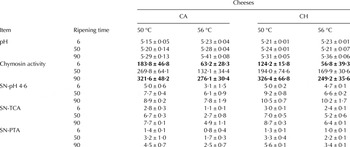
pH, residual coagulant activity (nmol product h−1 g−1) and SN fractions in cheeses expressed as the percentage of total N during ripening (means ± s.d. of duplicate analysis of the four replicas of cheeses)

For chymosin activity, the bold highlighted results show that the coagulant activity at the end of ripening was higher than in the young cheeses
Significance of effects time of ripening (F1), coagulant type (F2) and scalding temperature (F3) and their interaction on pH, chymosin activity and SN fraction

NS, no significant
* P < 0·05
Residual coagulant and plasmin activity
The residual coagulant activity in the cheeses is shown in Table 1. The cheeses scalded at 50 °C had a significantly higher residual coagulant level than the cheeses cooked at 56 °C, which was tested over the entire ripening process (Table 2). However, the coagulant activity increased significantly during the ripening of all cheeses, which suggested reactivation of the enzyme after heat treatment. This effect was more evident for the cheeses scalded at 56 °C, and consequently, the differences in the residual coagulant activity between cheeses scalded at 56 and 50 °C were lower at the end of the ripening than at the beginning (Table 1). However, the interaction scalding temperature × ripening time was not significant.
Regarding the type of coagulant used, the differences between residual CH and CA were not statistically significant in Reggianito cheeses, regardless of scalding temperature and ripening time (Table 2). These results indicate that the experiments for the selection of equivalent doses of both coagulants were accurate not only to obtain equal milk-clotting times in cheese making but also to provide similar activities in the cheese during ripening.
The plasmin activity of 90-d-old cheeses was not affected by cooking temperature. The mean value for all cheeses was 4·65 ± 1·13 nmoles AMC min−1 g−1.
Proteolysis assessment
Soluble nitrogen
The nitrogen content in the different soluble fractions (SN) increased significantly during cheese ripening (Table 2). Moreover, the coagulant type and the scalding temperature had a significant influence in the SN fractions. Overall, the CA cheeses showed significantly lower levels than the CH cheeses at the two scalding temperatures tested during the entire ripening process (Table 1). For the SN-TCA fraction, a significant interaction between the coagulant and temperature factors was found (Table 2), however the difference between the CA and CH cheeses was only significant in those scalded at 56 °C. On other hand, clear differences in the values of all the nitrogen fractions were detected and were dependent on the intensity of the heat treatment applied during scalding. These differences were consistent over the ripening period for both coagulants tested, with significantly lower values for the cheeses cooked at 56 °C (Table 1). For SN-TCA, the scalding temperature also significantly interacted with the ripening time (Table 2). While the values of SN-TCA increased significantly during ripening time for the two temperatures used, the change was lower at 56 °C than at 50 °C. At 6 d of ripening, the SN-TCA level was similar in all cheeses, but the differences increased with ripening time. Interestingly, the differences in proteolysis that are attributable to scalding temperature were higher for the cheeses made with camel coagulant. For example, the increase in nitrogen content in the soluble fractions of the CA-50 °C cheeses compared with CA-56 °C was higher than the difference between the respective CH cheeses (Table 1).
Electrophoresis
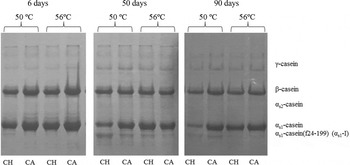
The electrophoretic profiles of the pH 4·6-insoluble N fractions of the cheeses are shown in Figure 1. As observed for the SN fractions, the CA cheeses showed lower levels of proteolysis than CH at the two scalding temperatures tested. At 6 d of ripening, a weak band of αs1-I (f24-199) was observed in the cheeses made with CH, which was not found in the CA cheeses. Concomitantly, a lower intensity for the intact αs1-casein band was found in the CH cheeses.
Electrophoretic profiles of insoluble cheese fractions at pH 4·6 during ripening.

Regarding the influence of temperature, the αs1-I fraction was detected in the 50 °C CA and CH cheeses from the beginning of ripening, while for those scalded at 56 °C, it was observed only after 50 d. Similarly, the intensity of this fraction at 50 and 90 d was higher in the cheeses with the lower scalding temperature. In contrast, the γ-casein fractions increased during ripening but there were no differences between the cheeses with different scalding temperatures or coagulants. There were also no effects observed for the band corresponding to β-casein for either temperature or type of coagulant.
Peptide profiles
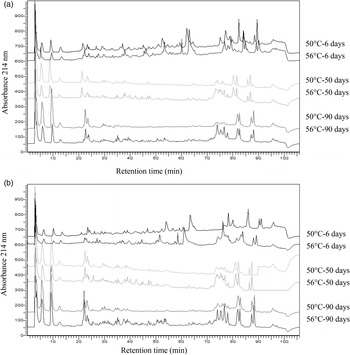
During ripening, the changes in the peptide profiles of each type of cheese were recorded, and these changes were more evident in those scalded at 50 °C (Fig. 2). In the 50 °C cheeses, a marked decrease of the hydrophobic peptides, found in the middle and final parts of the profiles (at elution times higher than 40 min), and a greater increase of the hydrophilic peptides at the beginning of the chromatogram, was observed in comparison with cheeses scalded at 56 °C. When both coagulants were compared, the profiles were similar for the samples scalded at 50 °C, while minor differences were found for the cheeses scalded at 56 °C (Fig. 2 A and B). In the last samples, less proteolysis was detected in the CA cheeses, which was evidenced by lower heights of the initial peaks.
Peptide profiles of water-soluble extracts of cheeses at 6, 50 and 90 d of ripening. (a) CA cheeses at 50 and 56 °C, (b) CH cheeses at 50 and 56 °C.

Discussion
Proteolysis during cheese ripening depends on the active proteolytic agents and the environmental conditions in the food matrix, which are determined by the cheese making technology. In the present work, we investigated the effect of lowering the curd scalding temperature in Reggianito cooked cheese to increase proteolysis and promote accelerated ripening. The cheeses were made with two coagulant enzymes that are widespread in Argentina: bovine and camel chymosins.
During cheese making, the amount of coagulant retained in the curd depends on several factors, such as pH at whey draining, scalding temperature, cheese moisture and type of coagulant (Bansal et al. Reference Bansal, Fox and McSweeney2007, Reference Bansal, Fox and McSweeney2009b). Consequently, the residual coagulant activity varies widely among cheese varieties (Grappin et al. Reference Grappin, Rank and Olson1985; Bansal et al. Reference Bansal, Fox and McSweeney2009b). In this work, no changes in the moisture content of the cheeses were obtained, even for different cooking temperatures. This was achieved by working the mixture of whey and curds for longer during the ‘curd drying’ step, i.e., below 45 °C, and it allowed us to compare the residual coagulant amount and proteolysis during ripening in similar cheese matrices.
Cooked cheeses are not generally considered to contain significant residual coagulant activity (Garnot & Mollé, Reference Garnot and Mollé1987; Delacroix-Buchet & Fournier, Reference Delacroix-Buchet and Fournier1992; Rampilli et al. Reference Rampilli, Raja and Gatti1998). However, our results showed that coagulant inactivation is not complete, and more interestingly, that an increase of the enzyme occurred during ripening. The increase was more pronounced when scalding was conducted at 56 °C. A similar trend was previously reported for Reggianito cheeses cooked at different temperatures, which included a scalding step as high as 60 °C (Hynes et al. Reference Hynes, Aparo and Candioti2004). Previous investigation also revealed that chymosin inactivation was a partial and reversible process in Cheddar cheeses (Hayes et al. Reference Hayes, Oliveira, McSweeney and Kelly2002). In the present work, we detected that the enzyme activity at 90 d of ripening was approximately 2 times higher than the initial level in the cheeses scalded at 50 °C, while a 4-fold increase was found in the cheeses cooked at 56 °C. Consequently, the coagulant activity levels between the 90-day-old cheeses were not as different as in the 6-day-old cheeses.
In previous works, null thermostability of several chymosin (bovine, camel, buffalo and goat) was demonstrated after 24 h of treatment at temperatures above 50 °C. However, when the heat treatment was applied during 1 h, some residual activity was detected (Vallejo et al. Reference Vallejo, Ageitos, Poza and Villa2012). In the cheeses described in our work, the heat treatment was applied only during a few minutes during cheese making, so it is possible that the inactivation effect was limited. On the other hand, Garnot & Mollé (Reference Garnot and Mollé1987) verified that the most of chymosin in milk was inactivated in conditions encountered during Swiss cheese making (53 °C at pH 6·5 during 60 min) and showed a lower inactivation when the pH was 6·50 in comparison with 6·75. In our work, the pH during milk coagulation was lower (6·30). Meanwhile, Delacroix-Buchet & Fournier (Reference Delacroix-Buchet and Fournier1992) found that the production of the peptide αs1-I from αs1 casein in Gruyère cheeses was retarded during ripening when the cooking temperature was raised from 52 to 56 °C, and they suggested a higher inactivation of chymosin at the higher cooking temperature.
For the source of the chymosin, our results indicated that both enzymes had similar stability towards thermal treatment, which was demonstrated by the residual coagulant activity. However, certain proteolysis indexes, such as the peptide profiles and SN-TCA, indicated significantly lower proteolysis in the cheeses made with camel chymosin when the highest scalding temperature was applied. These results suggested that camel chymosin is more heat labile when a cooking temperatures of 56 °C was applied. Contradictory results were found by Vallejo et al. (Reference Vallejo, Ageitos, Poza and Villa2012), who reported that camel chymosin was more thermostable than bovine chymosin between 50 and 60 °C. However, in this work, the thermostability of the chymosins was assessed in assays carried out in buffer solutions, and the effect of cheese matrix on this property was not considered. In this sense, it is important to take into account that different milk compounds have a protective effect on the stability of chymosin, as was verified in previous works (Garnot & Mollé, Reference Garnot and Mollé1987).
The curd scalding temperature may affect plasmin activity (Somers & Kelly, Reference Somers and Kelly2002; Ismail & Nielsen, Reference Ismail and Nielsen2010); therefore, we monitored the level of this indigenous enzyme in our cheeses. No significant differences were found, which is consistent with previous studies on Reggianito-type mini-curds (Vélez et al. Reference Vélez, Bergamini, Pozza, Candioti, Perotti and Hynes2011). The differences in plasmin were only significant in the cheeses cooked at very different temperatures, with changes from 48 to 55 °C for the scalding conditions (Somers & Kelly, Reference Somers and Kelly2002). In addition, higher levels of plasmin were observed in Swiss cheese, which is cooked at 50 °C, compared with Cheddar cheese, where the cooking temperature during production is 37 °C (Ismail & Nielsen, Reference Ismail and Nielsen2010).
αs1-Casein is the most susceptible protein in the cheese matrix to the activity of coagulant enzymes during cheese ripening. The primary site of attack is the Phe23-Phe24 bond to subsequently produce peptides αs1 (f1-23) and αs1-I (f24-199) (Carles & Ribadeau-Dumas, Reference Carles and Ribadeau Dumas1985). The peptide αs1-I (f24-199), is water-insoluble and can be observed in the electrophoretic study (Fox, Reference Fox, Roginsky, Fuquay and Fox2003; McSweeney, Reference McSweeney2004). Our results for the electrophoretic profiles corroborate the residual coagulant activity and the SN fractions. The cheeses scalded at 50 °C that showed an increased residual coagulant activity also showed higher αs1-casein degradation with a consequent higher production of peptide αs1-I (f24-199). Similar results were obtained by Sheehan et al. (Reference Sheehan, Oliveira, Kelly and McSweeney2007), who observed that an increase in the scalding temperature during semi-hard cheese making lowered the αs1-casein degradation in the 53 < 50 < 47 °C range.
For the soluble fractions, the same trend was found, where there was increased N content in all fractions assayed for cheeses scalded at 50 °C. In SN-pH 4·6 and SN-TCA, this increase was most likely due to the direct influence of coagulant activity, which provided large and intermediate peptides. Higher levels of SN-PTA during ripening also may reflect an indirect influence of the coagulant because a richer pool of intermediate size peptides that most likely favored proteolysis and peptidolysis due to the starter culture (Sousa et al. Reference Sousa, Ardö and McSweeney2001; Gobetti & DiCagno, Reference Gobetti, DiCagno, Roginsky, Fuquay and Fox2003; Upadhyay et al. Reference Upadhyay, McSweeney, Magboul, Fox, Fox, McSweeney, Cogan and Guinee2004).
Although the increased coagulant activity and the production of its typical derived peptides are consistent in our work, contribution of proteolytic agents other than chymosin should not be discarded. Cathepsin D (Hayes et al. Reference Hayes, Hurley, Magboul, Larsen, Heegard, Oliveira, McSweeney and Kelly2001) and cell envelope proteinases of starter cultures of Lactobacillus helveticus may contribute to αs1-I production in cheeses cooked at high temperatures (Delacroix-Buchet & Fournier, Reference Delacroix-Buchet and Fournier1992; Sadat-Mekmene et al. Reference Sadat-Mekmene, Richoux, Aubert-Frogerais, Madec, Corre, Piot, Jardin, le Feunteun, Lortal and Gagnaire2013).
For proteolysis related to the type of chymosin, the camel coagulant showed slightly lower proteolytic activity during ripening, which was verified by lower levels of SN fraction and lower heights of the initial peaks in the peptide profile at 56 °C in the cheeses produced with camel chymosin in our study. A similar trend was obtained by Bansal et al. (Reference Bansal, Drake, Piraino, Broe, Harboe, Fox and McSweeney2009a) in Cheddar cheeses produced with the same enzymes. Nevertheless, these authors found more pronounced differences in the peptide profiles of the Cheddar cheeses analysed, attributing such differences both to the lower amount of camel coagulant they added and to its less intensive nonspecific proteolytic activity. Camel chymosin has been reported to have highly specific coagulant activity and low nonspecific proteolytic activity, which outperforms bovine chymosin (Kappeler et al. Reference Kappeler, van den Brink, Rahbek-Nielsen, Farah, Puhan, Bech Hansen and Johansen2006). Bansal et al. (Reference Bansal, Drake, Piraino, Broe, Harboe, Fox and McSweeney2009a) also found β-casein hydrolysis in cheeses made with bovine chymosin, which was not exhibited in camel chymosin cheeses. In our study, however, we did not identify β (f1-189/192) in any of the cheeses analysed. The changes attributable to the type of chymosin were detected in our work in the soluble nitrogen fractions and by the peptide profiles.
In low-fat and reduced-fat Cheddar cheese, the use of camel chymosin in the cheese making process resulted in lowered proteolysis and less bitterness, an effect that was attributed to a decreased production of hydrophobic peptides from β-casein (Govindasamy-Lucey et al. Reference Govindasamy-Lucey, Lu, Jaeggi, Johnson and Lucey2010; Børsting et al. Reference Børsting, Qvist, Rasmussen, Vindeløv, Vogensen and Ardö2012). Møller et al. (Reference Møller, Rattray and Ardö2012) also verified lower proteolytic activity of camel chymosin on αs1 and β-casein in vitro in comparison with bovine chymosin. Møller et al. (Reference Møller, Rattray and Ardö2013) found that low salt Cheddar cheeses made with bovine chymosin contained lower amounts of intact αs1-casein than those made with camel chymosin, especially during early ripening. In low-moisture, part skim mozzarella cheese, Moynihan et al. (Reference Moynihan, Govindasamy-Lucey, Jaeggi, Johnson and Lucey2014) also found lower proteolysis in cheeses manufactured with camel chymosin than in cheeses made with bovine chymosin, which the authors deemed beneficial for longer shelf-life of the resultant mozzarella. As in our study, Moynihan et al. (Reference Moynihan, Govindasamy-Lucey, Jaeggi, Johnson and Lucey2014) used equivalent levels of both coagulants that were calculated based on the milk clotting time.
Thus far, most reported investigations on the use of camel chymosin indicate that defects attributable to bovine chymosin-mediated proteolysis, especially in low fat or part skim cheeses, can be avoided or minimised by replacing it with camel chymosin. However, in our study, we did not find defective or negative proteolytic changes associated with proteolysis by bovine chymosin, and its replacement by camel chymosin did not significantly change the primary proteolysis pattern of the cheese. In effect, there were no changes observed for the hydrolysis products of β-casein due to the type of coagulant. Neither were difference in hydrophobic region of peptide profiles – above 40 min retention time – observed when both coagulants were compared.
The investigation of cheese proteolysis mediated by camel chymosin is new and is most likely not yet conclusive, especially when different cheeses are compared.
Conclusions
Accelerated proteolysis was achieved in Reggianito cheeses when a lower scalding temperature was applied, due to increased retention of coagulant activity. The residual coagulant activity increased during ripening and tended to equalise in all cheeses at 90 d. However, the residual activity, as well as the proteolysis, was always higher in the cheeses scalded at the lower temperature by all applied indexes.
For the comparison between camel and bovine chymosin, our results confirm that camel chymosin is less proteolytic than bovine chymosin, although the differences were not as marked as those published by other authors. The proteolysis patterns were similar for both enzymes, especially as observed by electrophoresis, but the bovine chymosin showed a more rapid progression of proteolysis during the ripening for all samples. No evidence of defective or unexpected proteolysis products, such as hydrophobic peptides derived from β-casein, was detected in either cheese.
The authors acknowledge INTA (Instituto Nacional de Tecnología Agropecuaria, Argentina) for the doctoral fellowship of Luciana Costabel and the assistance of Alejandra Cuatrin for the statistical advice. The present work was financially supported by grants from UNL (Universidad Nacional del Litoral).