INTRODUCTION
Pelvic radiotherapy plays an important role in the modern multi-modal treatment of the locally advanced rectal cancers and significantly reduces local recurrence.Reference Hermann, Henkel, Christiansen, Vorwerk, Hille, Hess and Schmidberger1 The complications of these multi-modal therapies have attracted more attention due to improvement of the survival rates in patients with rectal cancer.2 Thus, it is important to take these complications into consideration.
Testes exposure doses equal to 20 cGy can increase luteinising hormone (LH) level in some patients due to the damage to seminiferous tubules.Reference Kinsella, Trivette, Rowland, Sorace, Miller, Fraass, Steinberg, Glatstein and Sherins3 There is a dose-dependent increase in LH after radiotherapy and the length of recovery period depends on the received doses.Reference Kinsella, Trivette, Rowland, Sorace, Miller, Fraass, Steinberg, Glatstein and Sherins3–Reference Hansen, Trykker, Svennekjaer and Hvolby5 Although no radiation threshold has been defined, doses above 1.2 Gy increase likelihood of permanent azoospermia.Reference Howell and Shalet6
Injury to Leydig cells causes an increase in LH level and a decrease in Testosterone level. Doses more than 2 Gy are needed to induce some degree of hypogonadism (low testosterone level) and patients who are treated by pelvic radiotherapy have increased risk of even permanent Leydig cell dysfunction with reduced testosterone levels.Reference Bruheim, Svartberg, Carlsen, Dueland, Haug, Skovlund, Tveit and Guren7 Complications such as a decrease in lean body mass and muscle bulk, decrease in bone density, malaise, melancholy, anxiety and decrease in mind activity have been well described.Reference Izard8,Reference Shores, Sloan, Matsumoto, Moceri, Felker and Kivlahan9 The ability to have orgasm will be lost in about 50% of men after treating for rectal cancer.Reference Mannaerts, Schijven, Hendrikx, Martijn, Rutten and Wiggers10
Linear accelerator (LINAC) has lots of differences compared with Cobalt 60 (Co60) machine in collimation system, photon energy and penumbra. LINAC has one-tenth penumbra compared to Co60.Reference Schmitt, Glaeser and Kotsch11 So it seems scattered dose to testes during pelvic radiotherapy and changes in hormone profile after pelvic radiotherapy are different using these two machines.
To our knowledge, there has not been a study comparing the testes exposure level during radiation therapy for rectal cancer using different irradiation machines yet. Therefore, the aim of this study was to investigate sex hormones changes following testes exposure to radiation in rectal cancer radiotherapy while studying the scattered radiation doses received by the testes.
MATERIALS AND METHODS
This was a cohort study. The inclusion criteria were male patients, definite diagnosis of rectal cancer confirmed by pathology and receiving no pelvic radiotherapy previously. The patients could receive chemotherapy concurrent with radiotherapy in an adjuvant, neo-adjuvant or palliative setting.
The study purpose was explained to the patients and informed consent was obtained before enrolment. Ethical committees in Shaheed Beheshti University of Medical Sciences approved the study protocol.
Thus, 28 patients entered the study, consecutively. After a thorough staging procedure and determining the lesion distance from the anal verge via computed tomography simulation and proctorectoscopy, and after determining tumour volume and computerised planning, pelvic radiation was delivered with three fields (posteroanterior (PA) and two lateral fields) or box (four fields) techniques. All patients treated in prone position. Fourteen patients were treated by Co60 with a source diameter of 2 cm, and 14 patients were treated by LINAC (Varian clinac CD2300) with 18 MV photon up to a total dose of 45–50.4 Gy in1.8 Gy daily fractions, 5 days per week. The appropriate blocks were established only in PA field. The patients were treated using Co60 or LINAC machine based on ward circumstances such as availability of the accelerator, technical problems, etc.
Five patients in LINAC group and four in Co60 group were randomly selected (using simple randomisation method) and testes exposure dose was measured by Lithium Fluoride (LiF) thermoluminescent dosimetry (TLD). In each selected patient four LiF TLDs were placed on the scrotum in a plastic package along the body axis and this stage was repeated three times (in the beginning, middle and the end) during course of radiotherapy.
The mean dose to the testes per fraction was calculated according to the mean TLD readings at each session. The cumulated dose was computed at the end of treatment by multiplying calculated mean TLD readings of three sessions by number of fractions. Before initiating the therapy, 7 ml of venous blood sample was taken after over night fasting from the patients to measure testosterone, LH and follicular-stimulating hormone (FSH) levels. Another sample was taken 3–6 weeks after the termination of the therapy course for the same purpose. All samples were saved at –70 °C until the day of last sampling for last patient. Testosterone, LH and FSH were measured in all samples at the same day. Chemo-luminescence method was used to determine serum hormones level. The reference levels for testosterone, LH and FSH were 2.8–8ng/ml, 1.24–7.8IU/l, and 1.4–15.4IU/l, respectively. Presence of the testes in the field of radiotherapy for any reason, use of any hormonal drugs and incomplete radiation course for any reason were considered as exclusion criteria.
All the quantitative variables were compared by t-test or Mann–Whitney test and all the non-quantitative variables were compared by χ2-test; p ≤ 0.05 was considered to be statistically significant. After data collection, they were analysed by SPSS software, version14.
RESULTS
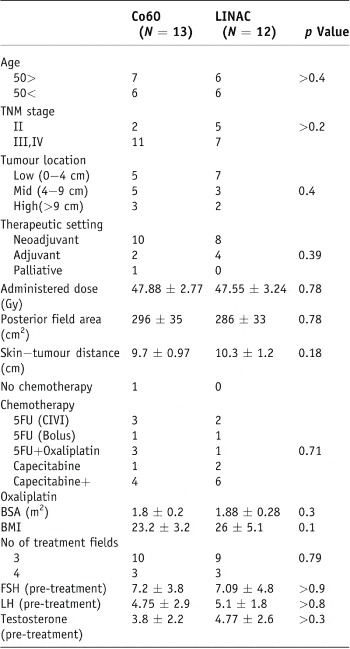
Twenty-eight male patients with rectal cancer with a mean age of 52.72 ± 13 years entered the study. Two patients were excluded from the study due to early death in the course of therapy and one was excluded due to the presence of testes within the field of radiotherapy. Characteristics of patients treated in the two groups have been shown in Table 1. There were no significant differences between two groups in terms of the number of therapeutic fields, distance of the lesion from anal verge, distance of the tumour centre (depth of treatment for posterior field) from the skin, the size of the posterior field of therapy, stage of disease, chemotherapy regimen and age. Before starting irradiation, hormone levels (testosterone, LH and FSH) were in normal range for all patients except one patient in Co60 group. Also, there was no significant difference in pre-treatment sex hormone levels between the two groups (p < 0.2).
Distribution of patient and treatments’ characteristics in each group

Data are presented as mean ± SD or percentage.
p < 0.05 significant.
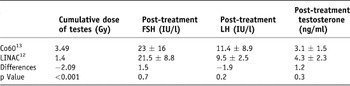
The relationship between the type of radiation machine and testes dose and the hormone indices has been shown in Table 2.
Testes dose and changes in sex hormone levels under therapy by each type of radiation machine
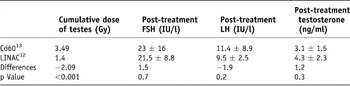
The mean testes doses in five patients treated by Co60 and four patients under therapy by LINAC were 120mGy (±20.3) (range: 85–135mGy) and 55mGy (±24.7) (range: 29–80mGy), respectively, when undergone dosimetry in a single radiotherapy session. These figures when multiplied by the number of therapy sessions give us the mean cumulative received radiation doses in a single course of pelvic radiotherapy in Co60 and LINAC groups which were 3.27Gy (range: 2.4–3.8Gy) and 1.4Gy (0.73–2Gy), respectively. These amounts were 6.6% (range: 4.7–7.5%) and 3% (range: 1.6–4.4%) of the total target dose, respectively.
The difference between the testes received radiation doses in Co60 and LINAC groups was statistically significant (p = 0.003) and the difference between the cumulative testes received radiation doses was also significant in the two radiation settings (p = 0.002).
Hormone changes
In one patient treated by Co60, FSH and LH levels were high (15.8 and 10.8 IU/l, respectively) before treatment but all the other values in all patients were in normal range before treatment and there were no significant differences in mean values for LH, FSH and testosterone between the two groups (Co60 and LINAC). Before radiotherapy the mean FSH level in patients treated using Co60 and LINAC were 7.2 ± 3.8 IU/l and 7.09 ± 4.8 IU/l, respectively. After radiotherapy, FSH increased in all patients and the mean FSH level in patients treated using Co60 and LINAC were 23 ± 16 IU/l and 21.5 ± 8.8 IU/l, respectively which both had made a significant difference compared to the pre-treatment values (p < 0.001). There was no significant relationship considering the type of the radiation machine (p = 0.77).
The mean LH levels in patients treated using Co60 and LINAC were 4.75 ± 2.9IU/l and 5.1 ± 1.8 IU/l, respectively before treatment. After radiotherapy, LH levels increased in all patients except one in Co60 group. Increased mean LH level (11.4 ± 8.9 IU/l) was significant in Co60 group (p < 0.003). Mean LH level (mean = 9.5 ± 2.5IU/l) also significantly increased in LINAC group (p < 0.001). The amount of this increase was not significantly related to the type of radiation machine (p = 0.2).
The mean testosterone levels in patients treated using Co60 and LINAC were 3.8 ± 2.2 ng/ml and 4.77 ± 2.6ng/ml, respectively before treatment. After radiotherapy, six patients from Co60 group (46%) and four patients from LINAC group (33%) had testosterone levels lower than normal range. The mean testosterone levels in patients treated under Co60 and LINAC settings were 3.1 ± 1.5ng/ml and 4.3±2.3ng/ml, respectively, after radiotherapy. In the other words, testosterone levels had an 18% decrease in the Co60 group which was significant (p = 0.04) and had a 10% decrease in LINAC group which was not significant (p = 0.3).
DISCUSSION
In this study we showed that testes scattered dose was up to 7.5% of the total tumour doses (mean = 6.6%) when treatment was delivered by Co60 machine and that the testes received radiation doses were more than 2 Gy (a doses in which irreversible azoospermia occurs) in all the five patients who underwent dosimetry.
Also, testes scattered doses were up to 4.4% of the total tumour doses (mean = 3%) when treated using LINAC and testes received radiation doses was more than 2 Gy in one out of four patients who underwent dosimetry.
Because all the variables including patients’ characteristics and treatment techniques were statistically similar in patients in both groups, it seems that the apparent difference between testes received doses in the two groups is due to intrinsic differences between Co60 and LINAC machines such as the broadness of penumbra, system collimation, energy and so on.
In 2001, Budgell et al.Reference Budgell, Cowan and Hounsell12 measured testes scattered doses in phantom and also in five patients with rectal cancer who were treated by 6 MV photons using TLDs. The testes scattered doses was 2.8% in average (1.9–4.1%) of the total tumour doses which was similar to the doses of the patients in the LINAC group [3% (1.6–4.4%)] in our study. In that study, testes scattered dose was in accordance with their distance from the field’s lower limit, total treatment doses and photon energy.
In 2003, Piroth et al.Reference Piroth, Hensley, Wannenmacher and Zierhut13 studied 18 patients with rectal cancer under pelvic radiotherapy with three fields (up to 50.4 Gy). Dosimetry was carried out in these patients by TLDs and the mean testes scattered doses was 1.6 Gy (0.98–3.19 Gy) which is similar to that of our patients in LINAC group [1.4 Gy (0.73–2 Gy)].
Dueland et al.Reference Dueland, Guren, Olsen, Poulsen and Magne Tveit14 studied 25 patients with rectal cancer under radiotherapy (46–50 Gy). Nine patients were treated with two anteroposterior and PA fields and 16 were treated with three fields. Testes scattered doses were measured by TLD. The mean testes scattered doses was 8.4Gy (3.7–13.7Gy) which was too high compared to all the previous studies and ours. The authors of that study never mentioned patients’ characteristics, energy used by radiation devices, treatment techniques such as patients’ fixation, shielding, etc. It seems that the differences between their figures and others might be due to the differences in the above mentioned factors.
Hermann et al.Reference Hermann, Henkel, Christiansen, Vorwerk, Hille, Hess and Schmidberger1 studied testes scattered doses in patients with rectal cancer under pelvic radiotherapy (50Gy) with four fields’ technique, using ionisation chamber. These patients were treated with 20 MV photon using multi-leaf collimator (MLC) with dose per fraction of 2Gy. The mean testes scattered radiation doses was 3.56Gy (0.7–8.4Gy) which was equal to 7.1% of the total tumour doses in average. Fifty-eight percent of the scattered doses were from the posterior field, 30% from the anterior field and 12% from the lateral fields. The testes scattered radiation dose was in accordance with the testes distance from the lower margin of the field. The difference between the testes received doses in this study and that of ours seems to be due to the probable differences in patients’ thickness (taking the 20 MV-energy used in treating these patients into consideration), tumour localisation, testes distance from the lower margin of the field, dose per fraction of 2Gy, use of MLC, use of a four-fielded technique (we just treated three patients with four field box technique in each group) and patient fixation techniques.
Out results suggest that a serious injury will occur to the testes during the radiotherapy of rectal cancer specially when using Co60. Almost all our patients underwent chemotherapy at the same time of their radiotherapy, with agents such as 5FU, Capecitabine and Oxaliplatin. Our study is not capable to discriminate gonadotoxicity of radiotherapy from chemotherapy.
There would be no change in FSH and LH levels after the injection of combination chemotherapy containing 5FU.Reference Takizawa and Horii15 No reports have also been made on the gonadotoxicity of Capcitabine and Oxaliplatin.
The testes received radiation doses in both groups of our study were higher than critical limits in which both cellular groups of testes (seminiferous tubules and Leydig cells) will be injured and therefore sex hormone profiles before and after therapy showed significant difference. In our study, FSH and LH levels increased by 230% and 140% respectively, and testosterone level decreased by 18% in the Co60 group with a mean scatter testes dose of 3.27Gy. FSH and LH levels increased by 200% and 87% respectively, 3–6 weeks after radiotherapy and testosterone level decreased by 10% in the LINAC group with a mean scatter testes dose of 1.4 Gy.
In the study by Dueland et al.Reference Dueland, Guren, Olsen, Poulsen and Magne Tveit14 which the mean testes dose was 8.4 Gy, FSH and LH levels increased by 100% and 70%, respectively, 5 weeks after radiotherapy and testosterone levels decreased by 25%.
In the study by Hermann et al.Reference Hermann, Henkel, Christiansen, Vorwerk, Hille, Hess and Schmidberger1 which the mean testes radiation doses was 3.56Gy, FSH and LH levels increased by 350% and 185%, respectively, 3–8 weeks after radiotherapy and testosterone level decreased by 23%.
In the study by Dueland et al.,Reference Dueland, Guren, Olsen, Poulsen and Magne Tveit14 the amount of decrease in testosterone level after radiotherapy was statistically significant (p < 0.001). They have also noted that the significant decrease in testosterone level was detected only when the testes received radiation doses was 1.5–5.5Gy. They concluded that Leydig cells are not as resistant to low dose radiation as previously thought.
In our study, the 18% decrease of testosterone level in the Co60 group was statistically significant (p = 0.04) but the 10% decrease of testosterone in the LINAC group was not statistically significant (p = 0.3) which is compatible with Dueland’s study. But the 23% decrease in testosterone levels in the study by Hermann et al.Reference Hermann, Henkel, Christiansen, Vorwerk, Hille, Hess and Schmidberger1 was not significant despite the testes received radiation doses of more than 3.56 Gy, which is probably due to inadequate number of patients.
What can be concluded from this study is that testes received scattered doses in rectal cancer radiotherapy in Tehran’s Imam Hossein hospital is not more than that of studies carried out in other countries (either in Co60 or LINAC setting).
Regardless of the role of surgery and chemotherapy in causing sexual complications during the treatment of rectal cancer, radiotherapy can cause infertility in many male patients with rectal cancer and also cause temporary and permanent hypogonadism in many other patients.
However, using Co60 is the major limitation of our study. Although at the present time, cobalt is not used in most of the countries and has been removed from the therapeutic list, but in our country, Iran, it is yet applied for radiotherapy.
Thus, attempts on finding newer and more efficient ways to lower the testes radiation does during rectal cancer radiotherapy seems to be essential considering the decrease in age of rectal cancer patients and the increase in patients’ survival rate. As we showed in this study using LINAC instead of Co60 can reduce gonadal irradiation during pelvic radiotherapy but cannot prevent gonadal toxicity in all patients. Thus well designed testes shielding with proper material is essential part of pelvic radiotherapy in rectal cancer patients
Acknowledgements
The authors thank Farzan Institute for Research and Technology for technical assistance.