It would be a mistake to claim that the Gezi Park uprisings permanently changed the Turkish political climate as much as they did its cultures of resistance and civil society. The protests confirmed a larger cultural and social transformation in Turkey that was put in motion in the 1980s with the marriage of democracy and global neo-liberalism. Turkey saw societal changes just like in the late capitalist West, nurturing a consumerist as much as a performance-driven society which Lyotard described as constitutive of our postmodern culture. What was new during the Gezi Park protests, however, was the unprecedented display of performativity as a resource for resistance against coercive practices of the state, the police and the government.Footnote 2 In this article, I wish to claim this emergence of a ‘new performativity’ in Turkey ever since the Gezi protests, which influences the art scene. In order to analyse this new performativity, I revisit some key performative moments and their insistence on a (politics of) representation that called for political reflectiveness and validation, as part of the grass-roots activism that came to be known as the ‘Gezi movement’ or the ‘Gezi spirit’.
The importance of re-examining these historical moments comes at a time when key figures of the Gezi movement are being legally tried for allegedly ‘organizing’ the protests in a bid to overthrow the government. This is an attempt not only to blemish the memory and any commemoration of Gezi, but also to discredit the agency and ingenuity shared between the many nameless citizens who contributed to the performative protest actions by putting their bodies at risk each day during the protests. It is, therefore, of absolute significance to archive and reflect on events that can give us broader insight into the new performativity that is interwoven in Turkey's cultures of resistance and artistic and civic engagement.
Conceptual framework and outline
In the literature around the Gezi protests, many commentators have written extensively about the festivalization of Gezi, its Bakhtinian ‘carnivalesque’, which helped the movement to channel – and celebrate – dissidence as a distraction from state and police coercion tactics, or as a downright outrage against the government's repressions in everyday life.Footnote 3 Part of the protest tactics was indeed to reclaim and in part defuse some of the coercive practices by means of humour and language games, such as the frequent reference to Gezi Park as a ‘Gas Festival’.Footnote 4 Gurur Ertem has reinterpreted the carnivalesque nature of the Gezi protests as ‘a site of joyous and subversive energies’.Footnote 5 She refers to Elbieta Matynia's argument, where carnival and Lent are metaphors for democracy's potential and vulnerability respectively: ‘fertility, imagination, and generosity on the one hand, intellectual poverty, complacency, and abuse on the other’.Footnote 6 It is precisely Gezi's performative excessiveness that left a ‘vital legacy’ of a ‘robust civic creativity’.Footnote 7
Yet, as Baz Kershaw has remarked on this very topic when addressing protest as a theatricalized action, the problem with analysing this type of subversion as Bakhtinian carnivalesque or festival – and thus as ‘ritual purgation’ – is twofold. First, it obfuscates difference and usurps ‘creativity of practice by recommending a primacy of schema’.Footnote 8 Indeed, treating all performative protest actions and events equally as manifestations of Gezi Park's festivalization would limit them to being part of a repertoire, thereby not only diminishing the agency of the protestors but also distancing them indiscriminately from their ‘real’ purposes and effects, whether they are subversive or actually reactionary. Second, such an approach may overemphasize the aesthetic aspects of protest actions as art objects, thereby losing sight of historical and ideological relevance.
With this critique in mind, I propose to look first at the political climate in which art and artists take a particular historical role and place in defining the new performativity as a culture of dissent to coercive practices in Turkey, before, during and right after the Gezi protests. As such, I will include the actual protest's context in my analysis, in which the major ideological struggles and epistemic changes of that particular period take place. This will include a discussion of a number of meaningful events in the theatre, at Gezi Park and in the media, as well as of the wider context of complex relations between state, art and theatre. Then, by means of short case studies, I will discuss the new performativity and its inherent contradictions by means of Judith Butler's notion of performativity, her critique of Hannah Arendt's ‘space of appearance’, and Peggy Phelan's notion of ‘active vanishing’.Footnote 9
Butler's notion of performativity, and her own recent reviewing of that theory, can help us to untangle some of the micro-political workings of protest and social movements, alongside media practices, to uncover Turkey's shifting cultural climate. Butler's well-known definition of performativity as ‘reiterative power of discourse’Footnote 10 allows for a political reading of singular performative acts, both in language and with the body, as part of a wider cultural discourse to which it always brings a form of excess, and therefore a moment of uncertainty, in meaning.Footnote 11 Butler's own recent attempts to extend this idea of performativity to address issues of assembly, vulnerability and precarity of the body in protest movements inspires me to look at her rereading of Arendt's ‘space of appearance’.Footnote 12 This will introduce an important aspect of the new performativity: a fundamental paradox of visibility and (political) representation, which Peggy Phelan already introduced through her notion of ‘active vanishing’.Footnote 13
Finally, I will investigate the influence of Gezi's performativity on new playtexts, new dramaturgies and new theatre productions. It is only now that we are beginning to see the contours of Gezi's performativity influencing a larger culture of resistance, while civic networks – as well as theatres – continue to be infiltrated, censored and shut down. My investigation thereby aims to conceptualize some of Gezi's protest actions as cultural performances of dissent that are linked to these larger fluctuating social and historical(-materialist) processes.
The critical role of the artist
Although Gezi's new performativity is not exclusively (re)produced by artists who are already aware of the possibilities of performativity by profession, in Turkey's public realm they play a particular social and educative role whether they want it or not.Footnote 14 Art, in a ‘Kemalist’ framework, is historically related to founding father Mustafa Kemal Atatürk's nation-building project, which underscored the role of art for education. A first case study that contextualizes this role of the artist as well as the political climate that caused the Gezi uprising is the art installation bangbangbang by Turkish artist Ayşe Erkmen. Despite the already extant repression of any form of political resistance or sympathy with the Gezi protests, the work was on display at the entrance of the 13th Istanbul Art Biennial at the Istanbul Museum of Modern Art, from 12 September until 20 October 2013. It contains a replica of a green wrecking ball swinging from a crane. The artist explained that it was meant to work as a ‘portrayal of evil with aesthetics’, but its criticism of the government was rather evident. Gezi provided enough context for visitors to interpret the piece as AKP's ‘wrecking-ball’ effect on the public sphere, which would ironically also eventually hit the museum for real, as its main building at the Bosporus in Tophane has now been demolished to make way for a completely new building. The artwork may also have reminded viewers of another incident in 2011, when then prime minister Erdoğan took odds against a Statue of Humanity, erected on Kazıktepe Hill in Kars by artist Mehmet Aksoy as a gesture of reconciliation towards Armenia. During his visit in January 2011, Erdoğan called the monument a ‘freak’ (Turkish ucube), after which the city authorities decided to remove the statue. This occurrence, amplified by mainstream press and media, gives a first glimpse of how artists are named and shamed by high-level politicians, which grants artists a particular social function in public discourse, along with a high price to pay if they do not comply. Strong personal condemnations of art and artists by state representatives are generally understood as a negative confirmation that the art does not comply with the desired hegemony of the Turkish state, and are thus seen to be disruptive.
The symbol of the wrecking ball is emblematic of the political situation, which caused Turkish citizens to respond when – after a short notice by the government on 27 May 2013 – bulldozers showed up in Istanbul's Gezi Park to remove its ancient sycamore trees to make way for a prestigious, yet controversial, building project that included a shopping mall and luxury residences in the shape of a reconstructed Ottoman artillery barracks that stood once there.Footnote 15 AKP's metaphorical wrecking ball was temporarily stopped when a group of artists and activists occupied the park. Film actor and director, and MP for the Peace and Democracy Party (BDP), Sırrı Süreyya Önder threw himself in front of a bulldozer to prevent it from uprooting the park's trees. One month before the Gezi protests, film actors and directors were also targeted by police brutality when they protested against a redevelopment project on Istiklal Street near Taksim that would destroy one of Turkey's oldest cinemas, the Emek Theatre, within the Circle d'Orient building.
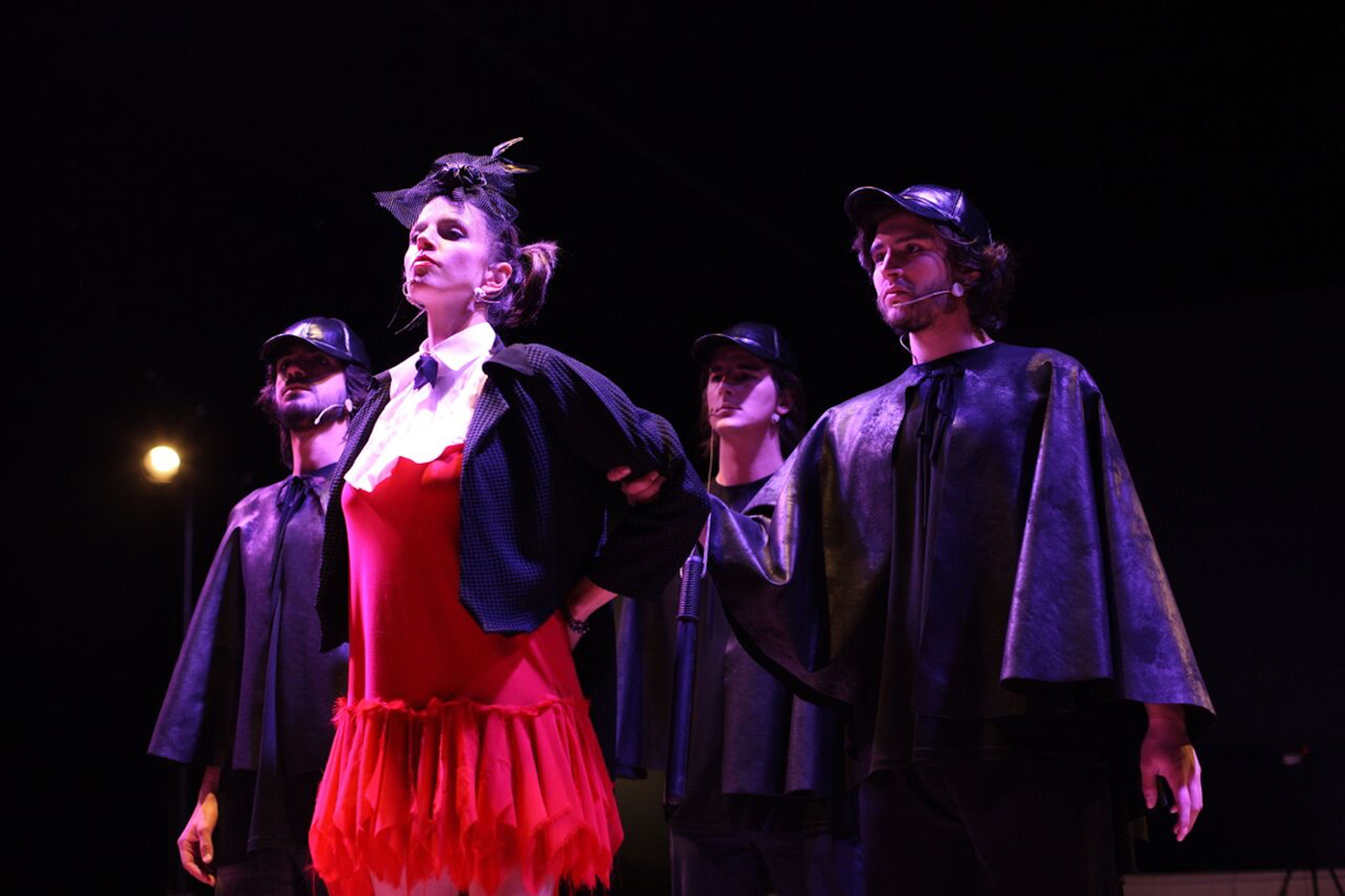
According to the pro-government newspaper Yeni Şafak on 10 June 2013, Gezi's ‘coup’ was ‘rehearsed’ (they write prova, which means ‘rehearsal’ in Turkish) in a theatre play entitled Mi Minör, written by Meltem Arıkan and directed by Mehmet Ali Alabora (then president, and founder, of the Turkish Actors’ Union).Footnote 16 Arıkan was also one of the first to tweet on that night of 27 May to gather in the park, which marks the beginning of the occupation. They were both targeted by a harsh defamation campaign in the media, supposedly for the role the theatre play had played in ‘preparing the revolution’ due to its content (based on the Arab Spring), its live use of social media (just as in the Gezi protests), and the foreign support it had received. The Yeni Şafak article suggested some evil plotting by a foreign lobby, but the support turned out to be a digital PR agency owned by Turks in Britain who did the promotion for the play. The play's content may also have struck a nerve since it showed a dictator (played by Alabora) who rules over a fictional country, Pinima. Its use of social media onstage enabled spectators to interact with the play, though in a limited way, creating a doubling of real-time and online performance. By chance, there was a female character in a red dress in the play, which could be reminiscent of the famous Gezi icon, the kırmızılı kadın (‘woman in red’), based on a photograph of academic Ceyda Sungur while she got sprayed with tear gas from nearby in the early days of the occupation of Gezi Park. ‘What a Coincidence!’ was the headline in Yeni Şafak. Since Mi Minör was actually based on the Arab Spring revolutions, the resemblance was coincidental rather than foreboding.
Actress Pinar Ögün as the Pianist, accidentally wearing a red dress. In the play, this character directly interacts with the audience, trying to make them aware of the oppression in a fictitious country called Pinima. Photograph by Payidar Seyma Bestay.

The independent newspapers and social-media outlets reported ‘lynch justice’ on Alabora, on 15 June 2013. ‘I owe an acknowledgment to the Yeni Şafak newspaper for taking theatres this seriously’, Alabora retaliated.
In our age it is impossible to create social events with theatre, but the Yeni Şafak newspaper gave great importance to our play by claiming that our play ‘Mi Minör’, which we made with great devotion, is as effective as ‘Vatan Yahut Silistre’, which was performed two streets away from our stage in 1873.Footnote 17
What we are witnessing here is the performativity of rightist–populist and leftist narratives underscoring repertoires of symbolic politics with precisely the theatre as a space of (assumed) contention. Namık Kemal's play mentioned by Alabora, which was closely related to the 1908 Second Constitution uprising (aka the Young Turk Revolution in the final years of the waning Ottoman Empire), is a well-placed reference that aims to appropriate an old nationalist icon pre-dating the Turkish Republic. Kemal, who was a strong opponent of the then-oppressive regime, was exiled for this play, which managed to mobilize people on its opening night on Güllü Agop's Theater in Gedikpaşa on 1 April 1873. Right before the 1908 uprising, despite it being censored, the play was performed at ‘every street corner’.Footnote 18 Alabora might have remembered Kemal's exile from the Ottoman Empire when he left Turkey to escape the political heat.Footnote 19
So the double reference to Mi Minör as a ‘rehearsal for the revolution’, first by the conservative, right-wing media to discredit individual artists and then by means of Alabora's explicit comparison to a pre-Republican nationalist play, demonstrates a first instance of the complex symbolic intertwining of performativity and politics in Turkey.Footnote 20 It also reveals the polarized climate in which artists try to present artistic work for audiences that are also affected by state propaganda, which makes the position of the theatre artist progressively vulnerable and prone to self-censorship.Footnote 21 Turkey's ever restricting and politically volatile climate cautions against too overt expressions of dissidence. Performativity, then, not only allows for a specific covert symbolic politics defined by a group or a set of individuals who seek to provoke a certain response in the public, but also plays with the politics of symbols as such, enabling new significations that sidetrack censorship practices.
Standing Men: a politics of symbols versus open signifiers
The polarizing declarations by high-profile AKP members of Parliament suggest that theatre and performing artists play a role in their domestic politics and electoral campaigns. With this, they give the performing arts perhaps more credit than they deserve. Yet the antagonism confirms artists’ social role, while it serves a political discourse against the ‘old Kemalist elites’ who are associated with the largest oppositional party, the CHP (Republican People's Party), once the ‘white Turkish’, pro-European base of the modern republic of Turkey. In May 2012, Erdoğan criticized theatre workers in the southeastern province of Kahramanmaras as ‘elitists’ who mock the people.Footnote 22 Former interior minister İdris Naim Şahin declared even earlier, on 30 December 2011, that art is ‘the backyard of terrorism’.Footnote 23 Such statements belong to a broader strategy to antagonize artistic expression in the same way as the opposition in the ideological abstractions of Kemalism. It is, therefore, of no surprise that some artists have in their turn strategically (re)appropriated Kemalist symbols to resist AKP's intrusions into people's daily lives.
An exemplary case study is the Standing Man (duran adam) by dancer and choreographer Erdem Gündüz.Footnote 24 On the night of 17 June 2013, two days after the Gezi Park occupation was broken and all hopes seemed lost, Gündüz stood still for more than eight hours on Taksim in front of the Atatürk Cultural Centre. As he stated himself, he was aware of the possible media exposure and the associated symbolism:
I turned to face the Atatürk Culture Center (AKM), the iconic arts building which dominates Taksim Square. Right in front of me, the Turkish flag was waving. I also knew that the country's primary news agency, Anadolu Agency, had an office overseeing the square. I started standing just like a statue.Footnote 25
It did not take long before his image reached immediate iconic status. With the help of social media, the Standing Man not only became a ‘meme’ and the collective face of the anti-government protests overnight, it also introduced at the time a new phase of non-violent action. Later, it was hailed as a symbol for freedom of speech, when Gündüz received the M100 Media Prize in Germany.
Social media platforms played a significant role in generating the new performativity through images, as was the case also with other Gezi icons, like the woman in the red dress (kırmızılı kadın), mentioned above, the woman in black (siyahlı kadın), a whirling dervish wearing a gasmask, ‘Çarşı’ (a football fan of Beşiktaş), naked man (çiplak vatandaş), Reading Man (kitap okuyan adam), ‘Guitar Hero’, ‘RedHack’, ‘Talcid Man’ (referring to the self-made milky concoction that helped to appease irritation caused by tear gas), etc. Each was in their own way a performative protest act that gave expression to the diverse backgrounds of the Gezi participants. Digital platforms formed the stage for these distinctive performances exclusively as still images or icons that encouraged other demonstrators to re-enact them and add their own versions to the list. Standing Man seemed, then, the culmination of a master frame shared between these icons, as it summed up Gezi's original goal of peaceful resistance in the face of an enhanced police brutality while keeping the identity as well as the interpretation of the act more or less undetermined. I am reminded of the following comment on the reiterative and recursive, and therefore performative, nature of Standing Man's meme status, occupying first and foremost virtual space through its hashtags:
One of the most powerful aspects of #standingman is its iterability. By performing the meme you not only promise an audience for others, encouraging them to repeat and perpetuate the meme, you also produce a setting, a context for the meme. Each individual performance of #standingman is an acknowledgement of the whole and a recreation of the seed pattern.Footnote 26
Many versions followed, most notably of a woman named Yonca, who was the first to step into Gündüz's footsteps by standing for more than thirty hours near the spot in Ankara where twenty-six-year-old demonstrator Ethem Sarısülük was shot in the head. Through standing as an act of endurance, resistance and political vigil, it has been frequently said, like in an article in the Hürriyet newspaper, the Turkish people – particularly those born after the 1980s – became familiar with performance art as act of civil disobedience, though that may be an overstatement due to lack of memory of earlier public acts of performance.Footnote 27
Within theatre and performance studies, much attention has been given to Standing Man for its ‘non-movement’ or ‘non-action’, as a politico-aesthetic expression, or just as performance.Footnote 28 In previous analyses, there has been a general preoccupation with the dissenting body, the stillness of standing, or its aesthetic resemblance to modern dance theatre that appropriated embodied protest aesthetics.Footnote 29 The strength of the Standing Man was, however, exactly its openness, its non-violent representation of resistance within the complexity of the Gezi movement, embodied by one individual, which immediately turned into a collective experience. Moreover (and this has been underdeveloped in international scholarship and reporting), Standing Man presented a cunning play with symbols and signs, and with the very regimes of visibility, representation and perception in Turkish public and political culture. It is my contention that Standing Man demonstrates the very politics of symbols it draws its inspiration from.
First of all, Standing Man should be seen in a larger history of performative protest actions on the street that Turkey shares with similar historical repertoires around the world. There is a repertoire of ‘die-ins’, ‘lie-ins’ and ‘sit-ins’ in historical protest movements that stresses the impact and importance of occupying space, and its main principle is performative. Lesser known, for instance, was an earlier mass choreography by choreographer Mihran Tomasyan in Turkey, called The Meeting of Bare Feet and Dance, on 27 January 2007, one week after the murder of the Turkish-Armenian journalist Hrant Dink. Tomasyan invited everybody to lie down on the pavement like the assassinated, covered by a newspaper, ‘to die 15 minutes to be born again’. But much earlier, the Action Theatre for Revolution (devrim icin hareket tiyatrosu or DİHT) was formed in Turkey in September 1968, when discussions on alternative theatre forms were in full swing. The DİHT wanted to play on the streets, in factories, in universities, rather than in traditional theatre spaces.Footnote 30 One of their most cited performances is their first play, The Bridge, which was made as an act of protest against the construction of the Bosporus Bridge (officially the 15 July Martyrs Bridge) in Istanbul, because it would destroy the slum districts.
More significantly, on the one hand, Standing Man recuperated a variety of symbols that could be read as clearly Kemalist, and it could, therefore, also be understood as a comment on Turkey's specific history with state conformity and the sovereign gaze. On the other hand, Standing Man appropriated symbols that are more related to the transnational struggles of a generation, including an unacknowledged identity politics, a corporate media bias and a desire for a real or direct democracy in the age of neo-liberalism. Hence Standing Man was, in Donatella della Porta's words, a ‘contentious performance’ that demonstrated an ‘intertwining of transnational inspiration with local forms of diffusion’.Footnote 31
Contentious performance
Let us focus now on the symbolic play of Standing Man more closely. First of all, Gündüz chose to stand on Taksim Square, exposing himself in a very vulnerable situation amidst the police brutality, as an object of the unknown spectator's gaze, mediated by the live stream that was quickly set up once people starting noticing the silent standing act. In doing so, Gündüz exposed himself through this self-performance to an extended visibility, temporality and risk, which could be read as a reference to those many unnamed citizens who go unnoticed on a daily basis and who feel unrepresented in the wider political conjuncture.Footnote 32 Second, Gündüz stood still in front of a large image of Mustafa Kemal Atatürk that was draped between two Turkish flags at the front of the ill-fated Atatürk Cultural Centre. At the time, the building was turned into a police station that worked as a kind of panopticon – a space of surveillance (in Foucault's sense) – monitoring the area around Taksim. Previously, the building had been ‘hacked’ by Gezi protestors who had draped its facade with banners, among which at its centre was the slogan of the Communist Party (TKH), Boyun eğme (‘Don't bend your neck’). Atatürk's portrait was not only installed there purposefully by the authorities as a replacement for the communist slogan but also as a display of power and control, reminding Istanbul's citizens and dissenters of a togetherness as a nation, while perhaps unwittingly confirming the panoptic powers of the newly erected police state – and thereby the sovereign gaze of the state – by giving it a familiar face. Here, Gündüz suggests a more questioning pose vis-à-vis today's Kemalism and its main nationalist symbolism.Footnote 33
Jacques-Allain Miller's description of ‘a brutal dissymmetry of visibility’ explains the duality in this seeing and being seen, namely that of ‘the seer with the sense of omnipotent voyeurism and the seen with the sense of disciplined surveillance’.Footnote 34 With Gündüz's lonely figure staring into the eyes of the mute founding father of the Turkish republic, the performance of seer and seen reproduces the asymmetric relation between the multitude of protesters and the authorities when no dialogue seems possible; or as Öztürkmen suggested about most of the protest performances at Gezi Park, ‘The performances that occurred between the official authorities and the Gezi Park occupants and supporters were all internally dialogic or intertextual’, and so was Standing Man.Footnote 35 Despite the clearly Kemalist context, Standing Man could also be giving cultural legitimacy to the successful Diren! (‘resistance’) master frame, precisely by embodying the very idea of the effaced Boyun eğme slogan. According to Kıvanc Atak, this was necessary to ‘create an indigenous agency of mobilization’.Footnote 36
It is in this discursive ambiguity and uncertainty of meaning that the new performativity heralded by the Standing Man – or in Kershaw's words, a dramaturgy for protest events – gains currency. Kershaw explains this ambiguity as a drawing on tradition to produce a ‘more or less recognizably ordered socio-political action while never foreclosing on unpredictability, the potential of disorder’.Footnote 37 Despite its openness as a major but hybrid signifier, the Standing Man was contentious in the way it created through its plurality a ‘space of appearance’, as Hannah Arendt initially suggested in The Human Condition: a space ‘between people’ which constitutes political action. Indeed, Standing Man's spatial occurrence in inhabiting a space on Taksim Square and all its subsequent occupations did something similar to what Judith Butler describes with assembling in growing crowds:
we see some way that bodies in their plurality lay claim to the public, find and produce the public through seizing and reconfiguring the matter of material environments; at the same time, those material environments are part of the action, and they themselves act when they become the support for action.Footnote 38
Yet a recent feminist reading by Öykü Potuoğlu-Cook did point out the failure of Standing Man when one considers the implications of a gender construction in the space of appearance this act reproduces:
His initial singular occupation of Taksim Square inevitably reproduced the notion that public space ultimately belonged to men. He, thus, invoked the conservative prescriptions on female public presence and mobility. From this angle, both Gündüz's performative austerity and command of space undercut his broader critique of autocratic patriarchal neo-liberalism.Footnote 39
This is also the crux of Arendt's argument about the production of space, according to Butler: that the body in the public sphere is always ‘masculine and unsupported, presumptively free, but not itself created’.Footnote 40 Butler elaborates on the paradox in great detail:
For politics to take place, the body must appear. I appear to others, and they appear to me, which means that some space between us allows each to appear. We are not simply visual phenomena for each other – our voices must be registered, and so we must be heard; rather, who we are, bodily, is already a way of being ‘for’ the other, appearing in ways that we cannot see, being a body for another in a way that I cannot be for myself, and so dispossessed, perspectivally, by our very sociality … No one body establishes the space of appearance, but this action, this performative exercise happens only ‘between’ bodies …Footnote 41
Butler's critical and feminist rereading of Arendt gives us an explanation why Gündüz's ambivalently open signifier, through his self-performance as a man, becomes only political once it is reproduced and shared by other standing bodies. In between all these individual reiterations and reinterpretations lies the space of appearance, and precisely there emerges the political moment, which precludes a power that ‘operates prior to any performative power exercised by a plurality’.Footnote 42
The paradox of ‘active vanishing’
Butler's rereading of Arendt brings us to one other aspect relevant to understanding Standing Man's contribution to the new performativity: a paradox that Peggy Phelan addressed through her notion of ‘active vanishing’ in Unmarked.Footnote 43 The term reveals a paradox in performance art that could also explain a significant paradox in the particular economy of symbols of the Turkish protest actions, and thereby its culture of dissidence. Active vanishing is ‘a deliberate and conscious refusal to take the payoff of visibility’.Footnote 44 Performance fulfils this particular visual strategy of active disappearance as a kind of compromise between staying unmarked and the desire for political representation, which is not equal to visibility. Unmarked does not mean un-remarked, as Phelan explains:
I am not suggesting that continued invisibility is the ‘proper’ political agenda for the disenfranchised, but rather that the binary between the power of visibility and the impotence of invisibility is falsifying. There is real power in remaining unmarked; and there are serious limitations to visual representation as a political goal.Footnote 45
The paradox is that remaining unmarked or invisible has real power – it does not need to lead to confirmation of the political order – but a complete withdrawal from representation is also unattainable.
Within a context of totalizing state repression, Turkey's performative protest culture deals with a similar paradox. Gündüz's act of protest, which was originally meant to take place for days or even months, was demanding for an enhanced and enduring visibility of Gezi's events against state censorship and total blackout of the media. And yet its primary strength and appeal lie in the repetition of the act by thousands of anonymous individuals inside and outside Turkey, thereby rendering it unmarked or invisible to the sovereign gaze that was precisely symbolized by Atatürk's giant portrait. Perhaps Gündüz failed to keep his Standing Man ‘unmarked’ due to the many interviews and much media attention that followed, yet the plurality of versions did enhance an active disappearance, where everybody could be Standing Man, or rather standing people.
It is exactly this paradox that drives the symbols beyond the individual level of an identity politics by a certain group and attaches them to a larger set of collective strategic practices and social/urban movements on a translocal level. In the case of the waves of Gezi Park protests, the new protest performativity spread far beyond Istanbul in urban areas all over Turkey. The appeal of this performativity lies in what Giorgo Agamben formulated around the same time as the Gezi protests: ‘destituent power’.Footnote 46 It is a power that deactivates the governmental machine – represented by the police as ‘sovereign’ power – from its very inception. It stands in contrast to constituent power in that it does not challenge or reconstitute governmental power, but it destitutes it by withdrawing from it; likewise, ‘Occupy Gezi’ created a space for exploring other forms of life, politics and democracy: the withdrawal or absence of a demos, like Jean-Luc Nancy's inoperative community.Footnote 47
New dramaturgies and limitations
Unsurprisingly, only independent theatres and theatre artists produced the theatre performances that were inspired by the Gezi movement. Particularly in Istanbul, Galata Perform, Kumbaracı50, Mekan Artı, Destar Tiyatro, Talimhane Tiyatrosu and Ikincikat, which have approximately fifty to sixty seats, play an important role.Footnote 48 Yet most of the performances were rather short-lived and had, therefore, only a small impact on audiences that were already accustomed to these theatres’ styles and probably knew all the events and concerns related to the Gezi movement all too well.
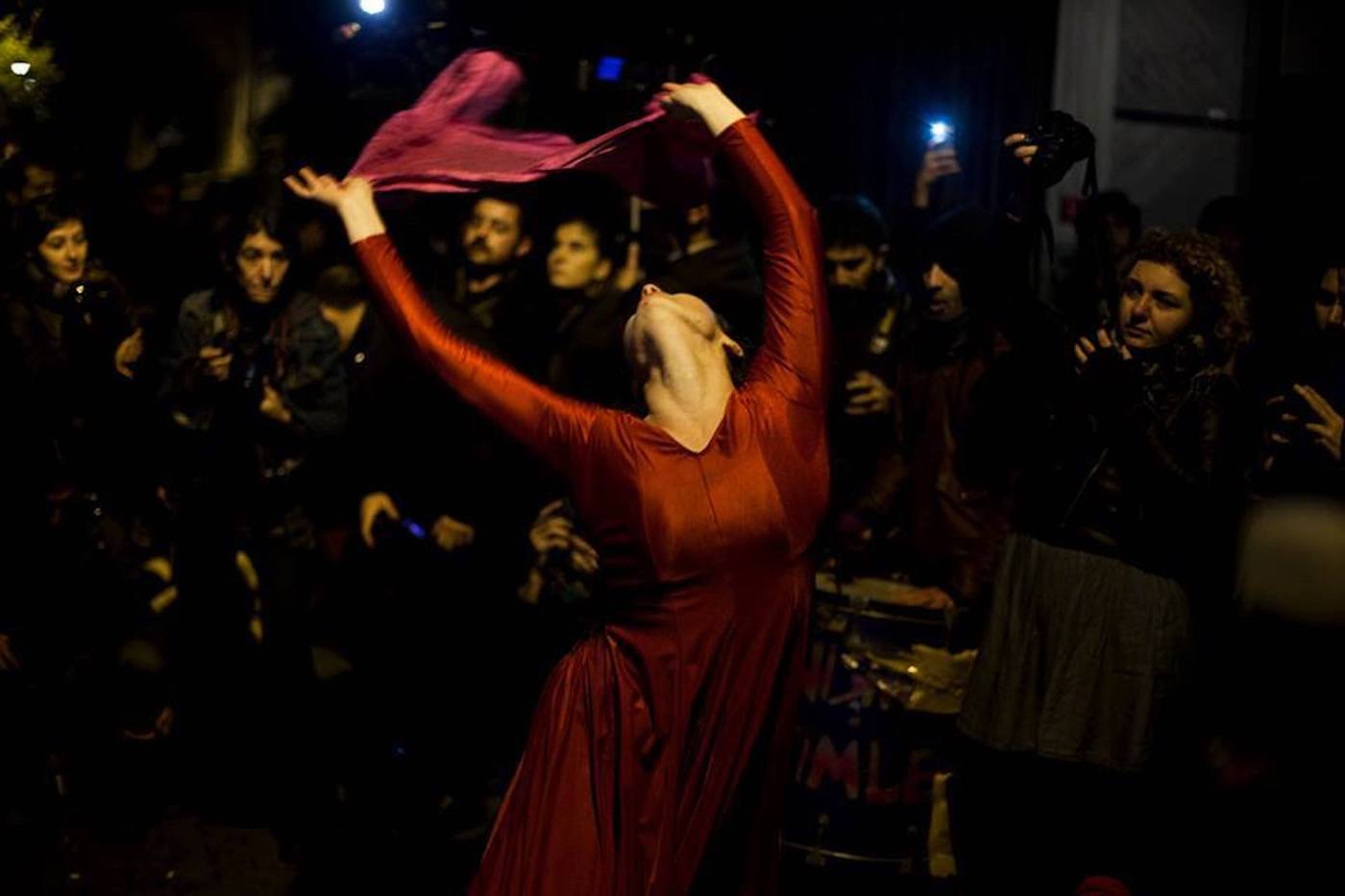
But there is a more fundamental problem when trying to represent such a complex social and political movement that blurred the lines between art and life, social reality, current politics and naive utopianism: ‘active vanishing’ does not easily translate to the conventions of the (bourgeois) theatre stage that are historically predicated by physical distance and separation from life through the construction of a fiction, even if that fiction attempts to simulate reality. The theatres mentioned are most commonly seeking for an uncomplicated visibility of the Gezi themes to draw attention, but once they come to the stage, they lose a great deal of their destituent power and authenticity. One exception is Gonca Gümüsayak's Liquid Politics dance choreography, which she performed in various contexts and places, mostly in Istanbul's public spaces right after the Gezi protests. Gümüsayak's ‘stand-up perform dance’ not only visually refers to known Gezi symbols, but also aims to politicize contemporary dance by undermining the audience's perception of reality and its underlying political imagination. In the dance, she gradually morphs her body from a distortedly masked, authoritative, masculine figure, dressed in a suit, to a swirling ‘woman in red’. Through her ever-changing performance, she claims authenticity of her art and its changing symbolism, while referencing the kırmızılı kadin (and perhaps with that, all women in the protests) as well as the icon of the masked whirling dervish.
Gonca Gümüsayak performs as ‘woman in red' in the streets around Taksim, Istanbul, as part of Liquid Politics (2014). Published with permission of the photographer Italo Rondinella.

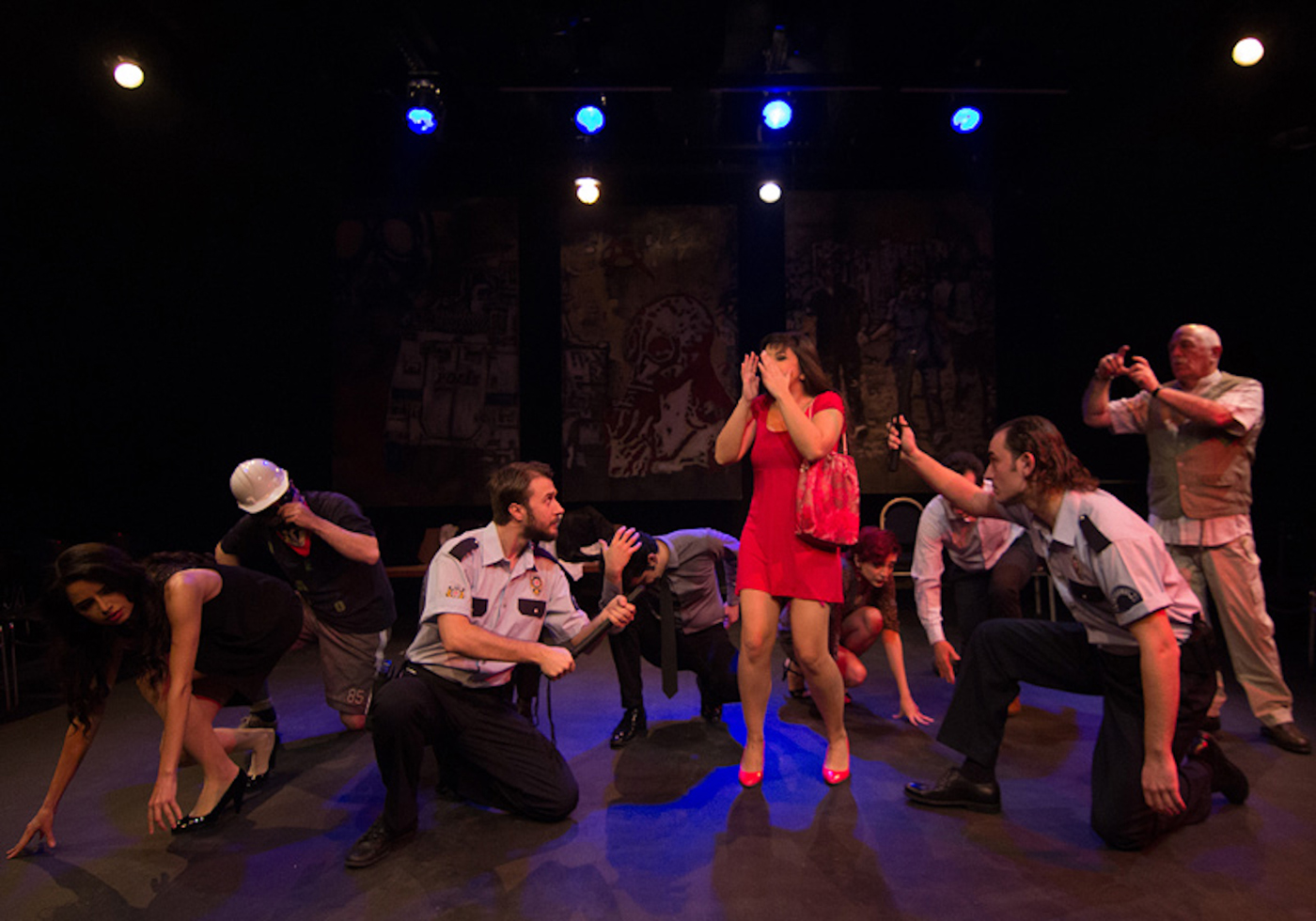
Gezi's politics of symbols is perhaps both the burden and the gift that post-Gezi performativity has to come to terms with. A musical by Istanbul-based Talimhane Tiyatrosu (in collaboration with Neuköllner Oper in Berlin), entitled Taksim Meydan ı, turns the icons of the Gezi protests around by showing confrontations between characters (a lawyer, a doctor, a prostitute, a police officer, an old 1970s revolutionary, etc.) as ‘stock’ characters, who discuss and look at the Gezi protests from the outside. The outsider's perspective was meant to draw in the audience, yet many who came to see the show had already experienced the protests from the inside. The musical was designed as a form of reminiscent/commemorative theatre.Footnote 49 However, the general feeling was that it was just too soon to make theatre about Gezi at a time when the Gezi icons were already being reified.Footnote 50 Its underlying identity politics might also be too celebratory and uncritical in its shown simplicity. It did retain a sense of the creative, poetic and humorous interventions during the protests. The musical's space of the singing voice could also be regarded as an answer to a media space that is saturated by the voice of authority, particularly that of Erdoğan as the voice of the state on television and public radio.
The Musical Theatre Production Taksim Meydanı by Talimhane Tiyatrosu, directed by Mehmet Ergen. A ‘woman in red' character is at the centre, surrounded by other characters portraying ‘outsiders' to the Gezi protest events. Photographer’s name withheld. Published with permission of the director, Mehmet Ergen.

Nevertheless, there are new theatre texts in Turkey that give voice to the politically silenced and socially vulnerable, although many of them were realized outside Turkey or with the help of institutions that help protect freedom of speech.Footnote 51 A new theatre text, SAY YOUR NAME/Adine Söyle, was realized within Arcola Theatre's Ala-Turca programme that questions the very relationship between big corporations, the government and the media through the Gezi Park protests. Another music theatre play, Taksim Forever/Rüyalar parkı/Park der Träume, premiered in August 2014 at the Neuköllner Oper in Berlin. It tells the fictional love story of a German sound artist meeting a Turkish activist during Gezi. This play reflects on the vital question: what are you prepared to fight for?
References to Gezi in most of these new theatre texts are quite straightforward, lack any nuance and reflect the artist's point of view with a clear, sometimes explicitly didactic message concerning social justice, freedom of expression and remembrance of the events. Iconic references are, indeed, hard to misinterpret by audiences who have lived the Turkish state repression, the Twitter ban or the Gezi events first-hand. For them, the rather overt simplicity may be less attractive, which serves to question which audiences these new texts and performances are really trying to reach. Yet they represent more than singular texts. They are, in themselves, tapping into the same ‘repertoires’ as the performative protest actions on the streets, with the difference that they mean to exert ‘transformative power with aesthetics and efficient narrative’, as Turkish-Kurdish playwright, actor and director Aydin Orak affirmed.Footnote 52
A problem with archiving and studying these new ‘post-Gezi’ texts is that they usually fall below the radar of the mainstream media, criticism and, therefore, the official archive.Footnote 53 Moreover, theatre is going through a difficult time in Turkey and appreciative audiences for such new works are highly concentrated in the cities, particularly in the independent and private theatres of Istanbul. So it would still be too optimistic to claim that Gezi changed Turkish culture permanently. And yet its expressions in new theatre texts give evidence of a larger structure of feeling, a cultural transformation already under way and a message of hope that will resonate with future generations.
Conclusion
It is a well-known critique that ‘revolutions’, and their subversive, carnivalesque and destituent powers, in our late capitalist world only last during the events; thereafter, order is restored. This is not any different in Turkey. After Gezi, Turkey became increasingly more authoritative, repressive, centralizing power while witch hunts against ever-new ‘enemies’ blaze through its institutions, affecting the very fabric of the cultural infrastructure as well as the overall mentality of the people. The order has not only been restored; it is ‘tightened’ in the worst possible sense. However, the performativity of the Gezi protests has left a lasting impact on Turkey's cultural, social, discursive and aesthetic fronts.Footnote 54
What I hope to have conveyed is that a new performative awareness in Turkey has started, which expresses itself in many forms and which grew out of the social uprising of Gezi in 2013. I defined this performativity through Butler as a reiterative or recursive power of expressing dissidence that asks for a response, a mobilization, from its recipients. Performative protest acts in Gezi operate, therefore, mostly on relational terms. Today, they extend through the recursivity of images and memes on digital media platforms. And they include often a plethora of signifiers that create their own symbolic politics against those who mean to provoke or silence dissidence. Through a notion of ‘active vanishing’, I demonstrated an inherent paradox in this new performativity, between a wish for representation which seeks visibility, thereby causing fragility in the face of state repression and coercion, and a strategic restraining from the payoff of that visibility to (re)claim destituent power. Having said that, we must be cautious of new performative forms that are rather reactionary and aim at reinforcing the regime's narratives and myths and the existing social order.
As for the payoff for theatre artists and audiences, post-Gezi may well yield a new theatre movement that, in the face of current austerity, will produce new plays and performances, which are not necessarily about Gezi but that are inspired by the same multifaceted politics of symbols. Time will tell. But it is now already apparent that the new performativity is part and parcel of a new culture of dissidence that was set in motion during Gezi. It is perhaps premature to say, but it seems that this new performativity changed the nature of protest irrevocably in seeking new ways to stay unmarked while looking for a more lasting presence and memory beyond state persecution. Despite their necessary shortcomings, the ‘post-Gezi’ dramaturgies certainly try to do exactly this.
Her Yer Direniş, Her Yer Sahne! Footnote 55