The dairy “maturation” of milk is defined as the period between milk collection on the farm and the beginning of the cheesemaking process in the vat. During this time, physico-chemical, microbiological and technological characteristics of milk are modified to some degree. The nature and the extent of these variations are influenced by several factors, which depends on the conditions (time/temperature) of the milk maturation process (Amram et al. Reference Amram, Delespaul, Vandeweghe, Schneid and Lenoir1982; Desmazeaud, Reference Desmazeaud and Eck1984).
Parmigiano-Reggiano is a hard cheese made from raw cows' milk produced in a limited geographic area in Northern Italy. Only raw, unheated milk may be used and the use of additives is strictly forbidden. The raw material is obtained by commingling (approximately 1:1) the partially skimmed evening milk and the full-cream morning milk. The key features of the cheesemaking process (Council Regulation, 1992) are: the maturation of the evening milk, the use of natural whey starter cultures, the use of calf rennet, a ripening period from 12 to 24 months (www.parmigiano-reggiano.it). The maturation of milk represents a critical step and one of the characterising elements of the whole cheesemaking process (Battistotti & Corradini, Reference Battistotti, Corradini and Fox1993). It can be divided in two steps: the first one, which lasts about 6 h, occurs between milking in the parlour to delivery to the cheese factory; the following step occurs in the cheese factory (10–12 h) where the milk rests in large flat vats to obtain the gravity separation of milk fat. When the desired fat separation is achieved, the partially skimmed raw milk of about 1·7–1·8% fat is drained from the bottom of the flat vats into the cheese vat. This second step is defined as the “natural creaming” of milk (Ma & Barbano, Reference Ma and Barbano2000).
The natural creaming by gravity separation is essential to optimize the fat to casein ratio of milk in the vat. The cheese yield and textural properties of cheese are strongly influenced by the fat to casein ratio (Guinee et al. Reference Guinee, Mulholland, Kelly and Callaghan2007) and in hard cheeses, like Parmigiano-Reggiano, it should range between 0·95 and 1·10 (Mariani et al. Reference Mariani, Summer, Formaggioni, Malacarne and Battistotti2001).
Remarkable modifications of the milk fat structure take place during gravity separation. The separation results in a gradient of fat content and fat globule size from top to bottom of the milk in the large flat vats (Ma & Barbano, Reference Ma and Barbano2000). The bottom layer of the milk, which is drained into the vat, is enriched by small size fat globules. These small size fat globules are “included” in the casein reticulum of the cheese better than large globules. This allows for the formation of the most suitable curd to support the higher physico-mechanical stress applied during the cheesemaking process (curd breaking, stirring, cooking, etc.). Conversely, there is little information about the effects of dairy maturation on the contents and relationship with other milk constituents, such as nitrogen fractions and mineral components, as well as its technological properties (Bagni et al. Reference Bagni, Chiavari, Castagnetti, Grazia and Losi1987).
The storage conditions of the evening milk and the technical-structural characteristics of the holder used for the gravity separation of fat, could significantly affect the modifications of milk during the maturation stage (Zannoni et al. Reference Zannoni, Nanni and Mora1984). Historically, the milk has been stored and delivered to the cheese factory in 52 l churns. Once in the cheese factory, the milk was poured into large flat vats containing 10–12 hl, where it rested until draining into the cheese vat. Recently, thermoregulated tanks (not lower than 18°C) and thermoregulated large flat vats (capacity 60 hl at about 15°C) have been introduced to replace, respectively, churns and large flat vats. However, no studies have been carried out in order to verify the effect of these new technologies on the dairy maturation of milk. This is essential when considering PDO (Protected Designation of Origin) cheeses, where modifications to cheesemaking technology must be carefully evaluated in order to verify that they do not affect the characteristics and properties of the cheese.
The aim of the research was to study the effect of the dairy maturation conditions, involving traditional and novel technologies, on the physico-chemical characteristics and technological properties of milk for Parmigiano-Reggiano cheese manufacture.
Materials and methods
Experimental design
The investigation was carried out at 3 cheese factories producing Parmigiano-Reggiano cheese, in the province of Parma. Three different operating conditions (CF1, CF2 and CF3) for the dairy maturation of milk were considered, one for each cheese factory. Full cream milk of the evening milking was stored on the farm and delivered to the cheese factory in churns (CF1) or in thermoregulated tanks at a temperature not lower than 18°C (CF2 and CF3). The natural creaming was performed in traditional large flat vats containing 10–12 hl (CF1 and CF2) or in thermoregulated large flat vats containing 60 hl at about 15°C (CF3).
Eight trials throughout 2 consecutive years were performed in each CF1 and CF2: 4 trials per year, 2 in summer and 2 in winter. In CF3, 12 trials were carried out throughout 2 years: 6 trials per year, 3 in summer and 3 in winter. Because of elevated CFU/ml values in the evening milk (data not shown) one trial was not considered in the study. In each cheese factory, 3 (CF1 and CF2) or 2 (CF3) holders for the natural creaming process were selected for milk sampling and the same holders were sampled during the other trials. In particular, samples were taken from the full cream milk of the evening milking (FC milk) at the onset of the natural creaming process, when the evening milk was poured into the holder for natural creaming. Samples were also taken of the partially skimmed milk by natural creaming (PS milk) the following morning in the vat, immediately after drainage of the PS milk from the bottom of the creaming holder to the cheese vat. On milk samples, compositional analysis, rennet-coagulation and rheological properties were performed.
Milk compositional analysis
The following standard milk analyses were carried out: pH with a potentiometer, titratable acidity with 0·25 m-NaOH using the Soxhlet-Henkel method (Anon., 1963) and fat and lactose by infrared analysis (Biggs, Reference Biggs1978) with a Milko-Scan 134 A/B (Foss Electric, DK-3400 Hillerød, Denmark). Total nitrogen (TN) in milk, non-casein nitrogen (NCN) in acid whey at pH 4·6 and non-protein nitrogen (NPN) in milk after treatment with trichloroacetic acid (TCA; 120 g/l), were determined by the Kjeldahl method (Aschaffenburg & Drewry, Reference Aschaffenburg and Drewry1959). Proteose-peptone N (PPN) was determined by the Kjeldahl method in acid whey obtained according to van Boeckel & Crjins (Reference van Boeckel and Crijns1994). From these nitrogen fractions, total protein (TN×6·38), casein nitrogen (CN=TN – NCN), casein (CN×6·38), wheyproteins N (WN=NCN – NPN), wheyproteins (WN×6·38), proteose-peptone (PP=PPN×6·38), casein number (casein nitrogen×100/total nitrogen) were calculated. The following mineral components were determined: total calcium and soluble calcium in milk and rennet whey, respectively (De Man, Reference De Man1962); total phosphorus in milk, soluble phosphorus in rennet whey and total acid-soluble phosphorus in milk after treatment with TCA (120 g/l) (Allen, Reference Allen1940); distribution of calcium and phosphorus fractions according to White & Davies (Reference White and Davies1958). Total solids (TS) were determined in 10 g milk in a drying oven at a temperature of 102°C according to Savini (Reference Savini1946). Solids-not-fat (SNF) were calculated as follows: SNF=TS – milk fat. Total bacterial count (TBC) was determined on PCA plate after incubation at 30°C for 72 h.
Analyses of milk coagulation properties
To milk samples (10 ml) 0·2 ml (1:100) a rennet solution (1:19 000; Chr. Hansen, I-20094 Corsico MI, Italy) was added. The coagulation characteristics, milk clotting time (r), curd firming time (k20) and curd firmness (a30 and a45), were measured at 35°C (McMahon & Brown, Reference McMahon and Brown1982) using a Formagraph (Foss Electric). Milk clotting time is the time from the addition of rennet to the onset of gelation. Curd firming time is the time from the onset of gelation till the signal attains a width of 20 mm. Curd firmness is the width of the signal 30 min (a30) and 45 min (a45) after the addition of rennet.
Analyses of milk rheological properties
Resistance to compression and resistance to cut of the coagulum were measured 30 min after the beginning of coagulation, using the Gel Tester apparatus (Marine Colloids Inc. Springfield, NJ 07081, USA) (Annibaldi, Reference Annibaldi and Parmigiano-Reggiano1973).
Statistical analyses
To evaluate the significance of the differences between PS milk and FC milk and also between the various operating conditions (CF1, CF2 and CF3), the collected data were transformed as follows: the value assigned to PS milk was calculated by the difference between the analytical value of PS and that of the corresponding FC milk; the value assigned to the FC milk was zero.
The transformed data were analysed by ANOVA univariate (SPSS 14.0 version, Chicago, IL 60606, USA), according to the following GLM:

where: yijk=dependent variable; μ=common mean; αi=effect of “maturation” (i=1 PS milk, 2 FC milk); βj=effect of the operative condition (j=1 CF1, 2 CF2, 3 CF3); εijk=error.
Results and Discussion
pH, titratable acidity, basic compostition and nitrogen fractions
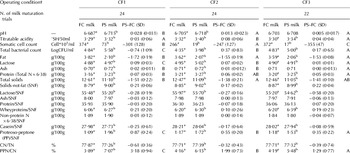
The variations of pH and titratable acidity values, basic composition parameters and nitrogen fractions content between FC milk and the corresponding PS milk are reported in Table 1. Mean values of pH, lactose, total bacterial count and somatic cell count of FC milk can be defined as normal.
pH, titratable acidity, basic composition and nitrogen fractions values of the full cream milk of the evening milking (FC milk) and those of the corresponding partially skimmed milk by natural creaming (PS milk)

† FC milk of the evening milking was stored on the farm and delivered to the cheese factory in churns (CF1) or in thermoregulated tanks at a temperature not lower than 18°C (CF2 and CF3). The natural creaming was performed in classical large flat vat of 10–s12 hl (CF1 and CF2) or in thermoregulated (about 15°C) large flat vat of 60 hl (CF3)
A, B, C :differences (PS–FC) with different letter differ between operating conditions for P⩽0·05
a, b :values of FC and PS milk with different letter in the same operating condition differ for P⩽0·05
A significant increase (P⩽0·05) in pH during the maturation of milk was observed in CF1 and CF2. The increase of pH was higher (P⩽0·05) in CF1 than CF2 and CF3. The values of titratable acidity were higher (P⩽0·05) in PS milk than in FC milk in each operating condition. The increase observed in CF2 was higher than those reported in CF1 and CF3.
As expected, a significant decrease of fat, total solids and somatic cell count was observed during the maturation of milk. On the other hand, an increase of the concentration of non-fat constituents – protein, lactose and ash – was registered in PS milk. To remove the concentration effect exerted by the creaming and milk water evaporation, the contents of milk constituents were reported on solids-not-fat (SNF). From this point of view, the lactose content was lower (P⩽0·05) in PS milk than in FC milk. There was no difference in the variation of lactose between the various operative conditions and was probably related to the degradation of lactose by the milk microflora. Compared with FC milk, PS milk showed lower values (P⩽0·05) of casein and casein number and higher contents (P⩽0·05) of whey proteins and, particularly, proteose-peptone. These variations indicated a partial breakdown of casein by the plasmin (Andrews & Alichanidis, Reference Andrews and Alichanidis1983) during the maturation step. The increase of proteose-peptone – per 100 g SNF or 100 g casein – was significantly higher (P⩽0·05) in CF1 than in CF2 and, in particular, than in CF3. In CF1 there was no system to control the temperature of milk. This condition seems to favour the activity of plasmin and/or proteases of microbial origin (Kang & Frank, Reference Kang and Frank1988). The control of temperature during the whole process of maturation (CF3) has reduced the proteolysis of casein that takes place in this phase.
Mineral elements content and salts equilibria
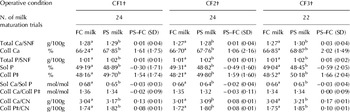
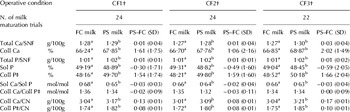
The values of the content and of the ratios of calcium and phosphorus fractions concerning FC milk and the corresponding PS milk are shown in Table 2.
Mineral content and salts equilibria of the full cream milk of the evening milking (FC milk) and those of the corresponding partially skimmed milk by natural creaming (PS milk)
† FC milk of the evening milking was stored on the farm and delivered to the cheese factory in churns (CF1) or in thermoregulated tanks at a temperature not lower than 18°C (CF2 and CF3). The natural creaming was performed in classical large flat vat of 10–12 hl (CF1 and CF2) or in thermoregulated (about 15°C) large flat vat of 60 hl (CF3)
‡ Corrected value for the lipide phosphorus quota
a, b: values of FC and PS milk with different letter in the same operating condition differ for P⩽0·05
Compared with FC milk, PS milk was characterised by a higher content of total calcium and total phosphorus on SNF in each operating condition (P⩽0·05). The PS milk showed higher percentage values of the colloidal fractions of calcium (P⩽0·05) and phosphorus (P⩽0·05) than those observed in FC milk. Moreover, a significant variation (P⩽0·05) of the molar ratio between calcium and phosphorus in the soluble phase was reported during this phase. PS milk showed higher values of both colloidal Ca/casein (P⩽0·01) and colloidal P/casein (P⩽0·01) than FC milk. The variations of mineral contents and salts equilibria were not different (P>0·05) between CF1, CF2, and CF3.
Most papers deal with the effect of acidification on the milk salts equilibria. They report a solubilisation of colloidal calcium and phosphorus as pH decrease (Dalgleish & Law, Reference Dalgleish and Law1989; Le Graet & Brulé, Reference Le Graet and Brulé1993; Law & Leaver, Reference Law and Leaver1998). On the basis of these observations, the increase in the mineralisation degree of the micelles observed here was probably associated with the increase of the pH values of milk. Moreover, these modifications had determined a decrease of the molar ratio between calcium and phosphorus in the soluble phase of milk. This parameter has a certain technological interest: it represents an index of the availability of ionic calcium (Ca++) during the second phase of milk rennet-coagulation, e.g. the aggregation of paracasein micelles (Hyslop, Reference Hyslop, Fox and McSweeney2003).
Rennet-coagulation aptitude and rheological properties
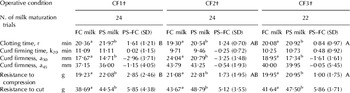
The variations of rennet coagulation parameters and rheological properties between FC milk and the corresponding PS milk are shown in Table 3.
Rennet-coagulation aptitude and rheological properties of the full cream milk of the evening milking (FC milk) and those of the corresponding partially skimmed milk by natural creaming (PS milk)

† FC milk of the evening milking was stored on the farm and delivered to the cheese factory in churns (CF1) or in thermoregulated tanks at a temperature not lower than 18°C (CF2 and CF3). The natural creaming was performed in classical large flat vat of 10–12 hl (CF1 and CF2) or in thermoregulated (about 15°C) large flat vat of 60 hl (CF3)
A, B: differences (PS–FC) with different letter differ between operating conditions for P⩽0·05
a, b: values of FC and PS milk with different letter in the same operating condition differ for P⩽0·05
Compared with FC milk, PS milk was characterised by a higher rennet coagulation time (P⩽0·05) and lower curd firmness measured 30 min after rennet addition (P⩽0·05). When considering the different operating systems, the increase in milk clotting time was greater (P⩽0·05) in CF1 than in CF3. The variation observed in CF2 was not different with respect to either CF1 or CF3. Within a certain limit, milk clotting time is positively correlated with pH values (Shalabi & Fox, Reference Shalabi and Fox1982; Zoon et al. Reference Zoon, van Vliet and Walstra1989; Ikonen et al. Reference Ikonen, Morri, Tyrisevä, Ruottinen and Ojala2004). As a consequence, the greater increase of milk clotting time observed during maturation of CF1 is related to the higher increase of pH value registered in this operating condition than in either CF2 or CF3.
Concerning the rheological properties of the curd, PS milk was characterised by higher values of both resistance to compression (P⩽0·05) and resistance to cut (P⩽0·05) than FC milk. When comparing operating systems, a higher increase (P⩽0·05) of resistance to compression was observed in CF1 with respect to CF3. CF2 variation was not different with respect to either CF1 or CF3.
Rheological properties of the coagulum – expressed as resistance to compression and resistance to cut values – define both the curd firmness and elasticity. A firmer and more elastic curd can support the higher physico-mechanical stress undergone during the cheesemaking process (curd breaking, stirring, cooking etc.). As a result, a more effective and homogeneous whey drainage during the processing, and sedimentation can occur, with neither elasticity nor cohesion loss over the whole cheese mass (Walstra, Reference Walstra and Fox1993; Lucey, Reference Lucey2001). This condition is essential for producing long ripened cheeses such as Parmigiano-Reggiano. Under this profile, the dairy maturation determined a significant improvement of the technological properties of milk. This seems to be related to the lower fat:casein ratio of PS milk and the variations of the mineralisation degree of the casein micelle (Johnston & Murphy, Reference Johnston and Murphy1984; Udabage et al. Reference Udabage, McKinnon and Augustin2001; Choi et al. Reference Choi, Horne and Lucey2007).
The results observed here show the fundamental role exerted by the process of milk maturation on the specific technological aptitude of milk to be processed into Parmigiano-Reggiano cheese. In fact, besides optimizing the fat to casein ratio of vat milk and removing bacteria spores and somatic cells, the maturation step involved a structural modifications of the casein micelle such as to improve the syneresis of the cheese mass, this latter is an essential property for the production of long ripened cheeses. The introduction of thermoregulated holders seems to have improved the maturation process of milk when compared with traditional systems. In fact, a reduction of the proteolysis of casein by the plasmin and an attenuated worsening of the rennet clotting time was observed in CF2 and, particularly, in CF3.
Variation in the differences between PS and FC milks (PS-FC) in pH, TBC and fat were clearly lower in CF3 than CF1 (see sd values in table 1). This means that the control of milk temperature throughout the whole maturation phase offers a greater control of both microbial development and extent of creaming.
The introduction of thermoregulated holders raises questions about the usefulness of blending PS milk with full cream milk of the morning milking prior processing. Historically blending of milks was introduced to restore the processability of PS milk in winter, when the temperature of PS milk fell below 10°C. However this practice overwhelmed the physico-chemical modifications of milk that took place during maturation and is likely to wipe out differences observed among CF1, CF2 and CF3. The opportunity to control milk temperature would avoid the need for blending and, consequently, it would allow full advantage to be taken of the improving processing quality of milk induced by maturation. However this point has to be evaluated carefully and specific studies are needed to exploit this opportunity.
This work was supported by the Emilia-Romagna region, Italy.