Public health agencies have improved their emergency readiness by integrating various aspects of public health into emergency management.Reference Bashir, Lafronza and Fraser 1 One aspect of disaster preparedness that has particularly benefited from these improvements is the proliferation and strengthening of disaster coalitions. Participation in community partnerships has been encouraged by funding agencies and is now required by The Joint Commission and the US Department of Health and Human Services Office of the Assistant Secretary for Preparedness and Response’s (ASPR’s) Hospital Preparedness Program.Reference Toner, Waldhorn and Franco 2 Following the 2001 terrorist attacks in the United States (9/11 and anthrax), the Joint Commission shifted their attention from organizational to community-wide preparedness. It issued new standards requiring health care agencies to have a command structure that linked to the community’s command structure and to work cooperatively with community partners to provide mutual aid. 3 ASPR reinforced this shift by financially supporting initiatives that encouraged health care agencies to form coalitions and prepare to respond to emergencies as a coordinated system.Reference Toner, Waldhorn and Franco 2 , Reference Rambhia, Waldhorn and Selck 4 Nonetheless, creating healthy, functioning collaborative relationships remains challenging.Reference Toner, Waldhorn and Franco 2 , Reference Dobalian 5
As a federal health care system, the Veterans Health Administration (VHA) combines health and government responsibilities to provide care before, during, and after emergencies. It adheres to the same accreditation emergency management requirements as private hospitals, while additionally being tasked to support the National Disaster Medical System when requested by the federal government. 6 Therefore, VHA requires emergency managers (EMs) at all Veterans Affairs Medical Centers (VAMCs) to prepare their facilities for disasters, including collaborating with local community partners (eg, response agencies, health care facilities, community organizations).Reference Dobalian 5 Yet, despite national efforts to promote VAMC–community joint preparedness, a perception remains that it is challenging to engage VAMCs in partnerships with their communities.Reference Toner, Waldhorn and Franco 2 , Reference Dobalian 5 , Reference Dobalian, Callis and Davey 7
In 2012, the Veterans Emergency Management Evaluation Center initiated a study to understand the nature and scope of emergency management collaborations between VAMCs and local non-VA organizations. We explored how the status of VAMCs as federal entities affects collaborative work with local governmental and nongovernmental entities. We sought to understand facilitators and barriers local VAMC EMs face when collaborating with non-VA entities.
METHODS
Of the 152 VAMCs within the VHA, 15 EMs were identified for interviewing by using purposive and snowball sampling techniques. Selection criteria included facility size and representation from each of the Federal Emergency Management Agency (FEMA) regions to include preparation for a range of disasters. Respondents participated in semi-structured telephone interviews lasting 60 to 90 minutes.
Sections of the interview transcripts eliciting information on barriers and facilitators were identified for analysis herein. Two researchers independently coded the first one-third of the transcript portions, then compared and agreed on coding to refine the codebook. They repeated the process for the next two-thirds of the transcript portions. The team reviewed the coded data to identify recurrent and overlapping themes. Themes identified in the analysis were organized into 2 categories: (1) internal (ie, factors from within individual VAMCs or by VA policy) and (2) external (ie, interagency or interpersonal factors).
This study was approved as a Quality Improvement project by the VA Greater Los Angeles Health Care System Institutional Review Board.
RESULTS
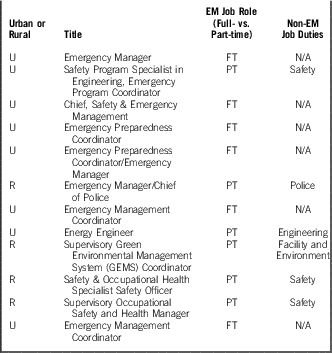
Twelve EMs agreed to participate from across the nation (see Table 1 for interviewee characteristics). All interviewees indicated collaborating with at least one non-VA partner on disaster preparedness or response activities.
Interviewee CharacteristicsFootnote a

a Abbreviations: FT, full-time; N/A, not applicable; PT, part-time; R, rural; U, urban.
Internal Themes
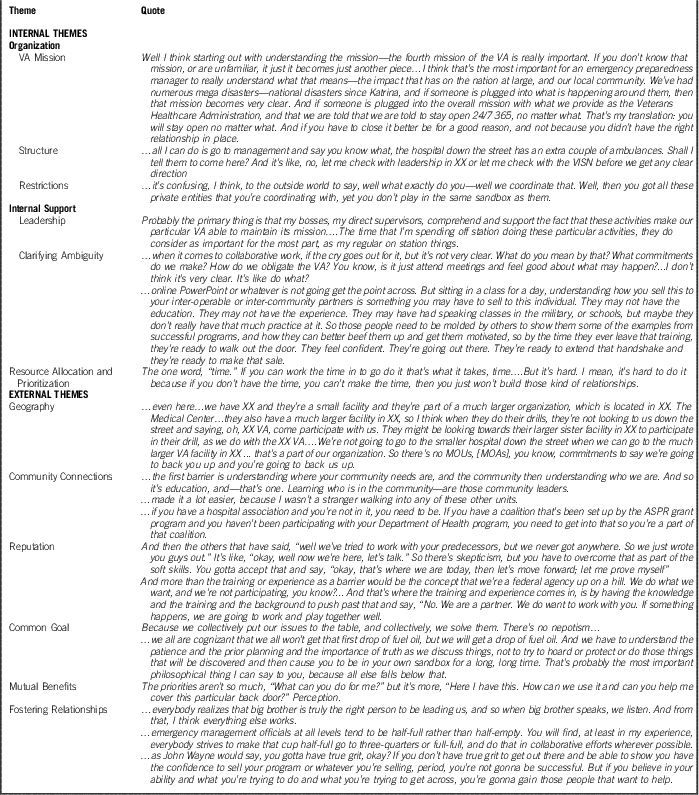
See Table 2 for illustrative quotations.
Illustrative Quotes Demonstrating Factors Affecting Collaborative RelationshipsFootnote a

a Abbreviations: ASPR, US Department of Health and Human Services Office of the Assistant Secretary for Preparedness and Response; MOA, memorandum of agreement; MOU, Memorandum of Understanding; VISN, Veterans Integrated Service Networks.
Organizational Mission
Facilitators
The VA’s “Fourth Mission” underscores the importance of the “community” part of emergency management. (The VA’s “Fourth Mission” is to improve the nation’s preparedness for response to war, terrorism, national emergencies, and natural disasters by developing plans and taking actions to ensure continued service to veterans, as well as to support national, state, and local emergency management, public health, safety and homeland security efforts.)
Barriers
The VA’s primary focus is on veterans; limited disaster preparedness resources need to be prioritized internally.
Organizational Structure
Facilitators
Regional oversight of activities can provide an incentive to collaborate.
Barriers
Large chains of command (eg, sharing responsibility between the VAMC and its regional EM) can slow or limit collaborative opportunities, sometimes confusing who has certain responsibilities. Hiring requirements and delays can prevent training of new EMs by departing or retiring EMs, impeding continuity of established connections.
Restrictions
Barriers
Clarity is lacking about whether federal funding can support resource-sharing with privately funded partners and vice versa. Questions exist around Memorandums of Understanding (MOU’s): what can one legally commit to with community partners? Can they be signed? What can they include? Creating MOUs often necessitates legal counsel, falling outside the expertise of EMs.
Leadership Support
Facilitators
Facilitators included clear communication and active engagement with leadership about potential partnerships and expectations of what is permissible and leadership who emphasize collaboration, support time on collaborative activities, grant sufficient autonomy, authorize hiring full-time or additional staff, and encourage sharing resources.
Barriers
Barriers include leadership who see limited benefits from collaboration or who place lower priority on emergency management. Examples include “inappropriate” job classification or not hiring full-time staff.
Clarifying Ambiguity
Facilitators
Facilitators include a more formal definition of collaboration and clearer guidance on how to actualize collaboration requirements and formalize external relationships. Examples include (1) providing new hires an experienced mentor with whom they can attend community meetings until they feel confident and are seen by partners as sufficiently knowledgeable and experienced, (2) VA regional networks introducing new hires to fellow EMs who can offer them support, and (3) in-person trainings that provide education and can emphasize “soft skills” required for engaging community partners.
Barriers
The VA Guidebook for EMs was characterized as describing what one cannot do but being sparse on “how to do it.” It was mentioned that the Guidebook was being revised to include more “how to” details, but that it was currently challenging for even experienced EMs to understand their role in collaborating with other organizations. Restrictions were perceived on the types of commitments and resources that VAMCs can promise to non-VA partners, even with the knowledge that in the midst of a disaster, EMs will likely become the local representative of the federal response in their community and may need to coordinate shared resources.
Resource Allocation and Prioritization
Facilitators
Facilitators included making collaboration a regular part of one’s schedule, organizing community events, and providing VA staff time and space to partner agencies. The community characteristics perceived as being more receptive to partnerships and sharing resources included being at risk for a high number of disasters, having had previous disaster experience, and being rural or geographically secluded. Some EMs in rural areas were more likely to identify a larger, “sister” VA facility nearby as a priority partner rather than a small non-VA facility, thus receiving the benefits of a collaborative relationship, while decreasing the need for complicated MOUs.
Barriers
Barriers included time constraints to travel to partner agencies and collaborative meetings (eg, 4-hour drives to community meetings made in-person attendance difficult). Small, rural VAMCs with a single, often part-time EM managing multiple facilities indicated a lack of time, lack of clarity, or little interest in investing extra time in collaboration. These EMs sometimes were resistant to having collaboration become a job expectation.
External Themes
See Table 2 for illustrative quotations.
Community Connections
Facilitators
Facilitators included learning about the community, community leaders, the structure and role of other organizations, and clearly communicating with potential partners. VA colleagues and nonwork friends can provide community contacts, while participation in multiple community groups (eg, local hospital associations, coalitions) offers additional networking.
Barriers
Barriers included not understanding the community’s needs or how VAMCs fit with those needs. EMs new to the community, emergency management, or their job may find it challenging to identify contacts and initiate communication without assistance. Partnerships that rely on individual relationships between organizations may be vulnerable as job turnover can interrupt continuity. If past relationships were negative, prior interactions may hinder the development of new relationships.
Reputation
Facilitators
The perception of the VA as isolationist was believed to have decreased over the last few years. EMs articulating VAMC’s responsibilities around emergency management at community meetings and emphasizing the desire to collaborate can overcome misperceptions.
Barriers
The VA’s reputation of being “aloof” or self-contained, skepticism of the VA’s ability to contribute to community preparedness and response, or negative opinions of the VA (eg, negative perceptions of care, EM predecessor was un-collaborative) can cause community organizations to hesitate to include VAMCs in activities.
Common Goal
Facilitators
Facilitators included EMs recognizing “You’re part of the community whether you plan to be or not” and all partners believing they will benefit from working together, devoting time to collaboration, contributing to communal coffers, and working together collectively enable the community to succeed as a whole.
Mutual Benefits
Facilitators
Facilitators included approaching collaboration as an asset, rather than looking for what partners can offer; informing partners what each agency can offer and their resource limitations; and sharing resources in a manner that avoids the need for MOUs. For example, hosting partner events (eg, trainings) on VAMC property provides necessary space to a partner and allows VAMC staff to attend a beneficial training. These events provide rich opportunities for partner engagement. Other preparedness activities (eg, providing space on VAMC campus to store emergency supplies for the community) can demonstrate how relationships can be mutually beneficial.
Barriers
Barriers included not knowing the available resources of each partner agency.
Fostering Relationships
Facilitators
Facilitators included investing time and resources, proactively joining in partner events, having a community group leader or other individual whose dedication to collaboration goes beyond minimum job requirements, not taking criticism of the VA personally, being persistent, and taking the initiative to meet people and contribute to meetings. Some personality characteristics (eg, optimism, flexibility, maturity, confidence, ability to balance work requirements) and interpersonal skills (eg, active listening, asking probing questions, being personable) of EMs and partners are conducive to collaboration.
Barriers
Barriers included confusion around how to maintain engagement with partners.
DISCUSSION
VHA EMs indicated at least a minimal level of collaboration with external regional entities around preparedness and response. Many invested significant effort in community collaboration. Some acknowledged an interest in improving coordination with non-VA entities. Others reported a hesitancy to invest time into outreach and relationship development. The barriers and facilitators of VHA–community collaborations we identified are corroborated by existing literature on collaboration, community coalitions, and emergency management partnerships.Reference Carrier, Yee, Cross and Samuel 8 , Reference Toner, Ravi and Adalja 9
Similar to VHA EMs’ experiences, other organizations’ policies, regulations, and regular duties may sometimes supersede preparedness and collaborative activities.Reference Carrier, Yee, Cross and Samuel 8 Differences in decision-making and authority structures between organizations may pose challenges for diverse partners.Reference Toner, Ravi and Adalja 9 , Reference Dunlop, Logue and Vaidyanathan 10 Federal or grant funding restrictions may divert time to noncollaborative areas of emergency planning or mission-specific activities rather than those that promote collaboration.Reference Toner, Ravi and Adalja 9 , Reference Dunlop, Logue and Vaidyanathan 10 Yet, we found that collaborative activities can occur without committing financial resources, thereby encouraging collaboration before a disaster.Reference Bashir, Lafronza and Fraser 1 , Reference Dunlop, Logue and Vaidyanathan 10
Gaining buy-in from leadership, especially hospital executives, can be challenging.Reference Toner, Ravi and Adalja 9 , Reference Gamboa-Maldonado, Marshak and Sinclair 11 But, leadership involvement and support can build organizational investment12 and lead to sharing lessons from past collaboration efforts,Reference Schoch-Spana, Selck and Goldberg 12 which can better position the organization to continue positive relationships. Many agencies, VA included, face staffing shortages and limited time and resources for emergency management activities, let alone something as time-intensive as collaboration.Reference Toner, Waldhorn and Franco 2 , Reference Carrier, Yee, Cross and Samuel 8 Resources are often prioritized to preparedness efforts for internal facilities rather than external collaborations. Nonetheless, collaboration offers an opportunity to share resources without heavy financial investment (eg, hosting events, providing space to store response supplies) which, in turn, creates the potential for organizations to accrue substantial benefits (eg, better trained staff, easier and quicker access to response supplies).
Smaller institutions may have financial constraints and fewer available personnel, reducing their ability to engage with other organizations.Reference Toner, Waldhorn and Franco 2 , Reference Carrier, Yee, Cross and Samuel 8 Yet rural communities may encourage relationships if the population is tight-knit, where knowing one another can facilitate introductions.Reference Schoch-Spana, Selck and Goldberg 12 Challenges overcoming preconceived notions, territorialism, and working in isolated silos are faced by coalitions as well as EMs.Reference Carrier, Yee, Cross and Samuel 8 - Reference Dunlop, Logue and Vaidyanathan 10 However, aligning partner organizations’ goals and identifying a shared vision can reduce hesitancy to work together.Reference Bashir, Lafronza and Fraser 1 , Reference Schoch-Spana, Selck and Goldberg 12 - 14 In order to provide mutual support, partners must be aware of what each organization is able to do and share.Reference Toner, Waldhorn and Franco 2 , Reference Dunlop, Logue and Vaidyanathan 10 Clear communication, internal and external, available learning opportunities, and forthright discussions all help to build and maintain strong relationships.Reference Bashir, Lafronza and Fraser 1 Interpersonal skills and active listeningReference Gamboa-Maldonado, Marshak and Sinclair 11 can improve communication, while working together on an ongoing basis and emphasizing reciprocity can build familiarity 14 and trust,Reference Thomson, Perry and Miller 13 key components for strong collaboration during and after a disaster.
This study had limitations. The data are a point-in-time perspective from 2012 and may not be indicative of current experiences of VHA EMs. A larger sample size may be helpful to generate more generalizable information, and future projects may benefit from seeking the perspectives of VHA regional EMs and community-based partners.
CONCLUSION
For disaster preparedness and response systems to be successful, collaboration between private and public entities is invaluable and is often a necessity. Recent disasters have underscored the importance of pre-disaster coordination and communication between public and private entities. Emergency management and public health have made great strides in strengthening the nation’s response capabilities. Unfortunately, federal agencies have traditionally faced challenges when trying to engage in local collaborative, community partnerships. Understanding the barriers VAMCs confront, as well as the potential facilitators to collaboration that we identify in this study, should enhance the development of VAMC–community partnerships and improve community health resilience.
Acknowledgments
The authors thank Deb Riopelle, MSPH, and Rebecca Saia for their support in recruiting and interviewing the participants for this study. This material is based upon work supported by the Department of Veterans Affairs, Veterans Health Administration, Office of Patient Care Services. The views expressed in this article are those of the authors and do not necessarily reflect the position or policy of the Department of Veterans Affairs or the US government.