





Introduction
Premature neonates face a risk of nutritional deficiencies soon after birth because of a sudden interruption of continuous nutrient supply from the placenta. The postnatal stress, organ immaturity and intensive care support add to their nutritional needs when compared with a fetus of similar gestational age(Reference Kleinman1,Reference Uauy, Koletzko, Koletzko, Poindexter and Uauy2) . The ideal growth target in premature infants would be to match the growth rate and body composition achieved by the fetus of similar gestational age in utero while avoiding any untoward complications. However, post-delivery, it becomes extremely challenging to match the optimal levels of nutrient intake and growth in a premature baby, particularly a sick baby. Thus, many preterm infants accumulate significant nutrient deficits during the neonatal intensive care unit (NICU) stay leading to extrauterine growth restriction(Reference De Curtis and Rigo3,Reference Sakurai, Itabashi and Sato4) . This nutrient deficit is heightened in very low birth weight (VLBW) infants (birth weight <1500 g) and very preterm infants (birth gestation <32 weeks). With an improved understanding of physiology and advances in neonatal nutrition, it is possible to provide better nutrition to preterm babies. Preterm babies should be provided adequate calories and proteins immediately after birth to prevent endogenous protein breakdown and improve growth and tissue remodelling(Reference Ziegler5). Early initiation and optimising nutrient intake in preterm infants may improve clinical outcomes such as neurodevelopment, bronchopulmonary dysplasia (BPD), metabolic bone disease and retinopathy of prematurity (ROP)(Reference Chan, Johnson and Leaf6–Reference Klevebro, Westin and Stoltz Sjöström8).
Beyond the well-established association with somatic morbidity, postnatal growth in preterm infants is increasingly recognised as a key determinant of neurodevelopment. A substantial proportion of premature infants experience postnatal growth restriction, which has been consistently associated with impaired neurocognitive outcomes in later childhood(Reference Ehrenkranz, Dusick and Vohr9). In a large European cohort study, El Rafei et al. demonstrated that postnatal growth failure remains highly prevalent in extremely preterm infants and is independently associated with adverse neurodevelopmental outcomes at 5 years of age(Reference El Rafei, Maier and Jarreau10). This underscores the central role of optimising early enteral nutrition in supporting both somatic growth and long-term neurodevelopment.
Although parenteral nutrition remains a temporary alternative to provide critical nutrition immediately after preterm birth, early enteral feeding confers significant nutritional and non-nutritional benefits(Reference Alshaikh, Dharel and Yusuf11). Delaying enteral nutrition can lead to reduced intestinal growth, atrophy of mucosa, intestinal barrier dysfunction and abnormal gut microflora. Human milk (HM) is considered the best option for enteral feeding for all neonates(Reference Embleton, Jennifer Moltu and Lapillonne12). HM feeding for preterm infants has several benefits, including improved feed tolerance, lower risk of necrotising enterocolitis (NEC), late-onset sepsis (LOS) and ROP, as well as shorter hospital stay(Reference Vohr, Poindexter and Dusick13,Reference Miller, Tonkin and Damarell14) . However, HM alone is insufficient to meet the additional nutrient requirements of preterm infants. Adding protein and calories to HM in the form of a multicomponent human milk fortifier (HMF) is a common practice to enhance growth in preterm infants(Reference Kuschel and Harding15,Reference Adamkin and Radmacher16) . The clinical challenge with aggressive enteral feeding in preterm infants with immature gut motility is the fear of NEC. This has led to a huge variation in feeding practices among neonatal units globally.
Developing and following a standardised feeding regimen (SFR) has shown to be an effective strategy for reducing NEC. However, there are often variations in practice when it comes to feeding practices for this vulnerable group(Reference Jasani and Patole17,Reference Ramaswamy, Bandyopadhyay and Ahmed18) . Clinical practices are often determined by local knowledge, past experiences and traditions. And with evidence around feeding strategies frequently evolving, it can be challenging for clinicians to stay up-to-date. The purpose of this narrative review is to summarise recent evidence-based enteral nutrition practices for VLBW infants. We searched databases including Medline, Embase and CENTRAL from 1990 until December 2025 to incorporate the most recent pivotal trials. Systematic reviews, meta-analysis and randomised controlled trials (RCT) were eligible for inclusion. The evidence was systematically appraised for quality, strength, reliability and external validity and graded using the Oxford Centre for Evidence-Based Medicine (CEBM) framework based on the latest available research(19,Reference Burns, Rohrich and Chung20) . Throughout this review, the type of underlying evidence (e.g. RCT, Cochrane systematic review or meta-analysis, observational study or expert consensus) is explicitly identified to allow readers to gauge the strength of each recommendation, and the corresponding CEBM level of evidence (LOE) and grade are stated for every recommendation (online Supplementary Table 1).
This would help practicing physicians apply the evidence to practice and improve communication with parents.
Initiating enteral feeds
Oral immune therapy
The oral cavity is a predominant site of microbial colonisation, and the oral mucosa acts as a vital interface between microbiota, immunological factors in colostrum and the infant’s immune system. Colostrum is the milk produced in the first few days after birth when tight junctions in the mammary epithelium are open. Compared with mature HM, human colostrum has higher concentrations of secretory IgA, growth factors, lactoferrin, anti-inflammatory cytokines, oligosaccharides, antioxidants and other protective components(Reference Radillo, Norcio and Addobbati21). Oral immune therapy (OIT) is a method of application of colostrum or HM in the infant’s mouth. In the first few days of life, OIT with oropharyngeal colostrum (OPC) is proposed to be a novel, low-cost and easy-to-administer intervention to improve outcomes in preterm infants. The benefits and technique of OIT are described in Figure 1.
Overview of oral immune therapy: benefits and procedure.

Physiologic considerations(Reference Rodriguez, Meier and Groer22–Reference Glass, Greecher and Doheny24)
• Systemic absorption of protective factors through the buccal mucosa is promoted.
• Cytokines in colostrum stimulate the oropharyngeal-associated lymphoid tissue by activating T-cells with systemic dissemination through a cell-to-cell signal.
• Lactoferrin protects the mucosal barrier by its anti-inflammatory effects, promoting mucosal healing. Milk antioxidants protect against mucosal injury caused by free radicals and maintain cell membrane integrity.
• The use of oropharyngeal colostrum prevents pathogenic colonisation in respiratory and digestive tract mucosa and thus protects the mucosal immune barrier.
Protocol for oropharyngeal colostrum administration
OIT in preterm infants consists of placing a small amount (0·1 to 0·2 mL) of colostrum directly onto the buccal mucosa at least once and ideally every 3–4 h within the first 48 h after birth. This can be done by instilling colostrum inside each cheek via syringe or by gently painting the colostrum over the tongue, around the gums and along the lips using a sterile swab soaked with colostrum, such that it is directly absorbed by the buccal mucosa(Reference Nasuf, Ojha and Dorling25–Reference Zhang, Ji and Hu27).
Minimal enteral nutrition and early feed initiation
Minimal enteral nutrition (MEN), also known as trophic feeding, gut priming or hypoenergetic feeding, is defined as a small volume of non-nutritive feeds, usually 10–24 mL/kg/d, for gut maturation, reduction of mucosal atrophy and possible protection against NEC(Reference Neu28,Reference McClure and Newell29) . Early feed introduction reduces time to full enteral feeds, duration of total parenteral nutrition (TPN) and rates of late-onset infection(Reference Chitale, Ferguson and Talej30,Reference Anne, Aradhya and Murki31) .
Physiologic considerations(Reference Morgan, Bombell and McGuire32)
• Gastrointestinal (GI) mucosal and villous atrophy are prevented.
• GI mucosal immunity is improved, and GI inflammation is prevented.
• GI growth, function and motility are stimulated.
• Plasma concentrations of several enteric hormones, for example, gastrin, enteroglucagon and motilin, similar to that seen in healthy, milk-fed, term infants are elevated.
Minimal enteral nutrition protocol
MEN should be started as soon as possible after birth in preterm infants(Reference Embleton, Jennifer Moltu and Lapillonne12). The volume of MEN can range from 10 to 20 mL/kg/d and can be initiated from day 1 of life onwards. A shorter duration of trophic feed (2 d v. 6 d) is associated with a reduction in time to achieve full enteral feeding, without an increase in NEC(Reference Salas, Kabani and Travers33,Reference Bozkurt, Alyamac Dizdar and Bidev34) . Perinatal asphyxia, Doppler changes, fetal growth restriction, respiratory distress, sepsis, hypotension, glucose disturbances, ventilation and umbilical lines are not contraindications for trophic feeds(Reference Anne, Aradhya and Murki31,Reference Morgan, Bombell and McGuire32) . MEN should be avoided only if there is suspected surgical bowel condition or significant haemodynamic instability.
Although MEN is widely practised, early advancement of enteral nutrition without a prolonged trophic phase is also a well-established and evidence-based approach. The 2022 ESPGHAN position paper(Reference Embleton, Jennifer Moltu and Lapillonne12) concluded that there is no clear beneficial effect of enteral fasting or MEN of any duration compared with advancing feeds immediately after birth. In several European centres, feeds are advanced from the first day of life, with reported median times to full enteral feeding of 5 (5–7) d even in infants born <32 weeks’ gestation, with appropriate growth and body composition(Reference Wiechers, Avellina and Luger35).
Early total enteral feeds
Early (sometimes termed as ‘immediate’) total enteral feeding (ETEF) means that newborn infants receive all their prescribed nutrition as milk feeds (either HM or formula) and do not receive any supplemental parenteral fluids or nutrition from birth(Reference Nangia, Vadivel and Thukral36).
Physiologic considerations(Reference Nangia, Bishnoi and Goel37,Reference Senterre38)
• Successful expression and lactation are promoted, and maternal breast milk feeding is established as the primary source of infant nutrition.
• The risks and costs associated with the administration of intravenous fluids or parenteral nutrition are avoided.
• GI physiological, endocrine and metabolic maturity that allows infants to attain nutrient intakes to optimise growth and development are accelerated.
• Microbiome transition after birth is accelerated.
Early total enteral feeding protocol
Soon after birth, 60–80 ml/kg/d of orogastric tube feed is initiated for haemodynamically stable babies, born >28-week gestation and without additional risk factors. Either mother’s own milk (MOM) or donor HM is used for ETEF. Once tolerated, the feed volume is gradually increased by 20 ml/kg/d till full feed volume of 150–160 ml/kg/d is reached.
Evidence and recommendations
Contemporary evidence has further strengthened the case for early exclusive enteral feeding in stable preterm infants. The recently published FEED1 trial(Reference Ojha, Mitchell and Johnson39) compared full exclusively enteral fluids from day 1 with gradual feeding in preterm infants and represents the largest multicentre RCT in this domain. Similarly, Alshaikh et al. demonstrated in a RCT that early exclusive enteral feeding in 30–33 weeks’ gestation infants was safe and was associated with reduced central line use and shorter time to full feeds without an increase in NEC(Reference Alshaikh, Hassan and Alburaki40). The recent evidence regarding strategies to initiate enteral feeding in VLBW infants is summarised in Table 1.
Strategies for feed initiation

Table 1. Long description
A table with 10 rows and 6 columns summarizing studies on feed initiation strategies in preterm infants. The columns are labeled Author, year, Type of study, Population, Intervention, Control, and Outcome. The table includes various studies with different interventions and controls, focusing on outcomes such as reduced incidence of sepsis, NEC, feeding intolerance, and time to full enteral feeding. Each row provides details on the study type, population, intervention, control, and outcome.
OIT, oral immune therapy; RCT, randomised controlled trial; NEC, necrotising enterocolitis; VLBW, very low birth weight; MEN, minimal enteral nutrition; TPN, total parenteral nutrition.
The process of OIT with maternal colostrum displays no side effects and does not require considerable costs. Overall, OIT is considered a cost-effective method and is recommended for all VLBW infants. Efforts should be made to increase rates of OIT through regular quality improvement practices (LOE 1a, Grade A). ETEF with HM is safe and feasible for clinically stable preterm infants born at ≥29 weeks gestation and with birth weight >1000 g. However, evidence is lacking in extremely preterm neonates and those with fetal growth restriction or abnormal Doppler (LOE 1a, Grade A). There is no clear benefit of enteral fasting or MEN of any duration compared with advancing feeds soon after birth (LOE 1c, Grade A). Delayed feed initiation (>4 d) does not reduce the risk of NEC (LOE 1c, Grade A)
Which milk to start
Mother’s own milk
MOM is considered the preferred choice of diet for preterm and VLBW infants. The benefits of HM for preterm infants include reduction in mortality and morbidities such as NEC, LOS, ROP, BPD, length of hospital stay and costs(Reference Miller, Tonkin and Damarell14,Reference Sisk, Lambeth and Rojas46–Reference Furman, Taylor and Minich48) . Predominantly HM feeds can also improve cognition and provide protection against diabetes, metabolic syndrome and hospital admissions in early childhood(Reference Vohr, Poindexter and Dusick13,Reference Hair, Peluso and Hawthorne49) .
Physiological considerations(Reference Ballard and Morrow50–Reference Gates, Marin and Leo52)
• HM is considered to be a species-specific biological ‘dynamic’ system.
• It contains many bioactive and immunomodulatory factors, such as GI hormones, Ig, lactoferrin, lysozyme, oligosaccharides, nucleotides, growth factors, enzymes, antioxidants and cellular components that actively modulate the immune response and modify the intestinal bacterial flora.
• Oligosaccharides present in HM help in lowering the risk of infections and modulate epithelial and immune cell responses.
Cytomegalovirus (CMV) transmission via mother’s own milk
MOM from CMV-seropositive mothers can transmit postnatal CMV to very preterm infants, with the potential for symptomatic disease, particularly in extremely low birth weight (LBW) and extremely preterm infants. Strategies historically used to inactivate or reduce CMV in MOM include Holder pasteurisation, short-term high-temperature treatment and freeze–thaw cycles. However, pasteurisation also reduces the bioactive and immunological components of MOM(Reference Piemontese, Mallardi and Liotto53,Reference Braga and Palhares54) . The 2022 ESPGHAN position paper takes a measured view on this issue and does not generally recommend routine pasteurisation of MOM, noting that the long-term clinical consequences of postnatal CMV transmission via MOM in very preterm infants remain uncertain(Reference Embleton, Jennifer Moltu and Lapillonne12).
Pasteurised donor human milk
Mothers who deliver prematurely often face challenges in producing and sustaining sufficient volumes of milk to meet their infant’s requirements. If MOM is unavailable, pasteurised donor human milk (PDHM) is recommended as the next best option due to its effectiveness in reducing the risk of NEC(Reference Quigley, Embleton and McGuire55). Donor human milk (DHM) is usually pooled from 2–5 donors pasteurised and dispensed for use in the NICU. Fortified PDHM is preferred over preterm formula milk in infants born <32 weeks’ gestation or with a birth weight <1500 g, if there is insufficient MOM supply(Reference Embleton, Jennifer Moltu and Lapillonne12,Reference Pillai, Albersheim and Berris56) .
Physiological considerations(Reference Arslanoglu, Bertino and Tonetto57,Reference Gates, Hair and Salas58)
DHM delivered to a HM bank is stored at –20 °C. Prior to dispensing, milk is thawed and pasteurised to inactivate majority of the viral and bacteriological pathogens(Reference Pitino, O’Connor and McGeer59):
• The ideal pasteurisation process should have a rapid heating phase, followed by a phase of constant temperature and finally a rapid cooling phase. Currently, the Holder pasteurisation method is recommended for the pasteurisation of HM.
• PDHM is known to retain many beneficial and protective components of fresh HM. However, bioactive components of HM, including live cells, lactoferrin, lysozyme and Ig mainly secretory IgA, are substantially decreased by pasteurisation.
• PDHM is usually term milk and often supplied by mothers who have extra milk. Thus, PDHM may have a lower protein and energy content than freshly expressed breast milk.
Formula feeds
Premature infants are given formula feeds only in situations where quantity of MOM is insufficient, and, if PDHM is not available(Reference Embleton, Jennifer Moltu and Lapillonne12). The Cochrane review by Quigley et al. showed that formula feeding had no significant disadvantage in terms of survival or neurodevelopmental outcomes; however, there was a significant increase in the relative risk (1·87 times) of NEC when compared with breast milk(Reference Quigley, Embleton and McGuire55). VLBW infants fed preterm formula have better weight gain than those with fortified HM(Reference Hay and Hendrickson60).
Physiological considerations(Reference Bakshi, Paswan and Yadav61,Reference Zadák and Kent-Smith62)
• The preterm formulas have relatively lower osmolar glucose polymers as a source of carbohydrates.
• The protein content of standard preterm formulas is considerably higher than term formulas, which range between 1·6 and 2·2 g per 100 ml.
• Preterm formulas also are designed with higher contents of Ca, P, Na and K to match the higher requirements in preterm infants.
• Fat-soluble vitamin content (vitamin A and E) is also higher in preterm formula to compensate for limited fat absorption.
• Despite these higher nutrient contents, some micronutrients might require additional supplementation.
The comparison of nutrient composition of HM v. formula (term and preterm formula) is described in online Supplementary Table 2.
Evidence and recommendations
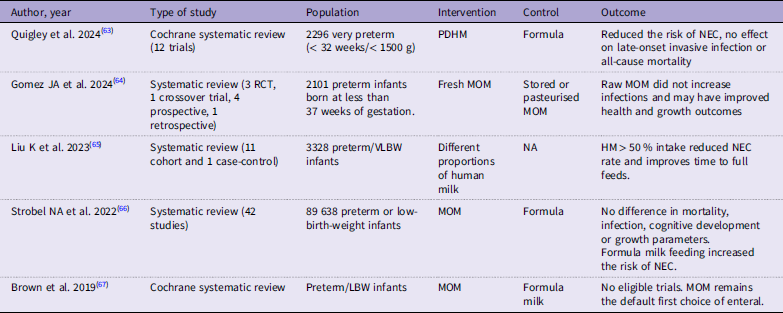
The evidence regarding choice of milk and comparison of various options for feeding preterm infants is described in Table 2.
Evidence for type of milk

Table 2. Long description
The table compares various studies on the effects of different types of milk on preterm infants. It has six rows and seven columns. The columns are labeled Author, year, Type of study, Population, Intervention, Control, and Outcome. The rows present data from different studies. Row 1: Author: Quigley et al., year: 2024, Type of study: Cochrane systematic review (12 trials), Population: 2296 very preterm (< 32 weeks/< 1500 g), Intervention: PDHM, Control: Formula, Outcome: Reduced the risk of NEC, no effect on late-onset invasive infection or all-cause mortality. Row 2: Author: Gomez JA et al., year: 2024, Type of study: Systematic review (3 RCT, 1 crossover trial, 4 prospective, 1 retrospective), Population: 2101 preterm infants born at less than 37 weeks of gestation, Intervention: Fresh MOM, Control: Stored or pasteurised MOM, Outcome: Raw MOM did not increase infections and may have improved health and growth outcomes. Row 3: Author: Liu K et al., year: 2023, Type of study: Systematic review (11 cohort and 1 case-control), Population: 3328 preterm/VLBW infants, Intervention: Different proportions of human milk, Control: NA, Outcome: HM > 50 percent intake reduced NEC rate and improves time to full feeds. Row 4: Author: Strobel NA et al., year: 2022, Type of study: Systematic review (42 studies), Population: 89 638 preterm or low-birth-weight infants, Intervention: MOM, Control: Formula, Outcome: No difference in mortality, infection, cognitive development or growth parameters. Formula milk feeding increased the risk of NEC. Row 5: Author: Brown et al., year: 2019, Type of study: Cochrane systematic review, Population: Preterm/LBW infants, Intervention: MOM, Control: Formula milk, Outcome: No eligible trials. MOM remains the default first choice of enteral.
PDHM, pasteurised donor human milk; NEC, necrotizing enterocolitis; RCT, randomised controlled trial; MOM, mother’s own milk; VLBW, very low birth weight; LBW, low birth weight.
The first choice for feeding preterm infants is MOM (expressed or direct breast-feeding based on the infant’s maturity and clinical status). If MOM is unavailable, PDHM can be used as an alternative. Preterm formula should be used only if MOM and PDHM are unavailable (LOE 2a, Grade B).
How to establish full enteral nutrition
Feed advancement strategies
Promotion of early and rapid establishment of full enteral feeding, particularly when maternal milk is available, is critical in reducing neonatal morbidity, mortality from sepsis and healthcare costs worldwide, including neonatal units in low-resource settings. Recent literature shows that faster feed advancement (25–40 ml/kg/d) is feasible and leads to achievement of full enteral feeds earlier without increasing the risk of NEC in premature infants(Reference Ramaswamy, Bandyopadhyay and Ahmed18,Reference Oddie, Young and McGuire68) .
Physiological considerations(Reference Calkins, Venick and Devaskar69–Reference Dorling, Abbott and Berrington71)
• Faster feed advancement avoids the risks associated with prolonged parenteral nutrition.
• Risks of parenteral nutrition-associated complications such as sepsis and mortality are significantly higher in resource-limited countries.
• Concerns with rapid feed advancement include lack of adequate breast milk supply during the initial postnatal weeks and fear of NEC.
Standardised feeding regimen
SFR refers to having a uniform unit-specific protocol for feed initiation and advancement. It is a simple, easy, no-cost and globally applicable tool. SFR specifies when trophic feeds should be initiated and how long it should be continued. It also specifies the choice of milk, rate of feed advancement and volume of full enteral feeds. It should also outline a strategy to define, evaluate and manage ‘feeding intolerance’(Reference Jasani and Patole17).
Physiological considerations(Reference Rossholt, Bratlie and Wendel72,Reference Fu, Arhin and Schulz73)
• Adherence to SFR ensures uniform feeding practice and prevents rapid changes in feed volumes, thereby reducing the risk of feed intolerance and NEC.
• Implementation of a SFR facilitates postnatal growth and improves clinical outcomes.
The evidence base for SFR is derived primarily from observational before-and-after studies and quality-improvement reports rather than from RCT directly comparing SFR with no SFR(Reference Jasani and Patole17,Reference Rossholt, Bratlie and Wendel72) . The recommendation to adopt SFR rests on the consistent direction of effect across multiple observational cohorts and on its endorsement by ESPGHAN 2022 guideline as an implementation strategy that reduces practice variation.
Maximum feed volume
Higher feed volume will improve nutrient delivery and growth and in turn may improve neonatal outcomes. However, there are concerns that high-volume feeds may cause feed intolerance, NEC or complications related to fluid overload such as patent ductus arteriosus (PDA) and BPD. ESPGHAN suggests enteral intake up to 200 ml/kg/d to be appropriate and safe depending on clinical status(Reference Embleton, Jennifer Moltu and Lapillonne12). The maximum total volume of enteral feeds used in most neonatal centres across the world is between 150 and 180 mL/kg/d(Reference Klingenberg, Muraas and Isaksen74,Reference Abiramalatha, Thomas and Thanigainathan75) .
Physiological considerations(Reference Bell and Acarregui76,Reference Arslanoglu, Moro and Ziegler77)
• To meet the nutritional requirement of preterm infants at a full feed volume of 160 mL/kg/d, each 100 ml of HM should ideally contain 2·5 gof protein (actual range is 1–1·5 gm/100 ml) and 81 kcal energy (actual range is 65–70 kcal/100 ml).
• Higher fluid intake may be associated with BPD and PDA.
• Standard fortification does not provide adequate nutrients at volume of 150 ml/kg/d.
When to withhold feeds
Feed intolerance is a common setback for premature infants in the NICU(Reference Weeks, Marino and Johnson78). Manifestation of feed intolerance due to ileus of prematurity (e.g. abdominal distension, bile stained and/or increased gastric residuals) is very common during this critical period in preterm neonates(Reference Lucchini, Bizzarri and Giampietro79,Reference Fanaro80) . However, there is no universally accepted definition for feed intolerance. Defining feed intolerance on the basis of a relative gastric residual volume (GRV) threshold (e.g. >50 % of the previous feed) can be misleading, particularly when small absolute feed volumes are being administered. Residuals up to approximately 4–5 mL/kg are considered to lie within the physiological range in stable preterm infants(Reference Riskin, Cohen and Kugelman81). A more physiologically appropriate approach is therefore to integrate an absolute GRV threshold (mL/kg) with clinical signs such as bilious or haemorrhagic aspirate, abdominal distension or tenderness, emesis, apnoea or temperature instability, rather than relying on a single relative cut-off. Before reflexively interrupting feeds, supportive measures such as adjusting feed volume and optimising body position should also be considered, as prone positioning has been shown to reduce GRV and improve feed tolerance(Reference Chen, Tzeng and Gau82).
Physiological considerations(Reference Abiramalatha, Thanigainathan and Ramaswamy83)
• Delayed recognition of NEC and continuing feeds can be catastrophic for a preterm infant
• Routine assessment of GRV and abdominal girth and reducing feed volume based on individual parameters leads to slower progression to full enteral feeds.
(a) Gastric residual volume
Recent guidelines recommend against measurement of gastric residues in a clinically stable preterm infant(Reference Embleton, Jennifer Moltu and Lapillonne12). Assessment of GRV should be performed only when other clinical signs associated with feeding intolerance or NEC are present such as significant abdominal distension, tenderness, emesis, bloody stools, apnoea and temperature instability(Reference Branagan, Murphy and O’Sullivan84). Routine monitoring of gastric residual may also increase the time to regain birth weightand number of feed interruption episodes and may have little or no effect on all-cause mortality before hospital discharge(Reference Abiramalatha, Thanigainathan and Ramaswamy83).
(b) Abdominal girth monitoring
There are no RCT that confirm the role of abdominal circumference measurement as a sole parameter in feeding outcomes and NEC. An increase in abdominal circumference of <1·5 cm can occur normally, and in the absence of other clinical signs, it should not be considered indicative of disease(Reference Meldere, Urtans and Petersons85).
Evidence and recommendations
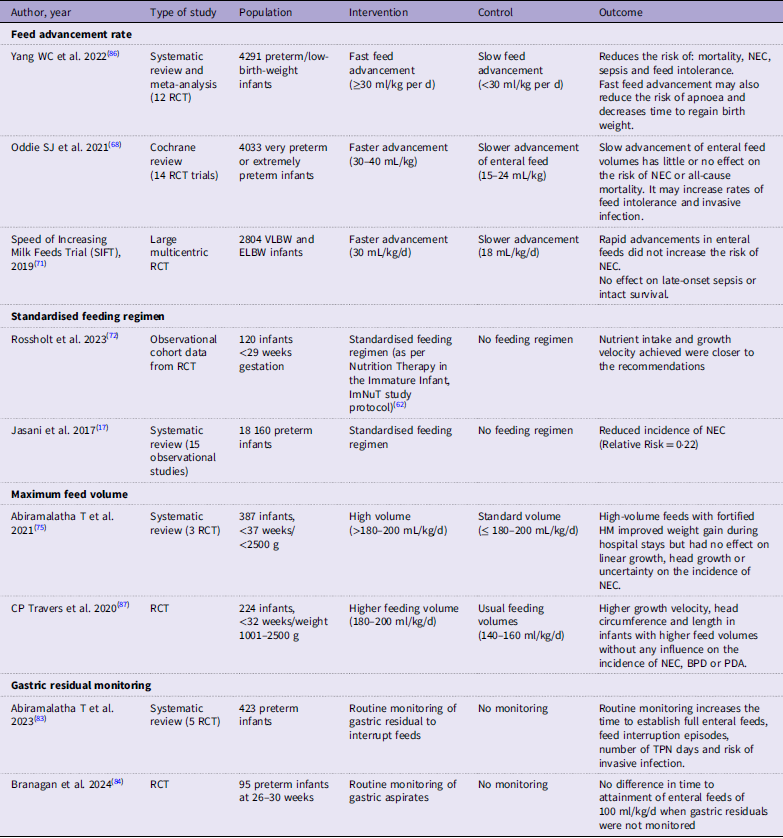
The evidence regarding various strategies for feed advancement, SFR and maximum feed volume is summarised in Table 3.
Evidence for feed advancement and standardised feeding regimen

Table 3. Long description
The table compares various studies on feed advancement and standardized feeding regimens in infants. It has six columns: Author, year, Type of study, Population, Intervention, Control, and Outcome. The table includes multiple rows, each representing a different study. Row 1: Author, year: Yang WC et al. 2022; Type of study: Systematic review and meta-analysis (12 RCT); Population: 4291 preterm/low-birth-weight infants; Intervention: Fast feed advancement (≥30 ml/kg per d); Control: Slow feed advancement (<30 ml/kg per d); Outcome: Reduces the risk of: mortality, NEC, sepsis and feed intolerance. Row 2: Author, year: Oddie SJ et al. 2021; Type of study: Cochrane review (14 RCT trials); Population: 4033 very preterm or extremely preterm infants; Intervention: Faster advancement (30–40 mL/kg); Control: Slower advancement of enteral feed (15–24 mL/kg); Outcome: Slow advancement of enteral feed volumes has little or no effect on the risk of NEC or all-cause mortality. Row 3: Author, year: Speed of Increasing Milk Feeds Trial (SIFT), 2019; Type of study: Large multicentric RCT; Population: 2804 VLBW and ELBW infants; Intervention: Faster advancement (30 mL/kg/d); Control: Slower advancement (18 mL/kg/d); Outcome: Rapid advancements in enteral feeds did not increase the risk of NEC. Row 4: Author, year: Rossholt et al. 2023; Type of study: Observational cohort data from RCT; Population: 120 infants <29 weeks gestation; Intervention: Standardised feeding regimen (as per ImNuT study protocol); Control: No feeding regimen; Outcome: Nutrient intake and growth velocity achieved were closer to the recommendations. Row 5: Author, year: Jasani et al., 2017; Type of study: Systematic review (15 observational studies); Population: 18 160 preterm infants; Intervention: Standardised feeding regimen; Control: No feeding regimen; Outcome: Reduced incidence of NEC (RR = 0.22). Row 6: Author, year: Abiramalatha T et al. 2021; Type of study: Systematic review (3 RCT); Population: 387 infants, <37 weeks/<2500 g; Intervention: High volume (>180–200 mL/kg/d); Control: Standard volume (≤ 180–200 mL/kg/d); Outcome: High-volume feeds with fortified HM improved weight gain during hospital stays but had no effect on linear growth, head growth or uncertainty on the incidence of NEC. Row 7: Author, year: CP Travers et al. 2020; Type of study: RCT; Population: 224 infants, <32 weeks/weight 1001–2500 g; Intervention: Higher feeding volume (180–200 ml/kg/d); Control: Usual feeding volumes (140–160 ml/kg/d); Outcome: Higher growth velocity, head circumference and length in infants with higher feed volumes without any influence on the incidence of NEC, BPD or PDA. Row 8: Author, year: Abiramalatha T et al. 2023; Type of study: Systematic review (5 RCT); Population: 423 preterm infants; Intervention: Routine monitoring of gastric residual to interrupt feeds; Control: No monitoring; Outcome: Routine monitoring increases the time to establish full enteral feeds, feed interruption episodes, number of TPN days and risk of invasive infection. Row 9: Author, year: Branagan et al. 2024; Type of study: RCT; Population: 95 preterm infants at 26–30 weeks; Intervention: Routine monitoring of gastric aspirates; Control: No monitoring; Outcome: No difference in time to attainment of enteral feeds of 100 ml/kg/d when gastric residuals were not monitored.
RCT, randomised controlled trial; NEC, necrotizing enterocolitis; VLBW, very low birth weight; BPD, bronchopulmonary dysplasia; PDA, patent ductus arteriosus; TPN, total parenteral nutrition.
Rapid daily feed advancement at rate of 25–40 ml/kg/d in preterm infants is safe and feasible (LOE 1a, Grade A). Each unit should develop a SFR based on latest available evidence. SFR should include the following parameters: OIT, choice of milk, initiation of enteral nutrition, rate of daily feed advancement, definition and management of feeding intolerance and HM fortification strategy (LOE 2a, Grade B). Total feed volume of 160 to 180 ml/kg/d is standard practice for VLBW infants. On an individualised basis, higher feed volumes may be used with careful monitoring (LOE 1c, G B). Feeding intolerance is suspected when any significant GI manifestations (bilious emesis, abdominal tenderness, haemorrhagic aspirates, blood in the stools, etc.) or more than one minor feature are identified. Routine monitoring of gastric aspirates for assessment of feed tolerance is not recommended for preterm infants (LOE 1a, Grade A).
What to add – human milk fortifier
Although HM is ideal for all neonates, it is insufficient to meet the additional nutrient demands of a preterm infant(Reference Adamkin and Radmacher16,Reference Schanler, Shulman and Lau88) . Due to inadequate nutrient intake, immature digestive system and co-morbidities, preterm infants are prone to poor growth and neurocognitive impairment. Hence, nutrient fortification of HM is necessary to minimise these consequences(Reference Brown, Lin and Embleton89). Bovine milk-based multicomponent fortifiers are most commonly used in NICU to boost the nutrient content of HM. Infant formula powder has also been used to fortify HM with some short-term benefits(Reference Chinnappan, Sharma and Agarwal90). The standard preparation of fortified HM involved addition of one sachet HMF to 25 ml of HM. The nutrient composition of commercial powder HMF is given in online Supplementary Table 3.
Need for human milk fortifier
Fortification of expressed breast milk with HMF increases the nutrient content of the milk without compromising its non-nutritional beneficial effects. HM fortification improves short-term weight gain, length and head growth without any adverse effects(Reference Brown, Lin and Embleton89). For a VLBW baby on full volume HM diet, standard fortification provides about 40 % of the daily protein requirement and over 70 % of Ca-P requirement.
Initiating fortification
The optimal feed volume at which HMF should be added to HM has been evolving. The conventional approach is to fortify HM after achieving an enteral feed volume of 100–120 ml/kg/d. Historically, feed intolerance and the risk of NEC have been used as a justification for delaying the introduction of HMF. Small RCT have shown that early fortification with HM-based fortifier, at feed volume 40–70 ml/kg/d, may increase length gain velocity from birth to 36 weeks post menstrual age (PMA)(Reference Salas, Gunawan and Nguyen91). However, a systematic review comparing early fortification of HM v. late fortification revealed little or no effect on short-term growth, NEC, time to reach full enteral feeds, Extra-uterine growth restriction (EUGR) at discharge, number of feed interruption episodes, duration of TPN, incidence of invasive infection, all-cause mortality and duration of hospital stay(Reference Thanigainathan and Abiramalatha92).
Type of fortifier
HMF is typically a bovine-based multi-nutrient powder fortifier that contains varying amounts of protein, energy, minerals, trace elements, vitamins and electrolytes. It may differ by the origin of milk used (bovine or human) and by nutrient composition (multi-component fortifiers or single-component supplement). HM-based fortifier is obtained by concentrating heat-treated DHM and then adding essential micronutrients. Various energetic densities of this fortifier allow for individualised adjustment based on the infant’s growth; however, the HM-based HMF is costly. Most of the literature supporting HM-based fortifiers come from company-funded trials with a high risk of bias. Thus, in settings where donor HM banks are well established, there is no additional advantage of using a HM-derived HMF, as compared with standard bovine milk-derived HMF(Reference O’Connor, Kiss and Tomlinson93,Reference Ananthan, Balasubramanian and Rao94) . Liquid fortifiers provide an additional option for feeding preterm infants whose mothers have insufficient milk supply to fulfil the infant’s needs since the use of a liquid fortifier extends the volume of milk as well as reduces the need for using powder HMF. Advantages of liquid HMF include less chances of microbial contamination and easier mixing(Reference Schulz and Wagner95). However, a potential disadvantage of liquid HMF is that it displaces a non-trivial proportion of MOM from the final feed (typically 20–25 % by volume, depending on the product)(Reference Schulz and Wagner95–Reference Thoene, Lyden and Weishaar97). This dilution reduces the infant’s exposure to the bioactive and immunological components of fresh MOM, which may be clinically relevant in the smallest and most immature infants. Powdered HMF, by contrast, preserves MOM volume but introduces additional handling and microbial-contamination considerations. The choice between liquid and powdered fortifier should therefore weigh practical workflow advantages against the goal of maximising MOM exposure. Single-component fortifiers are suitable in settings where individualised targeted fortification approach is practiced.
Although uncommon, milk curd obstruction (inspissated milk syndrome) is a clinically important complication in preterm infants receiving fortified HM. Affected infants may present with abdominal distension, feed intolerance and acute deterioration. Characteristic findings include pale or acholic stools and echogenic, with abdominal ultrasound showing non-mobile intraluminal bowel content(Reference Longardt, Loui and Bührer98,Reference Walsh, Anthony and Wang99) . Because the clinical picture can mimic NEC, clinicians should maintain a low threshold for considering this entity in fortified, exclusively enterally fed preterm infants who deteriorate without a clear infective or surgical cause.
Optimising fortification
Typically, fortification with multicomponent HMF is started once infant has tolerated partial enteral feeds, as per the unit policy. The fortification strategy could be either standard or individualised fortification(Reference Adamkin and Radmacher16). Standard fortification involves addition of fixed dose fortifier to HM as per manufacturer recommendations. The presumed calorie and protein intake of the baby are calculated based on assumed fixed HM nutrient content (standard) or nutrient content adjusted for type of milk and stage of lactation (corrected fortification). Individualised fortification is adjusting the HMF intake based on actual calorie/protein content of HM as measured by a milk analyser (targeted) or based on the baby’s blood urea nitrogen (BUN) levels (adjustable). The various strategies of HM fortification are described in Figure 2. Once full fortification is achieved as per unit strategy, ongoing monitoring the infant’s growth parameters is essential, to optimise fortification. Daily measurement of weight and weekly measurement of length and head circumference are needed to assess whether feeding change is making an impact on growth. It is preferable to use a length board for length measurement, which is a two-person activity. The growth parameters should be tracked using appropriate growth charts. For VLBW infants, Fenton preterm growth charts are recommended till 50 weeks, followed by transition to WHO growth standards(Reference Fenton and Kim100,Reference Fenton, Nasser and Eliasziw101) . Changes in fortification should be guided by weekly z-score difference for weight and the clinical context(Reference Arslanoglu, Moro and Ziegler102).
Strategies and approaches for human milk fortification. HMF, human milk fortifier; MOM, mother’s own milk; DHM, donor human milk.

Post-discharge fortification
To improve and maintain growth post-discharge, various studies have been conducted to assess the feasibility and effects of HMF after discharge. A study by Zacchariassen et al.(Reference Zachariassen, Faerk and Grytter103) provided fortification post-discharge for 4 months and showed no difference in growth but better lung function in the fortification group at 6 years. Another study by O’Connor et al.(Reference O’Connor, Khan and Weishuhn104) showed better weight, length, head growth, visual function and bone mineral density in the fortification group maintained until 1 year of age. Post-discharge fortification of HM has shown no adverse effects and can be considered as an option if poor post-discharge weight gain is noted in breast milk fed babies. The need for post-discharge fortification or post-discharge formula (if mother’s milk is insufficient) can be decided on an individualised basis. There is no data regarding the role of adding medium chain triglycerlide (MCT) oil to milk as a calorie source for preterm babies.
Evidence and recommendations
The summary of evidence regarding HM fortification is described in Table 4.
Evidence on fortification of human milk

Table 4. Long description
The table compares multiple studies on human milk fortification, detailing the type of study, population, intervention, control, and outcomes. It includes studies on fortification yes or no, initiating fortification early or delayed, and human or bovine-milk-based fortification. The table has 13 rows and 6 columns. Column headers are Author, year, Type of study, Population, Intervention, Control, and Outcome. Row 1: Kumar M et al., 2021, Systematic review (5 RCT), 423 VLBW infants, Fortification with formula milk, No fortification or fortification with HMF, Improved short-term growth with formula fortification compared with no fortification. No difference between fortification with HMF or formula. Row 2: Brown JV et al., 2020, Cochrane review (18 RCT), 1456 infants, <37 weeks/<2500 g, Fortification with multi-component HMF, No fortification or placebo, Multi-nutrient fortification increases the rate of weight gain (mean difference 1.76 g/kg/d), length and head circumference. Insufficient evidence on long-term growth or neurodevelopment. Row 3: Wynter, Z et al., 2024, RCT, VLBW infants, Bovine milk-derived HMF with first feedings, Delayed fortification at 80 ml/kg/d, The immediate fortification was safe and well tolerated. No difference in incidence of metabolic acidosis, NEC, retinopathy and sepsis. Row 4: Salas AA et al., 2023, RCT, Extreme preterm infants ≤28 weeks, Early fortification with HMF from day 2, Fortification from a median postnatal age of 15 d, Better length gain velocity, less decline in HC z-scores. No difference in fat-free mass. Row 5: Hilditch et al., 2022, Meta-analysis (3 RCT), 378 preterm neonates (27-30 weeks/<2000 g), Early <40 ml/kg/d feeds, Fortification at ≥75 mL/kg/d, No difference in rates of necrotising enterocolitis, sepsis, feeding intolerance and infant growth. Row 6: Thanigainathan S, 2020, Cochrane meta-analysis (2 RCT), 237 preterm, VLBW infants, Early fortification (< 100 mL/kg/d feeds and < 7 d postnatal age), Late fortification (≥ 100 mL/kg/d feeds or ≥ 7 d postnatal age), No effect on growth outcomes, incidence of surgical NEC, time to reach full enteral feeds, EUGR, duration of TPN, duration of central line use, mortality and duration of hospital stay. Row 7: Galis R et al., 2024, Meta-analysis (4 RCT), 681 neonates ≤28 weeks /≤ 1500 g, Fortified with human milk-derived fortifier, Fortified with bovine milk-derived fortifier, Mortality was significantly lower in infants fed with an HM-HMF. No difference in NEC, BPD, sepsis or ROP. Row 8: Jensen GB et al., 2024, RCT, 229 extremely preterm infants (<28 weeks), Human milk-based fortifier, Bovine milk-based fortifier, No difference in the composite outcome of NEC, sepsis or death. Row 9: Premkumar MH et al., 2019, Cochrane systematic review (1 RCT), 127 infants, <37 weeks, Human milk-based fortifier, Bovine milk-based fortification, Human milk fortifiers did not improve growth, decrease feed intolerance, late-onset sepsis, NEC or death. Row 10: Sanchez-Holgado M et al., 2024, RCT, 38 premature infants (<1000 g), Targeted fortification, Adjustable fortification, No differences in weight gain velocity at 28 d. No differences in the weight/length or HC z-scores change between different time points. Row 11: Seliga-Slwcka J et al., 2023, RCT, 39 preterm infants (≤32 weeks), Targeted fortification, Standard fortification, No significant difference in velocity of weight gain, length or head circumference. The trial was interrupted due to serious intolerance in five cases. Row 12: Rochow et al., 2021, RCT, 103 preterm infants (<30 weeks), Individualised fortification, Standard fortification, Higher macronutrient intake and better weight gain. Row 13: Fabrizio V et al., 2020, Cochrane review (7 RCT), 521 preterms (<37 weeks / < 2500 g), Individualised (targeted or adjustable) fortification, Standard fortification, Individualised fortification increased weight gain, mean difference (MD 0.43 g/kg/d), may have increased length (MD 0.43 mm/d) and head circumference (MD 0.14 mm/d) gain.
RCT, randomised controlled trial; VLBW, very low birth weight; HMF, human milk fortifier; NEC, necrotizing enterocolitis; TPN, total parenteral nutrition; BPD, bronchopulmonary dysplasia; ROP, retinopathy of prematurity.
Fortification of HM with multicomponent powder or liquid HMF is recommended for all VLBW babies (LOE2a, Grade B).
Commencing fortification with a multi-component fortifier very early (at feed volume <40 ml/kg/d) is feasible with no major adverse effects. More data is needed in smaller babies to ensure safety of this practice (LOE 1b, Grade B). Moderately early fortification (40–100 ml/kg/d) is recommended in VLBW infants. (LOE 1a, Grade A). However, its safety in high-risk groups is unclear (IUGR/abnormal Doppler/peri-viable).
Standard fortification (fixed-dose or corrected) should be initiated for VLBW infants, and individualised fortification should be considered if weight gain is inadequate (LOE 1a, Grade A) Routine use of post-discharge formula or additives to milk, such as MCT oil, is not recommended given the lack of supporting evidence. HM-based fortifiers have not been shown to provide any benefits over bovine HMF in VLBW infants (LOE 2a, Grade B).
What to add – supplements
Preterm and LBW infants are born with low stores of micronutrients, since major transplacental transfer of these nutrients happens in the third trimester. Multiple micronutrients such as vitamin A, vitamin D, B complex vitamins, vitamin C, vitamin E, Zn, Fe and Mg are considered to be important for infant growth and development(Reference Kumar, Chowdhury and Sinha115).
Calcium and phosphorus
The majority of transplacental Ca and P transfer happens in the third trimester. Inadequate intake and reduced intestinal absorption of minerals, as well as increased excretion with diuretics, increase the risk of metabolic bone disease in preterm infants(116). Ca and P supplements are routinely provided, usually as a part of multicomponent HMF during hospital stay and as a separate supplement post-discharge. Inadequate provision of these minerals can lead to osteopenia and fractures. Although optimising mineral intake in preterm infants is important, there is no direct evidence to support the impact of different postnatal Ca and P intakes on long-term health or adult bone mineral content(Reference Fewtrell117). Serum Ca, P and serum alkaline phosphatase are used as laboratory markers for osteopenia of prematurity and can guide dose adjustments for these supplements. In addition to serum markers, measuring urinary Ca and P excretion can provide complementary information on mineral metabolism and the adequacy of supplementation(Reference Matejek, Pokorna and Drahy118,Reference Staub, Wiedmer and Staub119) . Urinary assessment is non-invasive and well suited to repeated monitoring in fragile preterm infants, making it a practical adjunct to biochemical screening for metabolic bone disease.
Vitamin D
Vitamin D promotes Ca absorption and bone mineralisation, and preterm infants are born with low stores of vitamin D. Hence, they are prone to osteopenia and fractures. Vitamin D is also crucial for multiple cellular processes; and long-term vitamin deficiency is associated with an increased risk of metabolic syndrome, various cancers and lower neurocognitive function(Reference Saggese, Vierucci and Boot120). Vitamin D supplementation in preterm or VLBW infants improves weight and height at 6 months of age. However, it has little or no direct effect on mortality, hospitalisation, head circumference, childhood growth and neurodevelopment(Reference Kumar, Shaikh and Sinha121).
ESPGHAN recommends pragmatic use of serum concentration >50 nmol/L to indicate sufficiency and a serum concentration <25 nmol/L to indicate severe deficiency. While different recommendations exist regarding the dose of vitamin D supplementation, a dose of 400–800 IU/d is most commonly prescribed(Reference Embleton, Jennifer Moltu and Lapillonne12). Monitoring the adequacy of vitamin D supplementation can be done by measuring serum 25(OH)D periodically. Routine blood testing for vitamin D levels in preterm infants is not recommended, but it may be performed on an individualised basis. The daily requirement of Ca, P and vitamin D is described in online Supplementary Table 4.
Iron
Fe is essential for the formation of Hb in red blood cells responsible for carrying oxygen to tissues. Adequate Fe intake also supports the immune system and promotes optimal neurodevelopment. A systematic review that studied the effects of enteral Fe supplementation on preterm and LBW infants found that infants who receive Fe supplementation had a slightly higher Hb level, improved Fe stores and less risk of developing Fe deficiency anaemia, but the effects on long-term neurodevelopment were unclear(Reference Mills and Davies122). There is no data to show a discernible haematological benefit when the ‘standard’ doses of Fe (i.e. 2–3 mg/kg/d) are exceeded. Fe supplement is started at a daily dose of 2–3 mg/kg/d starting at 2–3 weeks of age for VLBW infants. Infants who receive erythropoietin treatment may need a higher dose of Fe (up to 6 mg/kg/d)(Reference Kling123). Fe status can be monitored by using serum ferritin levels; however, ferritin is an acute phase reactant and not reliable in ongoing inflammation or liver disease. Reticulocyte Hb content (CHr or Ret-He) offers a complementary, functional measure of Fe availability for erythropoiesis. Because it reflects Fe incorporation into newly formed red cells over the preceding 2–4 d, Ret-He provides earlier and more dynamic information than ferritin and is unaffected by inflammation(Reference Perchard, Barbaro and Rane124,Reference Lorenz, Arand and Büchner125) . Data from preterm cohorts born at <32 weeks gestation suggest that low Ret-He about 35–36 weeks’ postmenstrual age is associated with Fe deficiency and may have implications for later neurodevelopment(Reference Amin, Bansal and Varley126,Reference Hulse, Bahr and Ostrander127) . Where laboratory capacity permits, combining serum ferritin with Ret-He provides a more reliable assessment of Fe status in preterm infants than either marker alone.
Zinc
Zn plays an indispensable role in tissue growth and differentiation. It is a structural component of hormones, nucleotides and proteins and is required for the production and functioning of many enzymes, involved in essential metabolic pathways. Zn deficiency in preterm infants can lead to acrodermatitis enteropathica, infections and/or poor growth. A small RCT involving thirty-six preterm infants by Díaz-Gómez et al. showed that a daily enteral Zn intake of 1·5–3 mg/kg/d helps to achieve optimal growth(Reference Díaz-Gómez, Doménech and Barroso128).
There is limited data to support that high-dose Zn supplementation can lower morbidity and mortality in VLBW infants(Reference Terrin, Berni Canani and Passariello129). Further studies are required to ensure that higher doses of Zn supplements (>3 mg/kg/d) are safe and effective.
Vitamin A
Vitamin A plays an important role in maintaining the integrity of epithelial cells lining the respiratory, GI and urinary tracts. Compared with term infants, preterm infants have lower concentrations of retinol and retinol-binding protein(Reference Tekgündüz, Dilek and Kara130). A Cochrane systematic review found that intramuscular vitamin A supplementation can reduce BPD in preterm babies(Reference Darlow, Graham and Rojas-Reyes131). However, these findings could not be replicated in further trials that used higher enteral doses of vitamin A(Reference Rakshasbhuvankar, Pillow and Simmer132). The NeoVitaA trial showed that postnatal high-dose fat-soluble enteral vitamin A supplementation in extremely low birth weight (ELBW) infants did not change the rate of moderate or severe BPD or death(Reference Meyer, Bay and Franz133). The recommended daily allowance of vitamin A for preterm infants is 1500–3000 IU/kg/d. Excessive doses of vitamin A may lead to toxicity and should be avoided.
Multivitamins
There is limited data regarding the benefits of enteral multivitamin supplements in preterm infants. A survey of fifty neonatal dietitians in the Australasian network reported that apart from vitamin D and Fe, about 15 % of neonatal units prescribed vitamin E and 11 % of units prescribed folic acid to preterm infants(Reference Oliver, Watson and Crowley134). The lack of availability of suitable micronutrient products, inadequate knowledge regarding optimal dosage schedules and lack of direct clinical benefit are reasons why multivitamin supplements are not routinely recommended in this population(Reference Ilardi, Proto and Ceroni135).
Evidence and recommendations
The evidence regarding micronutrient supplementation in preterm babies is summarised in Table 5.
Evidence on micronutrient supplementation

Table 5. Long description
The table compares various studies on micronutrient supplementation in preterm infants. It has six columns: Author, year, Type of study, Population, Intervention, Control, and Outcome. The table is divided into sections for different micronutrients: Ca/P, Vit D, Fe, Zn, Vitamin A, and Multivitamin/multi-nutrient. Each section lists studies with details on the study type, population, intervention, control, and outcomes. For example, the Ca/P section includes a systematic review by Mohan Kumar et al. 2022 with 162 preterm infants, comparing enteral Ca or P supplementation to placebo, showing no effect on weight, length, or head circumference. The Vit D section includes a systematic review and meta-analysis by Mohan Kumar et al. 2022 with 2479 preterm LBW infants, comparing vitamin D to no vitamin D/placebo, showing weight, height gain, and lesser vitamin D deficiency at 6 months. The Fe section includes a systematic review by Manapurath RM et al. 2022 with preterm infants, comparing enteral Fe supplementation to placebo, showing improved Fe status and little or no effect on weight gain/length/HC and infection risk. The Zn section includes an RCT by Sahin S et al. 2024 with 195 VLBW preterm infants, comparing supplemental Zn to standard dose Zn, showing decreased feeding intolerance, NEC, and LOS episodes. The Vitamin A section includes an RCT by Meyer et al. 2024 with 915 ELBW infants, comparing enteral high-dose vitamin A to placebo, showing no change in the rate of moderate or severe bronchopulmonary dysplasia or death. The Multivitamin/multi-nutrient section includes a systematic review by Liu Y et al. 2025 with 4956 preterm or LBW infants, comparing enteral micronutrients supplementation to placebo or no supplementation, showing no difference in neurodevelopmental impairments.
RCT, randomised controlled trial; LBW, low birth weight; VLBW, very low birth weight; NEC, necrotizing enterocolitis; LOS, late-onset sepsis; BPD, bronchopulmonary dysplasia.
The daily enteral Ca intake of 3·0–5·0 mmol (120–200 mg/kg/d) and P intake of 2·2–3·7 mmol (70–115 mg/kg/d) are recommended to prevent osteopenia of prematurity (LOE 2a, Grade B)
Vitamin D intake of 400–700 IU per kg per d (maximum 1000 IU/d) helps in the optimal utilisation of these minerals (LOE 1a, Grade A).
Periodic monitoring (once every 2 weeks) of serum Ca, P and alkaline phosphatase is recommended to screen metabolic bone disease. Ca and P supplements may be stopped if serial blood screening markers are normal at corrected gestation of 40 weeks (LOE 5, Grade D) Urinary Ca and P excretion may be used as a non-invasive adjunct to serum markers to help individualise mineral supplementation (LOE 2b, Grade B).
Daily Fe intake of 2–4 mg/kg/d is suggested for VLBW babies after 2 weeks of life, once the infant is tolerating full feeds (LOE 2a, Grade B).
Higher doses of up to 6 mg/kg/d may be needed if the infant is on erythropoietin or serum ferritin levels are low (<70 µg/L). Fe supplements should be continued till 6–12 months of corrected age (LOE 5, Grade D).
Multivitamin supplements that provide Zn at a dose of 2–3 mg/kg/d should be given to preterm infants, especially those with poor growth (LOE 2a, Grade B).
There are no benefits for routine supplementation with vitamin A, vitamin E and water-soluble vitamins for preterm infants (LOE 1a, Grade A).
Conclusions
Optimal nutrition during the neonatal period is crucial, and early enteral feeding should be considered in all VLBW infants when appropriate. OIT can be initiated soon after birth with MOM or PDHM. Except for surgical bowel condition or significant haemodynamic instability, MEN at 10–20 ml/kg/d can be initiated for all preterm infants. For stable babies with birth weight >1000 g, ETEF must be considered soon after birth. Expressed MOM is the first choice for feeding VLBW infants, followed by PDHM. Standardised feeding protocols improve outcomes, and a daily feed advancement rate of 25–40 ml/kg/d helps achieve faster full enteral nutrition. Total feed volume between 160 and 180 ml/kg/d can be considered based on clinical status of the baby. Fortification of HM with bovine HMF is recommended, as HM does not provide the target nutrients for preterm babies. If standard fortification is practiced and there is inadequate growth, individualised fortification strategies may be considered. Micronutrient supplements including Ca, P, vitamin D, Fe and Zn are advised for preterm infants during the NICU stay and post-discharge. Regular follow-up after discharge and nutritional monitoring of VLBW babies is advised. The summary of recommendations related to preterm enteral nutrition are described in Figure 3. The evidence around preterm nutrition is evolving, and regular nutrition audits along with new RCT will provide further insight regarding enteral feeding optimisation strategies in this vulnerable population.
Summary of evidence-based recommendations for enteral nutrition in very low birth weight infants. OIT, oral immune therapy; MEN, minimal enteral nutrition; ETEF, early total enteral feeding; VLBW, very low birth weight; MOM, mother’s own milk; PDHM, pasteurised donor human milk; HMF, human milk fortifier; NICU, neonatal intensive care unit.

Supplementary material
For supplementary material/s referred to in this article, please visit https://doi.org/10.1017/S0007114526108290
Data availability statement
Data sharing is not applicable to this article as no new data were created or analysed in this study. All evidence discussed in this review is derived from previously published studies, which are cited in the reference list and publicly accessible through their respective journals.
Acknowledgements
This research received no specific grant from any funding agency, commercial or not-for-profit sectors.
Anish Pillai conceptualised the project, contributed to the methodology and was involved in writing the original draft as well as reviewing and editing the manuscript. Gayatri Morajkar conducted the literature review and prepared the original draft. Nandkishor Kabra performed data curation and formal analysis. Mayuri Bhanushali, Prathamesh Khedkar, Vedika Mule and Anuja Datar contributed to drafting the manuscript and preparing the tables and figures. Sanju Sidaraddi and Deepika Tiwari contributed to the methodological planning, data curation and critical review and editing of the manuscript. Susan Albersheim supervised the work and provided critical review and editing. Rajavel Elango conceptualised the study, supervised the writing process and contributed to reviewing and editing the manuscript.
All authors have read and approved the final version of the manuscript and agreed to be accountable for all aspects of the work.
The authors declare no conflict of interest.




 Open access

