Ectoine belongs to a group of natural compounds, termed compatible solutes, which can be defined as organic osmolytes that are accumulated by the cell in high concentrations (up to several moles per liter) without disturbing vital cellular functions and the correct folding of proteins (Brown, Reference Brown1976, reviewed by Roberts, Reference Roberts2005). Compatible solutes maintain the cell turgor under conditions of low water activity by counteracting the efflux of water from the cell. In addition they have a stabilizing influence on the native structure of proteins and other cellular structures (Lippert & Galinski, Reference Lippert and Galinski1992). Ectoine shows a high solubility in water and is non-ionic at physiological pH (Galinski et al. Reference Galinski, Pfeiffer and Trüper1985). Currently the main use of ectoine is as a functional ingredient in skin care products, where it is used as a moisturizer and cell protectant (Bünger, Reference Bünger1998, Reference Bünger1999; Bünger et al. Reference Bünger, Degwert and Driller2001; Bünger & Driller, Reference Bünger and Driller2004). Osmoprotective compounds like ectoine also gained increasing interest for biotechnological applications and as highly effective protectants of proteins and cells (reviewed in Margesin & Schinner, Reference Margesin and Schinner2001; Roberts, Reference Roberts2005; Lentzen & Schwarz, Reference Lentzen and Schwarz2006).
The organic osmolyte ectoine occurs only in eubacteria and is widespread among halophilic and halotolerant eubacteria (Sauer & Galinski, Reference Sauer and Galinski1998). The surface of smear-ripened cheeses harbours a highly diverse bacterial flora of aerobic halophilic bacteria, e.g. Corynebacterium casei (Monnet et al. Reference Monnet, Correia, Sarthou and Irlinger2006), Staphylococcus saprophyticus (Mounier et al. Reference Mounier, Goerges, Gelsomino, Vancanneyet, Vandemeulebroecke, Hoste, Brennan, Scherer, Swings, Fitzgerald and Cogan2006), Arthrobacter spec. (Mounier et al. Reference Mounier, Gelsomino, Goerges, Vancanneyt, Vandemeulebroecke, Hoste, Scherer, Swings, Fitzgerald and Cogan2005) and Brevibacterium linens (Rattray & Fox, Reference Rattray and Fox1999).
Brevi. linens is strictly aerobic, with a rod-coccus growth style and a temperature growth optimum of 20 to 30°C. It is a halotolerant microorganism with optimum growth at pH 6·5 to 8·5 (Rattray & Fox, Reference Rattray and Fox1999) and produces ectoine as an osmoprotectant (Jebbar et al. Reference Jebbar, Champion, Blanco and Bonassie1998). The main reasons for the application of Brevi. linens in the cheese production process are development of flavour (Bockelmann et al. Reference Bockelmann, Hoppe-Seyler, Jäger and Heller2001), colour development (Loessner, Reference Loessner2000, Bockelmann et al. Reference Bockelmann, Hoppe-Seyler and Heller1996) and protection against growth of mildews (Jäger et al. Reference Jäger, Hoppe-Seyler, Bockelmann and Heller2000).
The conditions throughout the cheese production process, especially the salinity of brine baths used and the occurrence of the ectoine producing microorganism Brevi. linens led to the question whether ectoine can be found in surface-ripened cheeses. Therefore the aim of this study was to examine different types of red smear cheeses for the presence of ectoine.
Materials and Methods
Collection of cheese samples
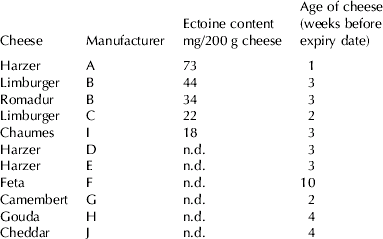
Samples of red smear cheeses from a variety of cheese manufacturers were purchased from local supermarkets (Table 1). Harzer cheese used for ripening experiments was provided directly from the cheese plant by Sachsenmilch AG, Leppersdorf, Germany (manufacturer A in Table 1). Other types of cheeses (e.g. Feta and Gouda) were analysed for control purposes.
List of cheese samples and analysis results
All cheese samples are produced by German manufacturers, except of manufacturer I (France) and J (UK) and were sampled from local retailers. The age of the respective cheese is displayed by the time span before the expiry date and the ectoine content was measured as described in Materials & Methods
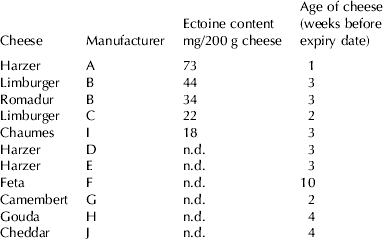
n.d.=not detected. The limit of detection was approx. 0·28 mg/200 g cheese
Preparation, extraction and analysis of cheese samples
Extraction method used for cheese samples
A modification of the extraction method of Bligh & Dyer (Reference Bligh and Dyer1959) was used for cheese preparation prior to HPLC and HPLC/MS analysis. All cheese samples were extracted and analysed as follows: The rind of a whole package of cheese was cut off to the depth of approximately 2–4 mm and separated from the inside mass. Rind and inside mass were mixed separately with a kitchen blender until the sample was homogeneous. To 5 g of each sample, 30 ml of a mixture of methanol, chloroform and water (10:5:4) was added and mixed thoroughly in a falcon tube on a shaker (Janke & Kunkel, IKA-Labortechnik, KS 250) for 60 min. Then 7·8 ml chloroform and 7·8 ml water were added and mixed for another 4 h followed by centrifugation for 10 min at 3940 g (Heraeus Labofuge 400R). The aqueous phase was removed, its volume measured and 200 μl analysed by HPLC. Experiments were conducted in duplicate.
To get accurate results for HPLC/MS analysis it was necessary to process a larger amount of cheese. For the preparation of a Limburger extract (manufacturer B), a modified extraction method was used: the rind of 2·2 kg Limburger cheese was cut off and extracted (as described above) with 2 l solvent. The aqueous phase was reduced under vacuum at 70°C to a volume of 500 ml. The liquid was desalinated by electrodialysis (Berghof, BEL – 500). The diluate was reduced under vacuum at 70°C to a volume of 135 ml followed by ion exchange chromatography (column material: Dowex Marathon C, column height: 47 cm, column diameter: 2 cm, column volume 147·6 ml, pump system: Watson Marlow 101 U). The fractions, where ectoine was detected (HPLC analysis), were pooled and desalinated again, followed by reduction under vacuum at 70°C to complete dryness. A solid matter of 3·26 g remained.
Ripening experiments
Ripening experiments were performed with cheese batches of Harzer cheese from manufacturer A. Cheese samples were incubated at 4°C and extracts prepared and analysed at the indicated dates.
Additionally, Brevi. linens population was measured by the method of Toolens & Koning-Theune (Reference Toolens and Koning-Theune1970). Harzer cheese samples were analysed at different ripening stages (4 times; from 1 week before, to 2 weeks after, the expiry date) for the population of Brevi. linens (cfu/g). Brevi. linens strain DSM 20425 was used as a positive control.
Experiment of alkaline hydrolysis
In this experiment we used the feature that under alkaline conditions and room temperature ectoine slowly hydrolyzes to α-N-Acetyl-2,4-diaminobutric acid and γ-N-Acetyl-2,4-diaminobutric acid (1:3). A Limburger cheese extract was prepared as described above. Limburger extract (100 mg) was dissolved in 5 ml H2O. To 1 ml of this solvent approximately 5 μl 10 m-NaOH were added to adjust the pH to 12·8 and then mixed for 24 h (Eppendorf Thermomixer comfort). The ectoine content was measured at the beginning, after 5 and 24 h by HPLC. Additionally, an ectoine sample (7 g ectoine/l) was analysed identically for control purposes. We used external standards (α-N-Acetyl-2,4-diaminobutric acid and γ-N-Acetyl-2,4-diaminobutric acid, bitop AG) for the identification of the hydrolysis products.
HPLC analysis
Ectoine detection and quantification was performed by HPLC according to the method of Severin et al. Reference Severin, Wohlfarth and Galinski1992. The HPLC instrumentation included a pump system (422 Biotek – Kontron), detector (Kontron 430), column (CC 125/4 Macherey+Nagel), stationary phase (nucleosil 100–5 NH2), pre column (CC 8/4 Macherey+Nagel) and eluent (acetonitril/phosphate buffer 70:30).
HPLC/MS analysis
Identity of the corresponding HPLC peak with ectoine was confirmed by HPLC/MS analysis. The aim of the HPLC/MS analysis was to identify ectoine according to the mol peak of 142 g/mol. The HPLC/MS instrumentation included a liquid chromatography processor (spectra system Finnigan Mat), a pump system (P4000/AS 3000) and a mass spectrometer TSQ (Thermoquest Finnigan).
Results and Discussion
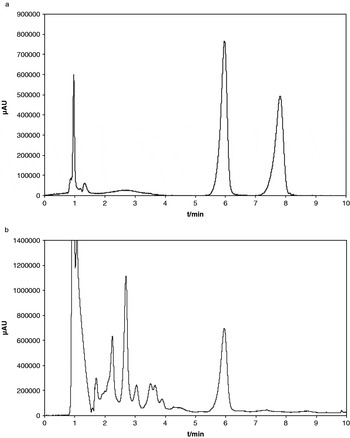
In the microflora of bacterial smear surface-ripened cheeses such as Limburger, Harzer and Chaumes, microorganisms such as Brevibacterium spp., Arthrobacter spp., Micrococcus spp., Corynebacterium spp. are found as the dominant bacteria. Some manufacturers use the ectoine producing organism Brevi. linens as a pure starter culture, others use it in a mixture with different microorganisms. To test whether ectoine occurs in red smear cheeses which use Brevibacterium as a starter culture, we tested two red smear cheeses, Harzer cheese (manufacturer A) and Limburger cheese (manufacturer B), for the presence of ectoine. Extracts of the rind and the inside mass of the cheese were prepared and analysed by HPLC. A HPLC chromatogram of a Limburger cheese extract is shown in Fig. 1. A component of the extract elutes at 5·95 min, corresponding well with the elution time of ectoine in a control run (5·97 min). A Harzer cheese sample was also analysed by HPLC and also showed a peak at the retention time of ectoine (data not shown).
(a): HPLC reference chromatogram of ectoine and hydroxyectoine measured from the pure substances. Retention time ectoine: 5·97 min. Retention time hydroxyectoine: 7·81 min. (b): HPLC chromatogram of Limburger rind. At a retention time of 5·95 min a single peak is visible which corresponds well with the retention time of ectoine shown in figure 1 a. No peak is visible at the retention time of hydroxyectoine.

Ectoine hydrolyzes under alkaline conditions into α-N-Acetyl-2,4-diaminobutric acid and γ-N-Acetyl-2,4-diaminobutric acid. This feature was used to confirm that the observed HPLC peak corresponds to ectoine. A sample of pure ectoine (7 g/l) was hydrolyzed under alkaline conditions and analysed by HPLC. A reduction of the peak corresponding to ectoine and the appearance of two new peaks at 7·18 min and 11·8 min, corresponding to α-N-Acetyl-2,4-diaminobutric acid and γ-N-Acetyl-2,4-diaminobutric acid, respectively was observed. Alkaline treatment of a Limburger extract led to very similar results: the area under the peak at 5·95 min is reduced by 90% after 24 h of alkaline treatment. The hydrolysis products, which appear in the HPLC chromatograms of the ectoine sample and Limburger extract, elute exactly at the same retention time as the used reference (α-N-Acetyl-2,4-diaminobutric acid and γ-N-Acetyl-2,4-diaminobutric acid; data not shown). This hydrolysis behaviour gave a strong indication that the HPLC peak from Limburger extract corresponds to ectoine.
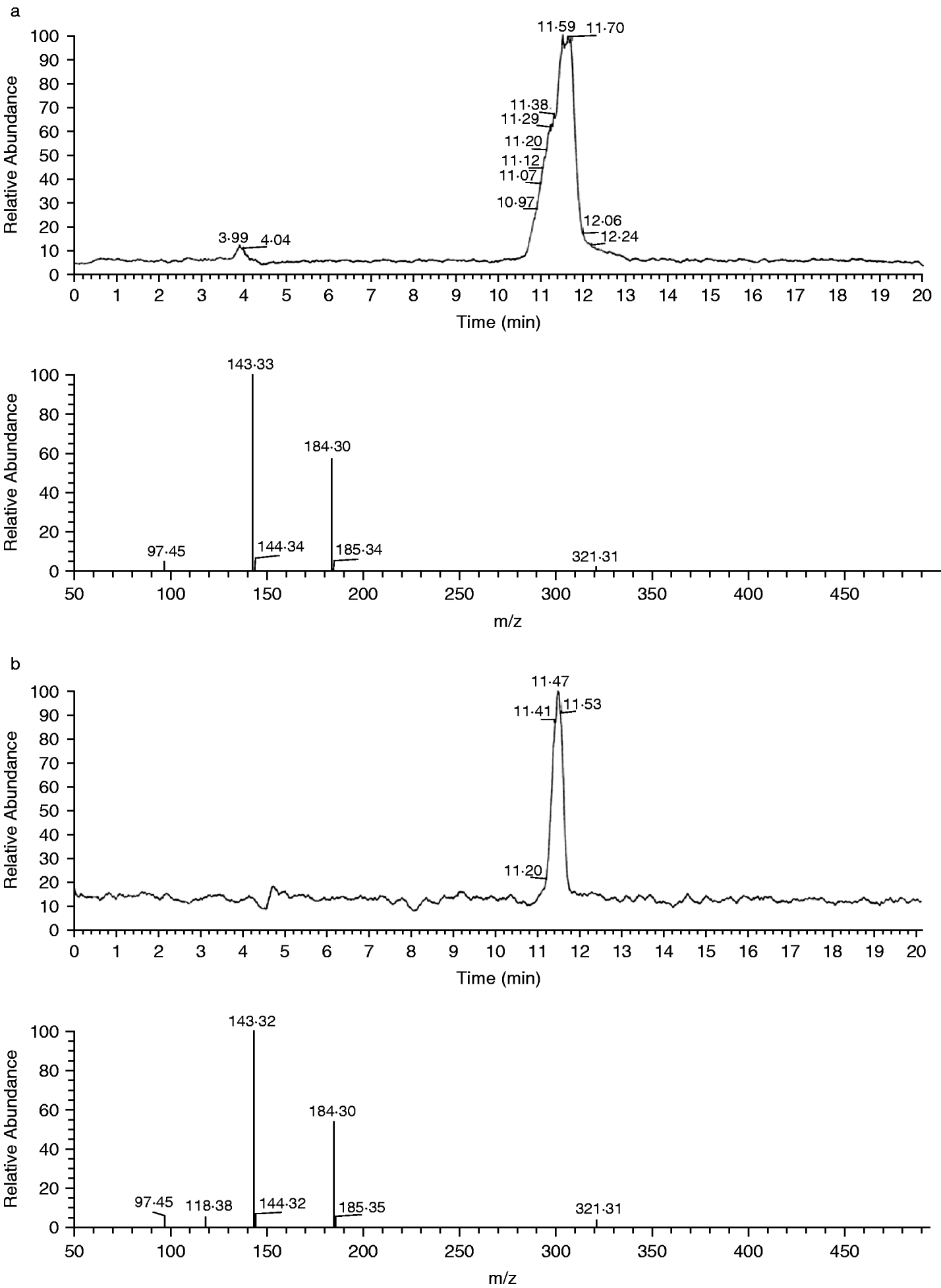
To finally confirm the identity of the compound, we used HPLC/MS analysis. A sample of the Limburger extract was analysed with HPLC/MS. Here, ectoine elutes in the retention time area of 11·55 min to 11·80 min (Fig. 2). In the mass spectrum referring to the UV-peak, we found different mass peaks corresponding to ectoine. The mass m/z=143·3 refers to the protonized form of ectoine, m/z=184·30 refers to acetonitril plus ectoine, m/Z=97·45 refers to ectoine minus one CO2-molecule, m/z=185·34 refers to ectoine plus acetonitril and plus one proton, m/z=144·34 refers to ectoine plus two protons. Furthermore, a mass of m/z=321·31 (composition unknown) was found in the ectoine sample.
(a): LC/MS reference chromatogram of ectoine measured from the pure substances. (b): LC/MS chromatogram of Limburger extract. In the mass spectrum referring to the UV-peak, all mass peaks corresponding to ectoine can be identified.
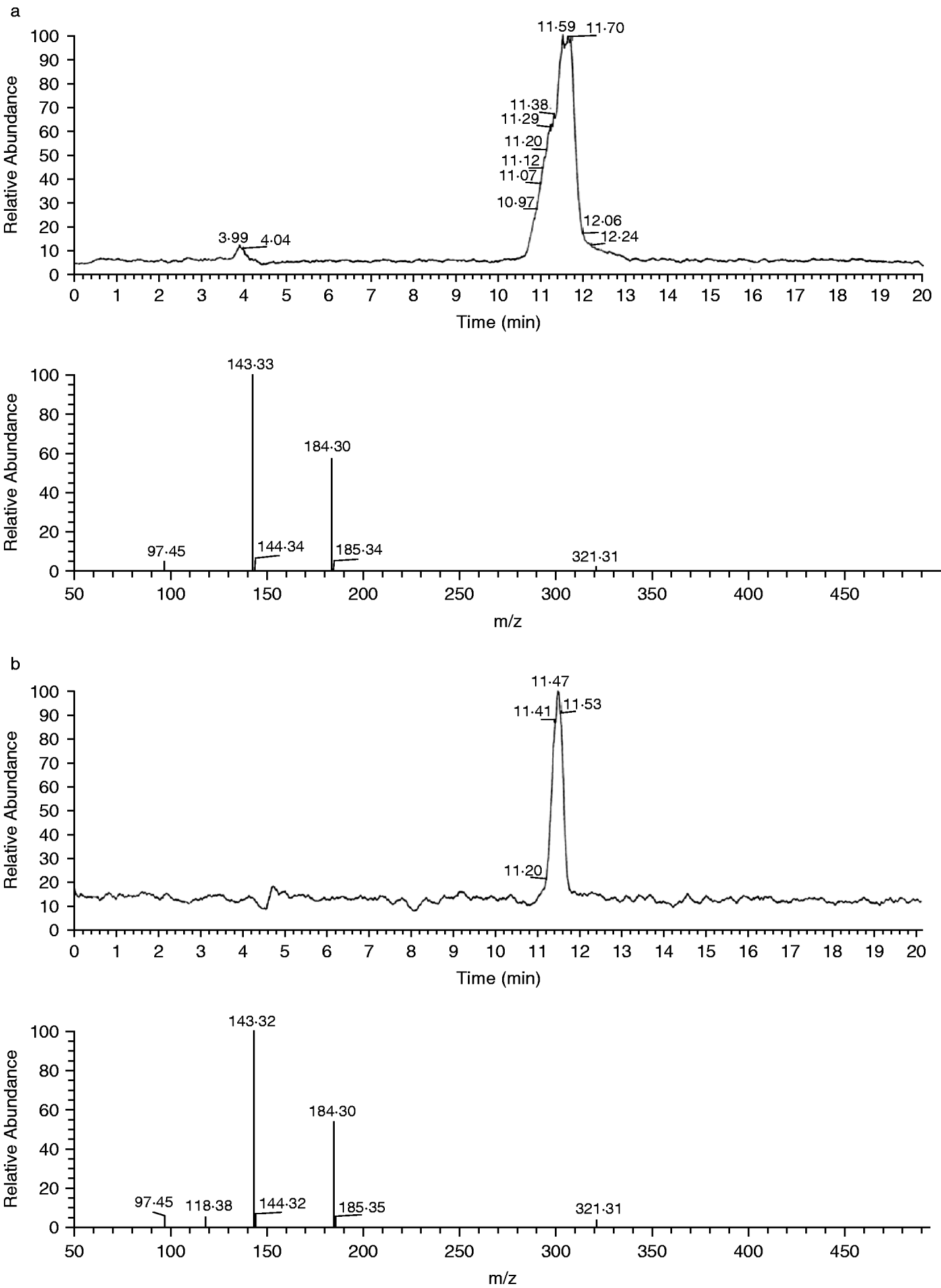
The HPLC/MS spectrum of the limburger extract shows a peak in the chromatogram of the UV-spectrum within the retention time area of 11·35 min to 11·58 min which can be assigned to ectoine. All of the masses which were assigned to different connections of molecules in the spectrum of the ectoine control sample can be retrieved in the mass spectrum referring to the UV-peak (m/z=143·3; 184·30; 97·45; 144·32; 185·34; 321·31). The mass spectrometry results confirm that the substance detected by HPLC analysis of cheese extracts is ectoine.
To further test the occurrence of ectoine in cheese, samples of red smear cheeses from different manufacturers, purchased from local supermarkets were extracted and analysed by HPLC. Other types of cheeses like Feta, Gouda and Camembert were analysed for control purposes.
Table 1 shows that, in addition to Harzer and Limburger cheese, ectoine can also be found in Romadur and Chaumes. When comparing Harzer cheese from different manufacturers, we found that only the cheese from supplier A (Sachsenmilch AG, Leppersdorf, Germany) contained ectoine. Here Brevi. linens is used as a starter culture for ripening (supplier A, personal communication). The lack of ectoine in the Harzer cheeses from manufacturers D and E may be due to differences in the production process, e.g. other starter cultures or lower salt concentrations. Also, the composition of the cheese microflora changes during the ripening process and starter culture organisms may disappear during this process (Bockelmann et al. Reference Bockelmann, Krusch, Engel, Klijn, Smit and Heller1997; Feurer et al. Reference Feurer, Vallaeys, Corrieu and Irlinger2004). Samples from other types of cheeses (Feta, Gouda, Cheddar and Camembert) did not contain ectoine. This may be due to the lack of ectoine-producing, surface-ripening bacteria like Brevi. linens in general (Feta and Gouda cheese) or in the specific ripening process (e.g. salt concentration) employed by the manufacturer (Camembert and Cheddar samples). It has also been shown that the resident microflora specific for a manufacturing site can be more important for the composition of the surface microflora than the starter culture (Mounier et al. Reference Mounier, Gelsomino, Goerges, Vancanneyt, Vandemeulebroecke, Hoste, Scherer, Swings, Fitzgerald and Cogan2005).
Quantitation of the HPLC peaks showed an ectoine content varying between 18 mg in 200 g (common package size) of Chaumes and 73 mg in a Harzer cheese (200 g). Ectoine was only found in the rind and not in the inside mass of the cheese. This corresponds well with the production of ectoine being linked to the occurrence of aerobic ectoine-producing bacteria like Brevi. linens.
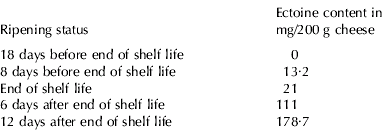
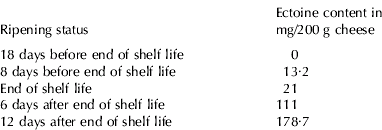
The microflora of red smear cheeses is complex and changes significantly during ripening (Bockelmann et al. Reference Bockelmann, Krusch, Engel, Klijn, Smit and Heller1997). At the end of the ripening process bacteria (Brevibacterium spp., Arthrobacter spp., Micrococcus spp., Corynebacterium spp.) dominate the microflora (Corsetti et al. Reference Corsetti, Rossi and Gobbetti2001). We performed HPLC analysis of cheese extracts at different ripening stages and found that the ectoine content increased with time (Table 2).
Ripening experiment with Harzer cheese
The ectoine content of Harzer cheese samples from manufacturer A was analysed at different ripening stages. Experiments were conducted in different independent trials and data show the typical progression of the ectoine concentration in one experiment
Using Harzer cheese from manufacturer A, we tested the assumption that Brevi. linens population, and hence ectoine content, increases with ripening time, by plating out dilutions of homogenized cheese rind on plates selective for Brevibacterium (Toolens & Koning-Theune, Reference Toolens and Koning-Theune1970). The lowest Brevibacterium content was measured one week before the expiry date (1·3×108 cfu/g). The population increased continuously with ripening time. The sample which was analysed on the expiry date had a population of 7·5×108 cfu/g, one week later a content of 1·95×109 cfu/g was measured and the cheese which was analysed two weeks after the expiry date showed the highest population (1×10¹⁰ cfu/g). The correlation between the increase in ectoine content and Brevibacterium population indicates that Brevibacterium is responsible for the occurrence of ectoine in cheese. However, the possibility cannot be excluded that also other ectoine-producing bacteria like Halomonas sp., which have recently been reported to occur in the surface of red-smear cheeses (Maoz et al. Reference Maoz, Mayr and Scherer2003; Mounier et al. Reference Mounier, Gelsomino, Goerges, Vancanneyt, Vandemeulebroecke, Hoste, Scherer, Swings, Fitzgerald and Cogan2005) contribute to the build-up of ectoine in the cheese rind.
In this report we demonstrated for the first time the occurrence of ectoine in food by analysing cheese products in which ectoine-producing bacteria are used in the production process. Ectoine may also occur in other foodstuff that involves the fermentation of halotolerant or halophilic bacteria under high-salt conditions like soy sauces, fermented fish sauces and cured meat.
We thank Beate Soyka, from Sachsenmilch AG in Leppersdorf, Germany, for helpful discussion and insight into the industrial production process of smear and soft cheeses and for her gracious supply of several cheese samples. In this context we are grateful for the possibility to visit the cheese factory in Leppersdorf. We are very thankful for the help with analytical methodology by Frank Gießelmann, Stefan Wolff and Thorsten Neuhaus (bitop AG) and for help with figure generation by Daniel Appel (bitop AG).