INTRODUCTION
Onchocerca volvulus is a human filarial nematode, which is transmitted by blackflies belonging to the genus Simulium and causes onchocerciasis or ‘river blindness’. Some 18 million people, mostly in Africa, are infected with this parasite. The objective of the African Programme for Onchocerciasis Control (APOC), launched in 1995, is to eliminate onchocerciasis as a public health problem through the implementation of community-directed treatment with ivermectin (IVM), the only drug suitable for mass treatment of the disease. Presently, more than 300 million doses of IVM have been distributed in Africa, some individuals having received more than 17 annual doses.
The possibility that this drug pressure may bring about the emergence of resistant strains of O. volvulus has been considered (Boussinesq and Gardon, 1999; Grant, 2000). Studies performed by Ali et al. (2002) in Sudan and by Awadzi et al. (2004a,b) in Ghana indicate that, in some individuals who had received multiple IVM treatments, a suboptimal response of the parasite to the drug may develop.
To limit or prevent the extension of this phenomenon, it is crucial to characterize the genes of O. volvulus that may be involved. Eng and Prichard (2005), Ardelli and Prichard (2004) and Ardelli and Prichard (2005) found that in O. volvulus, PGP and ABC (ATP binding cassette) transport genes are under selection with repeated treatments with IVM. In addition, Eng and Prichard (2005) found evidence of selection on the β-tubulin isotype I gene in a population of O. volvulus under IVM pressure in Ghana. β-tubulin is the main component of the microtubules, which are involved in essential functions of the cells, such as transport and movement, and may play an important role in the response of O. volvulus to IVM. For instance, while Blackhall (1999) found changes in the frequency of β-tubulin alleles in IVM-resistant Haemonchus contortus, Freeman et al. (2003) found that the amphidial neurones, which are rich in microtubules, are disrupted in a resistant population compared to a susceptible one.
In this context, we analysed the genotypes and phenotypes of O. volvulus adult worms collected before the introduction of ivermectin, in a hyper-endemic area for onchocerciasis. In this paper, we present the data on the frequency distribution of the β-tubulin alleles, and the link between the different genotypes and the fertility status of the female worms.
PATIENTS, MATERIALS AND METHODS
Study area and selection of patients
The data presented hereby correspond to baseline observations of a clinical trial whose aim was to address the effect of different regimens of IVM on both the viability and fertility of O. volvulus adult worms. The design of the study has been presented in detail by Gardon et al. (2002). Briefly, this study was carried out in the Mbam Valley, a region hyper-endemic for onchocerciasis located in the Central province of Cameroon. The inclusion criteria in the trial were to be a male between 18 and 60 years old, to show a minimum of 2 palpable nodules during the preliminary examination but to be otherwise in a good state of health, to have received no filaricidal treatment within the 5 previous years, and to be a volunteer and have signed an informed consent form. At the beginning of the trial, no IVM had been distributed in this area and no vector control activities had ever been conducted. The trial was approved by the Cameroonian Ministry of Public Health.
Collection of nodules and parasitological examination
A careful clinical examination of all patients was performed at the outset of the trial, in August 1994, in order to record all their palpable onchocercal nodules on a body chart. One of these nodules (or groups of nodules, when more than 1 nodule was found at the site of operation), selected at random, was then removed from each patient, just before the first IVM treatment. This paper considers only pre-treatment data. After the nodulectomy, each nodule collected was stored in a separate bottle containing a fixative solution as described by Schulz-Key and Karam (1984) (70% ethanol, 20% water and 10% glycerol). After 24 h, each nodule was moved into fresh fixative and stored at room temperature. One of the nodules collected from each patient was used for histological examination to evaluate the status of the worms regarding viability and fertility (Boussinesq et al. 2001). The remaining nodules, if there were any, were kept stored in the laboratory. The present study was performed using these remaining nodules.
Selection of nodules for genotyping and phenotyping
Of the 657 patients, 290 had more than 1 nodule at the nodulectomy site, before treatment. Thus for these patients, we had extra nodules left after the histology examination was performed. Separately to the data presented in this paper, nodules were collected after treatment with ivermectin to evaluate the effects of the drug on the adult worms (Gardon et al. 2002). For the purpose of the present report, only those patients who were able to provide nodules both before and after ivermectin treatment were selected for nodule examination. If we consider the 4 groups of treatment designed for the trial (for details, see Gardon et al. 2002), 24 patients in group 1, 20 patients in group 2, 32 patients in group 3, and 28 patients in group 4 met the above criteria, i.e. they provided at least 1 extra nodule before treatment, and at least 1 nodule after treatment.
Thus, 25 patients were selected randomly from the 32 and 28 patients from treatment groups 3 and 4. Regarding groups 1 and 2, all the 24 and 20 patients, respectively, were included in the analysis and the numbers were completed to 25 with patients who did not provide additional nodules after treatment. When there was more than 1 nodule from a given patient, the one used for the study was selected at random. Thus, a total of 100 nodules, collected before treatment from 100 different patients, were used for the study reported in the present paper.
The nodules (together with nodules taken after treatment) were individually coded and shipped to the Institute of Parasitology in Canada for worm genotyping. The researchers who conducted the genotyping were not aware of the history and characteristics of each nodule.
Besides this, one of our objectives was to assess the relationship between β-tubulin genotype of the female worms and their reproductive phenotype in an IVM-naive population. In a subsequent paper, we will consider the relationship between β-tubulin genotype of the female worms and their reproductive status phenotype following treatment.
Procedure for phenotyping the female reproductive status
In 2002, the nodules were washed with PBS for 24 h with regular changes of medium in order to remove all residues of fixative from the nodules. The nodules were then digested in collagenase using the protocol described by Schulz-Key (1988). As the nodules had been stored in a dehydrating fixative for several years, they were very resistant to collagenase digestion. The time of digestion ranged from 4 to 15 days. When needed, the collagenase medium was replaced after 4 days of digestion. Individual worms were collected and stored individually in labelled Eppendorf tubes. The tubes were then frozen at −80 °C. Each female worm was phenotyped by microscopical examination for its reproductive status in terms of production of microfilariae (mf) and embryos. Three groups were defined: (a) non-fertile females, i.e. worms with empty reproductive organs, (b) females with low fertility, in which the reproductive organs contained few embryos, and (c) fully fertile females, where the reproductive organs were full of mfs and embryos.
Procedure for genotyping
After the phenotyping, each worm was crushed and its DNA was extracted using a Dneasy™ kit (Qiagen Inc., Mississauga, Canada). The worms were genotyped for β-tubulin (GenBank, AF019886) by PCR amplification according to Eng and Prichard (2005) except that the 24 bp deletion observed in allele b compared with allele a reported by Eng and Prichard (2005) allowed allele identification by amplicon length gel electrophoresis (Eng and Prichard, personal communication). The PCR samples were analysed on a 2·5% agarose gel containing ethidium bromide (0·5 μg/ml) and electrophoresis at 100 V for 45 min.
Statistical analysis
Nodules normally contain a proportion of dead or moribund worms, which can still be extracted after nodule digestion (Boussinesq et al. 2001). Furthermore, these nodules had been stored in preservative for several years and, as a result, the DNA from some recovered worms is likely to have been fragile and fragmented. DNA from some worms could not be successfully amplified and consequently, the genotype of those worms could not be determined (see Results section). Therefore, as a first part of the statistical analysis, we evaluated possible differences between the group of worms that could be genotyped and those we were unable to amplify. For this purpose, we first performed a univariate analysis aimed at comparing, between the worms that could or could not be genotyped, 4 parameters: (a) the age of the patient in 1994; (b) the endemicity level in the patient's village, defined as the community microfilarial load (CMFL) (Remme et al. 1986), using 4 classes: 10–40, 41–60, 61–70 and 71–114 mf per skin snip (mf/ss); (c) the total number of female worms present in the nodule; and (d) the total number of palpable nodules harboured by the patient before the nodulectomy. Comparisons of age, total number of nodules and total number of worms in the nodule were performed using Mann-Whitney tests for 2 independent samples and comparisons between the different CMFL groups were done using a χ2 test. In the whole analysis, all statistical tests were performed at the 5% level.
To complement this analysis, we performed a multivariate analysis using a logistic regression model with mixed effect, accounting for any possible effect of intra-nodular clustering. The factor of interest considered in the model was the status ‘genotyped’ vs ‘non-genotyped’ and the potential associated factors included in this analysis were the same as in the univariate analysis.
In the second part of the statistical analysis, we assessed the frequencies of the two alleles (a and b) of the β-tubulin gene in the worm population, and the relationship between the different genotypes and the observed fertility phenotypes, as defined above. For this purpose, we first calculated the frequencies of each allele of the β-tubulin gene in the male and female worm populations separately. For both subpopulations, we tested for Hardy-Weinberg equilibrium using χ2 analysis. Then we analysed the distribution of the phenotypes across the 3 different possible genotypes (aa, ab and bb), also using a χ2 test. As the phenotype was only defined for female worms, this part of the analysis was restricted to the female worm population.
Preliminary analysis revealed that, in the female worms, a low degree of fertility appeared to be associated with the heterozygous genotype. Thus, in the third and last part of the analysis, we evaluated whether there was an association between the heterozygous status and some of the 4 extrinsic factors considered above. Age, total number of females in each nodule and total number of palpable nodules at the outset of the study were compared using Wilcoxon's test. The proportions of worms (heterozygous vs homozygous) in the different CMFL groups were compared using a χ2 test. Finally, we performed a multivariate analysis, using a logistic regression model with mixed effect, with the genetic status of the worm (heterozygous/homozygous) as the factor of interest, and the patient's age, the total number of female worms in the nodule, the CMFL in the patient's village, and the total number of palpable nodules before the nodulectomy, as possible co-factors.
All the statistical analyses were performed using STATA 6.0 (Stata Corporation, TX, USA) and SPSS 10.0 (SPSS Inc., Chicago, IL, USA).
RESULTS
General findings
From the 100 nodules available for analysis, 92 could be digested; the remainder were either calcified or empty. A total of 320 females (average of 3·48 females per nodule, range 1–10) and 153 males (average of 1·66 males per nodule, range 0–7) were collected. Of the 320 females collected, 319 could be phenotyped for their reproductive status and 230 (71·9%) could be genotyped for β-tubulin. Of the 153 males, 75 males were genotyped for β-tubulin while 78 (51·0%) could not be characterized.
Analysis of possible biases between genotyped worms and non-genotyped worms
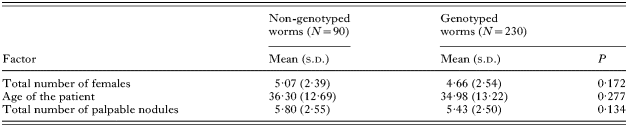
The mean number of females per nodule, mean patient age and mean number of palpable nodules, before the nodulectomy, are presented separately for genotyped and non-genotyped worms (Table 1). No significant differences were found between the 2 genotyped and non-genotyped worms.

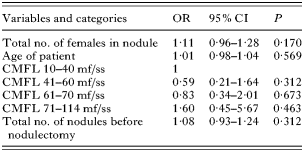
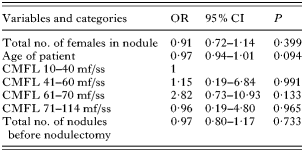
The percentage of worms that could be genotyped within the CMFL classes, 10–40 mf/ss, 41–60 mf/ss, 61–70 mf/ss and 71–114 mf/ss were respectively 73·4%, 66·0%, 72·9% and 82·9%. The χ2 test did not show any difference in the distribution of genotyped and non-genotyped worms between the CMFL classes. According to the multivariate logistic model, none of the factors were significantly associated with the probability of a worm being genotyped (Table 2).
Table 2. Odds ratios (OR) and 95% confidence intervals (95% CI) for logistic regression with mixed effect (accounting for potential intra-nodular clustering) of genotyped status on 4 factors (CMFL, community microfilarial load in the village of the patient. The ORs have been estimated on the female worm population (N=320).)

Allele frequencies
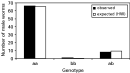
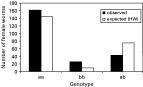
Of the 75 genotyped males, the frequencies of allele a and allele b were 0·933 and 0·067, respectively. The observed and expected genotypic frequencies under the hypothesis of Hardy-Weinberg are presented in Fig. 1. The number of worms with the genotype bb was too low to perform a valid χ2 test; however, the population genotyped seems to be in Hardy-Weinberg equilibrium. Of the 230 female worms genotyped, the frequencies of alleles a and b were respectively 0·793 and 0·207. The observed and expected genotypic frequencies under the hypothesis of Hardy-Weinberg are presented in Fig. 2. The χ2 test showed that the population of worms genotyped was not in Hardy-Weinberg equilibrium (N=230, χ2=42·4; degree of freedom (D.F.)=1; P<0·001) due to fewer heterozygotes observed than expected.

Fig. 1. Observed and expected (under Hardy-Weinberg hypothesis) genotypic frequencies for the 75 genotyped male worms.

Fig. 2. Observed and expected (under Hardy-Weinberg hypothesis) genotypic frequencies for the 230 genotyped female worms.
Relationship between the genotype and the reproductive phenotype of the female worms
The phenotype (degree of fertility of the females) has been defined according to 3 different categories: non-fertile, low fertility, and fully fertile. Of the 319 female worms phenotyped, 28, 110 and 181 were classified in these categories (i.e. 8·8%, 34·5%, and 56·7%, respectively).
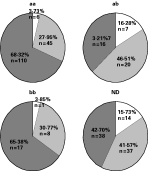
The analysis of the relationship between the genotype and the reproductive phenotype of the 230 females which could be both phenotyped and genotyped showed that the 2 groups of homozygote worms (161 aa and 26 bb) had a very similar phenotypic distribution (Fisher exact test, P<0·92). It also showed that the heterozygote females (N=43) were much less fertile than the homozygotes, taken together (χ2=17·96; D.F.=2; P<0·001). In particular, more than two thirds of the homozygotes were fully fertile, whereas only 37% of the heterozygotes were so (Fig. 3).

Fig. 3. Distribution of phenotypes in relation to the genotypes (aa, ab, bb, or not determined) of the total 408 females that were assessed for phenotype. □ Non-fertile; □ Low fertility; Fully fertile.
The phenotypic distribution within the non-genotyped worm population was significantly different from the distribution within the total genotyped worm population (χ2=12·90; D.F.=2; P=0·002); however it was similar to the distribution observed in the heterozygous worms (N=132; χ2=0·38; D.F.=2; P=0·83).
Investigation of the factors associated with heterozygosity
When performing univariate analysis, no significant associations were found between the heterozygote status of the worm and any of the dependent variables: mean age of the patient (N=230; 36·9 years in the homozygote group, and 33·8 in the heterozygote group, P=0·199), CMFL in the village of residence of the patients (N=230; χ2=5·9; D.F.=3; P=0·115), mean number of females in the nodule (N=230; 5·2 for the homozygotes and 4·6 for the heterozygotes; P=0·138) and mean number of palpable nodules recorded at the outset of the study (N=230; 5·8 for the homozygotes and 5·7 for the heterozygotes; P=0·914). Multivariate analysis (Table 3) confirmed the lack of association between heterozygosity and these 4 independent variables.
Table 3. Odds ratios (OR) and 95% confidence intervals (95% CI) for logistic regression with mixed effect (accounting for potential intra-nodular clustering) of heterozygotes vs homozygotes on 4 factors (CMFL, community microfilarial load in the village of the patient. The ORs have been estimated on the genotyped female worms population (N=230).)

DISCUSSION
This study is the first to analyse, at an individual worm level, the relationship between the O. volvulus β-tubulin genotype and the phenotype of the females with respect to their reproductive status. The present paper describes the situation in a parasite population collected from patients who had not received any previous antifilarial treatment. Before discussing the results, we must describe several constraints which occurred during the processing of the nodules in the laboratory, and their possible consequences on the results.
Firstly, in the present study, the digestion of the nodules required a longer time of incubation in collagenase compared to the protocol proposed by Schulz-Key (1988). This is due to the fact that the nodules were stored in fixative (70% ethanol, 20% water and 10% glycerol) for 8 years, and were fairly hard. During the time of the digestion, the nodule had to be peeled regularly in order to help the collagenase to digest deep nodular tissues. Some of the worms were calcified and fragile and some others were damaged. Care was taken to separate the worms and to avoid assessing different sections of the same worm by only genotyping worms that could be identified as individual worms.
Secondly, despite the care taken during the DNA extraction process, a significant number of worms could not be genotyped. This might have been due to some of the worms being dead or moribund, and to the fact that the digestion process was long. These two reasons could have resulted in fragmentation of the DNA. To reduce the impact of possible DNA fragmentation, we amplified fragments smaller than 300 bp but, nevertheless, this did not allow amplification of DNA from all of the worms.
As presented in the results section, we had more difficulty to amplify male DNA than female DNA. Two factors could explain the low success in genotyping the male worms. The first one is that the male adult worms are smaller compared to females, and thus produce less DNA. The second one is related to the assumed shorter life-span of the male worms compared to females. This may result in a higher proportion of dead or moribund males in the nodules compared to female worms, and in a greater extent of DNA fragmentation.
Concerning the difficulties of genotyping some female worms, we have performed several analyses to evaluate whether the population of those worms which could not be genotyped was similar to the population of worms that were genotyped. We demonstrated that the two populations did not differ according to various external factors (patients' age, CMFL level, etc.). One can speculate that some of the worms that could not be genotyped were dead or moribund. Their DNA may be more degraded or fragmented, and difficult to amplify. Dead worms are not necessarily rapidly resorbed and can be readily found in nodules (Kläger, 1988; Schultz-Key, 1988). Boussinesq et al. (2001) found that in the absence of treatment, 15·2% of adult female worms found in nodules are moribund or dead. In the present study, the two groups (genotyped vs non-genotyped worms) differed markedly according to their phenotype. Typically, the non-genotyped worms were much less fertile than the worms that could be genotyped. The inability to genotype these worms, probably due to the degradation of their DNA, and the low fertility observed, are consistent with the probability that some of these non-genotyped worms were dead or moribund.
A higher proportion of the male worms compared with the female worms could not be genotyped. This may reflect the fact that they are smaller, yield less DNA, and are possibly more susceptible to DNA degradation during the collagenase digestion and during storage. It was surprising that the frequency of β-tubulin allele b was much lower in the male worms than in the female worms. One would expect a similar frequency. We do not know why the frequencies were different, but it does suggest that genotype may affect survival of male and female worms differently. The lower frequency of allele b in the males compared with the females could be explained if the presence of allele b in the males reduces their fitness compared with allele a male worms and results in a lower representation of allele b than would be expected from its frequency in the female worms. Such an explanation is consistent with the reduced ability to genotype male worms compared with female worms.
It is particularly interesting to note that the phenotypic distribution observed in the non-genotyped worms was very similar to that found in the heterozygous worms. From this observation, one may wonder whether a large proportion of non-genotyped worms would be heterozygous worms or not. To test this hypothesis, we can show that if one assumes that all of the non-genotyped worms were heterozygotes (161, 26 and 43+89 (non-genotyped)) worms with genotypes aa, bb and ab, respectively), the female worm population would be in Hardy-Weinberg equilibrium (N=319; χ2=0·021; D.F.=1; P>0·8). This situation would be expected in a parasite population that had not been exposed to any drug pressure. Although it cannot be proven from this study, these results do suggest that the heterozygous worms may, in the absence of treatment, have a shorter life-span than the homozygous worms, an interesting possibility which requires further investigation
Thirdly, it is important to mention that, when female worms were genotyped, DNA from eggs (fertilized by male worms) and embryos located in their reproductive organs were extracted at the same time. Although only genotypes consistent with individual diploid organisms were observed and the most abundant DNA is likely to be observed during the genotyping, it should be born in mind that our measure of genotype could reflect contributions from sperm and/or offspring of female worms. Furthermore, any significant contribution of DNA from sperm or offspring in the worms would have likely increased the proportion of heterozygous worms recorded. This was not the case and the proportion of heterozygous worms measured was less than expected.
Regardless of the uncertainties discussed above, our observations allow us to draw several conclusions. Firstly, the results regarding the β-tubulin allele frequencies in Central Cameroon are interesting because similar figures were reported from IVM naive populations in Ghana collected in 1999 (Eng and Prichard, 2005). This study also showed that the proportion of worms with allele ‘a’ was much higher than allele ‘b’, in worms from untreated hosts.
A second interesting result is that none of the factors related to the hosts or to the nodules seems to be associated with the heterozygosity or homozygosity of the females. This observation has been obtained on the total number of worms that could be genotyped. However, it is still true when the analysis is performed after having taken the extreme assumptions that all the non-genotyped female worms were homozygous or all were heterozygous. No associations were found with any of the factors tested (analysis not shown). This lack of association between the genotype and factors related to the area (the force of infection assessed by the CMFL) or to the host (age and worm population within the host) should allow future comparisons, with limited bias, of allelic frequency of the β-tubulin gene between different geographical areas.
Our main results show that females that are heterozygous for β-tubulin present a reduced fertility compared to homozygotes. This is the case when the analysis is performed only on those worms which could be genotyped (P<0·001), or when one makes the extreme assumptions that all the non-genotyped worms are homozygotes (χ2=8·61; D.F.=2; P=0·013), or all are heterozygotes (χ2=27·93; D.F.=2; P<0·001). There are examples of heterozygotes displaying a reproductive disadvantage (e.g. Vamosi and Schluter, 1999; Via, Bouck and Skillman, 2000) The a and b β-tubulin alleles differ in their amino acid sequences in the H3 helix (Eng and Prichard, 2005) and these changes could affect the protein properties of the β-tubulin. β-tubulin is one of the two main components of microtubules. Microtubules are involved in many essential functions throughout the cell cycle, including cell division and reproduction, transport of material within the cell, movement of the cells themselves, and neuromuscular signal transmission. Many of these activities are associated with dynamic restructuring of the microtubule cytoskeleton, for instance, lengthening and shortening of individual microtubules, treadmilling of microtubules through the cell, or even the complete disassembly and rebuilding of microtubule arrays. Microtubules are essential for meiosis. The heterozygous females may have microtubules that are not as successful in meiosis as the homozygote aa which could induce fewer ovules able to be fertilized or with reduced neuromuscular coordination which could affect mating. Alternatively, β-tubulin genotype may affect worm viability and the reduced fertility of the heterozygotes could be related to reduced viability. Though these different scenarios can be considered, it is still not clear how the genotype of β-tubulin may affect function related to fertility.
As demonstrated in this study, the β-tubulin homozygous female worms had an apparently higher reproductive fitness than the heterozygous worms and further studies are needed to clarify the possible functional implication of the different s-tubulin alleles.
This study was supported by the River Blindness Foundation, the African Programme for Onchocerciasis Control (APOC), the Onchocerciasis Control Program in West Africa (OCP) and the UNDP/World Bank/WHO Special Programme for Research and Training in Tropical Diseases (TDR).