Introduction
In 2009, a national service profiling exercise was conducted throughout Scotland to determine and quantify the nature of psychiatric intensive care services delivered within the NHS. A total of 147 beds, comprising 14 units in 9 of the 14 health board areas were identified (NHS QIS, 2010). Whilst the exercise allowed an assessment of the provision and therapeutic environment of the PICUs, no attempt was made to investigate the nature of pharmacological treatment routinely prescribed in Scottish PICUs. Since PICUs are largely used to ‘treat patients displaying seriously disturbed behaviour that cannot be safely treated in an open acute psychiatric ward’ (National Institute for Clinical Excellence, 2005), previous research has found a higher prevalence of PRN (pro re nata: as required) prescribing and administration on PICUs compared to other wards. In particular, a higher incidence of administration by the intramuscular route (IM) and ‘higher doses’ of antipsychotics (Paton et al. Reference Paton, Barnes, Cavanagh, Taylor and Lelliott2008; Brown et al. Reference Brown, Chhina and Dye2010; Choong et al. Reference Choong, Coupe and Vijayan2012). Given the increased potential for harm to the patient from such prescribing, the Royal College of Psychiatrists has issued various consensus statements and specific guidance on how to avoid it altogether or to manage it better (Royal College of Psychiatrists, 2006). These include observing the British National Formulary (BNF) dose limits and implementation of a high dose protocol with subsequent recording of the reasons for high dose or combination antipsychotic prescribing. PRN prescriptions should also be regularly reviewed and recommendations or policies concerning emergency sedation or rapid tranquillisation (RT) should consist of thorough and unambiguous details of the drugs to be used and the doses to be given (Royal College of Psychiatrists, 2006).
The secure nature of PICUs makes them an appropriate environment for treating detained patients. Part 16 of the Mental Health Care and Treatment (Scotland) Act refers to the provision of compulsory treatment (pharmacological or otherwise) for detained patients. Any medication prescribed and administered after two months of treatment must: either be given with the patient's consent or (if the patient is unable or refuses to give it) only be given after recommendation of a second opinion doctor, the designated medical practitioner (DMP). Treatment details must be clearly and categorically provided in the treatment plan section of either the Certificate of Consent To Treatment (T2) or the Certificate of the Designated Medical Practitioner (T3). With respect to this part of the Act, the Mental Welfare Commission for Scotland (2011) identified poor conformance, although wards with a higher incidence of detained patients were generally found to perform better than those with predominately informal (voluntary) patients. This suggests that medication treatment regimens within PICUs should also show greater adherence to the Act.
There is a dearth of information about the nature of psychotropic medication routinely prescribed in Scottish PICUs. Additionally, concerns have been raised within NHS Scotland about the lack of published Scottish data about PICUs in general (NHS QIS, 2010). To help address this, the Scottish Mental Health Pharmacy Strategy Group (MHPSG) decided to conduct a national study to characterise the nature of medication prescribed in PICUs throughout NHS Scotland. (The MHPSG is a special interest strategic group consisting of senior mental health pharmacists from all mainland Scottish health boards with representation from addictions, academia, and the directors of pharmacy. Its remit is to promote mental health pharmacy within NHS Scotland which includes advising on policy and service development.)
Methods
A naturalistic retrospective study design was used. Ten out of 14 units representing 8 of the 9 health boards that have PICUs participated in the study. This represented 104 beds. Non-participation of units was largely due to logistical difficulties in co-ordinating and collecting the data. Two distinct time periods were allocated to the study and deliberately chosen to include weekends (Saturday 8th to Sunday 16th January 2011, and Saturday 30th June to Sunday 8th July 2012 inclusive). The dates were largely dictated by the commitments of the first author. Any patient receiving care in a PICU during these dates was eligible for inclusion in the study. A pro-forma was used to retrieve the data from the patient's prescription sheet (kardex) or the nursing or medical case notes. This was done by nursing or pharmacy personnel in the week immediately after the last day of the study period. The following details were collected: anonymised patient demographics, detention status and details of all prescribed regular and PRN psychotropic medication. (The pro-forma was piloted on an acute admissions ward at a Glasgow psychiatric hospital.) The project was considered as service evaluation rather than research and hence did not require MREC ethical approval. Data was entered and analysed using a Microsoft Office Access database.
Results
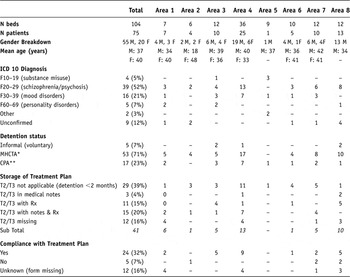
Data were collected for 75 patients consisting of 55 males (73%) with an average age of 37 years (range 16–64 years) and 20 females with an average age of 40 years (range 33–48 years). To our knowledge, this was the total number of patients who had been in a study PICU during the designated time periods. The overwhelming majority of patients (n = 68, 91%) were of white ethnicity; five patients were from the Black Minority Ethnic community; and details were missing for two individuals. The majority of patients (n = 39, 52%) had a diagnosis of schizophrenia and related psychotic disorders followed by mood (n = 16, 21%) and personality disorders (n = 5, 7%). Four patients had a diagnosis related to substance misuse. Nine patients did not have a diagnosis recorded in the notes or none had been confirmed at the time of data collection. Table 1 details the patient demographics.
Patient demographics including detention status

*MHCTA – Mental Health Care and Treatment (Scotland) Act (2000); **CPA – Criminal Procedure (Scotland) Act (1995) detained as ‘forensic patients’; Rx – regular prescription (kardex).
Five patients were admitted voluntarily (informally). The rest were either forensic patients detained under the Criminal Procedure (Scotland) Act (1995) (n = 17) or compulsorily detained under mental health legislation (n = 53, 71%). For detained patients receiving pharmacological treatment, the Mental Welfare Commission (2012) recommended that the T2 and or T3 form(s) be stored alongside the prescription (kardex) charts. Of the 41 detained patients to whom this applied, 26 patients had their forms stored alongside their kardex. However, only 15 of these patients had their forms stored alongside the kardex and the medical notes (considered ‘best practice’). The forms for 12 patients were unavailable or unaccounted for. Of the 29 forms which were available and considered for compliance, only five (17%) instances of treatment non-compliance were identified. (It is unknown whether new forms had been requested to address this.)
Prescribed regular and PRN psychotropic medication
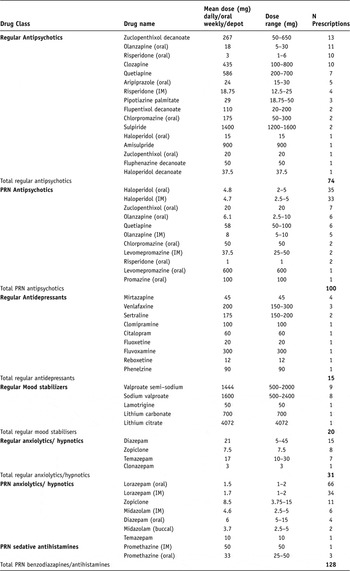
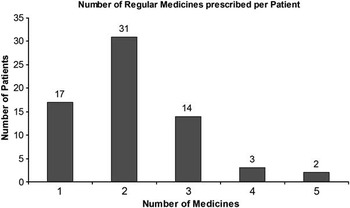
A total of 140 prescriptions for regular doses of psychotropic medication were written (see Table 2). Antipsychotics formed the largest group (n = 74, 53%), of which zuclopenthixol decanoate (n = 13) was the most common followed by oral olanzapine (n = 11), clozapine (n = 10) and risperidone (n = 10). Hypnotics and anxiolytics were the second largest group (n = 31, 22%) with the majority of prescriptions for diazepam (n = 15). Twenty patients were prescribed mood stabilisers, 17 of which were valproate. Antidepressants were prescribed the least (n = 15). Nine patients were not prescribed any regular psychotropic medication. The average number of regular prescribed psychotropic medications for the whole cohort was 1.9 but increased to 2.1 when the nine patients not prescribed any medication are excluded. The modal number of regular prescribed medicines was 2 (n = 31) followed by 1 (n = 17). Two patients were prescribed five regular medicines. See Figure 1.
Prescribed regular and PRN psychotropic medication

NB Some patients prescribed >1 antipsychotic
Number of regular psychotropic medicines prescribed per patient

A total of 228 prescriptions were written for psychotropic PRN medication and consisted of antipsychotics (n = 100, 44%), anxiolytics (n = 112, 49%), hypnotics (n = 12, 5%) and sedative antihistamines (n = 4). As some of the drugs are available in oral and injectable formulations, the total number of medicines prescribed was 21, which corresponded to 14 drugs. Lorazepam as oral (n = 66) and IM (n = 34) was the most frequently prescribed PRN medicine at a mean dose of 1.5 mg oral and 1.7 mg IM. Haloperidol was the second most frequent (oral n = 35; IM n = 33) at a mean dose of 4.8 mg oral and 4.7 mg IM. In 76 prescriptions (32%), the oral and IM doses of either lorazepam or haloperidol were written on the same line of the prescription sheet. This corresponded to 33 patients.
High dose antipsychotic prescribing
High dose antipsychotic prescribing is defined as: ‘A total daily dose of a single antipsychotic which exceeds the upper limit stated in the British National Formulary […] or a total daily dose of two or more antipsychotics which exceeds the BNF maximum using the percentage method’ (Royal College of Psychiatrists, 2006).
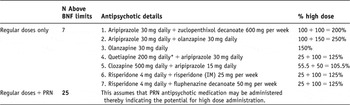
More than one regular antipsychotic was prescribed to 16 patients (21%). Eight patients were prescribed an oral and depot antipsychotic whilst the remainder were prescribed two oral antipsychotics. This excludes any PRN antipsychotics that may have been prescribed. The total daily regular antipsychotic dose for 53 patients was at or below the BNF maximum daily limit. Seven patients were prescribed high dose therapy as a consequence of their regular prescription. The number increased to 25 patients (47%) when as PRN antipsychotics were included. See Table 3.
Instances of high dose antipsychotic prescribing

*Maximum dose of 800 mg assumed for mania
Discussion
This study briefly describes the characteristics of patients admitted to Scottish PICUs and provides a description of psychotropic medication prescribed within that environment. A higher proportion of male patients suffering predominately from a psychotic illness were admitted during the study period. This demographic is similar to that found in other UK PICUs (Brown et al. Reference Brown, Chhina and Dye2008, Reference Brown, Chhina and Dye2010). Almost a quarter of the patients admitted to our study PICUs were under forensic services. Given the complexities associated with forensic psychiatric practice, government policy is that this patient group should be treated within a bespoke environment whenever possible (Scottish Executive, 2006). Recently, new custom built units have opened in several health boards, increasing the provision of both low and medium secure acute and rehabilitation beds. However, given the presence of forensic patients in this study, it may be that demand for acute (forensic) beds is currently not being met within the forensic directorate. The impact this may have on referrals to PICUs from other (open) wards, hospitals or health boards may require investigation.
The psychotropic medicines routinely used in Scottish PICUs are similar to those reported elsewhere (Choong et al. Reference Choong, Coupe and Vijayan2012; Brown et al. Reference Brown, Chhina and Dye2010) and reflective of recent evidence which shows olanzapine and risperidone as the most effective of the atypical antipsychotics (excluding clozapine) (Stroup et al. Reference Stroup, Leiberman, McEvoy, Swartz, Davis, Rosenheck, Perkins, Keefe, Davis, Severe and Hsiao2006; Leucht et al. Reference Leucht, Komossa, Rummel-Kluge, Corves, Hunger, Schmid, Lobos, Schwarz and Davis2009). Depot antipsychotic prescribing was also relatively high (n = 24, 32%) but similar to that seen in other PICU populations (e.g. 31% IM depot or long acting antipsychotics in Brown et al.'s (2010) survey). The number of regular psychotropic medicines prescribed per patient may be considered low, particularly for a PICU population, but it is similar to that found in other PICU populations, notably Brown et al. (Reference Brown, Chhina and Dye2010) who reported a mean number of 2.4. Given the higher staff complement in PICUs, there may be less emphasis on pharmacological treatment and greater attempt at implementing a more holistic treatment regime encompassing psycho-social elements.
The Mental Welfare Commission for Scotland (2012) found that 12% of patients did not receive treatment as per their treatment plans. Our study found a comparable number at 17%, although the status of 12 forms was unknown, which could potentially bring the number up to 59%. The majority of units are found to comply with MWC recommendations by storing the forms alongside the kardex. This arrangement facilitates the prescribing and administration of medication in a more timely manner, which is particularly warranted in an acute situation. Whilst missing forms are a concern, this may be an artefact of the data collection process. The form may have been available elsewhere or with a clinician, perhaps being re-written. Individuals assigned with data collection may have had different perceptions as to what constituted a ‘missing’ form. The Mental Welfare Commission for Scotland (2012) report also concluded that good availability of forms, alerts, audits and pharmacy input did not appear to reduce the risk of unlawful treatment or show better compliance with treatment plans. This is contrary to the experiences of clinical staff working in those environments. The suggestion is that having regular dedicated pharmacy input to the ward often results in better implementation of systems and guidance concerning medication. All the health boards who participated in this study have a clinical pharmacy service. However, amongst some of the smaller health boards, it is unlikely that this extends to the provision of a regular pharmacist exclusively attached to the PICU. Nevertheless, the timely completion of treatment forms should be seen as the responsibility of the multidisciplinary team (MDT).
Multiple prescribing or poly-pharmacy of antipsychotics tends to be more prevalent in secure environments, even though there is limited evidence for its benefits (Correll et al. Reference Correll, Rummel-Kluge, Corves, Kane and Leucht2009). Such co-prescribing of antipsychotics occurs for a variety of reasons, most commonly, when one antipsychotic is being withdrawn and another started or when an oral antipsychotic is being switched to a depot (or vice versa). Some patients are also deliberately prescribed a depot, albeit at the lower end of therapeutic doses, alongside an oral antipsychotic, particularly if there is poor or erratic oral compliance. It is vital that both formulations are considered during any medication review. This can be compounded by the design of some in-patient prescription charts which do not always make it explicitly clear whether an oral or injectable form of medication is prescribed. Whenever poly-pharmacy of antipsychotics occurs, the propensity for high dose antipsychotic prescribing also exists. It is suggested that patients prescribed combined antipsychotics are 20 times more likely to be prescribed high dose (Paton et al. Reference Paton, Barnes, Cavanagh, Taylor and Lelliott2008). In this study, a relatively low incidence (9%) of high dose prescribing of regular antipsychotics was identified. Partial response is another common reason for poly-pharmacy and frequently occurs with clozapine. The evidence for the effectiveness of clozapine augmentation is limited but as a practice is generally accepted and routinely applied (Paton et al. Reference Paton, Whittington and Barnes2007; Taylor & Smith, Reference Taylor and Smith2009). Only one patient amongst this population was prescribed clozapine augmentation therapy (clozapine 500 mg + aripiprazole 15 mg). The reasons for it were not explored but likely to be due to intolerable side effects of clozapine. The management and subsequent monitoring of such patients should be implemented as per the Royal College of Psychiatrists’ (2006) guidelines. The research evidence suggests that appropriate monitoring of individuals receiving more than one antipsychotic is rather poor, particularly amongst patients in the community (Taylor et al. Reference Taylor, Mir, Mace and Whiskey2002). In this study, the status of monitoring amongst high dose patients was not investigated.
Antipsychotic poly-pharmacy is particularly problematic when PRN antipsychotics are prescribed alongside regular doses, as the potential for the total daily dose to exceed BNF limits (regular + PRN > 100%) is greatly increased. Seven patients were identified as high dose by their regular medication but this increased to 25 patients when the PRN medication was included, representing an increase of almost 30%. PICU patients are by definition more acutely unwell and hence at increased risk of receiving PRN medication. Perhaps the prescribing doctor should more carefully consider the dose of regular antipsychotic (if any) before prescribing the PRN dose, particularly in a PICU. A total antipsychotic dose of greater than 100% should only be justified if that were the minimum dose (in 24 hours) required to keep the situation safe. It is worth noting that the Royal College of Psychiatrists’ (2006) guidelines state that the decision to use high dose antipsychotics should only be taken by a consultant psychiatrist. The reality is that junior doctors will most often be involved during admission and the subsequent prescribing of regular and PRN medication. This suggests that consultant psychiatrists should be reviewing all prescriptions within the usual admission timeframe of under 24 hours.
Almost a third of psychotropic PRN prescriptions were written in a manner considered unsafe, i.e. with oral and IM formulations written on the same line of the prescription chart. When written like this, it gives the impression that there is little, if any difference between the two formulations, particularly when the maximum daily dose is calculated as an accumulation of doses administered (i.e. lorazepam up to 8 mg in 24hr). This is not an accurate predictor of the amount of drug absorbed. Other studies (Baker et al. Reference Baker, Lovell and Harris2008) investigating PRN prescribing have also identified this as a problem area. This study shows that the safe prescribing of PRN doses within PICUs is currently outstanding. As to the appropriate choice of PRN IM medication, recent SIGN guidelines (Scottish Intercollegiate Guideline Network, 2013) recommended a combination of haloperidol and promethazine; with benzodiazepines on their own as the least suitable. Our findings show high use of IM haloperidol on its own, or a benzodiazepine on its own and no instances of a combination of IM haloperidol with IM promethazine. The SIGN guidance was issued after our data collection so we cannot comment on the extent of compliance with the guidelines. However, this study has highlighted the fact that the guidelines represent an interesting challenge for in-patient services which, it seems, will have to radically alter their practice. It is also worth noting that promethazine has the potential to cause QTc elongation and this alone might be good enough reason to avoid its use, even though it is a recommended treatment option.
This study has allowed, for the first time, an opportunity to comment on the nature of medication prescribed in Scottish PICUs. Unfortunately it was not possible to conduct an analysis of prescribing in individual units or to compare practice between health boards, given the small number of patients recruited in some areas and the degree of variability in bed numbers. Nevertheless, a strength of the study is the ability to generalise, as eight out of the nine health boards with PICUs were included. However, this characteristic inadvertently also contributes to the limitations. Not all units could participate at the allocated time and a gap of 15 months existed between phases. It is possible that this gap and the time of year (i.e. post-Christmas and pre-summer holidays) could have impacted not only on patient demographics but on clinician availability and hence prescribing practice. As the project was instigated by pharmacy personnel, it may have lacked ownership amongst ward (nursing) staff. In areas lacking pharmacy input, the data was wholly collected by nursing personnel. It is possible that if nurses did not view the study as a priority of necessity, some eligible patients may have been missed, i.e. boarders or temporary patients, self-discharge etc. It may also have resulted in selective reporting as individual units may have viewed the study as an investigation about their own practice. This may explain the low numbers of patients recruited from some units and health board areas. Additionally, the study was conducted without any specific resources or funds and data collection was wholly dependent on the goodwill of colleagues.
Conclusions
The nature of psychotropic medication prescribed in Scottish PICUs is described for the first time. The propensity for high dose prescribing as a consequence of regular and PRN administration of antipsychotics appears to be relatively high. Combined use of oral and IM forms of the same drug without any allowances being made for bioavailability also remains apparent. For detained patients, compliance with medication treatment plans was less than perfect.
Acknowledgements
Thanks are extended to the clinical staff who collected the data and to the MHPSG for facilitating the project, in particular Thom Shaw and Irene Sharkie. The authors are particularly grateful to the referees for their constructive comments.
The study was initiated by the MHPSG.
No financial award or grant was awarded to support the work reported in this paper.