

INTRODUCTION
Written forms of words, or orthographic input (OI), can affect learners’ ability to establish lexical representations; in some cases, this can lead to an inability to acquire targetlike phonological forms of second language (L2) words. The specific contribution of OI on language performance varies; some studies indicate that OI can aid in the establishment of lexical representations (e.g., Escudero, Hayes-Harb, & Mitterer, Reference Escudero, Hayes-Harb and Mitterer2008; Showalter & Hayes-Harb, Reference Showalter and Hayes-Harb2013), while others indicate that OI can interfere or have no effect on lexical acquisition (e.g., Burki, Spinelli, & Gaskell, Reference Burki, Spinelli and Gaskell2012; Escudero, Simon, & Mulak, Reference Escudero, Simon and Mulak2014; Simon, Chambless, & Kickhöfel Alves, Reference Simon, Chambless and Kickhöfel Alves2010). Recent research has demonstrated that learners can take advantage of OI when learning the phonological forms of new words under some circumstances. However, few L2 orthography-phonology studies to date include actual learners of the target L2 or learners at different stages of acquisition (i.e., beginner, intermediate, advanced). Instead, acquisition in prior studies is operationalized as naïve (no target-language experience) listeners’ abilities to learn a pseudolanguage or language that reflects properties of a target L2. The present study is an investigation of phono-lexical acquisition in the presence of OI by learners of the target language, as well as naïve learners, and is an attempt to mediate OI difficulties observed during initial stages of acquisition. That is, we ask how L2 OI affects naïve and experienced learners’ abilities to learn the phonological forms of words when first language (L1) and L2 writing systems differ.
Numerous OI factors can affect phono-lexical acquisition; these include, but are not limited to, familiarity and frequency of L2 words (e.g., Veivo & Järvikivi, Reference Veivo and Järvikivi2013), the phonological contrasts targeted in the experiments (e.g., Escudero, Reference Escudero2015), and the L1 and L2 that are involvedFootnote 1 (e.g., Erdener & Burnham, Reference Erdener and Burnham2005). In the present study, we focus on two variables: grapheme familiarity and congruence. We define grapheme familiarity as the presence or absence of a grapheme within an L2 relative to a speaker’s L1. For example, graphemes in L2 Arabic are entirely unfamiliar to L1 English speakers who are accustomed to the Roman alphabet. However, the graphemes used in L2 Spanish are familiar to L1 English speakers, as both languages are written in the Roman alphabet. A grapheme’s familiarity is an indication of linguistic units a learner must acquire; that is, an L1 speaker learning an L2 that uses the same graphemes will not have to acquire new graphemes. The second variable of interest is congruence, which we define as the manner in which letters and sounds are mapped (grapheme-phoneme correspondences; GPCs) in a language and the relation of these mappings in the L1 and L2. An L1 speaker of English learning L2 Dutch will encounter congruent GPCs; for instance, in both English and Dutch <p> is mapped to [p]. An L2 speaker of English learning L2 Dutch will also encounter incongruent GPCs or differences between GPC mappings in English and Dutch; for example, <g> is mapped to [g] in English but to [ɣ] or [x] in Dutch. Therefore, when an L1 speaker of English is learning Dutch, they must “unlearn” the English GPC and learn the new Dutch GPC. These two variables and their effect on phono-lexical acquisition are described in more detail in the next section.
The orthography-phonology literature provides evidence that learners transfer aspects of their L1 (e.g., GPCs) to the L2 even when aspects of the L2 system differs from the L1 system (e.g., L1 <s>-[s], L2 <s>-[z]) and can lead L2 learning outcomes to become nontargetlike (Bassetti, Reference Bassetti2006; Hayes-Harb, Nicol, & Barker, Reference Hayes-Harb, Nicol and Barker2010). Few studies have investigated how learners at different stages of acquisition (i.e., beginner, intermediate, advanced) perform relative to one another or how to mitigate these effects (e.g., Hayes-Harb & Hacking, Reference Hayes-Harb and Hacking2015; Özçelik & Sprouse, Reference Özçelik, Sprouse and Gürel2016; Veivo & Järvikivi, Reference Veivo and Järvikivi2013). In light of results from previous studies, we additionally tested the efficacy of interventions to mitigate effects of grapheme familiarity and congruence in naïve learners to develop targetlike GPCs in early stages of acquisition.
BACKGROUND
EFFECTS OF GRAPHEME FAMILIARITY AND CONGRUENCE
In the initial stages of phono-lexical acquisition, learners appear to transfer knowledge of their L1 linguistic system (phonology, orthography, and GPCs) to the L2 system. In some instances, the systems are similar enough that little to no effect is observed. However, when a learner erroneously applies their L1 knowledge to an L2, this can result in nontargetlike performance or acquisition (as in, e.g., Bassetti, Reference Bassetti2006).
Escudero, Hayes-Harb, and Mitterer (Reference Escudero, Hayes-Harb and Mitterer2008) found that OI can be beneficial to participants’ ability to learn L2 word forms. In their study, the alphabets employed by the L1 (English) and L2 (Dutch) were the same (i.e., familiar)—the Roman alphabet. Showalter and Hayes-Harb (Reference Showalter and Hayes-Harb2015) investigated whether an entirely unfamiliar orthography would likewise be beneficial during phono-lexical acquisition. Native speakers of English were exposed to pseudo-Arabic words in minimal pairs containing the /k/-/q/ contrast, pictured meanings, and either OI as the Arabic script (orthography) or a meaningless letter sequence (no orthography; < ط ط ط ط >). At test, participants exposed to the Arabic script did not perform differently than their No Orthography counterparts. Showalter and Hayes-Harb tried to mediate grapheme familiarity in a series of subsequent experiments, manipulating the instructions provided to participants, the script of stimulus presentation (i.e., the Roman alphabet), and the number of talkers. None of the manipulations affected performance. It was posited that participants’ low accuracy might have stemmed from the difficultly to perceive the /k/-/q/ contrast and not difficulties from the OI.
Mathieu (Reference Mathieu2016) also investigated grapheme familiarity effects. Native English speakers learned words containing the /ħ/-/χ/ contrast, but were exposed to written forms in the Arabic script (completely unfamiliar), the Cyrillic script (unfamiliar), or a Hybrid script (first letter Cyrillic, rest of the letters Roman alphabet). Differences in grapheme familiarity did not affect accuracy; however, Mathieu (Reference Mathieu2016) found that words containing possible incongruences (e.g., Roman-looking Cyrillic letters <h>) could have led participants to incorrectly make use of their L1 knowledge (e.g., <h>-[h] not target [ħ]) and negatively affect accuracy. As in Showalter and Hayes-Harb (Reference Showalter and Hayes-Harb2015), Mathieu (Reference Mathieu2016) posited that the contrast may have been too difficult for naïve learners to perceive, and the effects of the OI could not be isolated.
Looking at effects of congruence, Hayes-Harb, Nicol, and Barker (Reference Hayes-Harb, Nicol and Barker2010) found that native English speakers experienced significant interference when L1-L2 GPCs were incongruent. Native English speakers learning a pseudo language were exposed to auditory forms, pictured meanings, and written forms following English spelling conventions (e.g., [gufə]-<gufa>) or not conforming to English spelling conventions (e.g., wrong letter [keʃəf]-<kezef> or extra letter [degəd]-<degund>). At test, when asked to indicate whether pictured meanings and auditory forms matched, participants exposed to spelled forms that did not conform to English conventions were more likely to accept mispronunciations (e.g., indicate that [kezəf] was a correct auditory form) than those with English-conforming spellings. Specifically, the nonconforming participants’ accuracy at test was significantly affected by incongruent spellings.
A similar congruence effect was found in Hayes-Harb and Cheng (Reference Hayes-Harb and Cheng2016). In addition to seeing pictured meanings and hearing auditory forms, native English speakers learning pseudo-Mandarin were exposed to either spelled forms in Pinyin or Zhuyin. These two word-learning conditions allowed the researchers to observe effects of grapheme familiarity, with Romanized Pinyin being familiar to the native English speakers and the characters of Zhuyin being unfamiliar. In addition, the effect of congruence was tested, with the Pinyin stimuli split into congruent (e.g., <mie>-[mie]) and incongruent (e.g., <xiu>-[ɕiou], English [ziou]) forms. While the Zhuyin participants required more time to learn the words, Pinyin participants had less accurate performance overall due to low accuracy on the incongruent stimuli. What is especially important to note in Hayes-Harb et al. (Reference Hayes-Harb, Nicol and Barker2010), as well as Hayes-Harb and Cheng (Reference Hayes-Harb and Cheng2016), is that neither study contained difficult-to-perceive contrasts. All phones in Hayes-Harb et al. (Reference Hayes-Harb, Nicol and Barker2010) were familiar to the native English speakers, and, while some phones were unfamiliar in Hayes-Harb and Cheng (Reference Hayes-Harb and Cheng2016), the ability to make decisions about word forms at test did not rely on contrasts involving new phones. These two studies provide evidence that, even in the context of familiar input, learners are affected by interference effects from incongruence.
One question that arises is whether experienced learners—learners who have been consistently exposed to the target language in some manner (e.g., classroom, self, or immersion exposure)—of a target L2 overcome effects caused by OI during phono-lexical acquisition. Previous studies yield mixed results; in some cases, experienced learners have demonstrated that they rely less on L1 knowledge that may interfere in the L2 (e.g., Özçelik and Sprouse, Reference Özçelik, Sprouse and Gürel2016; Veivo and Järvikivi, Reference Veivo and Järvikivi2013). Vokic (Reference Vokic2011) found that native Spanish speakers, with an average of 23.8 years of experience (having classroom instruction for an unspecified number of years), applied L1 Spanish sound-spelling correspondence rules to L2 English flap (/ɾ/) production. In English, the flap is mapped to <t>, <d>, <tt>, or <dd> intervocalically; in Spanish, <t> and <d> are mapped to [ð] and [t] in that environment and <tt> and <dd> do not exist; the Spanish speakers often produced <d>/<dd> as [ð] and <t>/<tt> as [t]. Furthermore, the Spanish speakers were more likely to rely on Spanish mappings for <t> and <d> and produce the flap in forms spelled with <tt> and <dd> (not present in Spanish). Vokic (Reference Vokic2011) found that speakers were influenced by their L1 GPC knowledge, and when a word was more familiar to learners, they were more likely to produce targetlike phones and mediate L1 GPC interference effects.
Much like Bassetti (Reference Bassetti2006) and Vokic (Reference Vokic2011), Bassetti and Atkinson (Reference Bassetti and Atkinson2015) investigated learner productions and effects of L1 GPC knowledge. Native Italian speakers, who had been learning English for an average of 10 years in an instructed setting, read aloud or repeated English words that contained “silent letters” (e.g., <b> in <comb>), vowels that were represented as a single versus double grapheme (e.g., [i] in <these> versus <cheese>), the past tense morpheme <-ed>, and homophones (e.g., [wʊd] <wood/would>). Despite their language experience, learners mispronounced words in English (more during reading aloud than word repetition), as they applied their knowledge of GPCs in Italian to English. During the reading aloud task, 85% of speakers added silent letters to their pronunciations of each stimulus, only one-third of past-tense endings were targetlike in voicing and one-third were produced with epenthesized vowels, and the participants produced significantly longer vowels with digraphs and significantly produced homophones pairs as nonhomophones when spelled differently.
To the best of our knowledge, there are few studies that investigate the acquisition of L2 Russian words in relation to OI (and, additionally, in instructed learners). Comer and Murphy-Lee (Reference Comer and Murphy-Lee2004) provides a foundation, investigating the effects of GPCs on reading and writing accuracy in native English speakers in their first semester of Russian. Comer and Murphy-Lee questioned whether certain Cyrillic letters (and GPCs) would be consistently problematic or whether learners would be able to acquire targetlike Russian GPCs by the end of the first semester. Focus was upon recognition of GPCs and not accurate productions of Russian-specific phonology (e.g., palatalization). Learners read aloud sentences that contained familiar and new words during three recordings: after 4, 8, and 12 weeks of instruction.
While students generally improved their ability to read graphemes aloud in a targetlike manner over the 12 weeks, two crucial findings emerged. First, participants who did not demonstrate improvement within the first 4 weeks fell behind and received lower course grades. There were also graphemes that were difficult for the majority of participants and continued to pose difficulty by the end of the semester (i.e., Ц, ё, Ю, Й, Э; to a slightly less extent Х, б, Щ). Common difficulties with pronunciation included letters differing only in diacritics (e.g., <ё> and <e>), new words or unknown letters (which were either ignored or substituted with a different word), and letters that looked like the Roman alphabet but map to a different sound (e.g., <в>-Russian [v], English [b]). The findings of Comer and Murphy-Lee (Reference Comer and Murphy-Lee2004) suggest that some GPCs are difficult for Russian learners, and that the inability to accurately map sounds and letters early can negatively impact language learning success.
Comer and Murphy-Lee (Reference Comer and Murphy-Lee2004) provides evidence that native English-speaking learners can experience difficulties with Russian GPCs; however, the relevance of Comer and Murphy-Lee’s (Reference Comer and Murphy-Lee2004) findings to those of the present study may be limited. Comer and Murphy-Lee (Reference Comer and Murphy-Lee2004) were interested in the relationship between learners’ ability to pronounce sounds represented by graphemes and ultimate success in a language learning classroom, whereas the present study is focused upon the ability to learn the phonological forms of new words. Minimally, Comer and Murphy-Lee (Reference Comer and Murphy-Lee2004) provide evidence that knowledge of GPCs is correlated with other kinds of success in a language learning classroom.
While the previously mentioned studies investigated the effects of OI in instructed learners’ acquisition, many of them do not systematically include learners at various stages of acquisition. They include a single group of learners (i.e., only advanced learners), or look at heterogeneous groups of “learners” who have differing target L2 experience. They do not indicate how OI affects learners over the course of phono-lexical acquisition (i.e., naïve learner, beginner, intermediate, and advanced).
There are studies that include intervention (brief instruction to naïve learners; in an attempt) to mitigate difficulties associated with OI or other variables (e.g., using OI to enhance performance on L2 contrasts). Accuracy at test within these studies demonstrates varying degrees of beneficence. In Showalter and Hayes-Harb (2015; detailed in the preceding text), native English speakers were unable to make use of the Arabic script during word learning. To mitigate the suspected script difficulty, Showalter and Hayes-Harb (Reference Showalter and Hayes-Harb2015) provided (brief) intervention using instructions that included descriptive information about Arabic (i.e., it is read from right to left), as well as examples with arrows pointing to the consonants. Participants were also presented with English examples, showing that the first letter was on the left in English and on the right in Arabic. This intervention did not assist participants during phono-lexical acquisition of words containing the /k/-/q/ contrast. Jackson (Reference Jackson2016) attempted to mitigate the difficulty of the /k/-/q/ contrast by Romanizing the Arabic script and differentiating the sounds using diacritics or providing a novel grapheme (e.g., <ḳ> and <λ>, respectively for /q/), as well as providing instruction about the sounds and their corresponding letters. Participants exposed to an intervention (through the instruction/description on the graphemes and phonemes) performed more accurately than their nonintervention counterparts, but not significantly so. It could be that the /k/-/q/ contrast was difficult to perceive even with the script/grapheme changes, making beneficial effects of OI unidentifiable.
Hayes-Harb, Brown, and Smith (Reference Hayes-Harb, Brown and Smith2017) investigated whether an intervention using explicit instruction about GPCs would affect native English speakers’ productions of German word-final devoicing of stops. Exposure to spelled forms results in a higher rate of voicing. Participants exposed to instruction, which told them to remember that spelled forms did not always reflect pronunciation (e.g., <g> may be pronounced as [k]), did not differ in their performance at test to those without instruction. In this case, an intervention did not mitigate effects of OI.
SHOWALTER (2018) AND THE PRESENT STUDY
Showalter (Reference Showalter2018) investigated the effects of grapheme familiarity and congruence on native English speakers’ ability to make inferences about the phonological forms of L2 pseudo-Russian words. During a word-learning phase, participants heard auditory forms of words, saw pictured meanings, and either saw a meaningless sequence of letters (i.e., <XXX>) or saw Cyrillic forms. The stimuli were divided into three types: Familiar Congruent (familiar graphemes and congruent GPCs, e.g., <КОМ>-[kom]), Unfamiliar (unfamiliar graphemes, e.g., <ГИЛ>-[gil]), and Familiar Incongruent (familiar graphemes, incongruent GPCs, e.g., <РАТ>-[rɑt]). All phones were familiar (or English-like), allowing OI effects to be isolated (no confounding difficult-to-perceive contrasts (as in e.g., Showalter & Hayes-Harb, Reference Showalter and Hayes-Harb2015 or Mathieu, Reference Mathieu2016). Participants were tested on their ability to determine whether auditory forms and pictures were matched or mismatched at test. It was found that those exposed to the Cyrillic spelled forms had more difficulty at test than those exposed to <XXX>; specifically, Familiar Incongruent stimuli significantly interfered with participants’ accuracy at test (e.g., identifying <PAT>-[pat] as mismatched).
A change from Showalter (Reference Showalter2018) is the inclusion of Russian language learners. Because Orthography and No Orthography condition naïve learners’ performances differed, and interference effects were quite robust, it is of interest to determine when these effects are “overcome” during L2 Russian acquisition. It is expected that learners, at some stage, map Russian graphemes and phonemes in a targetlike manner, but whether this is true has not been empirically found. Finally, Showalter (Reference Showalter2018), Comer and Murphy-Lee (Reference Comer and Murphy-Lee2004), and Bown et al. (Reference Bown, Bown, Christiansen, Dudley, Gibbons and Green2007) present evidence that Russian GPCs are difficult for naïve and beginner learners. It is expected that learners with more Russian experience will be less affected by “misleading” OI. If more experienced learners do not overcome OI effects, it is of interest whether OI effects can be mitigated early so that naïve and beginner learners can acquire Russian in a targetlike manner and succeed in Russian courses. The present study is therefore designed to answer the following questions: How do grapheme familiarity and congruence interact during L2 Russian phono-lexical acquisition? Are grapheme familiarity and congruence effects mediated as experience increases? Can the effects of grapheme familiarity and congruence in naïve learners be mediated through intervention?
METHOD
Russian allows for both grapheme familiarity and congruence to be manipulated within a single script; in relation to English and the Roman alphabet, Cyrillic contains familiar graphemes, unfamiliar graphemes, congruent GPCs, and incongruent GPCs, allowing us to investigate effects of OI on an individual participant basis. As mentioned, the present study is an extension of Showalter (Reference Showalter2018), with the inclusion of instructed learners of Russian and interventions designed to mitigate OI effects during GPC acquisition. Because the stimuli in Showalter (Reference Showalter2018) included both words and nonwords of Russian, as well as real object pictures, the stimuli in the present study had to be redesigned so as not to advantage the learners or negatively affect word learning by, for example, requiring them to learn a new Russian word for a known object. Due to the stimuli changes, we also sought to replicate the results of Showalter (Reference Showalter2018) in the two naïve learner conditions (No Orthography and Orthography).
PARTICIPANTS
Naïve Learners of Russian
There were four groups of naïve learners, who were randomly assigned to one of four word-learning conditions (described later), and were native English speakers with no hearing, developmental, or neurological disorders. All participants were recruited from undergraduate linguistics courses at the University of Utah through flyers or class visits and received course credit or monetary reimbursement for their participation. Naïve learners had no formal (instructed) Russian or Cyrillic experience and were randomly assigned to the Orthography (n = 20), No Orthography (n = 20), Intervention A (n = 20), or Intervention B (n = 20) word-learning condition described in the following text. The No Orthography group consisted of 5 males and 15 females and had an average age of 23.3 years (range 18‒39).Footnote 2 The Orthography group was comprised of 10 males and 10 females and the average age was 24.5 years (range 19‒48). The Intervention A group consisted of 8 males and 12 females and had an average age of 21.4 years (range 17‒32). The Intervention B group was comprised of 4 males, 15 females, and 1 participant who did not elect to indicate gender. The average age of the Intervention B participant group was 24.8 years (range 17‒71).
Learners of Russian
Learners of Russian were recruited from Russian courses at the University of Utah and received course credit for participation. Learners at the university are assigned to classes (levels) using an in-house placement measure, and intact classes based on this placement were utilized under the assumption that Russian proficiency (not experience) was comparable within a class. Learners who have exposure to Russian as a result of a religious mission are placed within a 3000-level class. To ensure that students in each level would be as comparable as possible, all testing took place within a 2-week period in the first two months of the semester. Demographic and language learning information for experienced learners was made to be as equivalent as possible within class levels; however, due to the low number of intermediate students (2000-level and volunteers), learners were divided into Beginner and Experienced groups based upon a combination of their current class and years learning Russian (not proficiency as would be indicated through a standard proficiency exam). Dividing the learners in the manner stated could make them less distinct (see additional concerns in the “Discussion” section). However, to mitigate this issue, only enough learners from the intermediate classes to create group sizes adequate for statistics and whose demographics (years learning Russian) most closely matched those of the beginner and experienced learners were chosen. An independent-samples t-test revealed a significant difference between the years learning Russian for the beginner (mean 0.27 years) and experienced (mean 3.28 years) learner groups (t(38) = ‒7.59, p = 0.00), providing confirmation that the beginner and experienced groups were indeed different from one another. Some learners were excluded for previous experience with a Cyrillic based non-Russian language (n = 2), being a nonnative speaker of English (n = 5), or being a heritage speaker of Russian (n = 4). These factors could unduly advantage learners over other learners or naïve learners.
Beginner learners (n = 20) were enrolled in Russ 1010 (first semester of university classes; n = 15) or 2010 (first semester of second year Russian; n = 5) and had been learning Russian for less than a year (except one learner who had 3 years of experience; this learner was placed into Russ 1010 through the in-house placement measure). Time learning Russian ranged from 1 month to 3 years, and the group average was 0.27 years. All beginners self-rated their proficiency as “basic” (options: basic, conversational, fluent), except for two who rated their proficiency as “conversational.” The average age for the group was 23.4 years (range 18‒63) and consisted of 13 males and 7 females. Other than one participant spending 1 week in Latvia, none of the beginner learners had spent time in a Russian-speaking country. Beginner learners did not report using Russian outside of studying or in class, but a few noted (rarely) listening to music, watching videos or movies, or practicing with others (classmates). Table 1 summarizes the demographic and questionnaire information for this group.
Demographics for beginner learners of Russian
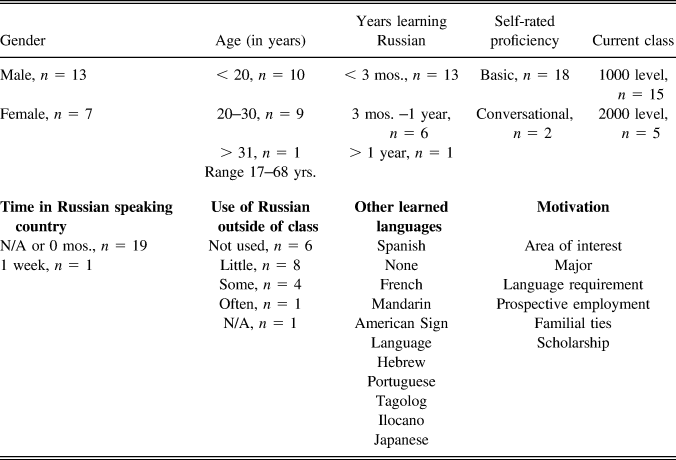
Note: Mos.= months; Yrs. = years
Experienced learners (n = 20) were students enrolled in a 3000-level class or higher, except for two enrolled in 2010. The average time learning Russian was 3.28 years (range 1‒7), the average age was 22.8 years (range 18‒35), and the group included 15 males and 5 females. Seven self-rated their proficiency as fluent or as between conversational and fluent (i.e., conversational/fluent), while the remainder rated themselves as conversational (one self-rated as basic). Sixteen of the participants had previously visited a Russian-speaking country, and most of them had gone for a religious mission lasting a few weeks to 2 years (with the exception of one person who stayed only 4 days). Overall, the experienced learners reported using Russian outside of class; they watched videos, read books/articles, listened to music, or spoke with native Russian speakers at least once a week, if not more (in addition to practicing with classmates). Table 2 summarizes the demographic and questionnaire information for the experienced learners.
Demographics for experienced learners of Russian
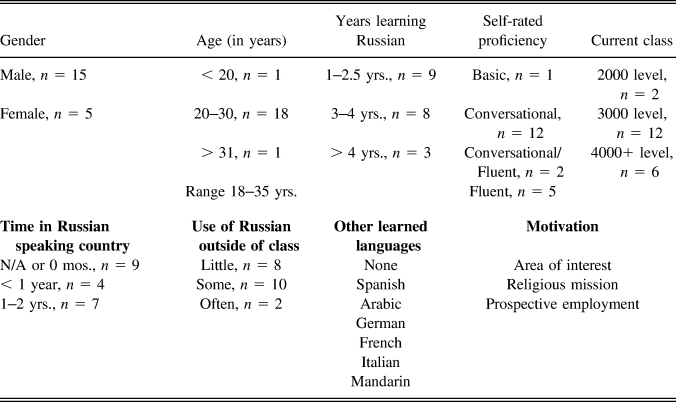
Note: Mos.= months; Yrs. = years
All learners of Russian completed word learning with the Cyrillic representations (Orthography condition word learning). A No Orthography Russian learner condition was not included (nor was a No Orthography Intervention condition), as the comparison of primary interest was between the various learner and intervention groups and the naïve orthography group. It is, however, an empirical question whether learners of Russian without OI indeed perform similarly to naïve learners or whether their experience with Russian might affect their Russian-like word-learning ability in the absence of OI.
STIMULI
All stimuli contained familiar phones or phones that sound English-like. Three stimuli conditions were constructed: Familiar-Congruent (FamCong), Unfamiliar (Unfam), and Familiar-Incongruent (FamIncong). FamCong stimuli contained experimental (the initial) consonants in which all graphemes were familiar and mapped to the same phone in English and Russian (e.g., <MAKO>-[mɑkə]). Unfam stimuli contained initial Cyrillic-specific consonants (e.g., <Ш>-[ʃ]), but the remainder of the word was written with familiar graphemes, or those common to English and Russian, and contained congruent GPCs (e.g., <ШОМА>-[ʃomə]). Stimuli in the FamIncong condition were written with familiar graphemes, but the English GPC and the Russian GPC for the word initial consonant were not the same (e.g., <РАМО>- Russian [rɑmə]; English [pɑmə]). All stimuli were of the type CVCV. A full list can be found in Table 3.
List of stimuli
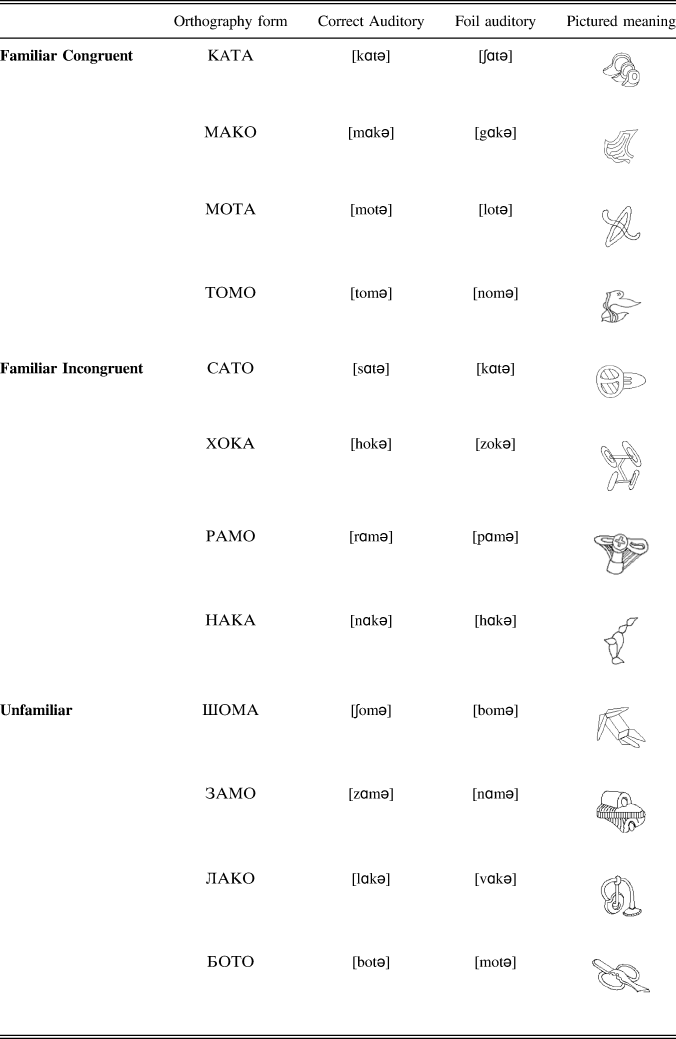
All stimuli were nonwords (henceforth referred to as words) and paired with a nonobject picture. Nonobject pictures ensured that Russian learners would not be learning a new word for a picture already in their lexicon. Nonobject pictures also ensured that, if any experimental words were (similar to) real Russian words, learners would not be advantaged; if a word were similar, they might not have to “learn” it again. Following phonology patterns of Russian, the first syllable was stressed and the final vowel was reduced to [ə]; trochee syllables occur in English (e.g., <mocha>-[mokə]), and should not sound exceptionally unfamiliar to naïve learners. Consonants for each group were distributed as equally as possible, with an attempt to maintain nonword status, have no group overlap, and (as able) avoid English-sounding words.
Each word had associated correct and foil auditory forms. Correct auditory forms followed Russian grapheme-phone mappings. Foil auditory forms for FamIncong stimuli contained the incongruent English mapping (see Table 3). Foil auditory forms for the FamCong and Unfam stimulus conditions were at least two articulatory features (initial consonant only) away to minimize cross-group form overlap, to exclude English-like words, and to avoid real words of Russian.Footnote 3 Minimal overlap across the groups and correct/foil forms occurred (i.e., [motə] was the correct auditory form for <MOTA> and the foil form for <БОТО>), but allowed for avoidance of real Russian words and English-sounding words given the consonants and grapheme-phone combinations available.
FamIncong stimuli were redesigned after review of the stimuli in Showalter (Reference Showalter2018). All FamIncong stimuli pairs had roughly equivalent accuracy scores and fell below FamCong and Unfam scores. The incongruent <B>-[v] pair was replaced; /b/-/v/ are auditorily confusable (see e.g., Ota, Hartsuiker, & Haywood, Reference Ota, Hartsuiker and Haywood2009; Experiment 1) and the pair had the lowest accuracy scores in Showalter (Reference Showalter2018). Because we were unable to discern if scores were due to the OI or auditory confusability, <B>-[v] was replaced with the pair <X>-[h]. While this mapping may occur in English, GPCs of this type do not occur word initially (for more discussion see Hayes-Harb & Cheng, Reference Hayes-Harb and Cheng2016). Scores for the pair <C>-[s] were equivalent to other pairs in Showalter (Reference Showalter2018), supporting inclusion. Again, this mapping is possible in English but is not frequently observed in initial position (i.e., <#CA> is not pronounced as [sa], but the [s] mapping in words such as <science>, <city>, <acid>, etc.).
Unfamiliar stimuli followed the previously stated rules, and whether the unfamiliar grapheme would be familiar through exposure to other languages (e.g., Greek letters in sorority/fraternity names). Additionally, in Showalter (Reference Showalter2018), all graphemes in the Unfam condition were unfamiliar. Because only the first consonant is crucial to test and is of focus in the other stimulus groups (especially FamIncong), only the first consonant was an unfamiliar grapheme in the present (this also addresses the issue that the unfamiliar vowel was different than the other two conditions, i.e., /i/ versus /ɑ/ and /o/, in Showalter, Reference Showalter2018). This change could make word learning more difficult, given that all stimuli are now maximally similar (previously, participants performed near ceiling on Unfam stimuli).
Two native Russian speakers, including the speaker who produced the stimuli and one visiting graduate student, helped create the nonwords,Footnote 4 which were also checked against a Russian dictionary. The stimuli were then produced by a native female speaker of Russian (26 years old) from Russia. She had been in the United States for 3 months as a Fulbright Scholar. She read the words three times in a row and read the entire list two times. The researcher chose the best quality correct-foil pair.
PROCEDURE
General Procedure
Following similar studies (e.g., Hayes-Harb & Cheng, Reference Hayes-Harb and Cheng2016; Mathieu, Reference Mathieu2016; Showalter & Hayes-Harb Reference Showalter and Hayes-Harb2013, Reference Showalter and Hayes-Harb2015), the present study contained an auditory word-picture matching paradigm. The experiment was presented using DMDX (Forster & Forster, Reference Forster and Forster2003) in a sound-attenuated booth, with participants seated in front of a computer. There were three phases: word learning, a criterion test, and a final test.
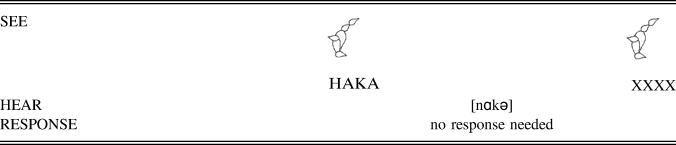
Naïve learners were randomly assigned to one of four word-learning conditions: Orthography, No Orthography, Intervention A, or Intervention B. All learners were assigned to the Orthography condition, as we were interested in how OI variables would affect their performance at varying experience levels. During word learning, participants saw nonobject pictured meanings, heard correct auditory forms, and either saw the sequence (<XXXX>; No Orthography) or the words’ spelled forms (Orthography, Intervention A, Intervention B). An example trial can be found in Table 4 for Orthography and No Orthography participants (intervention conditions are explained in the following section). Participants did not need to provide answers during word learning but were told to memorize the words and their meanings. All 12 words were randomly presented two times per block in four different blocks for a total of 96 presentations.
Example word-learning trials
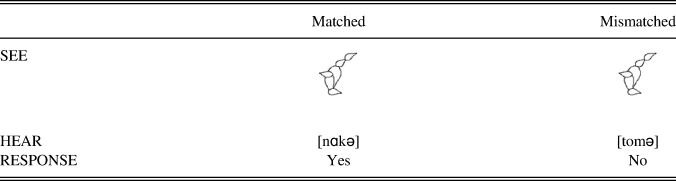
After word learning, participants completed the criterion test, which indicated whether they had generally learned the words (i.e., that there were 12 different words). Twelve of the auditory word-picture pairings were matched as presented during word learning, and 12 were mismatched with a word from a different stimulus condition (example trials are shown in Table 5). Participants had three seconds to answer before the trial timed out, the response was marked as incorrect, and the next trial began. If participants did not reach a criterion of 90% accuracy they repeated the word learning‒criterion test cycle, which could be done as many times as necessary.
Example criterion test trials
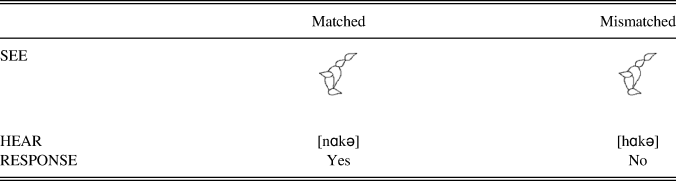
The final test was identical to the criterion test, but mismatched items were based on foil auditory forms. Participants made decisions about 24 auditory word-picture pairs; 12 of the pairs were matched and 12 mismatched. Example trials are provided in Table 6. After participants completed all three phases of the experiment, they filled out a questionnaire detailing their language background and (for learners) Russian learning experience. The entire experiment took approximately 30 minutes to complete.
Example final test trials
Interventions
To create interventions we reviewed current Russian instructional materials. Syllabi for 1st- and 2nd-year classes (i.e., Russian 1010, 1020, 2010, 2020) from three universities, one Russian instructional website (Между нами Mezhdu nami; deBenedette, Comer, Smyslova, & Perkins, n.d.), and eight Russian textbooks were reviewed. Finally, Russian instructors completed an online survey about observed GPC and Russian alphabet difficulties.
Syllabi indicated that instructors dedicate anywhere from a few days to roughly 2 weeks (in instructional time; 3‒4 contact hours a week) for learning the alphabet. Beyond in-class instructional time, some instructors provided websites or materials for additional reference, but did not explicitly address the alphabet and GPCs again. This is counter to other issues (e.g., spelling rules, stress), which are reviewed in various chapters and contexts.
An online instructor survey was sent to a nationwide Russian instructor listserv to collect accounts and reactions of GPC difficulties. The survey contained questions regarding instructors’ basic language background, Russian teaching experience, and impressions of GPC difficulties learners may have. A total of 49 responses were collected; however, due to technical difficulties only 39 of the responses could be analyzed. Thirty-six instructors reported that they were currently teaching or taught in university/college settings, and 29 instructors had more than 5 years of Russian teaching experience. Instructors also indicated that students typically had no or less than 2 years of Russian experience prior to their classes.
The last section of questions referred to GPC difficulties. A brief paragraph introduced the issue, outlining English-Russian GPC differences, examples, and what must be (un)learned by students. Instructors were asked whether they observe issues with GPCs. If an answer of “NO” was supplied, the respondent was thanked, and the survey ended. If an answer of “YES” was supplied, respondents continued with specific questions about observed difficulties. Eleven of the 39 instructors responded with “NO.” The 28 instructors responding “YES” were provided the Cyrillic alphabet in both print and cursive, as well as capital and lowercase forms, and asked to indicate which letters provide difficulty or confusion for students. Both print and cursive were included, as some letters may be troublesome in only one form.Footnote 5 Of the 33 printed letters, 6 were identified by 8 or more of the instructors as troublesome: Бб, Вв, Йй, Рр, Цц, and Щщ. Of the 33 cursive letter forms, 6 were identified by 8 or more of the instructors as troublesome (provided here in print): Бб, Вв, Гг, Дд, Йй, and Тт. Results indicate that letters with congruent GPCs in English and Russian (Аа, Kk, and Мм) did not cause difficulties; however, unfamiliar graphemes or graphemes in incongruent GPCs do provide some degree of difficulty.
Instructors were asked how they address GPC difficulties; only two respondents indicated explicitly addressing sound-spelling issues. The majority of instructors’ responses mirrored syllabi and textbooks—minimal time is spent on the alphabet prior to moving along. A few instructors implied that “good learners” will acquire what is needed to succeed in Russian, while some instructors indicated that they provide additional materials to help students (e.g., handouts, videos, tutoring, flashcards, exercises). Instructors unanimously answered that textbooks lack adequate coverage of GPCs.
Comer and Murphy-Lee (Reference Comer and Murphy-Lee2004) found that learners who do not establish targetlike GPCs early in their first semester of Russian are more likely to fall behind their peers and receive lower grades. Instructors were asked whether they agreed with this conclusion, and what impressions they had of GPC-Russian performance correlations. In general, instructors observed difficulties as those described by Comer and Murphy-Lee (Reference Comer and Murphy-Lee2004) and reported that an inability to establish targetlike GPCs affects multiple language skills; this causes students to fall behind, receive lower grades, drop Russian from their course load, or enter a state of arrested development. Instructors indicated learners require a range of time, from the first few weeks to the end of the 2nd year (4th semester), to “sort out” the difficulties. Furthermore, many instructors indicated that “serious,” “diligent,” or “better” language learners would acquire targetlike GPCs early. Other students would have to study on their own or receive lower grades.
Responses demonstrate that Russian instructors observe GPC difficulties in learners, recognize the inability to establish targetlike GPCs early in acquisition is a detriment to progress and success, and agree that current materials do not adequately address and assist with these difficulties. In addition to the Russian instructional materials, instructor surveys, and previous findings of GPC difficulties, we reviewed L2 acquisition instructional techniques. The goal was not to design classroom instruction or to survey the state of L2 Russian instruction, but understand whether an experimental intervention could mitigate OI difficulties and facilitate acquisition in naïve learners.
Input enhancement is an instructional technique designed to draw attention (explicitly or implicitly) to a particular L2 form (Sharwood Smith, Reference Sharwood Smith1993). Given that the present study investigates the effects of OI, the enhancement of focus is textual enhancement. The effect of input enhancement on participants’ acquisition is, in general, largely dependent on the tested linguistic form, task type, or enhancement provided, and most studies focus upon either grammatical elements (e.g., verbal morphology) or lexical learning, with few studies examining L2 phonological acquisition. Those that do focus upon phonological forms (e.g., Alsadoon & Heift, Reference Alsadoon and Heift2015) have found that attention drawn to OI is beneficial in phonological tasks. Enhancing the consonants of focus in the present stimuli may draw attention to familiarity and congruence differences, aiding performance at test.
With the collected information, two interventions were created: Intervention A and Intervention B. Intervention A did not have instruction prior to word learning, and, during word learning, the first consonant (of GPC focus) of each word was bolded and enlarged. Other textual enhancement was not chosen, for example, underlining, as this could have been erroneously taken as a diacritic. If this occurred, it would be difficult to determine whether participants interpreted textual enhancement as a reason to focus on the first consonant or believed they were hearing a new sound (and not a familiar phone, drawing attention away from OI). Table 7 provides an example of a word-learning trial for each stimulus condition.
Example Intervention A word-learning trials
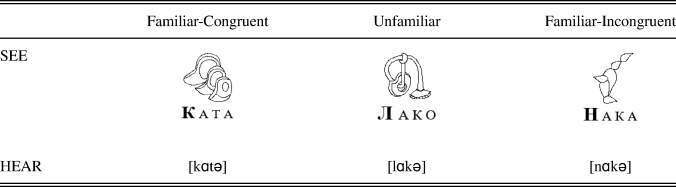
Intervention B provided instruction prior to word learning. Participants were told that there were “some important points to remember.” They were then provided information about the three stimulus conditions. For the FamCong group they were told, “some of the spelled forms will look and sound very familiar,” and the next screen presented a visual and auditory example. For the FamIncong group they were told, “Some of the spoken words will sound like English, but the spelled forms contain different letters than you might expect.” Again, they were subsequently provided an example. On the next screen, the consonants from the incongruent stimuli (i.e., C, X, P, H) were written in red with the warning, “These letters will sound different than you expect!” The last screen of instruction said, “Take a moment to review the letter groups. The blue letters are new letters. The black letters are familiar letters. The red letters are familiar but sound different.” The accompanying picture included the consonants in their stimuli and color groups: blue letters were <Ш, З, Л, б>, black letters were <М, Т, К>, and red letters were <C, X, P, H>. Instructions were self-paced and participants could take as long as necessary to review them. After the participants had gone through the instruction portion of the intervention, they proceeded to the word-learning phase. Word learning was identical to that of Intervention A with the enlarged and bolded forms.
RESULTS
CYCLES
We first reviewed the number of word learning‒criterion test cycles required by each group to reach criterion (to learn the words and their meanings). The following are the mean number of cycles required per group: No Orthography 1.30 (range 1‒3), Orthography 1.45 (range 1‒3), Intervention A 1.80 (range 1‒4), Intervention B 1.90 (range 1‒4), Beginner 1.45 (range 1‒3), and Experienced 1.20 (range 1‒2). The average number of cycles for each group were submitted to a one-way between-subjects ANOVA with word-learning condition as the independent variable (six levels: No Orthography, Orthography, Intervention A, Intervention B, Beginner, and Experienced) and number of cycles as the dependent measure. There was a significant effect of group (F(5, 114) = 3.48, p = 0.006. partial η 2 = 0.117). Pairwise analyses (independent samples t-tests) indicated there were significant differences between the following: No Orthography and Intervention A (t(38) = ‒2.21, p = 0.033), No Orthography and Intervention B (t(38) = ‒2.92, p = 0.006), Intervention A and Experienced (t(38) = 2.89, p = 0.006), and Intervention B and Experienced (t(38) = 3.79, p = 0.001). In each of these pairs, the Intervention condition participants required more cycles to reach criterion than the other pairwise condition. There were two marginally significant differences: Orthography and Intervention B (t(38) = ‒2.03, p = 0.050) and Intervention B and Beginner (t(38) = 2.03, p = 0.050). Again, the Intervention condition participants required more cycles to reach criterion. No other group differences for required cycles were significant. These results indicate that only intervention participants required additional exposure to the stimuli to learn the words and their meanings, and they only required more cycles in comparison to No Orthography and Experienced participants.
D-PRIME SCORES
To measure sensitivity to the stimuli differences, proportion correct scores were converted to d-prime scores. Figure 1 presents these scores by stimulus condition and word-learning group. The d-prime scores were then submitted to a two-factor mixed-design ANOVA with word-learning condition as the between-participants variable (six levels: No Orthography, Orthography, Intervention A, Intervention B, Beginner, and Experienced) and stimulus condition as the within-participants variable (3 levels: Unfam, FamIncong, FamCong). There was a significant main effect of stimulus condition (F(2, 228) = 17.80, p = 0.000, partial η 2 = 0.135), a significant interaction of stimulus condition and word-learning condition (F(10, 228) = 2.15, p = 0.022, partial η 2 = 0.086), but no significant main effect of word-learning condition (F(5, 114) = 2.07, p = 0.074, partial η 2 = 0.083). That is, all participants were affected by the different stimulus conditions, and participants’ accuracy at test on the stimulus conditions varied across the word-learning conditions.
Mean d-prime by word-learning condition per stimulus condition. Error bars represent ±1 standard error.
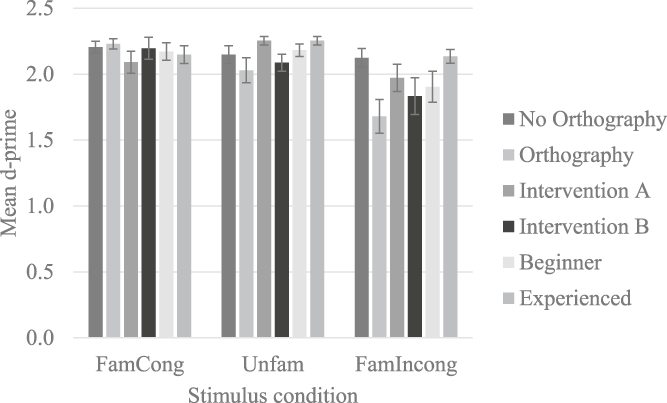
With the finding of a significant stimulus and word-learning condition interaction, the effect of word-learning condition on performance in each stimulus was examined. Three one-way between-subjects ANOVAs with word-learning condition as the between-participants variable (six levels: No Orthography, Orthography, Intervention A, Intervention B, Beginner, and Experienced) and stimulus condition d-primes as the dependent measures were conducted. There was a significant effect of word-learning condition on FamIncong stimuli (F(5, 114) = 2.70, p = 0.024, partial η 2 = 0.096), but no effect of word-learning condition on either Unfam stimuli (F(5, 114) = 2.19, p = 0.060, partial η 2 = 0.081) or FamCong stimuli (F(5, 114) = 0.552, p = 0.736, partial η 2 = 0.023). Participant accuracy at test did not differ on Unfam or FamCong stimuli; however, FamIncong stimuli, as predicted, did contribute to varied results in accuracy across the participant groups.
Investigating the effect of word-learning condition on FamIncong stimuli further, a series of pairwise comparisons were conducted (independent-samples t-tests). The following differences between conditions’ d-prime scores were significant: No Orthography d-primes were higher than Orthography d-primes (t(38) = 3.04, p = 0.004), and Experienced d-primes were higher than Orthography d-primes (t(38) = ‒3.28, p = 0.002). No other differences were significant, but Experienced d-primes were nearly significantly higher than Intervention B d-primes (t(38) = ‒2.03, p = 0.050). These results confirm that naïve learners have difficulty making inferences about phonological forms of L2 words when exposed to L1 incongruent OI; the Orthography group was significantly less accurate at test on FamIncong stimuli than their naïve, No Orthography counterparts. They also indicate that the Experienced learners, with more exposure to Russian and Cyrillic, did not encounter L1 interference or difficulty with the phonological forms of the stimuli as naïve learners exposed to OI did. However, neither the Intervention (A and B) participants nor the Beginner learners were either negatively affected (performance similar to the naïve, Orthography participants) or unaffected (performance similar to the Experienced or No Orthography participants) by FamIncong stimuli. Further discussion on differences in performance across the groups is provided in the “Discussion” section.
DISCUSSION
The research questions for the present study were: How do grapheme familiarity and congruence interact during L2 Russian phono-lexical acquisition? Are grapheme familiarity and congruence effects mediated as experience (exposure to and time learning Russian) increases? Can the effects of grapheme familiarity and congruence be mediated in naïve learners via intervention?
First, we compared the scores of naïve learners of Russian who were either exposed to Cyrillic input (Orthography) or the sequence <XXXX> (No Orthography). Participants exposed to OI performed less accurately at test than those who were not exposed to spelled forms. Specifically, participants demonstrated an interference effect associated with FamIncong stimuli. That is, when GPCs were English-Russian incongruent (e.g., <H>-English [h], Russian [n]), native speakers of English were unable to suppress their knowledge of L1 GPCs to acquire the new L2 GPCs. Accuracy at test for both groups of participants on FamCong and Unfam stimuli was near ceiling, suggesting that, in this case, congruent GPCs and unfamiliar graphemes do not interfere with phono-lexical acquisition. It can be concluded, under the present circumstances, that grapheme familiarity did not affect participants’ ability to learn new L2 words; however, the variable of incongruence did affect targetlike acquisition.
Comparing accuracy at test by the naïve learners (Orthography and No Orthography) and the experienced learner groups, similar stimuli condition patterns were found. Overall, FamCong and Unfam accuracy at test was high, but FamIncong stimuli yielded the lowest accuracy. However, as experience level increased, accuracy at test on FamIncong stimuli increased as well. In response to the research questions, effects of OI appear to be mediated with increased Russian (GPC) experience. Indeed, d-prime scores of the (naïve) Orthography and Experienced groups significantly differed on FamIncong stimuli. While d-prime scores between the Beginner and Experienced groups did not significantly differ on FamIncong stimuli, the Experienced group did have (descriptively) higher d-primes. Experienced learners performed equivalently across stimulus conditions, suggesting that they were not affected (more/unduly) by grapheme familiarity or congruence. Their Russian experience and knowledge of the L2 sound-spelling mappings supported their ability to make targetlike inferences about word forms.
It is worthwhile to consider the differences outlined here regarding the distribution of participants in the Russian learner conditions. There were not enough experienced learners from “intermediate”-level classes to make up a separate intermediate group. These participants were instead assigned to either the Beginner or Experienced learner condition based upon a combination of their years of experience with Russian and current class (to provide an equal number of participants per condition). This likely had the effect of increasing variability among each of the experienced learner groups, which might have lowered the power of statistical comparisons between performance by the two groups; however, recall the difference between the performance of naïve learners (Orthography) and Experienced learners was significant. The division of the experienced learners in the study is a limitation, and it would be worthwhile to replicate the study under more controlled conditions. One issue with the use of Russian, despite its benefits for stimuli, is its status as a learned language at the University of Utah. Other universities may have larger numbers of learners to support a greater number (and therefore more homogenous division) of experienced learners.
Finally, the naïve learners in the two Intervention conditions did not perform significantly different from one another, although Intervention B and Experienced participants did have nearly significantly different d-primes on FamIncong stimuli. In this case, the extra instruction provided to the Intervention B participants may have been too taxing, and the extra input to keep in memory while being exposed to textually enhanced forms, pictured meanings, auditory forms, and written forms caused a decrease in accuracy. It could also stand to reason that Intervention A participants, who needed to figure out the GPC “rules” on their own (not explicitly told the rules as in Intervention B), performed more accurately. However, differences between these groups were not significant. Reflecting on the number of word learning‒criterion test cycles required by the groups, Intervention A and Intervention B participants both required more cycles than the other conditions. In fact, all significant pairwise comparisons included one of the Intervention conditions. However, because the Intervention conditions’ results patterned as the other conditions did, we posit that the extra cycles were due to the additional input provided in the instruction/textual enhancement and did not unduly affect results.
Intervention participants, similar to other participants, performed highly accurately on FamCong and Unfam stimuli, but L1 GPC interference in the FamIncong stimulus condition yielded a decrease in accuracy at test. The Intervention conditions did not outperform their nonintervention naïve learner counterparts or the experienced learners. Descriptively, their d-primes were higher than the nonintervention participants and lower than those of the experienced learners. Surprisingly, the naïve and Beginner learners’ d-primes were not significantly different (the beginner learners had an average of 0.27 years of experience). That is, a month of instruction did not provide an advantage to the beginner learners.
Results in the present study comparing the two naïve learner groups (Orthography and No Orthography) were consistent with the results of Showalter (Reference Showalter2018), suggesting that the interference effect of incongruent GPCs (in the case of Russian Cyrillic) is robust. Importantly, the effect of incongruence on results in the presence of familiar phones provides evidence that OI and L1 GPC knowledge are significant factors in the acquisition of novel words. As found in Hayes-Harb, Nicol, and Barker (Reference Hayes-Harb, Nicol and Barker2010) and Hayes-Harb and Cheng (Reference Hayes-Harb and Cheng2016), incongruent GPCs yielded the least accurate performance from participants, while other OI differences (e.g., unfamiliar graphemes in Hayes-Harb and Cheng and the present study) did not negatively affect accuracy. The results of these studies indicate that when naïve learners are exposed to L2 GPCs in conflict with the L1 system, L1 knowledge will interfere.
It can be seen in the d-prime scores that, as experience (exposure to the target language) increased, accuracy at test increased. The results suggest that naïve learners would not be expected to perform in a targetlike manner within a single experimental time. Beginner learners, with formal instruction for an average of 0.27 years, had less accurate performance (not significant) than their Experienced learner counterparts (with 3.28 years of experience). While overall accuracy was quite high, the differences in d-primes between Beginner and Experienced learners suggests that learners in other studies, which have not found targetlike performance, could lack needed instruction or experience. For instance, the first-year learners of Mandarin in Bassetti (Reference Bassetti2006) or Spanish in Rafat (Reference Rafat2016), may not have achieved a level of proficiency to overcome effects of interfering L1 knowledge interacting with OI. It is also worthwhile to examine why experiments with learners who had longer exposure to an L2, beyond the 3.28 years in the present study, continued to be affected by L1 knowledge (e.g., Bassetti, Sokolović-Perović, Mairano, & Cerni, Reference Bassetti, Sokolović-Perović, Mairano and Cerni2018 and learners’ average of 10 years of experience; Vokic, Reference Vokic2011 and learners’ 23.8 years of experience). There may be variables such as individual differences (including, e.g., memory, motivation, or age of onset of learning), phonological contrasts, or task type that interact with language experience and affect performance. Directly of concern in OI studies is an individual learner’s familiarity/knowledge with L2 graphemes and GPCs. Future research should include a questionnaire or test of grapheme/GPC familiarity in the target language, and, for more accuracy, a comparison among a learner’s self-assessment of their grapheme/GPC familiarity/knowledge, a test of their grapheme/GPC familiarity/knowledge, and instructor input about grapheme/GPC familiarity/knowledge.
Promising for L2 learners, experienced learner accuracy at test suggests that L1 knowledge can be “overcome” and L2 incongruous GPCs can be acquired in a targetlike manner. Özçelik and Sprouse (Reference Özçelik, Sprouse and Gürel2016) and Veivo and Järvikivi (Reference Veivo and Järvikivi2013) also support this conclusion. Thus, while OI is a powerful factor in L2 acquisition, experience can mitigate the reliance on L1 OI knowledge or L2 OI that is misleading.
Current Russian textbooks, instructional materials, and a Russian instructor survey were analyzed to determine whether instructors observed OI difficulties in students and what assistance they provide to mitigate these difficulties. Current practices are mainly based on instruction of, for example, phonics and the alphabet, but little attention or elaboration is provided beyond the first week. Instructors agreed that learners need to acquire targetlike GPCs early to succeed in Russian, and that current materials do little to help with encountered difficulties. Based on information from instructional sources, studies providing instruction to participants (e.g., Bown et al., Reference Bown, Bown, Christiansen, Dudley, Gibbons and Green2007; Hayes-Harb, Brown, & Smith, Reference Hayes-Harb, Brown and Smith2017; Jackson, Reference Jackson2016), and input enhancement studies (e.g., Alsadoon & Heift, Reference Alsadoon and Heift2015; Han, Park, & Combs, Reference Han, Park and Combs2008), two interventions were designed. The main goal of the interventions was to aid naïve learners in realizing that some Russian graphemes would be new, and some would look similar but sound differently than expected.
For one group, the intervention included only textual enhancement, bolding and enlarging (the experimental) word initial consonants. For the other group, the intervention included textual enhancement and instruction about the included graphemes and GPCs. This instruction reflected what is found in textbooks and during the initial weeks of Russian instruction. The instructor surveys did not provide detailed or explicit information about techniques for assisting learners with development of targetlike GPCs. The interventions were a first effort to provide evidence-based assistance with Russian orthography-phonology difficulties. At the very least, the present interventions afforded the opportunity to observe whether a short exposure to enhanced forms and instruction can affect learners’ immediate recall of phonological forms over unenhanced OI that interferes with L2 acquisition. The results suggest that, while a statistically beneficial intervention was not provided, exposure to enhanced forms (Intervention A) during initial acquisition may mitigate the effects of OI during phono-lexical development as learners attend to input differences but must come to their own conclusions about what is important in the input. This supports the findings of other OI studies which include instruction (e.g., Alsadoon and Heift, Reference Alsadoon and Heift2015; Bown et al., Reference Bown, Bown, Christiansen, Dudley, Gibbons and Green2007; Jackson, Reference Jackson2016).
The present study provides evidence of the robust nature of OI on participants’ phono-lexical acquisition. Namely, incongruent GPCs significantly interfered with (all) participants’ accuracy at test. Native English speakers without Cyrillic experience were unable to suppress their L1 GPC knowledge to make decisions about L2 word forms that contained incongruent GPCs, but were not affected by word forms that contained congruent GPCs or unfamiliar graphemes. Naïve learners exposed to OI had lower accuracy scores at test, as well as significantly different d-prime scores on incongruent stimuli, than participants not exposed to OI. Naïve learners exposed to one of two interventions and OI did not significantly differ from naïve learners exposed to only OI. However, their scores patterned in much the same way in the stimulus conditions, and they descriptively outperformed their nonintervention counterparts. Finally, the same stimulus condition patterns were found with learners of Russian, and more experience yielded higher accuracy at test. Learners in the Experienced group descriptively outperformed all other conditions, and they had significantly higher d-prime scores on incongruent stimuli than the Orthography condition. Importantly, given the incongruent GPC effects and that all auditory forms contained familiar phones, results suggest that OI is a crucial portion of the input that participants make use of when making decisions about lexical items. While the exposure to classroom instruction aids performance, the brief interventions provided to naïve learners did not (although, descriptively, it provided a benefit over nonintervention), suggesting that research on how to provide intervention early and mitigate learner difficulties (see Comer & Murphy-Lee, Reference Comer and Murphy-Lee2004 discussion) requires investigation.