Development of salted eggs
Reports of producing salted poultry eggs, based on native techniques, have been available from many countries including Philippines, Thailand, and China. Processors in Thailand treated duck eggs with aqueous paste of rice husk mixed with sea-shore sand for about 15 to 30 days to achieve salted eggs (Sachdev, Reference SACHDEV1986). A Chinese method to produce salted eggs has been based on washing of eggs, twice with water, once with wine and then holding them in a boiled solution of salt having some zanthoxylum (pepper of Sichuan) for three months. In another process reported from Philippines, 10 eggs were treated with solution of six parts of water, one part of salt, approximately 45 g of rice wine and 15 g of peppercorns for 30 days (Demi Quinn, 2003).
All such methods have been based on long durational treatment of eggs with a salted medium. In principle, the food safety of poultry products could be ensured through minimum processing time under hygienic conditions. In view of these longer treatments and need for cost efficient techniques to prepare salted eggs, a set of experiments were based on the effect of different dipping times (12, 24, 36 and 72 hrs) and temperature (room temperature 27-37°C, RH- 32-42% and refrigeration i.e. 4±1°C), effect of brining conditions (table salt with and without sand), and treating shelled eggs with synthetic vinegar and super saturated salt solution (38%) on the saltiness of shelled eggs. From these studies it was inferred that dipping chicken eggs in commercial synthetic vinegar followed by its treatment with a saturated solution of common salt could successfully be used for producing highly acceptable salted chicken eggs (Marandi, Reference MARANDI2007). In another report (Anonymous, Reference ANONYMOUS2010a), salted duck eggs had been prepared through treatment with a salt solution, made by dissolving rock salt in boiled water and subsequently cooled, for 30 days. Obviously, this process involved a longer treatment period similar to the other methods reported above.
Consumer preferences
Experiments undertaken (Ram et al., Reference RAM, SACHDEV and MARANDI2008) to compare the acceptability of hard boiled salted as well as unsalted (Control) chicken eggs on a seven point sensory scale, through a tasting panel representing all the five regions of India i.e. north, south, east, west and central region showed that higher preferences were reported by sensory judges from southern parts for albumen texture, yolk texture, albumen odour, yolk odour, saltiness in albumen and overall acceptability of the salted chicken eggs over the unsalted (Control) eggs as compared to those representing northern, western, eastern and central regions. Based on these results, it was inferred that salted chicken eggs were highly acceptable over the unsalted ones.
Input energy and costs
The input energy estimates, reported for the first time for processing brined chicken eggs indicated a requirement of 0.1756 MJ human input energy (hE) per160 chicken eggs (Marandi et al., 2008). Calculations based on the existing cost of ingredients used for processing brined eggs (at laboratory scale) revealed (Marandi et al., 2008) mere expenditure of 0.25 INR/ egg which could possibly be reduced further when salted chicken eggs are produced on large/ commercial scale.
Quality estimates
Egg quality is a key aspect of marketing, particularly during storage and transportation, and has to be determined for salted eggs. A comparison of external as well as internal egg quality traits for brined as well as untreated (control) eggs made during storage is presented below.
egg weight
As far as changes in egg weight of brined and untreated chicken eggs are concerned, no significant differences were observed (Marandi, Reference MARANDI2007). During egg storage, the loss in egg weight is a phenomenal change. This is attributed to loss of moisture as well as carbon dioxide from the egg contents. Many reports are available on different methods/products applied to seal the shell pores. These included thermostabilisation, lime water treatment and oil spray treatment. As far as brining is concerned, relatively lesser loss of weight has reported from salted eggs as compared to the control (unsalted) group, stored at ambient (27-37°C, RH 32-42%) and refrigerated (4±1°C) temperatures (Marandi, Reference MARANDI2007) for five and ten days respectively possibly due to sealing of egg shell pores with sodium chloride particles imposing restriction for moisture losses from egg shell surface. No other reports could be found regarding weight loss patterns from brined chicken eggs.
shell strength
The shell quality is important to withstand externally applied forces particularly during transportation. The strength of eggshell is dependent on parameters such as thickness, size and radius of curvature of the shell. Environmental temperature, age of bird and its genetic constitution affect the shell strength. A negative correlation has been reported between eggshell strength and hen productivity (Oosterwoud, Reference OOSTERWOUD1987). Wong et al. (Reference WONG, HERALD and HACHMEISTER1996) evaluated different food protein coatings for shelled eggs with respect to changes in interior quality when stored at room temperature and shell characteristics (strength, thickness, morphology and colour). They concluded that eggshell coated with corn zein solution exhibited the least moisture loss, greater shell strength and maintained a higher Haugh unit value than egg coated with other treatments. It was suggested that protein coating enhanced the mechanical strength of eggshells and delayed the deterioration in interior quality of eggs. While studying the influence of adding table salt in drinking water of birds on egg shell quality, Pourrezai et al. (2000) studied the effect of sodium chloride intake through drinking water or feed by laying hens on the egg quality. They inferred that higher salt supplies to birds rendered eggs with thinner shells. Anderson et al. (Reference ANDERSON, THARRINGTON, CURTIS and JONES2004) did not find any differences in shell strength of eggs received from random-bred control strains. Salting treatment was found to have weakened the shell thickness as compared to the unsalted experimental chicken table eggs (Marandi, Reference MARANDI2007). The reduction in the shell thickness in the treated group might have been due to the reaction between synthetic vinegar and calcium of shell resulting in thinning of shell. No published reports on this aspect of salting could be located in the literature.
ease of peeling
Ease of peeling hard cooked eggs in the shell is of practical importance in food preparation as this property is greatly altered by preservation methods. In a study related to the pH of both uncooked albumen and homogenized albumen from hard-cooked eggs, Fuller and Angus (Reference FULLER and ANGUS1969) found that the crossover from poor to good peeling characteristics corresponded to pH values of 8.6 to 8.9 of raw egg white. They indicated that peeling properties of hard-cooked eggs could be altered by the addition of 1%, 5% and 10% NaCl or CaCl2 to the cooking medium. These treatments did not affect the peeling quality of eggs collected within 8 h of oviposition. However, addition of NaCl to the cooking medium of eggs stored at 10 to 13°C for 24 h enhanced peeling properties. The storage temperature of eggs also influenced their peelability, greater ease of peeling was most rapidly attained at storage above room temperature. Storage of fresh chicken eggs at 30°C or higher for about 24 h before cooking helped in improving ease of peeling. Eggs refrigerated for three days (5°C) were slightly difficult to peel whereas, those held at the same temperature for seven days showed good peeling results (Singh, Reference SINGH1986). Eggs should be held until the pH of the albumen reaches 8.7 or higher for improved peeling. Eggs held for 48 h at a temperature of about 15°C resulted in the desired pH in the albumen. Albumen with the pH range of 8.7 to 8.9 or higher resulted in easy-to-peel hard cooked eggs (Stadleman and Cotterill, Reference STADLEMAN and COTTERILL2002). Marandi (Reference MARANDI2007) observed better peelability of salted chicken eggs as compared to the control (Unsalted) group.
albumen quality
Addition of NaCl has been shown to increase the heat stability of individual proteins in whole egg (Woodward and Cotterill, Reference WOODWARD and COTTERILL1983). The correlation of the rheological behaviour of egg albumen to temperature, pH, and NaCl concentration was reported by Gardner (Reference GARDNER1984). Holt et al. (1984) observed a positive response for added table salt on the textural characteristics of the albumen gels. Egg white proteins are the principal solute present in egg white, making up 10% of its weight. In unwashed shell eggs, the pH of albumen increased to 9.7 and denaturation of proteins including ovotransferrin started during the first week of storage at 25°C with diffuse denser bands and faster migration than those in fresh albumen (Ogawa et al., 1990). Decline in the albumen index during storage is attributed to reduction in the interaction between lysozyme and ovomucin complex following rise in albumen pH and thereby promoting degradation of ovomucin protein (Singh and Panda, Reference SINGH and PANDA1990). Decrease in Haugh unit values during storage of eggs was reported by Kahraman-Dogan et al. (Reference KAHRAMAN-DOGAN, BAYINDIRLI and OZILGEN1994). Curtis et al. (Reference CURTIS, ANDERSON and JONES1995) found higher Haugh unit scores for eggs cryogenically cooled with carbon dioxide gas after 30 days of storage, as compared to ambiently cooled eggs. Lametti et al. (Reference LAMETTI, ELENA DONNIZZELLI, ROVERE, SQUARCINA and BONOMI1999) observed that insolubilisation or gel formation of egg albumen due to high pressure treatment (up to 10 min at 800 MPa) could be averted by adding sodium chloride. Insolubility of denatured proteins has been reported by Hank et al. (Reference HANK, KUNKEL, DAWSON, ACTON and WARDLAW2001). Relatively lower pH in albumen, higher scores of albumen index and Haugh Unit were observed in salted eggs compared to the unsalted eggs when stored at ambient (27-37°C, RH 32-42%) as well as refrigerated (4±1°C) temperatures for five, ten and fifteen days (Marandi, Reference MARANDI2007). This may be due to salting causing slower breakdown of ovomucin.
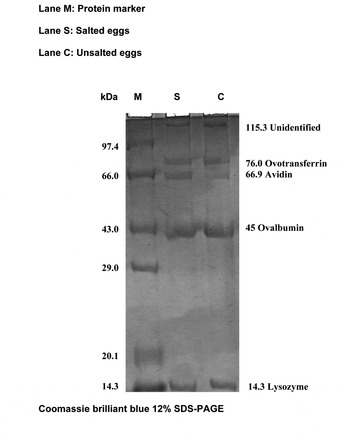
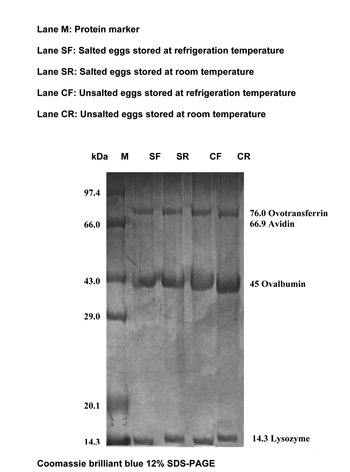
The effect of storage on protein fractions of chicken egg albumen determined through paper electrophoresis has been reported by Sachdev (Reference SACHDEV1974) but no effect of salting was found in these studies. Marandi (Reference MARANDI2007) studied the protein profile through SDS-PAGE and found an ‘Avidin’ band in all the fresh salted or untreated eggs. However, its weak presence, indicative of better protein quality, continued only in the samples from salted eggs stored for five days under refrigeration temperature (Figures 1and 2).
Albumen protein fractions of freshly processed salted egg.

Albumen protein fractions of salted and unsalted chicken eggs of 5th day of room as well as refrigerated storage.

yolk quality
Differences in the salt and nitrogen content, composition of lipid and storage stability of chicken salted egg yolk from both conventional and immersion methods have been compared (Peh et al., Reference PEH, CHANG and LI1982). A higher salt concentration in the immersion solution or coating paste resulted in higher penetration rate of salt into the egg yolk. Chiang and Chung (Reference CHIANG and CHUNG1986) reported that the egg yolk become watery and did not attain desirable characteristics after brining. Woodward (Reference WOODWARD1988) collected information on the texture of cooked egg yolk as influenced by physical manipulation of raw egg yolk and brining of shell eggs. The physical-chemical properties of salted egg yolk during granulation or gelation process were studied by Wang, (Reference WANG1991). Manufacture of salted hen yolk from fresh hen yolk was also reported by (Wang, Reference WANG1992). In practise, the salted egg yolk, a traditional Chinese product, is commonly consumed with rice gruel for breakfast and is widely used for bakery products like- Chinese tamale (Anonymous, Reference ANONYMOUS2004).
Yolk colour is an important quality trait influencing consumer acceptance. Discoloration of the yolk surface of hard-cooked eggs is due to the formation of ferrous-sulphide produced at the interface of the yolk and the albumen. Iron from the yolk reacts with hydrogen sulphide from the albumen. The severity of the discoloration can be influenced by cooking temperature, cooking time, pH of the yolk, and storage time before cooking (Stadleman and Cotterill, Reference STADLEMAN and COTTERILL2002). Yolk indices for salted, fresh and stored chicken eggs were reportedly (Marandi, Reference MARANDI2007) superior over the unsalted group. Saltiness score in yolk of brined eggs was significantly higher than untreated ones, kept under ambient and refrigerated temperatures. Interestingly, the yolk saltiness gradually increased during the storage period (Marandi, Reference MARANDI2007) which could be due to loss of moisture from stored eggs.
While studying the egg yolk omega-6 and omega-3 fatty acids levels, antioxidant status, and ex vivo eicosanoid production in chick cardiac tissue, Bautista-Ortega et al. (Reference BAUTISTA-ORTEGA, GOEGER and CHERIAN2009) reported changes induced in egg yolk n-3 FA increased tissue n-3 FA without affecting hatchability. However, no such changes in brined eggs could be seen.
functional properties
Watanabe et al. (Reference WATANABE, HAYAKAWA, MATSUDA and NAKAMURA1986) investigated the heat-induced aggregation of whole egg proteins through various treatment combinations ranging from 70–85°C, pH 2.0–9.0, and table salt concentrations of 0–3%, by using multiple regression analysis and vertical flat-sheet polyacrylamide gel electrophoresis. The importance of single variables was in the order of temperature, pH and NaCl concentration, and the combined variable of pH and NaCl had a highly significant (p<0.001) effect on soluble protein content. From the fractional and step-wise aggregation appearances of whole egg proteins in the electrophoretic patterns, the heat stability of major proteins was considered to increase as pH (pH>5) and NaCl concentration increased. Chung and Ferrier (Reference CHUNG and FERRIER1992) determined the emulsifying properties of egg phosvitin dissolved in water and 0.1, 0.5 and 1.0 M NaCl from pH 3 to 10. The change in its emulsifying activity (EA) with pH was small but significant (p<0.05), and emulsion stability (ES) was relatively high (68-73%), except at pH 5 (17%) and 10 (48%). The EA of phosvitin was higher than that of bovine serum albumin (BSA) at pH 3 or 8 and ES was higher than BSA at all pH levels except at pH 5 and 10. Added NaCl decreased in the EA of phosvitin at pH 3 and 10 and decreased the ES between pH 3 and 9. Increased instability of emulsions resulted mainly in coalescence of oil droplets at NaCl ≥ 0.5M. Salt increased the viscosity of phosvitin emulsion only at pH 3 but not at pH > 5. The viscosities of BSA emulsions were higher than those of phosvitin at pH 3, 5 or 8.
While studying the influence of salt content (7-14% of weight) on the rheological behaviour of egg yolk in the temperature range 5-60°C, Ibarz (Reference IBARZ1993) described such rheological behaviour by the power law equation. An increase in the salt content lead to an increase in the consistency index, whereas the flow behaviour index showed a tendency to decrease. The effect of temperature on the consistency was reportedly related by an Arrhenius-type equation in which the activation energy decreased with the increase in salt content. To elucidate the relationship between shyandan yolk formation and NaCl penetration degree, Lai et al. (Reference LAI, CHI and KO1999) brined fresh duck eggs in 26% NaCl and conducted a prolonged brining test for up to 24 weeks. Shyandan yolk was obtained from brine-cured duck shell eggs in 26% NaCl for 4-6 weeks and subsequently heated at 85°C for 90 min. Though NaCl contents for albumen and yolk increased to 14.8 and 8.9%, respectively, during the prolonged test for up to 24 weeks, the R values (NaCl/water × 100) were similar (increased from 0.6 to 21) throughout the brining process. The oil-off ratio of the yolk increased rapidly from 14% to 50% (0-6 weeks) and gradually decreased during the extended brining. Granulation and gelation of yolk appeared in the different stages of the brining process. This study demonstrated the formation of shyandan yolk as determined by the degree of NaCl penetration.
Hatching brined eggs
In a pilot study, Sachdev et al. (Reference SACHDEV, SAXENA, TOMER and RAM2010) hatched the broiler chicks from brined fertile broiler eggs. Hatchability was significantly better during summer month of May as compared to those hatched during winter (October) months. The number of ‘dead in shell’ embryos from salted eggs during winter hatches had more foul smelling aqueous content. This could possibly be due to hygroscopic nature of table salt ultimately deterring the hatchability of brined eggs. Reports had previously been available on hatching brine shrimp (Anonymous, Reference ANONYMOUS2010b) but, no report could be located in the literature on hatching brined chicken/poultry eggs.
Growth performances and carcass quality
Body weights, taken up to five weeks of age, in broiler chicks hatched from brined as well as control (unbrined) eggs indicated better growth of male birds as compared to the females. Chicks from brined eggs were lighter than the control (Saxena et al., Reference SAXENA, SACHDEV, TOMER and RAM2009). Chicks hatched in summer had a lower rate of gain as compared to those reared during winter. The dressed weight, carcass quality traits based on breast, drumstick, thigh, neck, back and giblets’ weight, taken for birds at five weeks age, were comparatively lower for females than the males. Carcass traits for salted chicks were relatively poorer than the untreated ones (Sachdev et al., Reference SACHDEV, SAXENA, TOMER and RAM2009).
Immuno-competence
In a pilot study, the immuno-competence of brined as well as untreated embryonated egg was evaluated (Murugkar, Reference MURUGKAR2009). After standardising an infective dose of a virus as a challenge, 1000 EID50 of the virus was subjected to survivability studies. 100 µl of the viral inoculum was introduced into the embryo and the eggs were incubated. The eggs were screened daily for mortality and the dead embryos were chilled and stored at 4ºC before harvesting. The embryos that were dead within the first 18 hours were assumed to have died due to other contamination and were discarded from the study. The mortality of the embryos was recorded on daily basis and the percentage of embryonic death was calculated. All the live embryonated eggs were chilled after five days. The AAF of the chilled eggs was harvested and the HA titre of the AAF determined, which revealed no effect of salting on the infectivity of avian influenza virus. Such reports are yet to be confirmed through further studies.
Conclusions
Brining eggs has been very old concept of value addition but the technologies used have been quite cumbersome and time consuming. In this review, the available methods of egg brining have been presented and methods of brining and their relative efficacy for various measurements presented. Information regarding brining effects on egg quality, hatchability of brined eggs with post hatch progeny performances including their immuno-competence particularly against common diseases, are available in limited publications and further research is required to elucidate the true value and best method of brining eggs.