1 Introduction
Pre-aspiration is broadly defined as a period of friction between the offset of modal voicing and the closure of a following voiceless obstruent (e.g. Laver Reference Laver1994: 150; Helgason Reference Helgason2002: 9; Silverman Reference Silverman2003: 575; Clayton Reference Clayton2010: 7; Gordeeva & Scobbie Reference Gordeeva, Scobbie, Fuchs, Toda and Żygis2010). Although it is said to be a phonemic feature that cues a phonological contrast and precedes voiceless plosives in a relatively small number of languages (e.g. Icelandic, see Nance & Stuart-Smith Reference Nance and Stuart-Smith2013 for an overview), pre-aspiration is also found as a variable feature in a number of other languages and can be influenced by linguistic and extra-linguistic factors. In particular, recent work has shown that it is a feature of many varieties of English in Scotland (Gordeeva & Scobbie Reference Gordeeva, Scobbie, Fuchs, Toda and Żygis2010, Clayton Reference Clayton2017), England (Jones & Llamas Reference Jones, Llamas, Solé, Recasens and Romero2003, Watson Reference Watson2007, Hejná & Scanlon Reference Hejná2015, Kettig Reference Kettig2015), Wales (Hejná Reference Hejná2015), and North America (Clayards & Knowles Reference Clayards and Knowles2015).
In the case of Welsh, previous work has suggested that pre-aspiration is a non-obligatory feature of the language before fortis plosives (Ball Reference Ball, Ball and Jones1984, Morris Reference Morris, Meyerhoff, Adachi, Daleszynska and Strycharz2010, Spooner Reference Spooner2016, Iosad Reference Iosad, Botma and van Oostendorpforthcoming) but there has been no work which systematically examines this feature. The aim of this small-scale study, therefore, is to investigate pre-aspiration in the Welsh spoken in Bethesda (Gwynedd, north Wales) and the extent to which it is influenced by linguistic and extra-linguistic factors. Specifically, we present an analysis of fortis and lenis tokens (the latter of which are variably voiceless in Welsh, see Ball Reference Ball, Ball and Jones1984: 18) and investigate (i) the frequency with which pre-aspiration occurs in the data, (ii) the duration of pre-aspiration and (iii) the noisiness of pre-aspiration using the band-pass filtered zero crossing rate measurement (BP ZCR; Gordeeva & Scobbie Reference Gordeeva, Scobbie, Fuchs, Toda and Żygis2010, Nance & Stuart-Smith Reference Nance and Stuart-Smith2013).
1.1 Defining pre-aspiration preceding plosives
The friction which characterises pre-aspiration (Helgason Reference Helgason2002: 9) has been described as a turbulent flow of air passing through the glottis and occurs as a result of glottal abduction (following the end of modal voicing of the vowel) prior to closure of the following voiceless plosive (Ladefoged & Maddieson Reference Ladefoged and Maddieson1996). The abduction of the glottis results in a period of breathy voice prior to the offset of voicing and period of voiceless pre-aspiration. Breathy voice and pre-aspiration have been shown to be sensitive to different prosodic and segmental factors and might therefore be treated as separate phenomena (Kingston Reference Kingston, Kingston and Beckman1990, Hejná Reference Hejná2015). Breathiness has, however, also been shown to be an important cue in the perception of pre-aspiration (Ní Chasaide Reference Ní Chasaide1985). The majority of studies therefore adopt a broader definition of pre-aspiration which includes both the period of breathy voice at the offset of modal voicing and the following period of voiceless pre-aspiration (Helgason Reference Helgason, Solé, Recasens and Romero2003; Helgason & Ringen Reference Helgason and Ringen2008; Stevens Reference Stevens, Schötz and Ambrazaitis2010, Reference Stevens and Alvord2011; Karlsson & Svantesson Reference Karlsson and Svantesson2011; Nance & Stuart-Smith Reference Nance and Stuart-Smith2013; Ringen & van Dommelen Reference Ringen and van Dommelen2013).
1.2 Fortis and lenis plosives in Welsh
Welsh has both fortis (/p t k/) and lenis (/b d ɡ/) consonants which may appear word-initially, word-medially, or word-finally. The fortis series are typically voiceless and aspirated whereas the lenis series are thought to be variably voiced and unaspirated (Hannahs Reference Hannahs2013: 15). Jones (Reference Jones, Ball and Jones1984: 41) notes that ‘[the lenis series] are regularly unvoiced in word initial and final positions… and frequently so in a medial fully voiced environment’.
Devoicing of lenis plosives is found as a regular phonological process in Welsh. This is known as provection. Hannahs (Reference Hannahs2013: 150–154) distinguishes between two types of provection. The first type occurs at morpheme boundaries and in the formation of compounding and is reflected orthographically (e.g. gwlyb /gwlɨːb/ ‘wet’ > gwlypaf /ɡwləppav/ ‘wettest’). The second type of provection affects lenis plosives in certain south-eastern varieties of Welsh and is affected by word position and stress (this is known as calediad in Welsh, see Thomas Reference Thomas and Ball1988). In such varieties, voiced obstruents are said to become voiceless following a stressed vowel and preceding another vowel or sonorant (e.g. cegin /keːkɪn/ ‘kitchen’, see Awbery Reference Awbery, Ball and Jones1984: 69; Hannahs Reference Hannahs2013: 151).
In addition to post-aspiration, fortis consonants in word-medial position are also considered to be geminated. This occurs when voiced obstruents lengthen following a penultimate stressed vowel (e.g. hapus /happɨs/ ‘happy’, see Ball & Williams Reference Ball and Williams2001: 25; Hannahs Reference Hannahs2013: 21). In northern varieties of Welsh (unlike in southern varieties), the penultimate stressed vowel is invariably short preceding both fortis and lenis consonants (Awbery Reference Awbery, Ball and Jones1984: 75). It is not known, however, whether there are differences between the duration of fortis plosives and voiceless lenis plosives in word-medial positions. In the context of the current research, it is important to ascertain whether there are differences between the duration of the voiceless fortis and lenis consonants in order to ensure that any differences found in the production of pre-aspiration between the two series are not linked to consonant duration. We therefore examine this further in Section 3.1.
There are few acoustic studies of voicing in other varieties of Welsh and, in particular, northern varieties where the second type of provection referred to above does not occur. Consequently, it remains to be seen to what extent lenis plosives are voiced, whether voiceless lenis plosives in word-medial position are geminates, and to what extent pre-aspiration occurs in voiceless lenis plosives. We consider these questions in this paper in order to provide a more detailed account of pre-aspiration in Bethesda Welsh.
1.3 Pre-aspiration in Welsh
Ball (Reference Ball, Ball and Jones1984: 18) first suggested the presence of pre-aspiration in Welsh in an analysis of Voice Onset Time. Morris (Reference Morris, Meyerhoff, Adachi, Daleszynska and Strycharz2010) examined the frequency and duration of pre-aspiration before /p/, /t/, and /k/ in the speech of four Welsh–English bilinguals from different areas of north Wales. In this preliminary study, based on 119 Welsh tokens and 49 English tokens, he found that 60.5% (n = 72) of the Welsh tokens were pre-aspirated. Similar to the results of previous studies across languages (e.g. Foulkes & Docherty Reference Foulkes, Docherty, Foulkes and Docherty1999a, Helgason et al. Reference Helgason, Solé, Recasens and Romero2003, Gordeeva & Scobbie Reference Gordeeva and Scobbie2007, Watson Reference Watson2007, Clayton Reference Clayton2017), he reports more frequent productions and longer duration of pre-aspirated tokens among female speakers (Morris Reference Morris, Meyerhoff, Adachi, Daleszynska and Strycharz2010: 7). This, he suggests, may be either due to physiological reasons (for more details see e.g. Helgason Reference Helgason2002: 229–231) or because his female participants were more regular users of Welsh (Morris Reference Morris, Meyerhoff, Adachi, Daleszynska and Strycharz2010: 16). More recently, both Iosad (Reference Iosad, Botma and van Oostendorpforthcoming) and Spooner (Reference Spooner2016) have investigated the devoicing of plosives following stressed vowels in south-eastern dialects of Welsh. In both these studies, pre-aspiration was noted as being a feature of fortis plosives.
Pre-aspiration has also been found in an in-depth study of Welsh English in Aberystwyth (mid Wales). Hejná (Reference Hejná2015) reported that pre-aspiration was on the whole a variable feature subject to both linguistic and extra-linguistic influences. Firstly, pre-aspiration was found to be near categorical only in the youngest speakers (98% in the data elicited from the youngest speaker, who was 24 years old in 2013). Secondly, although differences were found in the frequency of pre-aspiration between older female and male speakers, no such differences were found in the speech of the younger speakers (Hejná Reference Hejná2015: 261). These findings are highly relevant for a study of Welsh pre-aspiration in light of the fact that all of the participants were Welsh–English bilinguals and that linguistic features from Welsh are known to influence Welsh English either as substrate features or due to transfer in the speech of bilingual speakers (Wells Reference Wells1982: 351; Thomas Reference Thomas and Burchfield1994, Reference Thomas and Tristram1997; Mees & Collins Reference Mees, Collins, Foulkes and Docherty1999: 185–186; Paulasto Reference Paulasto2006). A number of linguistic factors have also been reported by Hejná (Reference Hejná2015): pre-aspiration and breathiness occurrence and duration are sensitive to the phonological length of the vowel, its phonological height, the place of articulation of the post-tonic obstruent, the manner of articulation of the post-tonic obstruent, and also stress.
1.4 Research questions
In order to provide a detailed account of pre-aspiration in Bethesda Welsh, we address the following research questions:
RQ1: Is pre-aspiration before fortis plosives a feature of the Welsh spoken in Bethesda, and can it also occur in the lenis plosives?
RQ2: To what extent do linguistic factors influence the presence of pre-aspiration, its duration and its noisiness, and do they do so in the ways reported for pre-aspiration in other languages?
RQ3: To what extent do extra-linguistic factors (speaker sex and home language) influence the presence of pre-aspiration, its duration and its noisiness, and how does this correspond to previous studies of sociophonetic variation in Welsh?
2 Community and methodology
2.1 Community
The data were collected as part of a wider study which compared phonetic and phonological variation in north-west and north-east Wales (Morris Reference Morris2013). The aim of that study was to examine the influence of linguistic factors as well as speaker sex, home language, and speech context (wordlist versus sociolinguistic interview) on the production of /r/ and /l/ in both the English and Welsh of bilingual speakers. It also compared differences in speech production between an area where Welsh is spoken by the majority of the local population (in the north west) and an area where English is the dominant community language (in the north east).
The decision to analyse a subset of these data was taken in order to reduce the extra-linguistic variables (namely speech context and area) in the analysis (see Section 2.3 below). Our aim in this study is to focus on the descriptive analysis of a linguistic feature of which there is very little previous description in an area which has not been considered in previous acoustic work. Indeed, there are very few acoustic descriptions of northern varieties of Welsh more generally (see Ball Reference Ball, Ball and Jones1981 for a review of earlier work; Morris Reference Morris2013, Cooper Reference Cooper2015). In order to achieve this aim, we do not address areal, contextual, or cross-linguistic variation so that (i) comparisons can be made with similar studies of pre-aspiration across languages and (ii) further community-specific studies can build on this work in order to ascertain the extent to which pre-aspiration is a linguistic feature between different varieties of Welsh.
The subset analysed in the current study come from the Welsh wordlist data elicited from 16 Welsh–English bilinguals from the town of Bethesda, north-west Wales. The town is located in Gwynedd, the county with the highest proportion of Welsh speakers, where 77.5% (n = 3501) of the population of the town speak the language (Welsh Language Commissioner 2016). In light of our aims to control for possible areal variation and concentrate on one community (see above), Bethesda was chosen because the site of data collection (a local high school) did not have a large catchment area in comparison to other towns included in the corpus. Consequently, the speakers included in the dataset all lived in Bethesda or one of the surrounding villages.
2.2 Speakers
Speakers were aged between 16 and 18 years old at the time of collection. As stated above, speakers were recruited from a high school which serves the local area and all speakers had been born in Bethesda and the surrounding area or had moved there before starting formal education. At the high school, both pupils from Welsh-speaking and non-Welsh-speaking homes are taught together primarily in Welsh. The majority of pupils at the school come from Welsh-speaking homes. The sample of 16 speakers was stratified equally according to sex and home language (Welsh or English). This yielded four speakers per cell.
2.3 The wordlist
The decision to include wordlist data has consequences given the emphasis in variationist sociolinguistics on vernacular speech. However, the comparison of sociolinguistic interview and wordlist data as a proxy for level of formality is in itself problematic (e.g. Coupland Reference DiCanio1980). As stated in Section 2.1, the current study includes only wordlist data in order to minimise any potential effects of contextual variation while examining the influence of linguistic factors and the extra-linguistic factors of sex and home language.
The wordlist contained a total of 200 words which were presented on a laminated sheet of A4 paper without a carrier phrase. Of these 200 words, 55 unique words which contained a plosive were presented. We extracted and analysed each token which contained a plosive, including some instances where either intentionally (n = 32) or unintentionally (n = 2) participants repeated the same word twice, (n = 34). This yielded 914 tokens. A total of 39 tokens were excluded as we were unable to make reliable acoustic measurements. This meant that a total of 875 tokens were included in the initial analysis (see Section 3.1).
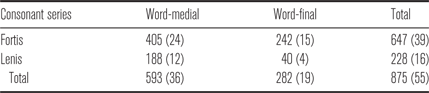
Number of tokens (and unique words) in each word position in the fortis and lenis series.

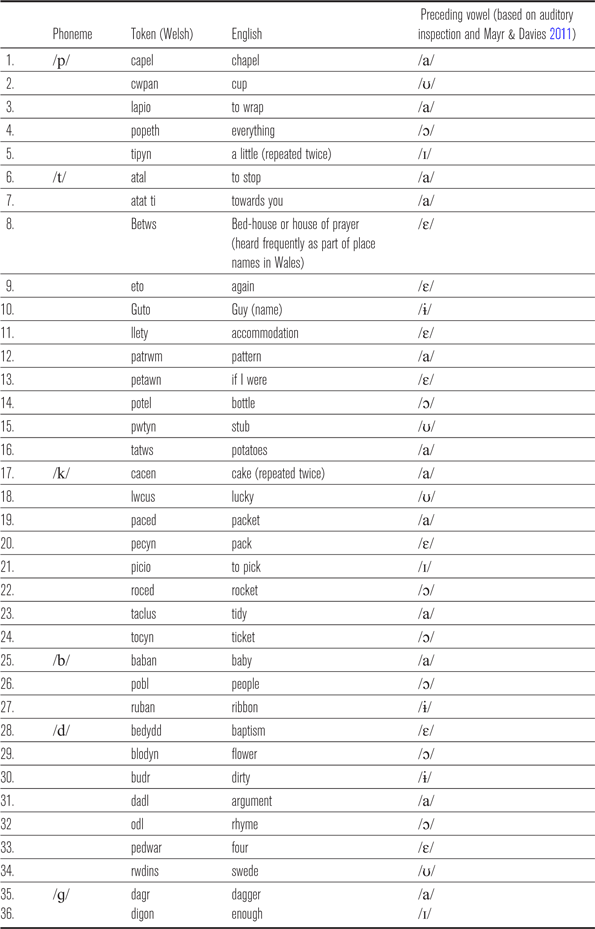
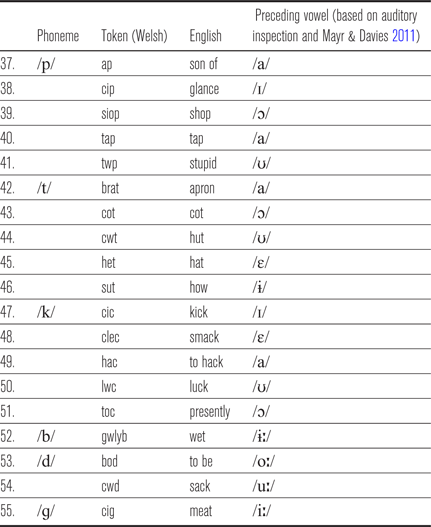
Table 1 shows the number of tokens and the number of unique words (in brackets) for each word position in the fortis and lenis series. Table A1 and A2 in the appendix show the full list of words included in the current study.
The word-medial tokens were all disyllabic and the word-final tokens were all monosyllabic. With some exceptions, stress falls on the penultimate syllable in Welsh (Hannahs Reference Hannahs2013: 41) and therefore all of the plosives analysed for the current study occurred in stressed syllables.
Although all lenis and fortis plosives are permissible word-medially and word-finally (Awbery Reference Awbery, Ball and Jones1984: 81), the wordlist did not contain equal numbers of tokens containing /p t k b d ɡ/ in these word positions. In order to improve the statistical modelling, we grouped the plosives according to bilabial (n = 201), coronal (n = 418) and velar places of articulation (n = 256), whilst also keeping the variable of consonant series (fortis and lenis).
All of the tokens in the dataset contain monophthongs. Following Mayr & Davies (Reference Mayr and Davies2011), the monophthong inventory for northern Welsh can be broadly described in terms of the short vowels /ɪ ɨ ʊ ɛ ə ɔ a/ and the long vowels /iː ɨː uː eː oː aː/. Note that the unpaired /ə/ vowel can appear in stressed syllables but does not occur in monosyllabic content words (Hannahs Reference Hannahs2013: 26). In monosyllabic (stressed) words, vowels are phonologically short preceding fortis plosives and long preceding lenis plosives (Awbery Reference Awbery, Ball and Jones1984: 66). In north-west Wales, stressed penultimate syllables (such as those found in the wordlist) are always short. This differs from southern dialects (where short vowels are found before fortis plosives and long vowels are found before lenis plosives) and central and north-eastern areas where variation between long and short vowels is thought to occur (see Awbery Reference Awbery, Ball and Jones1984 for an overview). The wordlist did not contain an equal number of tokens for each vowel category. For instance, some vowel categories appeared in more words than others, there are no examples of plosives following /ə/ in the dataset, and only monosyllabic tokens containing lenis plosives were preceded by long vowels.
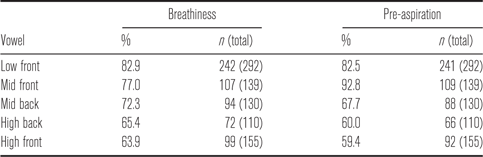
In order to improve the robustness of the statistical modelling and in light of the results showing correlations between vowel height and backness with pre-aspiration (see Section 2.6), we grouped some vowels together for the analysis. The vowel categories included in the analysis were high front (/ɪ ɨ iː/), mid front (/ɛ/), low front (/a/), high back (/uː ʊ/), and mid back (/ɔ oː/). Vowel duration was analysed as a separate factor in the analyses (see Section 2.6). The total number of tokens in each vowel category are shown in Table 3 in Section 3.2.
2.4 Data collection
Data were collected in a quiet room on school premises. Participants were asked to read each word clearly at a natural speed. Participants were recorded reading the wordlist using a Zoom H2 recorder attached to an omnidirectional Audio-Technica Lavalier (lapel) microphone with 50–18,000 Hz frequency response and −54 dB sensitivity. All sessions were recorded in WAV format with a sampling frequency of 44.1 KHz and 16-bit quantisation. The recording of the wordlist took place following a sociolinguistic interview in Welsh (see 2.1 above) and lasted on average seven minutes. Data were transferred to a laptop computer and transcribed using ELAN (Sloetjes & Wittenburg Reference Sloetjes and Wittenburg2008).
2.5 Acoustic analysis
We report our results separately for the two components traditionally assumed to form pre-aspiration in a broader sense: voiced breathiness and voiceless pre-aspiration (see Ní Chasaide Reference Ní Chasaide1985; Nance & Stuart-Smith Reference Nance and Stuart-Smith2013; Hejná Reference Hejná2015, Reference Hejná2016). This decision was taken as previous work has shown that pre-aspiration and breathiness may show differences in phonetic and phonological conditioning (see Section 1.1). Indeed, this was found to be the case in our data (see Section 3.3).
This paper focuses on three aspects of breathiness and pre-aspiration: frequency of occurrence, duration, and noisiness. Acoustic analyses were conducted in Praat (Boersma & Weenink Reference Boersma and Weenink2015).
We decided to include lenis tokens in our analysis due to previous claims that voicing is a variable feature of lenis plosives in Welsh (see Section 1.2). In order to examine pre-aspiration before lenis plosives, we coded each token for voicing by visually inspecting the spectrogram and took voicing duration measurements (not reported here). The results of this analysis are included in Section 3.1.
2.5.1 Identifying breathiness and pre-aspiration
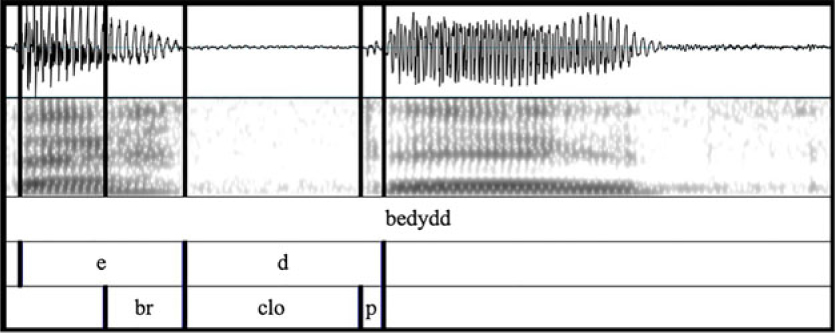
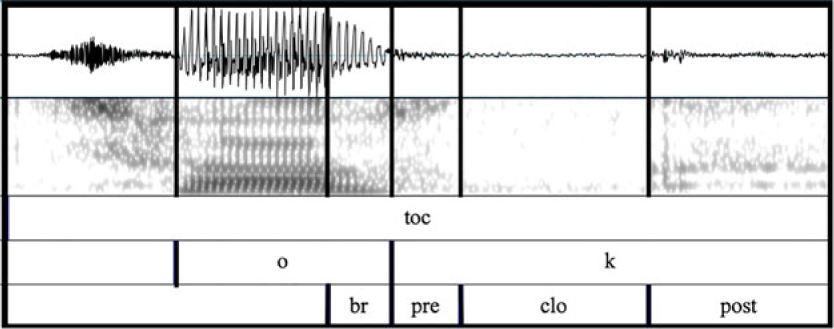
Each token was segmented and labelled as shown in Figures 1 and 2. The start of the preceding vowel was labelled at the onset of modal voicing. Breathiness (if applicable) was identified by a change to a quasi-sinusoidal waveform following the offset of modal voicing for the vowel and the onset of glottal friction as the glottis abducts (Nance & Stuart-Smith Reference Nance and Stuart-Smith2013: 130). The onset of pre-aspiration (if applicable) was marked at the point where voicing ceased, leaving voiceless glottal friction in the higher frequency portion of the spectrogram. The end of pre-aspiration was labelled at the end of glottal friction for the closure of the plosive. The end of the closure was labelled at the point of the plosive release.
Example of the identification and segmentation of a token in word-medial position showing breathiness; br = breathiness; clo = closure; p = post-aspiration.

Example of the identification and segmentation of a token in word-final position showing breathiness and pre-aspiration; br = breathiness; pre = pre-aspiration; clo = closure; post = post-aspiration.

2.5.2 Quantifying breathiness and pre-aspiration
The analyses of duration are based on non-normalised durational data (ms). We originally used normalised data (obtained by converting the duration of pre-aspiration into the percentage of the word duration) in the statistical modelling. The normalised data proved problematic, however, when comparing differences between pre-aspiration in word-medial and word-final contexts. Having compared the speech rate of participants impressionistically, we concluded that including non-normalised data in the final analysis would lead to more accurate results (see also Nance & Stuart-Smith Reference Nance and Stuart-Smith2013: 134). Durational measurements for both the preceding vowel and closure prior to the plosive release were extracted and included in the statistical modelling (see Section 2.6).
A relatively new measure, band-pass filtered zero crossing rate (BP ZCR), has been used in recent studies in order to measure the noisiness of breathiness and pre-aspiration (Gordeeva & Scobbie Reference Gordeeva, Scobbie, Fuchs, Toda and Żygis2010, Nance & Stuart-Smith Reference Nance and Stuart-Smith2013). BP ZCR calculates how many times per second the sound wave in a band-pass filtered signal crosses a certain point (zero point) in both periodic and aperiodic periods of aspiration (Nance & Stuart-Smith Reference Nance and Stuart-Smith2013: 147). The measure gives the mean zero-crossings per second: the noisier a period of breathiness or pre-aspiration is, the more frequently the wave crosses zero within a time interval. This mid-frequency noise is an important cue for the perception of breathiness and pre-aspiration before voiceless plosives (Nance & Stuart-Smith Reference Nance and Stuart-Smith2013: 130). The durational and BP ZCR measures were extracted with scripts designed by Shigeto Kawahara (modified by James Kirby and Wendell Kimper) and Olga Gordeeva, after the manual segmentation of the material.
2.6 Statistical analysis
For the statistical analyses of the presence of breathiness and pre-aspiration (a categorical dependent variable), mixed effects logistic regression analyses were conducted. For the analyses of duration and BP ZCR (continuous variables), we used mixed effects linear regression analyses. All statistical modelling was carried out using the lme4 (Bates et al. Reference Bates, Maechler, Bolker and Walker2015), lmerTest (Kuznetsova Reference Kuznetsova2015), and Effects (Fox et al. Reference Fox, Weisberg, Friendly, Hong, Andersen, Firth and Taylor2016) packages for R (R Development Core Team 2015) in RStudio (2015). Mixed effects modelling was chosen primarily as models can (i) deal with both binary and continuous data, (ii) consider random effects such as speaker or item, and (iii) are relatively robust when dealing with unbalanced datasets (see e.g. Baayen Reference Baayen2008).
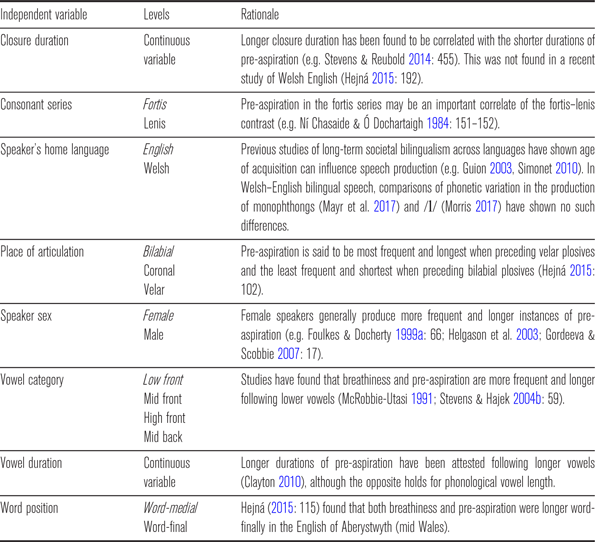
Table 2 shows the independent variables included in each analysis. Italicised factor levels indicate the level taken to be the baseline. A step-up approach to the statistical modelling was taken whereby variables were added to the model and discarded if they did not significantly improve the model fit. Similarly, interactions were added to the model and removed if they did not result in an improved model. The models were compared using log-likelihood tests and deemed to be improved when there was a significant difference between the models and a reduction in the model deviance. In each model, speaker and lexeme were treated as random intercepts. We also attempted to add word, closure duration and vowel duration as random slopes in the analyses but these models failed to converge. The final (and best-fitting) models, along with the factors included in those models, are reported in Section 3 and can be found in Tables A3–A8 in the appendix.
Independent variables considered in the statistical modelling.

3 Results
In the following section, we address the extent to which voicing was found between the fortis and lenis plosives in both word-medial and word-final positions. We then examine the frequency of occurrence, duration, and BP ZCR measurements of breathiness and pre-aspiration.
3.1 Presence of voicing in the dataset
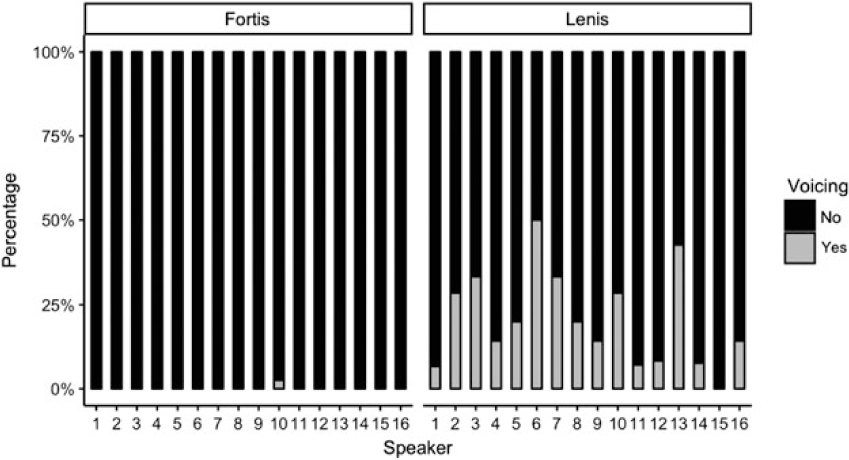
We firstly examined the presence of partial or full voicing in the production of the plosive (see Section 1.2). Of the 875 tokens, partial voicing of the plosive was found in 21.1% (n = 48/228 n = 48/228) of the lenis tokens and in 0.15% of fortis tokens (n = 1/647). There were no instances of fully voiced plosives. Unsurprisingly, there were no instances of either breathiness or pre-aspiration in tokens where voicing was found in the consonant. Voiced examples of lenis tokens were found in the speech of all speakers with the exception of one. Figure 3 shows the percentage of voiced and unvoiced tokens in the fortis and lenis series for individual speakers.
Percentage of voiced and voiceless tokens in fortis and lenis contexts by individual speaker (n = 875).

We also examined whether the presence of voicing is affected by the place of articulation of the lenis consonant: bilabial, coronal, and velar. The results of a Pearson’s Chi-square test suggest that there is no significant difference between the presence of voicing in bilabial and coronal plosives (χ 2(1,n = 197) = .01, p = .93). The differences between bilabial and velar plosives (χ 2(1,n = 88) = 1.09, p = .30) and coronal and velar plosives (χ 2(1,n = 175) = 1.03, p = .31) were also found not to be significant (Yates’ correction for continuity was used in the latter two tests as there were four instances of voiced velar lenis plosives).
We did not include voiced tokens in the following analyses, which are based on tokens which contained an unvoiced plosive (n = 826). The reasons for this were that voiced tokens were relatively infrequent, appeared in most speakers’ data, and were not sensitive to place of articulation effects regarding the frequency of application. Voiceless lenis tokens (n = 180) appeared in both word-medial contexts between vowels and word-finally.
In order to assess whether there were differences in length between the fortis and lenis series, particularly in word-medial position where fortis plosives are expected to be geminated (see Section 1.2), we conducted independent samples t-tests on the voiceless plosives in word-medial contexts and word-final contexts. In word-medial contexts, there was no significant difference between the duration of fortis (M = 409.29 ms, SD = 86.70) and lenis plosives (M = 414.03 ms, SD = 71.7, p = .57). In word-final contexts, there was also no significant difference between the duration of fortis (M = 248.28 ms, SD = 69.68) and lenis plosives (M = 248.48 ms, SD = 61.17, p = .91). This suggests that any differences found between fortis and lenis plosives in word-medial and word-final contexts will not be due to durational differences between the two series.Footnote 1
3.2 Frequency of breathiness and pre-aspiration
In the subset of tokens which did not contain a phonetically voiced plosive (n = 826), a period of breathiness was found in 74.3% (n = 614/826) of tokens. Pre-aspiration was found in 72.2% (n = 596/826) of tokens. Of the total number of unvoiced tokens, 66.2% (n = 547/826) contained both breathiness and pre-aspiration.
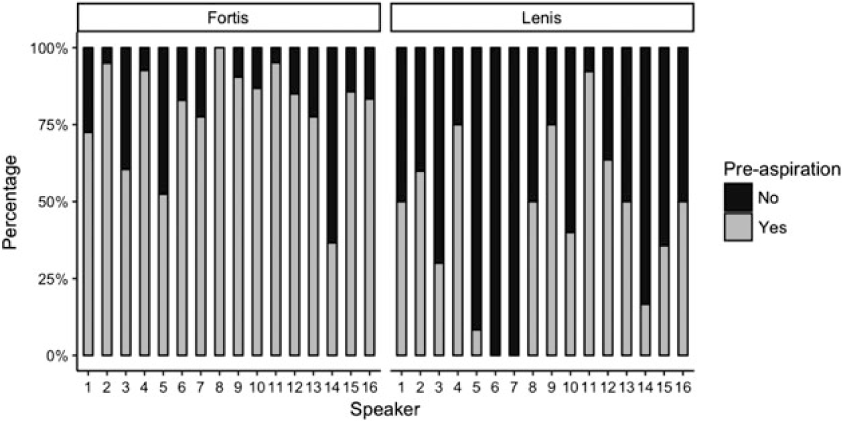
In the same subset of tokens which did not contain a voiced plosive, a period of breathiness was found in 79.6% (n = 514/646) of the fortis tokens compared to 55.6% (n = 100/180) of lenis tokens. Pre-aspiration was found in 79.7% (n = 515/646) of the fortis tokens compared to 44.5% (n = 81/180) of the lenis tokens. The data from individual speakers show that pre-aspiration is a variable feature preceding voiceless fortis plosives for all speakers, with the exception of Speaker 8, who pre-aspirated all fortis tokens (n = 40). Pre-aspiration preceding lenis tokens was found in the speech of all participants with the exception of Speakers 6 and 7. Figure 4 shows the percentage of pre-aspirated and non-pre-aspirated tokens in voiceless fortis and lenis contexts for individual speakers.
Percentage of pre-aspirated and non-pre-aspirated tokens in voiceless fortis and lenis contexts by individual speaker (n = 826).

The effects of linguistic and extra-linguistic factors on the presence of (i) breathiness and (ii) pre-aspiration were examined using mixed effects logistic regression modelling (see Section 2.6). Separate models were run with either breathiness or pre-aspiration as response variables and, in each model, both speaker and lexeme were coded as random factors. The response variables tested were speaker sex, home language, preceding vowel, place of articulation, consonant series, word position, vowel duration (ms) and closure duration (ms). The best-fitting models for both breathiness and pre-aspiration contained preceding vowel, place of articulation, consonant series, and speaker sex as predictor variables. An interaction between place of articulation and consonant series was retained in the final models. These factors were not found to be significant but significantly improved the model fit for both breathiness (χ 2(5) = 33.75, p < .001) and pre-aspiration (χ 2(5) = 59.02, p < .001) when compared using log-likelihood tests (see Section 2.6). As there was no breathiness or pre-aspiration in the phonetically voiced tokens, and due to the fact that voiced tokens appeared with relatively low frequency in the speech of most participants, they were not included in the models. The total number of tokens included in the statistical modelling was 826.
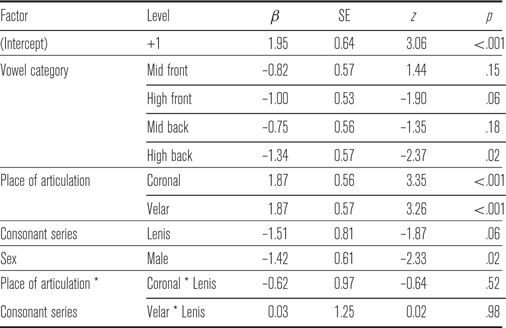
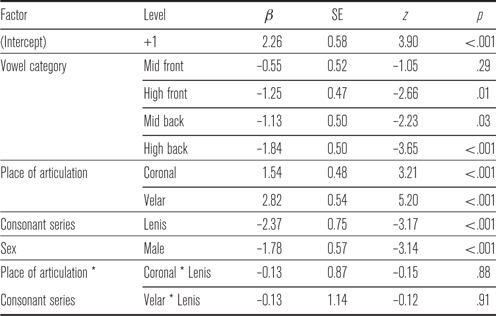
The full results of the statistical modelling can be seen in Tables A3 and Tables A4 in the appendix. Consonant series was not found to be a significant predictor on the presence of breathiness at an alpha level of .05 (β = −1.51, z = −1.87, p = .06). Pre-aspiration, however, was less likely to be found before voiceless lenis plosives than before fortis plosives (β = −2.37, z = −3.17, p < .001).
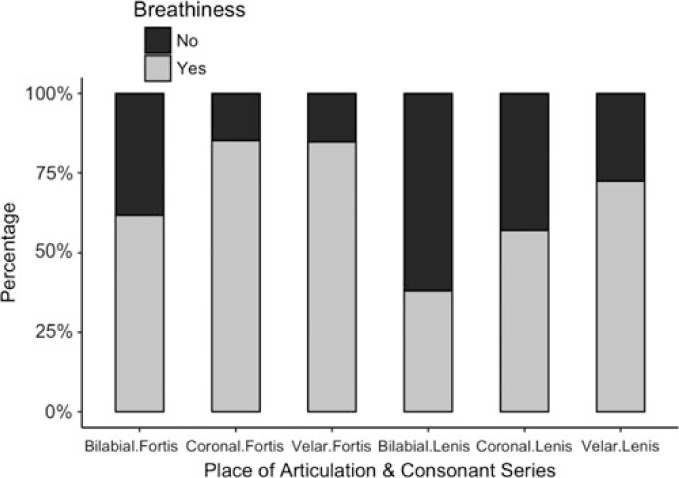
In addition to consonant series, place of articulation was found to be a significant predictor. Breathiness was more likely to be present before both coronal (β = 1.87, z = 3.35, p < .001) and velar plosives (β = 1.87, z = 3.26, p < .001) than before bilabial plosives. Of the voiceless tokens containing a velar plosive, 83.3% (n = 210/252) contained breathiness compared to 77.2% (n = 298/386) of tokens containing a coronal plosive and 56.4% (n = 106/188) of tokens containing a bilabial plosive.
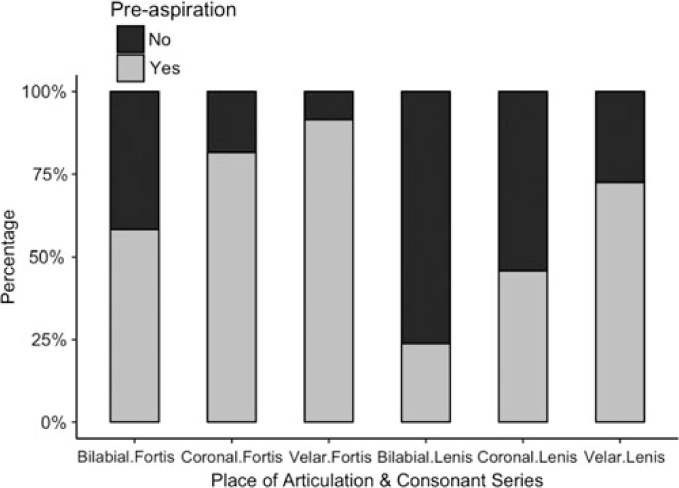
Pre-aspiration was also more likely to be present before coronal (β = 1.54, z = 3.21, p < .001) and velar (β = 2.82, z = 5.2, p < .001) plosives than before bilabial plosives. Of the tokens containing a velar plosive, 89.3% (n = 225/252) contained pre-aspiration compared to 71.5% (n = 276/386) of tokens containing a coronal plosive and 50.5% (n = 95/188) of tokens containing a bilabial plosive. Figures 5 and 6 show the percentage of voiceless tokens found to contain breathiness and pre-aspiration respectively grouped by both consonant series and place of articulation for comparison.
Percentage of breathy and non-breathy voiceless tokens by place of articulation and consonant series (n = 826).

Percentage of pre-aspirated and non-pre-aspirated voiceless tokens by place of articulation and consonant series (n = 826).

The preceding vowel was found to be a significant predictor of both breathiness and pre-aspiration in the models. When compared to low front vowels as the baseline, breathiness was found to be less likely to occur following high back vowels (β = −1.34, z = −2.37, p = .02). Compared to the same baseline vowel category, pre-aspiration was less likely to occur following high front vowels (β = −1.25, z = −2.66, p < .001), mid back vowels (β = −1.13, z = −2.23, p = .03), and high back vowels (β = −1.84, z = −3.65, p < .001). Table 3 shows the percentage of breathy and pre-aspirated voiceless tokens following each vowel category. The fact that breathiness following high front vowels was not found to be significantly less likely than when following low front vowels is slightly surprising given the descriptive data in Table 3. This may be due to the relatively low number of tokens in each vowel category, however, and should be treated with caution.
Percentage and number of breathy and pre-aspirated voiceless tokens by vowel. category (n = 826).

The results of the statistical modelling also suggest that male speakers are less likely to produce breathy (β = −1.42, z = −2.33, p = .02) and pre-aspirated (β = −1.78, z = −3.14, p < .001) tokens. Of the voiceless tokens produced by male speakers, 64.7% (n = 269/416) contained breathiness and 61.8% (n = 257/416) contained pre-aspiration. Of the tokens produced by female speakers, 84.1% (n = 345/410) contained breathiness and 82.7% (n = 339/410) contained pre-aspiration.
3.3 Duration
In order to examine the duration in the dataset, we conducted mixed effects linear analyses on the non-normalised durational measurements for breathiness and pre-aspiration (see Section 2.5.2). Again, we excluded the phonetically voiced tokens (n = 49/875) from the analysis as there were no instances of either breathiness or pre-aspiration. The total number of tokens included in the statistical modelling was 826. As in the models for frequency of occurrence, both speaker and lexeme were added to the models as random intercepts. The predictor variables tested were speaker sex, home language, preceding vowel, place of articulation, consonant series, word position, vowel duration (ms) and closure duration (ms). Interactions between place of articulation, consonant series, closure duration, and preceding vowel were also tested. The final model for breathiness is shown in Table A5 in the appendix. This model contained place of articulation, consonant series, word position and closure duration as predictor variables.
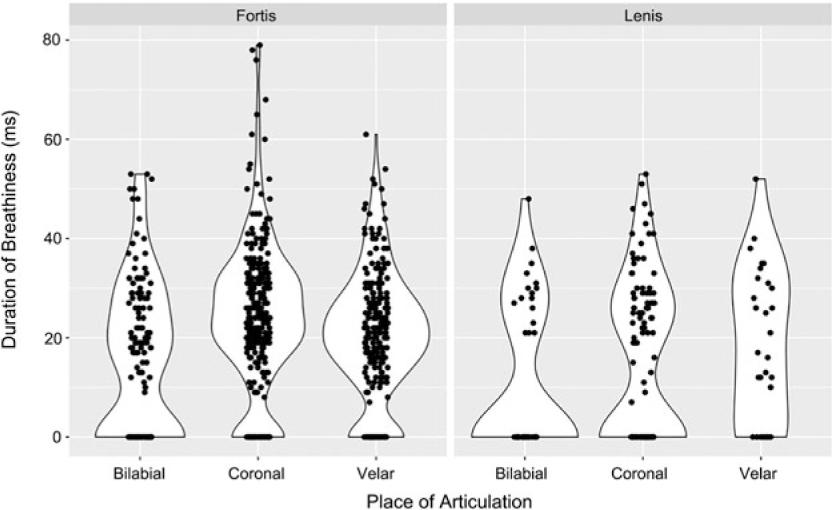
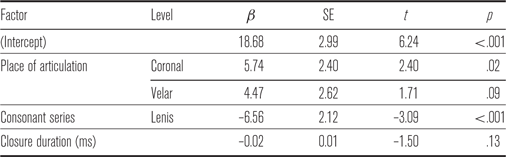
The results of the model indicate that breathiness is more likely to be shorter when followed by a lenis plosive than when followed by a fortis plosive (β = −6.56, t = −3.09, p < .001). The mean duration of breathiness was 21.09 ms (SD = 14.49) preceding fortis plosives compared to 12.26 ms (SD = 15.37) preceding lenis plosives.
Place of articulation is also a significant predictor with breathiness tending to be longer preceding coronals (β = 5.74, t = 2.40, p = .02). The mean duration of breathiness preceding coronals was 21.86 ms (SD = 15.55). For velars, the mean duration of breathiness was 20.49 ms (SD = 12.99). For bilabials, the mean duration of breathiness was 14.86 ms (SD = 15.16). Figure 7 shows the duration of breathiness tokens grouped by consonant series and the place of articulation of the preceding consonant.
Duration of breathiness (ms) by place of articulation and consonant series (n = 826).

The best-fitting model for the duration of pre-aspiration (ms) contained speaker sex, home language, preceding vowel, place of articulation, and consonant series. The full model can be found in Table A6 in the appendix. Interactions were removed during the modelling as they were not found to be significant and did not significantly improve the model fit.
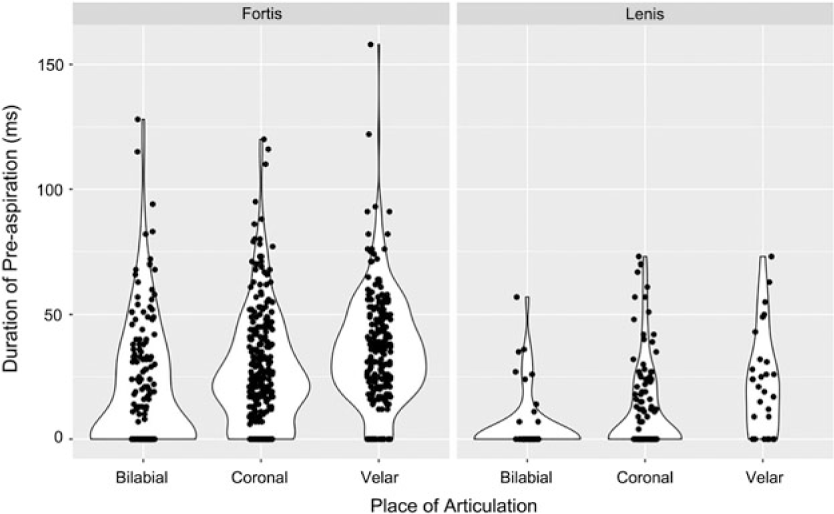
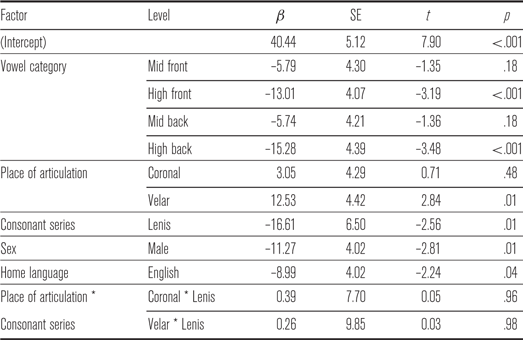
The results indicate that pre-aspiration is more likely to be shorter when followed by a lenis plosive than when followed by a fortis plosive (β = −16.61, t = −2.56, p = .01). The mean duration for fortis tokens was 29.50 ms (SD = 23.9) compared to 12.38 ms (SD = 18.04) for the lenis tokens.
Pre-aspirated tokens in velar contexts were also more likely to be longer compared to bilabial contexts (β = 12.53, t = 2.84, p < .001), which differs from the results for breathiness (see above). The mean duration of pre-aspirated tokens in velar contexts was 34.64 ms (SD = 22.42). The mean pre-aspiration for tokens preceding bilabial plosives was 18.19 ms (SD = 24.27). The mean duration of pre-aspirated tokens in coronal contexts was 23.58 ms (SD = 22.77), although this was not found to be significantly different for the duration of pre-aspiration preceding bilabials. Figure 8 illustrates the mean duration of pre-aspiration (ms) by consonant series and place of articulation.
Duration of pre-aspiration (ms) by place of articulation and consonant series (n = 826).

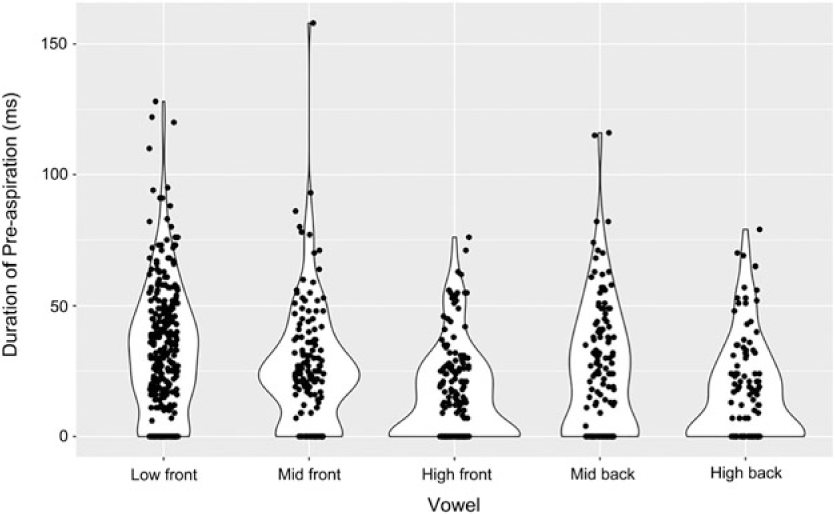
Unlike the results for breathiness, some vowel categories were found to be significant predictors of the duration of pre-aspiration. Specifically, pre-aspiration tended to be shorter following high front vowels (β = −13.01, t = −3.19, p < .001) and high back vowels (β = −15.28, t = −3.48, p < .001). The average duration of pre-aspiration by vowel category is shown in Figure 9.
Duration of pre-aspiration (ms) by vowel category (n = 826).

Male speakers tended to produce shorter instances of pre-aspiration compared to female speakers (β = −11.27, t = −2.81, p = .01). The mean duration of pre-aspiration for male speakers was 20.02 ms (SD = 22.04). For female speakers, the mean duration of pre-aspiration was 31.52 ms (SD = 24.2). Home language was also found to be significant in the statistical modelling, with those from English-speaking homes tending to produce shorter instances of pre-aspiration (β = −8.99, t = −2.24, p = .04). The mean duration of pre-aspiration among those from English-speaking homes was 21.31 ms (SD = 19.45) compared to 30.03 ms (SD = 26.78) among those from Welsh-speaking homes.
3.4 Band-pass filtered zero crossing rate (BP ZCR)
The BP ZCR measurements yield the mean zero-crossings per second split across five equal sections. A series of mixed effects linear analyses were conducted on the BP ZCR measurements. These included analyses of breathiness and pre-aspiration separately, as well as measurements taken from the offset of modal voicing to the plosive closure. In order to aid comparison with the frequency and durational data above, we report the analyses on breathiness and pre-aspiration separately. In line with the previous analyses, the results reported here concern only the phonetically voiceless tokens (n = 826). As we are not concerned with changes to zero-crossing rate over time, we base our analyses on the mean values.
As in the previous models, both speaker and lexeme were added to the models as random intercepts. The response variables tested were speaker sex, home language, preceding vowel, place of articulation, consonant series, word position, vowel duration (ms) and closure duration (ms). Interactions between place of articulation, consonant series, and preceding vowel were also tested. The best-fitting models for both breathiness and pre-aspiration included consonant series, place of articulation, vowel category, and speaker sex.
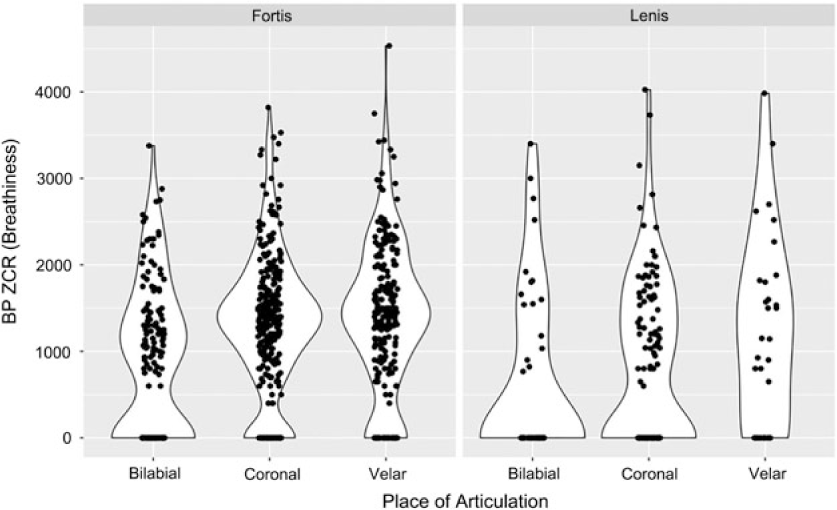
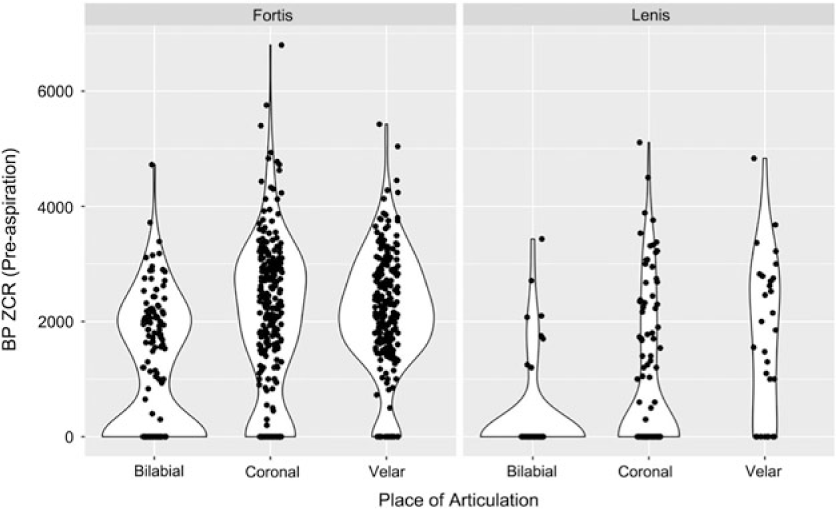
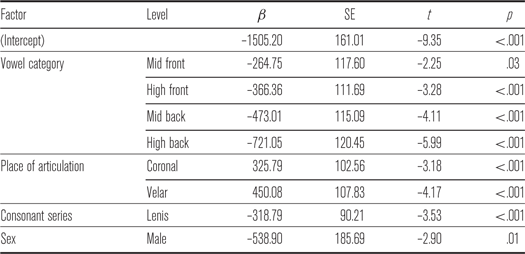
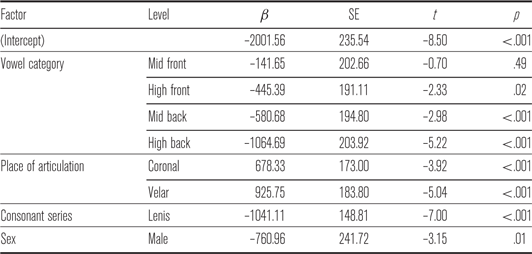
The models suggest that instances of breathiness and pre-aspiration are less noisy when preceding a lenis plosive than when preceding a fortis plosive (see appendix Tables A7 and A8 for coefficients and full models). Both breathiness and pre-aspiration were found to be noisier when preceding coronal plosives and velar plosives when compared to bilabials. Figures 10 and 11 show the BP ZCR measurements by consonant series and place of articulation for breathiness and pre-aspiration respectively.
BP ZCR measurements for breathiness by place of articulation and consonant series (n = 826).

BP ZCR measurements for pre-aspiration by place of articulation and consonant series (n = 826).

Vowel category was also found to be significant for the BP ZCR measurements for both breathiness and pre-aspiration. For breathiness, the mid front, high front, mid back and high back categories were all found to be less noisy when compared to low front vowels. For pre-aspiration, the high front, mid back and high back vowels were found to be less noisy than low front vowels.
Finally, male speakers tended to produce less noisy instances of both breathiness (β = −538.90, t = −2.90, p = .01) and pre-aspiration (β = −760.96, t = −3.148, p < .001).
4 Discussion
The current study aimed to ascertain whether pre-aspiration is a feature of Bethesda Welsh. The results indicate that, for most speakers, it is a variable feature. This section further discusses the frequency of occurrence of pre-aspiration (RQ1) and both the linguistic (RQ2) and extra-linguistic factors (RQ3) which influence its occurrence, duration, and noisiness.
4.1 Frequency of occurrence of pre-aspiration
As stated above, pre-aspiration (both breathiness and voiceless pre-aspiration) appears to be a variable feature and only one of the speakers produced all tokens as pre-aspirated in the fortis series (see Figure 5). Similarly, two speakers produced no pre-aspirated tokens in the lenis series. Pre-aspiration is not generally noted as a feature of the language in descriptions, yet we would argue that our results suggest that it is a feature which should be included in future studies of other dialects. This would allow areal comparisons to be made.
Pre-aspiration was also found in the voiceless lenis tokens though pre-aspirated tokens were significantly less likely in lenis contexts. Although comparisons between the fortis and lenis series are not wholly permissible due to the differing number of tokens, the fact that pre-aspiration was found in lenis plosives is somewhat surprising in light of suggestions that the feature is a consequence of post-aspiration anticipation (e.g. Hejná Reference Hejná2015: 91, 265), and is therefore rare among lenis plosives (which typically lack post-aspiration). However, San Martn Itunyoso Trique (DiCanio Reference DiCanio2012: 252–254) and Scottish Gaelic (Nance & Stuart-Smith Reference Nance and Stuart-Smith2013: 137–139) are notable examples of other languages that have been reported to show pre-aspiration both in the fortis and the lenis series. As the lenis plosives in the Bethesda data are not post-aspirated (despite being phonetically voiceless), anticipatory accounts cannot explain the presence of pre-aspiration in the lenis series in this instance. One possible scenario is that we may be dealing with an analogical extension from the fortis context in languages where pre-aspiration occurs preceding lenis consonants.
The fact that pre-aspiration was less frequent in the context of lenis tokens might suggest that it is a correlate of and possibly a cue to the fortis–lenis contrast in Welsh (as is the case for post-aspiration). Although pre-aspiration functions as a correlate of the fortis-lenis contrast in many pre-aspirating languages and their varieties (see Hejná Reference Hejná2015: Chapter 6 for an overview), the phenomenon is not generally thought to be a particularly salient cue to this contrast (see Hejná & Kimper forthcoming). Furthermore, the fact that pre-aspiration is a variable feature in voiceless fortis and lenis contexts diminishes its potential cue availability (in the sense of MacWhinney Reference MacWhinney and Robinson2001, Reference MacWhinney, Gass and Mackey2012). Further speech perception tasks using controlled stimuli will shed light on this. We would argue however that, as pre-aspiration is found in both contexts, it would be a more ambiguous correlate of the fortis–lenis contrast than post-aspiration, which is found in the fortis series only.
4.2 Linguistic constraints on pre-aspiration
Cross-linguistically, pre-aspiration is subject to a number of linguistic constraints. This study focused on the place of articulation of the plosive and vowel quality in both fortis and lenis contexts. The results were largely consistent for the two components of pre-aspiration (breathiness and voiceless pre-aspiration) although some differences were found and are discussed below.
The results for place of articulation agree with the generally reported effects across languages: the bilabial plosives (/p b/) were associated with the least frequent application of breathiness and pre-aspiration in comparison to the other places of articulation (/ t d/; /k ɡ/). The bilabial plosives also tended to have a shorter duration of breathiness and pre-aspiration, which is in agreement with previous work on pre-aspiration (Ní Chasaide Reference Ní Chasaide1985; Stevens & Hajek Reference Stevens, Hajek, Cassidy, Cox, Mannell and Palethorpe2004a, b; Helgason & Ringen Reference Helgason and Ringen2008; Nance & Stuart-Smith Reference Nance and Stuart-Smith2013; Clayton Reference Clayton2017). One exception is the duration of breathiness, where no differences were found between the bilabial and velar plosives.
Both pre-aspiration and breathiness also tended to be less noisy in the context of bilabial plosives as opposed to coronals and velars. Interestingly, pre-aspiration frequency and duration increase from the most anterior to the most posterior place of articulation in both series (/p b/ > / t d/ > /k ɡ/), which is not the case for breathiness (/p b/ < / t d k ɡ/). It is not clear what the reasons are for the general patterning of bilabials to exhibit the least frequent and the shortest breathiness and pre-aspiration, as well as the least noisy breathiness and pre-aspiration. We suggest that differences in pre-aspiration properties across the different places of articulation may be affected by the articulator mass in contact. The production of post-aspirated /t/ and /k/, especially if also affricated (which is a feature of Welsh and Welsh English, see Wells Reference Wells1982: 388), requires the contact between the two articulators to be greater than in the case of a post-aspirated and unaffricated /p/ (see Kang & Kochetov Reference Kang and Kochetov2010 for an EPG study of Korean plosives and affricates). This would lead us to expect greater differences in pre-aspiration across the places of articulation within the fortis series than in the lenis series, the latter of which is not associated with post-aspiration and affrication. However, at present there are no existing instrumental studies of affrication in Welsh, and testing whether articular mass can explain the patterns found remains to be addressed by future studies.
Previous work has shown that, across languages, low front vowels tend to be associated with more frequent and longer tokens of pre-aspiration as well as breathiness (e.g. Ní Chasaide Reference Ní Chasaide1985, McRobbie-Utasi Reference McRobbie-Utasi1992, Helgason Reference Helgason2002, Stevens & Hajek Reference Stevens, Hajek, Cassidy, Cox, Mannell and Palethorpe2004a, Gordeeva & Scobbie Reference Gordeeva and Scobbie2007). The results from this study are inconclusive with regards to vowel quality. Both breathy and pre-aspirated tokens were less frequent following high back vowels when compared to low front vowels but no other vowel categories were found to be significant. The same holds for the duration of pre-aspiration (though not breathiness, where vowel category was not found to be significant).
Both breathiness and pre-aspiration were also found to be the noisiest with low front vowels in comparison to mid back and high vowels (pre-aspiration and breathiness) and mid front vowels (breathiness only). This positive correlation mirrors previous findings for frequency and duration (see above) though it is somewhat surprising as we would expect noisier friction in the context of high vowels due to the narrower oral constriction (Ohala Reference Ohala2005: 420). It remains to be seen whether the interaction between the oral cavity and the larynx may shed light on why low vowels are associated with the most frequent, longest, and noisiest pre-aspiration in pre-aspirating languages. However, it should also be noted that the upper limit of the filtering in the BP ZCR measurements is at 5500 Hz, which means that friction at higher frequencies (more akin to pre-affrication rather than pre-aspiration) is not taken into consideration. To fully understand the developments of glottal and oral pre-aspiration and pre-affrication, further articulatory studies should examine different states of the larynx associated with the articulation of different vowels and acoustic studies should consider higher frequencies when applying the BP ZCR measure in order to examine these claims further.
4.3 Extra-linguistic constraints on pre-aspiration
Male speakers tended to produce less frequent and less noisy instances of both breathiness and pre-aspiration. Pre-aspiration also tended to be shorter when produced by male speakers although the same is not valid for breathiness. These patterns correspond to the general tendency among women to pre-aspirate more frequently than men and to produce longer instances of pre-aspiration (see e.g. Hejná Reference Hejná2015: Chapter 7), which has often been attributed to vocal-tract differences between men and women (e.g. Helgason Reference Helgason2002). This explanation is far from straightforward, however, especially considering vocal tract measurements are not taken as part of such studies. In addition, some studies have found few differences between male and female speakers’ productions of pre-aspiration (e.g. Stevens Reference Stevens, Schötz and Ambrazaitis2010). Hejná (Reference Hejná2015: 247–248) found no differences between younger adult speakers in her study of Aberystwyth English, which suggests that physiological differences may not be as linked to biological sex as previously assumed, or that physiological differences can be overridden in instances where social factors become more salient. It is therefore unclear whether Welsh pre-aspiration is subject purely to physiological sex differences or also social gender differences.
Recent work on phonological and phonetic variation in this area of Wales has found differences in speech production between male and female speakers for which a more socially-motivated explanation might be more suitable. In his study of (r) variation, Morris (Reference Morris2013) found that female speakers were more likely than male speakers to produce the standard variant of /r/ (the voiced alveolar trill [r] rather than the alveolar approximant [ɹ]) in Welsh speech. Morris (Reference Morris2017) found that female speakers tended to produce lighter realisations of /l/ in Welsh than male speakers (where /l/ is expected to be dark in all syllable positions) but also differentiated to a greater extent than male speakers between their realisations of /l/ in Welsh and English.
A similar claim can be made with regards to the finding that speakers from English-speaking homes were more likely to produce shorter pre-aspiration than those from Welsh-speaking homes (breathiness and frequency and noisiness of pre-aspiration are not affected by home language.). Although previous work across languages has shown clear age of acquisition effects on speech production among bilingual speakers (Piske, Mackay & Flege Reference Piske, Mackay and Flege2001), research on Welsh–English bilingual speech has found home language to be insignificant in the production of monophthongs (Mayr et al. Reference Mayr, Morris, Mennen and Williams2017) and /l/ (Morris Reference Morris2017) in both English and Welsh. Although this might not be surprising given the history of long-term language contact between Welsh and English, significant differences between home-language groups have been found in the production of /r/ in both languages in Gwynedd, and have been attributed to the tendency for linguistic background to be an important marker of peer-group membership in this community (Morris Reference Morris2013).
This suggests that a more socially-oriented explanation for the sex and home language variation found for pre-aspiration should be investigated in further work which considers both the perceptions of this variable among speakers and possible socio-indexical meanings on the one hand, and social structures in the local community on the other hand.
5 Conclusion
This paper investigated pre-aspiration in the Welsh of Bethesda (Gwynedd). Specifically, it sought to examine the frequency, duration, and noisiness of pre-aspiration (both breathiness and voiceless pre-aspiration) in the context of voiceless plosives.
It was shown that pre-aspiration is a variable feature in both fortis and, to a lesser extent, voiceless lenis contexts. The finding that the feature is also present before lenis plosives and the lack of voicing in non-initial contexts in the lenis series has hitherto been unreported.
We found that the presence of pre-aspiration, its duration, and its noisiness was influenced by linguistic factors which have also been shown to be significant in previous studies across languages. Specifically, pre-aspiration was less frequent, shorter, and the least noisy preceding bilabial plosives than when preceding coronal and velar plosives. In addition, pre-aspiration tended to be more frequent, longer, and noisier following front low vowels.
The influence of a speaker’s home language on pre-aspiration was not found to be consistent. Those from English-speaking homes were more likely to produce shorter pre-aspirated tokens, but the frequency and the noisiness of the phenomenon were not affected. Speaker sex was, however, found to be a consistently significant predictor across the three measures of pre-aspiration in the study in both fortis and lenis contexts. Male speakers were less likely to produce pre-aspirated tokens, and the duration of their pre-aspiration was shorter and less noisy than tokens produced by female speakers. The correlation between speaker sex and the three measures of pre-aspiration does support the results of previous studies across languages to a certain extent, and may be due to physiological differences between men and women.
Further acoustic and articulatory work should examine this feature using a more experimental design which allows for more control over vocalic context and which includes more speakers. Ethnographically-informed linguistic studies and perception experiments will also shed light on the extent to which pre-aspiration carries socio-indexical meaning for Welsh speakers and whether this might explain the differences found between male and female speakers and those from Welsh-speaking and English-speaking families.
Acknowledgements
The authors would like to thank anonymous reviewers for their helpful comments. Any remaining errors are, of course, our responsibility.
Appendix. Tokens and statistical models
Tokens
Word-medial tokens.

Word-final tokens.

Statistical models
Regression coefficients with z- and p-values for the model predicting the presence of breathiness.

Regression coefficients with z- and p-values for the model predicting the presence of pre-aspiration.

Regression coefficients with t- and p-values for the model predicting the duration of breathiness (ms).

Regression coefficients with t- and p-values for the model predicting the duration of pre-aspiration (ms).

Regression coefficients with t- and p-values for the model predicting the BP ZCR measurement of breathiness.

Regression coefficients with t- and p-values for the model predicting the BP ZCR measurement of pre-aspiration.