Introduction
Driven by the growth in the number of people with dementia and its associated consequences, Alzheimer’s disease (AD) – the most common type of dementia – has been defined as a public health priority worldwide (Wright and O’Connor, Reference Wright and O’Connor2018). Consequently, the World Health Organization has adopted a global action plan for the years 2017–2025 (Barbarino et al., Reference Barbarino, Lynch, Bliss and Dabas2019). One of the plan’s main goals is to reduce the fear associated with AD.
This is not surprising, as quantitative studies conducted among laypersons (LP) showed that dementia in general, and AD, in particular, is one of the most feared diseases, usually second to cancer (Awang et al., Reference Awang, Mansor, Nai Peng and Nik Osman2018; MetLife Foundation, 2011; Phillipson et al., Reference Phillipson, Magee, Jones and Skladzien2012), sometimes even preceding it (Alzheimer’s Association, 2014; Bystad et al., Reference Bystad, Gronli, Lilleeggen and Aslaksen2016). These feelings are shaped and reinforced by the media that tends to describe the disease as a dreaded and tragic disease, showing mostly its end-stage symptoms (Van Gorp and Vercruysse, Reference Van Gorp and Vercruysse2012).
Literature review
Despite its importance, the phenomenon of AD fear remains conceptually, methodologically, and culturally underdeveloped. The first researchers to define dementia fear were Cutler and Hodgson (Reference Cutler and Hodgson1996), who used the term “anticipatory dementia” to describe the fear of perceiving normal cognitive changes as indications of dementia. Since then, the terms “dementia fear” (Cantegreil-Kallen and Pin, Reference Cantegreil-Kallen and Pin2011; Ebert et al., Reference Ebert, Kulibert and McFadden2019; Norman et al., Reference Norman2019; Page et al., Reference Page, Hayslip, Wadsworth and Allen2019), “dementia worry” (Fresson et al., Reference Fresson, Dardenne, Geurten and Meulemans2017; Kessler et al., Reference Kessler, Bowen, Baer, Froelich and Wahl2012; Kinzer and Suhr, Reference Kinzer and Suhr2016; Molden and Maxfield, Reference Molden and Maxfield2016; Phillips et al., Reference Phillips, Muller, Preische and Laske2017; Ryu and Park, Reference Ryu and Park2019; Wong et al., Reference Wong, Smith and Jacova2019), and “concerns about dementia” (Tang et al., Reference Tang2017; Werner et al., Reference Werner, Goldberg, Mandel and Korczyn2013) have been used interchangeably, and almost exclusively to examine concerns about developing AD.
Kessler and colleagues (Reference Kessler, Bowen, Baer, Froelich and Wahl2012) were the first to provide a clearer conceptualization of the construct by defining dementia fear as a multidimensional concept composed of cognitive (i.e. thoughts and beliefs) and affective factors (i.e. dementia fear), and as varying in intensity – from mild worries to severe phobias or anxiety. Recently, researchers have suggested that worries about becoming depressed or embarrassed (Wong et al., Reference Wong, Smith and Jacova2019), or fear of becoming a burden to others (Page et al., Reference Page, Hayslip, Wadsworth and Allen2019) might be considered additional types of fear associated with AD.
Studies showed that fear of AD is often a barrier to seeking a timely diagnosis (Devoy and Simpson, Reference Devoy and Simpson2017; Harada et al., Reference Harada2017; Takeda et al., Reference Takeda, Ota and Taniguchi2017), and one of the most common emotions provoked by a person with AD, leading to stigmatic beliefs and discrimination (Werner et al., Reference Werner, Kalaitzaki, Spitzer, Raviv-Turgeman, Koukouli and Tziraki2019). However, similar to studies about fear, worry, and anxiety in general, a few studies (Harada et al., Reference Harada2017; Jang et al., Reference Jang, Yoon, Park, Rhee and Chiriboga2018; Tang et al., Reference Tang2017) have demonstrated that dementia fear may also have an adaptive role (such as promoting healthy behaviors and preparations to avoid or cope with the source of threat). However, as stated by Kessler et al. (Reference Kessler, Bowen, Baer, Froelich and Wahl2012), these arguments are awaiting further empirical confirmation.
Methodologically, most studies examining AD fear are quantitative, although only a few used structured, validated scales (Kessler et al., Reference Kessler, Bowen, Baer, Froelich and Wahl2012; Page et al., Reference Page, Hayslip, Wadsworth and Allen2019). Finally, culturally, to the best of our knowledge, no studies have cross-culturally examined the meaning of AD fear. This is surprising because perceptions of AD are culturally determined (Calia et al., Reference Calia, Johnson and Cristea2019; Hillman and Latimer, Reference Hillman and Latimer2017), and we can expect that the emotional reactions to the disease vary in different societies, as well as among different groups.
Objective and importance of the study
In sum, despite the increase in the amount of studies examining AD fear, there is still a need for additional research to fully understand this complex and prevalent phenomenon. Hence, as part of a larger study, which examines how moral and psychosocial attitudes regarding early diagnosis of dementia are embedded in social and cultural contexts, the current study intended to explore and characterize the meaning of AD fear among persons without a diagnosis of AD.
We expect the current study to provide us with the knowledge to build an empirical basis to understand how sociocultural attitudes in this field can differ or not between countries. Although challenged by methodological and logistic complexities, expanding cross-cultural studies in the area is an important aim if we want to promote experiences and data exchange between countries, as has been suggested by several European dementia initiatives. Moreover, given the scarce and mostly descriptive state of the literature in the area of fear of AD, our study might help guiding the development of future research and hopefully of interventions to reduce its negative and increase its positive consequences.
Thus, our primary research question was: What are the main perceptions and experiences of dementia fear among LP, persons with Mild Neurocognitive Disorder (MND, previously called Mild Cognitive Impairment), and their relatives in Israel and Germany. Recent conceptualizations of AD as a continuum starting with a preclinical phase before the appearance of clinical symptoms (Dubois et al., Reference Dubois2019), make these groups of particular interest and relevance to the study topic, as they represent unaffected individuals, who might provide a more generalized view of feelings of fear which are not directly influenced by the experiences of the disease and/or by the caregiving situation.
We chose to compare Israel and Germany for several reasons. Both countries share some of the basic characteristics of Western modern countries, but differ in regards to others. For example, based on Hofstede’s model, Israel is characterized by a lower level of individualism (54 and 67, respectively), but by a much higher level of uncertainty avoidance (81 and 65, respectively), than Germany (Hofstede Insights, 2020). This means that, compared to Germany, Israel is a more collectivistic culture with closer family ties, and higher tendency to belong to “groups” and to rely on them. Moreover, with one of the highest levels of uncertainty avoidance, Israeli culture is characterized by a stronger desire for rules, ritual, and tradition than the German culture (Hofstede Insights, 2020), and a higher tendency to be more expressive and less open to change and innovation (de Mooji and Hofstede, Reference de Mooji and Hofstede2010) than Germany.
In terms of AD, the proportion of persons aged 51 and over having a diagnosis of dementia was 1.0% in Germany and 4.1% in Israel (Goncalves-Ferreira et al., Reference Goncalves-Ferreira, Brandao and Fonseca Cardoso2018). Finally, the topic of early diagnosis and prediction of dementia have gained increasing attention in both countries. This includes the initiation of National Strategic Plans to increase awareness of AD and other types of dementia in Israel (Brodsky et al., Reference Brodsky, Bentur, Laron and Ben-Israel2013), as well as recently in Germany (DZNE 2020; Federal Ministry of Education and Research, 2020).
Finally, and specifically to the current study, fear of dementia is a relevant topic for ethical and social reflection on dementia research and aging care provision. Various studies have highlighted very striking differences between German and Israeli debates on health care ethics (Raz and Schicktanz, Reference Raz and Schicktanz2016). For example, while in ethics of begin of life and reproductive medicine, Israeli culture has been characterized as very permissive and embracing compared to Germany, in end-of-life issues, such as passive euthanasia or advance directives, Germany is more liberal and supportive of patient’s interest than Israeli culture. Therefore, it would be interesting to see, where to locate these cultures’ attitudes toward aging medicine, including diagnosis of dementia, on this spectrum of health care across the life span.
Methods
Study design
A qualitative methodology and cross-sectional design were adopted. Given the complexity of the phenomenon under study, and the abovementioned limitations of the quantitative studies, we adopted this methodology as the most appropriate way of attaining an in-depth understanding of participants’ perspectives, opinions, and experiences about AD fear. Thus, focus groups (FGs) and face-to-face, semi-structured interviews were used to elicit participants’ experiences of fear regarding a diagnosis of AD. Intrigued by the new developments in AD risk prediction and presymptomatic biomarkers testing for AD, and by the yet scarce number of studies in this area, we were especially intrigued in eliciting participants’ perceptions of fear regarding an early diagnosis of AD.
Participants
The study included 63 Israeli and 67 German participants representing 3 groups: LP (n = 82 [Germany n = 43, Israeli n= 39]), persons with MND (n = 28 [Germany n = 12, Israel n = 16]), and family members of people with MND (n = 20 [Germany n = 12, Israel n = 8]).
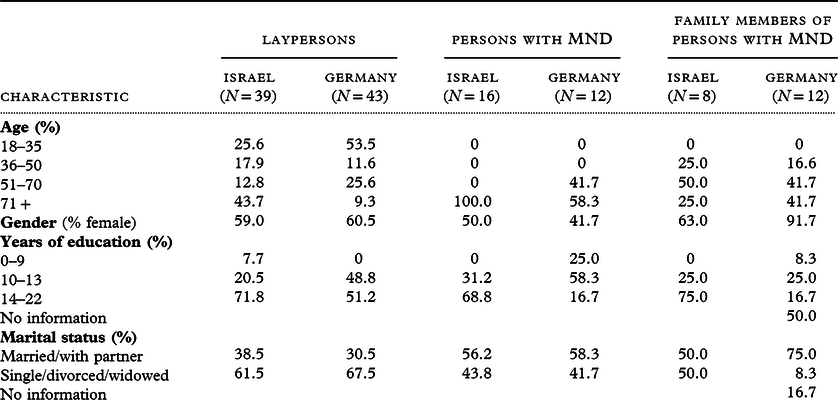
As can be observed in Table 1, with the exception of family members of persons with MND, participants’ characteristics were similar in both countries in terms of gender and marital status. In terms of their age, German participants were younger in all of the groups, and individuals with MND and their family members had a lower level of education compared to Israeli participants in these groups.
Participants’ sociodemographic characteristics by group and country

Procedure and data collection
As is common in cross-national qualitative studies (Chapple and Ziebland, Reference Chapple and Ziebland2018), slightly different methods were used to comply with the two countries’ cultural and legal differences. In Israel, nine FGs were conducted from October 2018 to March 2019: three with people with MND (n = 16), one with family members of people with MND (n = 8), and five with LP (n = 39). In Germany, five FGs were conducted in four German cities in Middle and West Germany from June 2017 to February 2018 with family members of people with advanced dementia (n = 20) and MND (n = 7). For this study’s purpose, the latter were included as participants. Additionally, seven FGs were conducted with LP from June to November 2016 (n = 43). Finally, following the request of potential participants, 12 face-to-face, semi-structured interviews were conducted with people with MND from August to December 2017 instead of FGs. Five face-to-face interviews were held with the participation of their family members, whose answers were included in the study.
In Germany, data collection started earlier because of the availability of additional funding and research capacities. However, FGs and face-to-face interviews were conducted following a semi-structured interview guideline common to all groups. The guideline was developed jointly by the teams in both countries in English, and later translated into Hebrew and German. All researchers agreed that the meaning of each question should be identical, even if it was not a literal translation. Interviews started by asking the participants to introduce themselves and relate their personal experience with AD and with persons with the disease. This was followed by the presentation of a vignette (see Appendix 1), portraying a person in the early stages of the disease. Probes were used to prompt the experiences, emotions, and thoughts provoked by the person in the vignette. FGs and face-to-face, semi-structured interviews lasting an average of 90 min were conducted in each country by a member of the research team with experience in qualitative research, until saturation was reached.
To ensure data trustworthiness, FG discussions and face-to-face interviews were audio recorded and then transcribed verbatim. Transcriptions were pseudonymized (Metschke and Wellbrock, Reference Metschke and Wellbrock2002). However, because of limited budget and time issues, it was not possible to translate all of them into English. Instead, researchers in each country prepared detailed coding guidelines, including verbatim quotes translated into English and representative of the participants’ answers and discussions. These were discussed in a personal work meeting held between the teams; upon agreement, they guided the analysis in each country.
Sampling and recruitment
Purposive sampling was used in both countries. In Israel, people with MND and their relatives were recruited from a Mental Health Medical Center in the central part of Israel. The aims and importance of the study were explained to the director of the Third Age Clinic at the center, who on time contacted potential participants. If a verbal consent was obtained, they were contacted by the research team and informed about the time and meeting of the FGs. All the participants signed an informed consent before the initiation of the groups. LP were recruited via researchers’ professional and personal connections. The research coordinator selected potential participants with an effort to achieve diversity regarding age, gender, educational, and social background.
In Germany, several strategies were used. LP were recruited by means of flyers and posters distributed and posted at local public institutions and public hospitals in the respective cities, providing genetic testing and counseling. Social media (Facebook), mailing lists, and online advertisements were used for additional recruiting. Relatives of persons with MND were recruited by disseminating flyers and posters at collaborating memory clinics, as well as via email to patients’ organizations in West and Middle Germany. Additionally, an advertisement was placed in regional newspapers in two mid-sized cities in Middle Germany.
Data analysis and triangulation
The analysis included several recommended steps for thematic content analysis (Braun and Clarke, Reference Braun and Clarke2006). In the first step, FGs discussions and face-to-face interviews were transcribed and read several times. In the second step, the whole data set was systematically coded according to the main study topic: participants’ experiences of fear regarding AD. Coding was developed both inductively and deductively. Fear and related topics emerged as an inductive theme, as it was not initially part of the research agenda. The analysis software Atlas.ti™ supported the German data coding and analysis.
Given the exploratory nature of this bilingual, cross-cultural study, it was decided to capture the different types of experience of fear that emerged. We used participants’ explanations for their elicited reactions, expressions, and feelings to understand their meaning; identify categories and codes through inductive coding; and to discover main themes. Coding sheets (compiled in tables) enabled quotations to be organized by themes, categories, and codes. Categories and codes were discussed within and across research groups in both countries until a consensus was reached. Participants’ triangulation was conducted after the main themes were identified and an agreement was attained among the members of the research teams via discussions and consultation of the current literature (Howe, Reference Howe2012).
Ethical considerations
The study protocol was approved by the University of Haifa’s Ethics Committee (Ref. Nr. 384/17; 12/11/2017) and the University Medical Center Göttingen’s Ethics Committee (Ref. Nr. 16/10/14) and (Ref. Nr. 17/12/16).
Results
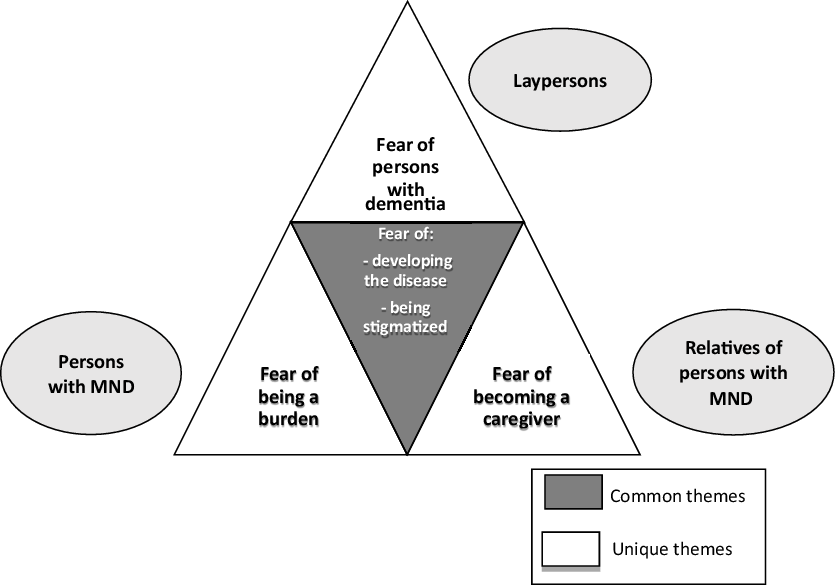
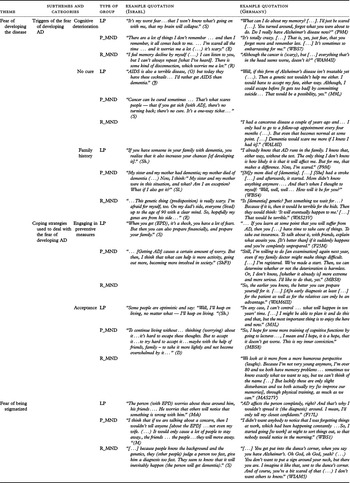
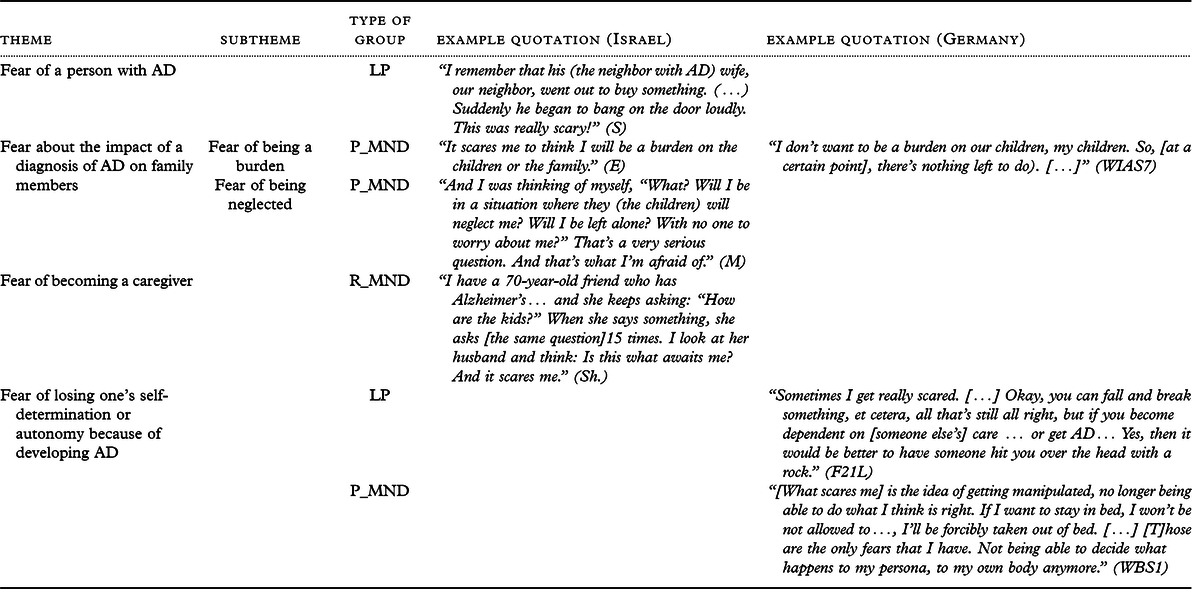
The results are presented in two sections: first, we present themes that were common to all groups in both countries. Second, we relate to themes that were unique to a single group or a single country. Figure 1 illustrates the relationships between these common and unique themes. Common and unique themes, together with subthemes and example quotations are presented in Tables 2 and 3, respectively. Each quotation is followed by a unique participant reference relating to group membership, i.e. LP, persons with MND (P_MND), and relatives of persons with MND (R_MND).
Common and unique themes.

Common themes across groups and countries

Abbreviations: LP, layperson; P_MND, person with MND; R_MND, relative of a person with MND.
Unique themes to some groups or country

Abbreviations: LP, layperson; P_MND, person with MND; R_MND, relative of a person with MND.
Common themes
Two overarching themes – labeled “Fear of developing AD”, and “Fear of being stigmatized” – were identified across all groups and countries.
Fear of developing AD
Concerns about developing AD pervaded across groups and countries. Participants used terms varying in intensity, such as fear, worry, and even shock to express the frightening emotions aroused when confronting the possibility of developing AD.
Two subthemes, reflecting triggers to these feelings and coping strategies, composed this theme:
Triggers of fear of developing AD
Participants described three triggers: cognitive deterioration; AD as an incurable disease; and having a family history of the disease.
Cognitive deterioration
In all groups, prospects of cognitive decline were mentioned as one of the main reasons prompting feelings of fear and despair. However, memory problems were the only symptom of cognitive decline associated with the concerns expressed. Some of the participants shared experiences of occasional memory lapses, describing them as a “frightening experience” or their “worst fear”.
No cure
Notions of dementia as an incurable and untreatable disease were associated with profound feelings of fear. Israeli participants reported being more frightened of developing AD than cancer or AIDS, because of the availability of treatments for these diseases as opposed to AD. Among German participants, feelings of hopelessness and futility regarding receiving a diagnosis of dementia were the main sources of fear of developing the disease.
Family history
Having a close relative with dementia (usually a parent or sibling) was also associated in all groups with feelings of fear and worry. This was not based on a deep understanding of the increased risk associated with having a family history of the disease, but rather on having vaguely heard about “this genetic thing”. Having a family history of dementia aroused feelings of fatalism and worry among participants – for themselves and for future generations.
Coping strategies used to deal with the fear of developing AD
This subtheme summarizes the techniques used by the participants to manage their fear of developing AD. Two subthemes, reflecting different coping strategies, emerged from the data.
Engaging in preventive measures
Participants in all groups voiced the possibility of managing the fear and shock aroused from anticipating developing dementia by being involved in activities that might, in their opinion, decrease this risk such as in physical, social, or cognitive activities. Others commented on organizing financial issues, or simply sharing their concerns with their loved ones, as ways to alleviate their concerns about the future.
Acceptance
Coping with the fear by accepting the situation was another strategy discussed by the participants. Some mentioned that, in an effort to deal with their feelings of fear, they relied on humor and laughter as ways to come to terms with the possibility of getting sick.
Fear of being stigmatized
The second theme common among the groups related to concerns regarding other people’s reactions. Participants mainly worried about what others would think about them if they developed AD. They particularly emphasized the fear of being secluded by others, including their loved ones. Some participants also expressed concerns about an early diagnosis of dementia affecting their social and work lives.
Unique themes
In addition to the abovementioned themes, which were common to all groups in both countries, several unique thematic emphases emerged – either for one of the groups or one of the countries.
Groups’ distinctive fears
These included – LP fears of a person with dementia; persons with MND fears about the impact of a diagnosis of AD on family members; relatives of a person with MND fear of becoming a caregiver; and fear of losing one’s self-determination.
LP fear of a person with AD
This fear was prominent among Israeli participants who reported experiencing anxiety when encountering a person with AD, especially as this person was described as being “different” or someone who might behave unexpectedly, and even “aggressively”.
Persons’ with MND fear about the impact of a diagnosis of AD on family members
These participants expressed two types of concerns about how developing AD might affect their loved ones, and especially their children. Participants in this group raised concerns about becoming a burden to their relatives. Israeli participants in this group also expressed worries about being neglected by their relatives.
Relatives’ of persons with MND fear of becoming a caregiver
This theme was particularly evident among Israeli spouses, mainly regarding worries about the frightening possibility of acquiring a new role, i.e. becoming a caregiver, and about how this would affect their lives.
Fear of losing one’s self-determination or autonomy because of developing AD
This theme emerged only among German LP and persons with MND, who expressed deep worries about the prospect of losing their right to self-determination and autonomy because of AD. Participants described the frightening situation of having someone else care for their needs, and even “manipulating” their body and identity.
Discussion
This study yielded important conceptual and methodological insights into better understanding of the fears associated with AD. Our results showed that fear of AD includes different types of fear – some common across groups and countries, and others unique to only some of them.
Fear of developing AD
The first notable finding was that the fear of developing AD permeated the lives of all participants in both countries. Its magnitude was reflected in the words used by the participants to describe the emotions elicited by the hypothetical experience of developing AD, such as “terrifying” and “shocking”. This is not surprising, as studies conducted among healthy populations showed that between 13 and 60% of the participants reported being worried or very worried about developing the disease (Bowen et al., Reference Bowen, Kessler and Segler2018; Cantegreil-Kallen and Pin, Reference Cantegreil-Kallen and Pin2011; Cutler and Bragaru, Reference Cutler and Bragaru2015; Tang et al., Reference Tang2017). Our study showed that individuals with MND and their relatives in both countries share a similar fear. More importantly, the qualitative methodology used in the current study led to a more profound understanding of this emotion. Listening directly to the participants’ voices allowed us to shed light on the causes or triggers of the fear of developing AD, and to identify the strategies used to manage it.
Three causes were identified as triggering feelings of fear about developing AD across groups and countries. Two depicted internal triggers – cognitive deterioration and beliefs of AD as an untreatable disease. The third was an external trigger – family history of the disease. Cognitive impairment is one of the leading symptoms of dementia, in general, and of AD, in particular (Hugo and Ganguli, Reference Hugo and Ganguli2014). Participants’ perceptions of cognitive deterioration – as one of the main activators of feelings of fear – are consistent with the literature on cancer fear, demonstrating that physical symptoms are a common trigger of this type of fear among symptomatic (Almeida et al., Reference Almeida, Elliott, Silva and Sales2019), as well as asymptomatic individuals (Vrinten et al., Reference Vrinten2017). However, when evoking cognitive impairment as a trigger, participants in both countries referred almost exclusively to memory problems rather than to other cognitive deficits. The fact that memory loss is recognized as the key sign of AD by LP (Cahill et al., Reference Cahill, Pierce, Werner, Darley and Bobersky2015), and is the main complaint presented to clinicians when seeking help (Hugo and Ganguli, Reference Hugo and Ganguli2014), might explain the fear elicited by this symptom.
Moreover, perceptions of AD as a disease without a foreseeable cure promoted feelings of fear and worry among the participants. While it is true that there is, as yet, no cure for the disease (Arvanitakis et al., Reference Arvanitakis, Shah and Bennett2019), expressing this notion was associated with a sense of hopelessness, leading to emotions of fear and even distress. Similar associations were reported in regard to cancer fear (Vehling and Kissane, Reference Vehling and Kissane2018), suggesting that fear associated with life-threatening illnesses is a universal phenomenon – not only across groups and cultures as demonstrated in our study, but also across diseases.
Finally, having a family member with AD was another discriminable source of worry among Israeli and German participants. While studies have consistently shown a genetic predisposition for developing AD, in general, and in early-onset familial dementia, in particular (Durmaz et al., Reference Durmaz2019), this trigger seemed to be based on vague, rather than fact-related, knowledge about the role of genetic risk factors. This conclusion is supported by findings of a systematic review on knowledge about AD, showing that knowledge about AD genetic risk was quite modest across different populations (Cahill et al., Reference Cahill, Pierce, Werner, Darley and Bobersky2015).
Losing one’s self-determination was an additional source of fear, although it was expressed only by German participants. Indeed, German LP and persons with MND frequently mentioned the fear of losing control over one’s own self and self-determination. They expressed strong emotional reactions, sometimes even followed by contemplating suicide, as a way to remedy the situation before it was too late. It should be noted that the German guardianship law is quite restrictive regarding ensuring as far as possible a citizen’s right for participation, information, and decision-making. The interest in suicide found in our study correlates with an increasing trend in the German public toward acceptance of suicide and active euthanasia in case of a serious incurable disease (IfD Allensbach, 2016). Indeed, the right to assisted suicide was recently categorized as a fundamental human right by the Federal Constitutional Court (2020). Moreover, differences in both countries’ cultural and religious beliefs, regarding the balance between the sanctity of life and self-determination (Schweda et al., Reference Schweda, Schicktanz, Raz and Silvers2017), might also explain the unique findings in Germany.
Similar to Jang and colleagues (Jang et al., Reference Jang, Yoon, Park, Rhee and Chiriboga2018), two adaptive strategies – engaging in preventive measures and acceptance – were discussed as the main mechanisms to cope with the consequences of fear of developing AD. These coping strategies were also reported in studies assessing fear of cancer recurrence (Lebel et al., Reference Lebel2018), and are in accordance with social cognitive models of disease prevention (Conner et al., Reference Conner, McEachan, Taylor, O’Hara and Lawton2015). However, unlike the management of cancer fear, participants in our study did not overtly discuss maladaptive strategies, such as avoidance and reassurance seeking (Almeida et al., Reference Almeida, Elliott, Silva and Sales2019). Several explanations might clarify this discrepancy. First, cancer fear studies mostly examined fear of recurrence. Therefore, they were based on symptomatic participants with a previous diagnosis of cancer. The fact that our participants had not yet received a diagnosis of AD for themselves or their relatives, might explain their reliance on adaptive strategies. Second, not explicitly mentioning avoidance as a way of dealing with the fear associated with developing AD might itself reflect avoidance behavior. Future studies should further explore the feasibility of this explanation.
Fear of stigmatization
Similar to dementia worry studies (Kessler et al., Reference Kessler, Bowen, Baer, Froelich and Wahl2012; Phillipson et al., Reference Phillipson, Hall and Cridland2016), as well as cancer fear studies (Vrinten et al., Reference Vrinten2017), worries about being the target of other persons’ stigmatic beliefs was central among all groups in both countries. This is an important finding, especially since stigmatic beliefs were found to be a deterrent to initiating health behaviors, such as help-seeking (Herrmann et al., Reference Herrmann2018; Phillipson et al., Reference Phillipson, Magee, Jones, Reis and Skaldzien2015). However, while reducing stigma has been mentioned anecdotally as a potential way to manage dementia fear (Bowen et al., Reference Bowen, Kessler and Segler2018; Ryu and Park, Reference Ryu and Park2019; Scerri and Scerri, Reference Scerri and Scerri2017), this association still awaits empirical examination.
In addition to these almost universal types of fear associated with AD, it was possible to discern in our data several types of fear that were more prominent in specific groups or countries. For example, Israeli LP expressed being scared when meeting a person with AD, especially if the person acted aggressively or “out of control”. This is an interesting finding since, to the best of our knowledge, experiences of fear evoked by aggressive behavior displayed by individuals with AD were examined among professional and nonprofessional caregivers (Scott et al., Reference Scott, Ryan, James and Mitchell2011; Spencer et al., Reference Spencer, Funk, Herron, Gerbrandt and Dansereau2019), but not among the general public. Moreover, it might reflect the cultural differences between the countries, especially in the uncertainty avoidance dimension. As stated above, with a very high score in this dimension, Israelis might tend to express more openly and freely certain types of fear, such as being afraid by someone else’s behavior, especially in reference to a person with a disease. Alternatively, it might be associated with the low tendency to change that characterizes cultures with high levels of uncertainty avoidance (de Mooji & Hofstede, Reference de Mooji and Hofstede2010). Indeed, a recent study comparing German and Israeli dementia advocacy groups, showed that German groups are more heterogeneous, allowing for self-advocacy, while Israeli groups are more traditional focusing strongly on caregivers (Schicktanz et al., Reference Schicktanz, Rimon-Zarfaty, Raz and Jongsma2018).
Worries about becoming a burden to others is a common theme evoked by persons with mild cognitive impairment in qualitative studies in several countries (Gomersall et al., Reference Gomersall, Smith, Blewett and Astell2017; Vernooij-Dassen et al., Reference Vernooij-Dassen, Derksen, Scheltens and Moniz-Cook2006). Similar worries were expressed in our study by Israeli and German participants with MND, but also by German LP. These emotions might be associated with general feelings of worry and anxiety about confronting a debilitating condition and increased dependence (Lloyd-Williams et al., Reference Lloyd-Williams, Kennedy, Sixsmith and Sixsmith2007).
Finally, relatives of persons with MND in both countries expressed fears of becoming a caregiver. This is not surprising, as there is a universal understanding that assuming a caregiver role – a realistic possibility for relatives of persons with MND (Carlozzi et al., Reference Carlozzi2018; Seeher et al., Reference Seeher, Low, Reppermund and Brodaty2013) – is a stressful experience, impacting the caregiver’s quality of life and wellbeing (Cross et al., Reference Cross, Garip and Sheffield2018; Hooper and Collins, Reference Hooper and Collins2019). Interestingly, in a recent quantitative study conducted among 2,609 Asian American LP, aged 18–98, around a quarter of the participants expressed similar concerns (Jang et al., Reference Jang, Yoon, Park, Rhee and Chiriboga2018). While LP in our study did not express these worries, future studies should further explore them in other cultural groups.
Study limitations
Before discussing the study’s implications, its limitations must be acknowledged. First, despite the advantages of the triangulation of multiple groups’ views in two countries, as with any qualitative research, the generalization of our findings is limited. Having additional FGs with other relevant groups, such as family members of persons with a diagnosis of AD, might have shed more light on additional experiences of fear associated with the disease. Second, participants in all of the groups were selected through convenience sampling. In Israel, participants were mainly recruited from one clinic; some of them even knew each other. Finally, we did not examine the participants’ level of knowledge about AD. Given the inconclusive findings of the relationship between knowledge and fear of AD (Werner et al., Reference Werner, AboJabel and Maxfield2020), examining this variable in our study could provide us with important information.
Study strengths
Despite these limitations, this study has important strengths. First, theoretically, it supports and even expands recent conceptualizations about dementia fear as a multidimensional concept (Page et al., Reference Page, Hayslip, Wadsworth and Allen2019). Our findings demonstrated that although general feelings of fear about developing the disease are common among different groups and countries, there are also unique experiences not shared by all of them. This stresses the importance of attending to the needs arising from the shared, as well as the unique worries of each group. Moreover, our data revealed, for the first time, the causes or triggers of the fear of developing AD. This is an important contribution, which might guide the development of interventions aimed at preventing, rather than reducing, the adverse consequences of this emotion, and increasing its positive ones.
Second, the comparison between the two countries showed that although fear of dementia is universal, it is also shaped by cultural and social experiences. Finally, the use of a qualitative methodology proved to be particularly well-suited to understanding such complex and sensitive emotions.
Practically, we expect our findings of the ubiquity of the phenomenon of fear of dementia to guide health care professionals and policy-makers in national and international settings. However, not of lesser importance, attention should be paid to the unique themes that emerged in our study. For example, the media could ease LP fear of a person with AD by presenting a more positive, hopeful counter-frame to the dominant negative and stigmatizing bio-medical views presented today. To manage the fears expressed by persons with MND and their family members, clinicians should pay increased attention to how they communicate the diagnosis. Since approximately 20–40% of the cases diagnosed with MND improve over time, and only 10–15% per year progress to dementia (Mishra and Singh, Reference Mishra and Singh2019), fears could be reduced if this information is provided, or if services providing support to them were available.
In conclusion, our study revealed that fear of AD is a complex phenomenon with some commonalities and differences among groups and cultures. These findings hold implications for interventions stressing the need to delineate specific strategies to different groups and cultures. Moreover, attention should be paid not only to the detrimental consequences of fear of AD, but also to its role as a promoter of health behavior and an enabler for action.
Finally, we suggest national dementia plans to stress the importance of addressing these fears. For example, reasonable coping strategies can be strengthened, such as developing sociopolitical concepts of dementia-friendly communities.
Conflict of interest
None.
Source of funding
This study was funded by a grant from the German–Israeli Foundation for Scientific Research and Development (GIF) (grant number G-1413-119.4/2017) to Perla Werner and Silke Schicktanz. Data collection conducted with laypersons in Germany was funded by the Swedish Riksbankens Jubileumsfond (grant number 1351730).
Description of authors’ roles
Perla Werner designed the study, supervised data collection and data analysis in Israel, and wrote the first draft of the paper. Natalie Ulitsa collected the data and conducted data analysis in Israel. Daphna Shephet assisted in data collection in Israel. Hanan Abojabel assisted in the writing of the manuscript. Zümrüt Alpinar-Sencan helped in collecting the data and conducted data analysis in Germany. Silke Schicktanz designed the study, supervised data collection and data analysis in Germany, and assisted with writing the paper.
Acknowledgments
We thank Mr. Leopold Lohmeyer for conducting the face-to-face interviews and Dr. Ile Kermel Schiffman and Sabine Wöhlke for their support in conducting part of the focus groups in Israel and Germany, respectively.
Appendix 1. Vignette
Ms. Wagner/Cohen is 62 years old and notices that she occasionally forgets certain things. She visits a memory clinic to be examined. After a few tests – both physical as well as neuropsychological tests, such as repeating a word list – she is told that there would be a higher risk of her developing Alzheimer’s disease in the years to come.