Introduction
Sociocultural models of body dissatisfaction emphasize the role of the media in the onset, development, and maintenance of negative evaluative body image (Thompson et al. Reference Thompson, Heinberg, Altabe and Tantleff-Dunn1999). While extensive research has examined the effect of more traditional forms of media, like magazines and TV (e.g. Grabe et al. Reference Grabe, Ward and Hyde2008), less research has investigated how newer forms of media such as Internet-based social networking sites (SNSs) are impacting upon users’ appraisals of their body size and shape (Holland & Tiggemann, Reference Holland and Tiggemann2016). Fewer studies still have investigated this with a focus on adolescent girls, a group more likely to engage in excessive online social networking (e.g. Kelly et al. Reference Kelly, Zilanawala, Booker and Sacker2019) and report more negative body image evaluations in comparison with male peers (e.g. Jones, Reference Jones2004; Lawler & Nixon, Reference Lawler and Nixon2011; Dooley et al. Reference Dooley, O’Conoor, Fitzgerald and O’Reilly2019). Given that body dissatisfaction has been linked with a range of adverse outcomes, including the onset of eating disorders (e.g. Stice & Shaw, Reference Stice and Shaw2002), low self-esteem, increased negative affect (Stice & Bearman, Reference Stice and Bearman2001), and significant emotional distress (Johnson & Wardle, Reference Johnson and Wardle2005), examining factors that contribute to lower levels of body satisfaction in this vulnerable group is of critical importance for psychological research in order to improve targeted prevention and early intervention endeavors.
Recent years have witnessed the proliferation and increasing popularity of online social media and networking sites like Facebook, Snapchat, or Instagram. Mobile devices provide convenient access to the Internet to the extent that a recent US report stated that 45% of adolescents claim they are online ‘almost constantly’ (Pew Research Centre, 2018). Considering these rates of exposure, it is imperative to investigate how this new form of media may be contributing to the body image appraisals of adolescent users.
Adolescence is a time when identity is being forged. Physical appearance is highly valued to the extent that it is the most important predictor of adolescents’ overall self-worth (Harter, Reference Harter, Damon and Lerner2006). Thinness, for girls, is deemed an advantageous attribute for peer acceptance in a developmental period where the peer group gains significant saliency and group acceptance is highly important (Oliver & Thelen, Reference Oliver and Thelen1996). Indeed, sociocultural models also highlight how peers play an important role in identifying and reinforcing appearance ideals and beauty standards (Thompson et al. Reference Thompson, Heinberg, Altabe and Tantleff-Dunn1999). Engagement in peer appearance conversations and receipt of peer appearance criticism are common everyday interactions among adolescents in many Western cultures (e.g. Jones et al. Reference Jones, Vigfusdottir and Lee2004; Carey et al. Reference Carey, Donaghue and Broderick2010; Lawler & Nixon, Reference Lawler and Nixon2011; Webb et al. Reference Webb, Zimmer-Gembeck and Donovan2014; Kierans & Swords, 2016; Trekels & Eggermont, Reference Trekels and Eggermont2017). In Ireland, adolescents have reported being influenced by the appearance values and behaviors of their peers (Kierans & Swords, 2016), and peer appearance conversations and criticism have been linked with body dissatisfaction, particularly among young girls who have a greater propensity to discuss appearance ideals compared with their male counterparts (Lawler & Nixon, Reference Lawler and Nixon2011). Thus, SNSs may represent a distinct platform where body dissatisfaction levels can be exacerbated due to the strong peer presence on the site and the constant stream of photos and social information that is being perpetuated through the newsfeed feature (Perloff, Reference Perloff2014).
While the literature has reported that time spent on SNSs is significantly related to body image concerns (Fardouly & Vartanian, Reference Fardouly and Vartanian2015; de Vries et al. Reference De Vries, Peter, de Graaf and Nikken2016) and depressive symptoms (e.g. Kelly et al. Reference Kelly, Zilanawala, Booker and Sacker2019), it appears that the type of activity engaged in while online is worth further consideration (e.g. Tiggemann & Miller, Reference Tiggemann and Miller2010; Tiggemann & Slater, Reference Tiggemann and Slater2013). For example, Meier and Gray (Reference Meier and Gray2014) noted how it was not the frequency or quantity of Facebook use among adolescents that predicted their levels of body dissatisfaction, but rather the extent to which adolescents engaged in appearance-related activities such as viewing, tagging, or commenting on images of themselves or others. Similarly, Tiggemann and Miller (Reference Tiggemann and Miller2010) found that it was adolescent girls’ engagement with appearance-focused content while online that was associated with crucial mediating mechanisms implicated in the processes linking media exposure and body dissatisfaction such as internalization of the thin ideal and social comparisons. Internalization of the thin ideal refers to the degree to which an individual cognitively ‘buys into’ sociocultural ideals, ascribes personal relevance to them, and seeks to pursue these often unattainable goals (Thompson & Stice, Reference Thompson and Stice2001). Thin ideal media have been shown to induce girls’ and women’s internalization of sociocultural ideals and their propensity toward appearance comparisons (Keery et al. Reference Keery, van den Berg and Thompson2004).
Social comparisons are at work when individuals evaluate and determine their personal worth based on perceptions of how they measure up to others across a range of domains Thompson and Stice (Reference Thompson and Stice2001). Festinger’s Social Comparison Theory (Reference Festinger1954) proposes that individuals increase rates of social comparisons when they are unsure of themselves. This aspect of the theory may be particularly relevant for adolescents who, according to Erikson (Reference Erikson1959), are undergoing an ‘identity crisis’ and may turn to peers to obtain social information about the self in order to reduce uncertainty and forge their identity (Abrams & Hogg, Reference Abrams and Hogg1988; Butzer & Kuiper, Reference Butzer and Kuiper2006).
In their systematic review on the impact of SNSs on body image and disordered eating outcomes, Holland and Tiggemann (Reference Holland and Tiggemann2016) suggest that engaging in social comparisons mediated the relationship between time online and body image appraisals. Further to this, in their sample of female university students, Fardouly and Vartanian (Reference Fardouly and Vartanian2015) identified the value of examining both the frequency and direction of comparisons, particularly ‘upward comparisons’, where one’s own appearance is perceived to be less appealing or attractive than others. This practice has been associated with lower self-esteem (Allan & Gilbert, Reference Allan and Gilbert1995), higher body dissatisfaction rates (Ricciardelli & McCabe, Reference Ricciardelli and McCabe2001), and disordered eating (Saunders & Eaton, Reference Saunders and Eaton2018). It has been reported that adolescent girls engage in this behavior more frequently than adolescent boys (Jones, Reference Jones2001) with social targets for such comparisons including peers, family members, and celebrities (Krayer et al. Reference Krayer, Ingledew and Iphofen2008). With SNSs like Facebook uploading over 350 million pictures to its platform every day (Social Report, 2018), the Internet offers increased opportunities for adolescent users to engage in social comparisons. Indeed, it is suggested that individuals who have a high social comparison orientation may be drawn to these sites for this very reason (Vogel et al. Reference Vogel, Rose, Okdie, Eckles and Franz2015).
Sociocultural models (e.g. Thompson et al. Reference Thompson, Heinberg, Altabe and Tantleff-Dunn1999) have been tested repeatedly in the literature and have received empirical support for their proposition that the media influences body dissatisfaction levels through the mediating processes of internalization and social comparisons (e.g. Keery et al. Reference Keery, van den Berg and Thompson2004). These mediating mechanisms are important for explaining variation in body dissatisfaction rates. For example, research has found that although most female adolescents are aware of depictions of the ‘thin ideal’ in the media (Milkie, Reference Milkie1999), the extent to which girls deem them to be personally relevant or attainable varies. Objectification theories (e.g. Fredrickson & Roberts, Reference Fredrickson and Roberts1997) have also attempted to explain the effect of the media on body image appraisals. They propose that the pervasive promotion of appearance ideals for girls and women through media channels induce women and girls to relentlessly and self-consciously monitor and compare their bodies’ external appearance and internalize how they expect others to perceive them, a process termed as ‘self-objectification.’
The present study
When exposed to media portrayals of the thin ideal, body surveillance, or the monitoring of outward appearance, and the processes of internalization and social comparisons are argued to underlie higher levels of body dissatisfaction. Although there has been a proliferation of studies examining the effects of social media usage on body image with young adults in recent years, adolescents have not been afforded the same attention within the literature (Holland & Tiggemann, Reference Holland and Tiggemann2016). These populations, from sequential – but different – periods of the life course, should not be assumed to be the same in terms of psychological processes and outcomes. Self-esteem, for example, has been shown to decline during adolescence (Robins & Trzesniewski, Reference Robins and Trzesniewski2005) but to increase gradually during emerging adulthood (Chung et al. Reference Chung, Robins, Trzesniewski, Noftle, Roberts and Widaman2014). Furthermore, the popularity of SNSs among adolescent girls (e.g. Kelly et al. Reference Kelly, Zilanawala, Booker and Sacker2019) who are a group already noted to have widespread dissatisfaction with their body shape and weight (e.g. Dooley et al. Reference Dooley, O’Conoor, Fitzgerald and O’Reilly2019) is particularly concerning. More work is needed to examine the processes at work.
In the present study, Facebook is the SNS in focus. Facebook is the most popular social network in the world (Statista, 2019a) and is one of the most used among teenagers, such that a majority of adolescents across the US and UK are active members (Pew Research Centre, 2018; Ofcom, 2019). As adolescent girls use social media sites, particularly those like Facebook that are visually oriented, more than their male counterparts (Pew Research Center, 2018), these sites may be acting as a unique platform for social comparisons with the female peer group.
Research has found that exposure to peers who closely typify the thin ideal heightens body dissatisfaction levels in young women (Krones et al. Reference Krones, Stice, Batres and Orjada2005). Social comparisons to peers rather than celebrities may afford different outcomes for body image concerns as peer appearances may be evaluated as being more moderate and personally attainable due to peers’ similar lifestyles and resources (Mussweiler, Reference Mussweiler2003). Furthermore, because users present idealized depictions of themselves online, this behavior may be distorting the reality from which actual comparisons stem (Feinstein et al. Reference Feinstein, Hershenberg, Bhatia, Latack, Meuwly and Davila2013). The first aim of the present study is thus to explore participants’ reports of social comparisons with proximal (e.g. close friends and family) and more distal (e.g. celebrity) female targets. Comparisons will be assessed in terms of both frequency and favorability, where the appearance of others is perceived to be more appealing than one’s own. Associations with reported body dissatisfaction will also be examined.
It also appears that measuring total time spent on SNSs, which does not account for how this time is spent, is less informative than specifically measuring time spent engaging in appearance-related activities while logged on. For example, members of Facebook can access a wide range of features that allow them to engage in activities such as live chat or video streaming, playing games, posting comments or photographs, or sharing links to content deemed interesting. Obviously, many of these activities are not related to physical appearance. As such, this study also aims to ascertain among a sample of adolescent girls if there is an association between appearance-related activities, specifically, and body dissatisfaction. It draws upon sociocultural and objectification models of body dissatisfaction to examine social comparisons and internalization of the thin ideal as significant mediating mechanisms.
Participant age and self-esteem, the attitude one has toward the self, also referred to as self-worth or self-image (Rosenberg, Reference Rosenberg1965), will be controlled for as possible confounding variables. During adolescence, self-esteem and body image judgments are rapidly developing and fluctuating, with researchers highlighting the inextricable link between the two (Harter, Reference Harter, Damon and Lerner2006; van den Berg et al. Reference van den Berg, Mond, Eisenberg, Ackard and Neumark-Sztainer2010). In addition, various research studies with samples of adolescents or young people have found self-esteem to have varying mediating and moderating roles in explaining sociocultural influences on body dissatisfaction (e.g. Stice & Whitenton, Reference Stice and Whitenton2002; De Sousa et al. Reference De Sousa, Cipiani, Coelho, Paes and Ferreira2014; Ahadzadeh, Sharif, & Ong, Reference Ahadzadeh, Sharif and Ong2017). It appears that low self-esteem may contribute to girls’ engagement in body comparisons and heighten levels of internalization, and other processes that increase vulnerability to body dissatisfaction (e.g. Durkin & Paxton, Reference Durkin and Paxton2002; Caqueo-Urízar et al. Reference Caqueo-Urízar, Ferrer-Garcia, Toro, Gutiérrez-Maldonado, Penaloza, Cuadros-Sosa and Galvez-Madrid2011). Of course, it may also be the case that self-esteem is also influenced by exposure to media portrayals of the thin ideal, comparisons, and internalization and body dissatisfaction. Thus, controlling for a possible confounding variable such as self-esteem reduces threats to the validity of inferences that may be made about associations from the mediation analysis.
In summary, the following two research hypotheses were proposed: (1) there will be a positive association between body dissatisfaction and adolescents’ frequency and favorability (i.e. direction) of comparisons to proximal (e.g. close friends) and distal (e.g. celebrities) female targets on SNSs like Facebook and (2) Social comparisons and internalization of the thin ideal will mediate associations between online appearance-related activity and body dissatisfaction (while controlling for age and self-esteem).
Methods
Participants
Participants (n = 210) were female students aged between 12 and 17 years (M = 15.16, SD = 1.17) from three second-level schools in Ireland (one single-sex school, one fee-paying school, and one located in an urban area. None were identified as being in receipt of government support to tackle social or educational disadvantage). All participants had completed at least 8 years of formal education.
Materials
Appearance exposure
The eight-item Photo Subscale devised by Meier and Gray (Reference Meier and Gray2014) was used to determine how often participants engage in appearance-related activities (e.g. ‘update your profile photo’ or ‘view friends’ photos of themselves’) while on Facebook. Participants indicated their typical engagement with a photo-related feature on a 5-point scale ranging from ‘0 = almost never or never’ to ‘4 = nearly every time I log on’ or ‘4 = more often than once a month’, depending on the feature examined. Scores can range from 0 to 32 with higher scores indicating higher engagement in appearance-related activities. Internal consistency reliability in the present study was acceptable (Cronbach’s α = .82).
Comparisons to specific target groups
With regard to specific female target groups on Facebook, participants completed items devised by Fardouly and Vartanian (Reference Fardouly and Vartanian2015) to report the frequency with which they make appearance comparisons (‘When looking at photos of the following people, how often do you compare your body to theirs?’ 0 = never to 4 = very often) and the direction of these appearance comparisons (‘When comparing your body to each of the following people, how do you rate yourself?’ 1 = much better to 7 = much worse). Higher scores indicated greater tendencies to engage in social comparisons and upward comparisons on Facebook, respectively.
The female target groups varied in relational closeness and comprised family members, close friends (i.e. females you are friends with on Facebook and regularly hang out with), distal peers (i.e. females you know on Facebook or otherwise but do not regularly hang out with), and celebrities (e.g. actors, musicians, and models). Scores obtained for each target group were analyzed separately for both comparison measures.
Internalization of the thin ideal
The Thin-Ideal Internalization Scale has been utilized in recent studies to measure levels of internalization of the thin ideal within the female population (e.g. Stice et al. Reference Stice, Rohde, Shaw and Gau2017). Using a 5-point response scale (0 = strongly disagree to 4 = strongly agree), participants rated the extent to which they agreed or disagreed with eight statements relating to their levels of internalization such as ‘Slim women are more attractive’ and ‘Women with toned bodies are more attractive’. Scores can range from 0 to 40 with higher scores indicating higher levels of internalization and lower scores on the scale indicating lower levels of internalization. Internal consistency reliability in the present study was high (Cronbach’s α = .90).
Body dissatisfaction
Using a 6-point response scale (0 = never, 5 = always), participants completed the nine-item Body Dissatisfaction Subscale of the Eating Disorder Inventory (Garner et al. Reference Garner, Olmstead and Polivy1983) to rate statements about their body image. Scores can range from 0 to 45 with higher scores indicating higher levels of body dissatisfaction. Internal consistency reliability in the present study was acceptable (Cronbach’s α = .83).
Self-esteem
Self-esteem was assessed using Rosenberg’s Self-Esteem Scale (Rosenberg, Reference Rosenberg1965). Using a 5-point response scale (0 = strongly disagree to 4 = strongly agree), participants rated the extent to which they agreed or disagreed with 10 statements about their self-esteem, such as, ‘On the whole I am satisfied with myself’. Scores can range from 0 to 40, with higher scores on the scale indicating higher levels of self-esteem. Internal consistency reliability in the present study was acceptable (Cronbach’s α = .78).
Procedure
Ethical approval was granted by the School of Psychology ethics committee within the authors’ university. After obtaining consent from school principals, parent information and consent forms were sent home with students which outlined the objectives of the study. Students whose parents signed consent forms were then provided with information sheets and assent forms and invited to take part in the study. Parent consent response rate was 59% and student assent response rate was 100%. Data collection took place in a group setting with a staff member present during school hours between December 2015 and January 2016. Upon completion, questionnaires were collected and all participants were debriefed verbally and in writing.
Data analysis
‘Rule of thumb’ guidelines (e.g. Garver & Mentzer, Reference Garver and Mentzer1999) proposing a ‘critical sample size’ of 200 for path analyses were consulted in advance of data collection. Two hundred and ten participants completed the survey instrument. Their data were analyzed using the Statistical Package for the Social Sciences (SPSS, version 23.0; IBM SPSS, Chicago, IL) and the process computation tool for SPSS (Hayes, Reference Hayes2017). Analyses of missing data indicated that no item exceeded a missing rate above 5%. Little’s missing completely at random (MCAR) tests indicated that these items were missing completely at random and so scores were imputed employing expectation–maximization algorithm (Little & Rubin, Reference Little and Rubin2002).
Results
There will be a positive association between body dissatisfaction and adolescents’ frequency and favorability of comparisons to proximal (e.g. close friends) and distal (e.g. celebrities) female targets on Facebook.
Table 1 shows how time spent engaged in social comparisons with the target groups of family, close friends, distal peers, and celebrities on Facebook was significantly correlated with body dissatisfaction in adolescent girls (all p < .001). Target-specific upward comparisons were also significantly associated with body dissatisfaction among the sample (all p < .01), most particularly when adolescent girls perceive their appearance as being worse than that of close friends (r = .47).
Bivariate and partial correlations between body dissatisfaction and the frequencies and direction of appearance comparisons to specific target groups

*p < .01.
Figures inside parentheses are partial correlations where the frequency or direction (as applicable) of appearance comparisons to the other target groups was controlled for.
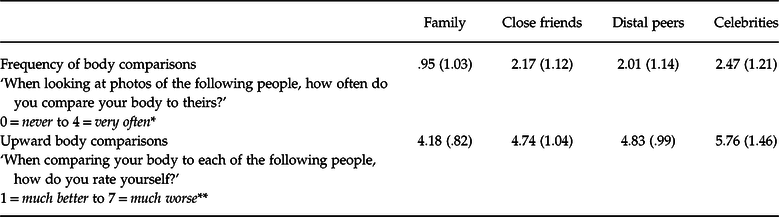
Repeated measures analyses of variance (ANOVA) tests revealed that participants’ responses to the different target groups differed significantly with regard to the time they spent engaging in social comparisons (F(2.845, 591.8) = 131.83, p < 0.001; partial eta squared .388) and the direction of these comparisons (F(2.154, 447.94) = 134.4, p < 0.001; partial eta squared .391). As shown in Table 1, adolescent girls most frequently compared their bodies with celebrities followed by close friends, distal peers, and family. All mean frequency scores were significantly different from each other at p < .001, except for the mean difference between close friends and distal peers which was significant at p<.05. Body comparisons were found to all be in an upward direction, with participants rating their bodies least favorably when compared with celebrities, followed by distal peers, close friends, and finally, family. Comparisons between close friends and distal peers were not significantly different from each other (p = .134). All other means were significantly statistically different from each other at p < .001.
Social comparisons and internalization of the thin ideal will mediate associations between online appearance-related activity and body dissatisfaction (while controlling for age and self-esteem).
Hayes’ process formulation for mediational regression (Hayes, Reference Hayes2017) was used to develop a serial multiple mediator model to investigate the hypothesis that frequently making social comparisons, upward comparisons, and internalization mediate the relationship between Facebook appearance-related activity and body dissatisfaction. Self-esteem and age were added to the model as covariates so that their influence may be statistically controlled for when estimating the other relationships in the model. As body dissatisfaction was significantly associated with time spent engaged in social comparisons and the direction of these comparisons with all target groups, two new variables were computed for this analysis to represent (i) the average rating for how often participants reported that they engaged in social comparisons while on Facebook across all target groups and (ii) the average rating of upward comparisons made while on Facebook with all target groups.
Mean (SD) ratings of the frequencies and directions of appearance comparisons to specific target groups on Facebook

* All means are significantly statistically different from each other at p < .001 except for the mean difference between close friends and distal peers which is significant at p < .05.
** Any mean above 3.5 represents upward comparisons where participants rate their bodies less favorably than the targets’ bodies. Comparisons between close friends and distal peers are not significantly different from each other (p = .134). All other means are significantly statistically different from each other at p < .001.
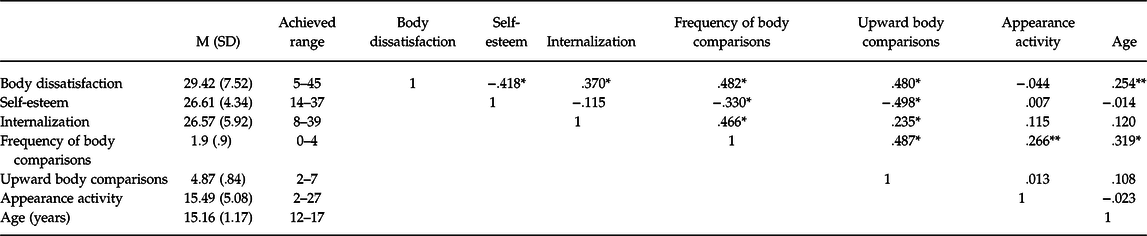
Table 3 displays the bivariate and partial correlations among the values and Fig. 1 displays the proposed model. Significant paths are denoted with a bold line.
Descriptive details for, and correlations between, key variables

Upward body comparisons, frequency of body comparisons, and internalization as mediators in the relationship between Facebook appearance activity and body dissatisfaction while controlling for self-esteem and age. Standardized path coefficients are presented. Bold lines indicate significant pathways.
(Total fffect: b = −.0369, SE = .0700, p>.05; Direct effect: b = −.1316, SE = .0672, p>.05; Indirect Effect: XM1Y = .0697, Boot SE = .0323, 95% CI = .0129 to .1416; XM2Y = −.0196, Boot SE = .0216, 95% CI = −.0729–.0075; XM3Y = −.0042, Boot SE = .0143, 95% CI = −.0339–.0262; XM1M2Y = .0211, Boot SE = .0152, 95% CI = −.0018–.0569; XM1M3Y = .0278, Boot SE = .0142, 95% CI = .0041–.0597).
*p < .05, **p < .001.

Overall, the model accounted for 39.32% of the variance in body dissatisfaction levels [R 2 = .3932, F(6, 168) = 18.1406, p < .0001]. The direct effect of Facebook appearance activity on body dissatisfaction was not significant (b = −.1316, SE = .0672, p > .05). However, comparison frequency significantly mediated this relationship so that more appearance activity was associated with making more social comparisons which was in turn associated with greater body dissatisfaction, resulting in a significant indirect effect (b = .0697; 95% CI: .0129–.1416). In addition, greater internalization of the thin ideal further mediated the indirect effect of Facebook appearance-related activity and comparison frequency on body dissatisfaction (b = .0278; 95% CI: .0041–.0597). Other indirect effects of Facebook appearance-related activity on body dissatisfaction were not significant. The strongest predictor of body dissatisfaction was how frequently participants compared their bodies to those of other girls (b = .2317, SE = .0845, p < .05). Table 4 contains the model coefficients.
Model coefficients for the effect of Facebook appearance activity on body dissatisfaction with frequency of comparisons, upward comparisons, and internalization as mediators and self-esteem and age as covariates. Figures in parentheses represent values related to the unstandardized beta coefficients

Discussion
The results of this study revealed that adolescent girls’ body dissatisfaction was significantly related to appearance-related activity engaged in while on Facebook. Specifically, body dissatisfaction was significantly related to (i) time spent engaged in social comparisons and (ii) upward social comparisons with female celebrities, close friends, peers, and family members while on Facebook. Evaluating oneself more frequently in comparison with celebrities and less favorably in comparison with close friends was most strongly associated with poorer body image appraisals. When responses to all female targets were considered together, time spent engaged in appearance-related activity on Facebook was not found to be directly associated with body dissatisfaction but had an indirect relationship through the mediating mechanism of frequent social comparisons and internalization of the thin ideal. Thus, Facebook activities involving the appraisal of one’s own and others’ photographed images were associated with more frequent social comparisons, and engaging in frequent social comparisons was related to body dissatisfaction. Furthermore, the relationship between frequent social comparisons and body dissatisfaction was also mediated by internalisation of the thin ideal.
The sociocultural environment of SNSs
Jones (Reference Jones2004) describes the ‘appearance culture’ that is often nurtured during adolescence where girls perceive thinness as being an advantageous attribute for peer acceptance. This study adds to existing research examining appearance culture among young Irish girls (e.g. Lawler & Nixon, Reference Lawler and Nixon2011; Kierans & Swords, Reference Kierans and Swords2015) but extends it to focus on the influence of online SNS. It also suggests that appearance-focused activity may indirectly drive adolescent girls’ body dissatisfaction through the mechanisms of social comparisons and internalization of appearance ideals, aligning with related research in the field (Groesz et al. Reference Groesz, Levine and Murnen2002; Jones, Reference Jones2004; Levine & Harrison, Reference Levine, Harrison, Bryant and Oliver2009). As such it also supports sociocultural and objectification theories which state that increased exposure to images of female targets may instigate increased rates of social comparisons. These comparisons highlight discrepancies between one’s own appearance and that of the societal norm or expected standard. If self-evaluations are unfavorable, they may exacerbate body dissatisfaction. Importantly, individual levels of internalization may be a critical underpinning factor in explaining individual variation in body dissatisfaction.
It may be the case that sites like Facebook are a medium that exemplify the appearance culture of adolescent girls, where users are uploading idealized depictions of themselves (Feinstein et al. Reference Feinstein, Hershenberg, Bhatia, Latack, Meuwly and Davila2013). For the first time, these sites afford adolescents the opportunity to view images of many other girls on digital screens with on-demand access. Furthermore, photographs can be edited, cropped, and filtered which may be elevating the number of photographs that emulate idealized versions of beauty for young adolescents.
Implications and interventions
Body dissatisfaction levels in early adolescence are the single best predictor of body dissatisfaction levels in late adolescence (Dion et al. Reference Dion, Blackburn, Auclair, Laberge, Veillette, Gaudreault, Vachon, Perron and Touchette2015). Furthermore, body dissatisfaction has been characterized as a significant component of eating disorder onset, typically during the late adolescent period, with girls being at greater risk than boys (Rohde et al. Reference Rohde, Stice and Marti2015). As such, early intervention is of critical importance. Previous literature has supported the effectiveness of cognitive dissonance interventions in reducing levels of internalization and body dissatisfaction (e.g. Halliwell & Diedrichs, Reference Halliwell and Diedrichs2014). Media literacy programs have also elicited positive results in reducing body dissatisfaction levels (e.g. Watson & Vaughn, Reference Watson and Vaughn2006). From the current results, these interventions could be improved upon with the addition of social media education focusing on the ‘appearance culture’ being promoted through sites like Facebook. With previous interventions placing greater emphasis on female adult models that are depicted in the media through advertisements (e.g. Wilksch et al. Reference Wilksch, Tiggemann and Wade2006; Watson & Vaughn, Reference Watson and Vaughn2006), future interventions could focus on adolescent populations and inform them how peers can present idealized versions of themselves on social media platforms (Zhao et al. Reference Zhao, Grasmuck and Martin2008), by cropping, editing, and filtering their photographs to make themselves appear thinner and more attractive.
Limitations and future research
The current study was correlational in design and therefore causation cannot be implied as other variables not controlled for may have been influencing the results obtained. Future research in the area of social media and body dissatisfaction could adopt experimental designs to investigate whether time spent engaged in social comparisons on sites like Facebook are causally linked with levels of body dissatisfaction.
Future research could also examine the transactional and reciprocal effects of social media. It is uncertain whether vulnerability factors such as high levels of internalization or body dissatisfaction predispose individuals to seek out content that instigates behaviors such as social comparisons, or whether SNSs such as Facebook cause individuals to engage in such behaviors due to the features they afford which may heighten their levels of internalization and body dissatisfaction. A recent study by Rousseau et al. (Reference Rousseau, Eggermont and Frison2017) with an adolescent population suggests that body dissatisfaction positively predicts comparison on Facebook. In addition, these authors noted that passive Facebook use, meaning the ‘the monitoring of other people’s lives by viewing the content of others’ profiles without direct exchanges between the users’ (Frison & Eggermont, Reference Frison and Eggermont2015: 4), stimulated increased rates of social comparisons that, in turn, exacerbated body dissatisfaction levels.
Previous research has also found that the relationships between variables outlined in sociocultural models of body dissatisfaction vary depending upon the age, gender, and sociocultural setting of the participants. For example, cultural specificities are important factors to consider when devising and analyzing sociocultural models of body dissatisfaction, with the focus on appearance potentially varying between countries. As a case in point, one study noted how Australian participants reported perceiving greater media and peer influence, internalization, and appearance comparisons compared with their French counterparts (Rodgers et al. Reference Rodgers, Chabrol and Paxton2011). The authors reasoned that Australian women may be more greatly influenced by Western ideals of beauty due to Australia being a largely English-speaking country and therefore more susceptible to the influences of the US diet industry and culture. The authors further reasoned that the French culture may act as a buffer for young French women where attitudes around food and diet have been described as being more positive than other Western countries (Holdsworth, Reference Holdsworth2008). Furthermore, associations within sociocultural models have been found to be stronger for girls than boys (Papp et al. Reference Papp, Urban, Czeglédi, Babusa and Tury2013). It may also be the case that parental influences on body image are stronger for younger adolescents compared with older adolescents and young adults (Shroff & Thompson, Reference Shroff and Thompson2006). Given these findings, further attention is warranted to extrapolate how the effects of online media exposure can vary depending upon an individual’s sociocultural environment, gender, and age.
Future research might consider looking to other established models of body image appraisals (e.g. Tripartite Model of Body Dissatisfaction) to determine potential additional variables that may explain adolescent body image dissatisfaction following exposure to online media platforms. The development of a comprehensive model, incorporating mediating and moderating variables, that specifies social media’s potential effect on adolescent body image appraisals, would also further explain its role in comparison to other traditional forms of media outlets (Prieler & Choi, Reference Prieler and Choi2014).
Considering the proliferation of research within the positive body image literature, future research could also benefit from examining protective factors that may buffer young girls from the more adverse effects of social media sites. Emerging research has highlighted how young women who were exposed to body-positive posts experienced improvements in mood, body satisfaction, and body appreciation in comparison to being exposed to thin ideal and appearance-neutral posts (Cohen et al. Reference Cohen, Fardouly, Netown-John and Slater2019).
The theory also suggests that the impact of social comparisons on self-evaluations can vary depending on the comparative target’s distance, extremity, and attainability in relation to the self (Mussweiler, Reference Mussweiler2003; Mussweiler et al. Reference Mussweiler, Epstude and Corcoran2005). If an individual believes a desirable attribute in another is attainable, they may be inspired and assimilate with them, whereas contrasting effects may occur when an individual believes that such an attribute is outside their realm of ability (Lockwood & Kunda, Reference Lockwood and Kunda1997). For example, Mussweiler’s (Reference Mussweiler2003) Selective Accessibility Model suggests that celebrities represent an unattainable, psychologically distant, and extreme target of comparison for adolescent girls. Consequently, social comparisons to close friends and family rather than celebrities or distal peers may afford different outcomes for body image concerns as close friends’ appearances may be evaluated as being more personally attainable and less extreme due to their similar lifestyles and resources (Kierans & Swords, Reference Kierans and Swords2015).
Finally, it would be interesting to explore how other SNSs, particularly those with an exclusively visually focused platform such as Instagram, impact upon users’ mental health. Given Instagram’s popularity among adolescents (Statista, 2019b) and its focus on visual representations of the self (e.g. uploading of selfies), exploring if engagement was associated with a heightened risk for experiencing elevated levels of body dissatisfaction for adolescent girls would be worthwhile.
Conclusion
The constant stream of appearance-focused content being perpetuated through the newsfeed feature on Facebook may afford greater opportunities to vulnerable adolescents to engage in social comparisons with female targets (Perloff, Reference Perloff2014). The present study suggests that frequent engagement in social comparisons, less favorable self-evaluations, and a tendency toward internalization of appearance ideals are all important processes in explaining how adolescent girls’ online appearance-related activities are related to negative body image appraisals. It thus appears that Facebook represents an additional appearance culture environment for female adolescents. With technology and the use of social networking platforms advancing at an exponential rate, research is continually needed to investigate any impact on young users’ mental health.
Conflicts of interest
Maeve Scully, Lorraine Swords, and Elizabeth Nixon have no conflicts of interest to disclose.
Ethical standards
The authors assert that all procedures contributing to this work comply with the ethical standards of the relevant national and institutional committee on human experimentation with the Helsinki Declaration of 1975, as revised in 2008. The study protocol was approved by the ethics committee of the participating institution.
Financial support
This research received no specific grant from any funding agency, commercial, or not-for-profit sectors.