As Latin America obtained independence in the 1820s, the newly established governments became frequent borrowers in London, at that time the main financial centre of the world.Footnote 1 The subsequent history of Latin America's indebtedness during the nineteenth century was one marked by frequent episodes of debt defaults. Therefore, the historiography has mainly focused on the reasons behind governments’ poor performance in terms of debt repayment. Scholars have emphasised the role of domestic conditions to explain the region's tendency to default.Footnote 2 In this article, I argue that the relationships between governments and merchant banks were at least as relevant as borrowers’ internal conditions.
The literature on Latin American debt crises during the nineteenth century is abundant.Footnote 3 Their frequency has been explained by the region's political instability and persistent state of war (Sicotte and Vizcarra Reference Sicotte and Vizcarra2009), and its macroeconomic volatility. This volatility was caused, in turn, by Latin America's integration into the world economy, based on exports of its commodities (Prebisch Reference Prebisch1922; Ford Reference Ford1956) and marked by an unfavourable trend of the region's terms of trade (Williamson Reference Williamson2008). Reinhart et al. (Reference Reinhart, Reinhart and Trebesch2016) show that between 1815 and 2015 falling commodity prices were accompanied by reversals of capital flow bonanzas. These double shocks to commodity-exporting countries were historically followed by waves of sovereign defaults.
These works do not consider other external factors related to international financial markets. In this article I focus on the dynamic relationships between merchant banks, bondholders and Latin American governments, and analyse whether conflicts of interest among merchant banks could have contributed to Latin America's persistent defaulting. My point of departure is the literature on the history of stock markets and their regulatory framework.Footnote 4 In particular, the regulations established at the London Stock Exchange obliged potential borrowers to settle bondholders' claims before a new loan could be issued. Merchant banks could then collude with borrowing governments, offer investors generous settlement terms on defaulted debt, and then issue a new loan. Given the potential profits that banks could generate from underwriting commissions, the debt settlements that they promoted during lending booms were often short-lived. As we shall see, several loans that were issued in the aftermath of a debt settlement defaulted shortly thereafter.
The general position of nineteenth-century Latin American governments was one of severe financial strain, with very few alternatives to increase their financing sources. Accepting debt settlements, which they were unable to pay, was the norm. This pattern questions the notion of market efficiency as discussed in the literature on sovereign defaults. According to these studies, falling bondholders’ losses and declining defaults’ duration demonstrate that markets operated more efficiently over the nineteenth century. I posit, on the contrary, that these variables may be misleading under specific contexts. The attitude of the most important British merchant bank for Latin America, Baring Brothers, was to avoid approving debt settlements if it had reasonable doubts about a government's capacity to repay. The period that a government remained in default could therefore be extended, even though the settlement reached had a higher probability to endure.
I provide historical evidence that most debt settlements during the nineteenth century were short-lived, and that many of them were followed by the placement of new government bonds and renewed defaults. I observe that favourable credit conditions – the supply factors – favoured the resolution of debt disputes, even if such arrangements rarely considered the fiscal position of borrowers. The relations between governments and financial intermediaries were most often short-lived, as they benefited from a one-time collusion at the expense of bondholders and at the governments’ own medium-term fiscal costs.Footnote 5 However, investors were not passive observers of this structure, and penalised governments’ unstable relations with their underwriters through higher borrowing costs.
In the rest of the article, I begin with a brief sketch of the argument, based on the literature of bondholders’ committees and the position of merchant banks. I then describe the long-term pattern of debt settlements in Latin America, outline a historical analysis of the first boom and bust period and analyse the role of financial intermediaries. Thereafter, I provide further evidence on the process through which merchant banks assisted Latin American governments to settle their debt disputes, mainly during periods of high liquidity. I contrast this behaviour with the attitude of Baring, a bank caring about its reputation and therefore unwilling to place in the market bonds with a high probability of default. Baring preferred to delay an agreement and to refrain from issuing new loans if the bank perceived that a settlement would not be permanent. I conclude with some final remarks.
I
The literature on sovereign defaults emphasises that a major reason why borrowers repay their debts is the possibility of otherwise being excluded from capital markets.Footnote 6 In the nineteenth century, London emerged as the world's leading financial centre (Cassis Reference Cassis2006). Economic historians have described how the London Stock Exchange (LSE) emerged as the institution that enforced the capacity of unsatisfied bondholders to exclude borrowers from the market (Neal and Davis Reference Neal and Davis2006; Flandreau Reference Flandreau2013). This capacity was mainly pursued through the General-Purpose Committee, which was in permanent communication with organised bodies of bondholders. Kamlani (Reference Kamlani2008) posits that it was the ‘structural power’ of British capital, related to the capacity of the British government to impose a wide range of sanctions, that provided an immense bargaining power to bondholders’ bodies and merchant banks. These sanctions involved the withholding of credit, international creditor coordination and coercion, and international law.
British bondholders organised committees to facilitate negotiations and to gain bargaining power through increased government lobbying. Suter (Reference Suter1992) had first argued that the fall in default durations observed in the nineteenth century was related to the coordination mechanisms established in particular through the creation of the British Corporation of Foreign Bondholders (CFB).Footnote 7 Esteves (Reference Esteves2007, Reference Esteves2013) argued that the CFB contributed to an acceleration of the negotiations between bondholders and governments. This perspective also corresponds to previous remarks by Marichal (Reference Marichal1989) and Suter (Reference Suter1992), who observed that the lengths of default decreased in the nineteenth century (falling from 14 years between 1821 and 1870 to 6.1 years between 1871 and 1925).Footnote 8 However, Flandreau (Reference Flandreau2013) provides a more sceptical view about the role of the CFB. For this author, previous organisations, in particular the Spanish Bondholders Committee, had been particularly relevant since at least 1836, or about 30 years before the creation of the CFB. This predecessor to the CFB also held its bargaining power through its permanent communication with the LSE. Finally, Flandreau and Flores (Reference Flandreau and Flores2012a) also show that the sole participation of the CFB in debt negotiations did not have an effect on bond prices. On the contrary, bond prices increased when the CFB was supported by a prestigious merchant house (Baring in particular) during the negotiations with defaulting governments.
A major bone of contention among scholars concerns the precise role of merchant banks. A strand of the literature posits that merchant banks supported the creation of the CFB due to ‘the conscience of the loanmongers’, as the banks were originally responsible for selling the bonds to investors (Jenks Reference Jenks1927). Economic historians have concurred that banks acted with self-interest by allowing governments to enter into the market. Eichengreen and Portes (Reference Eichengreen and Portes1986) suggest that merchant banks (issuing houses) were prone to a conflict of interest, as they had two sets of customers – bondholders and borrowing governments. Esteves (Reference Esteves2007) also argues in favour of a moral hazard argument, in which banks profit from an asymmetry of information, giving them incentives to issue high-risk loans and also influencing bondholders' committees. However, Flandreau and Flores (Reference Flandreau and Flores2009) introduced a reputation argument for ‘prestigious banks’, whose main interest was to issue low-risk loans, as a default could damage their reputation and thus their market share.
Following this banks’ reputation argument, Flandreau and Flores (Reference Flandreau and Flores2012a, Reference Flandreau and Flores2012b) showed that when governments contracted the agency of a ‘prestigious bank’, the risk premium fell and new loans were issued on better terms. This was also the case when such banks participated in the negotiations with bondholders. Their ability to impose sanctions on defaulting governments stemmed from the fact that those banks were capable of excluding governments from capital markets by assuming the role of market gatekeepers, given the high concentration in the underwriting market of sovereign debt in London.Footnote 9 In the aftermath of lending booms, two banks (Rothschild and Baring) basically monopolised the totality of loan issues, while during booms their participation declined significantly. Esteves (Reference Esteves2013) recognises that the participation of prestigious merchant banks led to particularly positive results for bondholders in terms of profitability, but argues that the participation of the CFB in default negotiations led to better results as compared to negotiations with ordinary banks’ intervention.
To summarise, scholars who claim that the establishment of the CFB had positive effects on the sovereign debt market argue that merchant banks had previously obliged bondholders to accept unfavourable agreements in order to allow a government to regain capital market access. The existence of the CFB led to more rapid debt default settlements and better outcomes for the bondholders. However, a main question is whether such a framework was established at the expense of a higher default frequency. On the contrary, ‘prestigious banks’ did not suffer from conflicts of interest, but their defaults’ management should have led rather to longer default durations and more short-term bondholders’ losses, but also to fewer defaults and a slower acceleration of loan issuing.
II
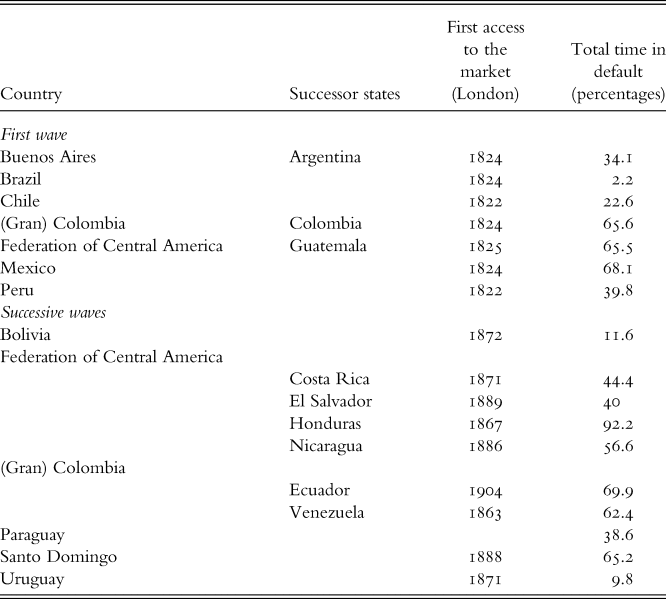
Table 1 shows the proportion of time during which Latin American countries were in default from first market access until 1914.Footnote 10 The upper part of the table includes the countries that accessed the market during the first wave of lending (during the 1820s), while the lower part displays those that entered the market thereafter. These figures provide a first insight into the strong diversity of experiences within the subcontinent and suggest that borrowers’ seniority and repayment records are unrelated. Brazil and Uruguay could be considered as good payers, as they were rarely in default (2% and 9% respectively). Brazil was among the first borrowers and ‘only’ defaulted twice by the end of the period (1898 and 1914) (Abreu Reference Abreu2006). Uruguay issued its first loan in London in 1864 and defaulted in 1876 and 1890. Interestingly, Brazil's domestic conditions were not unique in Latin America in terms of political and macroeconomic stability.
Entering the market and time in default, 1822–1914

Notes: Argentina assumed the debt of Buenos Aires in 1880. The Federation of Central America was dissolved between 1838 and 1840. According to the CFB (1915), there was a previous agreement (in 1827) on the shares of the first loan to be assumed by each country. The Republic of Colombia was divided into three separate countries in 1832 (New Granada, Ecuador and Venezuela), and a convention was agreed upon regarding the proportions of the first loan to be assumed by each country in 1834.
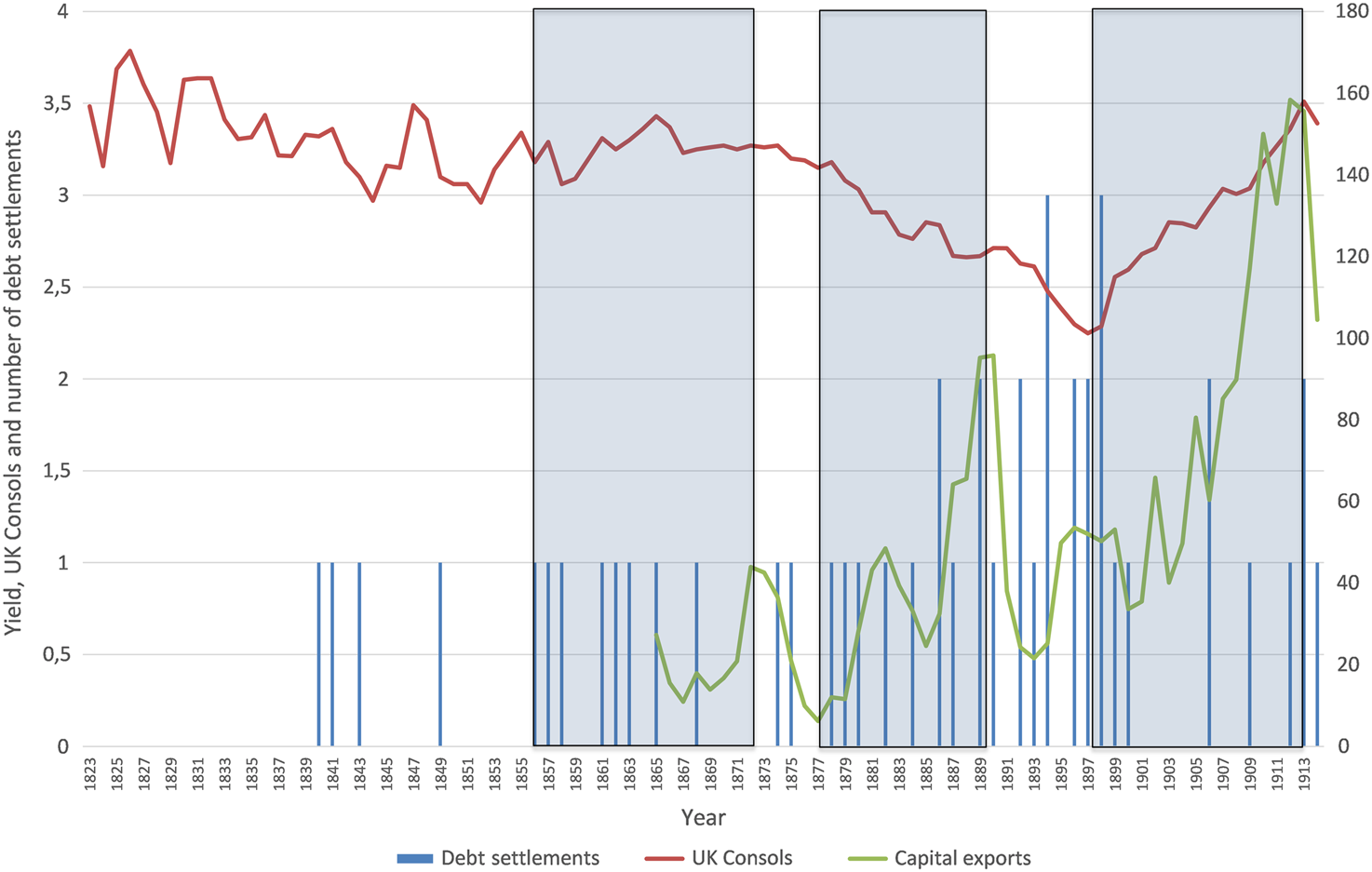
The relevance of supply-side factors in analysing the timing of debt settlements is shown in Figure 1. According to the narrative described above, we would expect that periods of high liquidity should foster the number of debt settlements, and be accompanied by new lending booms. The figure depicts the number of debt settlements per year between 1820 and 1914 (right axis) along with market conditions in the London sovereign debt market. As a liquidity measure, I include the yields paid by UK long-term bonds (UK consols), and the total amount of capital exports as computed in Stone (Reference Stone1999).Footnote 11 Debt settlements can be clustered around specific subperiods. Before 1855, we observe only four settlements that followed the first waves of defaults. This means that during three decades, governments from Latin America were unable (or unwilling) to reach a settlement with bondholders. On the contrary, between 1855 and 1867 – the years that preceded the formation of the CFB in 1868 – there were already six settlements.
Debt settlements, capital exports and UK consols, 1823–1914
Source: See text.

We cannot assess the relevance of supply-side factors during those years based on Figure 1, as UK consols were stable, and Stone's capital export series began only in 1865. However, historical narratives concur that lending to foreign governments soared since the late 1850s, and was interrupted by the world's economic crisis of 1873 (Marichal Reference Marichal1989; della Paolera and Taylor Reference della Paolera and Taylor2013). The recovery was rapid and the number of settlements in the late 1870s and early 1880s was accompanied by a decline in the yields of UK consols and by a renewed surge in capital exports. Finally, the export boom at the turn of the century was also preceded, in the late 1890s, by a high number of settlements.
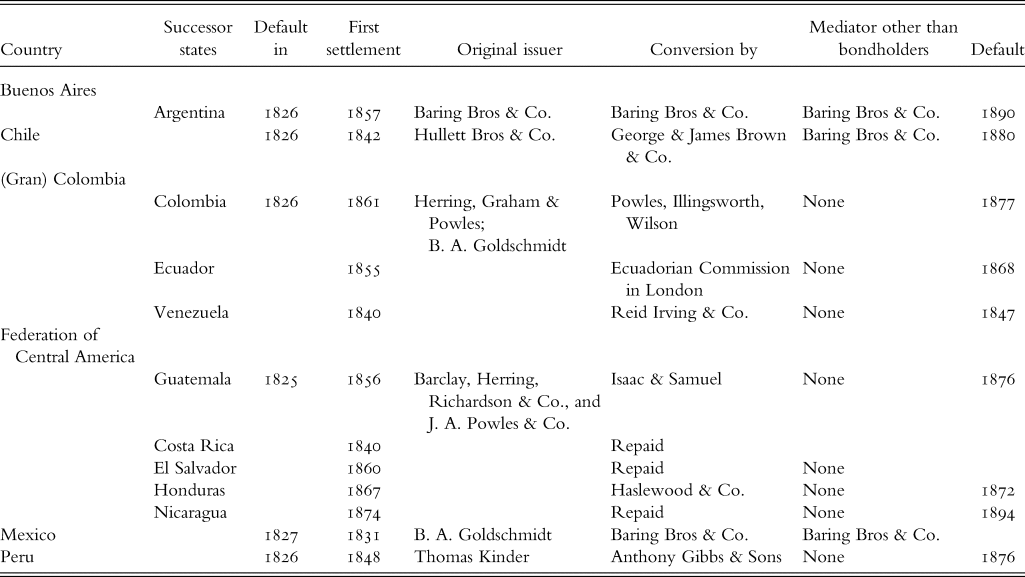
The capacity of governments to attract foreign loans during favourable junctures was enabled by a market structure capable of mobilising investors. The number and identity of intermediaries who intervened in different phases of a loan issue varied. Most of them were originally European merchants, now active in borrowing countries.Footnote 12 Through their privileged position as well-informed agents in both Europe and Latin America, they were also the first to detect the potential opportunities to issue loans in Europe's capital markets. However, the marginal nature of their underwriting activity meant that they held no moral obligation to intervene in case of default. Table 2 provides the names of the firms that were involved in the first wave of lending to Latin America, and also those of the intermediaries who participated in the negotiations of the subsequent defaults.Footnote 13
First settlements and role of merchant banks in the aftermath of the first wave of lending to Latin America

Sources: Corporation of Foreign Bondholders, Annual Reports (1874, 1877, 1915), Fenn (Reference Fenn and Nash1869), Fenn and Nash (Reference Fenn and Nash1883), Dawson (Reference Dawson1990), The Times and Flandreau and Flores (Reference Flandreau2009).
This first lending wave involved merchants and merchant banks from both sides of the Atlantic. For Colombia, Herring, Graham & Powles and B. A. Goldschmidt, contractors and issuers of the first loans, had obtained different concessions for gold mines in Colombia in a parallel activity to the loan issues (Liehr Reference Liehr1989). Powles Illingsworth, who participated in the bonds’ conversions, was a merchant house in London but had a permanent presence in Colombia, where their interests were concentrated in the mining sector (Mejía Cubillos Reference Mejía Cubillos2012). The Powles family had already been active as arms’ exporters and providers of short-term loans to Colombia in the 1820s (Flandreau and Flores Reference Flandreau and Flores2009). In Peru, Gibbs & Sons was a merchant house that had established commercial relations in South America since 1805. They became the sole firm in charge of Peru's guano export between 1840 and 1860, and had provided financial support to the government during periods of financial distress (Mathew Reference Mathew2009). In the case of Buenos Aires, the original contractors were Carlson, Castro & Robertson, the latter being originally Scottish merchants based in Liverpool and having a branch in Buenos Aires (Böttcher Reference Böttcher1996). These merchants had commercial relations with Baring, a connection that would lead to the loan issuing of 1824.
Table 2 also summarises the information on defaults and settlement years in the aftermath of the first lending boom of the 1820s. It confirms the fact that almost none of the original issuing houses was present as default mediators or as issuers of the bonds’ conversions with which defaults were settled.Footnote 14 This is striking if we consider that issuing houses were supposed to act as the financial agents of borrowing governments. They had the responsibility of paying the dividends and coupons of borrowing governments in Britain.Footnote 15 As Table 2 suggests, the relations between governments and their financial agents were mostly short-lived, and governments could decide to change for several reasons, or even abandon having any agent.Footnote 16 Obviously, financial agents had the same liberty to resign. In a default event, financial agents were also the first windows to which bondholders could address their claims, though they held no legal responsibility as to the fate of the bonds. This structure explains perhaps why original issuers and those in charge of the conversions were almost never the same agents. In fact, other than Baring, no other issuing house was also in charge of any conversion. The last column of Table 2 shows the name of the merchant bank that participated in the negotiations to resume payments when the bank acted either as the direct representative of the bondholders or else jointly with them, as reported either in the CFB Annual Reports or in the press (in particular The Times).
Not all Latin American governments had a permanent financial agent in London. Therefore, coupon payments and bonds’ conversions were directly assumed by diplomatic representatives. For instance, Ecuador's government had directly negotiated with bondholders, and it was the government's Commission in London that was in charge of coupon payments. This was also the case with most settlements of the Central American defaults, which involved the payment of cash representing a portion of their respective share of the original loan. These negotiations were characterised by the absence of intermediaries, being directly undertaken between governments’ and bondholders’ representatives. These negotiations were mostly concentrated on the amount of cash to be paid.Footnote 17 The private character of these disputes was particularly acute in the case of Nicaragua. Even if the CFB had been already established, the government negotiated directly with specific bondholders (i.e. no public announcement was issued). The Council of the CFB advised against the offer of the government, though a majority of bondholders ended up accepting the offer (Corporation of Foreign Bondholders (Great Britain) Council 1877, 1915).
In line with Flandreau and Flores's (Reference Flandreau and Flores2009) ‘reputation’ argument of financial intermediaries, we observe that Baring's behaviour towards Latin America's defaults was unusual. The bank had been the most important underwriting bank in London before the 1820s, mainly due to its successful floating of the 1817 and 1818 French loans (Cassis Reference Cassis2015, p. 115). However, during the first lending wave, Baring participated only marginally (their total market share was 10 per cent), the reasons for this being the cautious nature of the new bank's leadership.Footnote 18 Even so, the bank did not turn its back on Latin America – quite the contrary. Furthermore, Baring became the only bank that persisted, over decades, in defending the interests of bondholders. The correspondence on Baring's issues reveals that investors held Baring responsible for Argentina's default and it was with this bank that they sought information regarding negotiations with the government.Footnote 19
The record of Baring as capital market ‘gatekeeper’ and as bondholders’ defendant was, nonetheless, far from perfect. Baring had tried to persuade Argentina's government to resume debt repayment since its 1826 default, but did not succeed until three decades later. In 1842, the bank sent an agent, Francis Falconnet, to Buenos Aires where he acted as the principal negotiator with Argentina's government. Falconnet accomplished his mission and reached an agreement for the resumption of partial debt service in 1844, when the ongoing war against Uruguay was over. However, this agreement lasted only about a year, due to the Anglo-French blockade of Buenos Aires in 1845 (Ziegler Reference Ziegler1988, p. 111). Baring, along with British merchants, complained to the Foreign Office, although the blockade would not end until 1849. The final agreement was not reached until 1847.
Baring also participated in negotiations on defaulted loans to which the bank was initially unconnected, albeit with contrasting experiences. The bank assumed the agency for Mexico in 1826, Chile in 1844, Colombia in 1858 and Venezuela in 1859.Footnote 20 The reasons why Baring got involved in these countries are diverse, but were mostly related to commercial interests. In the case of Mexico, Baring had participated in the business of cochineal since colonial times (Ziegler Reference Ziegler1988, p. 32). It then became involved in a set of investments related to the mining sector (mainly silver) and agreed to assume the financial agency of the Mexican government in 1826, when the original underwriters went bankrupt (Ziegler Reference Ziegler1988, p. 106; Salvucci Reference Salvucci2009, p. 101). Baring was an effective mediator between bondholders and the government, and facilitated a first agreement for the resumption of payments with bondholders in 1831. However, the Mexican government was unable to keep its debt service stable (the country was experiencing civil conflict and the separation of Texas) and finally defaulted in 1836. Baring resigned as Mexico's financial agent because the bank was unable to obtain a proper engagement from the government to resume debt service (Costeloe Reference Costeloe2003, p. 34).
The correspondence between Baring and its agents in Mexico and Argentina shows that the bank continuously analysed the fiscal situation of the governments, and attempted to adapt (even if temporarily) the debt service that could be realistically requested. In Mexico, Baring further supported the idea of having bondholders’ representatives in charge of securing a portion of the Customs houses’ revenues in Veracruz and Tampico, and this was part of the agreement of the 1830 conversion plan. In the case of Chile, the final agreement of 1842 was reached under the auspices of Baring (Dawson Reference Dawson1990, p. 206). According to Ferrada Urzúa (Reference Ferrada Urzúa1945), the revenues of Chile's government had stabilised and increased in the years prior to the settlement. While Baring considered the bondholders’ claims and the annual repayment amounts they required, the bank analysed Chile's domestic conditions and the risks that could eventually entail further debt service interruptions. Even if this strategy did not always succeed, it allowed governments, to a large extent, to reach sustainable levels of repayment. Chile did not interrupt its debt service until 1880.
III
Historians disagree on the final balance that resulted from the cooperation between merchant banks and bondholders during negotiations with defaulting governments. In one instance, a prestigious bank (Rothschild) led the negotiations with Brazil's government in 1898 while consulting the CFB (Flandreau and Flores Reference Flandreau and Flores2012a). This was a successful case given the expediency of the negotiations and the low level of losses suffered by bondholders. Baring frequently cooperated with bondholders, even if this cooperation took different forms. Behr (Reference Behr1951) describes how Isidor Gerstenberg, the founder and first president of the CFB, initially attempted to involve Baring in the establishment of the new bondholders’ association in 1866. The bank refused, raising an argument of a potential conflict of interest, given the bank's relationship with sovereign issuers. Nevertheless, Baring's proximity to bondholders was developed through different paths. An illustrative example is the case of Baring's former agent in Argentina, Francis Falconnet, who subsequently became the (independent) representative of bondholders in Mexico in 1850, after Baring had resigned as Mexico's financial agent. When Baring resumed its attempts to settle Mexico's defaulted loans some years later, the bank became the formal representative of the Mexican Bondholder Committee (‘after years of persuasion, it should be added’ (Costeloe Reference Costeloe2003, p. 84)).
One may wonder whether Baring was also prone to conflicts of interest and promoted debt settlements with the sole aim of facilitating market access to former defaulters. Two of the debt settlements discussed above, Chile and Argentina, seem to contradict this possibility. In the case of Chile, the government undertook the construction of a railway in the aftermath of the debt settlement. While the government explored the possibility of issuing a foreign loan, it was obliged to finance the project by an internal loan. Baring did not enter into any new financial transaction before 1858. By then, Chilean finances had been stabilised and debt service had been met regularly.
In the case of Buenos Aires’ default of 1826, the government had sought to reach an arrangement involving the conversion of old bonds along with the issue of a new loan since 1832.Footnote 21 Baring rejected such propositions, given its concerns for the weak state of Argentina's public finances. Even in the aftermath of the debt settlement of 1857, Baring again refused to issue a loan on behalf of the Argentine confederation. The correspondence with a promoter is illustrative. A certain José Buschenthal had obtained a concession from Argentina's government to construct a railway between two Argentine provinces, Rosario and Cordoba, for which he asked Baring to issue a loan in London. In a letter dated 19 August 1858, Buschenthal introduced his proposal by recalling a previous attempt of his, to which Baring had supposedly replied that the
Buenos Aires bonds not being settled, we should find difficulties at noting the new loan in the Stock Exchange, and that it would be better to wait some time.
The reply encouraged Buschenthal to insist:
Considering the crisis over, the affairs of the Buenos Aires bonds arranged, and the commercial and political state of the confederation prosperous, I think the time came (to resume) the negotiation of the loan.Footnote 22
There were, nevertheless, other cases in which Baring accepted the issuing of a loan just after a debt settlement. Two relevant cases were Venezuela in 1862 and Mexico in 1864. In the case of Venezuela, Baring had expressed its reservations on issuing the new loan along with the conversion of the old, defaulted bonds (‘we are embarked, and it is now obligatory to conduct the ship to a safe port or sink with her’).Footnote 23 However, the bondholders had favoured this issue as the loan was to be used to pay old debts and ‘free’ the customs revenues from those creditors. Venezuela defaulted in 1864 in the aftermath of a civil war. In the case of Mexico, a loan was issued in 1864, when the political regime in Mexico had transitioned to a monarchy led by Maximilian I (from the House of Habsburg), and supported by the French government which had previously invaded the country in 1861. This new regime led to expectations of a period of political stability and sound public finances. Apparently, Baring had to compete with Rothschild who proposed to issue a loan with a French guarantee (Salvucci Reference Salvucci2009). However, Maximilian's regime turned out to be short-lived and financially weak. The retreat of the French from the country led to the fall of Maximilian's government and the repudiation of the loans in 1866.
It is very likely that Baring's approach as default manager was exceptional. According to contemporary documents, it may be safe to assert that conflicts of interest and ‘bad’ practices were common. In 1875 the British Parliament set up the Select Committee on Foreign Loans to investigate the alleged corruption in the loans issued on the London Stock Market. Its report describes different settlements that were reached only to allow defaulting governments to access the London debt market, even though those settlements were unsustainable from the borrowers’ perspective. This was the case with Honduras. According to the report, in the early 1860s the government had accumulated debts from the first (defaulted) loan of 1825, two internal loans, another one from a British merchant house (for the purchase of arms) and a final loan by the British government. The government recognised that additional funds, being required for the construction of a railway across the country, would only be available once an arrangement could be found for the defaulted federal debt.
The resolution contemplated the conversion of a specified sum on the face value of the original bonds and the capitalisation of the arrears, adding up to about 90,000 pounds sterling. The conversion was part of a new issue, which foresaw a total amount of one million pounds sterling. As the author of the report recognised, this sum was simply unaffordable:
It will be easily understood that the Republic of Honduras had not the state of material development, density of population, favourable conditions of finances, organised resources, or industry and commerce, to be in the most appropriate position for the issue of a million sterling with probability of success in the English market; that is, a loan thirty-six times greater than that part of the Federal debt belonging to Honduras, which had just been arranged, and the interest on which the Republic had neither been able to pay, nor to give anything on account of it for forty years.Footnote 24
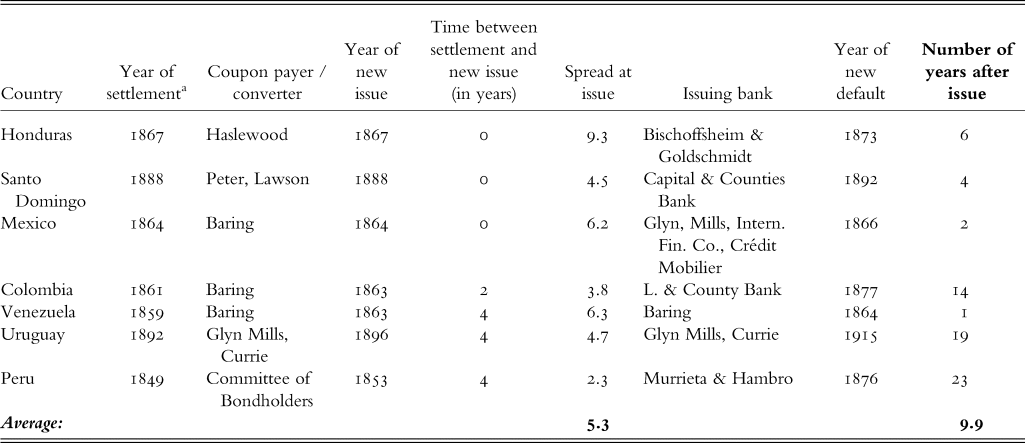
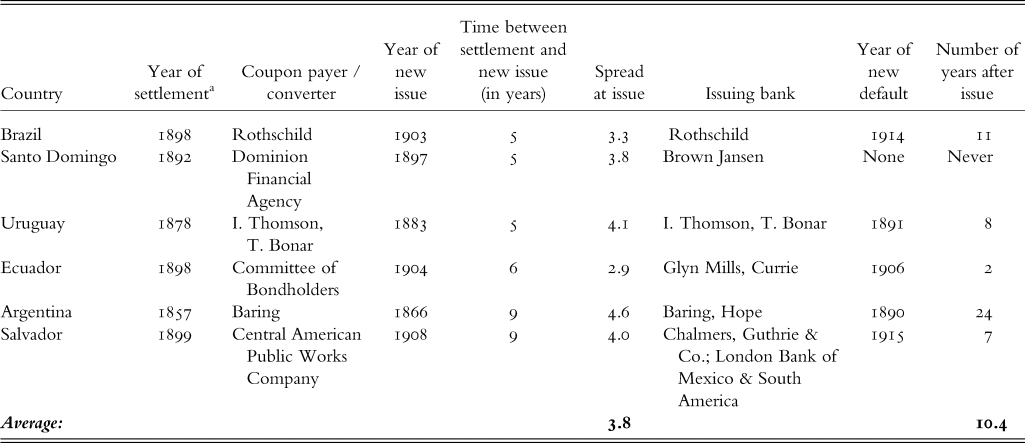
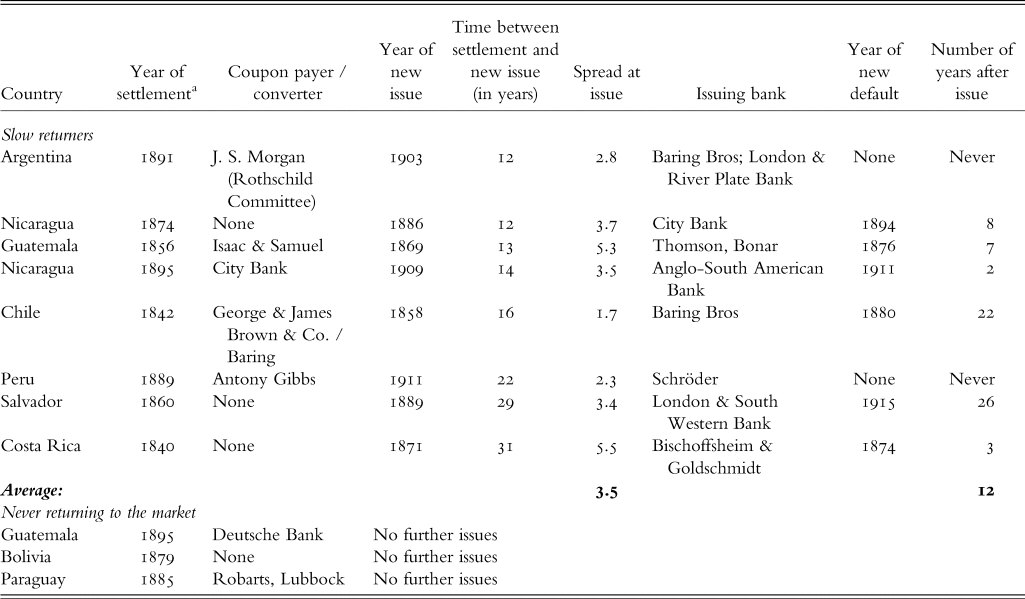
The question that emerges is whether the Honduras model predominated and if so, whether this was related to Latin America's high propensity to default. Tables 3a–c report all the loans issued by Latin American governments that were issued after a debt settlement and the time elapsed between the end of a default and the renewed access to the market. These tables also show the spreads at issue of the new loans, the time elapsed before they entered into default, and the identities of underwriters. We could expect that investors, knowing that a settlement was reached with the sole purpose of a government being allowed to re-enter the market, also expected that the new bonds had a higher probability of default. Such a prospect would therefore imply that these bonds would offer higher yield premiums. To test this hypothesis, Table 3 is divided into three groups according to returning expediency: (a) the most rapid returning governments that re-entered the market up to four years after a settlement; (b) those that returned ‘on average’ (5 to 9 years), and finally, (c) those that were slow-returning (12–31 years). Table 3c also includes governments that never returned to the market.
Rapid returning governments

a Last year of default.
Sources for Tables 3a–c: Corporation of Foreign Bondholders, Annual Reports (several issues), The Times and Flandreau et al. (Reference Flandreau, Flores, Gaillard and Nieto-Parra2010).
Average returning governments

a Last year of default.
Slow returning and never returning borrowers

a Last year of default.
Several features stand out. Among the eight rapid-returning governments, three issued new loans almost at the same time as they settled their previous debts (conversions were undertaken along with a call for new capital). They were also those that defaulted most rapidly (within two to six years; only Venezuela fared worse, defaulting the year after the loan issue). In comparison, the loans for Colombia, Uruguay and Peru did not default until at least one decade after the year of issue. Expectedly, spreads at issue were the highest for this group of countries, even if they showed a strong variation.Footnote 25 By contrast, slow-returners display the lowest spreads at issue. Governments that returned to the market more rapidly were also those that had the highest spreads and those that also defaulted more rapidly. The opposite holds for slow returners, even though this group includes loans that did not default (Argentina and Peru) and the case of Chile, discussed above, and whose partial default took place 22 years after the new loan had been issued.Footnote 26
Regarding the attitude of investors towards rapid-returning governments, it is very telling that the press and bondholder circles often commented when a settlement was reached with the purpose of having a government return to the market, further supporting the idea that these issues were those with the highest spreads at issue. In the case of the Honduras loan – which had a spread at issue of 9.7, the highest from all the loans from Tables 3a–c – the CFB (1915) stated that the settlement was effected in preparation of a loan the governments aimed at floating for the construction of an inter-oceanic railway. The Times warned investors: ‘Without any disparagement to the honesty of the intentions of the Honduras Government, it may be assumed that its financial ability is too weak and untried.’Footnote 27 In the case of Santo Domingo, the negotiations for the settlement of the default had been very complicated, with the estimated bondholders’ losses being around 90 per cent.Footnote 28 According to The Times, and as described in the CFB Annual Report for 1898, the bondholders had initially refused the offer, although they ended up accepting as the government's representative threatened them with repudiation.Footnote 29
Tables 3a–c do not consider the loans issued privately nor the issues that took place in other financial markets, but the message does not seem to be different for these loans. So, for instance, Guatemala's government settled its default in 1856, and privately issued a loan in 1863 (a rapid returner) that defaulted one year thereafter (CFB 1915). The government of Bolivia was unable to borrow in London after its debt settlement of 1879, even though the government managed to issue a new loan in Paris in 1905 (a slow returner), on apparently advantageous conditions. I calculate the spread at issue of 1.55 per cent.Footnote 30 The issue took place 26 years after the settlement with British investors. By comparison, Santo Domingo's Paris loan of 1895 (three years after settlement with the CFB, a rapid returner) defaulted four years later.
IV
In this article, I introduced a different explanation of why Latin American governments defaulted so frequently. The market framework that dominated European financial centres provided governments with a readily available source of funds, which they frequently resorted to. Latin America's domestic conditions did not allow governments to secure a stable capacity to repay the debt contracted. Nevertheless, even if most of Latin American bonds were considered as a speculative investment, the price that governments were obliged to pay was equally high. This dependence on foreign finance was also a reflection of the underdevelopment of the region's domestic financial markets.
One may wonder whether financial intermediaries should have better screened the borrowers that accessed London's capital market and prevent defaults. This is how certain banks, such as Baring and Rothschilds, generally operated. However, their market share diminished in periods of high liquidity, and other banks looking for short-term gains were willing to issue high-risk bonds. Even if the London Stock Market and the CFB pressed merchant banks and governments to satisfy the claims of bondholders, they were not responsible for market screening and vigilance. In periods of high liquidity, bondholders were also willing to invest in high-risk assets, while merchant banks were willing to provide intermediation services. This process did not involve the CFB, and investors could only attempt to properly assess the risk from the new bonds. These periods also coincided with rises in Latin America's external debt.
A major implication, as presented in this article, was Baring's strategy of credit withholding, as shown in the cases of Argentina and Chile. This was also the case with Rothschild towards Brazil, which prevented an increase of the government's indebtedness since the late 1880s, as the country was unable to redress its fiscal imbalance and its currency depreciation. These countries were, unsurprisingly, the countries with the lower frequency of defaulting, along with Uruguay, also a ‘Baring country’. By preventing these governments from contracting loans they could not repay, their borrowing record also improved.