Over-conditioning at calving, i.e. overweight, over-fat and/or oversize, has a deleterious effect on dairy cows' health and performance (Rukkwamsuk et al., Reference Rukkwamsuk, Kruip and Wensing1999; Dann et al., Reference Dann, Morin, Bollero, Murphy and Drackley2005, Reference Dann, Litherland, Underwood, Bionaz, D'Angelo, Mc Fadden and Drackley2006), but it also affects milk composition (Mann et al., Reference Mann, Yepes, Overton, Wakshlag, Lock, Ryan and Nydam2015). Over-conditioning is generally associated with increased frequency of dystocia problems and calving difficulties, which often result in premature culling. In the particular case of over-conditioning at calving, feed intake at the beginning of lactation is reduced, and energy requirements for maintenance, growth and milk production are generally not fulfilled. Most published studies on feeding strategies during gestation have focused on multiparous cows, with a special emphasis on dry period management (Mann et al., Reference Mann, Yepes, Overton, Wakshlag, Lock, Ryan and Nydam2015).
In the present work we hypothesised that over-conditioning is also a concern for heifers, especially in early maturing and fast growing breeds such as Holstein if they first calve at an older age (30 to 36 months of age). Indeed, despite many studies published on the interest of decreasing age at first calving down to 24 months of age (Le Cozler et al., Reference Le Cozler, Lollivier, Lacasse and Disenhaus2008, for a review), it is not uncommon that Holstein heifers still first calve at around 30 months of age or more. This could be the case in seasonal calving systems, where heifers and cows have to be successfully pregnant within a limited reproductive period in time, generally 2 to 3 months (Lane et al., Reference Lane, Crowe, Beltman and More2013). In case of failure to conceive in time, heifers are either culled or rebred 9 to 10 months later (Le Cozler et al., Reference Le Cozler, Lollivier, Lacasse and Disenhaus2008; Le Cozler et al., Reference Le Cozler, Peyraud and Troccon2009). In a strategy of first calving at 2 years of age, breeding can also be generally delayed for heifers born late in the season up to 23–26 months of age, resulting in first calving at 32–36 months of age. Although first calving at 36 months of age is not recommended, these animals are interesting models to create significant differences in body weight and body condition at first calving in dairy cows, and to study the impact of over-weighing/over-fattening on the performance of primiparous cows. The present experiment aimed at studying the effects of 2 levels of feeding during mid- and late gestation (low (L) vs. high (H)) on the body performances of primiparous Holstein heifers, as well as the impact on milk production and composition.
Materials and methods
General purpose
The experiment took place at the INRA experimental farm at Mejusseaume–Le Rheu, in western France (48°11′N; 1°71′W; altitude 35 m), where a calving season strategy during autumn (September to December) is applied. This experimental work has been conducted during Spring and Summer 1996 and 1997, in accordance with the French national legislation on the use of animals for research. Two replicates were performed to get enough animals per treatment and to test any possible year effect. In this experimental herd, heifers usually first calve at 24 months of age. However, for those born late in the season or when development is considered to be insufficient for a first calving at 24 months of age, reproduction is delayed for a first calving at 32–36 months of age. The present experiment was performed on 2 successive years on these late weaned animals. It comprised a total of 47 gestating Holstein heifers, selected at an average age of 27 months and a body weight (BW) of 570 kg. All of them had completed the early gestation stage (0–3 months) and had just entered mid-gestation stage (3 to 4 months) at the beginning of the experiment.
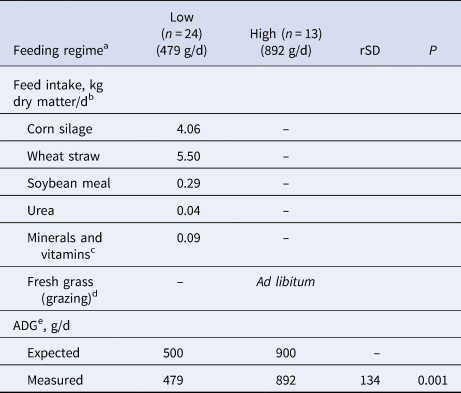
The experimental period started in March and ended in August. The 47 heifers were allocated to 2 groups, according to the merit of their parents (milk yield and composition of the mother, and genetic index of father), BW and age. The experimental design consisted of either a high (H) or low (L) level of feeding until 3 weeks before the expected calving date, in order to achieve an average daily gain (ADG) of 900 g/d and 500 g/d for H and L heifers, respectively. The daily energy requirements (per unit feed per litre, UFL) and daily expected protein digestible in the intestine (PDI, per g) were then equal to 6.5 and 580, and 8.6 and 676 for L and H heifers, respectively (INRA, 2007). Two feeding treatments were applied, and consisted of (Table 1):
• ad libitum grazing for the H heifers (24 h/d), with free access to good quality grass, complemented with minerals and vitamins according to recommendations (INRA, 2007);
• a daily amount of 10 kg DM/d/heifer of a total mixed ration (TMR) of corn and/or grass silage plus soybean/rapeseed meal, complemented with minerals and vitamins, for L heifers. The TMR was distributed every day on a group basis (5–6 heifers per group). Refusals, if any, were collected and weighed every week. L heifers were all housed indoors, on a deep straw bedding with fresh straw distributed every day. Because of the variations in ingredient composition, the ration was complemented with urea when necessary, to fulfil the INRA recommendation for heifers to achieve an expected gain of 500 g/d (INRA, 2007). During the experiment, heifers had free access to good quality wheat straw. Possible intake of such a straw was not considered in the final analysis about feed intake.
Feeding treatments fed to Holstein heifers during mid- and late gestation to study performance on first lactation (Lsmeans values)

rSD, Residual standard error.
a High (H) or Low (L) level of feeding until 3 weeks before expected date of calving, in order to achieve an average daily gain of 900 g and 500 g, respectively.
b Average composition: corn silage: 35%; DM; per kg DM: 0.91 UFL, 71 g PDIN, 28 g PDIE; wheat straw: 88%; DM; per kg DM: 0.42 UFL, 22 g PDIN, 44 g PDIE; soybean meal: 88%; DM; per kg DM: 1.21 UFL, 443 g PDIN, 426 g PDIE.
c Mineral content (per kg): 8 g P, 23 g Ca, 5 g Mg, 5000 mg Zn, 5000 mg Mn, 12 mg Se, 40 mg I, 10 mg Co, 4 00 000 IU vit. A, 80 000 IU vit. D3, 1 000 000 IU vit. E.
d Composition of fresh grass: not available.
e ADG: average daily gain, from end of month 3 of gestation until week 3 before expected parturition.
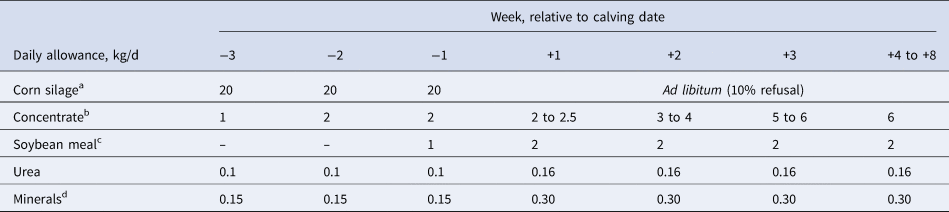
Three weeks before the expected date of calving, all heifers were housed indoors, together with multiparous cows, in a cubicle barn with fresh straw bedding distributed daily. Heifers were fed individually and received a daily TMR composed of corn silage (7 kg DM), concentrate (1 kg), urea (100 g), and a mineral/vitamin complement (150 g, with 7% P, 22%; Ca and 4%; Mg) (Table 2). During weeks 2 and 1 before the expected date of parturition, the individual TMR was completed daily with an additional 1 kg of concentrate and an additional 2 kg of concentrate and 1 kg of soybean, respectively. After calving, cows individually received corn silage ad libitum (i.e., 10% refusal at least per day), 2 kg/d of soybean meal, completed with 160 g/d of urea and 300 g/d of a mineral/vitamin complement (7% P; 22% Ca and 4% Mg). From calving until week 4 post-partum, the level of concentrate was increased from 2 to 6 kg/d/heifer. The concentrate was then limited to 6 kg/d until the end of the experiment (week 8). This feeding strategy was calculated for an estimated milk production basis of 31 kg/d/cow. Feed was distributed twice a day (9.00 and 16.30).
Feeding allowance during the last 3 weeks of gestation and during the beginning of lactation (0 to 8 weeks)

a Corn silage: 35% DM; per kg DM: 0.91 UFL, 71 g PDIN, 28 g PDIE.
b Wheat straw: 88% DM; per kg DM: 0.42 UFL, 22 g PDIN, 44 g PDIE.
c Soybean meal: 88% DM; per kg DM: 1.21 UFL, 443 g PDIN, 426 g PDIE.
d Mineral content (per kg): 7 g P, 22 g Ca, 4 g Mg.
During the entire experiment, all heifers and cows had free access to fresh water.
Measurements
Heifers were weighed every month during gestation and every week during lactation, the latter just after milking and before they had access to feed. Body condition score (BCS) was determined by three trained technicians using the method and 0–5 point scale developed by Bazin et al. (Reference Bazin, Augeard, Carteau, Champion, Chilliard, Cuylle, Disenhaus, Durand, Espinasse, Gascoin, Godineau, Jouanne, Ollivier and Remond1984) at the beginning of the experiment, before calving, and, on average, during week 6 of lactation, in addition to four routine measurements made weekly during the first month post-partum.
Feed composition was estimated based on average samples for corn silage, straw, soybean, and concentrate. No such information was available for fresh grass. This corresponded for corn silage to 35% DM and per kg DM, to 0.91 UFL for energy, and 71 g PDIN (protein truly digested in the small intestine limited by energy supply; Jarrige, Reference Jarrige and Libbey1989) for protein; for wheat straw to 88% DM and per kg DM, 0.42 UFL, and 22 g PDIN; and for soybean meal to 88% DM and per kg DM, 1.21 UFL, and 443 g PDIN. During lactation, daily feed intake was calculated individually as the difference between daily feed allowance and refusals. Refusals were collected every day at 7.00 and weighed. The composition of refusal and allowance were presumed to be the same. Dry matter (DM) for silage was determined 5 times per week, while other DM (concentrate, soybean meal, etc.) were determined once per week.
Milk production was automatically recorded during each milking, twice/d. During 6 successive milkings (Tuesday to Thursday), milk samples were collected and analysed from each cow, to determine fat and protein contents (Milkoscan, Foss Electric, DK-3400 Hillerod, Denmark). The composition of milk fatty acids was determined based on samples collected during the Wednesday morning milking, during weeks 3 and 6.
A blood sample (20 ml) was collected with heparin as an anticoagulant during weeks 2, 4, 6 and 8 of lactation. This was done on Tuesday mornings, after milking and before access to fresh rations. After centrifugation (15 min at 3000 rpm), plasma samples were stored until laboratory analysis (glucose, beta-hydroxybutyric acid (BHBA), non-esterified fatty acid (NEFA), and urea). To follow the cyclicity of primiparous cows, a 5 ml blood sample was collected from the jugular vein into heparinised vacutainer tubes every 10 d, starting at day 7 of lactation. During analyses, when progesterone levels were higher than 1 ng/ml, animals were considered to be cyclic. Oestrus behaviour was also closely observed and noted by trained technicians.
Laboratory analysis
Automated enzymatic methods using a Cobas Mira multichannel analyser (Roche, Basel, Switzerland) were performed to determine concentrations of glucose (bio-Merieux; Marcy l'Etoile, France), NEFA (Wako Chemical NEFA C; Unipath, Dardilly, France), urea (Roche, Neuilly-sur-Seine, France) and BHBA (3-HB-dehydrogenase method; 3-d-hydroxybutyrate kit; Randox Laboratories Ltd., Crumlin, UK).
Milk fatty acids were determined by gas chromatography of the butyl esters of fatty acids, on an a-polar capillary column after alcoholic extraction of the fat from milk preserved at −15 °C (in the presence of hydrochloric acid). The temperature of the chromatograph was programmed to separate acids ranging from 4 to 18 carbons. Milk fatty acids were analysed to determine the percentages of short, medium, and long fatty acids, according to the method described by Hurtaud et al. (Reference Hurtaud, Rulquin and Vérité1993), based on the method developed by Bauchard and Duboisset (Reference Bauchard and Duboisset1983). Briefly, milk fatty acids were transesterified with 1 ml of a methanol-NaOH solution (100/2, vol/wt) followed by 0.5 ml of methanol/boron trifluoride (100/20, vol/vol), and 2 ml of hexane. Fatty acid methyl esters were then injected into a gas chromatograph (Varian 3400, Les Ulis, France) equipped with an electron ionisation detector. The carrier gas was helium. The oven temperature was programmed from 70 to 220 °C at 100 °C/min, and held for 32 min. The injector and detector temperatures were 220 and 250 °C, respectively.
Calculations and statistical analysis
The net energy balance (NEB) was determined as the difference in energy input (feed) and output (milk), expressed per unit feed per litre (UFL; INRA, 2007). During lactation, dry matter (DM) was determined 5 times/week on corn silage and once/week on soybean and concentrate samples, respectively. Energy content of corn, concentrate and soybean was then estimated on a DM basis from reference values (INRA, 2007) and it was calculated for milk, according to its composition.
Statistical analyses were performed using GLM procedures on SAS Software (SAS 9.3, SAS Institute Inc., Cary, NC). To study feed intake, average milk production and composition, BW, and BCS changes, the model included the effect of the year of experiment, feeding treatment during mid and late gestation (High vs. Low), and their interaction. Individual cow effect was nested in the feed level. A similar model was used and completed by the effect of the week of lactation as follows:
• weeks 3 and 6, to study changes in fatty acid composition during lactation
• weeks 2, 4, 6 and 8, to study average values of NEFA, glucose, urea, and BHBA.
Non-significant effect or interaction was removed and analysis was performed again.
No statistical analysis was performed on reproduction data due to the limited number of animals regarding this aspect. However, the results will be briefly presented, as well as the results at the start of second lactation. Mean values are presented and comparisons with P < 0.01 were declared highly significant and P < 0.05 significant.
Results
Of the 47 gestating heifers that entered the experiment at an average age of 1054 (±59) d, only 39 were kept in the final analysis. Reasons for removing were abortion (2 H), death at calving (1 H and 1 L), and culling before week 8 of lactation due to health problems (mastitis and legs disorder; 2 H and 2 L).
Body weight (BW) and body condition score (BCS) changes
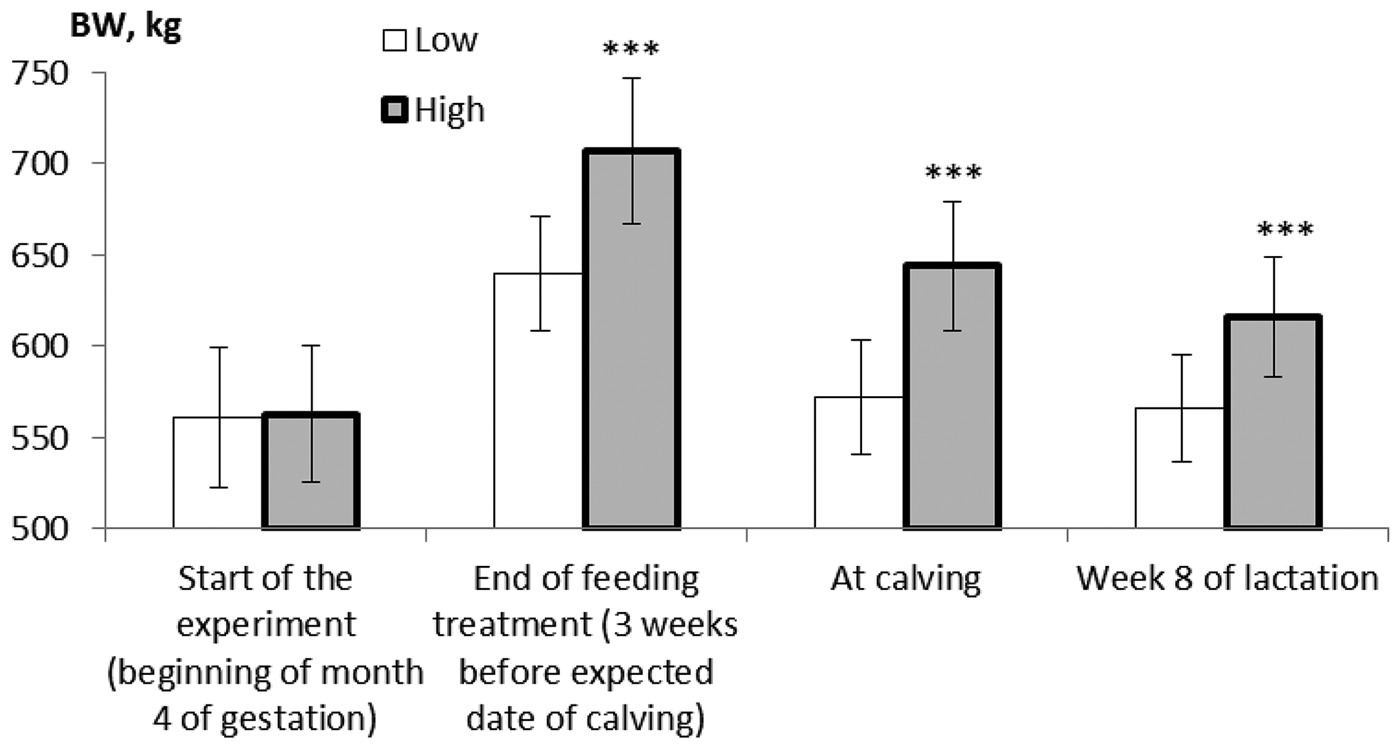
L and H heifers weighed 561 ± 33 and 563 ± 37 kg at the start of the experiment, respectively (Fig. 1). At the end of this experimental treatment, i.e. 3 weeks before the expected date of calving, they weighed 640 ± 31 and 707 ± 40 kg, respectively (P < 0.001), corresponding to an ADG of 479 and 892 g/d (P < 0.001). After calving, L and H cows weighed 572 ± 31 and 644 ± 35 kg, respectively (P < 0.001). During lactation (weeks 1 to 8), the BW of L cows did not vary (571 kg on average) but it decreased significantly for H cows (643 to 605 kg).
Effect of increasing average daily gain from 4 month of gestation until 3 weeks before expected calving on body weight (BW) of Holstein heifers during gestation, at calving and at week 8 of lactation (means value ± standard deviation). High and Low corresponded to average daily gain of 892 g/d (expected: 900 g/d) and of 479 g/d (expected 500 g/d) from 4 month of gestation until 3 weeks before expected calving. H heifers grazed ad libitum and L heifers received a total mixed ration limited to 9.98 kg/DM/d/heifer of corn silage, wheat straw, soybean meal, urea and minerals and vitamins. At each stage of growth, *** represent a significant difference at P < 0.001.

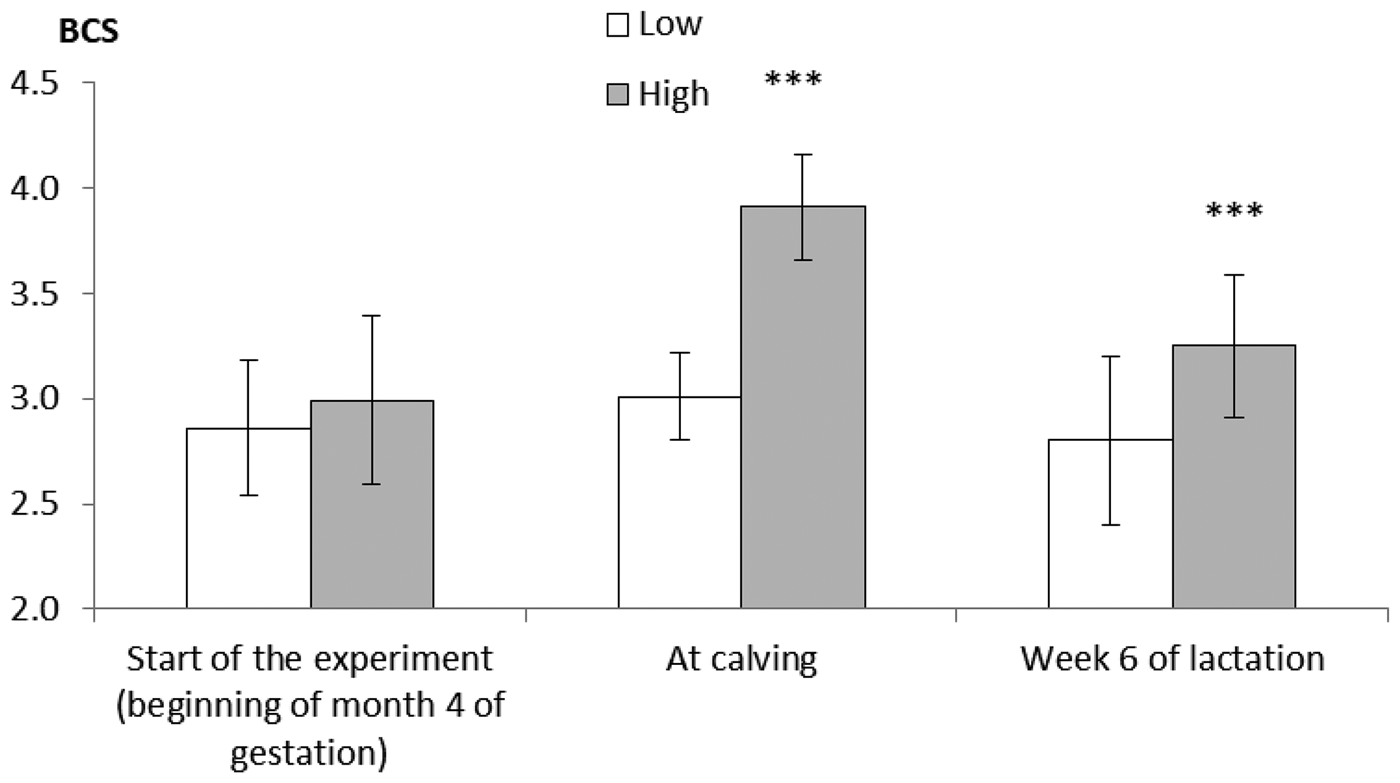
BCS was 2.86 ± 0.32 and 2.99 ± 0.40 at the start of the experiment for L and H heifers, respectively (no difference). It increased up to 3.01 ± 0.21 and 3.91 ± 0.25 at calving, respectively (Fig. 2; P < 0.001). From weeks 1 to 6 of lactation, BCS decreased by 0.21 and 0.66 for L and H cows, respectively (P < 0.05).
Effect of increasing average daily gain from 4 month of gestation until 3 weeks before expected calving on body condition score (BCS) of Holstein heifers at calving and at week 6 of lactation (means value ± standard deviation). High and Low corresponded to average daily gain of 892 g/d (expected: 900 g/d) and of 479 g/d (expected 500 g/d) from 4 month of gestation until 3 weeks before expected calving. H heifers grazed ad libitum and L heifers received a total mixed ration limited to 9.98 kg/DM/d/heifer of corn silage, wheat straw, soybean meal, urea and minerals and vitamins. At each stage of growth, *** represent a significant difference at P < 0.001.

Feed intake and energy balance
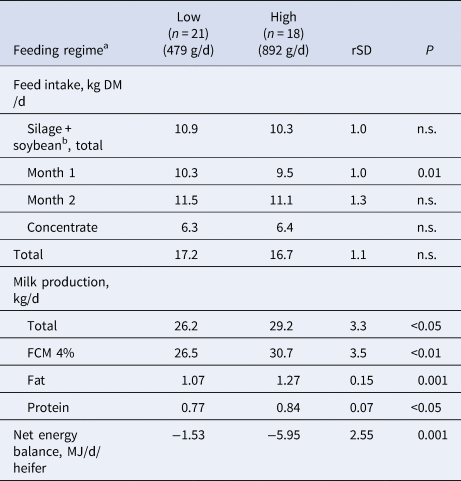
From weeks 1 to 8 post-partum, feed (corn silage + soybean meal ration) intake was numerically higher in L cows in comparison with H cows (10.9 vs. 10.3 kg DM/d/cow; Table 3; n.), with a significant difference during the first month of lactation: 10.3 vs. 9.5 kg DM/d/cow. Daily corn silage intake increased from 4.6 up to 8.9 kg DM during this period (soybean meal remained at 2 kg DM/d/cow during this period). The highest differences between treatments were noted during week 2 ( + 1.4 kg DM/d/cow; P < 0.01) and 3 ( + 0.9 kg DM/d/cow; P < 0.05) in favour of L cows.
Effect of feeding regime fed to Holstein heifers during mid- and late gestation on performance during first lactation, from calving until end of week 8 of lactation (Lsmeans values)

FCM 4%, Fat-Corrected Milk 4%.
rSD, Residual standard error.
a High (H) or Low (L) level of feeding until 3 weeks before expected date of calving, in order to achieve an average daily gain of 900 g and 500 g, respectively. Only cows having successfully completed the first 8 weeks of lactation are included. Composition: corn silage: 35% DM; per kg DM: 0.91 UFL, 71 g PDIN, 28 g PDIE; wheat straw: 88% DM; per kg DM: 0.42 UFL, 22 g PDIN, 44 g PDIE; soybean meal: 88% DM; per kg DM: 1.21 UFL, 443 g PDIN, 426 g PDIE.
b Soybean meal: 2 kg/d.
Based on feed composition, we calculated that during the gestational treatment period, L cows received 11.73 MJ net energy (NE) per day to achieve an ADG of 480 g/d, whereas for an ADG of 890 g/d, the H cows individually consumed 11.66 MJ NE per day. During lactation, each H cow exported 3.145 MJ NE/d more in their milk compared to L cows. We thus calculated a negative energy balance (allowance – requirement) of −5.95 and −1.53 MJ NE/cow/d for H and L cows, respectively (P < 0.001).
Milk production and composition
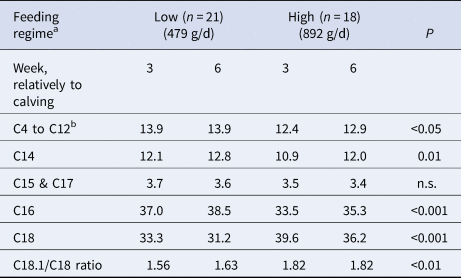
On a daily basis from parturition until the end of week 8, H cows produced more milk (29.2 vs. 26.2 kg; P < 0.05), protein (0.840 vs. 0.477 kg; P < 0.001), and fat (1.27 vs. 1.07 kg; P < 0.05) in comparison with L cows (Table 3). Fat concentration in the milk was higher for H cows (41.6 vs. 44.4 g/kg, respectively, P < 0.01), but no difference was observed in protein concentrations between treatments. Except for fatty acids with C15 and C17 chains, all other fatty acid concentrations were affected by the feeding treatment, without any effect of the week of lactation (Table 4). Only C18 fatty acid concentration was higher in H cows: more than 36.2 vs. less than 33.3% (P < 0.001). The ratio (C18.1/C18) was lower for L than for H cows (P < 0.01).
Effect of feeding regime fed to Holstein heifers during mid- and late gestation on the composition of free fatty acids in milk (%)

a High (H) or Low (L) level of feeding until 3 weeks before expected date of calving, in order to achieve an average daily gain of 900 g and 500 g, respectively. Only cows having successfully completed the first 8 weeks of lactation are included.
b C4 to C18.1: corresponded to fatty acid chain length.
Blood parameter changes
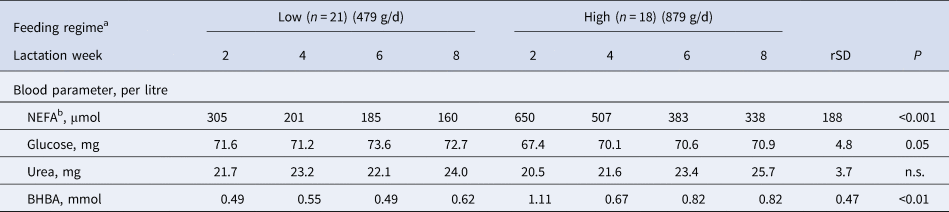
From weeks 2 to 8 post-partum, serum NEFA concentration decreased regularly, but always remained twice as high in the sera of H cows in comparison with L cows, regardless of the week of lactation (Table 5; P < 0.001). BHBA was also lower in L cows' sera (P < 0.01), with the highest difference observed during week 2 (0.49 vs. 1.11 mmol/L; P < 0.001). Glucose was higher in L than in H cows' sera (P < 0.05). No difference between treatments was noted regarding urea concentration.
Effect of feeding regime fed to Holstein heifers during mid- and late gestation on blood metabolites during early lactation (Lsmeans values)

rSD, Residual standard error.
a High (H) or Low (L) level of feeding until 3 weeks before expected date of calving, in order to achieve an average daily gain of 900 g and 500 g, respectively. Only cows having successfully completed the first 8 weeks of lactation are included.
b BHBA: beta-hydroxybutyric acid; NEFA: non-esterified fatty acid.
Reproduction and further performances (data not presented)
Progesterone analysis indicated that 34 dairy cows were cyclic on average 30.9 ± 9.9 d after calving, whereas oestrus detection based on animal behaviour recorded by technicians indicated an average post-partum interval age of 52.3 ± 21.4 d for these 34 cows. Anoestrus was detected in 5 cows (1 H, 4 L), and 1 cow (H) failed to conceive in time. At the end of the reproduction period, 33 cows started a new gestation and successfully calved for their second lactation. Immediately after second calving, cows weighed 655 (L) and 660 (H) kg, corresponding to an increase in BW of 84 and 15 kg (P < 0.01) between first and second calving for L and H cows, respectively. During the first two months of second lactation, they respectively produced 34.7 (L, n = 16) and 35.2 kg (H, n = 15) kg milk/d, without any difference in milk yield, protein, and/or fat concentration.
Discussion
The present study investigates the effect of different strategies during mid and late gestation in gestating heifers and the consequences of relative over-conditioning on the start of first lactation. Although it was not possible to measure it for animals while in pasture, we assumed that the higher growth performances, with higher BW and BCS at calving, was due to higher feed intake for grazing heifers, and this included energy and protein intake. Feed composition, not only intake, might also have an impact on subsequent performance, as already noticed during rearing prior to conception (Le Cozler et al., Reference Le Cozler, Peyraud and Troccon2009). However, feed allocations were the same for all animals during the last few weeks before calving, in order to avoid any effect of energy during the close-up period prior to calving that can lead to effects on metabolism and milk production.
As expected, a high level of growth during this period resulted in relative over-conditioning (higher BW and BCS), which indicated that energy intake was higher for H heifers than for L heifers. Thereafter, primiparous cows with both higher BW and BCS (H group) produced more milk, with higher milk concentrations of protein and fat, but also had reduced daily feed intake. As a result, they lost more body weight and body reserves at the beginning of lactation, in accordance with previous results published by Agenäs et al. (Reference Agenäs, Burstedt and Holtenius2003) and Dann et al. (Reference Dann, Litherland, Underwood, Bionaz, D'Angelo, Mc Fadden and Drackley2006). Because milk production increased faster than feed intake, cows usually experienced a negative energy balance. The NEB after calving calculated in the present study indicated that it was also affected by the level of energy intake during gestation. Janovick et al. (Reference Janovick, Boisclair and Drackley2011) and Mann et al. (Reference Mann, Yepes, Overton, Wakshlag, Lock, Ryan and Nydam2015) advised that overfeeding energy prior to parturition should be avoided to prevent such a negative NEB. A higher NEB is associated with higher lipolysis, as reflected by higher circulating levels of NEFA and glucose in the sera of H cows, and, to a lesser extent, with BHBA in animals' blood (Rukkwamsuk et al., Reference Rukkwamsuk, Kruip and Wensing1999). Holtenius et al. (Reference Holtenius, Agenäs, Delavaud and Chilliard2003) also noted that overfeeding during the dry period resulted in a higher level of circulating NEFA and reduced feed intake, in accordance with other authors who generally found an increase in feed intake at the start of lactation with restricted-energy diets prior to parturition (Dann et al., Reference Dann, Litherland, Underwood, Bionaz, D'Angelo, Mc Fadden and Drackley2006; Douglas et al. Reference Douglas, Overton, Bateman, Dann and Drackley2006). However, such results were not observed by Agenâs et al. (Reference Agenäs, Burstedt and Holtenius2003) and Mann et al. (Reference Mann, Yepes, Overton, Wakshlag, Lock, Ryan and Nydam2015).
The higher fat concentration in the milk of H cows also reflects this higher mobilization (Palmquist et al., Reference Palmquist, Beaulieu and Barbano1993), since the fat content in the milk is directly correlated with plasma NEFA concentrations (Pullen et al., Reference Pullen, Palmquist and Emery1989). It is thus not surprising to find a higher concentration of preformed fatty acids (chain with more than 16 carbons) in the milk of H cows. The difference in concentration of these fatty acids between weeks 3 and 6 indicated that this phenomenon (higher lipid mobilisation for H heifers) persisted during the beginning of lactation, in accordance with Mann et al. (Reference Mann, Yepes, Overton, Wakshlag, Lock, Ryan and Nydam2015). The utilisation of body reserves, i.e. fat content, results in triglycerides and glycerol in plasma, which are of importance for gluconeogenesis. In excess, fatty acids are transformed into ketones, which are associated with decreased feed intake and consequently, losses of body reserves and reduced milk production. High levels of BHBA after calving are thus generally considered to be a good indicator for risks associated with hyperketonaemia post-partum. However, no ketosis was noted in the present study, probably because of the primiparous status of the animals, which are generally less sensitive to ketosis, and because for ketosis occurrence, BHBA concentration should be higher than 1.2 mmol/l (van der Drift et al., Reference Van der Drift, Houweling, Schonewille, Tielsens and Jorritsma2012; McArt et al., Reference McArt, Nydam and Oetzel2013).
As energy exported in milk production increased faster than energy intake, the cows usually experienced a negative energy balance, which was more pronounced in H than in L cows. Many studies have established the negative relationship between nutrition and fertility (Cardoso, Reference Cardoso2017). In the present study, due to the limited number of observations, no statistical analysis was performed, but 33 of 47 heifers (39 if early culling is not considered) were pregnant in time. A possible explanation of such good results was the low NEB (only −0.9 and −3.5 UFL), and limited BCS losses, which were equal to 0.21 and 0.66 in present study, close to the 0.5 optimal value reported by Roche et al. (Reference Roche, Friggens, Kay, Fisher, Stafford and Berry2009) in their review. However, if high levels of feed allowance before calving have been associated with high milk production during lactation (Mantysaari et al., Reference Mäntyssari, Invargartsen and Toivonen1999), this is probably due to the positive relationship between BW at first calving and subsequent milk production during first lactation in Holstein cows (Hoffman, Reference Hoffman1997). If increasing BW at first calving in primiparous cows is a way of increasing milk production, the over-conditioning that may result has long been known to have negative effects (dystocia for example; Philipson, Reference Philipson1976). Reducing body condition at calving is a way to increase feed intake in cows and, probably, to decrease the risk of ketonaemia. The higher feed intake at the beginning of lactation, associated with a lower milk production, also probably allowed L cows to compensate for the difference in BW with H cows at the beginning of second lactation.
In conclusion, relative over-conditioning at a late (36 months) first calving resulted in reduced post-partum feed intake and a higher negative energy balance, but increased milk and milk components yields. No effect on subsequent reproductive performance was seen. The degree of over-conditioning achieved was relatively modest, and further work is needed to confirm these conclusions in other circumstances (greater over-conditioning, higher yield, younger calving age).
Acknowledgements
The authors wish to thank everyone involved in the project, especially the technicians at the experimental station who took great care of the animals and those who performed laboratory analysis.