Introduction
In recent years the body of research dealing with non-native language processing has grown; however, the question of whether non-native speakers apply the same or different mechanisms as natives is still unresolved. Some researchers have claimed that non-native speakers apply the same mechanisms but processing is restrained by lower working memory, decoding difficulties or processing speed (e.g., McDonald, Reference McDonald2006). Others have proposed that non-native language performance relies more on lexically-based rather than grammatically-based mechanisms and information sources (e.g., Clahsen & Felser, Reference Clahsen and Felser2006).
The majority of studies on non-native processing have concentrated on sentence-level phenomena (especially ambiguity resolution), but only a few have investigated morphological processing. The prevailing method used in the latter type of studies is masked priming, which is thought to tap into early automatic processes free of semantics (see Forster, Reference Forster1998). Participants are presented with morphologically complex words as primes, which are masked (with, e.g., a row of hash marks as a forward and the target as a backward mask) and shown for short stimulus onset asynchronies (SOAs) of 60 milliseconds or less so that participants are not consciously aware of the primes. Faster response times (in comparison to an unrelated prime) to the stem as target are seen as evidence that the stem is accessed when the morphologically complex word is encountered, i.e., complex words are decomposed into stem and affix.
Previous studies with derived primes have consistently found facilitation effects in non-native speakers (Silva & Clahsen, Reference Silva and Clahsen2008; Diependaele, Duñabeitia, Morris & Keuleers, Reference Diependaele, Duñabeitia, Morris and Keuleers2011; Kırkıcı & Clahsen, Reference Kırkıcı and Clahsen2013; but see Clahsen & Neubauer, Reference Clahsen and Neubauer2010); however, opinions differ with respect to how native-like this group's processing of morphologically complex words is. For instance, Diependaele et al. (Reference Diependaele, Duñabeitia, Morris and Keuleers2011) report similar priming effects for non-native and native speakers, whereas Silva and Clahsen (Reference Silva and Clahsen2008), who also included an identity prime as a second baseline condition, found only partial priming in their non-native groups (i.e., derived words were less effective as primes than identity primes) but full priming in native speakers, which the authors interpret as evidence that non-native speakers rely less on decompositional processes.
However, there is reason to be sceptical about these conclusions, specifically with respect to the claim that non-native speakers are sensitive to morphological relatedness in the same way as native speakers. Instead, non-native processing might be influenced by the surface form of words, i.e., the observed facilitation for morphologically related word pairs might be due to the shared letters between the two words. While previous masked priming studies with native speakers did not show any facilitation for purely orthographically related prime-target pairs, some studies with non-native speakers have shown signs of orthographic priming (Diependaele et al., Reference Diependaele, Duñabeitia, Morris and Keuleers2011; Feldman, Kostić, Basnight-Brown, Filipović Đurđević & Pastizzo, Reference Feldman, Kostić, Basnight-Brown, Filipović Đurdević and Pastizzo2010). For instance, Diependaele et al. (Reference Diependaele, Duñabeitia, Morris and Keuleers2011) found, in addition to the above effects for derived items, significant facilitation effects for purely orthographically related items such as freeze – free in their non-native groups. As the focus of these studies was on the morphologically related items, though, the orthographic effects were only mentioned briefly. The present study, in contrast, directly compares purely orthographically related prime-target pairs to derived items with the same degree of shared letters.
Materials
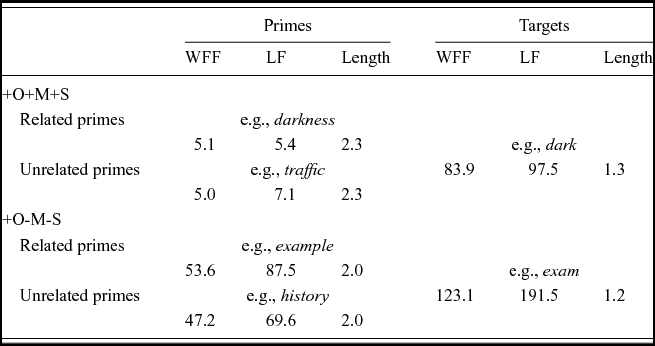
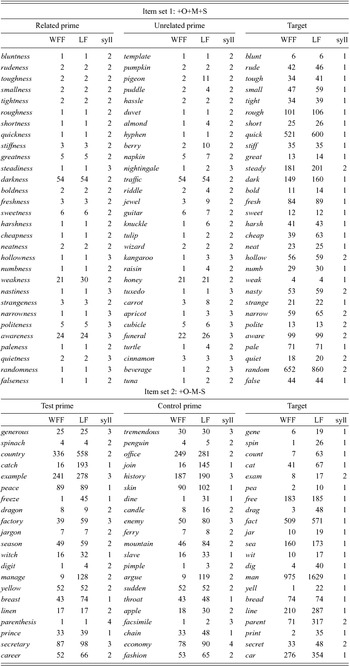
The present study contained two item sets, one with orthographically, morphologically and semantically (+O+M+S) and one with purely orthographically (+O-M-S) related prime-target pairs.Footnote 1 Each target was preceded by three types of prime: related, unrelated and identity. Set 1 consisted of thirty adjectival targets (e.g., dark) preceded by the corresponding –ness nominalisation as a related prime (e.g., darkness), a length- and frequency-matched simple noun as an unrelated prime (e.g., traffic) or the adjective itself as an identity prime. In set 2, twenty-one related primes and targets were matched to the +O+M+S items with respect to the amount of orthographic overlap. The related primes (e.g., example) contained the target (e.g., exam) in the beginning and ended in a letter sequence that never functions as an affix in English (here: –ple). Related prime-target pairs of the two sets did not differ significantly with respect to the amount of shared letters, as measured both absolutely (t < 1) and with spatial coding (t(28) = 1.02, p = .317) using the Match Calculator implemented by Davis (Reference Davis2000). Unrelated primes (e.g., history) were of the same category as related primes and were matched for length and frequency using the webCELEX database (http://celex.mpi.nl/); see Appendix for a full list of experimental stimuli.
Related and unrelated primes in both item sets were matched for length in syllables (t < 1 for both +O+M+S and +O-M-S) and word form frequency (+O+M+S: t < 1; +O-M-S: t(20) = 1.32, p = .20). Additionally, the related and unrelated primes of the +O-M-S items were matched in terms of letters (t(20) = 1.45, p = .16). Across item sets, targets were matched for length in syllables (t(48) = 1.09, p = .28), word form (t < 1) and lemma frequency (t(27) = 1.10, p = .28). Length and frequency information for both item sets is provided in Table 1.
Length and Frequency information (from webCELEX) for related and unrelated primes as well as targets of the two item sets [WFF = word form frequency, LF = lemma frequency, Length = Length in syllables].

Experimental items were distributed across three lists so that participants saw targets only once. The 51 experimental targets were mixed with 309 fillers in a pseudo-random order. Fillers were word-word, nonword-word, word-nonword and nonword-nonword pairs, with 50 percent of targets being existing words. Nonwords were created by changing 1 to 3 letters of existing English words. Targets and primes were a mixture of simplex and morphologically derived adjectives, verbs and nouns, in equal shares. As some of the filler prime-target pairs were orthographically related or contained identity primes, the overall relatedness ratio was 18.89%. In order to counterbalance training or fatigue effects, each of the three lists was reversed for half of the participants.
Participants
Forty-nine advanced learners of English with German as their L1 (15 male, mean age: 23.98, SD: 3.74) as well as a control group of fifty English native speakers (14 male, mean age: 40.22, SD: 13.85) took part in the study, for course credit or payment. All participants were residing in Germany at the time of testing, using both English and German in everyday life. The native speaker group had acquired English from birth while the non-native group started learning English at an average age of 9.78 (SD: 2.12), forty-two individuals as their second language (L2) and seven as their L3. They all learned English through instruction in school (N = 47) or kindergarten (N = 2). In addition, twenty-eight learners spent three months or more living in an English-speaking country (one aged 1–3). The non-native group completed either the computer-based Quick Oxford Placement Test (OPT, Oxford University Press & Cambridge ESOL, 2001) or the grammar part of the paper-based Oxford Placement Test (Allan, Reference Allan2004), which tests comprehension as well as grammatical proficiency in English, reaching a mean score of 78.84% (SD: 9.33). In the Common European Framework of Reference for Languages (CEFR), this score corresponds to the C1 level (“advanced,” “effective proficiency”). All participants had normal or corrected-to-normal vision.
Procedure
Participants were tested individually in a quiet room. They were asked to perform a word-nonword decision task, pressing one of two buttons on a gamepad as quickly and accurately as possible. Yes-responses were given with the dominant hand. Participants were not told about the presence of the primes.
Visual stimuli were presented on a 15” screen in white writing on a black background (font size: 28) with the DMDX software (Forster & Forster, Reference Forster and Forster2003). Primes were presented in Bookman Old Style; targets (and the mask) were shown in Comic Sans MS.Footnote 2 Each trial consisted of four visual events: (1) a mask with as many hashes as the prime had letters displayed for 500 milliseconds, (2) the prime word displayed for either 33 (short SOA) or 67 milliseconds (long SOA) immediately following the mask, (3) the target displayed for 500 milliseconds immediately after the prime and (4) a black screen until the next trial was initiated by the participant's button press or automatically after a time-out of 5000 milliseconds. Participants were randomly assigned to one of the SOAs and lists.
In addition to the masked priming experiment, participants completed the OPT and rated their familiarity with the experimental targets on a scale from 1 (‘I have never encountered this word’) to 7 (‘I encounter this word on a daily basis’). In the end, the experimenter checked whether participants had noticed the primes. Thirty-six participants reported seeing flickers of letters or words on the screen. Three native and seven non-native speakers reported that they could occasionally, i.e., in less than 5 percent of trials, read prime words; only one participant gave an estimate of 20–30 percent. None of the participants were excluded from the analysis. The whole session lasted approximately 45–60 minutes, of which the lexical decision task took 25–30 minutes.
Data Coding and Analysis
The dependent variables were participants’ accuracy and reaction time (RT), as measured by the DMDX software from the display of the target word until the button press. Prior to analysis, one non-native participant with an exceptionally high error rate (19.44%) was excluded. Outlier removal consisted of timeouts, unknown targets (with familiarity ratings of 1) and extreme RTs (>1500ms). Due to too few data points in the non-native data for two items (bluntness – blunt, witch – wit), these items were excluded from the data set entirely. In total, 4.80 percent of the data (L2: 5.31%, L1: 4.31%) was removed. Furthermore, incorrect responses were not included in the RT analysis (overall: 2.69%, L2: 3.67%, L1:1.76%).
Data was analysed with linear mixed-effects models (generalized ones for the error data) using the software ‘R’, version 2.15.2 (R Development Core Team, 2012) and R's lme4 package (Bates & Sarkar, Reference Bates and Sarkar2007). Based on the Box-Cox power transformation technique (Box & Cox, Reference Box and Cox1964), reaction times were inverse-transformed (-1000/RT). Models included the experimental factors Group (native vs. non-native), SOA (short vs. long), Relation Type (+O+M+S vs. +O-M-S) and Prime Type (related vs. unrelated and identity vs. unrelated) as well as, if significantly improving model fit, the following continuous (centred) predictors: Trial Number, Target Frequency, Target Length, Target Neighbourhood Size and, because of a wide range (21–68 years) in the native group, Age (as well as Age of Acquisition and Placement Test Score, for the non-native subset). With respect to the factor Prime Type, the first comparison investigates whether the related primes significantly accelerated target recognition and the second comparison reflects repetition priming, thus testing whether (non-native) participants processed the primes. Models had random intercepts by participants and items and/or random slopes for the factors Group, SOA (both by items), Relation Type (by participants), Prime Type (by participants and/or items) as well as Trial Number (by participants), if justified by the data. Following from interactions, data was split into subsets.
In line with previous studies on L2 processing of derivation (Silva & Clahsen, Reference Silva and Clahsen2008; Diependaele et al., Reference Diependaele, Duñabeitia, Morris and Keuleers2011; Kırkıcı & Clahsen, Reference Kırkıcı and Clahsen2013), we expect facilitation effects for +O+M+S items in both participant groups. However, if non-native speakers’ processing is delayed (e.g., McDonald, Reference McDonald2006), these effects might only surface in the long SOA for the non-native group. With respect to the +O-M-S items, significant facilitation effects are only anticipated for the non-native but not for the native group if non-native speakers are influenced by the surface form of words (i.e., their orthography) during processing, as suspected based on Diependaele et al.'s (Reference Diependaele, Duñabeitia, Morris and Keuleers2011) and Feldman et al.'s (Reference Feldman, Kostić, Basnight-Brown, Filipović Đurdević and Pastizzo2010) findings.
Results
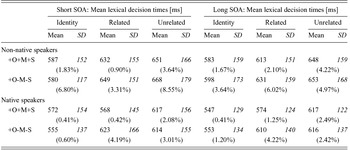
Table 2 shows non-native and native speakers’ mean error rates (in parentheses) and reaction times to targets in the two item sets for the two SOAs separately.
Non-native and native raw mean reaction times and error rates (in parentheses) following identity, related and unrelated primes for the two items sets in the short and long SOA.

With respect to the accuracy data, the overall generalized linear mixed-effects model revealed main effects of Relation Type (t = 2.02), with lower accuracy for +O-M-S items, of Prime Type, reflecting higher accuracy rates following related (t = −2.17) and identity (t = −3.33) primes in comparison to unrelated ones, and of Age (t = 2.11), with lower accuracy for younger participants. As the effect of Prime Type (related vs. unrelated) was modulated by Relation Type (t = −2.26), the data was split into subsets based on Relation Type. A main effect of Prime Type surfaced for +O+M+S items only (t related = −3.50 and t identity = −3.13 vs. +O-M-S: t related = 0.07 and t identity = −1.83), indicating that accuracy was higher after morphologically but not after purely orthographically related primes. An effect of Group for +O-M-S items (t = 3.24) reflected non-native speakers’ lower accuracy for these items.
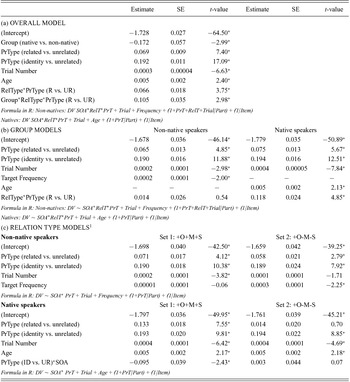
For reaction times, Table 3 presents the output from the best-fit models. Below, only significant effects of the experimental factors and respective interactions will be discussed. The overall model (see Table 3a) revealed main effects of Group (t = −2.99), reflecting longer RTs for non-native speakers, and Prime Type (t related = 7.40 and t identity = 17.09), with faster RTs following both related and identity primes. More importantly, there was an interaction of Prime Type (related vs. unrelated) and Relation Type (t = 3.75), which was further modified by Group (t = 2.98), suggesting different patterns of facilitation for the two item sets in native versus non-native speakers. Therefore, data was split by Group (see Table 3b): both the non-native (left) and native (right) model revealed main effects of Prime Type, with faster reaction times following both identity and related primes, showing that both participant groups (1) processed the masked primes and (2) were sensitive to the experimental manipulation. Prime Type (related vs. unrelated) interacted with Relation Type in the native but not the non-native subset, indicating a difference in priming for +O+M+S and +O-M-S in native but not in non-native processing. To explore this interaction, both the native (Table 3c, bottom) and non-native (top) sets were further split by Relation Type: While non-native speakers showed priming effects for both item sets, native speakers’ RTs were not significantly facilitated by purely orthographically related primes (see right-most column). Both groups showed repetition priming throughout but, in the native +O+M+S subset, Prime Type (identity vs. unrelated) interacted with SOA, reflecting the fact that repetition priming was stronger in the long SOA.
Output from best-fit linear-mixed effects models run on inverse-transformed reaction time data for (a) the entire data set, (b) the Group subsets (non-native versus native) and (c) the Relation Type subsets (+O+M+S versus +O-M-S items for non-native and native speakers separately), with the factors Group (native vs. non-native), Relation Type (RelType: +O+M+S vs. +O-M-S), SOA (short vs. long) and Prime Type (PrType: related vs. unrelated; identity vs. unrelated). Only significant effects with t>|2| are reported [SE = standard error].

1In order to keep the models within each of the groups (native vs. non-native) parallel, factors which significantly improved the model for one of the two sets (+O+M+S versus +O-M-S) only were added to the winner model of the other set (if they did not change the model significantly).
Apart from the above interaction with SOA, there were no further main effects or interactions with this factor in any of the models, indicating that the prime duration did not have an impact. Furthermore, including the learners’ age of acquisition of English and the Oxford Placement Test scores did not significantly improve model fit, suggesting that age of acquisition and proficiency did not affect participants’ reaction times.
Discussion
The present study confirmed the suspicion that non-native processing might be influenced by orthography (following Diependaele et al., Reference Diependaele, Duñabeitia, Morris and Keuleers2011; Feldman et al., Reference Feldman, Kostić, Basnight-Brown, Filipović Đurdević and Pastizzo2010). While priming for +O+M+S items was seen in both participant groups, facilitation after purely orthographically related primes was only found in the non-native speaker group. Crucially, this facilitation effect for +O-M-S items was not significantly different from the one observed for +O+M+S items, questioning whether the effects for derived items in non-native processing, observed both in the present and in previous studies, are morphological in nature.
Priming effects were obtained irrespective of SOA indicating effects on target recognition times for primes shown for just 33 milliseconds. This finding provides evidence against the view that non-native processing is simply delayed (e.g., McDonald, Reference McDonald2006). While non-native language processing is not necessarily slower or less automatic than L1 processing, our findings suggest that early word recognition processes in a non-native language are driven more by surface-form properties (viz. orthographic overlap) than by structural information (viz. morphological relatedness).
Further evidence for the influence of orthographic overlap on non-native visual word recognition comes from studies with cognates, i.e., words which share a substantial amount of letters across different languages. In a cognate priming study with Spanish-English bilinguals, Duñabeitia, Dimitropoulou, Morris and Diependaele (Reference Duñabeitia, Dimitropoulou, Morris and Diependaele2013) report significantly faster reaction times to English targets when these were preceded by cognate primes (e.g., estudiante ‘student’ – study) but not when the primes were non-cognates (e.g., doloroso ‘painful’ – pain). The authors interpret these results as evidence that facilitation effects are due to orthographic activation caused by the shared letters between cognates.
Our finding that priming effects for derived word forms in non-native speakers are not morphological in nature but are caused by orthographic relatedness may also apply to inflected word forms. If darkness primes dark due to the shared letters, the same may hold for walked and walk. However, results from previous masked priming studies with inflected word forms are mixed: while some studies reported significant priming effects for inflected word forms (Feldman et al., Reference Feldman, Kostić, Basnight-Brown, Filipović Đurdević and Pastizzo2010), others did not find such effects (Silva & Clahsen, Reference Silva and Clahsen2008; Kırkıcı & Clahsen, Reference Kırkıcı and Clahsen2013). Furthermore, the question to what extent priming effects between inflectionally related pairs are due to orthographic relatedness is still open.
In conclusion, the present study shows that non-native speakers are heavily influenced by surface form (i.e., a word's orthography) during word recognition and that what appears to be morphological priming effects in non-native speakers may be more apparent than real.
Experimental stimuli