Learning new words is a key part of language acquisition. Knowing the mechanisms behind this capacity can help us understand what makes some people better at learning foreign languages than others. In this paper, we focus on the mechanisms involved in learning new words. It is a complex process that consists of several steps: extracting the new word from the stream of speech, creating a representation of the new word in phonological short-term memory (STM), relating the newly acquired word form to preexisting conceptual knowledge, and encoding it in long-term memory (for descriptions of different phases of word learning, see, e.g., Service & Craik, Reference Service and Craik1993). This paper investigates the initial steps on the way to vocabulary learning: how representations of new word forms are created and maintained in phonological STM, and how this influences the auditory acquisition of word forms. We explore the mechanisms that allow the learner to turn a stream of speech into sequences of segments and encode them in memory. We discuss two such mechanisms: universal speech segmentation and phonological mapping. The former, as the name suggests, is a general facility for segmenting speech, while the latter remains dependent on language-specific phonological representations. Until now, many studies have explored the phonological mechanisms of learning words in the first language (L1; de Jong, Seveke, & van Veen, Reference de Jong, Seveke and van Veen2000; Ramachandra, Hewitt, & Brackenbury, Reference Ramachandra, Hewitt and Brackenbury2011), but fewer have investigated the acquisition of new words in the second language (L2; Hu, Reference Hu2008), or in a completely new language. Yet, examining the process of novel word learning in L2 can shed new light on the mechanisms of creating the representation of novel word forms. Since one of the phonological mechanisms is language universal (universal speech segmentation mechanism) and the other is language specific (phonological mapping), by testing acquisition in two languages and examining if it is influenced by a common mechanism, we can establish which phonological mechanism supports word learning. In this paper, we explore these mechanisms in L1 and L2, asking which of them plays a key role in learning the vocabulary of the native and of the second language.
WORD LEARNING IN L1: PHONOLOGICAL STM AND BEYOND
Phonological STM is a memory component that is responsible for short-term retention of verbal information (Baddeley, Reference Baddeley2007; Baddeley & Hitch, Reference Baddeley, Hitch and Bower1975; Caplan & Waters, Reference Caplan and Waters1995; Eiter & Inhoff, Reference Eiter and Inhoff2010; Ellis & Hennelly, Reference Ellis and Hennelly1980; Gathercole, Reference Gathercole2006; Larsen & Baddeley, Reference Larsen and Baddeley2003; Repovs & Baddeley, Reference Repovs and Baddeley2006; Shebani, Van De Vijver, & Poortinga, Reference Shebani, Van De Vijver and Poortinga2005). Its capacity has been extensively studied as a predictor of success in word learning. It has been proposed that learners with high phonological STM capacity are better at maintaining intact representations of words in STM. This, in turn, facilitates encoding of the word representation in long-term memory (LTM), leading to its permanent acquisition (Gathercole & Baddeley, Reference Gathercole and Baddeley1989; Gathercole, Willis, Emslie, & Baddeley, Reference Gathercole, Willis, Emslie and Baddeley1992).
Phonological STM capacity is usually assessed through immediate serial recall tasks, and nonword repetition tasks (NWR). In immediate serial recall tasks participants memorize strings of words or nonwords (pronounceable nonce words such as kipser) and reproduce them in the order of presentation. A popular iteration of this task is the digit span task where participants repeat sequences of digits. In NWR tasks participants are presented with nonwords and are asked to say them immediately (Gathercole & Baddeley, Reference Gathercole and Baddeley1989; Gathercole, Willis, Baddeley, & Emslie, Reference Gathercole, Willis, Baddeley and Emslie1994).
Several studies have explored the connection between NWR and word learning, especially in L1 (Gathercole, Reference Gathercole1995, Reference Gathercole2006; Gathercole & Baddeley, Reference Gathercole and Baddeley1989; Gathercole, Tiffany, Briscoe, Thorn, & ALSPAC Team, Reference Gathercole, Tiffany, Briscoe and Thorn2005; Gathercole et al., Reference Gathercole, Willis, Emslie and Baddeley1992; Lee & Gorman, Reference Lee and Gorman2013). Research shows that children able to repeat more nonwords tend to have larger vocabularies. If vocabulary size is taken to reflect the aptitude for learning new words, and NWR is assumed to measure phonological STM, then large phonological STM capacity seems to facilitate word acquisition. Children with high NWR scores at the age of 4 and 5 were also shown to have larger vocabularies in their native language 1 year later (Gathercole & Baddeley, Reference Gathercole and Baddeley1989; Gathercole et al., Reference Gathercole, Willis, Emslie and Baddeley1992; although see Melby-Lervåg et al., Reference Melby-Lervåg, Lervåg, Lyster, Klem, Hagtvet and Hulme2012, for a critical reanalysis). Furthermore, children with larger NWR scores and digit span have also been found to be better at learning new words in experimental settings (Čeponienė, Service, Kurjenluoma, Cheour, & Näätänen, Reference Čeponienė, Service, Kurjenluoma, Cheour and Näätänen1999; Gathercole & Baddeley, Reference Gathercole and Baddeley1990; Gathercole, Hitch, Service, & Martin, Reference Gathercole, Hitch, Service and Martin1997).
The above-mentioned studies suggest a relationship between phonological STM and new word learning in the learner's native language. It is worth noting that this relationship may change with time. Studies suggest that the correlation between NWR/digit span and word learning holds for younger children but fades away with age (Gathercole et al., Reference Gathercole, Willis, Emslie and Baddeley1992; Service & Craik, Reference Service and Craik1993). Not all researchers agree with this observation (Service, Reference Service1992; Service, Maury, & Luotoniemi, Reference Service, Maury and Luotoniemi2007), but it is important to bear in mind that the involvement of phonological STM (and possibly other factors and mechanisms involved) might vary at different ages or different levels of language proficiency.
In summary, STM is a gateway to encoding information about word form in LTM. The larger the STM capacity, the more efficient the LTM encoding. At the same time, if STM is to act as a gateway for word learning, the learner needs to be able to convert the stream of speech into a new word representation in STM. These representations can be then encoded in LTM while being maintained in STM. Thus, it appears that the relationship between STM and word learning depends on the ability to create new word form representations, that is, translating auditory input into a sequence of speech segments.
PHONOLOGICAL AWARENESS
As mentioned previously, NWR tasks are commonly used to measure STM capacity. The dependence of STM on phonological abilities is suggested by the strong correlation between NWR and phonological task results. Several researchers have claimed that the relationship between NWR and vocabulary is mediated by phonological abilities (Bowey, Reference Bowey1996, Reference Bowey2001; Metsala, Reference Metsala1999; Snowling, Chiat, & Hulme, Reference Snowling, Chiat and Hulme1991). Results of so-called phonological awareness tasks have been shown to correlate with L1 vocabulary size and word learning scores better than NWR (Bowey, Reference Bowey1996, Reference Bowey2001; Metsala, Reference Metsala1999). Phonological awareness tasks require the recognition and/or manipulation of syllables, phonemes, and other phonological units. For instance, in the elision task, participants are asked to divide speech into smaller parts (morphemes, syllables, or phonemes) and produce a given word without one of the parts (e.g., “say the word fixed without /k/”). Other tasks focus more on the recognition of syllables and phonemes, and the ability to create words out of them. In blending tasks, for instance, participants are asked to make a word out of a series of speech sounds (“What word do these sounds make: t-oi?”). Studies involving children below the age of 8 (3- to 5-year-olds) have demonstrated that the results of phonological awareness tasks correlate with vocabulary size to a greater degree than NWR scores (Bowey, Reference Bowey1996, Reference Bowey2001; Metsala, Reference Metsala1999). This indicates that, similarly to NWR tasks, phonological awareness tasks tap into phonological mechanisms required in the word learning process.
WHAT IS MEASURED BY NWR AND PHONOLOGICAL AWARENESS TASKS
NWR and phonological awareness tasks may tap into a variety of phonological mechanisms. These mechanisms facilitate word learning by turning raw auditory input into a novel word form representation that can be encoded in memory. There are two likely candidates for such mechanisms: a language-specific phonological mapping mechanism and a language-universal segmentation mechanism.
Language-specific phonological mapping depends on the quality and range of phonological representations already available to the learner. For the purpose of this paper, we define phonological representations as representations of segmental speech categories (segments)Footnote 1 and as sequences of segments (i.e., chunks; see Jones, Reference Jones2011) in learner's LTM. During phonological mapping, the learner investigates whether the new word contains known phonological representations. If so, these are recognized and mapped onto the novel word, turning raw auditory input into a sequence of speech segments. This hypothesis has already gained strong research support (de Jong et al., Reference de Jong, Seveke and van Veen2000; Jones, Gobet, Freudenthal, Watson, & Pine, Reference Jones, Gobet, Freudenthal, Watson and Pine2013; Jones, Gobet, & Pine, Reference Jones, Gobet and Pine2007; Jones & Witherstone, Reference Jones and Witherstone2011; Ramachandra et al., Reference Ramachandra, Hewitt and Brackenbury2011; Service, Reference Service1992; Service & Craik, Reference Service and Craik1993; Service et al., Reference Service, Maury and Luotoniemi2007; Storkel, Armbrüster, & Hogan, Reference Storkel, Armbrüster and Hogan2006). Although the solutions proposed by different researchers vary in terms of details, there is consensus regarding the general mechanism behind phonological mapping. Upon hearing a new word, representations of chunks and segments stored in the LTM of the learner are activated. These units are then reused to build the representation of the new word in STM (de Jong et al., Reference de Jong, Seveke and van Veen2000; Ramachandra et al., Reference Ramachandra, Hewitt and Brackenbury2011; Service et al., Reference Service, Maury and Luotoniemi2007), which can be later encoded in LTM. The efficiency of this process increases along with the quality of phonological representations available to the learner. Learners whose representations of phonological units (segments and chunks) are more accurate, recognize speech units more easily, and encode words containing them more quickly (de Jong et al., Reference de Jong, Seveke and van Veen2000; Service et al., Reference Service, Maury and Luotoniemi2007). Moreover, learners with a large phonological inventory of chunks of segments find it easier to encode new words in the STM: instead of encoding the word as a series of multiple segments, they can use a few chunks to represent it (Jones et al., Reference Jones, Gobet and Pine2007, Reference Jones, Gobet, Freudenthal, Watson and Pine2013; Jones & Witherstone, 2010). A number of researchers provided evidence supporting the existence of this mechanism. For example, de Jong et al. (Reference de Jong, Seveke and van Veen2000) showed that training children to recognize speech segments improves their performance on word learning tasks. In addition, novel words composed of common sequences of segments (i.e., chunks that the learner knows well) are easier to learn than words composed of rare sequences (Storkel, Reference Storkel2001, Reference Storkel2003; Storkel & Rogers, Reference Storkel and Rogers2000).
Although phonological mapping may be a strategy applied for learning languages in general, it needs to be remembered that familiarity with speech segments and chunks is strictly language specific; that is, the phonological mapping competence of a bilingual learner is going to be different for each language they speak. This is because every language uses different speech segments and chunks, and learners’ inventory of phonological representations will be different for different languages.
The other mechanism that likely takes part in word learning is often called serendipitous segmentation (Carroll, Reference Carroll2004; Cutler, Reference Cutler and Altmann1990; Norris & Cutler, Reference Norris and Cutler1985). It allows the learner to divide the speech stream into smaller units in order to build a makeshift phonological representation of the word before processing it further. We will refer to this mechanism as the universal segmentation mechanism. This segmentation mechanism taps into language-universal perceptual skills rather than language-specific phonological representations, hence the term universal in the name.
The notion of “segmentation” is understood in a number of ways in the literature. It is often defined as the process of dividing a speech stream into words (Gow & Gordon, Reference Gow and Gordon1995), although it can also mean dividing speech into smaller phonological units, such as syllables and segments. Although there is a large body of research on segmentation based on language-specific cues, studies support the existence of a language-universal segmentation mechanism (see Dahan & Magnuson, Reference Dahan, Magnuson, Traxler and Gernsbacher2006; Endress & Hauser, Reference Endress and Hauser2010, for review). Here, we understand universal segmentation as the process of segmenting speech on the basis of language-universal prosodic cues. Following Endress and Hauser (Reference Endress and Hauser2010), we assume that listeners are able to divide a stream of speech into words by relying on universal prosodic boundaries (e.g., changes in pitch, duration, and amplitude). This ability does not depend on familiarity with the language, and listeners are able to apply segmentation even in foreign languages.
Prosodic boundaries used as the main demarcation points for segmentation delineate all kinds of prosodic units: words, intonational phrases, feet, syllables, and moras. Thus, Endress and Hauser imply that the universal segmentation mechanism can be used to divide speech into not only words but also syllables and possibly segments. Multiple studies suggest that prosodic cues, such as pitch and amplitude change, can be used to segment speech into syllables and segments (Goswami et al., Reference Goswami, Thomson, Richardson, Stainthorp, Hughes, Rosen and Scott2002, Reference Goswami, Wang, Cruz, Fosker, Mead and Huss2011; Mcanally & Stein, Reference Mcanally and Stein1996; Richardson, Thomson, Scott, & Goswami, Reference Richardson, Thomson, Scott and Goswami2004; Talcott et al., Reference Talcott, Witton, Hebb, Stoodley, Westwood, France and Stein2002). Richardson et al. (Reference Richardson, Thomson, Scott and Goswami2004) and Goswami et al. (Reference Goswami, Wang, Cruz, Fosker, Mead and Huss2011) demonstrated that young children's sensitivity to amplitude and pitch changes, and their ability to segment speech are interrelated. Children with higher perceptual sensitivity are better at dividing words into onset, coda, and rhyme; they also recognize phonological units more successfully. We propose that the universal segmentation mechanism creates a temporary representation of the new word form in phonological STM, facilitating the encoding of this word form in LTM. Learners who are better at detecting prosodic boundaries will form more accurate representations, and be capable of more efficient LTM encoding.
To summarize, learning novel word forms relies on creating representations of these words in phonological STM. There are two possible mechanisms of creating such representations based on the input the learner had received. The first one, phonological mapping, assumes that representations of new words are created when familiar phonological representations are matched to segments and chunks encountered in speech. Universal segmentation assumes that representations of new words are created when the learner finds prosodic boundaries in the input, divides the input into smaller units (words, syllables, and segments), and uses those units for further processing.
It is not clear which of these mechanisms underlies word learning: phonological mapping, universal segmentation, or both. For example, in a neural network model by Elman and McClelland (Reference Elman and McClelland1984) phonological mapping is the primary mechanism of creating new word representations. In this model, phonological representations would be mapped onto an undivided speech stream, splitting the input into segments so as to establish and encode word representations. Such models do not support the existence of universal segmentation. Alternatively, universal segmentation might exist as a primary mechanism of turning raw input into a string of phonological units. On the basis of prosodic cues, speech is divided into smaller units, which are further processed, classified, and encoded. Finally, it is also possible that both mechanisms take part in word learning, but step in at different levels of language proficiency. Early in the course of language acquisition, when learners are not proficient and their language-specific phonological representations are not developed, the universal segmentation mechanism allows learners to extract words from the speech stream, divide them into smaller units, and create their representations (Carroll, Reference Carroll2004). Later, when the learner acquires the phonological representations typical for his or her native language, these representations may play a larger role in novel word learning, and phonological mapping becomes the primary mechanism for creating representations of novel words.
Research on L1 acquisition is inconclusive regarding the exact nature of the involvement of phonological mapping and universal segmentation in learners’ performance on phonological awareness and NWR tasks, or the relationship between phonological mapping, universal segmentation, and vocabulary. We propose that it is possible to tease these factors apart if word learning and phonological awareness are tested not in one, but two languages. This is because phonological mapping is language specific, while universal segmentation is not. If phonological mapping is responsible for the relationship between phonological awareness scores and word learning, then a phonological awareness test in L1 should predict predominantly novel word learning in L1, while L2 phonological awareness should predict predominantly L2 word learning. In contrast, if universal segmentation underlies this relationship, then phonological awareness task results in any language should predict word learning in any other language. Thus, investigating how phonological awareness tasks predict word learning in the same and in another language, should answer the question of which of these mechanisms is dominant. In the next section, we review studies that explicitly addressed the mechanisms of word learning in L2.
WORD LEARNING IN L2
To date, few studies have explored the phonological mechanisms behind the acquisition of vocabulary in a foreign language, although several researchers examined the role of phonological STM (as measured with NWR and digit span) in word learning (Baddeley, Papagno, & Vallar, Reference Baddeley, Papagno and Vallar1988; Cheung, Reference Cheung1996; Farnia & Geva, Reference Farnia and Geva2011; French, Reference French2006; Gathercole & Masoura, Reference Gathercole and Masoura2003; Hu, Reference Hu2008; Masoura & Gathercole, Reference Masoura and Gathercole1999; Papagno & Vallar, Reference Papagno and Vallar1995; Service & Kohonen, Reference Service and Kohonen1995). The results of these studies paint a complex picture. Papagno and Vallar (Reference Papagno and Vallar1995) found that a group of polyglots displayed superior performance on NWR and digit span over their nonpolyglot peers. This was coupled with better scores in a foreign-word learning task (Papagno & Vallar, Reference Papagno and Vallar1995). In another study, Cheung (Reference Cheung1996) showed that the results of immediate serial recall task with English nonwords (a task similar to NWR) predicted how well Cantonese-speaking children learned new English words. The immediate serial recall scores did not, however, predict participants’ overall vocabulary size in English. A study by Gathercole and Masoura (Reference Gathercole and Masoura2003), in which the participants were Greek children learning English, showed an opposite pattern of results: NWR in English was a strong predictor of English vocabulary size, but not of new English word learning. Two other studies (Masoura & Gathercole, Reference Masoura and Gathercole1999; Service & Kohonen, Reference Service and Kohonen1995) have found a correlation between NWR and L2 vocabulary size. It appears that while some studies show a relationship between NWR and experimental word learning in L2, some do not. Similarly, not all studies show a correlation between NWR and L2 vocabulary sizes.
To make matters even more complex, two longitudinal studies suggest that the relationship between NWR and word acquisition can change over time (Farnia & Geva, Reference Farnia and Geva2011; French, Reference French2006). In French's (Reference French2006) study, NWR scores predicted participants’ increase in L2 vocabulary throughout 5 months in an L2 immersion class. This effect was present, however, only in those participants whose initial L2 proficiency was low. In Farnia and Geva's (Reference Farnia and Geva2011) study, NWR scores predicted participants’ L2 vocabulary scores at the first time of testing, but they did not predict increase in L2 vocabulary scores over time. These results might suggest that NWR is related to vocabulary learning only in less proficient learners who are not very familiar with the language. It is possible that the participants of the Farnia and Geva study were simply too proficient in L2 to show the effect. This would be in line with L1 research showing the relationship between NWR performance and vocabulary only in the youngest (and thus, presumably, least proficient) participants.
The relationship between phonological awareness tasks and word learning has been explored in only a few studies. One study showed that phonological awareness tasks in L2 predicted L2 vocabulary scores, but not when NWR scores were controlled for (Farnia & Geva, Reference Farnia and Geva2011). Other research, involving Taiwanese school children (native speakers of Mandarin Chinese) learning English demonstrated a clear relationship between phonological awareness tasks in L1 and L2 word learning (Hu, Reference Hu2003, Reference Hu2008; Hu & Schuele, Reference Hu and Schuele2005). In the Taiwanese studies, phonological awareness tasks administered to the participants required spelling wordlike L1 nonwords, as well as substituting vowels and syllables in Chinese words. The scores on these tasks predicted how fast the participants would learn new English (L2) words in an experimental paired-associates paradigm (Hu, Reference Hu2003, Reference Hu2008; Hu & Schuele, Reference Hu and Schuele2005). The children learned unfamiliar English color terms (such as sage or ecru; Hu, Reference Hu2008), unfamiliar two-syllable nouns (such as conger; Hu, Reference Hu2003) or English-like names (e.g., Rotsy and Elger; Hu & Schuele, Reference Hu and Schuele2005). In all three studies, the children took part in several trials in which they saw word–picture pairs and were subsequently asked to recall the names when presented with the pictures. Immediate serial recall tasks (digit span and immediate serial recall with sequences of Chinese-like nonwords) and L1 phonological awareness scores came out as separate contributors to L2 learning scores. These studies suggest that the phonological mechanism underlying new word form learning is language universal rather than language specific, because scores in L1 phonological awareness tasks predicted L2 word learning. These results could be taken to mean that the mechanism supporting new word acquisition is the universal segmentation rather than language-specific phonological mapping.
THE PRESENT STUDY
Research indicates that there is a relationship between novel word form learning and phonological STM. According to Gathercole and Baddeley (Reference Gathercole and Baddeley1989), creating and maintaining an intact representation of a novel word form in STM is a prerequisite to its encoding in LTM. In the previous sections, we identified two mechanisms that might feed phonological information into STM: language-specific phonological mapping and universal segmentation. These mechanisms should be related to the success of word learning. Research to date does not seem to unambiguously identify which of these mechanisms is involved in word learning, and to what extent. This gap in the literature is hardly surprising for two reasons. First, it is possible that different mechanisms are employed depending on the level of familiarity with the language (French, Reference French2006; Gathercole et al., Reference Gathercole, Willis, Emslie and Baddeley1992). Second, the tools that can be used to gauge these mechanisms are far from perfect. Previous studies have used NWR and phonological awareness tasks to test phonological STM and other phonological factors in word learning, but it is not entirely clear what such tasks measure. A complex test such as NWR presumably taps into different kinds of processes at once, including perception of the word, creating temporary representation of the word form, and making an articulatory plan in order to produce it (Snowling et al., Reference Snowling, Chiat and Hulme1991). Performance on phonological awareness tasks, in contrast, might rely on different kinds of phonological mechanisms, including phonological mapping and universal segmentation. Moreover, different phonological awareness tasks could be tapping into different processes. It is perhaps due to these problems that the phonological mechanisms underlying novel word form learning are still relatively unexplored.
The present study seeks to further the understanding of phonological word learning mechanisms by analyzing the results of a broader range of tests in different languages. We tested a group of Polish children learning English at school. The participants’ English proficiency was measured with a productive vocabulary size test.Footnote 2 The children did several types of phonological awareness tasks in their L1 and L2. Our goal was to establish whether these tasks tapped into the universal segmentation skill, or language-specific phonological mapping. We also measured participants’ digit span to control for the involvement of phonological STM.Footnote 3 To test if the phonological awareness tasks in L1 and in L2, as well as the digit span, share the same variance, we conducted exploratory factor analysis. The assumption was that if the tasks had common variance, that would suggest the existence of a more universal phonological mechanism. Moreover, three kinds of novel word (in this case: nonword) learning tasks with varying degrees of familiarity have been introduced: a task with nonwords resembling words in participants’ L1, a task with L2-like nonwords, and one with nonwords mimicking a completely foreign language (LX nonwords). Our aim was to see whether phonological mapping and universal segmentation influence word learning to the same degree in different languages, particularly if the learner's proficiency in those languages differs. We looked for common variance between the scores on the tasks, which would imply the existence of a universal factor underlying word learning.
On the basis of the presented literature, we state the following hypotheses:
-
1. If the mechanism underlying the relationship between phonological awareness tasks and word learning is universal segmentation, we should see common variance in phonological awareness tasks in the two languages, and this common variance should predict memorizing nonwords of all types equally.
-
2.
-
a. If what underlies the relationship between phonological awareness tasks and word learning is phonological mapping, then exploratory factor analysis would show that tasks in each language load on a separate factor. The factor loaded by task in Polish should predict Polish word learning, and the factor loaded by the English task should facilitate English word learning.
-
b. Moreover, if phonological mapping facilitates word learning, we should see differences in scores between the three learning tasks. The L1 nonword task, which contains the largest number of familiar sound sequences, should be the easiest, followed by L2, and by LX.
-
-
3. If different mechanisms are recruited when learning novel words in languages at different levels of familiarity, L2 proficiency should interact with other variables in predicting L2 word learning scores. This is because children who know L2 better might employ different mechanisms when learning new words in this language than children who are not as familiar with this language.
METHOD
Participants
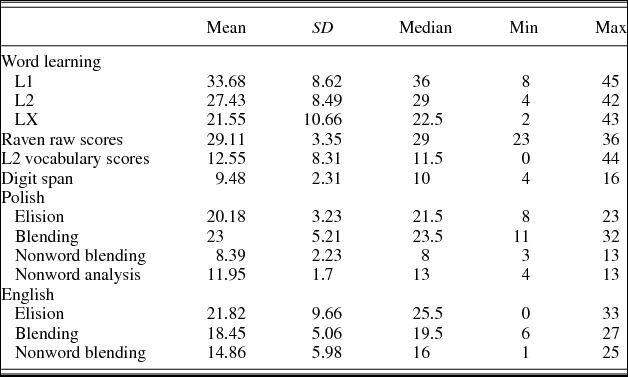
We recruited 49 Polish third graders from 10 public primary schools in Poznań. The participants’ parents gave informed consent for the children to take part in the study, and the children agreed to participate. Parents were asked to fill in a background questionnaire concerning children's language development and exposure to foreign languages. None of the participants were diagnosed with hearing impairments, dyslexia, or other global language impairments, and none had lived abroad for longer than a month. Four children were excluded from the study, because they did not complete all of the tasks. In addition, 1 child was excluded on account of his above-average exposure to English (the child was enrolled in regular, intensive, extracurricular English classes since the age of 3). Of the remaining 44 participants, 16 were male and 28 were female. The average age was 9 years 2 months (range = 8 years 2 months–10 years 8 months). All participants had normal to high IQ as measured by Raven's Colored Matrices Test (Raven, Szustrowa, & Jaworowska, Reference Raven, Szustrowa and Jaworowska2003; raw score: M = 29.11, SD = 3.35, range = 23–36). Average length of exposure to English was 3.66 years (SD = 1.66, range = 2–6). All children participated in English classes at school twice a week in accordance with the national curriculum (set at proficiency level CEFR A1). Twelve participants took additional lessons in English, usually tutoring sessions to catch up with the material covered at school. English proficiency of the students was measured with the Expressive One-Word Picture Vocabulary Test—Fourth Edition (Martin & Brownell, Reference Martin and Brownell2010), a test of productive vocabulary involving picture naming. The children scored on average 12.55 (SD = 8.31, range = 0–44), which placed them at the low level of proficiency in English. The results of the test were entered into the regression models as indicators of L2 proficiency. An additional vocabulary test based on the textbooks children used in school was administered, but it is not reported here.
Tasks
We administered a battery of phonological awareness tasks in Polish and in English, and three novel word learning tasks (with L1-like, L2-like, and LX-like nonwords). The children's nonverbal intelligence was estimated using Raven's Colored Matrices Test (Raven et al., Reference Raven, Szustrowa and Jaworowska2003) and the phonological STM was tested with Polish digit span and backward digit span tests taken from the Polish version of the Wechsler Intelligence Scale for Children (Matczak, Piotrowska, & Ciarkowska, Reference Matczak, Piotrowska and Ciarkowska2008). The materials and procedures for the nonword learning tasks and phonological awareness tasks are described below.
Phonological awareness tasks
We used three phonological awareness tasks in English and analogical tasks in Polish. The English tasks were taken from the standardized Comprehensive Test of Phonological Processing—Second Edition (CTOPP-2; Wagner, Torgesen, Rashotte, & Pearson, Reference Wagner, Torgesen, Rashotte and Pearson2013), widely used by clinicians to assess children's phonological abilities (e.g., Gorman, Reference Gorman2012). The Polish tasks were taken from a Polish standardized test battery used for diagnosing children with dyslexia: Dysleksja 3 (Bogdanowicz et al., Reference Bogdanowicz, Jaworowska, Krasowicz-Kupis, Matczak, Pelc-Pekala, Pietras and Szczerbinski2009). The tasks are described in more detail below.
ELISION
The English task was elision taken from CTOPP-2 (Wagner et al., Reference Wagner, Torgesen, Rashotte and Pearson2013), containing 34 test items, while the Polish task was Usuwanie fonemów [Phoneme deletion] (Szczerbiński & Pelc-Pękała, Reference Szczerbiński and Pelc-Pękała2009) from Dysleksja 3, containing 23 items.
In the Polish version, the experimenter produced each word and asked the participant to say it without a given sound, as indicated in the test manual (e.g. “Say the word /ˈdɔmɛk/ [house] without /k/”; correct answer: /ˈdɔmɛ/). The child received a point for each correct answer. In the English version, the experimenter played recordings of the words, produced by a bilingual Polish–English speaker. The child first produced the whole word, so that the experimenter could correct the child's pronunciation if necessary. Once the child said the word correctly, she was encouraged to say it again, this time omitting a particular sound (“Now say the word ‘span’ without ‘s’”; correct answer: “pan”). For each correct answer, the child received a point. The point was awarded if the child produced all the consonants in the word correctly. The quality of vowels was not assessed, since English vowel inventory is much more complex than Polish (12 in RP variant vs. 6 vowels in standard Polish). The task was terminated if the child produced three incorrect answers in a row.
BLENDING WORDS
The English version of the task was the blending words task from CTOPP-2 (Wagner et al., Reference Wagner, Torgesen, Rashotte and Pearson2013), which includes 33 recordings of sequences of speech sounds that form English words (for instance /s/ /ʌ/ /n/). The Polish version of the task consisted of 33 recordings of speech sound sequences forming Polish words. This task was prepared by the authors of this paper by translating its English version into Polish. We replaced the words used in the English version with their Polish phonological equivalents. For instance, the word “miss” (/m/–/ɪ/–/s/) used in the English task became “miś” (/m/ /i/ /ɕ/) [teddy bear] in the adaptation. This procedure was necessary, since no equivalent to the blending words test is available in Polish.
In each of the tasks, the participant heard a sequence of sounds played from the computer and was asked to produce a word consisting of those sounds (e.g., in the English version, the recording said: “What word do these sounds make: ‘To-i’?” Correct answer: “toy”). In both versions of the task, the child received 1 point for each correct answer. As before, the quality of vowels was not assessed in the English version of the task. Each task was terminated after the child produced three incorrect answers in a row.
BLENDING NONWORDS
For the English version, we used the blending nonwords task from CTOPP-2 (Wagner et al., Reference Wagner, Torgesen, Rashotte and Pearson2013), which is analogical to blending words. It consists of 30 recordings, each containing a series of sounds that together form a pronounceable nonword. For the Polish version, four tasks were selected from the Nieznany Język Diagnostic Battery (Bogdanowicz, Reference Bogdanowicz2009). The Polish tasks differed slightly from the English ones, since participants were asked to both create nonwords from sounds (two blending tasks, 13 trials altogether), as well as divide nonwords into phonemes and syllables (two analysis tasks, 13 trials altogether).
For the English task, the procedure was analogical to blending words. In the blending components of the Polish battery, the experimenter pronounced the sounds in a sequence according to a standardized procedure. The child was asked to produce a nonword out of each sequence. For each correct answer, the child received 1 point. In the analysis components of the battery, the experimenter produced a nonword and then asked the participant to say all the syllables or phonemes of the nonword. The child was also asked to clap her hands once for each syllable or phoneme. If the child clapped her hands an appropriate number of times, and segmented the nonword properly, she received 1 point for the trial. In the statistical analysis, the scores for the Polish nonword blending task, and for the Polish nonword analysis task were analyzed separately.
Novel word form learning
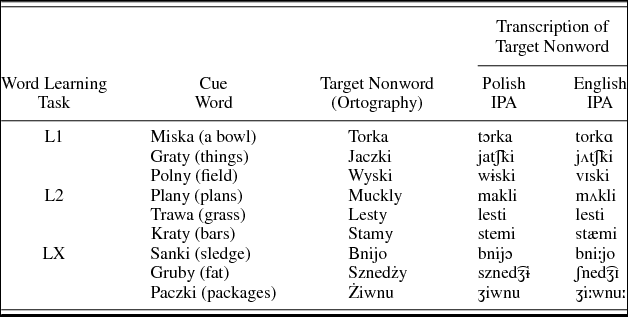
The novel word learning tasks used the paired-associates paradigm, traditionally associated with studies investigating cognitive factors in novel word form learning (Cheung, Reference Cheung1996; Gathercole et al., Reference Gathercole, Hitch, Service and Martin1997; Mirman, Magnuson, Estes, & Dixon, Reference Mirman, Magnuson, Estes and Dixon2008; Papagno & Vallar, Reference Papagno and Vallar1995; Windfuhr & Snowling, Reference Windfuhr and Snowling2001). The task resembles learning L2 words from a bilingual list. There were three such tasks, each requiring the participants to learn three word pairs in no more than 15 trials. Each pair consisted of a known L1 word (cue word) and a nonword (target). The structure of the target nonwords was different in each task, mimicking the structure of L1 (Polish-like nonwords), L2 (English-like nonwords), and LX (an artificial language, with nonwords that did not resemble any language known to children), respectively. Each language version was created using the procedure described below.
STIMULI
Nine cue words were chosen, and randomly assigned to the three language versions of the task (three cue words per task). They all had the same phonological structure: bisyllabic consonant–consonant–vowel–consonant–vowel (CCVCV) or CVCCV structures with stress placed on the first syllable. The lexical frequency of the cue words was controlled for using the National Corpus of Polish. Further, nine nonwords were created according to the procedure described below. They had the same phonological structure as the cue words. The resemblance of nonwords to actual words in Polish and in English was controlled with two parameters: phonotactic probability (with log all-n-gram frequency) and neighborhood density (with Phonological Levenshtein Distance 20 [PLD20]). All-n-gram frequency is computed as a mean (log) frequency of all n-grams, that is phoneme sequences (bigrams = two-phoneme sequences, trigrams = three-phoneme sequences, up to the length of the stimulus – 1) occurring in the word or nonword, weighted for the length of the n-gram (log frequency for each n-gram is multiplied by the length of this n-gram). The higher this metric, the more familiar the word fragments that make up the word or nonword are. In previous research (Szewczyk, Marecka, Chiat, & Wodniecka, Reference Szewczyk, Marecka, Chiat and Wodniecka2017) mean ngram-frequency turned out to be the best predictor of nonword repetition accuracy out of several other corpus-based indices. PLD20 is computed as the mean Levenshtein distance (the number of additions, deletions, and substitutions necessary to convert one string into another) between the stimulus and its 20 closest phonological neighbors, that is, words that are closest in phonological form to the stimulus. The lower the PLD20, the denser the phonological neighborhood of the stimulus. The Polish metrics were based on a phonologized version of the National Corpus of Polish (Przepiórkowski et al., Reference Przepiórkowski, Bańko, Górski and Lewandowska-Tomaszczyk2012), and the English metrics were based on the Computer Usable Version 3 corpus (Sobkowiak, Reference Sobkowiak2006), a corpus derived from Computer Usable Version 2 (Mitton, Reference Mitton1992), with added American phonological transcription. The mean statistics for all stimuli can be found in Table 1. Native speakers of relevant languages recorded the nonwords for each of the tasks: Polish for the L1 task, American English for the L2 task, and Russian for the LX task. The complete list of stimuli is in Table A.1 in Appendix A. The procedure of forming and controlling each set of stimuli is described below.
Mean lexical frequency, all-n-gram frequency, and PLD20 for all stimuli used in the task in English and in Polish

Note: To elicit phonological measures in both languages, vowels in English items were converted to their closest Polish neighbors, and vowels in Polish items to their closest English neighbors. The n-gram frequencies and PLD20 values can only be compared within the same language (i.e., within columns of the table), but not across Polish- and English-based metrics. Polish and English metrics are derived from different corpora; and they are based on languages that have a different number of phonemes, different phonotactic structure, and so forth, which renders them not directly comparable. PLD20, Phonological Levenshtein Distance 20.
CUE WORDS
As indicated by the very high all-n-gram frequency and low PLD20 scores (see Table 1), the cue words were very typical and well-formed Polish words. To avoid confusing the participant, we made sure that the cue words were distinct from each other, both orthographically and semantically. The cue words were randomly assigned to the three tasks (three cue words per task).
POLISH (L1) NOVEL WORD FORMS
The nonwords for the Polish novel word learning task were created by combining the 30 most frequent word initial CV structures with the 30 most frequent word final CCV structures and the 30 most frequent word initial CCV structures with the 30 most frequent word final CV structures in Polish (based on the phonotactic corpus of Polish; Dziubalska-Kołaczyk, Zydorowicz, & Jankowski, Reference Dziubalska-Kołaczyk, Zydorowicz and Jankowski2013). The resulting nonwords were subjected to a wordlikeness assessment (see Gathercole, Reference Gathercole1995) by 23 Polish native speakers. On the basis of these assessment, we chose three nonwords that were highly wordlike but did not resemble actual Polish words. As attested by the all-n-gram and PLD20 metrics (see Table 1), the phonological structure of these three nonwords was representative of Polish words.
ENGLISH (L2) NOVEL WORD FORMS
The English-like nonwords were created by combining the 30 most frequent word initial CVs with the 30 most frequent final CCVs with the 30 most frequent word initial CCVs with the 30 most frequent final CVs from the Corpus of Contemporary American English (Davies, Reference Davies2010). We excluded nonwords with any consonants that do not occur in Polish (such as /θ/ and /ð/) and subjected them to a wordlikeness assessment by 11 American native speakers. We chose three words that were highly wordlike, but did not resemble any English words. As can be seen in Table 1, the nonwords had high English all-ngram frequency and low PLD20 value in English, which means that their phonological structure was typical for English words. The same scores based on the Polish corpus (we transformed the vowels in the nonwords their closest neighbors in Polish and then calculated the metrics against this corpus) indicated that they were less typical for Polish words. The stimuli were recorded with an American English accent.
FOREIGN (LX) NOVEL WORD FORMS
This task was meant to mimic learning the words of an unfamiliar language. Therefore, we wanted LX words to be pronounceable, but phonologically structured in a way that is nontypical in both Polish and English. The words were also pronounced with a foreign accent unknown to the participants (Russian). Thus, the LX nonwords were composed from the least frequent, but legal structures in Polish, based on the phonotactic corpus of Polish (Dziubalska-Kołaczyk et al., Reference Dziubalska-Kołaczyk, Zydorowicz and Jankowski2013). These infrequent base structures were 11 initial CV, 10 initial CCV, 14 final CV, and 18 final CCV that did not violate the Sonority Sequencing Generalisation (Selkirk, Aronoff, & Oehrle, Reference Selkirk, Aronoff, Oehrle, Aronoff and Oehrle1984). We subjected these nonwords to wordlikeness assessment by 23 Polish native speakers and chose three words that were highly nonwordlike. As can be seen in Table 1, the Polish and English all-n-gram frequencies of these three nonwords were low, while the Polish and English PLD20 scores were high in comparison to the Polish and English word forms. Atypical in structure and pronounced with an unfamiliar accent, these items could be treated as words of a completely new language.
PROCEDURE
The same procedure was applied in each novel word learning task. All stimuli were presented via loudspeakers, using E-prime software (Psychology Software Tools, Inc.). Before each of the three tasks, the participants were informed that they will learn three words in a new language. Each learning task consisted of the presentation phase and the learning phase. During the presentation phase, the participants were presented with three prerecorded pairs of stimuli, each consisting of a Polish cue word and a nonword. Each pair was presented once, and then the child was asked to repeat the pair and memorize it. The learning phase consisted of 15 trials. In each trial, familiarity with all three word–nonword pairs was tested in randomized order. The cue word was played, and the child was asked to produce the nonword associated with the cue word. After each answer, as a form of feedback, the whole pair was presented again. The children were also given explicit verbal feedback (“correct” or “incorrect”) from the experimenter. Each correct answer earned the participant 1 point. The task was terminated after the 15th trial or when the child correctly recalled all three nonwords in two consecutive trials. If the task was completed before the 15th trial, the child was awarded points for all the remaining trials. The maximum score for each task was 45 points (15 trials × 3 pairs).
All three tasks (L1, L2, and LX) used the same assessment protocol. A nonword answer was considered correct if the child made no more than one mistake (substitution, deletion, epenthesis, or metathesis) in a consonant. Thus, rendition of /mekli/ as /mepli/ or /melki/ was considered correct, while /melpi/ or /meplɪn/ was considered incorrect. If the child changed the syllable structure of the nonword (e.g., deleted a vowel or syllable), then this was considered incorrect. As in the previous tasks, vowel quality was not assessed. This protocol was motivated by the results of the pilot study, which revealed that a strict scoring (disallowing for any consonantal mistakes) led to floor effects, especially in the LX task. In other words, the protocol was optimized to account for the quality of children's utterances across all three language versions of the task.
Procedure
Each child was tested individually at school, in a quiet room, after classes, in the course of three separate sessions (on separate days), each lasting about half an hour. During the first meeting, the L1 nonword learning task and the English vocabulary test were administered. During the second meeting, a psychologist administered the L2 nonword learning task, Raven's Colored Matrices, digit span task, and Polish phonological awareness tasks. During the last meeting, the LX nonword learning task and the English phonological awareness tasks were administered. For the majority of children, there was a weeklong break between each testing session. The break never exceeded 4 weeks.
RESULTS
Descriptive statistics
Table 2 Footnote 4 provides the descriptive statistics for tasks used in the study. As can be seen, the three novel word learning tasks differed in difficulty. A by-subject repeated measures analysis of variance (with Greenhouse–Geisser correction) shows a significant effect of language (L1, L2, LX) on the learning scores: F1 (2, 864) = 40.2253, p < .001, η2 = 0.224. Learning L1-like nonwords was easiest, followed by L2-like nonwords; LX nonwords were the most difficult to memorize. Pairwise post hoc t test comparisons with Bonferroni corrections indicate that the performance differences between all pairs of languages were significant (ps < .001).
Descriptive statistics for the word learning tasks and their predictors

Note: L1, first language; L2, second language; LX, unknown language.
To see if the differences between the word learning scores in the three languages were not caused by random variability within items, a by-item analysis of variance was conducted. We asked if the differences between L1 items, L2 items, and LX items were significant even if between-item variance was controlled. The answer was yes, indicating differences between the three groups: F2 (2, 6) = 15.6, p = .004, η2 = 0.84.
Exploration of the phonological awareness and phonological STM tasks
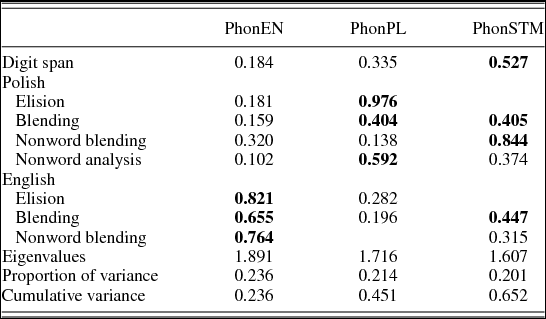
Prior to the analyses of word learning predictors, we ran exploratory factor analysis (EFA) on the scores of the 7 phonological awareness tasks (4 tasks in Polish, 3 in English) and the digit span to retrieve common underlying factors. We conducted EFA (varimax) with three factors that together accounted for 65.2% of variance (see Table 3). The loadings afford relatively easy interpretation: Factor 1 (PhonEN) is related primarily to English tasks, in particular word elision. Factor 2 (PhonPL) is loaded primarily by the Polish word elision task. Factor 3 (PhonSTM) is loaded by the blending tasks, both English and Polish, and by digit span. The extracted factors are used as predictors in the main analyses.
Summary of exploratory factor analysis for the phonological awareness tasks in Polish and in English (N = 44)

Predictors of novel word form learning tasks
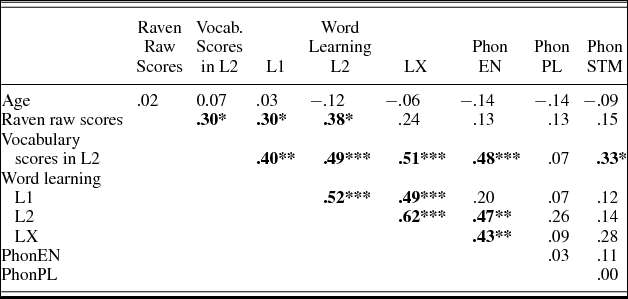
To explore the relationships between the variables in the study, we ran a series of correlation analyses. Table 4 shows the correlation matrix for the main variables. All nonword learning tasks were moderately correlated, and they all correlated with L2 vocabulary scores. In addition, Polish (L1) nonword learning scores weakly correlated with Raven raw scores, while English (L2) nonword learning scores correlated with Raven raw scores and with the phonological awareness factor PhonEN. The LX nonword learning task scores also correlated with the PhonEN factor.
Correlation matrix for the word learning tasks and the predictor variables

Note: L1, first language; L2, second language; LX, unknown language.
*p < .05. **p < .01. ***p < .001.
After correlation analysis, we conducted multiple regressions for the learning tasks. For each task, we identified the best regression model using the best-subsets procedure, minimizing the Schwartz information criterion (using leaps package in R; Lumley & Miller, Reference Lumley and Miller2004). In each regression model, we considered the following predictors: IQ, age, L2 vocabulary, PhonEN, PhonPL, and PhonSTM as well as interactions between vocabulary in English and the three phonological factors. We tested the accuracy of the models with a number of diagnostic tests; only the model for Polish language verged on heteroscedasticity while the rest were consistent with the assumptions.
Polish (L1) nonword learning
The all-subsets regression allowed us to choose the best model, presented in Table 5. In this model, none of the phonological awareness factors are significant predictors. The best fitting model (R 2 = .16, adjusted R 2 = .14, p = .007) included only one predictor, which was English vocabulary size.
Regression model for first language (Polish) learning task

**p < .01. ***p < .001.
English (L2) nonword learning
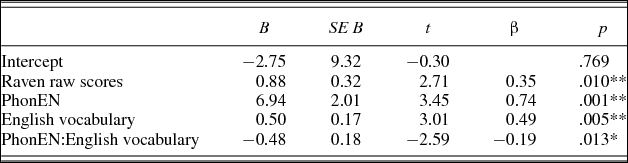
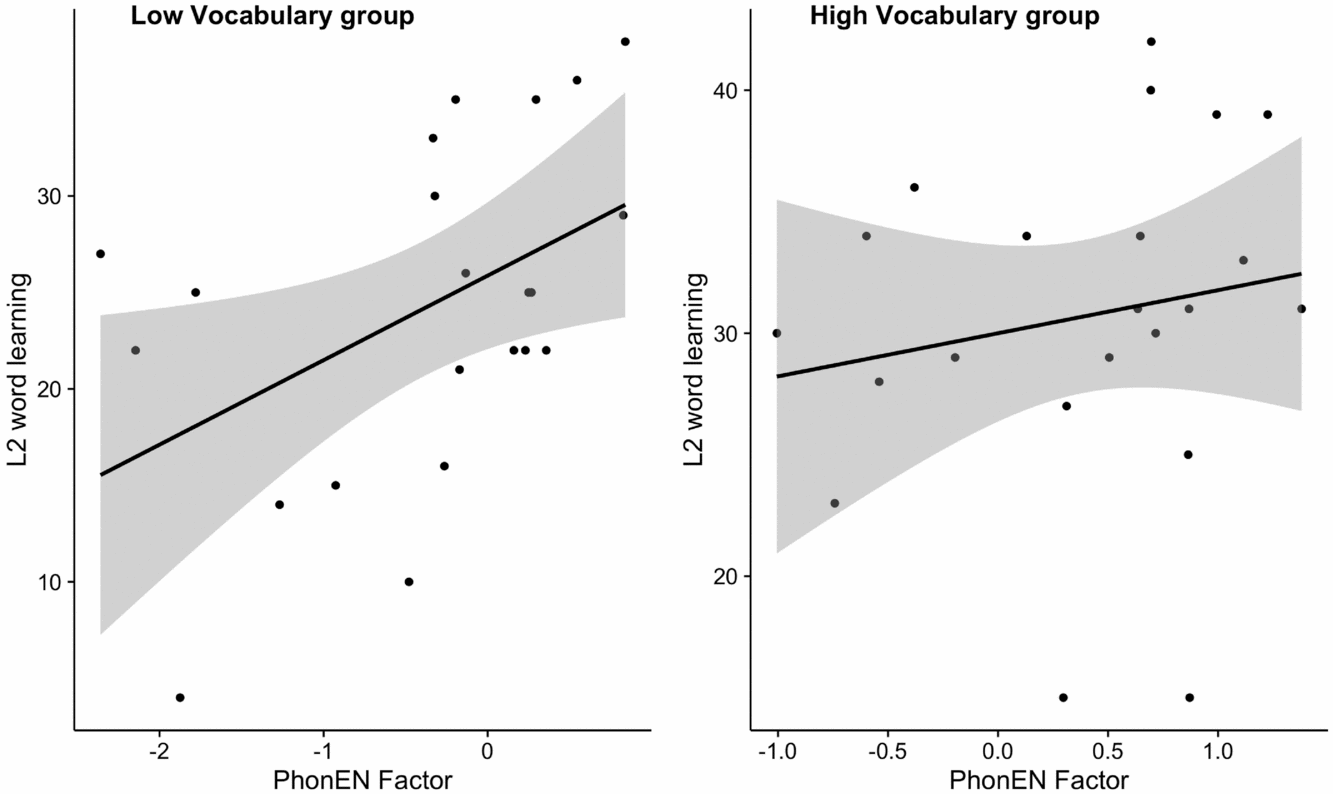
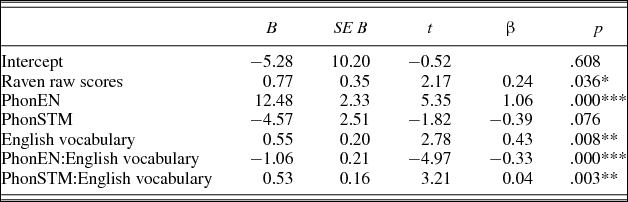
Table 6 presents the best model for the L2 task. The most significant predictor of the scores on the English-like nonword learning task is the PhonEN factor extracted from phonological awareness scores. High values of this factor correspond to successful performance in the L2 learning task. This effect was modified by the interaction with the English vocabulary size. To explore the nature of this interaction, we median-split the participants into a high vocabulary and low vocabulary group and tested these groups separately for correlations between the PhonEN and L2 word learning. There was a significant correlation between PhonEN and L2 nonword learning in the low vocabulary, r = .47, p = .026, 95% confidence interval (CI) [0.06, 0.75], but not in the high vocabulary group, r = .17, p = .44, 95% CI [–0.27, 0.55]. This relationship is illustrated in Figure 1. Apart from the effect of PhonEN and the interaction between PhonEN and L2 vocabulary, there was also a significant effect of English vocabulary size and of the Raven score. The model is a good fit to the data, and explains about half of the variance in the L2 nonword learning scores, F (4, 39) = 8.45, R 2 = .46, adjusted R 2 = .41, p = .000.
Regression model for second language (English) learning task

*p < .05. **p < .01.
The relationship of the significant correlation between PhonEN and second language nonword learning in the low vocabulary but not in the high vocabulary group.

Foreign (LX) nonword learning
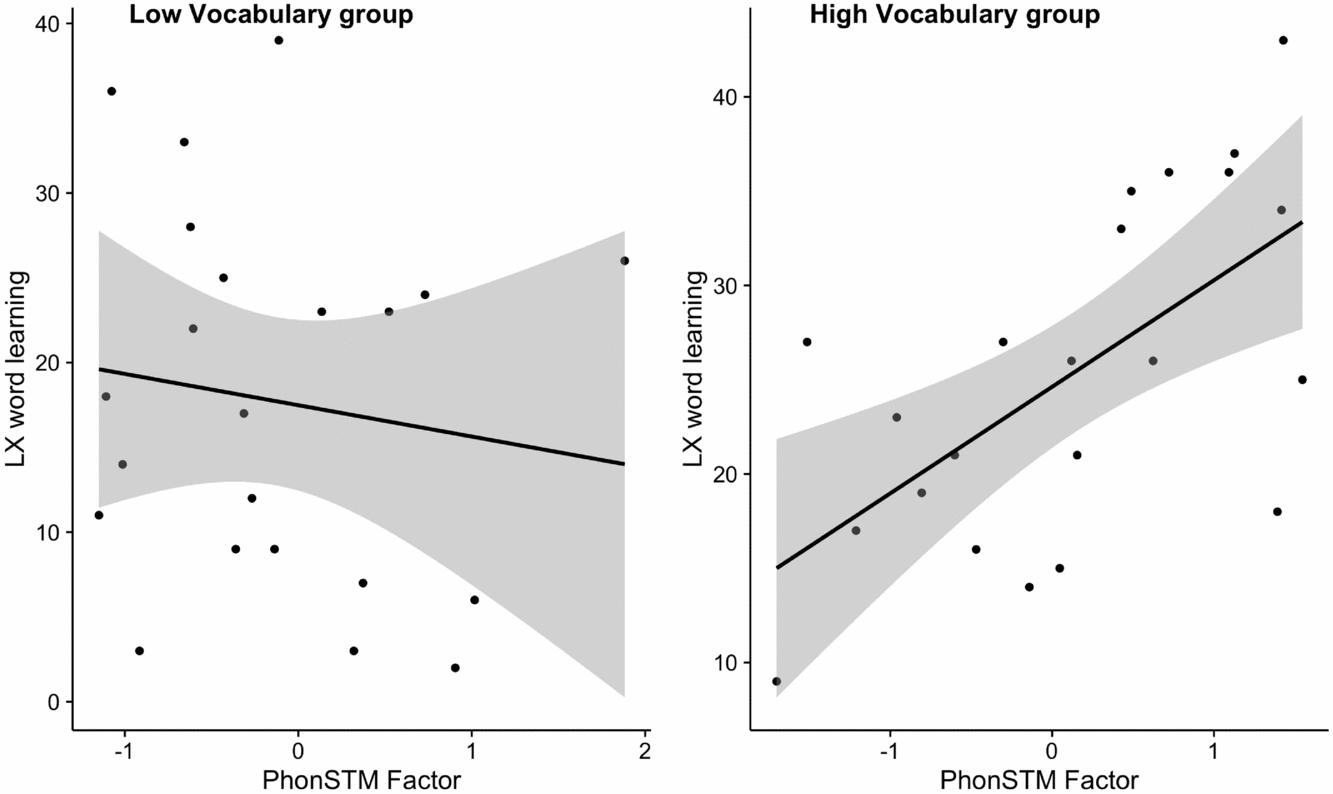
The best model for the LX task is presented in Table 7. PhonEN was the main factor, as children who scored higher in PhonEN performed better in the learning task. As before, this effect was modified by English vocabulary scores. To explore this interaction, we analyzed the correlations between PhonEN and word learning in the low and high English vocabulary groups. There was a significant correlation between PhonEN and LX word learning in the low vocabulary, r = .57, p = .005, 95% CI [0.20, 0.80], but not the high vocabulary group, r = –.10, p = .67, 95% CI [–0.50, 0.34]. These relationships are represented graphically in Figure 2. There was also an effect of vocabulary scores, and marginally significant effects of Raven raw scores and of PhonSTM. The PhonSTM effect was also modified by the English vocabulary scores. To explore this interaction, we again tested for the correlations between this phonological factor and word learning in the low and high vocabulary group. It turned out that PhonSTM predicted the scores in the LX nonword learning task only for the high vocabulary group, r = .62, p = .002, 95% CI [0.24, 0.83], but not for the low vocabulary group, r = –.13, p = .55, 95% CI [–0.53, 0.30]. This result is represented in Figure 3. This regression model explains 62% of the variation, F (6, 37) = 9.86, R2 = .62, adjusted R 2 = .55, p = .000.
Regression model for unknown language learning task

*p < .05. **p < .01. ***p < .001.
The relationship of the significant correlation between PhonEN and LX word learning in the low vocabulary but not the high vocabulary group.

The results for PhonSTM predicting the scores in the LX nonword learning task only for the high vocabulary group but not for the low vocabulary group.

DISCUSSION
In this paper, we investigated the mechanisms that facilitate novel word acquisition. In particular, we focused on two phonological mechanisms that are likely involved in creating the representations of novel words. To test the efficiency of novel word form learning, we used three paired-associate learning tasks. Participants learned nonwords that were created to resemble words of Polish (L1), English (L2), and a nonexistent language (LX). We also tested participants’ vocabulary size in L2, their phonological awareness in L1 and L2, and digit span in L1. Based on the literature, we identified two phonological mechanisms that might influence the acquisition of new word forms in the native and in a foreign language. These were a language universal segmentation mechanism and phonological mapping, which is dependent on the quality of phonological representations. Assuming that these two mechanisms might play a role in novel word learning, we made a number of predictions. First, if a universal segmentation mechanism underlies the relationship between phonological awareness and word learning, then the scores in awareness tasks in both L1 and L2 should share common variance. This common variance should predict nonword learning in all three languages tested. Second, if the relationship between phonological awareness tasks and word learning is mediated by phonological mapping, then the Polish phonological awareness tasks should predict nonword learning in Polish, while the English tasks should predict nonword learning in English. In addition, nonwords with more familiar phonological structure should be easier to learn than nonwords with less familiar phonological structure. Third, if different mechanisms of word learning are recruited at different levels of familiarity with the language, L2 proficiency (as measured with the L2 vocabulary size task) should interact with other predictors of vocabulary acquisition.
We used eight tasks as our primary predictors (seven phonological awareness tasks and digit span), and because the exact mechanism underlying performance on these tasks is not clear, we subjected them to EFA. The analysis revealed three underlying factors: one connected with phonological tasks (mostly elision) in L1 (PhonPL), one connected with phonological tasks (mostly elision) in L2 (PhonEN), and one connected with blending and digit span tasks (PhonSTM), likely related to phonological STM.Footnote 5 These factors, along with L2 vocabulary size and IQ, replaced the original predictors in the regression analyses.
The results suggested that the relationships between the variables are much more complex than originally expected. These results can be summarized in five points. First, the more familiar the nonwords in the word learning task were, the easier they were to learn. Nonwords resembling L1 were the easiest for our participants to learn, L2-like nonwords were more difficult, and LX nonwords proved to be the most challenging. Second, PhonEN, the factor based mostly on scores from the elision task in English, predicted learning in L2 and LX, but not in L1. This factor predicted word learning in the foreign languages only for participants whose L2 vocabulary size was small. Third, L2 vocabulary size predicted word learning in all languages tested. Fourth, the factor PhonSTM, associated with blending and phonological STM tasks, predicted learning LX nonwords, but only in children with large L2 vocabulary sizes. Fifth, Raven raw scores predicted word learning in foreign languages (L2 and LX). These results suggest that the tasks we used in the study tapped into a variety of processes, depending on participants’ L2 proficiency. In what follows, we propose a post hoc model explaining these results, and support it using the results of the present study and other studies.
A post hoc multilevel model of novel word acquisition
Learning words of more familiar languages involves different abilities and mechanisms than learning words of unfamiliar languages. Learning the words of a new language is determined primarily by the efficacy of a universal segmentation mechanism. After some time, the learner acquires phonological representations (segments and chunks of segments) typical for the language. These representations can then be used by the phonological mapping mechanism, which gradually takes over the burden of recognizing new words and building novel word form representations. At this stage of language acquisition, breadth and quality of phonological representations determines the speed of learning new words. The better defined and more varied the available segments and the longer the chunks of segments, the easier it becomes to learn new words. At the very beginning of this stage, phonological STM is a very important factor limiting the word learning ability. Larger STM enables the learner to maintain multiple short phonological sequences in memory, if longer sequences are unavailable. Finally, two factors are important at all stages of language acquisition: efficacy of LTM encoding and nonverbal intelligence. We describe this learning mechanism in more detail below. We start by describing two phonological mechanisms for forming novel word representations based on raw speech input, then move on to explain how these mechanisms are connected with memory (LTM encoding efficacy and phonological STM) and nonverbal intelligence.
Universal segmentation
As indicated in the section above, universal segmentation applies at the initial stage of language acquisition, when little to no phonological representations characteristic for the language are available. Both L2 learners and children who learn their L1 go through this stage. For a learner confronted with a passage spoken in a new language, all sounds blend together into a stream of noise. Carroll (Reference Carroll2004) describes this experience as a “wall of sound.” At the very early stages of language acquisition, the universal segmentation mechanism helps bootstrap language learning, enabling learners to start recognizing patterns in the wall of sound. The term universal indicates that this mechanism is equally applicable to learning any unfamiliar language. We predict that this mechanism operates whenever the learners process novel phonological word forms or try to learn new words, for example, when performing phonological awareness and novel word learning tasks in an unfamiliar language.
The mechanics of the universal segmentation mechanism are covered in detail above. To recap, Endress and Hauser (Reference Endress and Hauser2010) suggested that at the early stages of L1 acquisition, children might use prosodic cue detection to divide speech stream into words and other prosodic units. Other researchers argued that prosodic cues such as sensitivity to amplitude and pitch changes might be used to segment the stream of speech into syllables and segments (Goswami et al., Reference Goswami, Thomson, Richardson, Stainthorp, Hughes, Rosen and Scott2002, Reference Goswami, Wang, Cruz, Fosker, Mead and Huss2011; Mcanally & Stein, Reference Mcanally and Stein1996; Richardson et al., Reference Richardson, Thomson, Scott and Goswami2004; Talcott et al., Reference Talcott, Witton, Hebb, Stoodley, Westwood, France and Stein2002). Moreover, Ziegler and Goswami (Reference Ziegler and Goswami2005) suggested that chunks extracted as a result of segmentation are refined into phonological representations. In this paper, we extend this idea to foreign language learning and propose that in order to dissect the wall of sound phenomenon, L2 learners use the segmentation mechanism. This becomes a trigger for subsequent language acquisition, including vocabulary acquisition. In other words, we propose that the same universal skill is employed to segment any foreign language at initial stages of acquisition, when the phonological structure of the language is not familiar to the learner. Thus, it should co-determine results of any task requiring segmentation of speech in that language.
Out of the tasks we used in the present study, two types might rely on segmentation: nonword learning and L2 phonological awareness, particularly tasks involving elision (PhonEN). Many participants’ knowledge of L2 was not particularly advanced (as attested by low L2 vocabulary scores). For those children, both learning L2 nonwords and performing L2 elision was likely to rely primarily on the universal segmentation mechanism. We believe that this is why PhonEN scores predicted acquisition of L2-like nonwords. Moreover, because PhonEN turned out to be a measure of the universal segmentation skill for children with low L2 vocabulary, it also predicted scores in learning LX nonwords. The phonological structure of LX nonwords was unfamiliar, making universal segmentation necessary. We found that PhonEN predicted learning LX nonwords, but this relationship held only for children with small L2 vocabulary. This is because once children achieve some familiarity in English, they presumably do not rely to such an extent on universal segmentation strategies for phonological operations in this language. Similarly, since all Polish phonological tasks were conducted in the language that was highly familiar to the participants, the scores on those tasks (represented by the PhonPL factor) probably did not reflect the universal segmentation ability to a significant degree, and thus they did not predict nonword learning in any language.
One issue that needs addressing, however, is the discrepancy between our results and the results obtained in previous studies (Hu, Reference Hu2003, Reference Hu2008; Hu & Schuele, Reference Hu and Schuele2005). In our data, phonological awareness tasks in L2, but not in L1, predict L2 word learning in children with low L2 proficiency. In the studies by Hu, L1 phonological awareness scores predicted L2 word learning in children beginning to learn their L2. We believe that this discrepancy could be attributed to the choice of language tests and language pairs. The majority of phonological tests applied by Hu required the participants to divide speech into phonemes. Phonemes are not the natural speech units for speakers of Mandarin Chinese because the ability to manipulate phonemes is determined by the knowledge of the alphabet (Read, Yun-Fei, Hong-Yin, & Bao-Qing, Reference Read, Yun-Fei, Hong-Yin and Bao-Qing1986), and Mandarin Chinese is not an alphabetic language. Therefore, Hu's phonological tasks might have tapped into the universal segmentation mechanism despite being conducted in participants’ native language.
Phonological mapping
Phonological mapping is the second mechanism for creating novel word representations. Its efficacy crucially depends on the quality and breadth of language-specific phonological representations. We propose that, as language learners gain experience in listening to a new language, they become familiar with its segments and chunks of segments. The representations of those phonological structures, stored in LTM, are then used to decode novel words that contain them and to create phonological representations of these words. Based on this idea, we assumed that the better the children know the segments and the typical chunks of segments in a given language, the faster they would learn novel words in this language. This has been found in previous studies, and our data are in line with these findings. A comparison of overall scores in L1, L2, and LX nonword learning tasks revealed that children's ability to learn L1 nonwords was far superior to learning nonwords in L2, while LX nonwords were hardest to learn. This supports the hypothesis that familiarity with the phonological structure of a language facilitates word learning in this language.
We also hypothesized that the performance on phonological awareness tasks might measure the quality and breadth of language-specific phonological representations and thus the efficiency of phonological mapping. In this case, phonological awareness tasks in L1 should predict L1 nonword learning and phonological awareness tasks in L2 should predict L2 nonword learning. Although previous research showed that phonological awareness scores predict word learning and vocabulary size among children acquiring their native language (Bowey, Reference Bowey1996, Reference Bowey2001; Metsala, Reference Metsala1999; Ramachandra et al., Reference Ramachandra, Hewitt and Brackenbury2011), this prediction was not borne out by our data. PhonPL, the factor loaded by phonological awareness tasks in Polish, did not predict nonword learning in Polish. At the same time, PhonEN did not predict word learning in children with more developed English vocabulary.
This might indicate that, contrary to our assumptions, phonological awareness tasks (notably elision) do not measure the quality and quantity of phonological representations. As we have already argued, at the initial stages of language acquisition, elision-like tasks tap into the universal segmentation mechanism. At further stages of acquisition, elision-like tasks might tap into a specific metalinguistic ability to delete phonemes from speech. This ability would depend on literacy, rather than on phonological long-term knowledge (Port, Reference Port2007, Reference Port, Bohn and Munro2008; Ziegler & Goswami, Reference Ziegler and Goswami2005). Therefore, the studies that postulated a relationship between phonological awareness and vocabulary acquisition might instead have demonstrated the existence of a relationship between universal segmentation and word learning. This would be supported by the fact that most previous research on this topic focused on learners who have not yet fully acquired phonological representations in a given language (3- to 5-year-olds: Bowey, Reference Bowey1996, Reference Bowey2001; Metsala, Reference Metsala1999; Ramachandra et al., Reference Ramachandra, Hewitt and Brackenbury2011).
An alternative explanation for the lack of relationship between Polish phonological awareness and word learning tasks might be due to a lenient scoring procedure in the latter. Perhaps the Polish word learning task did not adequately tap into the quality of phonological representations, because the scoring ignored a number of phonological alterations in the pronounced words (such as mispronounced vowels). While using the same (lenient) scoring procedure was essential to compare the three learning tasks in our study, future studies could benefit from using both strict and lenient scoring procedures.
Universal encoding ability
Once the representation of the new word is created through the use of the appropriate phonological mechanism and maintained in STM, it needs to be encoded in LTM. We propose that learners differ with respect to the efficacy of the process of encoding phonological information in LTM, and we will refer to this efficacy as the universal encoding ability. In Davis and Gaskell's (Reference Davis and Gaskell2009) neurocognitive model of word learning, this factor would correspond to the efficiency of the first stage of word learning, namely, hippocampus-mediated rapid encoding. We propose that the LTM encoding ability is universal, and independent of language proficiency, affecting word learning at all stages of language acquisition.
In our data, the existence of universal encoding can be deduced from two results. First, scores in all three nonword learning tasks correlate with each other (see Table 4). The LX nonword learning score predicts the score in learning L1 nonwords, despite the fact that the two “languages” have little in common. We interpret this variance as reflecting a general LTM encoding ability. Second, somewhat counterintuitively, we found that L2 vocabulary size predicts nonword learning scores in all languages. We take this finding to suggest that, apart from measuring the size of vocabulary, and being an index of L2 proficiency, this score is also an indicator of children's LTM encoding capacity. In other words, better learners know on average more words in L2 than children who find language learning difficult. This hypothesis is corroborated by an additional analysis that shows that L2 vocabulary size and nonword learning scores in different languages explain the same part of nonword learning variance.Footnote 6 Thus, children who are good at encoding new words tend to know more words in L2, and they tend to get better scores in all nonword learning tasks.
Phonological STM
Apart from the ability to encode new information into LTM, phonological STM capacity is another language learning factor related to memory processes. Following Baddeley, Gathercole, and Papagno (Reference Baddeley, Gathercole and Papagno1998), we assumed that the representation of any unfamiliar word is maintained in phonological STM until the word can be stored in LTM. The degree to which STM supports word learning is modulated by two factors. The first factor is the extent to which the acquired nonword can be represented using chunks of segments familiar to the learner. This idea comes from Jones et al.’s models of nonword processing (Jones, Reference Jones2012; Jones et al., Reference Jones, Gobet and Pine2007, Reference Jones, Gobet, Freudenthal, Watson and Pine2013). If the nonword contains familiar phonological sequences, it will be encoded in STM, not as a series of separate segments, but as a combination of a few chunks, which takes relatively little effort to maintain. In contrast, when a nonword is composed of an unfamiliar sequence of segments, the learner has to keep many phonological units activated in STM at the same time in order to represent the entire nonword. In the extreme situation when there are no familiar chunks to be found in the word at all, the learner has to maintain simultaneous activation of all constituent segments. In such a case, STM supports novel word acquisition. Large STM capacity compensates for a poor phonological repertoire, and permits simultaneous activation of a larger number of fragmented chunks, increasing the chance that the word will be successfully encoded in LTM. However, having acquired most of the chunks of segments for a given language, the learner rarely needs to rely on his or her STM capacity for new word learning. As a result, STM capacity no longer limits word learning at this point.
The second factor modulating the extent to which STM supports word learning is the LTM encoding ability described in the previous section. When LTM encoding is slow and inefficient, STM capacity does not make much of a difference in learning aptitude. Even highly efficient STM is not able to maintain the constituents of the novel word activated long enough to enable error-free LTM encoding. Of course, language learning is still possible, but it would most likely require much more repetition. In contrast, if the learner's LTM encoding ability is high, STM capacity starts to make a difference in novel word learning. Learners who are able to maintain robust activations of the novel word constituents in STM longer are more likely to memorize the word. To conclude, the contribution of STM to novel word acquisition should be observable primarily for those learners who are able to efficiently encode new phonological information into LTM, and whose repertoire of chunks of segments is limited, namely, learners who are not very familiar with a particular language.
These insights are supported by our results. STM capacity of our participants (indexed by the PhonSTM factor) predicted novel word learning in LX, the language in which the participants’ repertoire of chunks of segments was severely limited. Since LX-like nonwords were composed of chunks unfamiliar to the participants, learning them required simultaneous activation of many segments, which can easily overtax STM. Thus, STM capacity emerged as a factor constraining LX-like nonword learning. The correlation between PhonSTM and LX nonword learning score held for participants with large L2 vocabulary scores, but not for those whose L2 vocabulary was small. As explained earlier, L2 vocabulary scores depend on the ability to encode words in LTM. Thus, our results show a relationship between LX nonword learning and STM only in those participants who demonstrated good LTM encoding ability.
We did not observe any phonological STM effects in L1- and L2-like nonword learning tasks, which is also consistent with the proposed model. PhonSTM should have no effect on learning L1-like nonwords because our participants were old enough to have robust knowledge of chunks of segments in L1. Therefore, representing novel L1-like words should not overtax phonological STM.
Within the proposed model, phonological STM limits learning L2-like nonwords in children who are not very familiar with the L2. The results, however, do not show this relationship, presumably because L2 vocabulary size in our study is related to two factors: L2 proficiency and the LTM encoding ability. Participants with a large L2 vocabulary likely had a wide repertoire of L2 chunks of segments, which means they did not need to rely on their STM. Consequently, their scores in learning L2-like nonwords did not depend on PhonSTM. It is possible, however, that the majority of participants with low L2 vocabulary scores also had low L2 encoding ability. Children with low L2 proficiency should have relied on STM for learning L2 words, although this relation might not have been visible in the data due to interference from the encoding ability. Hence, there was no relationship between PhonSTM and L2 nonword learning scores in this group.
Nonverbal intelligence
Nonverbal intelligence is the final variable influencing word learning in foreign languages (L2 and LX). The effect of Raven raw scores and foreign novel word learning scores indicates that children's general cognitive abilities play a role in learning new words, even if other factors connected with verbal skills have been controlled for. Perhaps this factor accounts for using task-specific strategies that enable learners to learn word pairs better. Due to the nonverbal character of this skill, its influence is not particularly relevant to the presented model. Nevertheless, the fact that nonverbal intelligence influenced participants’ performance underlines the importance of controlling for this factor in any developmental study involving learning.
Concluding remarks
This paper proposes a comprehensive model of word learning, which involves a universal segmentation mechanism, a phonological mapping mechanism, universal encoding ability, and phonological STM. We showed how these variables interact, both with each other and with the proficiency level of the learner. We proposed that universal encoding ability and phonological STM take part in word learning of any language, but that phonological STM is a particularly limiting factor in word learning by less proficient speakers. We also proposed that the universal segmentation mechanism is used in less proficient speakers to create representations of new words in the STM, facilitating word learning. Phonological mapping helps create word representations, supporting word learning in more proficient speakers.
Our study provides evidence for the claim that both language-specific and language-universal mechanisms take part in word acquisition, and that the involvement of such mechanisms depends on the language proficiency of the speaker. We also provide evidence that different tasks used in studies on phonological processing and word learning tap into different abilities, depending on the language proficiency of the tested person. We inferred that the divergent results of the word learning studies so far can be accounted for by the differences in the language proficiency of the participants. Hence, research on word learning and phonological mechanisms would likely benefit from taking the language proficiency of the participants into account. Our study set out to establish a framework to do just that.
APPENDIX A
Table A.1 provides all words and nonwords used in the word learning task. We transcribed all the nonwords into the International Phonetic Alphabet (IPA). To obtain PLD20 and all-n-gram frequency from both English and Polish corpora, we transcribed each word as if pronounced by a Polish speaker (Polish IPA transcription) and as if pronounced by an English speaker (English IPA transcribed). The L1 and LX nonwords were created on the basis of a phonologized Polish corpus. We converted the Polish transcriptions obtained from the corpus into English by changing the vowels in the Polish items into their closest equivalents in English. The L2 nonwords were created on the basis of a phonologized corpus of English. We converted their English transcription to Polish by replacing the English vowel symbols with the symbols of the closest Polish equivalents of these vowels.
Words and nonwords used in the word learning task

ACKNOWLEDGMENTS
This research was funded by National Science Centre Grant 2012/07/N/HS6/00415 and European Social Fund UDA-POKL.04.01.01-00-019/10-00. The Pro-Ed publishing company provided a free kit of the CTOPP-2 for the purpose of this research. We thank the institutions that provided the funding of the study, as well as Dr. Isabelle Darcy, Dr. Elisabet Service, and the two anonymous reviewers for helping us to greatly improve the manuscript.