Travelling Europe at present is an exhibition about archaeological finds from the seas around Sicily. The island's most striking recent discovery (2004–2005) is the site of the Battle of the Egadi Islands, where Rome wrested control of the Tyrrhenian Sea from Carthage in 241 BC. Several of the exhibits are from that site.
‘Storms, War and Shipwrecks: Treasures from the Sicilian Seas’ was the exhibition's title at the Ashmolean Museum in Oxford, running from June to September 2016. It was of medium size, by current standards. For much of the same time, the British Museum was also showing finds from Sicily. That exhibition was a bit bigger, and its theme historical, not technical (Booms & Higgs Reference Booms and Higgs2016). While the British Museum concentrated on the Greek and Norman periods, ‘Storms, War and Shipwrecks’ showed mainly Greek and Roman finds with small samples of Carthaginian, Byzantine, Arab and Norman material.
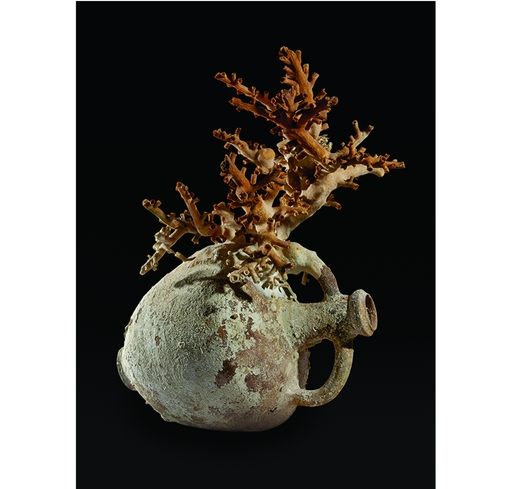
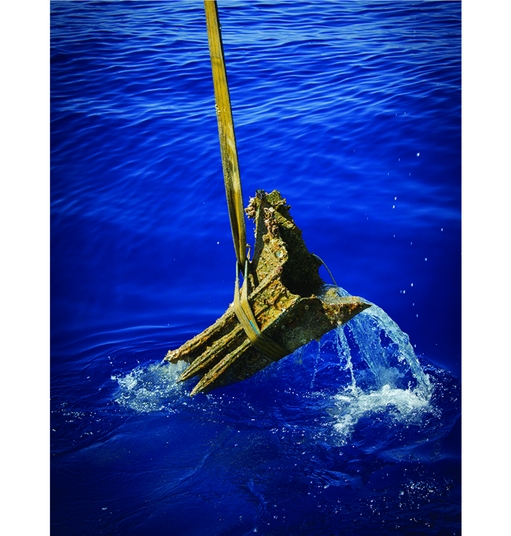
‘Storms, War and Shipwrecks’ was arranged in five sections. The first introduced marine underwater archaeology as a method, with a big map to show Sicily as a maritime cross-roads, and a display on techniques with particular reference to the work of Honor Frost in the Mediterranean. Marine taphonomy was explained with sulphur-coated finds from Panarea and a coral-sprouting amphora (Figure 1). As at the British Museum, and using one of the same images, ‘Storms, War and Shipwrecks’ provided a small sample of displays to illustrate Sicily's prehistory. The other four sections were set out in chronological order. From the Greek era were parts of anchors, cargoes of crockery, ingots, a helmet and a pile of Carthaginian coins. Two sections were devoted to the Roman period. The first showed three galleys’ rams from the Battle of the Egadi Islands (Figure 2; one of them only recovered in 2015), helmets, a shipboard altar and stove, bronzeware including coins and a merchant's balance, damaged stone busts (shipped, it was suggested, as ballast), and a fragmentary sword and scabbard from Central Europe. A bronze elephant's foot, trawled from the Sicily Channel, was evidently from a life-sized sculpture, part of it smoothed, perhaps at a public site by admirers’ fingers (Burgersdijk et al. Reference Burgersdijk, Calis, Kelder, Sofroniew, Tuso and van Beek2015: 95). The other Roman section showed liturgical bronzeware mounted amidst pieces of a kit of prefabricated stone components for the interior of a church, presumably intended for Emperor Justinian's re-conquest of Tunisia. The Medieval section showed ceramics, including a funnel for pouring sugar. Most of the displays were presented as assemblages or parts thereof, a cardinal principle in the archaeology of wrecks.
Amphora with coral (lent by the Soprintendenza del Mare; © Ashmolean Museum, University of Oxford).

Raising a warship ram (© Soprintendenza del Mare).
The finds are drawn from 13 collections in Sicily, eight in Holland and one in Germany. ‘Storms, War and Shipwrecks’ used various supplementary techniques of presentation, designed intricately but without distracting from the exhibits. The lighting was effective and, except around the busts and accompanying amphorae, the spacing allowed for a steady flow of visitors. A couple of stage-set arches, suggesting Roman and Byzantine designs, helped to distinguish the sections, and the Byzantine one was accompanied by choral music. The first part of the Roman section was dominated by life-sized models of a holed prow and a hull's ribs for mounting exhibits. Several little activities were offered: a set of finds to handle, three lids to lift for smelling the kinds of provisions carried in amphorae, a jigsaw for making a medieval mosaic. The most striking feature was a series of video animations. Small screens helped to explain several of the exhibits. Two of the screens were big, the first to introduce the exhibition and provide a historical framework; the second depicting an alluring explanation of how ships were rammed in naval warfare by imagining a bird's-eye view of the battle.
The exhibition's contents vary somewhat from gallery to gallery. There is no catalogue, but the brightly illustrated accompanying guide (Burgersdijk et al. Reference Burgersdijk, Calis, Kelder, Sofroniew, Tuso and van Beek2015, available in English or Dutch) shows some of the exhibits. It provides brief introductions to underwater archaeology and Sicilian history, including the Modern era, with a note on management of the island's archaeology; and there are a few pages on how Sicily has inspired art (including Antonello da Messina, one of whose paintings was in the British Museum's exhibition), Rossini's ‘Tancredi’, and film (including one from 2011 featuring African boat people).
The first version of the exhibition, ‘Sicily and the Sea’, was at the Allard Pierson Museum in Amsterdam, during 2014–2016. From Oxford, the exhibition moves to Palermo, Copenhagen and then Bonn, where it closes in 2018.
Acknowledgements
I am grateful to Claire Parris for arranging my visit and helping to explain the exhibition.