I. INTRODUCTION
Global warming is mainly attributed to an increase in atmospheric levels of CO2 for which the tremendously promoted burning of fossil fuels is commonly held to be responsible.Reference Siriwardane, Shen, Fisher and Poston1 The traditional CO2 capture measures are mainly based on chemical absorption with an aqueous alkanolamine solvent, such as monoethanolamine.Reference Li, Choi, Drese, Hornbostel, Krishnan, Eisenberger and Jones2 However, these technologies are very expensive and energy intensive, making them less attractive for proliferation in industrial applications. To make the separation process energy efficient, cost-effective, and available over a relatively wide range of temperatures and pressures, numbers of solid adsorbents have been developed.Reference Gray, Soong, Champagne, Pennline, Baltrus, Stevens, Khatri, Chuang and Filburn3,Reference Hicks, Drese, Fauth, Gray, Qi and Jones4 Particularly, a range of amine-modified adsorbents using porous materials as substrates has been explored, as their large specific surface area and pore volume are favorable to enhance the CO2 adsorption capacity. These adsorbents were fabricated through loading amines by impregnation or grafting onto different types of supports, including zeolites,Reference Zukal, Dominguez, Mayerova and Cejka5,Reference Cui, Kita and Okamoto6 carbon,Reference Pevida, Plaza, Arias, Fermoso, Rubiera and Pis7,Reference Van der vaart, Huiskes, Bosch and Reith8 organosilica, and surface-modified silica.Reference Drese, Choi, Lively, Koros, Fauth, Gray and Jones9,Reference Knowles, Graham, Delaney and Chaffee10 Compared with aqueous amine, the solid adsorbents can avoid diffusion difficulty, excessive corrosion problems, and foaming issue. However, large amount of amine loading on these microporous and mesoporous supports may cause serious pore block and CO2 mass transfer resistance, leading to the reduction of adsorption capacity.
Unlike granular adsorbents, fiber-based adsorbing materials show superior properties of large external surface area, short transit distance, low pressure drops, and flexibility,Reference Zhang, Zhang, Chen, Li, Qin and Yuan11,Reference Yang, Li, Chen, Zhao and Li12 which make the fiber to be a promising substrate for CO2 adsorbent. Li et al.Reference Li, Ge, Zhang, Chen, Zhang and Zhao13 coated the glass fiber with polyethylenimine (PEI) and used epichlorohydrin (ECH) as the cross-linking agent to make a novel adsorbent, and its adsorption capacity was as high as 4.12 mmol/g of adsorbent with a PEI/ECH ratio of 20:1. Yang et al.Reference Yang, Li, Chen, Zhao and Li12 also reported the use of a neoteric sorbent grafting allylamine (AF) onto the polyacrylonitrile (PAN) fiber and obtained the adsorption ability of 6.22 mmol/g PAN-AF when the grafting degree came to 60.0 wt%.
The grafting polymerization of glycidyl methacrylate (GMA) onto the polymer substrate is advantageous for further modification as it bears an epoxy group that is capable of reacting with various other functional groups.Reference Yang, Ma, Zhang and Chen14 In this study, a novel solid amine fiber with high CO2 adsorption capacity was prepared by grafting polymerization and subsequent amination with triethylenetetramine (TETA). To better understand the relationship between amine structure and its amine efficiency, ethylenediamine (EDA), diethylenetriamine (DETA), and tetraethylenepentamine (TEPA) were investigated as alternative amine agents, and adsorption capacities of the respective prepared fibers were compared. This work will be beneficial to the development of the efficient amine-based CO2 by clarifying the effects of variables concerning adsorbent properties, like structure and amine basicity, on CO2 chemisorption.
II. EXPERIMENTAL
A. Materials and reagents
Polypropylene (PP) fiber was provided by Zhongshan Xinshun Special Fiber Co., Ltd., Zhongshan, Guangdong, China. GMA, TETA, EDA, DETA, TEPA, dimethylformamide (DMF), and tetrahydrofuran (THF) were purchased from Guangzhou Reagent Company (Guangzhou, Guangdong, China). CO2 and N2 were obtained from Guangzhou Gas Company (Guangzhou, Guangdong, China). Deionized (DI) water, made in Sun Yat-sen University, was used to prepare all solutions in the study.
B. Preparation of solid amine fibers
1. Preparation of PP-GMA
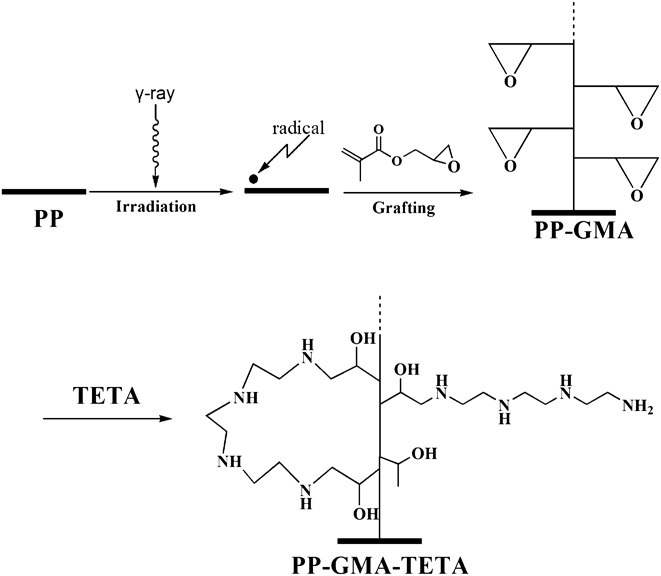
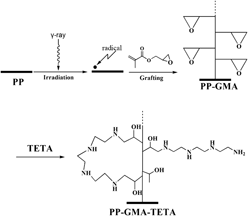
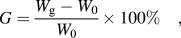
The preparation procedure of PP-GMA-TETA is illustrated in Fig. 1. In a typical preparation of PP-GMA, PP fiber was heated in boiling 5 wt% sodium hydroxide solution for 30 min followed by being immersed in acetone overnight and finally cleaned by water and dried at 60 °C. Then 10 g of pretreated PP fiber was immersed into 10 wt% GMA aqueous solution, and nitrogen was bubbled into the system for 10 min to remove oxygen. The obtained mixture was sealed in a polyethylene bag and subjected to γ-ray irradiation for a desired time. After polymerization reaction, the grafted fiber was washed with DMF and extracted with THF several times to completely remove the residual monomer and homopolymers. At last, it was dried in vacuum at 60 °C. The grafting degree was obtained according to the following Eq. (1):
 $$G = {{{W_{\rm{g}}} - {W_0}} \over {{W_{\rm{0}}}}} \times 100\% \quad ,$$
where W 0 and W g represent the weight of the original and grafted PP fibers, respectively.
Scheme of preparation of PP-GMA-TETA.

2. Preparation of PP-GMA-TETA
In a 100-mL three-neck flask, 2.5 g of PP-GMA fiber was aminated with 80 wt% TETA aqueous solution at a fixed temperature for a certain time. After amination reaction, the PP-GMA-TETA was washed with DI water thoroughly and then dried in vacuum at 60 °C. The amino substitution degree D a and amine content (A, mmol/g) of PP-GMA-TETA could be calculated by Eqs. (2) and (3)
 $${D_{\rm{a}}} = {{142.2({W_{\rm{a}}} - {W_{\rm{g}}})(1 + G)} \over {146.2{W_{\rm{g}}}G}} \times 100\% \quad ,$$
 $$A = {{{W_{\rm{a}}} - {W_{\rm{g}}}} \over {146.2{W_{\rm{a}}}}} \times 4 \times 1000\quad ,$$
where W g and W a are weights of the fibers before and after amination, respectively. G is the grafting degree of PP-GMA, 142.2 and 146.2 are the molecular weights (g/mol) of GMA and TETA, respectively, and 4 is the number of amine groups of TETA.
3. Solid amine fibers prepared with different types of amines
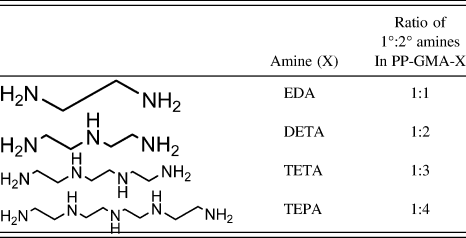
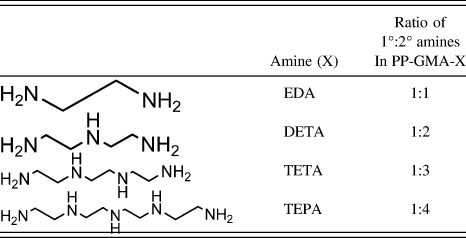
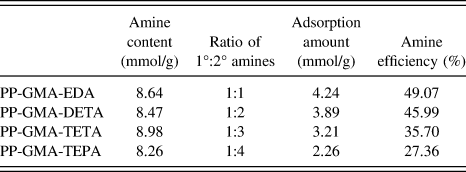
To investigate the relationship between the type of amine and CO2 adsorption performance, a series of solid amine fibers were fabricated with GMA and subsequently aminated with different type of amines. The structures of the amine reagents and the ratios of 1°:2° amines in corresponding sorbents are listed in Table I.
The structures of different amines and the ratios of 1°:2° amines in corresponding sorbents.
C. Structure characterization and mechanical test
The infrared spectra were obtained in the range of 4000–750 cm−1 using a Nicolet 760 Fourier transform infrared instrument (FTIR, Nicolet Instrument Co., Madison, WI) with the materials placed on the microsample holder.
A thermogravimetry analyzer (Netzch TG 209C, France) was applied to determine the thermal stability of the fibers. The tests were performed from 40 to 600 °C at a constant rate (10 °C/min) with the flux of the protective gas (nitrogen) and sweeping nitrogen being 40 and 20 mL/min.
To determine their composition, the fibers were first dried and then subjected to elemental analysis (EA). The nitrogen, carbon, hydrogen, and sulfur contents were determined directly by an Analysen systeme GmbH Elementar Vario EL (Germany), whereas the oxygen content was obtained by deduction of N, C, H, and S contents from 100%.
Scanning electron microscope (SEM, JSM-6610LV, JEOL, Tokyo, Japan) was used to observe the morphology and diameter of the fibers.
To perform the mechanical test on the fibers, a monofilament mightiness instrument (YG001A Textile Mill, Taicang, China) was adopted using an analog controller equipped with a 100 kN loading cell under 10.0 mm/min of stretching speed. The breaking load was measured by breaking force in centinewtons (cN). Each sample was tested for 10 parallel measurements.
D. CO2 adsorption measurement
In an adsorption/desorption process, a certain amount of fibers were cut into small pieces (about 0.5 mm) and outgassed at 80 °C under vacuum, then placed into an adsorption column (Φ = 1.3 cm). A dry nitrogen flow was introduced into the column at a flow rate of 20 mL/min for 10 min to remove the air and moisture. Then moist CO2/N2 mixture gas was introduced into the column at a flow rate of 33 mL/min, and the inlet and outlet concentrations of CO2 were determined by an Agilent 6820 gas chromatograph equipped with a thermal conductivity detector. The effect of adsorption temperature on the adsorption capacity was also investigated through adjusting the temperature of the water bath. The adsorption amount was calculated as shown in Eq. (5). After CO2 adsorption, the fibers were regenerated in boiling water at 100 °C for 20 min.
 $$Q = \int_0^t {\left( {{C_{{\rm{in}}}} - {C_{{\rm{eff}}}}} \right)} {\rm{d}}t{\rm{/22}}{\rm{.4}}W\quad ,$$
where Q is the adsorption capacity of PP-GMA-TETA (mmol/g), t is the adsorption time (min), C in and C eff are the influent and effluent flow rates of CO2 (mL/min), respectively, and W and 22.4 are the weight of PP-GMA-TETA (g) and molar volume of gas (mmol/mL), respectively.
III. RESULTS AND DISCUSSION
A. Effects of the reaction conditions on the amination degree of PP-GMA-TETA
As shown in Fig. 2(a), there was a noticeable growth of amination degree from 24.3% to 74.1% with the reaction temperature from 100 to 130 °C, for high temperature could not only benefit TETA to diffuse to react with the epoxy groups of PP-GMA fiber but also facilitate the ring-opening reaction of epoxy groups. Besides, the amination degree would increase from 49.1% to 77.0% when the reaction time was extended from 2 to 3 h [Fig. 2(b)]. A higher reaction temperature and a longer reaction time would just make the amination degree fluctuate mildly. Therefore, 130 °C and 3 h would be the optimal reaction condition balancing the amination degree and efficiency.
Effects of the reaction temperature and reaction time on the amination degree.
B. Chemical structure of PP-GMA-TETA
FTIR spectra of PP, PP-GMA, and PP-GMA-TETA are provided in Fig. 3 to show the chemical changes of the fibers in each step. Compared with the spectrum of the raw PP fiber, a strong absorption band at 1724 cm−1 showed up for PP-GMA, which was attributed to the C=O stretching vibration. Other new bands that appeared at 1150 and 905 cm−1 were characteristic of the C–O–C stretching vibration and the epoxy structures, respectively. The appearance of these peaks suggested that GMA had been introduced into the PP fiber successfully. After amination with TETA, the N–H stretching vibration appeared at 3200–3400 cm−1, and the stretching of NH2 groups showed up at 1568 cm−1. Moreover, the absorption band at 1724 cm−1 attributed to C=O weakened and the peak of 905 cm−1 ascribed to the epoxy group disappeared, indicating that the ring-opening reaction of the epoxy group had taken place in this process. These results confirmed that amination reaction was carried out between PP-GMA and TETA to obtain PP-GMA-TETA.Reference Yang, Li, Chen, Zhao and Li12,Reference Yang, Ma, Zhang and Chen14
FTIR spectra of PP, PP-GMA, and PP-GMA-TETA.
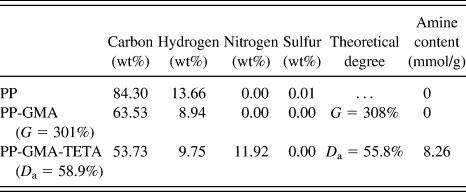
EA of PP, PP-GMA, and PP-GMA-TETA are shown in Table II to confirm the chemical composition and the group content of the fibers. After grafting polymerization with GMA, the carbon and hydrogen contents of fibers decreased from 84.3 and 13.66 wt% to 63.53 and 8.94 wt%, respectively. Therefore, the oxygen content would be calculated, and based on that, the grafting degree (G) of PP-GMA was 308%, close to the G of 301%, derived from the difference of the weights before and after grafting. After amination with TETA, the nitrogen content came to 11.92%, and based on it, the amination degree (D a) calculated was 55.8%, which was smaller than the G (58.9%) calculated based on the mass difference of the fibers before and after amination. Although any increment in the nitrogen content of PP-GMA-TETA was stemmed from amine groups, the amine content acquired based on the EA result reached 8.26 mmol/g after amination with TETA. Furthermore, the nitrogen contents in other adsorbents PP-GMA-X can also be calculated in this way.
Element analysis of PP, PP-GMA, and PP-GMA-TETA.
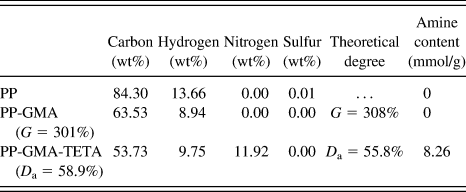
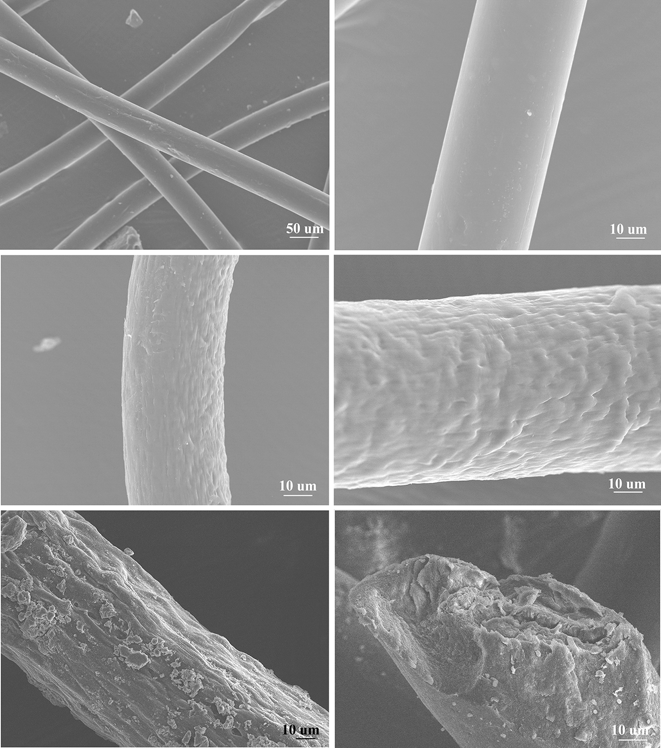
Figure 4 shows the morphologies of PP, PP-GMA, and PP-GMA-TETA captured by a SEM. Compared with the smooth surface of PP fiber, the surfaces of PP-GMA and PP-GMA-TETA became much tougher. Besides, PP-GMA and PP-GMA-TETA became much larger than that of PP due to a membranous layer of the GMA copolymers and their TETA derivatives enwrapped on the PP surface. These results were consistent with those obtained from FTIR.
SEM photographs of the original PP (a, b), PP-GMA (c, d), and PP-GMA-TETA (e, f).
C. Thermal stability of PP-GMA-X
The thermogravimetric analysis results of PP, PP-GMA, and PP-GMA-TETA fibers are shown in Fig. 5. The PP fiber did not begin to lose its weight until the temperature was raised to 380 °C, indicating its intrinsic thermal stability, and it showed only one platform at a mass loss of around 100%. In the case of PP-GMA, there were two platforms whose starting decomposition temperatures were 220 and 380 °C, respectively. It was believed that the first platform resulted from the degradation of the grafted GMA and the degradation of its inner PP substrate gave another loss when the temperature came to 380 °C. On the whole, the small weight loss of PP-GMA-TETA beneath 200 °C indicated that this kind of fiber could satisfy practical use in terms of thermal stability.
Thermogravimetric analysis of PP, PP-GMA, and PP-GMA-TETA.
D. Mechanical properties of the fibers
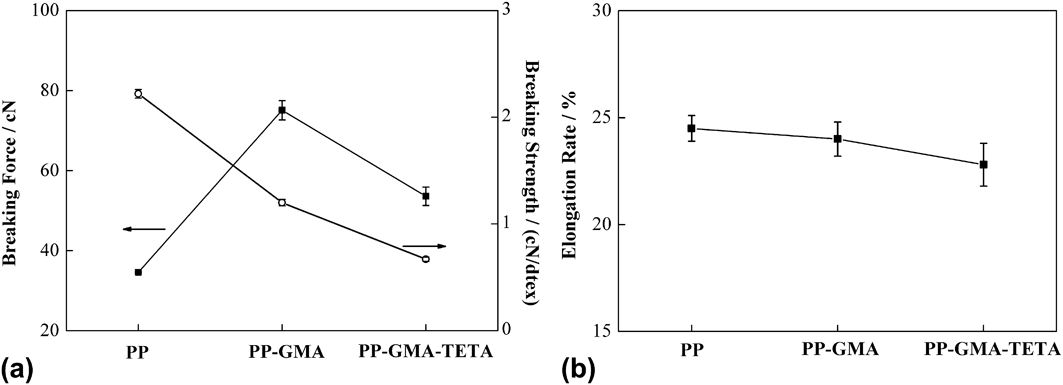
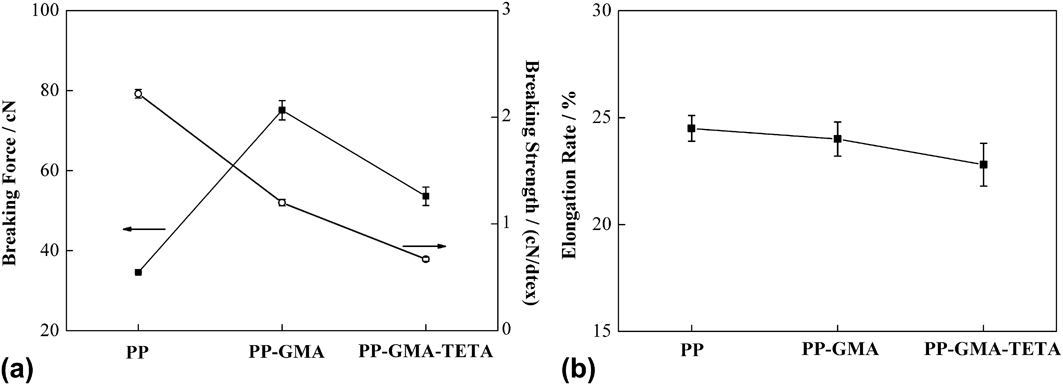
Figure 6 shows the mechanical properties of PP, PP-GMA, and PP-GMA-TETA. Compared with PP fiber, the breaking force of PP-GMA rose from 34.6 to 75.1 cN and then decreased to 53.6 cN after the amination process. It was because that after the introduction of GMA, the mechanical properties of the PP substrate was just mildly damaged, but at the same time, the diameter of the fiber almost doubled, and the coating layer of GMA would lead to a significant increase in the breaking force. Meanwhile, the hydrogen bonds formed between polymer chains containing –OH, –NH2, and –NH would also contribute to the increase in the breaking force. However, during the amination step, TETA (pH = 10.7) would pose a basic environment to the fibers, which would obviously weaken the mechanical strength of the fiber and consequently brought about a drop in breaking force of PP-GMA-TETA. On the other hand, the breaking strength of the fibers decreased from 2.2 to 1.20 cN/dtex and further to 0.61 cN/dtex after irradiation grafting and amination process. This could be attributed to the fact that although grafting of GMA on PP led to an increase in breaking force of PP-GMA and PP-GMA-TETA, the linear density of the composite fiber increased still more. As breaking strength (cN/dtex) is a specific strength, which is equal to the quotient of breaking force divided by the linear density of the fiber, much more increase in linear density cause a decline in breaking strength after each modification step. With respect to elongation, it decreased slightly from 22.5% to 21.4% after grafting GMA and further to 20.0% in the amination process. In brief, the mechanical strength of the fibers did not decay significantly in the modification process and could still meet the need of practical utilization.
Break strength and elongation rate of PP, PP-GMA, and PP-GMA-TETA.
E. Adsorption properties of PP-GMA-TETA
1. Effect of amination degree on CO2 adsorption ability of PP-GMA-TETA
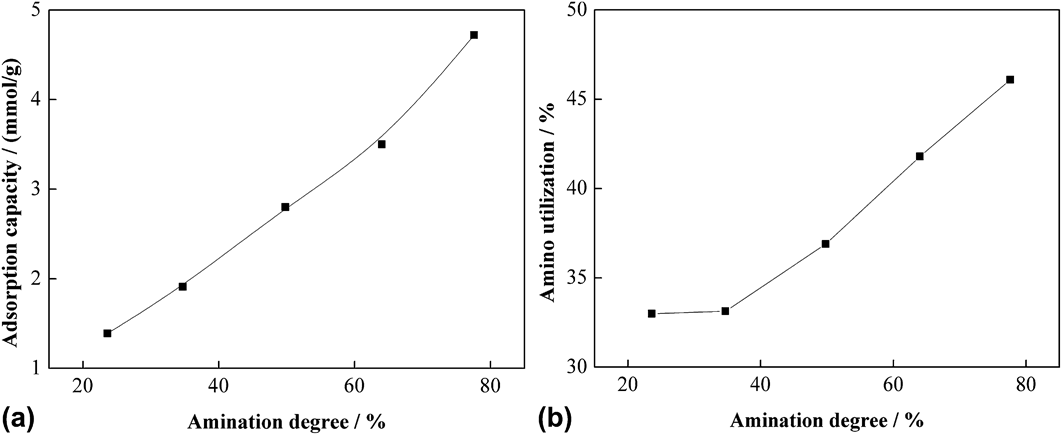
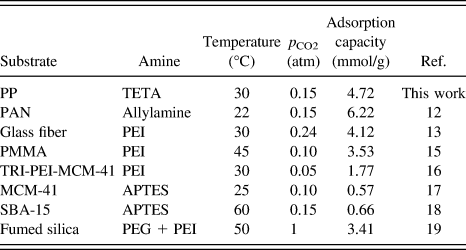
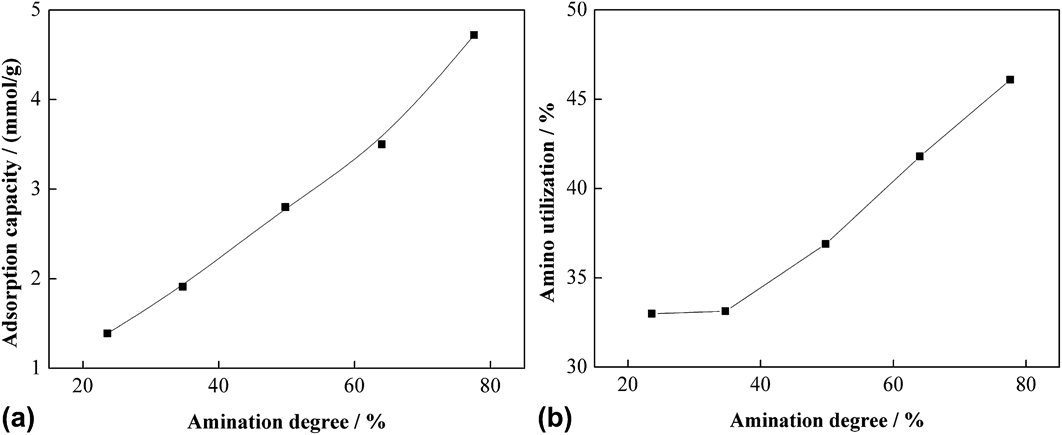
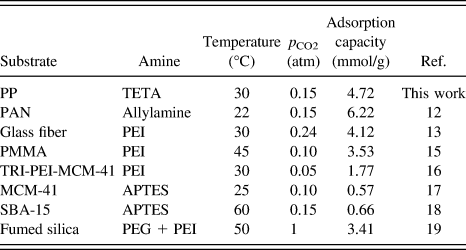
The CO2 adsorption capacity of PP-GMA-TETA with different amination degrees is presented in Fig. 7 to figure out the impact of amine content on CO2 adsorption. It showed that higher amination degree would result in higher CO2 adsorption capacity at normal temperature and pressure and in the presence of moisture. This could be attributed to that PP-GMA-TETA with higher amination degree contained more amine groups and performed better water adsorption ability; therefore, CO2 molecules had more chance to react with the amine to get a higher adsorption capacity. To better evaluate the adsorption properties of the sorbents, amine efficiency, which is the amount of CO2 adsorbed divided by the amount of amines present for a given weight of the fiber, was used to measure the degree to which an adsorbent met its theoretical capacity.Reference Gray, Soong, Champagne, Pennline, Baltrus, Stevens, Khatri, Chuang and Filburn3 Here, the amine efficiency was increased with the increasing amination degree. When the amination degree was 77.6%, the CO2 adsorption capacity and amine efficiency would be up to 4.72 mmol/g and 46.09%, respectively. Compared with other adsorbents reported (Table III), PP-GMA-TETA showed a relatively high adsorption efficiency, indicating its possibility for practical application.
CO2 adsorption capacity and amine efficiency of PP-GMA-TETA with different amination degrees (mass, 2.8 g; G = 300%; temperature, 30 °C, N2, 28 mL/min, and CO2, 5 mL/min).
Comparison of CO2 adsorption capacity of amine-functionalized solid sorbents.
2. Effect of temperature on CO2 adsorption ability of PP-GMA-TETA
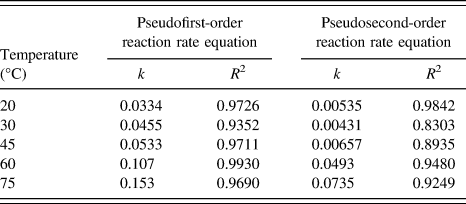
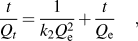
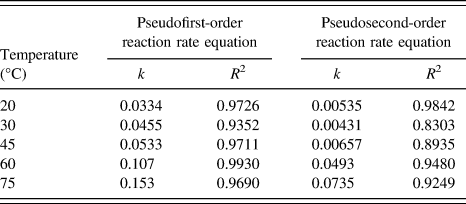
The CO2 adsorption capacity of PP-GMA-TETA at different temperatures is shown in Fig. 8. It indicated that temperature was an important factor that would greatly affect the CO2 adsorption performance. As the temperature was raised from 20 to 35 °C, the CO2 adsorption amount increased from 3.95 to 4.72 mmol/g; accordingly, the amine efficiency increased from 38.57% to 46.09%. This could be attributed to that higher temperature would accelerate the diffusion of CO2 into the interior of TETA layer of PP-GMA-TETA, which was benefit for CO2 to react with water and –NH2 and increased the amine efficiency. However, rising the temperature also had a negative effect on the adsorption capacity, which was to accelerate the decomposition of ammonium carbonate, unfavorable to the adsorption. Meanwhile, the CO2 adsorption reaction is an exothermic reaction, and therefore, the CO2 adsorption capacity will decrease at an excessively high temperature. Taking these factors into consideration, the experimental results showed that adsorption at 30 °C would improve the utilization of adsorbent and the adsorption kinetics. A relatively high adsorption capacity of 4.72 mmol/g and amine efficiency of 46.09% were achieved at this adsorption temperature. To better interpret the adsorption behavior and adsorption kinetics of PP-GMA-TETA, the pseudofirst-order reaction rate equation and the pseudosecond-order reaction rate equation were applied to fit the dynamic CO2 adsorption data at different temperatures. Their constants and correlation coefficients based on the stimulation results are presented in Table IV. It can be found that the pseudofirst-order reaction rate equation agreed better with the data than the pseudosecond-order reaction rate equation, as a higher R 2 in the pseudofirst-order reaction rate equation model at nearly all the temperatures. The energy for CO2 adsorption obtained with Arrhenius Eq. (8) reached 23.6 kJ/mol (Fig. 9). This result manifested that the interaction between the amine of PP-GMA-TETA and CO2 was relatively weak, which would be advantageous to the regeneration of the adsorbent.
 $$\lg ({Q_{\rm{e}}} - {Q_t}) = \lg {Q_{\rm{e}}} - {{k_1} \over {2.303}}t\quad ,$$
 $${t \over {{Q_t}}} = {1 \over {k_2Q_{\rm{e}}^2}} + {t \over {{Q_{\rm{e}}}}}\quad ,$$
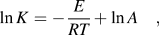 $$\ln K = - {E \over {RT}} + \ln A\quad ,$$
where t is the adsorption time; k 1 and k 2 are the pseudofirst-order reaction rate equation constant and pseudosecond-order reaction rate equation constant, respectively; Q e is the CO2 adsorption amount at equilibrium; Q t is the CO2 adsorption amount at time t; K is the first-order rate constant (min−1); T is the reaction time (min); E is activation energy (kJ/mol); and A is the preexponential factor.
Effect of adsorption temperature on CO2 adsorption capacity.
Kinetic parameters and correlation coefficients for CO2 adsorption on PP-GMA-TETA.
Arrhenius plots for the kinetic constants obtained by pseudofirst-order reaction rate equation.
3. Effect of CO2 concentration on CO2 adsorption ability of PP-GMA-TETA
Figure 10 shows the effect of different CO2 concentrations on the adsorption ability of PP-GMA-TETA. When the initial CO2 concentration was 20%, the PP-GMA-X samples reached the plateau of maximum adsorption capacity in 32 min, and the time spent to reach equilibrium adsorption was longer at lower CO2 concentration, indicating a faster kinetics of the adsorption process under higher concentration conditions. The adsorption capacity of PP-GMA-TETA (amine content = 5.53 mmol/g) for CO2 would also change with the CO2 concentration of the influent stream. When the CO2 concentration was raised from 10% to 20%, the CO2 adsorption amount increased from 1.95 to 2.22 mmol/g, and the amine efficiency increased from 33.73% to 47.99%.
Effect of adsorption temperature on CO2 adsorption capacity.
F. Regeneration properties of PP-GMA-TETA
Excellent regeneration performance of adsorbents is of great importance for practical application. To test the regeneration ability of PP-GMA-TETA, it was subjected to several CO2 adsorption–desorption cycles. CO2 adsorption breakthrough curves of the fresh fiber and the fiber regenerated by heating at 100 °C for 20 min are compared and shown in Fig. 11(a). Obviously, all regenerated fibers exhibited similar breakthrough behavior as the fresh fibers, indicating that PP-GMA-TETA showed good stability even after several regeneration cycles. Moreover, their adsorption capacity shown in Fig. 11(b) appeared quite close to that of the fresh fiber, which demonstrated that the CO2 was nearly released from the adsorbed PP-GMA-TETA completely after the desorption process and its adsorption capacity could be well maintained.
(a) Breakthrough curves of CO2 adsorption on fresh and regenerated PP-GMA-TETA and (b) CO2 adsorption capacities at each regeneration cycle (mass, 2.8 g; G = 300%; D a = 77.6%; adsorption temperature, 30 °C; N2, 28 mL/min; and CO2, 5 mL/min).
As shown in Fig. 12, the FTIR spectra of the as-prepared PP-GMA-TETA, the PP-GMA-TETA fiber after adsorption of CO2 and the regenerated fiber also revealed that the adsorbent was stable in the adsorption and regeneration process. After CO2 adsorption, the intensity of the broad and strong bands at 3200–3400 cm−1 and the one at 1565 cm−1 had been weakened obviously, as a result of the reaction between amine groups and CO2. Compared the FTIR spectrum of regenerated PP-GMA-TETA with that of the fresh fiber, it could be seen that the intensity of the bands at 3200–3400 and 1565 cm−1 were almost the same in terms of shape and intensity, which confirmed the successful regeneration.
FIIR spectra of the fresh, CO2 adsorbed, and regenerated PP-GMA-TETA.
G. Effect of amine species on the CO2 adsorption stability of PP-GMA-X and its thermal capacity
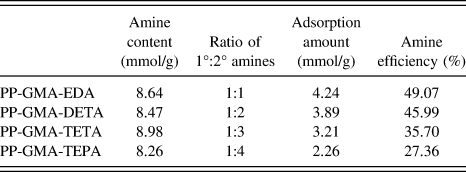
The influence of amine type on the adsorption performance was investigated at 30 °C, and the CO2 concentration was 15%. As shown in Fig. 13 and Table V, all the curves showed a steeper slope at the first stage, which revealed the rapid rate of adsorption, and the slope of the curves decreased with increasing adsorption time. Interestingly, although the PP-GMA-X fibers possessed similar nitrogen content, their amine efficiency was different and in the following order: PP-GMA-EDA > PP-GMA-DETA > PP-GMA-TETA > PP-GMA-TEPA, conformed with their content proportion of primary amines. This can be attributed to the higher efficiency of the primary amine to react with CO2 than the secondary amine. A larger amount of primary amine would bring about higher adsorption efficiency and adsorption rate. Meanwhile, the grafted shorter amine molecules offered less steric hindrance and benefited amine active sites to react with CO2 molecules.Reference Ko, Shin and Choi20,Reference Sartorl and Savage21 However, as can be seen in Fig. 14, amines with high amine content, such as EDA and DETA, would pose an excessive alkaline environment to the fibers and significantly reduce the stability of the prepared sorbents. As a result, to strike a balance between the adsorption capacity and the structural stability of the sorbent, TETA was chosen as an ideal amination reagent in this study.
Adsorption capacity of PP-GMA-X (mass, 1.0 g; adsorption temperature, 30 °C; gas flow rate, 30 mL/min; and CO2 concentration, 15%).
Thermogravimetric analysis of PP-GMA-X.
Adsorption properties of PP-GMA-X solid amine fibers.
IV. CONCLUSION
A solid amine fiber PP-GMA-TETA has been successfully prepared via irradiation grafting copolymerization with GMA onto the PP substrate followed by reacting with TETA. PP-GMA-TETA was proved to be an excellent adsorbent for CO2, with remarkable CO2 adsorption capacity (4.72 mmol/g), chemical stability, and good regeneration property. As for effect exerted by the amine structure, the results demonstrated that fibers with higher content of primary amine would obtain faster adsorption rates and higher adsorption capacities.
ACKNOWLEDGMENTS
The authors gratefully acknowledge the financial support provided by the National Natural Science Foundation of China (Grant No. 51173211), Science and Technology Project of Guangdong Province (Grant No. 2011B090400030), and Science and Technology Project of Zhuhai (Grant No. 2010B050102024).