Tetralogy of Fallot is the fifth most prevalent congenital heart condition and has been studied extensively over the years. It has an incidence rate of 1 in 3500 live births, that is approximately 38,000 patients are born with tetralogy of Fallot annually around the world.Reference Villafane, Feinstein and Jenkins 1 Without treatment, 30% of patients survive up to 10 years and 5% remain alive at 40 years.Reference Starr 2 The first repair operation was performed by Lillehei in 1954 using cross-circulation and a trans-ventricular approach to the ventricular septal defect closure and trans-annular patching.Reference Cooley 3 Since then, a spectrum of surgical alternatives to ventricular septal defect closure and right ventricular outflow tract obstruction relief have been developed and practiced worldwide. Emerging data suggest that repair technique has an impact on survival and right ventricular physiology as early as 16 months post-operatively.Reference Pondorfer, Cheung and Ashburn 4 Long-term follow-up studies have shown that the traditional trans-ventricular/trans-annular patching technique results in severe pulmonary regurgitation which leads to right ventricular dilation and dysfunction. The progressive right ventricular failure in these patients significantly increases the risk for arrhythmia and sudden cardiac death.Reference Gatzoulis, Balaji and Webber 5 On the contrary, single-centre reports demonstrate that there is a survival advantage and higher freedom from re-operation for those with a mixed lesion (stenosis and regurgitation) at the level of the pulmonary annulus.Reference Pondorfer, Cheung and Ashburn 4 , Reference d’Udekem, Galati and Rolley 6 Despite these encouraging findings, 60–65% of cases are performed through the traditional trans-ventricular/trans-annular patching technique mainly because of surgeon preference.Reference Al Habib, Jacobs and Mavroudis 7 , Reference Sarris, Comas, Tobota and Maruszewski 8 The reluctance to adopt the annulus preservation approach may be explained by: the fear of leaving residual right ventricular outflow tract stenosis and low quality available evidence on the impact of repair strategy on outcomes. None of the available data adjust or match participants on crucial confounders such as pre-operative cardiac morphology. Therefore, a large international prospective cohort study is essential in developing strong evidentiary support in this field and to resolve the controversy around optimal repair technique. As an initial step to designing this multi-centre study, a survey was undertaken to determine the degree of heterogeneity in surgical practices before initiating larger clinical studies. The survey would also determine the interest in conducting these larger multi-centre cohort studies at potential sites.
Materials and methods
A questionnaire was created with an aim to understand the surgical practice patterns and research infrastructure at each site. The domains of the questionnaire were generated and reviewed by experts in the field before the distribution of the survey. The survey consisted of questions regarding characteristics of the centre, tetralogy of Fallot repair strategy and technique, post-operative care and follow-up practices, and available research resources. A convenience sample of paediatric cardiac surgeons from 18 international institutions was identified. An invitation was sent to participants to complete the survey using Research Electronic Data Capture. Participants were given a 2-week period to complete the survey; follow-up e-mails were then sent to participants with incomplete responses.
The information on the perceived repair strategies, post-operative care, and follow-up practices are presented by each country. The overall summary measures for all countries, weighted by the total number of tetralogy of Fallot repairs in each centre, are also presented. The summary measures reported are means and counts (percentages). All analyses were performed using IBM SPSS Statistics 22.
Results
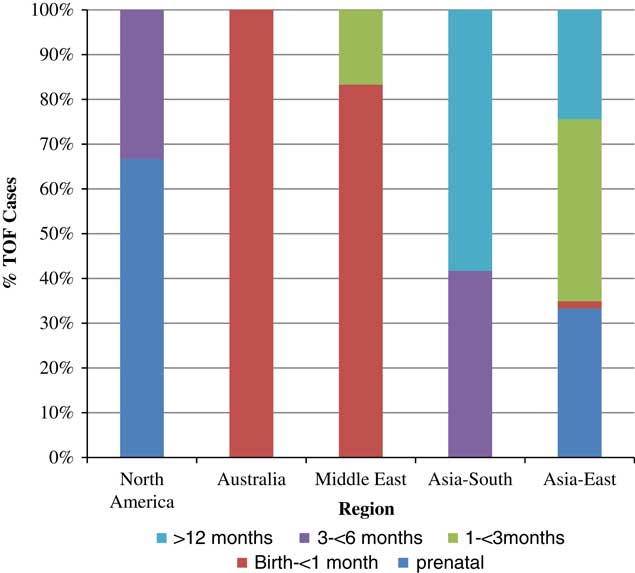
There was a 100% response rate to the survey with no missing data fields. These responses represent a total of 18 sites in 11 countries with an overall caseload of over 1800 tetralogy repairs annually. The participating sites represented United States of America, Canada, Australia, Japan, China, South Korea, Indonesia, India, Nepal, Saudi Arabia, and Turkey. The characteristics of participating sites are described in Table 1. The survey included sites of various surgical volume capacities (15–450 repair cases per year). In addition, heterogeneity in the age of tetralogy of Fallot diagnosis was noted amongst participating sites that may have an influence on the surgical management of their patient population (Fig 1).
Variations in age of tetralogy of Fallot diagnosis by region. Regions (number of sites): North America (3), Australia (1), East Asia (7), South Asia (3), and Middle East (4).

Site characteristics.

IQR=interquartile range; RVOT=right ventricular outflow tract; TEE=trans-oesophageal echocardiogram; TOF=tetralogy of Fallot.
Timing of repair
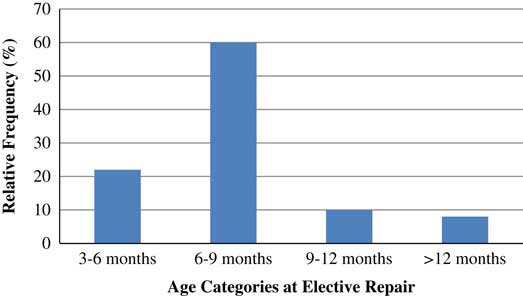
The survey demonstrated that 83% of surgeries are primary repairs. Most elective primary repair cases (60%) are being performed at 6–9 months of age (Fig 2). The decision to proceed with primary repair depends on patient’s age and weight at the time of repair. Patient’s age is found to influence the repair strategy in 47% of participating sites. The most common cut-off for considering primary repair is 1–3 months of age. Patient’s weight influences the timing of repair in 6/18 sites (14% weighted cases). The majority of these sites (5/6) would consider primary repair for infants 3 kg and above.
Age when elective repair would be considered.

Repair technique
In 44% of sites, more than one general repair strategy is used within the same institution. The choice of predominant repair strategy was influenced by institutional policy (54%), surgeon preference (40%), and level of evidence (10%) available to support the decision.
Ventricular septal defect closure
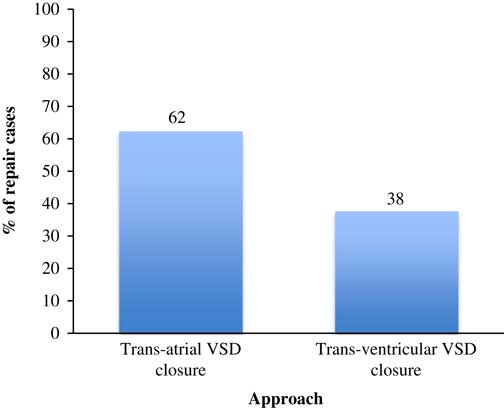
Approximately 38% of surgeons close the ventricular septal defect through a ventriculotomy incision, whereas 62% approach the ventricular septal defect through a trans-atrial incision (Fig 3).
Proportion of ventricular septal defects closed by a trans-atrial and trans-ventricular approach.

Right ventricular outflow tract management
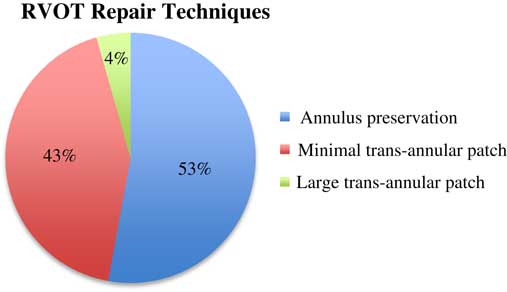
Approximately half of the surveyed centres operates with an aim to leave little or no obstruction at the level of the pulmonary valve. The estimated proportions of cases performed with annulus preservation, minimal trans-annular patch, and large trans-annular repairs are presented in Figure 4. More than 70% of responders rely on the pulmonary valve z-scores to determine the management technique of the right ventricular outflow tract. A z-score of −3 (determined by pre-operative echocardiogram studies) is the most common cut-off to proceed with a trans-annular patch. For centres that attempt to preserve the pulmonary annulus (52%), the majority of valves (84%) will be managed by a commissurotomy and a rigid bougie (Hegar) sizing during the repair procedure. At the completion of repair, the average acceptable peak trans-valvular gradient obtained by echocardiography is 38.6 mmHg (26–50 mmHg). Most centres aim for right ventricular systolic pressure to be <0.8 of systemic blood pressure.
Common right ventricular outflow tract repair techniques performed.

Follow-up practices
The majority (92%) of uncomplicated repaired patients attend clinical follow-up at least annually. Follow-up visits beyond the perioperative period are usually completed by the cardiovascular surgery service in 80% of cases. Otherwise, follow-up care is transferred to another service within the first month following a repair. Echocardiogram studies are the mainstay of follow-up; sedation is routinely used in 91% of studies performed in children 18–24 months of age. Cardiac MRI is routinely used in 17% of cases starting at a mean age of 10 years.
Discussion
Tetralogy of Fallot is one of the earliest studied congenital heart defects. There are a number of variations to the repair strategy employed worldwide. Emerging single-centre studies have demonstrated that repair technique may impact early and long-term morbidity and mortality.Reference Pondorfer, Cheung and Ashburn 4 , Reference d’Udekem, Galati and Rolley 6 , Reference Frigiola, Hughes and Turner 9 Therefore, it would be important to study these different techniques and their clinical implications through epidemiological studies. We conducted a survey of 18 potential participating sites for a large cohort study to better understand their surgical repair practices and determine if sufficient heterogeneity was present for a multi-centre observational study.
Timing of repair
Our survey shows that approximately 83% of repairs were performed without preceding palliation, which is similar to the rate published from the STS database. The majority of primary elective repair cases in our survey (60%) were performed at 6–9 months of age. Data on North American practice show repairs being performed at 3–6 months of age.Reference Al Habib, Jacobs and Mavroudis 7 Reasons for earlier elective repairs are not fully understood. Age of repair is usually influenced by the timing of presentation, presence of symptoms, practice preference, and greater resources for complex post-operative intensive care. According to our survey the majority of sites (14/18) have a specialised cardiac paediatric ICU facility. Post-operative care was mostly commonly provided by paediatric ICU trained physicians (92%), paediatric cardiologist with interest in intensive care medicine (48%), and cardiovascular surgeons (42%).
Repair strategy
This survey suggests that the majority of ventricular septal defect repairs in tetralogy of Fallot are performed through a trans-atrial approach (62%) and followed an annulus preservation strategy (53%) for managing the right ventricular outflow tract stenosis. A pulmonary valve annulus z-score of −3 is used as a cut-off to proceed with annulus preservation in most of these centres. The proportion of annulus preservation repair is significantly higher than reported by the EACTS and STS registries (1.5–20%).Reference Al Habib, Jacobs and Mavroudis 7 , Reference Sarris, Comas, Tobota and Maruszewski 8 Measured data would be important to determine if perception and practice are fully correlated. It is also possible that practice has evolved to more trans-atrial repairs subsequent to the large EACTS and STS registry publications.
Variation in practice
This survey demonstrates regional variations in tetralogy of Fallot management. The choice of surgical strategy for this population is highly influenced by surgeon preference and local policies. As such, a “standard” surgical strategy cannot be identified. We believe a rationale exists to conduct a large international multi-centre inception cohort study to create strong evidentiary support for surgical management of tetralogy of Fallot patients.
Limitations
Although this survey presents a multinational picture of contemporary tetralogy of Fallot surgical management, there are limitations that need to be taken into consideration. First and foremost, the results are reflection of the surgeons’ opinions that may suffer from recall bias. Moreover, there is a selection bias of participating centres and some regions were not included, such as South America and Africa. We attempted to achieve a balance between getting the necessary data on global practice and maintaining the simplicity and ease of completing the survey. Therefore, we elected to omit some operative details, such as use of leaflet augmentation, prevalence of concomitant tricuspid valve repair, and approach to infundibular muscle resection. As our main aim of this manuscript was to convey surgical practices, we did not report on any morbidity or mortality outcomes.
In conclusion, this survey of 18 international paediatric cardiac surgery centres demonstrates variations in tetralogy of Fallot surgical management and no accepted standard of practice. In addition, there are differences between these perceived practices and actual practices reported by large international registries. These discrepancies may be explained by the limitations of this survey or by evolving practice patterns. A multinational inception cohort study documenting the initial cardiac anatomy, surgical approaches, and intermediate and long-term outcomes is underway (NCT 2968264).
Acknowledgement
None.
Financial support
This research received no specific grant from any funding agency, commercial or not-for-profit sectors.
Conflicts of interest
Y. d’Udekem: Consultant/Advisory Board, Medical Specialties Distributors; G. S. Van Arsdell: Ownership Interest, Cell Aegis Devices; C. D. Fraser: Research Grant, Berlin Heart.