Healthcare-associated infections (HAI) have been a major global priority with higher rates in developing countries.Reference Pittet, Allegranzi and Storr 1 Surgical site infections (SSI) are more common in these countries and the high incidence can be associated with low socioeconomic level.Reference Rosenthal, Richtmann and Singh 2 The most recent estimates in developing countries found the prevalence of HAI to be 15·5 per 100 patients (95%, CI 12.6–18.9) with SSI being the most common infection.Reference Allegranzi, Bagheri Nejad and Combescure 3 By comparison, the HAI prevalence in the United States was found to be much lower at 4 per 100 patients, though SSI was still one of the most common infections.Reference Magill, Edwards and Bamberg 4 There are limited studies on the impact of HAI in developing countries, but these infections have been shown to increase length of stay, mortality, and cost. 5 The financial burden of HAI includes direct costs to the hospital for prolonged stay and readmission, as well as costs to the community and the patients themselves.Reference Reilly, Twaddle, McIntosh and Kean 6 Many global initiatives have addressed these higher rates of HAI and SSI in developing countries with programs such as continuous quality improvement efforts,Reference Huskins, Soule, O'Boyle, Gulácsi, O’Rourke and Goldmann 7 , Reference Weinberg, Fentes and Ruiz 8 antimicrobial stewardship, 9 use of checklists,Reference Haynes, Weiser and Berry 10 and infection prevention guidelines for facilities with limited resources.Reference Dramowski 11 Multiple tools have been developed for the assessment of infection control (IC) by the World Health Organization 12 and the US Agency for International Development has created the Infection Control Assessment Tool (ICAT). 13 The ICAT was developed with the aim of clearly identifying targets for improved IC practice that would contribute to lowering of HAI rates in low-resource healthcare facilities.Reference Huskins, Manchanda and Singh 14 , Reference Huskins, Ross-Degnan and Goldmann 15 Owing to concern for higher rates of HAI in developing countries and the high prevalence of SSI, we set out to further investigate specific areas where IC practices could be improved.
METHODS
Study Design and Participants
The ICAT was field tested by members of the Rational Pharmaceutical Management Plus Infection Control Project Team and consists of 21 modules related to IC across different topics and hospital departments. 13 Its goal is to reduce the risk of serious and preventable HAI in low- and middle-income countries with financial and resource constraints and limited staff training. 13 Through the Society for Healthcare Epidemiology of America (SHEA) international ambassador program, 6 international sites completed ICAT modules specific to IC programs and clinical service areas relating to surgery. One site was in Nepal (low income); 1 in India (low-middle income); 1 each in Argentina, Hungry, and South Africa (upper-middle income); and 1 in Greece (high income). SHEA international ambassadors were trained on the ICAT module via webinar by the senior author of this paper (N.S.) and thus were able to provide information within a system that they understood.
Procedures
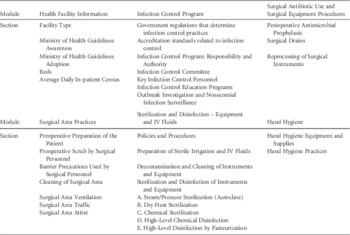
The sites were asked to complete 6 ICAT modules covering topics including health facility information, IC program, surgical antibiotic use and surgical equipment procedures, surgical area practices, sterilization and disinfection of equipment and intravenous (IV) fluids, and hand hygiene (Table 1). A hand hygiene observational checklist was also included in the ICAT. The surveys were completed by the healthcare epidemiologists (SHEA international ambassadors) who were familiar with IC practices and policies of their hospitals.
Section list by module

Data Collection and Processing
Each module is composed of a standardized questionnaire with multiple sections and point values ranging from 0 to 3 that are given for each response. Question formats included yes/no, multiple selections, and selecting 1 answer among choices. Each section was then scored and a percentage of total points was assigned. The scoring sheets with surveys were returned to SHEA ambassadors and verified, and any corrections were made as needed. No questions were added to the survey but if questions did not apply to a specific site they were removed per ICAT instruction.
Analysis
Data from the sites were totaled, scored, and analyzed on the basis of World Bank economy classification. 16 Data from the 6 sites from low- to high-income countries were assessed as median (range) of total points received across all sites for each section and module. The observational checklist on handwashing was scored separately.
RESULTS
The module on general hospital facility information revealed that facilities participating were both private and public hospitals with number of beds ranging from 645 to 2,245. Site 1 was a public hospital with 939-bed capacity located in Hungary, an upper-middle income economy. It had adopted ministry of health guidelines and had government regulations determining IC practices as well as accreditation standards related to IC. Site 2 was a public hospital with 1,384-bed capacity located in South Africa, an upper-middle income economy. It had also adopted ministry of health guidelines and had government regulations determining IC practices as well as accreditation standards related to IC. Site 3 was a private hospital with 645-bed capacity located in Argentina, an upper-middle income economy. It had adopted ministry of health guidelines and had government regulations determining IC practices. This site did not have accreditation standards related to IC. Site 4 was a public hospital with 2,245-bed capacity located in India, a low-middle income economy. It had adopted ministry of health guidelines but did not have any government regulations determining IC practices or accreditation standards related to IC. Site 5 was an academic hospital with 700-bed capacity located in Nepal, a low income economy. It had adopted ministry of health guidelines but did not have government regulations determining IC practices or accreditation standards related to IC. Lastly, site 6 was an academic hospital with 750-bed capacity located in Greece, a high income economy. It had neither ministry of health guideline awareness nor government regulations determining IC practices nor accreditation standards related to IC. Overall, survey results showed that IC programs were regulated by a government organization at 3 sites and only 2 sites had accreditation standards for IC.
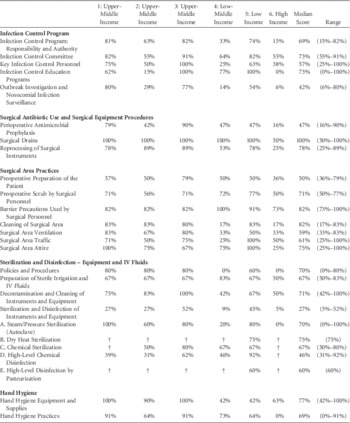
The results of each section are listed by country with median (range) of percentage of recommended IC practices followed (Table 2). Within the IC module, nosocomial infection surveillance and outbreak investigation received the lowest scores with 3 sites scoring less than 50%. The total median score for this section was 42% (6%–80%) adherence to recommended practices. IC program responsibility and authority, which addresses the role of IC personnel in the hospitals, had a median score of 69% (15%–82%) with 2 sites scoring less than 50%. The IC committee section addressed the role and organization of IC control committees in the hospital and scored a median of 73% (55%–91%). Key IC personnel training and level of effort scored a median 57% (25%–100%) with 2 sites scoring less than 50%. Lastly, the IC education programs section addressed orientation and continuing education programs in IC and scored a median 73% (0%–100%) adherence with 2 sites scoring less than 50%. The healthcare facility in Greece—the high-income country site in this study—scored less than 50% for 4 of the 5 sections in this module, including outbreak investigation and nosocomial infection surveillance (6%), IC education programs (0%), key IC personnel (38%), and IC program responsibility and authority (15%).
Percentage of recommended infection control practices followed by section and country

†No data or not applicable to site
The surgical antibiotic use and equipment procedures module consisted of sections on perioperative antimicrobial prophylaxis, surgical drains, and reprocessing of surgical instruments (Table 2). The lowest scores in this section were for perioperative antimicrobial prophylaxis, which addressed accessibility of written policies or guidelines, monitoring of adherence to guidelines, accessibility of antibiotics, and their appropriate administration. This section scored a median of 47% (16%–90%) adherence with 4 sites scoring less than 50%. Appropriate placement of surgical drains had a median score of 100% (50%–100%) adherence. Appropriate reprocessing of surgical instruments scored a median of 78% (25%–89%) with 1 site scoring less than 50%. The healthcare facility in Greece also scored less than 50% for 2 of these 3 sections—that is, perioperative antimicrobial prophylaxis (16%) and reprocessing of surgical instruments (25%).
The surgical area practices module included sections on preoperative preparation, preoperative scrub, barrier precautions, cleaning, ventilation, area traffic, and attire (Table 2). Preoperative preparation of the patient addressed written policy or procedures, bathing, hair removal, and antiseptic use, and scored a median of 50% (36%–79%) with 1 site scoring less than 50%. Preoperative scrub by surgical personnel had a median score of 71% (50%–77%). Barrier precautions used by surgical personnel scored a median of 82% (73%–100%). The section on cleaning of the surgical area questioned availability of written policies or guidelines, procedures for contaminated surgeries, and cleaning practices, with a median score of 82% (17%–83%) and 2 sites scoring less than 50%. Surgical area ventilation addressed ventilation systems, windows, air pressure, and air conditioning, with a median of 59% (33%–83%) and 2 sites scoring less than 50%. Surgical area traffic had a median score of 61% (25%–100%) with 1 site scoring less than 50%, and the surgical area attire median was 75% (25%–100%) also with 1 site scoring less than 50%. The Greek hospital scored less than 50% for 4 of the 7 sections, which included preoperative preparation of the patient (36%), cleaning of surgical area (17%), surgical area ventilation (33%), and surgical area attire (25%).
The sterilization and disinfection of equipment and IV fluids module included availability of policies and procedures, which scored a median of 70% adherence (0%–80%) with 2 sites scoring less than 50% for no written policies or procedures. Preparation of sterile irrigation and IV fluids, addressing where IV fluids are obtained or sterilized, scored 67% (50%–83%). Decontamination and cleaning of instruments and equipment, which questioned related policies and recommended practices for cleaning, scored 71% (42%–100%) with 1 score less than 50%. Sterilization and disinfection of instruments and equipment scored a median of 27% (5%–52%) with 5 sites scoring less than 50%. This section included a table that addressed how each instrument was sterilized and disinfected, although points were lost if instruments were disposable and did not apply. Autoclave sterilization was used by all 5 sites, with a median score of 70% (0%–100%) adherence to recommended practices and 2 sites scoring less than 50%. High-level chemical disinfectant was used by 5 of the sites with a median of 46% (31%–92%) and 3 sites scoring less than 50%. The Greek hospital scored less than 50% for sections on policies and procedures (0%), sterilization and disinfection of instruments and equipment (5%), and steam/pressure sterilization (0%). This site also did not use high-level chemical disinfection.
The hand hygiene module addressed availability of hand hygiene equipment and supplies with a median score of 77% (42%–100%). Two sites in the low-income category scored less than 50% with reports of fewer than 1 handwashing station per 6 beds with no available liquid soap or waterless alcohol-based hand antiseptic. That site also reported multiple-use cloth towels as a drying practice. The section on hand hygiene practices had a median score of 69% (0%–91%), including sections on reported routine use of hand hygiene. The Greek hospital scored 63% for hand hygiene equipment and supplies, which highlighted that soap and alcohol-based antiseptic were occasionally available, dispensers were topped off without cleaning, and there was fewer than 1 dispenser for every 4 beds. This site reported a score of 0% for hand hygiene practices, reporting no routine handwashing, no policy for covering skin lesions or short nails, and usual practice of gloving without washing. Hand hygiene observation was assessed by 1 site in a low-middle-income country, reporting 53% adherence to handwashing or alcohol-based rub prior to patient contact and 80% adherence following patient contact.
DISCUSSION
Our results indicate that adherence to recommended IC practices is suboptimal across a wide variety of sites. Opportunities for cost-effective improvement of SSI rates exist with major areas for development including (1) hospital-wide IC programs and surveillance, (2) antibiotic stewardship, (3) written and posted guidelines and policies across a range of topics, (4) surgical instrument sterilization procedures, and (5) improved hand hygiene.
Overall, IC programs had various limitations in these sites and HAI surveillance was not consistently performed at many sites. One site, for example, has an IC committee focused just on outbreaks of hospital infections without committee discussion of surveillance or endemic HAI. This site reported that no financial support was available for IC programs despite concerns regarding the potential financial impact of HAI.Reference Dimopoulou, Papanikolaou, Kopsidas, Coffin, Kourlaba and Zaoutis 17 An effective HAI surveillance program is recommended for all acute care hospitals as part of a complete strategy for the reduction of SSI.Reference Anderson, Podgorny and Berríos-Torres 18 Suggested models to reduce the incidence of SSI for hospitals in low- and middle-income countries use a validated system for measuring SSI rates.Reference Huskins, Soule, O'Boyle, Gulácsi, O’Rourke and Goldmann 7 SSI poses a unique but achievable challenge for surveillance and IC programs because many infections develop following discharge, making postdischarge surveillance an important component.Reference Manniën, Willie, Snoeren and van den Hof 19 Despite this, only 1 of the sites returning full survey data in our study reported performing postdischarge surveillance. Our data highlight a need to establish robust IC programs.
Perioperative antibiotic administration was another area of weakness with a large opportunity for improvement. Points were deducted for sites with no or limited written policies or guidelines on proper antibiotic use, no monitoring for adherence to guidelines, inaccessibility of antibiotic prophylaxis, and improper administration of antibiotics. One site in our study, for example, reported patients and families usually purchase prophylactic antibiotics outside the hospital prior to surgery. Antibiotic stewardship programs have an increasingly important role in low- and middle-income countries where many of the antimicrobial-resistant organisms originate.Reference Okeke, Laxminarayan and Bhutta 20 Implementation of antibiotic stewardship programs should reduce adverse events and limit healthcare costs due to poor antimicrobial use and antimicrobial-resistant infections. 9 Despite these concerns, in developing countries there is antibiotic misuse and lack of effective IC programs.Reference Okeke, Laxminarayan and Bhutta 20 , Reference Van Boeckel, Gandra and Ashok 21 This is a challenge in many parts of the globe, including our study sites.Reference Vatopoulos 22 – Reference Caini, Hajdu and Kurcz 25 Simple changes, such as the implementation of checklists for confirmation of sterility and antibiotic prophylaxis prior to incision, have been shown to be effective in reducing adverse outcomesReference Haynes, Weiser and Berry 10 and would likely reduce HAI and antimicrobial resistance through the interdisciplinary team approach as part of an antibiotic stewardship program.
Our data show that guidelines for perioperative antibiotic prophylaxis either may not exist in some facilities or are not readily accessible. With a global increase in use of total and “last-resort” antibiotics and increasing concern for resistant organisms,Reference Van Boeckel, Gandra and Ashok 21 , Reference Caini, Hajdu and Kurcz 26 the appropriate use of antibiotics with guidelines readily available in surgical areas should be a priority. The problem of absent or inaccessible guidelines occurred not only in antibiotic stewardship programs but also in other areas of surgical care, including preoperative preparation of the patient, cleaning of the surgical area, and surgical area traffic. For multiple sites, there were also no written policies or procedures for sterilization and disinfection of equipment.
Sterilization and disinfection of equipment was another area of concern highlighted by our study. The sterilization and disinfection of equipment and autoclave sections received low scores and this may be due to a limitation of the ICAT not accounting for disposable equipment. Despite this issue, individual responses highlighted a lack of defined policies and procedures for some sites, with some areas of improper instrument sterilization and disinfection technique. One site used nonrecommended practices, including chemical sterilization of oxygen masks, chemical and high-level disinfection of surgical instruments, storing sterile instrument packs directly on shelves or carts, and air drying instruments after chemical sterilization. Guidelines for recommended sterilization and disinfection should be made available and followed at all sites and are essential to limit the spread of HAI.Reference Rutala and Weber 27
Hand hygiene practices showed 1 site with inadequate hand hygiene equipment. The module also showed 1 site reported hand hygiene was not routinely performed before or after individual patient contact. This was consistent with low hand hygiene adherence even in high-income settings in Greece.Reference Kouni, Kourlaba and Mougkou 28 These findings indicate hand hygiene continues to be major factor in at least some settings and likely represents a large opportunity for improvement with staff education and practices. Behavioral interventions with educational programs, multidisciplinary quality improvement teams, compliance monitoring and feedback, and a mandated hand hygiene requirement statement have been shown to significantly reduce HAI and colonizationReference Aboelela, Stone and Larson 29 and would likely be beneficial in our study population.
Limitations of our study include having SHEA international ambassadors at each site completing the ICAT modules, thus introducing person-to person variability, although each respondent was trained by webinar. There were also limitations in the ICAT itself, which were noted in the section on sterilization and disinfection of equipment and IV fluids, because scores appeared falsely low in some sections owing to losing points for the use of disposable instruments. Despite these limitations, our data show there is opportunity for improvement in IC programs across economies, including HAI surveillance, antimicrobial stewardship, availability of written guidelines and policies, sterilization procedures, and hand hygiene. Concern for antibiotic resistance and for the lack of antibiotics in the pipelines has led to infection prevention initiatives and prudent use of antimicrobials. 30
Acknowledgments
Financial support. None reported.
Potential conflicts of interest. All authors report no conflicts of interest relevant to this article.