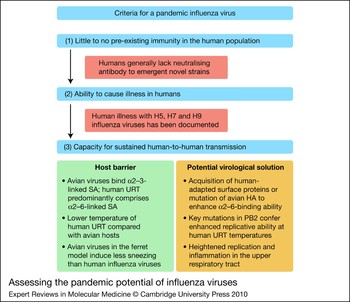
Influenza A viruses are single-stranded, negative-sense, enveloped RNA viruses, possessing eight gene segments that encode 11 known proteins (Refs Reference Chen1, Reference Webster2). The two major surface glycoproteins haemagglutinin (HA) and neuraminidase (NA) form the basis of serologically distinct virus subtypes. There are currently 16 HA and nine NA subtypes identified; all subtypes are found in wild waterbirds, the natural reservoir for influenza A viruses (Refs Reference Webster2, Reference Fouchier3). Despite this extensive diversity, only select subtypes have breached the species barrier, and, to date, viruses bearing H1, H2, H3, H5, H7 or H9 have caused documented human infections (Refs Reference Webster2, Reference Abdel-Ghafar4, Reference Belser5). The generation of a pandemic requires the emergence of a virus in the human population that (1) bears an HA to which there is little or no pre-existing immunity, (2) causes disease in humans, and (3) is capable of sustained human-to-human transmission (Fig. 1). However, only three subtypes (H1–H3) have acquired all three of these properties to cause pandemics in the last 100 years – in 1918 (H1N1), 1957 (H2N2), 1968 (H3N2) and 2009 (H1N1). In the relatively rare transmission of avian viruses to humans, primarily through contact with infected domestic poultry, H5, H7 and H9 subtypes have failed to establish a foothold in human populations. Therefore, understanding the ability of a virus to achieve a transmissible phenotype is an essential component in assessing the pandemic potential of novel subtypes. In this review, we highlight the complexities inherent in the study of influenza virus transmissibility, how the use of mammalian models and reverse genetics has facilitated a more detailed examination of the molecular determinants that govern virus transmission, and the clinical implications of this knowledge.
Assessing the pandemic potential of influenza viruses. Of the three properties an influenza virus must possess to cause a pandemic (blue boxes), avian influenza viruses currently meet two (red boxes). Several barriers have been proposed to contribute to the poor transmissibility of avian influenza viruses in humans (green box), but the potential for these viruses to overcome these barriers maintains their status as a pandemic threat (amber box). Abbreviations: HA, haemagglutinin; PB2, polymerase basic protein 2; SA, sialic acid; URT, upper respiratory tract.

Assessment of influenza A virus transmissibility
The ability of influenza viruses to spread through susceptible populations to cause annual epidemics and occasional pandemics is well documented. When modelling influenza virus transmission in a laboratory setting, accurately defining the route of transmission under investigation is crucial. Influenza viruses spread either by inhalation of virus-containing respiratory droplets or droplet nuclei expelled from an infected person during breathing, coughing, sneezing or talking, or by direct or indirect contact with virus-containing fomites on environmental surfaces (Refs Reference Alford6, Reference Bean7, Reference Lidwell8). The use of mammalian models has enabled detailed study of influenza virus transmission by both contact and respiratory droplet routes.
Transmissibility of human and avian influenza A viruses
Historical records suggest frequent appearances of a highly contagious, acute respiratory illness infecting humans since ancient times, with an aetiology consistent with present-day influenza epidemics (Ref. Reference Potter, Nicholson, Webster and Hay9). The efficient transmissibility of seasonal and pandemic influenza viruses is well known; the contagious nature of influenza has been documented by epidemiological studies from outbreaks occurring among diverse populations and locations, including cruise ships, school dormitories, hospitals and nursing homes (Refs Reference Miller10, Reference Mizuta11, Reference Earhart12, Reference Horcajada13, Reference Horman14). The presence of a single ill individual in a confined space, such as an airplane, was sufficient for an outbreak to occur among previously healthy passengers (Refs Reference Moser15, Reference Leder and Newman16). Analysis of global airline flight itineraries at the onset of the 2009 H1N1 pandemic found a strong correlation between international movement of travellers and countries with confirmed influenza infections, further illustrating the capacity for rapid spread of infectious disease in a highly mobile global population (Ref. Reference Khan17). The rates of influenza virus infections are highest during pandemics, when little to no pre-existing immunity to the virus exists among susceptible populations, although attack and case-fatality rates vary from pandemic to pandemic (Ref. Reference Taubenberger and Morens18). Nevertheless, once pandemic viruses become established in humans, their efficient seasonal spread among otherwise healthy individuals ultimately provides an ongoing and even greater public health burden in terms of hospitalisations and lives lost. Serious illness and death following seasonal influenza virus infection in the USA occurs predominantly among the elderly, resulting in an average of 36 000 deaths each year (Ref. Reference Thompson19). As such, influenza viruses present not only an occasional pandemic threat but also an ongoing annual threat to public health worldwide.
Unlike human influenza viruses, wholly avian low-pathogenic influenza viruses do not generally replicate to high titres in humans and have not been demonstrated to readily transmit between people (Refs Reference Beare and Webster20, Reference Uyeki21). However, sporadic human infections with avian influenza viruses of the H5, H7 and H9 subtypes have occurred, frequently following exposure to infected poultry (Refs Reference Abdel-Ghafar4, Reference Belser5, Reference Peiris22). Probable human-to-human transmission of highly pathogenic avian influenza (HPAI) viruses of the H5N1 and H7N7 subtypes has been reported rarely (Refs Reference Koopmans23, Reference Kandun24, Reference Olsen25, Reference Ungchusak26). Although these avian influenza viruses have not demonstrated the capacity for sustained transmission in a human population, continual evolution of these viruses in avian species calls for close surveillance of land-based poultry and individuals exposed to potentially infected birds for the emergence of a novel strain that might possess or readily acquire this ability. Transmission of influenza viruses between avian species, and transmission and subsequent establishment of influenza virus lineages in other mammals (including swine, equine and canine species), are a threat to public health but fall outside the scope of this review.
Modes of influenza virus transmission
The diversity of virus-containing particles expelled by infected persons can result in the transmission of influenza viruses to susceptible hosts by distinct routes (Ref. Reference Brankston27). The infectivity of airborne virus in small respiratory droplets (approximately <5 µm in diameter) can be very high: the infectious dose of influenza virus in humans following aerosol inhalation was reported to be as low as 3 50% tissue culture infectious doses (TCID50) in one study performed with experimentally infected persons (Ref. Reference Alford6). Transmission of large respiratory droplets (approximately >5 µm in diameter) can also occur by inhalation of virus particles by a susceptible person, or can contribute to contamination of proximal environmental surfaces. In the absence of respiratory droplets, transmission can occur by direct physical contact between an infected and susceptible person, or by indirect contact with contaminated environmental surfaces or fomites. Influenza A viruses can survive on hard, nonporous surfaces for 12–24 h, and on tissues, cloth and paper for <8–12 h; transfer of virus from these surfaces to hands can therefore take place up to several hours after initial virus deposition (Ref. Reference Bean7). Transmission of a seasonal H3N2 influenza virus was found to be more efficient by the aerosol route compared with contact with contaminated environmental surfaces (fomites) in the guinea pig model (Ref. Reference Mubareka28). Despite these studies, the relative contribution of contact, droplet or airborne transmission of influenza viruses in humans remains unknown.
Although avian viruses of the H5, H7 and H9 subtype do not currently possess the ability of sustained human-to-human transmission, the hundreds of documented cases of human disease caused by viruses within these subtypes demonstrate the ability of influenza A viruses to infect humans with varying efficiencies and by different routes. The majority of human cases of avian H5 and H7 virus infections have been associated with direct contact transmission from exposure to sick or dead poultry, often following slaughtering and preparing sick poultry for cooking (Ref. Reference Abdel-Ghafar4). For a minority of cases of H5N1 transmission, the only identified risk factor was visiting a live-poultry market, suggesting that one transmission route might be inhalation of aerosolised infectious poultry faeces or other material (Refs Reference Abdel-Ghafar4, Reference Uyeki29). Human H5N1 virus infection has also been documented following the consumption of uncooked blood from H5N1-infected ducks (Ref. Reference Abdel-Ghafar4). Experimentally, the consumption of raw H5N1-virus-infected domestic poultry by ferrets, or of virus-infected chicks by cats, was shown to be sufficient to cause infection of the respiratory tract in addition to the digestive tract (Refs Reference Rimmelzwaan30, Reference Lipatov31). Such data suggest that the respiratory tract can be infected by the oral consumption of uncooked poultry products, possibly through direct pharyngeal or tonsillar infection or inhalation of aerosolised virus during mastication. For select avian influenza viruses of the H7 subtype, transmission to humans involved initial conjunctival infections that in isolated cases have presented with respiratory disease (Refs Reference Koopmans23, Reference Olofsson32, Reference Du Ry van Beest Holle33). Thus, the conjunctiva might represent a primary portal of entry for H7 viruses. These ongoing human infections with viruses that do not currently have the ability to readily transmit among humans nonetheless constitute a public health threat and highlight the importance of understanding the mechanisms used by influenza A viruses to transmit by contact or airborne routes.
Mammalian models of influenza virus transmission
The ferret has been used to model influenza infection since it was first used to isolate the virus in the 1930s. Ferrets are naturally susceptible to influenza viruses and exhibit many clinical signs following infection (such as sneezing, fever and nasal discharge) that are comparable to influenza-like illness in humans (Refs Reference Smith and Sweet34, Reference Sweet35). Furthermore, the respiratory tract of ferrets appears to closely resemble that of humans, because avian H5N1 and human H3N2 influenza viruses display similar patterns of virus attachment to respiratory tissues of both species (Refs Reference van Riel36, Reference van Riel37). The utility of ferrets to assess the transmissibility of influenza viruses was described as early as 1941 in a study by Andrewes and Glover, who found that susceptible naive ferrets housed in the same room as ferrets shedding virus became infected, even when physical barriers that would trap and prevent the dissemination of large droplets were used (Ref. Reference Andrewes and Glover38). The ferret model has in recent years become the model of choice for most influenza virus research and is routinely used to examine the transmissibility of both human and avian influenza viruses by either direct contact or respiratory droplets (Refs Reference Herlocher39, Reference Maines40, Reference Tumpey41, Reference Squires and Belyavin42, Reference Yen43). The high susceptibility of ferrets to influenza virus infection can make it difficult to obtain ferrets that are seronegative against currently circulating influenza viruses for research purposes; despite this, the use of seronegative ferrets is essential both for experiment reproducibility and to best assess the inherent pathogenicity and transmissibility of a given virus following primary infection. However, it must be recognised that understanding these properties in a naive animal model might not fully address the more complex real-world situation of influenza infection in human populations, which possess varying degrees of adaptive immunity to circulating strains.
Like ferrets, guinea pigs are susceptible to both human and avian influenza viruses without prior adaptation, and the utility of this model for transmission studies has recently been examined (Refs Reference Azoulay-Dupuis44, Reference Lowen45, Reference Wetherbee46). Human influenza viruses transmit efficiently between guinea pigs by either direct contact or respiratory droplets (Refs Reference Lowen45, Reference Lowen and Palese47, Reference Van Hoeven48). However, unlike in ferrets, influenza disease in guinea pigs is not clinically apparent, and thus symptoms cannot be used to assess the progression of disease among inoculated or contact animals. Furthermore, the receptor distribution of the guinea pig airway is not yet fully characterised (Refs Reference Pastor49, Reference Jarreau50). Nevertheless, the relatively small size and lower cost of guinea pigs make them an attractive model for some laboratories, especially when studying the contribution of environmental conditions to virus transmissibility (Ref. Reference Lowen51).
Historically, mice have been the most widely used animal model for influenza virus research. Although inbred mice have been used extensively for the study of influenza virus pathogenicity, they are only infrequently used for a model of virus transmissibility. It has been hypothesised that influenza virus transmission in this model occurs primarily by airborne droplet nuclei, because comparable rates of transmission occur when infected and susceptible mice are either co-housed or separated by a barrier that allows for air exchange without direct or indirect contact between animals (Ref. Reference Schulman and Kilbourne52). Transmission of mouse-adapted avian viruses in mice has also been reported in both transmission models (Ref. Reference Wu53). However, a lack of consistency has been reported with this model, with a variability in results observed depending on parameters such as age of mice, virus strain tested, and route and dose of inoculum administered (Ref. Reference Schulman and Kilbourne54). As such, the mouse model is not widely used to study influenza virus transmissibility. The nonhuman primate model has been used to study the virulence of select influenza viruses, but because of limited numbers, cost and ethical considerations this species is also not a routinely used model to study influenza virus transmissibility (Ref. Reference Baskin55).
Transmissibility of the 2009 H1N1 pandemic virus
Emergence of the 2009 H1N1 virus, causing the first influenza pandemic of the 21st century, necessitated swift study of the transmissibility, pathogenicity, and antigenic and genetic features of this strain to guide public health responses and vaccine development. 2009 H1N1 viruses were found to be antigenically similar to classical swine and North American swine-lineage H1N1 viruses but both antigenically and genetically distinct from seasonal H1N1 influenza viruses (Ref. Reference Garten56). Previous studies have demonstrated the capacity of swine-origin influenza viruses to cause disease in humans; however, prior to 2009, human-to-human transmission of swine-origin H1N1 viruses was limited and not sustained (Refs Reference Myers, Olsen and Gray57, Reference Shinde58). Nevertheless, viruses of swine origin are capable of transmitting between pigs, from pigs to other mammalian species, and between mammalian species, demonstrating the ability of these viruses to pose a public health threat to humans (Refs Reference De Vleeschauwer59, Reference Ma60).
Given the efficient transmissibility in humans of seasonal influenza viruses, it was critical to determine whether 2009 H1N1 viruses shared this phenotype. Use of the ferret showed that 2009 H1N1 viruses transmitted efficiently in a direct contact model, comparable to seasonal H1N1 viruses, but with reduced efficiency by the respiratory droplet route compared with seasonal influenza viruses (Ref. Reference Maines61). However, when ferrets were housed in chambers with unidirectional airflow, efficient respiratory droplet transmission was observed, demonstrating that directed airflow towards naive contacts might enhance the respiratory droplet transmissibility of this virus (Ref. Reference Munster62). Decreased rates of household transmission of the 2009 H1N1 virus in the USA compared with previous pandemic viruses support the ferret modelling results, but similar rates of viral shedding, clinical illness and transmissibility between 2009 H1N1 and seasonal influenza viruses in Hong Kong suggest location-specific dynamics (Refs Reference Cauchemez63, Reference Cowling64). Recent studies also report low secondary transmission among household contacts of 2009-H1N1-infected individuals compared with seasonal influenza viruses (Refs Reference Doyle and Hopkins65, Reference Leung, Li and Chuang66). Unlike previous pandemic viruses, 2009 H1N1 viruses do not possess known molecular determinants of virulence, and addition of these mutations to this virus strain did not confer enhanced virus replication or transmissibility (Ref. Reference Herfst67). Continuing surveillance of this pandemic virus will allow for a greater understanding of how a virus capable of human-to-human transmission emerged from this constellation of avian-, human- and swine-origin genes.
Factors affecting influenza virus transmission
Several seasonal, environmental, viral and host factors can affect the ability of influenza viruses to transmit efficiently from one host to another. Understanding the behaviour of virus-containing aerosol particles in the environment is crucial for measuring the potential of influenza virus transmission. With the advent of reverse genetics technology for influenza viruses in 1999, infectious virus could be rescued entirely from plasmid-cloned influenza gene segments without helper virus (Refs Reference Hoffmann68, Reference Fodor69). The reverse genetics systems used to generate reassortant viruses along with the establishment of mammalian models to study virus transmission in vivo have broadened our capacity to identify viral molecular determinants that confer efficient influenza virus transmission. Although reported studies are limited, there is a clear role of host genetics in the susceptibility of individuals to influenza virus infection and severe disease. These combined research efforts made it possible to rapidly assess the transmissibility of viruses isolated during the 2009 H1N1 pandemic.
Environmental influences
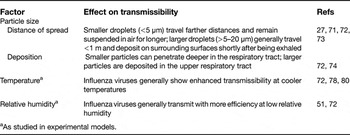
Individuals infected with influenza virus generate virus-containing aerosol particles of varying sizes by a diverse range of respiratory events. Coughing, sneezing and talking are considered the principal activities that produce aerosols, but normal breathing can also generate influenza-containing aerosol particles (Ref. Reference Stelzer-Braid70). The heterogeneity and dynamic nature of virus particles released into the environment facilitates several potential modes of exposure and subsequent transmission of virus to susceptible contacts (Table 1). Large aerosol droplets released from infected persons do not remain suspended in air and typically travel <1 m before landing on environmental surfaces or the mucosa of close contacts (Refs Reference Brankston27, Reference Nicas, Nazaroff and Hubbard71). Large droplets evaporate at a slower rate than small droplets and can contain virus that might remain infectious in the environment for up to several hours, facilitating potential contact transmission of virus to a susceptible host (Refs Reference Brankston27, Reference Hinds72). In contrast, smaller particles (<5 µm in diameter, or droplet nuclei) are capable of remaining suspended in air for longer durations of time and can be carried farther distances than large droplets, depending on the rate of particle desiccation and other environmental factors (Refs Reference Nicas, Nazaroff and Hubbard71, Reference Verreault, Moineau and Duchaine73). Particles of this size are capable of penetrating deep into the respiratory tract following inhalation, which is generally not the case for inhaled large droplets (Refs Reference Hinds72, Reference Tellier74). It is important to note that the sizes of particles described here denote generalities and do not represent absolute cutoff points for one mode of transmission or another.
Factors influencing behaviour of aerosols in the environment

aAs studied in experimental models.
Considering that size influences the movement, condensation and evaporation of aerosolised droplets generated by infected individuals, identifying the range of particle sizes expelled during respiratory events and the size range of these particles containing infectious virus is crucial for understanding the contagiosity of viral respiratory diseases (Ref. Reference Xie75). For instance, variability in bioaerosol concentration and total volume in exhaled air during coughing and sneezing of children in a school setting was demonstrated by mathematical modelling to influence transmission dynamics (Ref. Reference Chen76). Airway deposition, or the fraction of inhaled particles that are retained in the respiratory tract and not exhaled, varies greatly, depending on the individual's airway structure and physiology, breathing rate and volume, the size and composition of inhaled particles, and environmental conditions, such as airflow, temperature and humidity levels (Ref. Reference Hinds72). Once deposited in the respiratory tract, the ability of the particular virus to attach, infect and replicate at the site of deposition also has a role. Given the complexity in defining these parameters, most in vivo transmission studies have been limited in defining ‘respiratory droplets’ as inclusive of both large and small droplets in the absence of direct or indirect contact (Ref. Reference Maines40). However, with increased availability of aerosol generation, sampling and analytical instrumentation, more questions addressing the behaviour of aerosols in the environment and their impact on influenza virus transmission will likely be explored (Ref. Reference Verreault, Moineau and Duchaine73).
Weather conditions have been shown to further affect the persistence of aerosols in the environment and influence influenza virus transmission efficacy. It has been hypothesised that virus transmission occurs by the aerosol route in temperate climates and by the contact route in tropical zones, because research using the guinea pig model has shown that aerosol but not contact transmission is sensitive to these environmental conditions (Refs Reference Lowen and Palese77, Reference Lowen78). However, only recently have studies evaluating the contribution of specific environmental conditions on influenza virus transmission been investigated in animal models (Ref. Reference Lofgren79). Transmission studies in the guinea pig model with a seasonal H3N2 virus found that aerosol transmission efficiency was highest at 20% and 35% relative humidity, with transmission by this route abolished under conditions of high humidity (80%) (Ref. Reference Lowen51). This study further demonstrated efficient transmission of this H3N2 virus in guinea pigs by the aerosol route at 5°C, but not at 30°C (Ref. Reference Lowen51). A possible explanation for improved influenza virus transmission at lower temperatures was proposed by a group that used proton magic angle spinning nuclear magnetic resonance to generate detailed images of an influenza virus lipid envelope at different temperatures (Ref. Reference Polozov80). This study found that progressive ordering of lipids in the viral envelope in response to lower temperatures (like those encountered during airborne transmission in the winter months) facilitates enhanced resistance to environmental influences as it travels from one host to the next. Together, these findings point to low ambient air temperature and relative humidity as contributing factors for efficient influenza virus transmission in the winter months of temperate climates. Year-round and biannual circulation of seasonal influenza viruses in tropical and subtropical regions further underscores the importance of understanding the contribution of environmental properties on virus transmissibility (Refs Reference Nguyen81, Reference Wong82). Further research of other parameters that are influenced by seasonality, including atmospheric–oceanic variation, host health and social behaviour such as indoor crowding during cold weather and school attendance, is needed to accurately define those conditions that contribute to the seasonality of influenza virus transmission (Refs Reference Lofgren79, Reference Viboud83), especially given the unconventional global spread of the pandemic 2009 H1N1 virus during the spring and summer months.
Contribution of receptor binding and surface glycoproteins
The influenza virus HA binds to glycoconjugates containing terminal sialic acids (SAs) present on host cells throughout the respiratory tract epithelium prior to virus entry and replication. These SA receptors are predominantly found in two linkage conformations: Neu5Acα(2,6)–Gal (abbreviated as α2–6) and Neu5Acα(2,3)–Gal (abbreviated as α2–3) (Ref. Reference Skehel and Wiley84). Importantly, the distribution of these receptors affects the general species-specific cellular tropism of influenza viruses (Ref. Reference Ito and Kawaoka85). Human influenza viruses preferentially bind α2–6-linked SAs, which are located predominantly on nonciliated cells of the airway epithelium and nasal mucosa (Refs Reference Maines61, Reference Rogers and Paulson86, Reference Matrosovich87, Reference Shinya88). Avian influenza viruses, including HPAI H5N1 and H7N7 subtypes, preferentially bind α2–3-linked SAs, present on ciliated cells in the lower respiratory tract (Refs Reference Belser89, Reference Stevens90). Studies have shown that human influenza viruses predominantly bind to upper respiratory tract epithelial cells whereas avian influenza viruses bind alveolar cells, although this differentiation in binding is not exclusive (Refs Reference van Riel37, Reference Shinya88). Cell tropism can also be influenced by virus evolution over time; recent human H3N2 viruses show a greater tropism towards nonciliated cells compared with earlier isolates, which proportionally bind more ciliated cells (Ref. Reference Thompson91). Patterns of lectin binding to human airway epithelial cells demonstrate a predominance of α2–6-linked SA in the upper respiratory tract of humans (Refs Reference Ma60, Reference Maines61, Reference Munster62). In addition to differences in linkage conformation, the structural topology of sialylated glycans further influences the binding of influenza viruses to SA (Refs Reference Chandrasekaran92, Reference Srinivasan93).
Molecular studies on the HA of human H1–H3 influenza viruses have revealed specific amino acids situated in the receptor-binding domain that confer a preference for binding to α2–6-linked SA. For H3 viruses, the presence of a leucine at 226 and a serine at 228 in the HA protein results in α2–6-linked SA binding; glutamine and glycine are found at these positions in avian H3 viruses and confer a binding specificity for α2–3-linked SA (Ref. Reference Skehel and Wiley84). The receptor-binding site of the H2 HA is similar to that of H3 viruses, with a crucial role identified for residue 226 in the acquisition of human-receptor-binding specificity (Refs Reference Xu94, Reference Liu95). Human H1 viruses preferentially bind α2–6-linked SA but possess both Gln226 and Gly228; other HA residues, including Ser186, Asp190 and Asp225, can confer this binding preference (Refs Reference Skehel and Wiley84, Reference Glaser96). The alteration of two amino acids in the HA of the reconstructed 1918 virus (Glu190 and Gly225) was sufficient to switch the H1 HA to a preference for binding α2–3-linked SA and abolish respiratory droplet transmission of this virus in the ferret model (Ref. Reference Tumpey41) (Fig. 2). These results suggest that an important adaptation of an avian influenza virus to a mammalian host is to switch its preference for binding α2–3-linked SA.
Contribution of viral molecular determinants in influenza virus transmission. Use of reverse genetics has allowed for the generation of reassortant viruses that have facilitated our understanding of which viral genes contribute towards a transmissible phenotype. Viruses were constructed, evaluated for their sialic acid binding preference and tested for their ability to transmit by respiratory droplets in the ferret model. Abbreviations: HA, haemagglutinin; M, matrix protein; NA, neuraminidase; NP, nucleoprotein; NS, nonstructural protein; PA, PB1 and PB2, polymerase proteins; RD, respiratory droplet. References: human H3N2, Refs Reference Maines40, Reference Wan99; human H1N1, Refs Reference Tumpey41, Reference Van Hoeven103; human H1N1 mutants, avian H1N1 mutant and avian–human H1N1 reassortants, Ref. Reference Tumpey41; 2009 H1N1, Refs Reference Maines61, Reference Munster62; 2009 H1N1 mutant (Lys627), Ref. Reference Herfst67; H1N1 mutant (Gly22), Ref. Reference Chutinimitkul102; Eurasian lineage avian H5N1, Ref. Reference Maines40; Eurasian lineage avian H7N7, Ref. Reference Belser89; North American lineage avian H7N2, Ref. Reference Belser89, Eurasian lineage avian H9N2, Ref. Reference Wan99; H9N2–H2N2 reassortant, Ref. Reference Sorrell104.

To date, HPAI viruses of the H5 and H7 subtype have largely retained a binding specificity for α2–3-linked SA and have not demonstrated the capacity for efficient transmission through air by respiratory droplets in the ferret model (Refs Reference Maines40, Reference Yen43, Reference Belser89, Reference Stevens90). Even for the rare H5 or H7 wild-type virus that possesses dual binding to α2–3- and α2–6-linked SA, there was no change in the transmission phenotype (by respiratory droplets) in ferrets (Refs Reference Maines40, Reference Belser89, Reference Gambaryan97). However, a North American lineage H7N2 virus with an increased affinity for α2–6-linked SA showed efficient transmission by direct contact only in ferrets (Ref. Reference Belser89). A mallard H7N3 virus able to replicate in human airway epithelial cultures in vitro was also capable of partial direct contact transmission in the ferret model, as was an H9N2 virus that possessed Leu226 in HA (Refs Reference Song98, Reference Wan99). Although the H7 and H9 viruses discussed here did not transmit efficiently through air by respiratory droplets, the capacity for increased direct contact transmission might be the initial step towards the ultimate high-transmissible phenotype of human seasonal influenza viruses. Continued monitoring of avian influenza viruses isolated from domestic birds and humans exposed to them will provide a greater understanding of the pandemic potential of these viruses.
Site-directed mutagenesis along with reverse genetics has been used in attempts to identify the molecular changes necessary for altered the binding specificity of avian influenza viruses and to understand the effect of enhanced binding to α2–6-linked SA on avian influenza virus transmissibility. Unlike H1 viruses, substitution of Asp190 or Asp225 in the HA of an H5N1 virus is not sufficient to confer increased affinity for α2–6-linked SA (Ref. Reference Stevens90). Mutation of residues 226 and 228, which modulate binding specificity among H3 and H2 viruses, resulted in decreased binding of an H5N1 virus to α2–3-linked SA but only modest increases in affinity for α2–6-linked SA (Ref. Reference Stevens90). Substitution of additional amino acids within the HA of H5N1 viruses, including Ser193, Ala137 and Ile192, resulted in decreased binding to α2–3-linked SA or increased binding to α2–6-linked SA (Refs Reference Yang100, Reference Stevens101). Removal of a glycosylation site (Asn158) on the H5 HA yielded similar altered binding specificity among H5N1 viruses (Ref. Reference Stevens101). Overall, these studies show that mutations that confer a binding preference for α2–6-linked SA among H1, H2 and H3 viruses are not sufficient to elicit comparable human binding specificity on an H5N1 virus framework. Nonetheless, the studies provide a greater understanding of the ability of H5 viruses to acquire specificity for human receptors. Whether a change in receptor-binding specificity alone is sufficient for an avian influenza virus to acquire the ability to transmit efficiently in humans is not fully known. However, in one study, recombinant H1N1 viruses were designed to test the premise that binding preference for α2–6-linked SA receptors alone would allow efficient transmission of an avian H1N1 strain. A mutant avian Dk/NY/96 H1N1 virus was constructed containing Asp190 and Asp225 (Dk/NY/96-DD) by the introduction of point mutations into the HA. Although these changes switched HA to a preference for binding α2–6-linked SA receptors, neither the Dk/NY/96-DD mutant nor the parental avian (Dk/NY/96) virus transmitted to naive ferrets in respiratory droplet experiments (Ref. Reference Lowen and Palese77). Conversely, the construction of a 2009 H1N1 virus containing Gly222, a substitution in the HA associated with severe human cases and fatalities, resulted in a dual binding specificity for α2–6- and α2–3-linked SA but did not alter the transmissibility of this virus compared with wild-type strains (Ref. Reference Chutinimitkul102).
The use of avian–human reassortant viruses has broadened our understanding of how individual genes contribute towards the overall transmissibility of influenza viruses. Substitution of genes from a transmissible human influenza virus on the framework of a nontransmissible avian influenza virus has facilitated a more detailed examination of which genes are necessary to achieve a transmissible phenotype and have shown that virus transmissibility is a complex and polygenic trait. Avian–human reassortant viruses bearing surface proteins from human virus H3N2 but with the remaining genes from an avian H5N1 virus were not capable of transmitting by respiratory droplets in the ferret model (Refs Reference Maines40, Reference Van Hoeven103). An H5N1 virus with internal proteins encoded by human-virus genes was similarly incapable of respiratory droplet transmission, demonstrating that the presence of human-virus surface proteins or human-virus internal proteins alone in an ‘avian’ virus is insufficient to achieve transmission through the air (Ref. Reference Maines40). A reassortant virus bearing surface proteins of an H9N2 virus with enhanced binding specificity for α2–6-linked SA on the framework of a human H3N2 virus was capable of direct contact transmission in ferrets; subsequent adaptation of this virus in ferrets resulted in a virus capable of transmission by respiratory droplets (Refs Reference Wan99, Reference Sorrell104). Taken together, these studies imply a crucial role for influenza virus surface glycoproteins in overall virus transmissibility, but suggest that additional virus genes are needed for efficient transmission.
Other viral molecular determinants affecting influenza virus transmission
Beyond HA and NA, additional viral proteins have been examined for their contributing roles in influenza virus transmission. Notably, the involvement of the influenza virus polymerase complex in virus transmissibility has been an area of active investigation. A reassortant virus bearing human influenza virus HA, NA and polymerase proteins on the framework of a nontransmissible avian influenza virus was capable of transmission by respiratory droplets in the ferret model (Ref. Reference Van Hoeven103). Although reassortant viruses bearing human influenza virus surface glycoproteins and PA, PB1 or PB2 human influenza virus polymerase were all capable of efficient replication in the ferret upper respiratory tract, only the virus containing the human-virus PB2 transmitted by respiratory droplets. The PB2 protein, and residue 627 in particular, has been of particular interest given its roles in determination of host range, virulence in mammalian models and virus replication efficiency (Refs Reference Subbarao, London and Murphy105, Reference Massin, van der Werf and Naffakh106, Reference Hatta107). A lysine at position 627 has been shown to enhance replication efficiency in vitro at 33°C, the temperature of the human upper respiratory tract, and viruses bearing Lys627 in PB2 replicate to higher titres in mammalian nasal passages (Refs Reference Massin, van der Werf and Naffakh106, Reference Hatta108). The presence of Lys627 has been linked with enhanced virus transmissibility in both the ferret and guinea pig models (Refs Reference Van Hoeven103, Reference Steel109). In addition to Lys627, Asn701 has been associated with enhanced polymerase activity and heightened virulence, and has recently been identified as a determinant of virus transmissibility (Refs Reference Steel109, Reference Li110, Reference Gabriel111, Reference Gao112).
Influenza virus infections that result in expulsion of increased amounts of respiratory fluids, by sneezing for example, might provide an increased opportunity for the transmission of virus to susceptible persons. A general correlation has been observed between viruses that predominantly bind α2–6-linked SA and the incidence of sneezing in infected ferrets (Refs Reference Maines40, Reference Van Hoeven103, Reference Leigh113). Increased replication in the upper respiratory tract could result in heightened inflammation in the epithelial lining of nasal passages and, as a result, stimulate increased mucus production and sneezing, but this has not been experimentally shown. However, efficient transmission of human influenza viruses occurs in the guinea pig model in the absence of apparent sneezing (Ref. Reference Lowen45). Clearly, further studies are needed, not only to identify additional molecular determinants of influenza viruses but also to better understand their influence in host responses to infection that might enhance the spread of virus among people.
Host determinants affecting influenza virus transmission
The major focus of studies that seek to better understand influenza virus pathogenesis and transmission is on the contribution of viral determinants affecting infectivity and disease severity. Little information is available regarding host genetic determinants that might contribute to susceptibility or resistance to influenza virus infection. Nevertheless, some studies point to a potential contribution of an individual's genetic background as a contributing factor to their risk of infection and severe disease when exposed to influenza virus. Epidemiological findings have identified several family clusters of HPAI H5N1 infections, with severe outcome of infection documented among blood relatives but not among nonblood relatives such as spouses (Refs Reference Olsen25, Reference Dinh114, Reference Normile115, Reference Beigel116). Concurrently, common hygiene practices among family members and similar exposure to contaminated environments might also have a role (Ref. Reference Pitzer117). A separate study investigated the risk of severe influenza infection among genealogically connected people in Utah over a 100-year period and found that close and distant relatives of individuals who died of influenza had a significantly higher risk of dying than their spousal counterparts, pointing to genetic predisposition rather than environmental similarities as the greater contributing factor (Ref. Reference Albright118).
An individual's genetic makeup and immunological history undoubtedly influence the resulting immune response following virus infection and can have a strong effect on susceptibility to both infection and disease outcome. The role of immunological memory was clearly shown during the 1918 pandemic, because individuals possessing circulating HA-specific H1-virus crossreactive antibody showed enhanced survival compared with age groups likely to be serologically naive to the pandemic strain (Ref. Reference Ahmed, Oldstone and Palese119). In addition to the contribution of pre-existing immunity, the interaction of viral genes with the host immune system can influence disease severity. Patients infected with the 1918 influenza virus or HPAI H5N1 viruses have been linked to a dysregulation of the inflammatory response, a result affected by both viral and host genetic determinants (Refs Reference Yuen120, Reference Peiris121, Reference Cheung122, Reference de Jong123). Additional studies that focus on genetic factors that predispose people to increased risk of infection and severe disease caused by influenza viruses are needed; recent identification of candidate genes proposed to have a role in the genetic basis for influenza virus pathogenicity will facilitate this research (Ref. Reference Zhang124). Because prospective human studies are usually expensive and logistically challenging, the evaluation of host genetic variations and responses to influenza virus infection has been primarily limited to the murine model (Ref. Reference Trammell and Toth125). A recent study demonstrated substantial changes in HPAI H5N1 virus lethality among different strains of inbred mice, identifying a role for host genetic variation in influenza-virus-induced pathology in this model (Ref. Reference Boon126). As more information becomes available about genetic markers of susceptibility to influenza virus infection, we will be able to better identify at-risk groups and focus our efforts on implementing appropriate prevention and transmission control strategies.
Pharmaceutical and nonpharmaceutical interventions and influenza virus transmission
It is evident that viral, host and environmental conditions all influence how effectively influenza A viruses spread among humans. Given this breadth of exposure variability, efforts to mitigate human-to-human transmission of influenza viruses are diverse and use both pharmaceutical and nonpharmaceutical strategies. Several therapeutic approaches to lessen disease severity and reduce virus shedding have been shown to diminish virus transmission. Although outside the scope of this review, social patterns and behaviour, including the use of face masks, hand hygiene and social distancing, can further limit virus exposure to uninfected populations. Understanding how to maximise the effectiveness of each approach will contribute towards decreased influenza virus infection rates during both pandemic and interpandemic times.
Vaccination
Vaccination is the primary public health strategy to prevent or reduce disease following influenza virus infection. Simulation models demonstrate that vaccination has the potential to significantly reduce the spread and severity of disease in the event of a pandemic, although these transmission dynamics might be influenced by prior host immunity to heterologous strains (Refs Reference Germann127, Reference Park128). Two vaccine formulations are licensed for use in the USA: an inactivated virus preparation and a live attenuated virus preparation (Refs Reference Bridges, Plotkin, Orenstein and Offit129, Reference Belshe, Plotkin, Orenstein and Offit130). Clinical trials have shown reduced incidence of influenza infection among contacts of vaccinated individuals, suggesting that vaccination interrupts the transmission chain by bolstering herd immunity (Refs Reference Piedra131, Reference Glezen132). Vaccination of healthcare workers in long-term care facilities has also been associated with decreased rates of virus infection and mortality among patients (Refs Reference Potter133, Reference Carman134). However, the ability of vaccines to specifically reduce virus transmission has not been comprehensively examined. A recent study in the guinea pig model demonstrated that influenza virus vaccination does not uniformly block virus transmission following challenge (Ref. Reference Lowen135). Intranasally administered live attenuated vaccine elicited immunity in guinea pigs against both homologous and heterologous H3N2 viruses, effectively preventing virus transmission to naive contacts. Although guinea pigs vaccinated intramuscularly with inactivated vaccine showed reduced viral loads compared with unvaccinated animals, a complete block of virus transmission to contact animals was not observed (Ref. Reference Lowen135). These results indicate that the ability of a vaccine to protect against virus infection does not necessarily correlate with the ability to block virus transmission following vaccination. More extensive evaluation of vaccine candidates to examine their ability to mitigate both disease symptoms and transmission would offer a more complete understanding of vaccine efficacy.
Antiviral drugs
The use of antiviral drugs is considered a first line of defence in the event of a pandemic, and simulation modelling has demonstrated the potential of targeted prophylaxis antiviral use to contain the spread of a novel influenza virus (Ref. Reference Longini136). There are currently two classes of antiviral drugs licensed for the treatment of influenza: adamantanes and NA inhibitors. The drug amantadine and its analogue rimantadine function by blocking the ion channel formed by the viral M2 protein, thus altering endosomal pH levels and inhibiting the HA-mediated fusion of viral and endosomal membranes (Refs Reference Pinto, Holsinger and Lamb137, Reference Hay138). However, viral resistance to this class of drugs can be achieved by acquisition of key mutations in the drug target site, the transmembrane region of the M2 protein (Ref. Reference Simonsen139). Studies in the ferret model have demonstrated that seasonal influenza viruses that acquire adamantane resistance maintain the virulence and replication efficiency of wild-type virus without a loss of fitness (Refs Reference Herlocher140, Reference Sweet141). Drug-resistant strains appear to transmit as readily as sensitive strains, and the high prevalence of resistant viruses in circulation has unfortunately limited the use of this class of antiviral drugs (Refs Reference Hayden142, Reference Bright143). Two inhibitors of viral NA – oseltamivir and zanamivir – are effective against both human and avian influenza viruses because neutralisation of sialidase activity results in the aggregation of virus particles to SA on the surface of infected cells, preventing the effective release of virions and spread to uninfected cells (Refs Reference von Itzstein144, Reference Gubareva, Kaiser and Hayden145). Resistance to this class of antiviral drugs occurs less frequently compared with the adamantanes, because mutations in the NA active site are both largely subtype specific and more likely to adversely affect the function of this protein. Several key mutations in NA that confer a drug-resistant phenotype, including Val119 (H3N2), Lys292 (H3N2) and Tyr274 (H1N1), show decreased viral fitness in the ferret model, with reduced infectivity, replication and pathogenicity of seasonal influenza viruses compared with viruses that do not bear these changes (Refs Reference Carr146, Reference Ives147, Reference Herlocher148). HPAI H5N1 viruses, which do not readily transmit in the ferret model, are capable of maintaining their high pathogenicity phenotype on the introduction of mutations known to confer NA resistance (Ref. Reference Yen149).
Although mutations in NA frequently compromise overall viral fitness, the transmissibility of viruses resistant to NA inhibitors is dependent on the specific mutations conferring a resistant phenotype. Viruses with Val119 and Tyr274 mutations in NA are capable of direct contact transmission in the ferret model, unlike viruses that possess Lys292 in this protein (Refs Reference Herlocher148, Reference Herlocher150). However, viruses possessing the Tyr274 mutation require higher challenge doses to transmit, and studies in the guinea pig model have shown that Val119 viruses show decreased transmission by the aerosol route compared with wild-type viruses (Ref. Reference Bouvier, Lowen and Palese151). This observed variation in virus fitness and transmissibility in the ferret model appears to be dependent on the degree of NA functional loss (Ref. Reference Yen152). Study of these mutations on a homogeneous genetic background showed that NA mutations conferring greater reductions of enzymatic activity and thermostability, such as Lys292, show greater reductions in overall transmissibility compared with viruses that retain these properties, such as viruses possessing Val119 (Ref. Reference Yen152). This work indicates that viruses with mutations facilitating resistance to NA drugs are capable of being transmitted among people, albeit at reduced efficiency compared with wild-type viruses that retain sensitivity to these antivirals. The stockpiling of antiviral drugs is used by several nations (Ref. Reference Patel and Gorman153); in addition to concerns of quantity, drug resistance and availability of paediatric formulations, the effectiveness of these formulations in reducing the transmission of new virus strains among treated individuals should be evaluated and there needs to be continued surveillance to identify any influenza virus strains that acquire resistance to available antivirals. Postexposure oseltamivir prophylaxis of contacts of individuals with laboratory-confirmed influenza reduced the secondary spread of virus to susceptible individuals in two recent studies, demonstrating the ability of antiviral treatment to attenuate virus transmission (Refs Reference Hayden154, Reference Lee155). Furthermore, additional antiviral drugs need to be developed in the event that influenza viruses resistant to NA inhibitors attain increased circulation and pose a public health risk.
Interferon treatment in preclinical models
The host interferon (IFN) response has an important role in the establishment of an antiviral state that can limit virus replication following infection. Administration of exogenous IFN to engage this response prior to infection is a potential prophylactic or therapeutic strategy for influenza viruses and is used clinically for the treatment of other viral infections, including hepatitis C virus (Refs Reference Garcia-Sastre and Biron156, Reference Keam and Cvetkovic157). Previous studies have demonstrated the ability of exogenous IFN to reduce viral titres and to reduce disease severity following influenza virus infection in several animal models, including mice, ferrets and guinea pigs (Refs Reference Beilharz, Cummins and Bennett158, Reference Kugel159, Reference Tumpey160). It was recently shown in the guinea pig model that intranasal treatment with human IFN-α initiated one day prior to viral infection significantly reduced or prevented infection with a highly pathogenic H5N1 virus, the reconstructed 1918 pandemic virus, or the 2009 pandemic virus (Refs Reference Van Hoeven48, Reference Steel161). Furthermore, treatment of either inoculated or contact guinea pigs with IFN was sufficient to prevent transmission of the 2009 pandemic virus by direct contact (Ref. Reference Steel161). This work indicates that IFN treatment is capable of reducing viral titres and disease symptoms in infected animals in addition to blocking the transmission of virus to naive animals. These results suggest that investigations are warranted to assess the potential of IFN treatment for clinical use.
Conclusions
Despite these and other research efforts, much remains in question regarding the viral and host determinants of efficient influenza virus transmission. The seasonality of influenza virus transmission highlights the importance of environmental conditions on transmission efficiency, and with increased availability of specialised instrumentation to test the environmental parameters affecting influenza-virus-containing aerosols, many of these unanswered questions can be addressed (Ref. Reference Lofgren79). Understanding the mechanisms involved in influenza virus infection, transmission and disease progression will facilitate the implementation of more-effective clinical prevention and treatment strategies, preparing us not only for the next influenza season but also for the next influenza pandemic.
Acknowledgements and funding
We thank the peer reviewers of this manuscript for helpful suggestions. The authors have no financial conflicts to report. The findings and conclusions in this report are those of the authors and do not necessarily reflect the views of the funding agency.